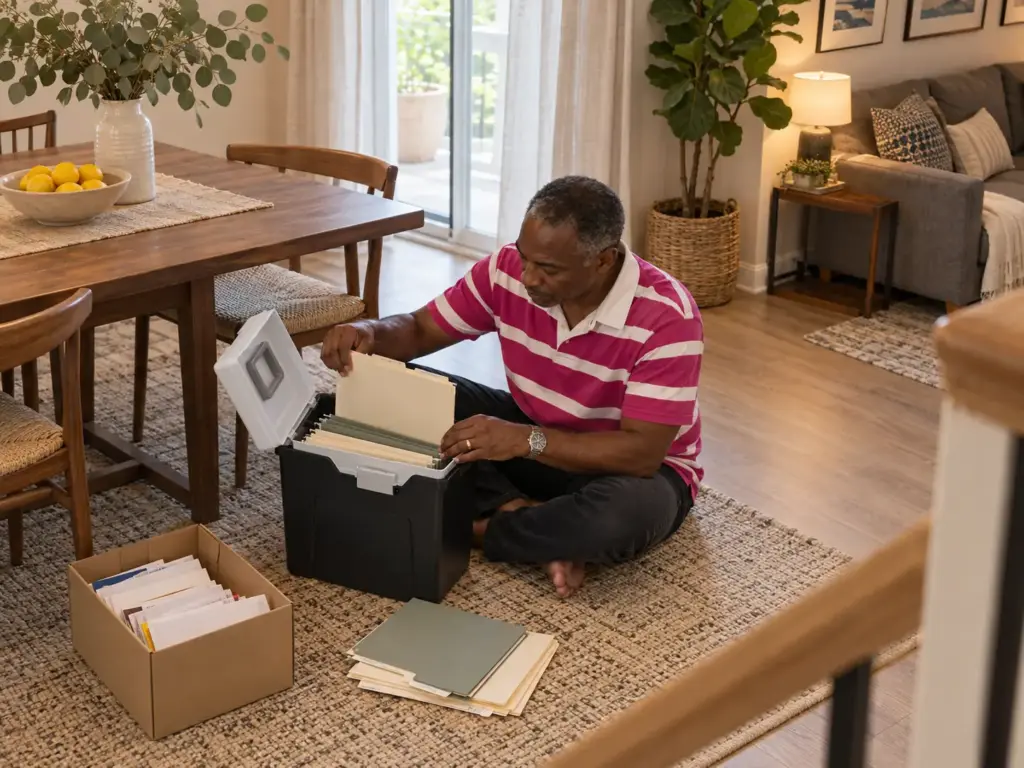
The papers sit on the dining table in three uneven stacks, an empty shoebox beside them, and somewhere in your browser there is a two-drawer cabinet you have not quite talked yourself into. You want the best filing systems for home narrowed down to one, picked today, before those stacks wander back into the kitchen drawer. NAPO’s own tips put the problem in one line: “80% of what we file never gets looked at again.” So this guide judges each system by where it breaks, not by how tidy it looks the first weekend. You get the options side by side, how to choose for your household, the free route against the paid kit, and how to set it up and keep it running, while the keep-for dates and the papers worth guarding have a guide of their own.
Seven ways to file household paper, matched to who they suit and the specific way each one fails:
| System | Best for | Where it breaks |
|---|---|---|
| Drawer cabinet with hanging folders | Steady paper flow and a permanent spot under a desk | Drawers with no cap fill up; 47 pounds of steel is hard to move |
| Lidded file box | Closet shelves, small spaces, households that move | Shut away in a closet it stops getting opened; some lids stop latching |
| Binders, one per person | Kids’ papers, medical history, a grab-and-go set for a move | Tops out at a few hundred pages: one person, not a household |
| Accordion file | Small volume and receipts, with no hanging hardware | Overfilled pockets and a flap that is hard to close |
| Pre-labeled kit (FreedomFiler) | People who want every label decision made for them | Setup takes several days before it files a single sheet |
| Rolling monthly folders | Bills and statements you keep two years or less | Falls apart without a fixed purge date |
| Broad categories sorted by year | Anyone who stalls on where a sheet belongs | Finding a paper takes longer, by design |
What the Best Filing Systems for Home All Get Right
You have probably built a filing system for home use before. It looked great for a weekend, and three weeks later the “to file” stack was back on the corner of the desk, a little taller than the one you started with. That was not laziness.
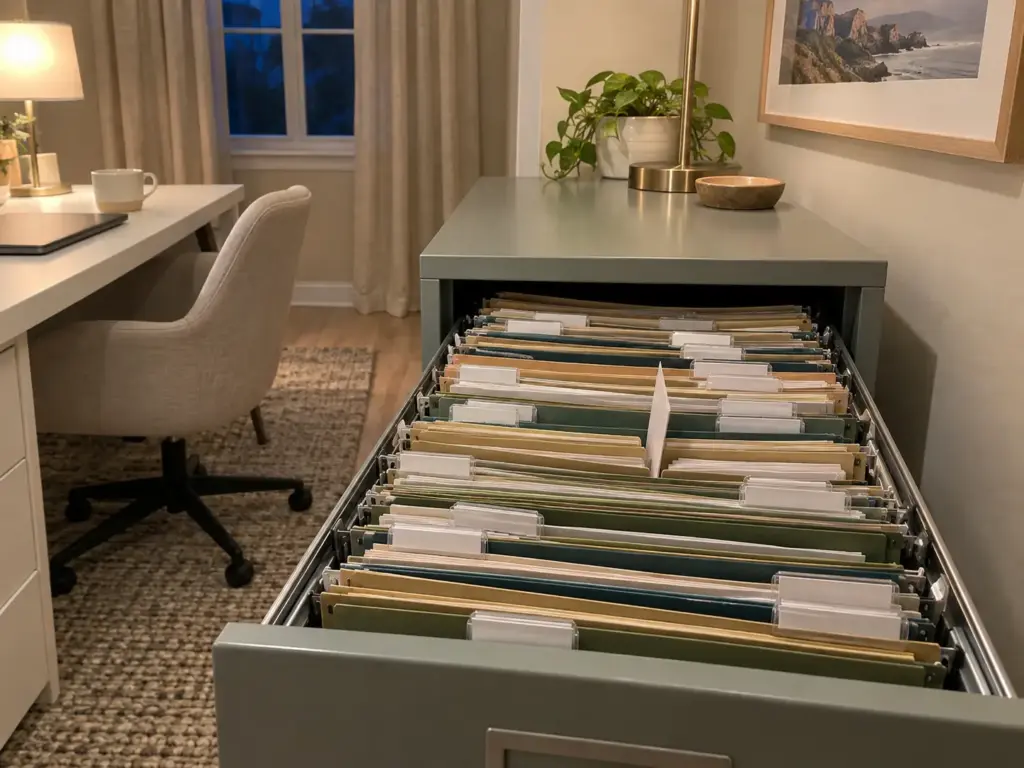
The system asked for a decision on every single sheet, and a stack is what filing looks like when each piece of paper costs one. Call it decision fatigue in a paper drawer.
Why filing has to be easier than finding
Count the traffic in each direction. Paper goes into a household file far more often than it comes back out: a statement, a receipt, an explanation of benefits, then months of nothing. That filing-versus-finding gap is the design rule: build for fast filing and accept slightly slower finding.
NAPO’s tips add a free trick that does half the purging for you. When you use a file, put it back at the front of the drawer. After a few months the front holds the 20% you actually touch, and the back holds the paper you can probably let go. A system that makes filing slow sends paper somewhere else, and that somewhere is usually the to-file pile that keeps growing on the desk.
Why too many folders send papers to the wrong place
A folder for every account feels precise: one utility per folder, one credit card per folder. In a r/declutter thread about exactly this, one commenter described keeping that setup and called it a pain, because papers kept landing in the wrong folder, and they will not go back. Twenty narrow folders means twenty chances to hesitate, and a hesitating hand drops the paper on the stack “for now.”
Another commenter summarized a method built for this problem, the Siderea filing system, made for people whose depression or other conditions make decisions hard: four or five extremely broad categories plus one marked IMPORTANT, sorted by year, and the instruction to file everything instead of deciding whether it is worth keeping. You lose a minute when you look something up. You gain a system you keep using.
Why every system needs a size limit
The other failure is quieter. A drawer with no capacity limit keeps accepting paper until it jams, then a second box appears, then a third; the original poster in that thread described a series of boxes scattered throughout the house. One commenter’s small two-drawer cabinet was their hard limit, and that cap forced them to cut the paper coming in instead of letting the space grow. They call it the container method.
Whatever system you choose, decide its size before you load it. Treat “it doesn’t fit” as a signal to purge, not to buy a bigger box.
Make the cap visible. Run a strip of masking tape across the inside wall of the box or drawer about two fingers below the rim. When the folder tabs reach the tape, something old comes out before anything new goes in. Nobody argues with a line they can see.
Cabinet, Box or No Hardware at All, and Where Each One Breaks
You are probably weighing this on a product page right now, a cabinet in one tab and a plastic box in another. The choice comes down to a tape measure and an honest guess about how often you move.
The drawer cabinet with hanging folders
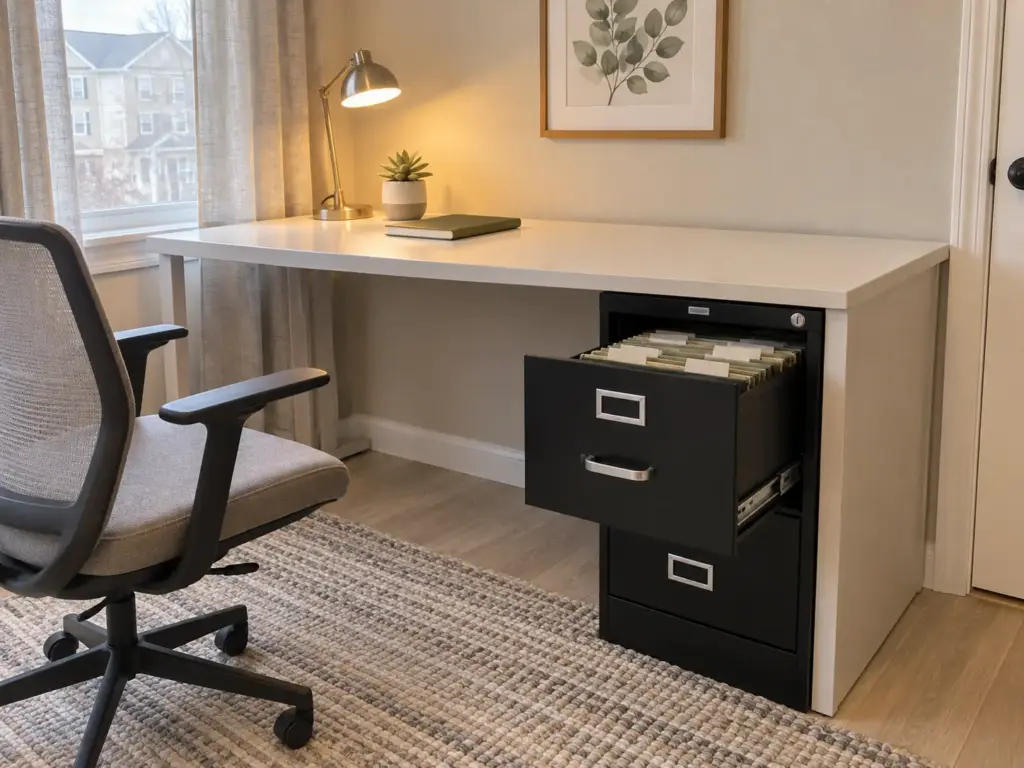
Hold the cabinet against the free option first. A box you already own and a handful of folders will carry most households for months, so a filing cabinet has to earn its floor space with something the box cannot do: steady paper flow, a lock, a permanent spot. NAPO’s tips say most people need a two-drawer file cabinet for active files, and the useful reading is a ceiling. Two drawers is the cap, not the starting point.
Drawer quality matters more than the finish. A commenter in the thread advises spending a little more on a decent 2-drawer cabinet with full-extension drawer slides, so the back of the drawer actually comes out to you instead of staying half-hidden.
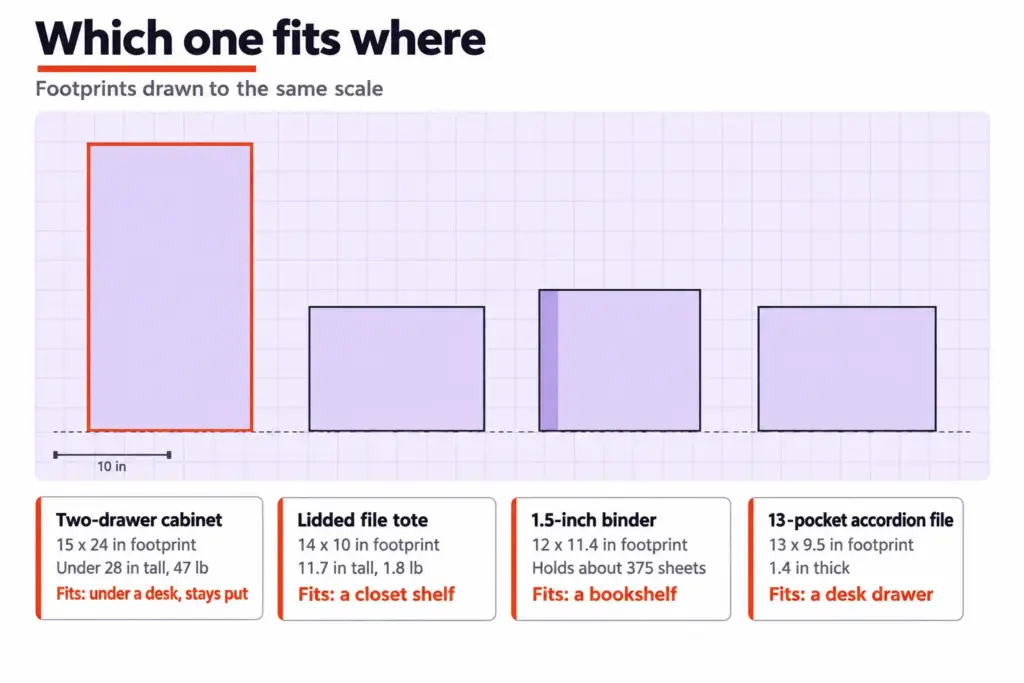
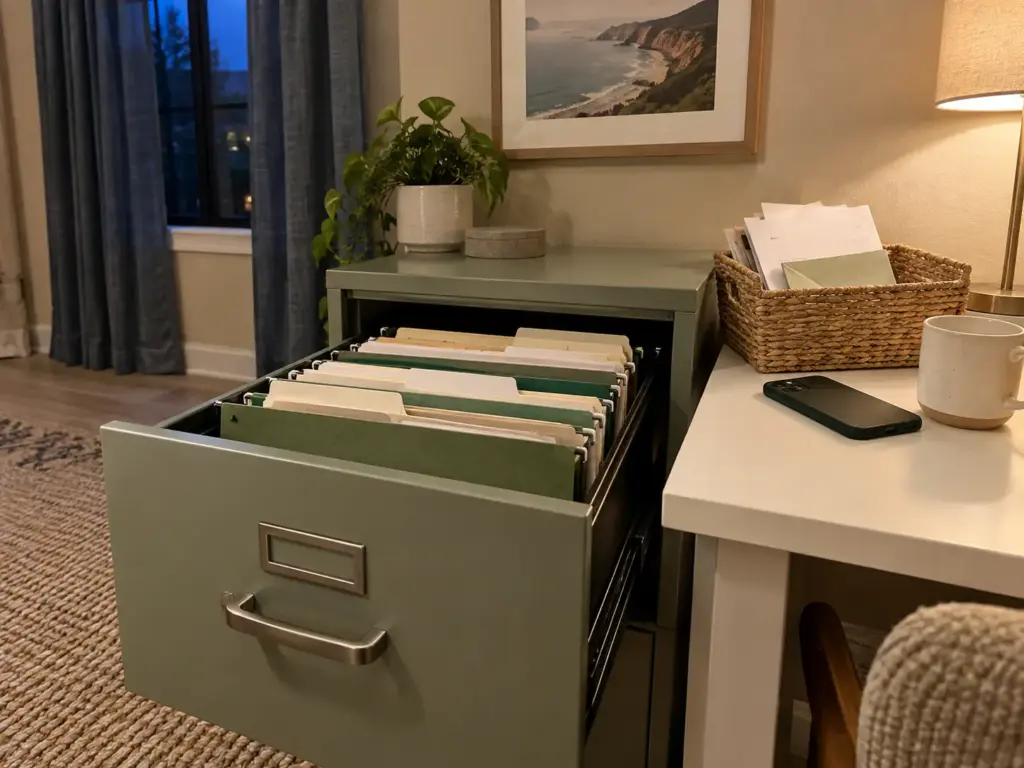
The Staples 2-Drawer Vertical File Cabinet is the size that fits most desks: about 15 inches wide, a little over 24 inches deep and just under 28 inches tall, lockable, built for letter-size hanging folders. It slides under a standard desk. It also weighs 47 pounds, and some units arrive damaged or with a lock that gives trouble, so test the key the day it lands. For a renter who moves every year or two, that weight is the real cost.
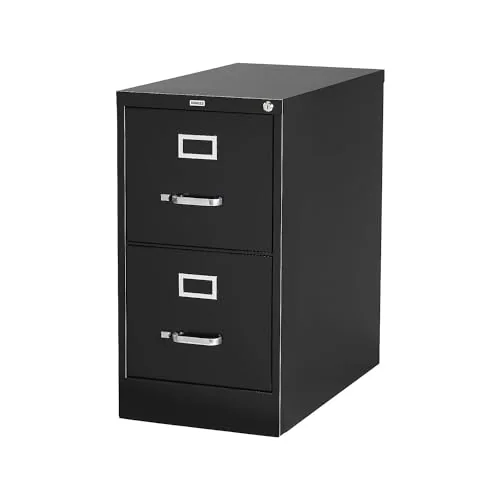
Where it breaks: without a cap, the second drawer becomes an archive nobody opens. And on moving day, it is the one piece nobody wants to carry down the stairs.
The lidded file box
The cheapest version is already in your house: a cardboard banker’s box, or the sturdy box a pair of boots came in. One commenter’s budget setup is barely more than that, a small lidded plastic box with a few hanging file holders and broad labels (bills, taxes, bank statements, car), plus a tray on the desk for whatever is still in play.
For something sturdier with a handle, the Staples File Folder Tote takes letter hanging folders in a 13.8 x 10.1 inch footprint, 11.7 inches tall, with a latch lid and a small organizer tray up top. It fits on a closet shelf and carries like a lunchbox. Buyers report that the lid compartment does not stay shut, that the plastic feels cheap and that some boxes arrive damaged, so treat it as a light-duty box, not a vault. If you would rather keep the active files on the desk, desk organizers that share the same file-box hardware do that job.
Put the two side by side and the decision mostly makes itself. The tote weighs 1.8 pounds and needs about 14 by 10 inches of shelf; the cabinet weighs 47 pounds and needs roughly 15 by 24 inches of floor, plus room for the drawer to slide out. One goes wherever you go, the other decides where your office is.
Both the box and the cabinet assume letter-size hanging folders, the everyday size for household paper. Legal size folders need drawers and boxes rated for legal, which run larger, so check the rating before you buy folders to match.
The box breaks differently from the cabinet. Shut away on a high closet shelf, it stops getting opened, and the paper meant for it starts living on the counter again. Keep it somewhere you pass.
Rolling folders and broad categories, with nothing to buy
Two of the sturdiest systems in the thread cost nothing but folders. The first is rolling: one commenter files by month everything they need for two years or less, 24 monthly folders in all. On the 1st of August they pull the oldest folder, glance through it, shred or recycle what is inside, and reuse the empty folder.
Bills are on autopay and incoming paper lands in a box first, so the folders only see paper that has already been dealt with. That 24-month span is the commenter’s rule for everyday paper, not a tax rule.
The second is the broad-category drawer where you sort by year, the Siderea approach made physical. Another commenter kept a drawer organized by year, a taxes file for the current year’s receipts, a couple of years of utility bills, and the papers for house repairs, held until the house was sold.
Each breaks in its own spot. Rolling folders need a fixed purge date; skip one August and you have 25 folders, then 30. The year-sorted drawer makes finding slower on purpose, which is fine for a bank statement and frustrating for a warranty you need this afternoon.
Pick the System by Household, Not by Taste
Picture two paper habits in one home. One of you keeps a neat folder per vendor; the other drops every envelope into a shoebox until it overflows. A system that suits only one habit gets ignored by the other, so start from who lives there, how much paper they produce and how their attention works.
Small volume, kids or a move: binders and accordion files
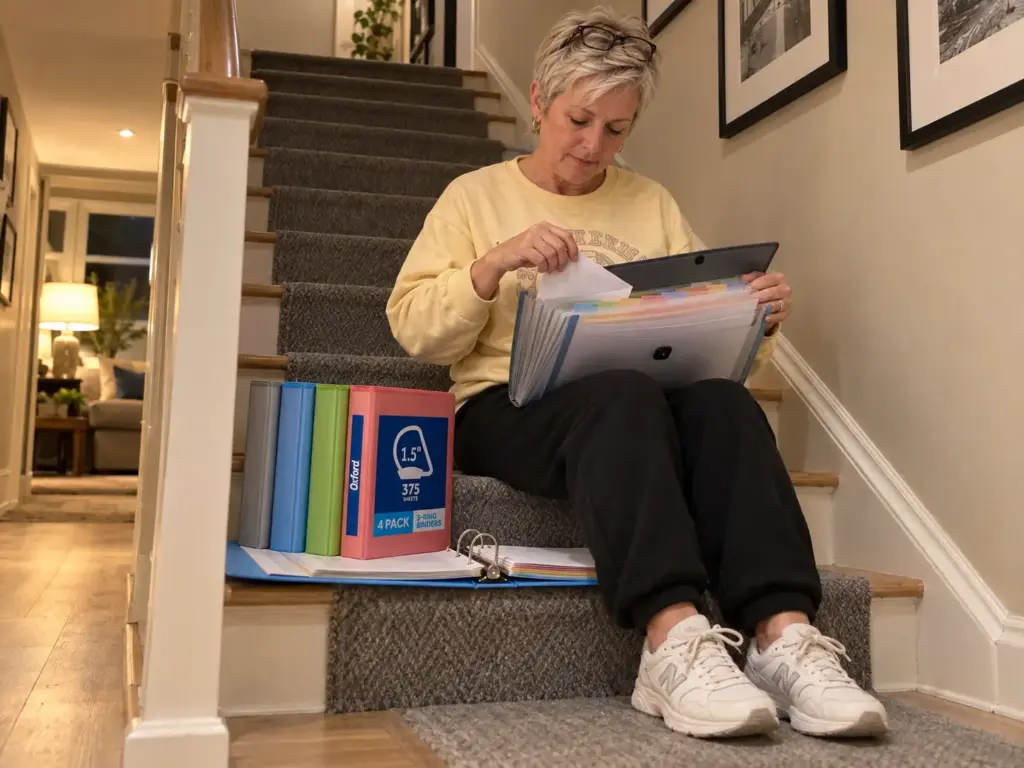
Check the closet before buying anything: most homes already have a couple of three-ring binders from an old job or a school year. NAPO’s tips recommend a three-ring binder per child for essential paperwork, and from about third grade a child can own theirs, with dividers for school, sports and music. The same idea makes a grab-and-go binder for moving documents: one binder or per-person bin each, out the door in one armful.
For a matched set, the Oxford 1.5 Inch 3 Ring Binders 4 Pack gives four colors for four people. Each binder is 12 x 11.37 inches, has two inside pockets and holds about 375 sheets. That capacity is the honest limit: a few hundred pages covers one person’s medical history or one year of statements, not a household.
Kids’ paper needs its own rule because the volume is relentless. Commenters suggest a larger accordion portfolio the child fills and edits, or one box where something has to come out before anything new goes in. One put it as let the box be the enemy, so the full box says no and you do not have to.
Photographing schoolwork and sending it to a grandparent clears the fridge door. Two commenters pushed back, though: they treasure their old report cards, so keep a small, chosen set rather than nothing.
For small volumes with no hanging hardware, any accordion or expanding envelope you already have will do. The Cesil 13 Pockets Accordion File Organizer is a tidier version at 12.99 x 9.45 x 1.38 inches, with 13 letter-size pockets and tabs, about right for a year of receipts or one child’s papers. Reviews are mixed on durability and pocket size, and some buyers find it hard to close once it is full, so it suits a light load.
Skipping folders entirely works too. A wall file organizer, or wall pockets and shelf boxes for small spaces, keeps paper in sight and off the desk.
A brain that forgets what it cannot see
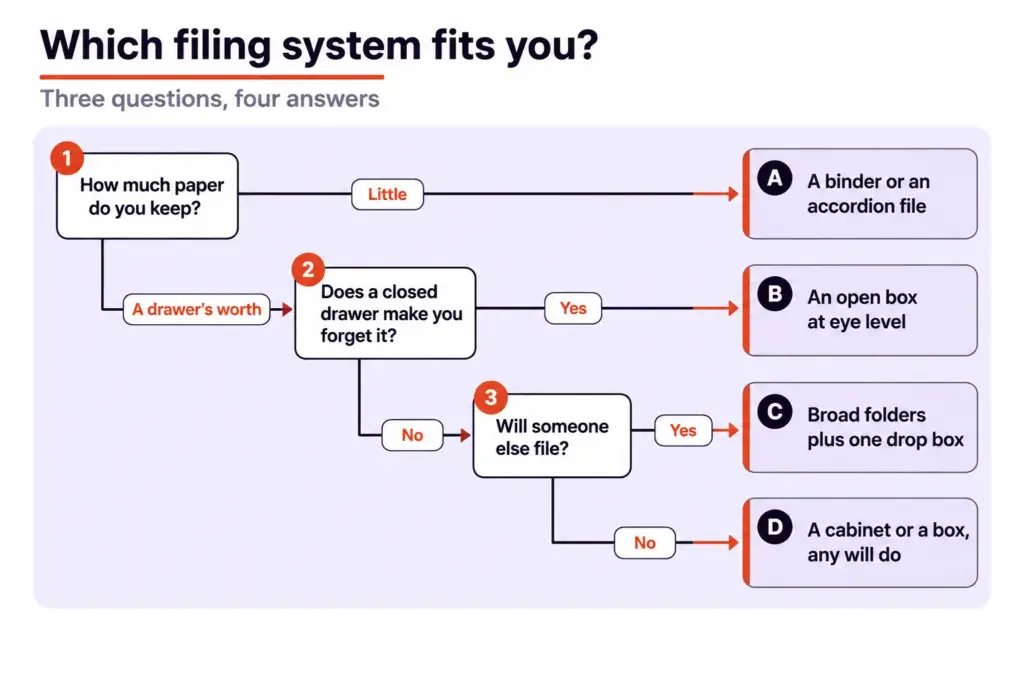
The two-drawer cabinet looks like the default, the grown-up answer. For a brain that runs on out of sight, out of mind, it is the wrong one, because a closed drawer is where paper goes to be forgotten. The ADHD friendly pick is an open file box at eye level, where the tabs stay visible.
According to organizer Kacy Paide in CHADD’s guide to organizing with ADHD, “Boxes encourage you to create tight categories, drawing lines in the sand in a way that a deep file drawer can’t do.” The system you will actually open beats the tidiest one you won’t.
Brains vary in stranger ways than that. One commenter files under the first word that comes to mind when they picture needing the paper, so the passport goes under I for ID. They do not recommend it as a rule; the point is to let the labels follow how your own memory retrieves things.
A partner who will not follow your folders
You cannot make someone else care about your categories, and you do not need to. Design for the minimum effort the other person will give: broad folders that you file into, plus one drop box where anything paper can land.
One commenter’s version is a shoebox that collects every letter and papery thing, emptied onto the desk once a week for action and filing. Your partner’s whole job is to drop paper in the box. Yours is to empty it.
Some households shrink the problem instead. Several commenters say autopay, emailed bills and online medical portals cut their paper to almost nothing, though that is a minority view in the thread. One who scanned everything warned that setup was slow but easy to keep going afterward. Treat paperless as a way to shrink the inbox, not as a reason to skip choosing a system.
A house with room to hide the pile
A small apartment caps your paper for you. A house does not. With a spare room, a basement or a deep closet, a box can sit for years without getting in anyone’s way, and no wall ever tells you it is full.
The commenter who advised a decent two-drawer added that a four-drawer is fine if you have room, but in a big house extra drawers tend to become the archive nobody opens. So the cap has to be a decision, not a dimension: pick the container size you would accept in a one-bedroom and hold yourself to it.
In a big house, write the year on the lid of any archive box the day it goes into storage. A box with a date gets opened and purged; a box with no date becomes part of the house.
The Free Route Versus the Paid Kit
You have probably come across the Freedom Filer name and wondered whether it is the piece your system is missing. The fair answer starts with what is in the package, and with what you can do using things you already own.
The free route: a box and folders you already own
A banker’s box or a shoebox, whatever folders are already in the house, and broad labels written by hand: that is a complete filing system. A commenter’s tip keeps it from getting fussy. Put one box bottom folder in for each broad category with a few manila folders inside it, and anything you are unsure about goes in the outer hanging folder rather than a new manila one, so the number of decisions stays low.
Buy folders first, then. Actually, count what is in your desk drawer first, and spend money only when a specific piece is missing.
What the FreedomFiler kit actually is
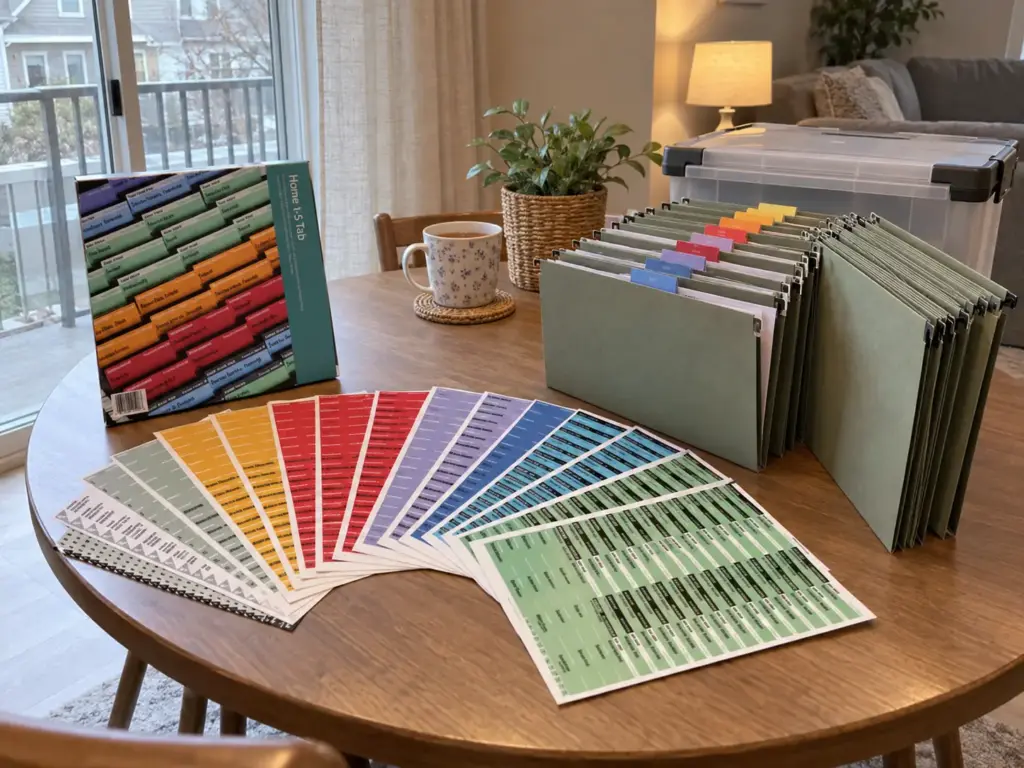
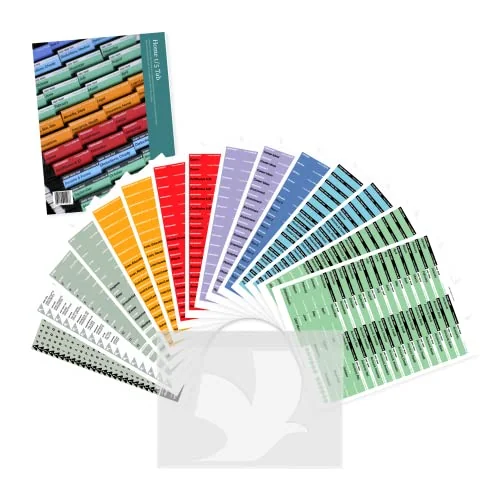
The FreedomFiler Home Filing System 1-5 Tab is a set of pre-printed labels in color-coded sheets and a booklet that tells you which folder each kind of paper goes into, with a self-purging split between temporary files and permanent files. It is not folders and it is not a box. You still supply hanging folders and a drawer or container, so the kit sits on top of the free route, not in place of it. This is the 1/5 tab set; the brand also sells a 1/3 tab version and a binder system.
It is well rated on Amazon, and buyers agree on its drawbacks too: setup takes several days, and they are split on whether it is worth the price. It earns its place for someone who wants the labeling decisions made by someone else and will follow a booklet. For someone who would write four broad labels by hand in a few minutes anyway, it buys very little.
The two cheap buys that make any system easier to use
If you are short on folders, buy folders before anything else. The Hanging File Folders 50 Pack Letter Size with 1/5-Cut Tabs measure 11.8 x 9.25 inches and fit the tote, the cabinet and the FreedomFiler labels alike. Some buyers find the tab slots too small for their labels, so slip one tab in to test before loading all 50.
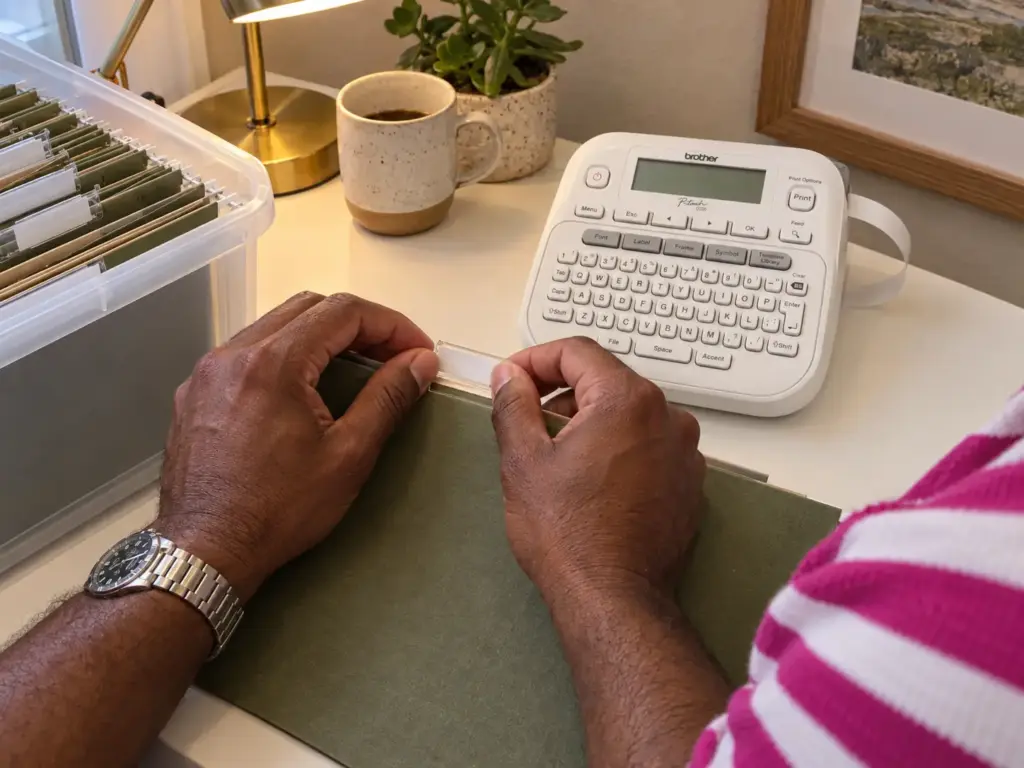
Labels are the second buy, and only after handwriting has had its chance. NAPO’s tips note that labels make any system easier to use, whether they come from a pen or a machine. If your handwriting smudges or fades, the Brother P-Touch PTD220 Label Maker prints on tape up to about half an inch wide and sits in a 5.9 x 6.2 x 2.7 inch footprint on the desk. Its screen is hard to read in low light, and there is no power adapter in the box, so plan on batteries or buy the adapter separately.
Set It Up Without Redoing the Sort
This part assumes the backlog is already sorted. If it is not, do a one-pass sort of the backlog first; that guide handles the sorting and shredding, and this one picks up once you have a clean stack and an empty container. The real risk now is turning that stack into forty folders on the first Saturday.
Start with four or five broad folders
One commenter’s budget box used four labels: bills, taxes, bank statements, car. That is a solid default for most households. Add separate folders only for paper that follows its own rules, the way the rolling-folder commenter does: current-year IRS forms, vehicle records for each car, medical records.
NAPO’s tips add one folder worth making on day one. Label it “Taxes” with the current year and drop your tax records in as they arrive, so April turns into emptying one folder. Then test every other folder with one question: if you cannot name what goes in it with a single word, it is too narrow.
Split temporary from permanent
Every system that lasts separates paper that rolls off from paper that stays. The Freedom Filer booklet builds that split in; the year-sorted drawer does it by keeping the house-repair papers apart until the house is sold. Color coding does it cheaply: one folder color for each, or one shelf for each.
Originals you cannot replace, like passports and birth certificates, belong in a fire-safe lock box (one commenter’s setup), not in the rolling folders. How long each kind of paper stays is covered under the IRS tiers below.
Give it one inbox and a cap
Incoming paper needs exactly one landing spot: an inbox tray, a basket, a shoebox or an upturned box lid, wherever it waits until the weekly slot. If mail scatters before it ever reaches the desk, start with a place for the mail by the door.
Then set the cap and hold it. The container is the limit, and when the folders stop fitting, something leaves.
Keep It Working With a Weekly Slot and a Yearly Purge
Every system works the week you build it. Consistency is what keeps it working: a short appointment on the same weekday and one date on the calendar when the oldest folder goes.
The weekly filing slot
NAPO’s tips suggest a weekly appointment of 15 to 30 minutes to empty the “To File” basket. Pick the day you are already at the desk and book it like a dentist visit, with a desk set up so paper is touched once: the inbox, the box and the shredder within one arm’s reach. Keep moving retrieved files to the front while you are there, so the back of the drawer lines up the next purge on its own.
If the weekly slot keeps slipping, shrink it rather than skipping it. Ten minutes that happen beat thirty that get postponed, and an inbox emptied every week never grows big enough to need a whole afternoon.
The yearly purge date
The rolling-folder commenter’s 1st of August is the part of that system that matters most. Not the month itself, any date works, but the fact that it is fixed: one day a year, the oldest folder comes out, gets a glance, gets shredded or tossed, and goes back in empty. A purge that waits until you feel like it never comes.
Put a recurring reminder on a date that already means something in your year, and let the reminder decide.
What the IRS actually asks you to keep
Several commenters in the thread mention seven years for tax paper, and it sounds like the safe default. It is not the default. Under the IRS’s own record-keeping tiers, most returns need supporting records for 3 years from filing; 6 years applies if you under-report income by more than 25% of your gross income; 7 years applies only if you claim a loss from worthless securities or a bad-debt deduction. A drawer sized for seven years of everything is bigger than the rule asks for most households.
Property records follow a different clock. The IRS says to keep them until the limitation period expires for the year you dispose of the property, so house purchase and improvement papers stay as long as you own the home and a while after it sells. Keep them out of the rolling folders entirely. For everything beyond tax paper, use the full keep-for list rather than a number you heard somewhere.
Choose the System You Will Still File Into in Three Months
The system that survives is the one that is quick to file into and has a hard size limit, whether that is a two-drawer cabinet, a lidded box or a shoebox. Choose by volume, space and the way your household’s attention works, and know where your pick breaks before you pay for it. And take the free route first: the kit and the cabinet earn their place only when they solve a problem you can name.
In three months, look at two things: whether the inbox has been emptied each week, and whether the container still closes without a shove. If either one fails, the system needs fewer folders or a smaller inbox, not more hardware.
Today, take whichever box or shoebox already holds paper in your home, put five broad folders inside it with handwritten labels, and set it where you walk past it. At the end of the week, check whether any paper landed on the table instead of in the box.
Frequently Asked Questions
01What is the best home filing system?
The best home filing system is the one you keep filing into: four or five broad folders in a container with a hard size limit, like a lidded box or a two-drawer cabinet. Pick the container by how much paper you keep and whether a closed drawer makes you forget it.
02What is the best file organizer for home?
A lidded file box with hanging folders suits most small and medium volumes, though it fails once it is hidden on a high shelf. A two-drawer cabinet handles steady paper flow but is heavy to move, and binders or an accordion file cover kids’ papers until they outgrow a few hundred pages.
03What is the best system of filing?
The best system of filing makes filing easier than finding, using a short list of broad categories or folders sorted by year, plus a fixed purge date. NAPO’s tips note that about 80% of filed paper is never looked at again, so speed at filing time matters most.
04What is the best way to file paperwork at home?
Drop all incoming paper into one inbox, then file it into broad folders during a weekly 15 to 30 minute slot. Keep temporary and permanent papers apart, and purge the oldest folder on the same date each year.
Disclaimer: ClutterlessNest is a participant in the Amazon Services LLC Associates Program. As an Amazon Associate we earn from qualifying purchases. This article may contain affiliate links — if you buy through them, we may earn a small commission at no extra cost to you. We only recommend products we have tested or genuinely believe in.