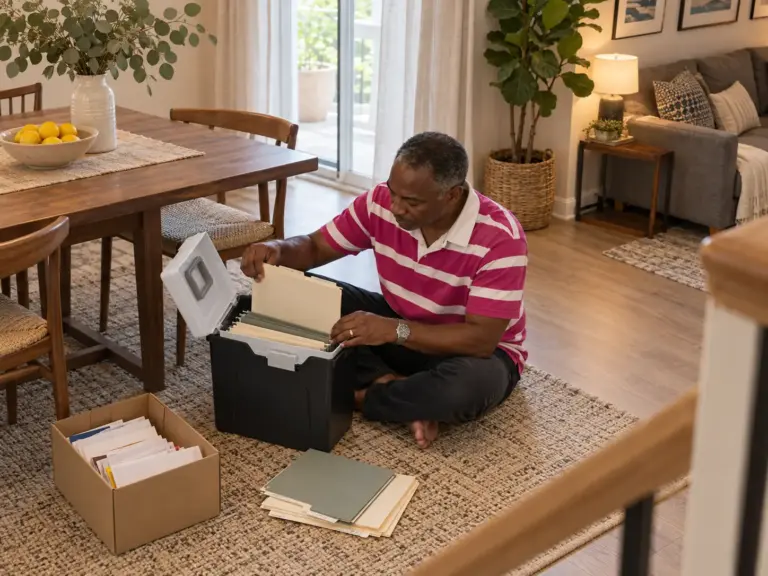

The insurance adjuster wants your policy number, and you are kneeling next to a plastic tub where a birth certificate shares a fold with last spring’s cable bill. A poster in r/organizing described that exact afternoon: they went looking for one paper and decided they could not live like this anymore.
Good important document organization is not a prettier binder or a heavier box. It is a short set of decisions about which papers you cannot replace, where each one lives, and whether someone other than you could find them. The plan below follows FEMA, Ready.gov, the IRS and NDSU Extension, plus what households in the organizing threads say held up: three tiers, a home for each, what a fire box will not do, and the habit that keeps it current.
Quick Answer
Organize important documents by how hard each one is to replace, in this order:
- Sort every paper into three tiers: irreplaceable, painful to replace, reference.
- Give the irreplaceable tier one protected home, not three drawers.
- Keep copies of those papers in a second place away from the originals.
- Write a one-page index of where everything lives, with no passwords on it.
- Date the index and review it at tax time or after any big life change.
Important Document Organization Starts With Three Tiers
Picture a birth certificate in one hand and a cable bill in the other, both headed for the same pile. That sort treats them as equals, and they are nowhere close. The useful question is not which category a paper belongs to but what it would take to get it back. Sorting by replaceability is the first step of any document organization system: it decides how much protection each paper earns, and it shrinks the part that needs a fire box down to something that fits in one.
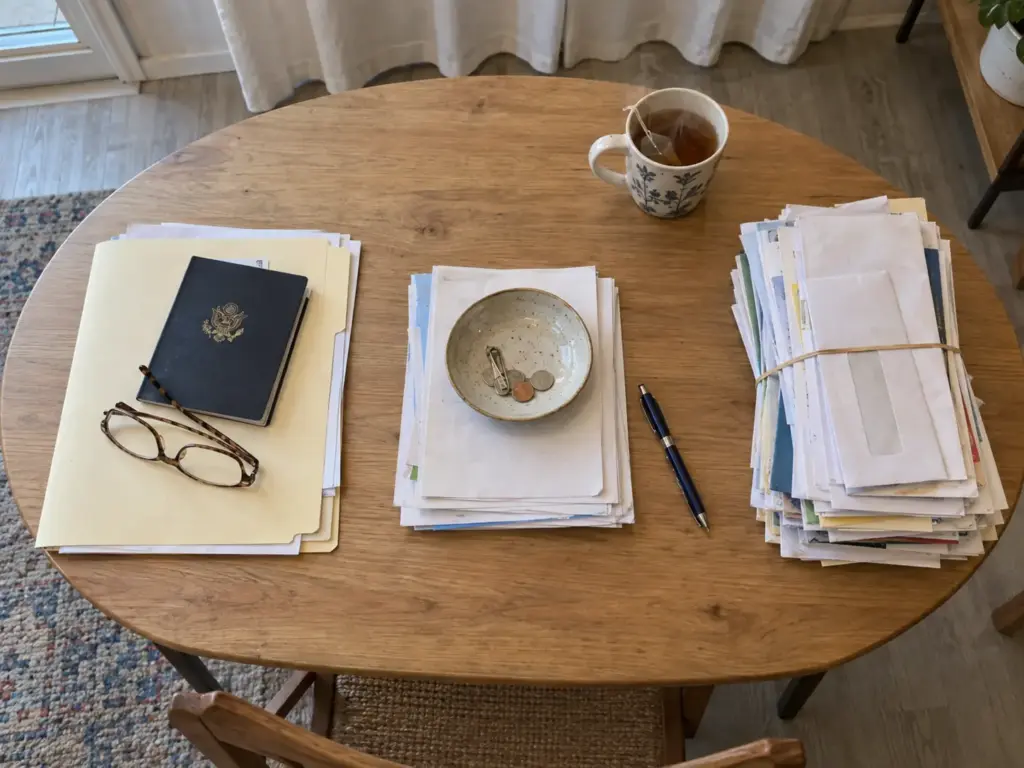
FEMA’s Emergency Financial First Aid Kit groups what matters into four buckets: household identification, financial and legal papers, medical information (medical records included), and household contacts. Treat them as your important documents checklist: they tell you what to gather, not how hard each piece is to replace. The tiers do that.
Tier One: Papers You Cannot Replace
FEMA’s identification checklist is a ready start for Tier One: birth certificates, adoption papers and custody papers, the marriage license, the divorce decree, the passport, naturalization papers and military discharge papers. Add the original will, trust papers and the power of attorney (the estate planning set), plus the deeds and vehicle titles. Some of these can be reissued, but only after forms, waiting, and proof of identity that usually lived in the same pile you just lost. If getting a paper back requires another paper from this stack, it belongs in Tier One.
Tier Two: Replaceable but Painful
The Social Security card surprises people by landing here. Social Security’s replacement-card page says a replacement is free, arrives by mail 5 to 10 business days after the request is complete, and that you may not need a card at all if you know your number.
Certificates of birth, marriage and divorce technically belong here too: FEMA notes they come from your state health or social services office for a small fee. Painful, slow, possible. But keep the birth certificate in Tier One anyway, because other replacements lean on it, and a slow replacement at the front of the chain delays everything behind it. Insurance policies, recent tax returns, the lease and the latest mortgage statement round out Tier Two; if an original goes missing, FEMA’s advice is to ask the company or agency that issued it for a copy.
Tier Three: Reference Papers
Statements, warranties, manuals, receipts, the current vehicle registration, medical bills and a couple of recent pay stubs make up Tier Three. You consult these; you do not need to protect them from a house fire. This is where a binder or an accordion file earns its place, and where most of a home’s paper sits.
The same r/organizing thread has a commenter who stalls over a medical bill (financial or medical?) and calls the moment pure panic. The tier settles most of it: Tier Three either way, so a misfile costs little. File it by what you will search for first and move on.
The tiers prove themselves on an ordinary weekday. A mortgage lender asks for last year’s return and a copy of the deed, and without tiers you tip the whole dump box onto the floor to find two sheets. With them, you open one folder. Everything outside Tiers One and Two belongs to the wider paper and file organization system that handles the rest of the household’s filing.
Where the Originals Live and What a Fire Box Will Not Do
The standard advice fits on one line: put it all in a fireproof safe. It is half an answer. A fire box protects against one threat out of several, and buyers in the reviews tend to discover the others after the purchase, starting with the lock.
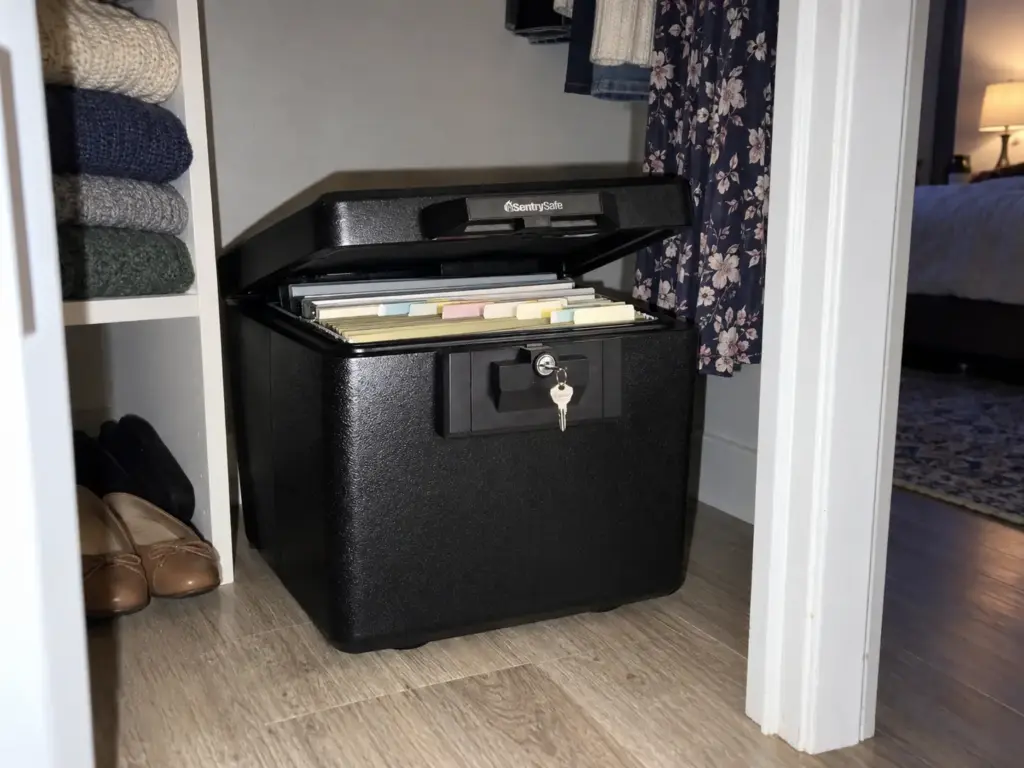
NDSU Extension splits the job across three locations. A bank safe deposit box holds the hardest-to-replace originals: titles, vital certificates and deeds. A fireproof safe at home holds recent tax records, insurance policies, a living will, the power of attorney, the original will, warranties, and a list of what is in the deposit box. A copy goes to an attorney, a relative or a friend.
Each location fails in a different way, which is why the split works.
The Home Fire Box: What It Buys You
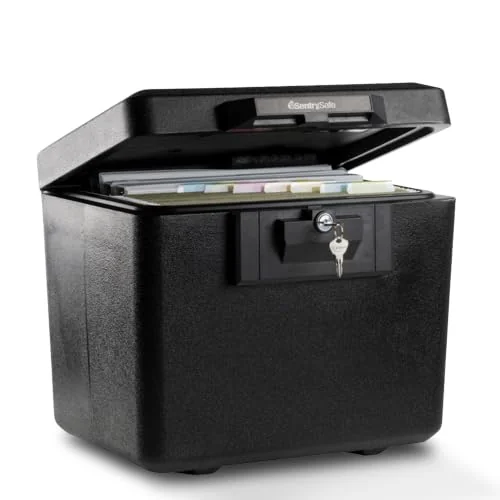
A fire box buys time, not immunity. According to NDSU Extension’s guide to keeping documents safe, “Unfortunately, even a fireproof safe can melt in a very hot fire.” The same page adds that it still beats a shoebox or a cardboard box. SentrySafe states that its 1170 document box is classified for half an hour at 1550°F, and that is the maker’s figure for fire.
Water is a different story. The 1170’s listing names fire and security as its perils and says nothing about water. A fire box is not a flood plan, and if water is the likelier threat where you live (a ground-floor unit, a basement that has flooded before), the fire rating matters less than where the box sits and whether a copy of each Tier One paper lives somewhere else.
Weight belongs in the plan too. NDSU’s advice is a box large enough for the papers but small enough to move yourself if you have to evacuate. The 1170 weighs close to 28 pounds and its reviewers report no handle, so it stays behind when you leave in a hurry. Keep it where you can reach it, not in the garage corner where things go to be forgotten.
Then there is the lock. Reviewers on sentrysafe.com and at Sam’s Club describe keys that jam or are hard to insert, and a key that cannot come out while the box is open. One reviewer adds that the fire resistance depends on the box being locked, which is that reviewer’s reading, not the maker’s statement.
Decide who gets the key before anyone needs it. If the box comes with a spare, give it to the person named on your index sheet or keep it with the sealed envelope, never on the same ring as your car keys and never taped under the box.
The Deposit Box Catch
A bank vault is excellent against fire and poor at one specific emergency. NDSU points out that banks can legally seal a safe deposit box once notified that the owner has died, and unsealing it then takes a court order. That makes it a strong home for a deed and a weak one for the paper your family needs on a Sunday night.
So think twice about the will. NDSU puts the original in the home safe, with a copy held by an attorney or a relative, so the people who need it first can reach it without the bank. Who can open what gets its own test further down.
The Size Check Nobody Does Before Buying
The 1170’s interior measures 10.4 inches high, 12 inches wide and 8.5 inches deep (maker’s figures), and SentrySafe says it accommodates hanging files. A Letter sheet is 11 inches long, so it fits across the 12-inch width. A Legal sheet is 14 inches long and will not lie flat inside.
Check your Tier One set against those numbers before anything goes in. Anything on legal stock has to be folded in a 12-inch box, which is fine for one or two documents and a mess for a stack. The 8.5-inch depth also caps how much fits, so the box will not take every tax return you have ever filed.
Twelve inches is the number to measure against.
Binders, Accordions and the Papers That Fit Nowhere
Somewhere in a lot of homes sits a box of 200 sheet protectors with nine of them used. The important documents binder did not stall because binders are bad; it stalled because it asked for a decision on every sheet. Tier Three needs a container that is easy to put things into.
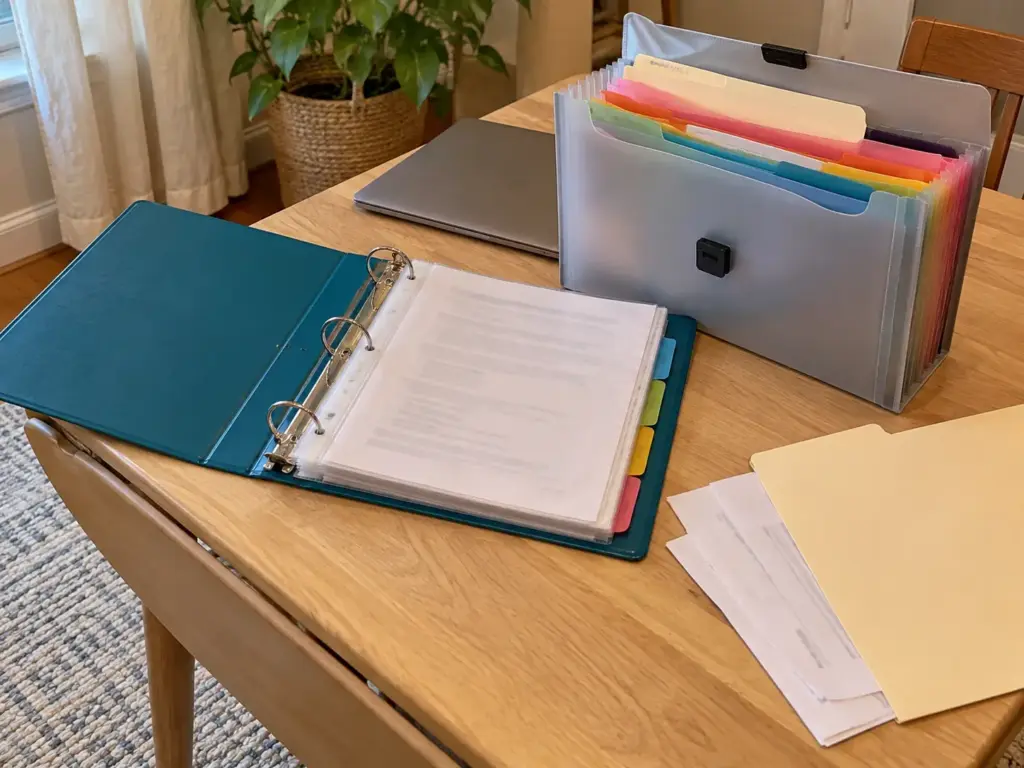
NDSU’s financial binder, the kind some people call a life binder, is a model to borrow from rather than copy whole: a three-ring binder, at least 16 index or tab dividers and page protectors, with sections for a personal directory, a professional directory and the location of documents. NDSU suggests a copy of the binder in the fire box, with a friend or in a deposit box, and the working original at hand.
One Binder Per Theme, Not Per Document
Commenters in the r/organizing thread suggested D-ring binders split by theme (vital, medical, financial) rather than giving every account its own section. The Oxford 1.5 Inch 3 Ring Binders 4 Pack Assorted Colors covers those three with one left over for the directory pages, each with 1.5-inch rings the listing puts at about 375 sheets. A different color per theme helps the person who is not you grab the right one.
Binders do not suit every household, though. Another commenter called binders and sheet protectors “much too fussy” to keep up, preferring labeled folders in a drawer, with the goal of finding anything in a minute or two. If your household already avoids the hole punch, believe that and go straight to folders.
Letter, A4 and Legal Will Not Share a Sleeve
The original poster in that thread had three paper sizes in one pile. Letter is 8.5 x 11 inches, Legal is 8.5 x 14 inches, and A4 is 210 x 297 mm, a little narrower than Letter and about two-thirds of an inch taller. One sleeve size will not hold all three cleanly.
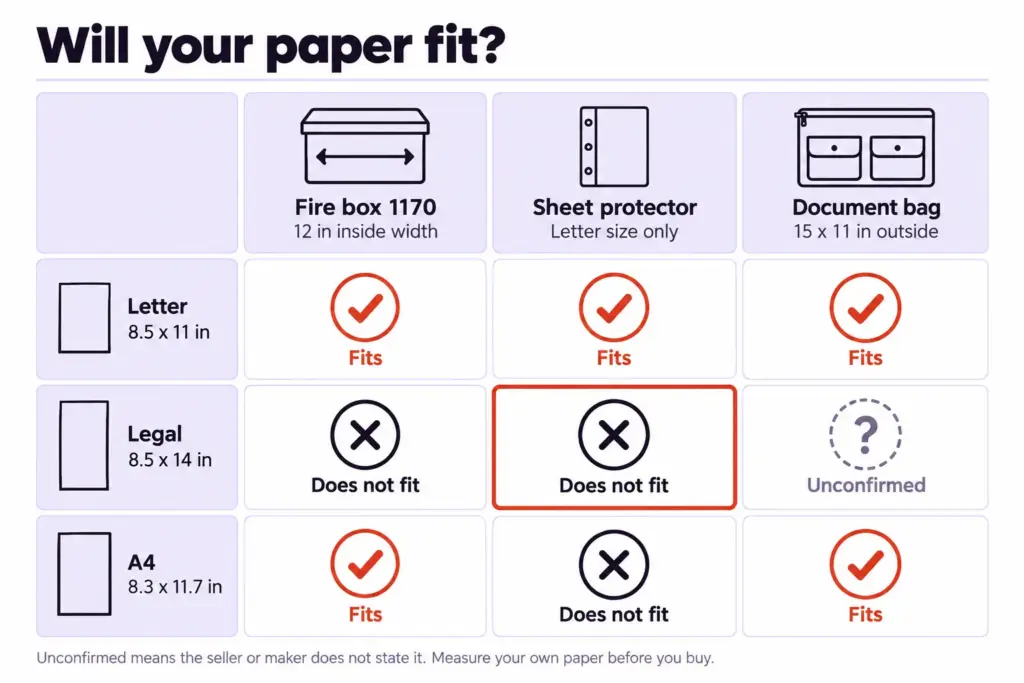
For the Letter papers you handle often (an insurance summary, the index sheet itself), Taja Sheet Protectors for 3 Ring Binder 200 Pack keep pages clean through repeated handling, and slim booklets slide in too. But they are Letter size sleeves only: a Legal page hangs three inches out of the top, and an A4 sheet catches on the opening.
The thread’s fixes for mixed sizes: a legal-size accordion file for everything, several smaller binders sorted by paper size, or an artist’s portfolio for the odd sizes. Bulky papers stay out of the binder entirely. Owner’s manuals and a thick stack of auto-repair records go in a file folder inside a box, because forcing them into sleeves is how a 1.5-inch binder stops closing.
The “Fits Nowhere” Folder
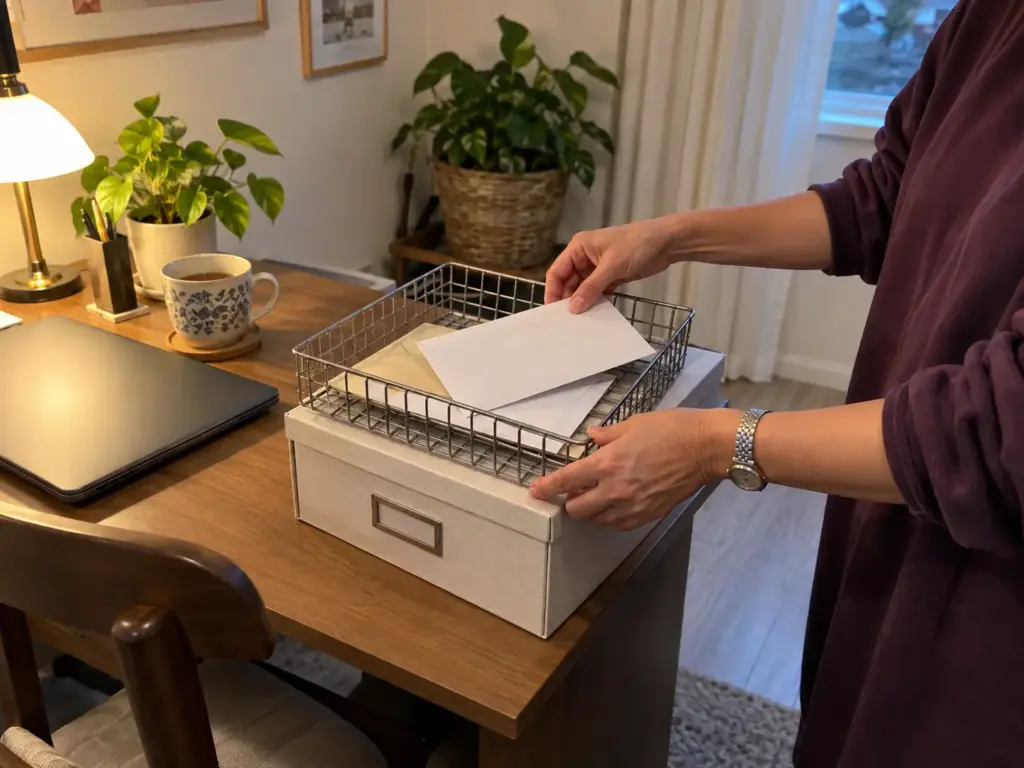
Some papers will not sort cleanly, and the thread’s rule keeps them moving: file by what you will search for first, then stop thinking about it. One folder for papers that fit nowhere is allowed, as long as it gets emptied. A commenter who needed a low-effort setup keeps a paper tray on top of a file box as the dump spot and sorts it into folders about once a month.
The budget route is the one commenters kept naming: a plastic accordion with your own envelopes instead of a premium organizer, twin-pocket portfolio folders labeled in a drawer, or manila folders in a box you already own. If you want tabs and pockets in one piece, the Cesil 13 Pockets Accordion File Organizer with Tabs gives each theme its own pocket; its listing does not confirm legal-size paper, so check your longest document against it first. One commenter found accordions harder to navigate than flipping through a binder, worth weighing if you like to see everything at once. This guide compares home filing systems by where each one breaks if you want the full picture.
Originals, Copies and the Grab-and-Go Set
Most evacuation checklists quietly assume the fire box comes with you. At close to 28 pounds with no handle, it probably will not. So the plan splits in two: originals stay protected at home or in the bank, and copies travel.
Which Papers Stay Originals
The rule works per document, not as a blanket. FEMA’s checklist says to photocopy your driver’s license and other photo ID front and back, and to photocopy the first two pages of your passport, while keeping the originals of what is hard to get. A copy speeds up a replacement request or a claim; it rarely stands in for the original.
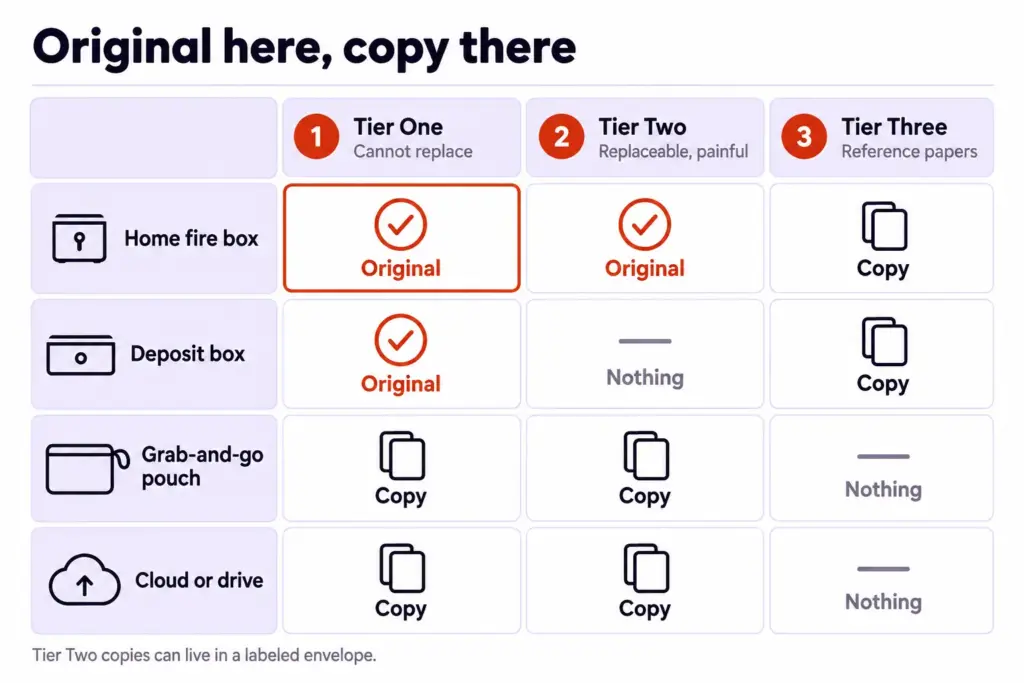
“Go digital” and “keep everything on paper” both get repeated as complete answers, and neither holds up as a blanket rule. One r/organizing commenter keeps only certified or notarized documents as originals and scans the rest. Another scanned and shredded 90 to 95 percent of their paper; the remainder fits in one box of hanging file folders instead of several 24-inch-deep boxes, with a thumb drive and the necessary originals in a fireproof safe.
Both landed on a short list of originals and copies of everything else. The scanning routine with backups that stick has its own guide.
What a Copy Is Good For
Copies work best spread out. FEMA’s kit suggests paper copies at home in a fireproof and waterproof box or safe, in a bank safe deposit box, or with a trusted friend or relative, and electronic copies password-protected on a removable drive in that box or in secure offsite storage. Ready.gov’s financial preparedness checklist points the same way: a safety deposit box, an external hard drive or a cloud backup.
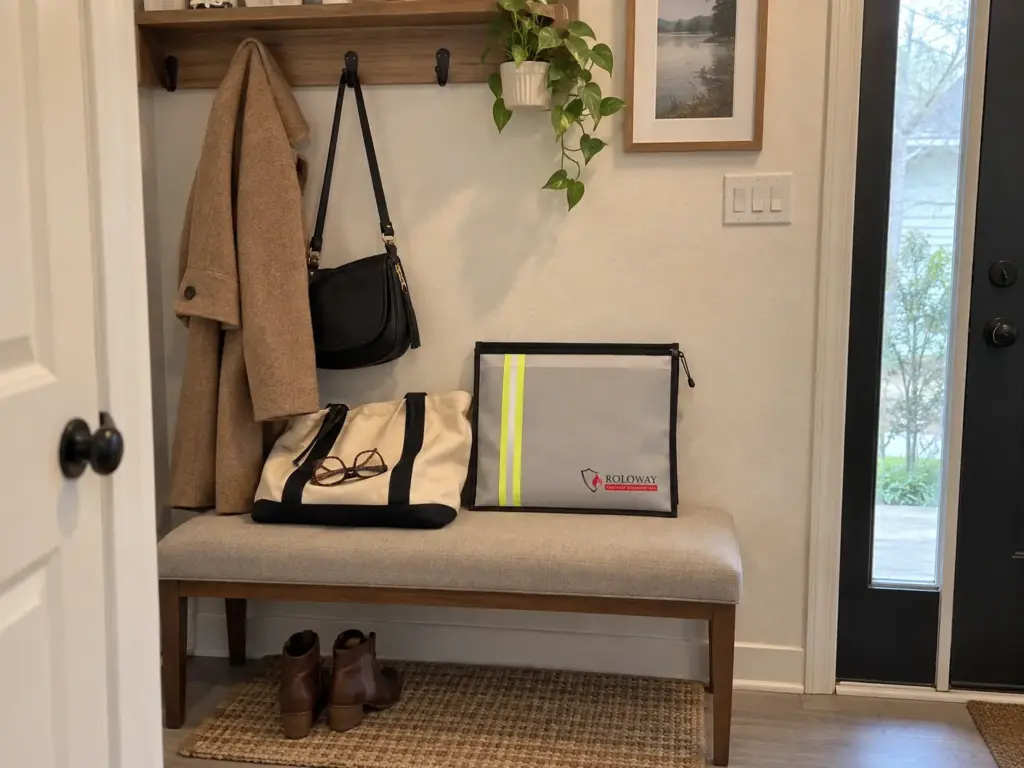
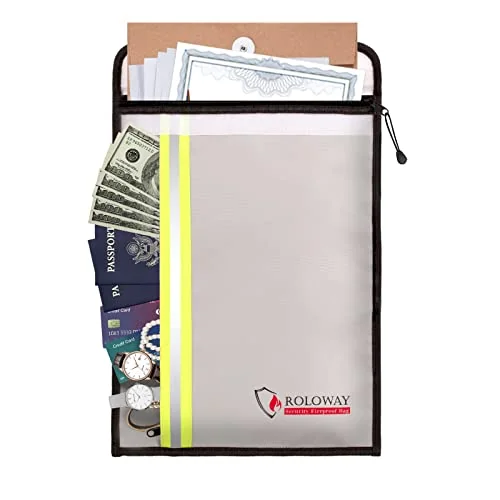
A copy of your insurance information gets a claim started, and FEMA notes a passport copy makes replacement quicker. For the Tier Two copies, a labeled envelope in a drawer costs nothing and does most of the work. The only extra worth adding is a light fireproof, waterproof document bag for the copies you would actually carry out the door, remembering that both of those claims are the seller’s own.
The Grab-and-Go Pouch
Imagine standing at the door with the car running and realizing your passport is locked in a 28-pound box at the back of a closet. The grab-and-go pouch exists so that moment never comes. It holds copies, never the only original: photocopies of each household member’s ID, your insurance policy information, a list of contacts, and the index sheet from the next section.
FEMA adds two things worth copying: photograph the documents, along with your rooms and valuables, and keep some cash with the kit. The pouch does not replace the box. It is the one piece of the system light enough to leave with you.
Could Someone Else Find It in Two Minutes?
Most households have one person who knows where everything is and has told nobody.

So run a two-minute test: could a relative with no key and no password find the will, the insurance policy and the list of accounts in two minutes? NDSU asks the same thing more plainly, whether the person taking over your affairs would have easy access. The person who ends up as executor is the real reader of this system. The organizing threads have a shorthand for that person: NOK, next of kin.
The Index Sheet and the Sealed Envelope
The index sheet is one page. NDSU’s binder has a “location of documents” section alongside a personal and a professional directory, and that is the model: each line names the paper, where it lives, and whether it is the original or a duplicate. For insurance and accounts, add where the beneficiary paperwork lives. Add the date you last checked each line, the way FEMA’s checklist leaves room for the date added or updated, so a stale entry shows itself.
Passwords stay off the sheet. FEMA’s Emergency Financial First Aid Kit says it does not recommend keeping written password lists with the paper or electronic copies, and suggests a hint word in place of the real value if you must write something down. A password manager is the safer home for the real ones; the sheet only says where the paper lives. The same kit describes the handoff: give a lawyer, advisor or trusted relative a paper copy in a sealed envelope, with instructions to open it only with your approval or that of someone you chose.
Print the index sheet three times: one for the binder, one for the grab-and-go pouch, one for the sealed envelope. When you update it, replace all three on the same day and write the new date at the top, or within a year the copies will disagree with each other.
Who Can Open What
Access is where good systems quietly fail. FEMA and NDSU both say to check with your bank about who can open a deposit box if the owner dies or becomes ill, and to write the answer down. FEMA also suggests filing the living will with your hospital and primary doctor, not only at home where nobody thinks to look.
Generic checklists miss things, too. A reviewer of one premium document organizer in the thread found its pages skipped trusts and power-of-attorney papers entirely. List the papers your household actually has, and note who holds the spare key and whose name is on the deposit box.
Renter Papers Versus Owner Papers
The Tier One set changes with the home. A renter’s set holds the lease or rental agreement, which FEMA treats as proof of housing (ask the owner for a copy if yours is missing), plus the renters insurance papers. One renter in the thread keeps lease papers in a labeled portfolio folder; another carries a birth certificate, passport and vaccine card in a passport holder, worried about things being rifled through in an apartment.
An owner’s set holds the mortgage or deed and the property records, which the IRS says to keep until the limitations period runs out for the year you dispose of the property. Either way, read your policy for flood coverage: FEMA notes flood damage is rarely covered by homeowners or renters policies. A renter’s system is move-ready by nature, since the box and the bag leave at the next lease. An owner has more paper and a house to leave in a hurry, which makes the pouch matter more, not less.
What to Keep, What to Shred and For How Long
The household that keeps every statement just in case usually cannot find the deed. Retention rules decide how much paper stands between you and the papers that matter, and a shoebox of expired bank statements is exactly where the one document that never expires tends to hide.
A Compact Keep-or-Shred Table
| Paper | Keep how long | Why | Tier |
|---|---|---|---|
| Vital records and the will | Keep forever (originals) | Hardest to replace | One |
| Property and home-improvement records | Until the limitations period ends for the year you sell | IRS property rule | Two |
| Loan and insurance papers | As long as the lender or insurer requires | Can outlast the tax clock | Two |
| Social Security card | Keep | Replacement is free | Two |
| Filed tax returns and their support | Copies of returns kept; support at least 3 years from filing, longer in some cases | IRS general rule | Three |
| Recent pay stubs | One or two | FEMA kit | Three |
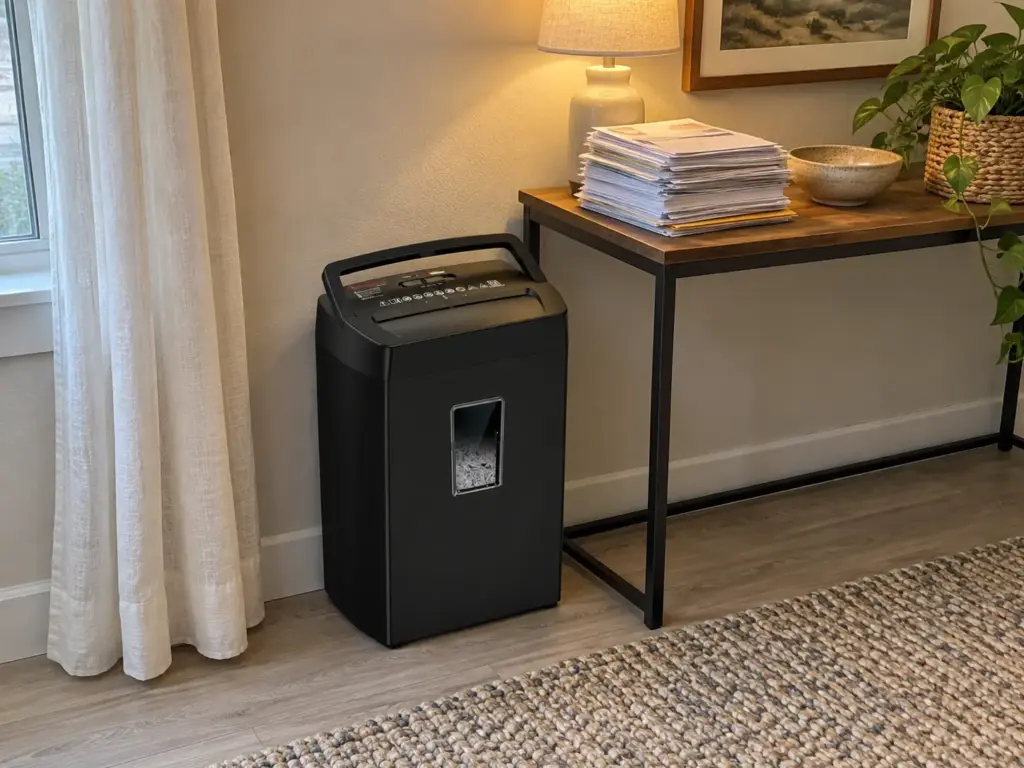
Anything that carries an account number, a Social Security number or a signature should be shredded rather than tossed, which also cuts the risk of identity theft. A cross-cut machine such as the Bonsaii 12-Sheet Cross Cut Paper Shredder 5.5 Gal takes 12 sheets at a time into a 5.5-gallon bin, which is enough for a first purge done over a few evenings. If the backlog is bigger than the system you are building, start with this plan for clearing a paper backlog before you sort it.
Where the Seven-Year Rule Comes From
Seven years is the number almost everyone quotes, and for most households it is longer than the general tax rule requires. According to the IRS’s guidance on how long to keep records, the general rule is three years from filing. The window stretches to six years if you left out more than 25 percent of your gross income, runs indefinitely if no return was filed or it was fraudulent, and employment tax records need at least four years.
FEMA’s kit says tax experts recommend seven years for returns, so if you keep seven years of returns, that is a conservative habit, not the IRS’s general rule. The IRS adds two things worth keeping in mind. Keep copies of the returns you filed, and before you shred anything, check whether an insurer or a creditor needs it longer, because loan and insurance papers can run on their own clocks.
Keeping the System Alive After the First Weekend
The binder looks perfect in week one. Nine months later a wad of loose paper is stuffed in the back pocket, and the index sheet describes a box that no longer exists. That slide is predictable, so it can be planned for.
Why Over-Built Systems Quietly Die
The r/organizing thread reads like a list of the ways this goes wrong. Binders “much too fussy” to keep up. A folder system described as “a lot of work,” with folders filling up and a plastic drawer organizer bending under the weight of the paper. A premium folio whose glue failed after about a year while it sat untouched in a drawer (the company did send a replacement).
The mechanism is the same each time. Every extra section, sleeve and subfolder is one more decision at the moment you file, and paper that needs a decision waits. A system with dozens of slots gets a pile on top; a system with a handful gets used.
The Inbox, the Monthly Ten Minutes and the Annual Review
Fewer parts keep it running: one inbox (the paper tray from the thread works) where every incoming document lands, one monthly sort of about ten minutes (a monthly filing habit small enough to survive a busy week), and one annual review of the index sheet against the box. A few minutes a week suits some households, and a check after a few months and then yearly suits others; either pace works if it actually happens.
And the inbox stays small only if new paper stops piling on top of it, which is the job of a mail organization system that holds before anything reaches the tray. For the annual review, FEMA’s kit names easy dates to hang it on: tax time, the daylight saving changes, your birthday or New Year.
Tie the annual review to filing your taxes. You already have the returns, the insurance statements and the account list out on the table that weekend, so checking each line of the index sheet adds minutes rather than a whole separate afternoon.
Life Events That Should Trigger an Update
Some changes cannot wait for the annual date. FEMA lists the moments to update right away: a change of insurer or residence, buying a home or renting an apartment, opening or closing accounts, a change in marital status, a new child, retirement planning, or losing someone in the household. Each one adds, replaces or retires a Tier One or Tier Two paper.
After the first insurance renewal or the first new account, pull the index sheet and see if it still matches what is in the box. If it does, the system is alive. If it does not, build a smaller system, not a stricter you.
Three Moves That Keep Your Papers Findable
Sort by replaceability, not by topic, so the papers you cannot get back are the ones that get the protection. Give that irreplaceable tier one protected home and keep copies of it somewhere else, because a fire box covers fire and not much more. Then make the whole thing findable by someone who is not you, with an index sheet, a sealed envelope and an answer to who can open the deposit box.
About three months out, open the box with the index sheet in hand and look at the inbox tray: if the sheet matches and the tray is close to empty, the system held.
Today, with what you already own, take one envelope, label it for the replaceable tier, and write a single page listing where each Tier One paper lives right now. Then notice how many lines on that page you had to leave blank, because those blanks are your first weekend’s work.
Frequently Asked Questions
01What are examples of important documents?
Important documents include birth and marriage certificates, passports, Social Security cards, wills, powers of attorney, deeds, vehicle titles, insurance policies and tax returns. FEMA groups them into household identification, financial and legal papers, medical information and household contacts. The hardest to replace deserve the most protection.
02How do I organize my important documents?
Organize important documents by how hard each one is to replace: irreplaceable, painful to replace, and reference papers, each tier with its own home. Give the first tier one protected home, keep copies elsewhere, write a one-page index of where things live, and review it at tax time.
03What is the best document organizer?
The best document organizer depends on the tier: a fire box for originals, a light fire-resistant bag for carry-out copies, and a binder or accordion for reference papers. Try labeled envelopes first, and check Letter versus Legal sizes and the weight before buying.
04Should I keep the original or a scan?
Keep originals of anything hard to replace, such as vital records, the will, deeds and titles, and use scans or photocopies for the rest. A copy speeds up a replacement or a claim, but it rarely stands in for the original.
05Is a medical bill a financial or a medical document?
File a medical bill wherever you will look for it first, which for most people is the medical folder. It is a reference paper either way, so a misfile costs little.
Disclaimer: ClutterlessNest is a participant in the Amazon Services LLC Associates Program. As an Amazon Associate we earn from qualifying purchases. This article may contain affiliate links — if you buy through them, we may earn a small commission at no extra cost to you. We only recommend products we have tested or genuinely believe in.