

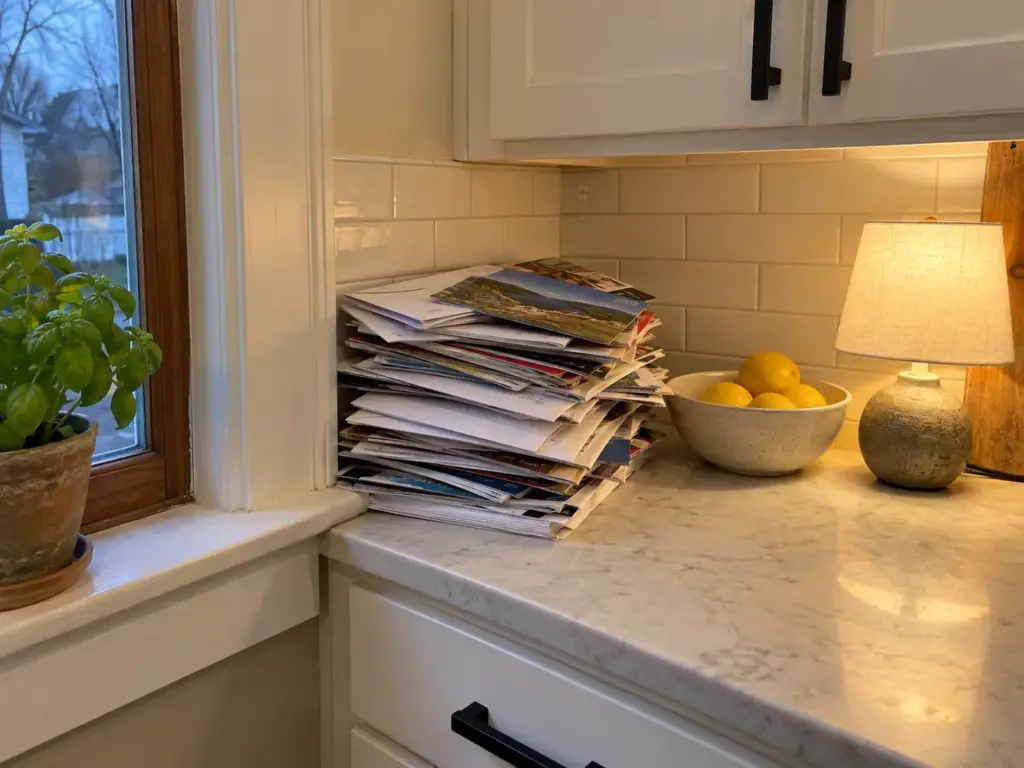
The counter by the door has a stack again: a credit card offer on top, two catalogs under it, and somewhere in the middle an envelope with a due date you haven’t seen yet. In an r/Xennials thread about storing mail, one commenter described the whole cycle as letting it pile “until i get sick of the piles,” shredding, then going back to piles, while the original poster watched bills, notices and statements spread across “the counter, table, somewhere out of the way.” That’s a reset powered by exhaustion, and no mail organization system survives on exhaustion. The plan below leans on what the FTC and the Postal Service publish and on what households in that thread actually do: shrink what arrives, pick one landing spot, give every piece one of four answers at the door, handle the pieces that need extra care, and clear the tray once a week.
Quick Answer
A mail organization system that holds does its work in the first minute after the mailbox:
- Cut the inflow with prescreened-offer, DMAchoice and catalog opt-outs.
- Pick one landing spot based on who opens the mail.
- Give every piece one answer at first touch: pay or act, keep, or toss.
- Shred anything carrying an account number or personal data.
- Empty the tray on a fixed weekly day, or sooner if it fills.
Why Your Mail Organization System Keeps Falling Apart
Most mail piles get cleared more than once. You clear the counter on a weekend, shred an armful of old offers, enjoy the bare surface, and by the next Friday the stack is back at half height. The cleanup worked. The mail organization system around it never existed, so the pile came back on schedule.
The Pile Is a Decision You Postponed
Each envelope that comes through the door carries a question: pay this, keep this, or get rid of it. A pile is a stack of those questions with the answers postponed, and every piece set down for later means reading it twice. The worst part is what hides in the middle. Imagine the electric bill that slid between two catalogs, sat under a furniture flyer for nine days, and surfaced the afternoon after its due date, only because the whole stack finally slipped off the counter.
A tray for sorting later is the usual suggestion, and it sounds sensible. But a tray with no limits only moves the pile about a foot to the left. It earns its place when two rules come with it: a hard cap, meaning one folder or one pocket and nothing more, and a fixed day when it gets emptied no matter how full it is. Without the cap, the tray is a pile with walls.
If the stack on your counter already runs back months, deal with that first using the method for clearing a paper pile that already exists, then start this system with today’s mail only.
Why Going Paperless Does Not Empty the Mailbox
Switching to paperless billing helps, and it still leaves a mailbox to deal with. In the same thread, a commenter whose bills are all electronic says they still get “dozens of random things a week with all my information on it” that they won’t just throw away, and they can’t stand it. Another describes a long tail of paper that keeps arriving after the switch: tax documents, insurance notices, government letters, the CYA documents nobody wants to lose.
Paperless shrinks the pile; it never removes the need for a step at the door. Going paperless at home tends to stall for the same reason a mail tray does: the decision about each piece still has to happen somewhere, and if it has no fixed place, it happens nowhere.
What a System Has to Do in the First Minute
A one-time organizing day treats mail as a backlog, but mail is a stream, with something new landing most days of the week. So the daily mail routine has to run in the first minute after the mailbox, while the envelopes are still in your hand, or it doesn’t run at all. That takes four things: one place where all mail lands, a short fixed set of answers, the recycle bin and a way to destroy personal data within arm’s reach of that place, and a container small enough that it can’t quietly turn into storage.
Anything you have to walk across the house for is a step you’ll skip.
Shrink the Inflow Before You Sort Anything
Sorting junk faster is still sorting junk. A few opt-outs do more for the pile than any organizer, and they cost an evening rather than a purchase.

Credit Card and Insurance Offers
The pre-approved credit card solicitations are the ones to stop first, because they carry your name next to a financial offer and they fade slowly. According to the FTC’s guide to prescreened offers, you can opt out for five years or permanently, and the permanent route needs a signed form. The same page sets expectations plainly: “Requests to opt out are processed within five days, but it may take several weeks before you stop getting prescreened offers.”
The request asks for your name, address, Social Security number and date of birth, so give those only to the official site the FTC names, never to a look-alike stop-junk-mail service. Then set a calendar reminder for year five (five years is plenty of time to forget you ever opted out).
Catalogs and Marketing Mail
DMAchoice, run by the Association of National Advertisers, reduces promotional mail from companies you’ve never bought from. It charges a one-time fee, and a registration covers ten years. The page is upfront about the limit: it “will not eliminate all promotional mail,” and companies you already do business with keep mailing. In a home with more than one adult, the ANA recommends a separate account for each person, and one account can carry the nicknames and misspellings your mail already shows up under.
For catalogs from stores you did buy from, Catalog Choice is a free nonprofit service covering thousands of senders. A merchant can take six to eight weeks to stop after your request goes through, so the catalogs on your counter today will still show up next month. It also files opt-outs for a previous resident or a deceased relative once you enter their name, which matters more than it sounds if you moved into a home that still gets someone else’s mail.
Hold this week’s catalogs back from the recycling and stack them next to the laptop. They are your opt-out list: the sender’s name and the exact spelling of your name are right there on the mailing label, so each Catalog Choice request takes a minute instead of a memory test.
The Pieces You Can Only Throw Away
Two opt-outs later, the mailbox will be thinner, not empty. The FTC lists what the prescreened opt-out doesn’t touch: mail from local merchants, charities, religious groups, alumni associations, companies you already do business with, and anything addressed to “occupant” or “resident.” Catalog Choice adds that the Or Current Resident flyer has no opt-out at all, and a note on the mailbox asking the carrier to hold it back is something the carrier isn’t required to honor.
That flyer goes from your hand to the recycle bin unopened. The commenter in that thread who keeps a junk bin by the door admits it is “always overflowing,” which says more about the volume coming in than the size of the bin.
Choose One Landing Spot Based on Who Opens the Mail
Think of a household where one adult opens everything the day it arrives and the other leaves theirs stacked for a week. A setup built for the first person collapses under the second, and one built for the second annoys the first. The landing spot, your mail station, has to survive both, and next to it you want the recycle bin or a wastebasket, a shredder or a lidded shred box, and a letter opener, all within arm’s reach.
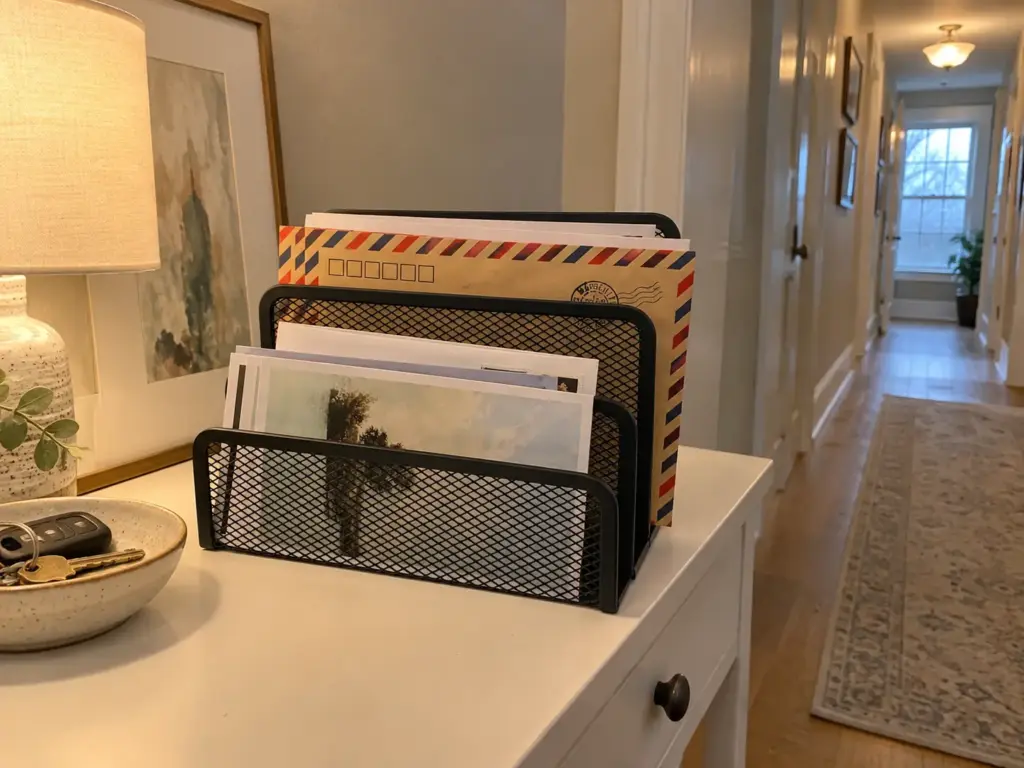
One adult with a few pieces a day and a free wall by the door does well with a wall pocket. Two or more adults with different habits do better with one lane each on a counter or a desk, and the kitchen counter tends to become the mail drop zone whether anyone plans it or not. Anyone who can’t stand the sight of paper should put the whole thing in a drawer.
Start with a Folder and a Bin You Already Own
Run the system for two weeks on what’s already in the house: a two-pocket folder or a shoebox lid in a drawer, plus the recycle bin.
The no-buy systems in that r/Xennials thread are mostly verbs. One commenter’s entire routine is “Open, read, shred.” Another spells out the long version: “Open, read, pay as needed, shred or burn anything with account info on it. Magazines, junk, and anything else go in the trash or recycle bins.”
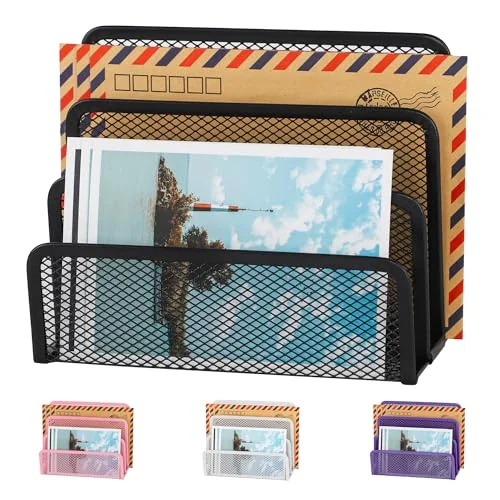
If you do buy a mail sorter (a letter sorter by another name), the number that matters is slot length, not slot count. A standard #10 business envelope is 4 1/8 by 9 1/2 inches, and letter paper is 8.5 by 11. Compact countertop sorters are often shorter than 9.5 inches, so every envelope rides above the rim and the long ones flop over the side. Shoppers compare how many slots a sorter has; compare how long each slot is instead, and choose by that.
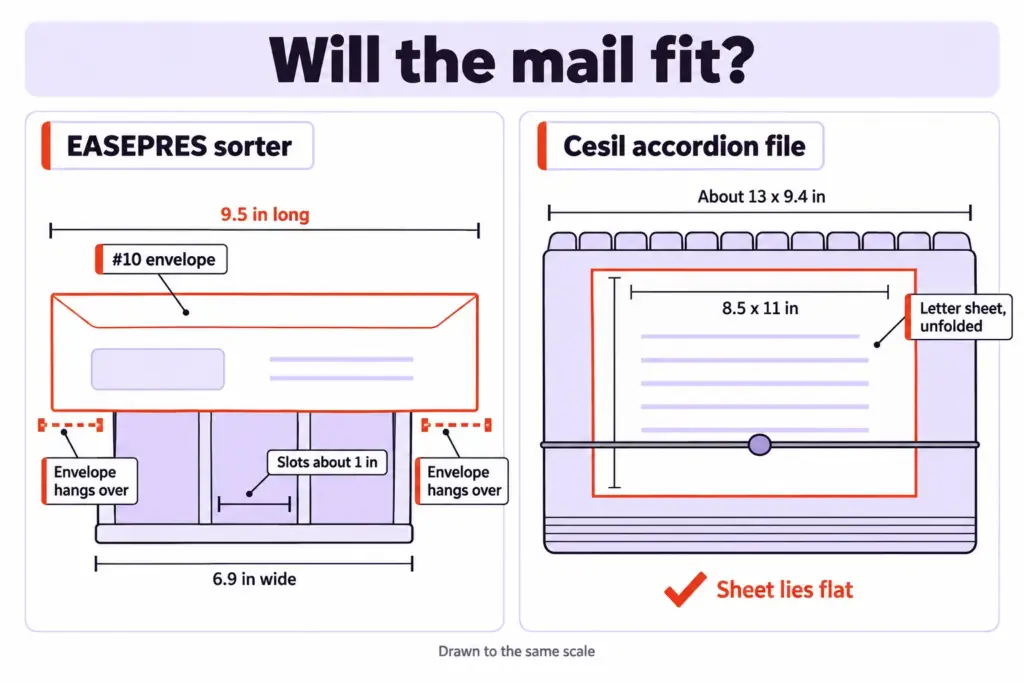
A short sorter isn’t automatically wrong. It holds the envelope upright with a few inches showing, which is fine for a lane you empty every few days and annoying for one that fills up. Check the listing’s width against 9.5 inches before ordering, and you’ll know which of those you’re buying.
The Wall Pocket by the Door
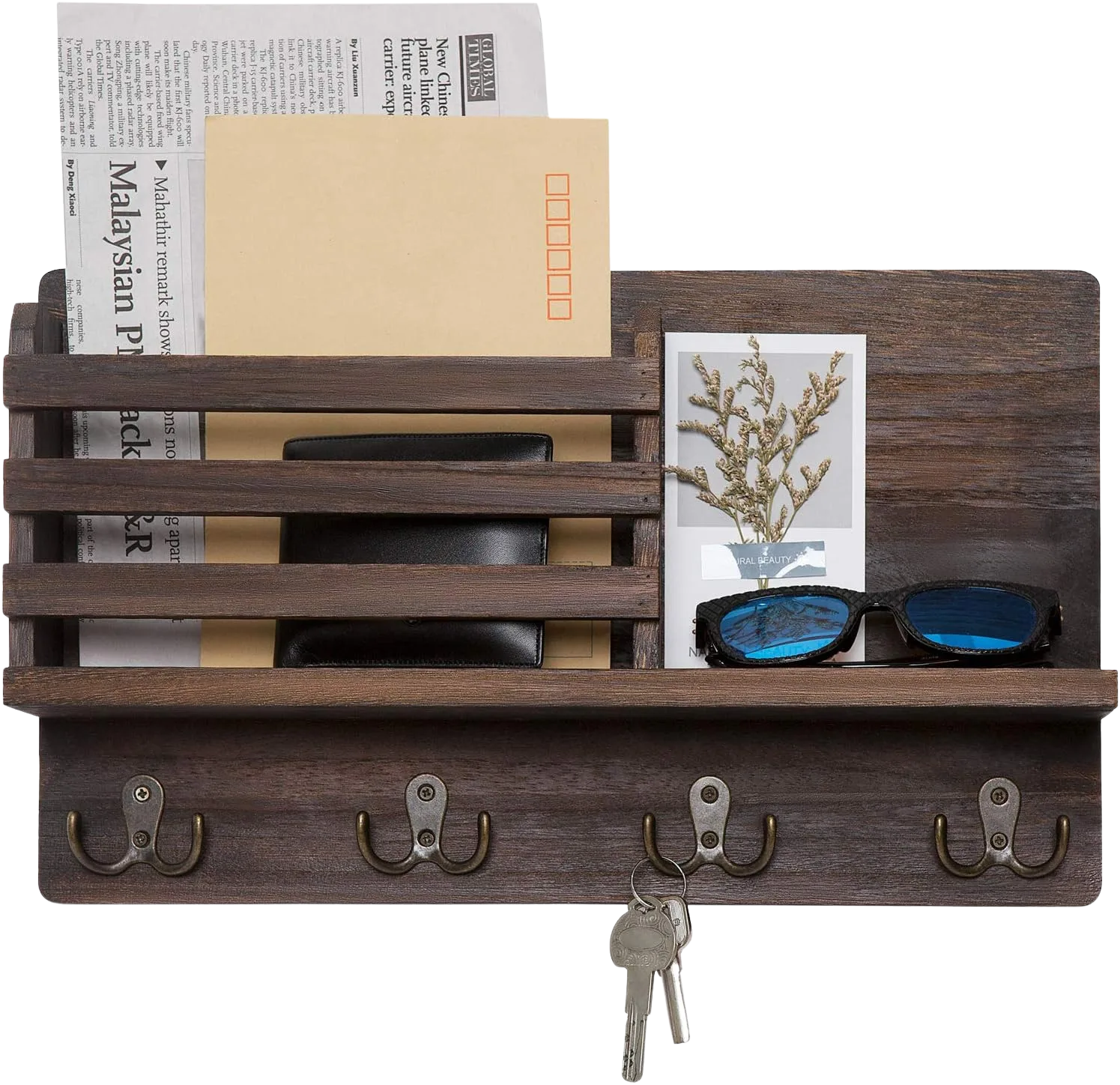
A wall mount mail holder suits the single adult who walks in, drops the keys and wants the mail off every flat surface. It keeps counter clutter down and puts the mail at eye level, where a week-old envelope is hard to ignore. It also means holes in the wall. If your lease or your patience rules that out, the renter-friendly, no-drill key and mail setups cover the door station without a nail, and the guide to organizing a small entryway handles the rest of the drop zone.
The Drawer Version for People Who Can’t Stand Visible Paper
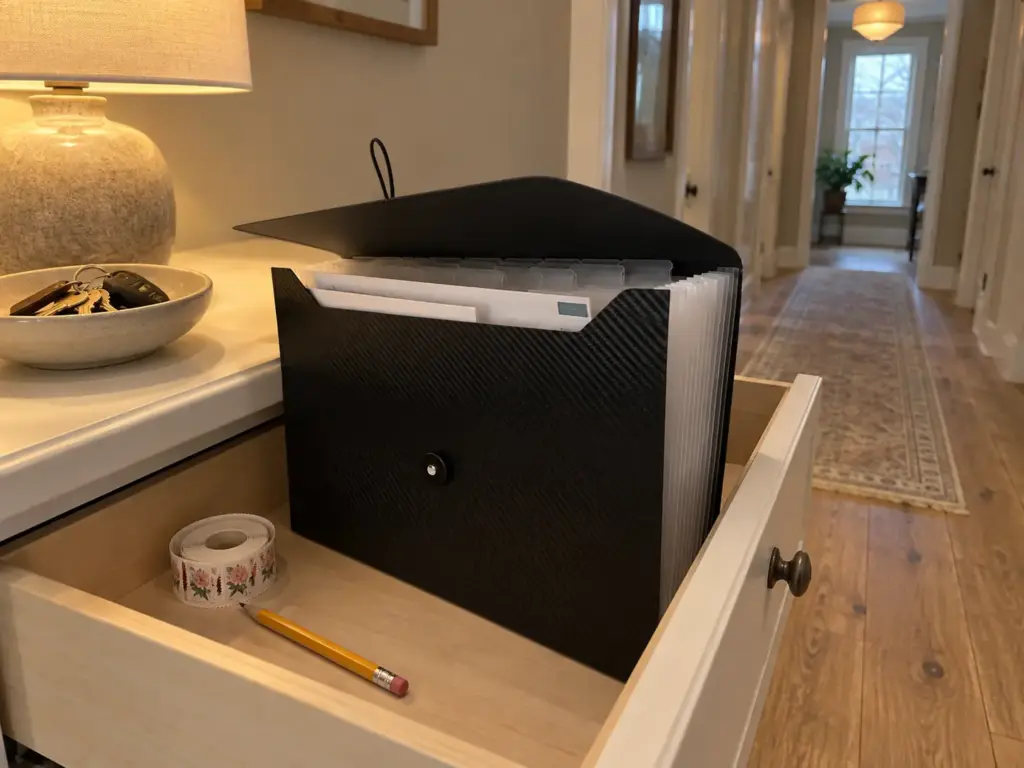
A drawer hides the system, which is the point for some people and the trap for others (out of sight only works for whoever still opens that drawer every day). The free version is any folder you already own, dropped in a drawer near the door. For more structure, the Cesil 13 Pockets Accordion File Organizer with Tabs measures about 13 by 9.4 by 1.4 inches, is an expandable file that closes with an elastic band, and holds an unfolded letter-size sheet flat, which a 6.9-inch countertop sorter can’t. Thirteen tabbed pockets are more than mail needs, so use four or five for your categories and give each person in the house a per-person folder pocket.
Durability is uneven in the reviews: some buyers say theirs came apart within a day, the elastic can get hard to close, and one student found it slow to open and file papers into the right slot. For a drawer you open daily, that last complaint matters more than the other two.
Countertop Lanes for a Shared House
Lanes are what make a counter work for two or more adults. A three-slot sorter becomes one lane per person, or three lanes by due date: due now, due this month, later. One reviewer bought two sorters, one for each spouse, and wrote out the system: “1st slot is due immediately, 2nd slot=later, 3rd slot b4 the month is over.”
Most three-slot sorters share one trade-off, and it’s length. A 9.5-inch envelope stands well above a frame under 7 inches wide, so the mail fans out over the top and the lanes blur together when they get full. On a counter you’re also trying to keep clear of the everyday clutter that piles up on kitchen counters, a small footprint is worth that overhang. On a desk, a sorter like this sits next to the other desk organizers worth buying without crowding the work surface.
Give Every Envelope One of Four Answers
The landing spot only holds what hasn’t been decided yet. The decision itself happens standing over the recycle bin with the envelope in your hand, and it takes seconds when the answers are fixed in advance.

Pay, Act, Keep, or Toss
Every piece gets exactly one answer. Pay and act share a lane: anything with a due date, a form to send back or a call to make goes in the act lane. Keep means a statement or document you’ll need later, and it goes in the To File tray. Toss splits two ways at the bin: plain junk goes in the recycling, and anything carrying an account number or personal data goes to the shredder.
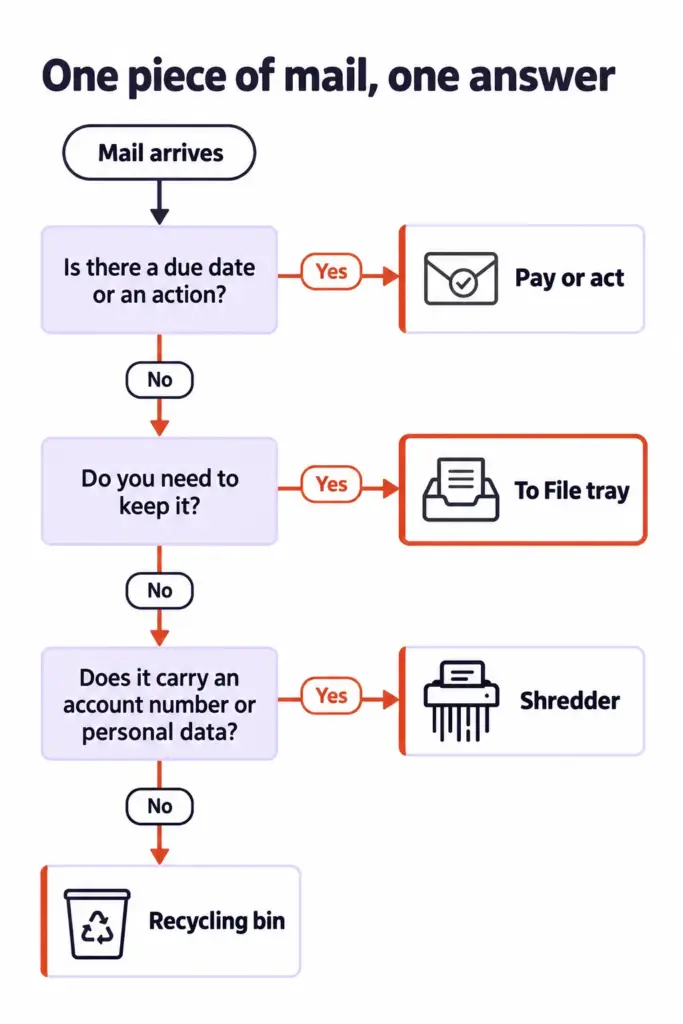
Four is enough on purpose, because each extra category is one more thing to weigh at the bin. The thread’s “open, read, shred” is the verb chain underneath: open everything, read only enough to know which answer applies, and let the envelope go in the same motion.
Due-Date Lanes for Bills and Notices
Inside the act lane, sort by date instead of by type. A lane for utilities and a lane for insurance tell you what a piece is; a lane for due this week tells you what to do next, and a late payment is the part that actually hurts. The reviewer’s three slots above are the simplest version of it: due immediately, later, before the month is over.
Anything you’re waiting on belongs in that lane too. If a check or a replacement card is on its way, a sticky note in the act lane keeps its absence visible until it shows up.
Labels the Whole Household Can Read
A lane without a label belongs to whoever set it up. Masking tape and a marker do the job for free, and they’re easy to rewrite when a lane changes purpose. Write each label as a noun, or better, as a verb: Pay, File and Shred tell the next person what to do with the paper in their hand, while Bills only tells them what it is.
If you’d rather have printed labels that match across every lane, the Brother P-Touch PTD220 Label Maker turns them out in a few seconds. It’s optional. The tape version runs the system exactly the same way.
Where the “To File” Tray Hands Off
This system ends at the To File tray. Give it a hard cap, one folder or one pocket, and when it fills, the weekly clear happens that same day. What happens to those papers next, and how long to keep them, belongs to your filing setup: the home filing systems compared by where they break pick up exactly there, and anything you’d rather scan goes through the paperless routine instead. All of it sits under the eight rules for paper and file organization that this intake step feeds.
Personal Data, Someone Else’s Mail, and the Keepsake Pile
A few pieces don’t fit the four answers cleanly, and they’re where most systems leak: the offer with your personal information on it that slips into the recycling, the letter for a stranger that sits on the counter for a month, the birthday card nobody can bring themselves to throw out.
What to Shred and What to Recycle
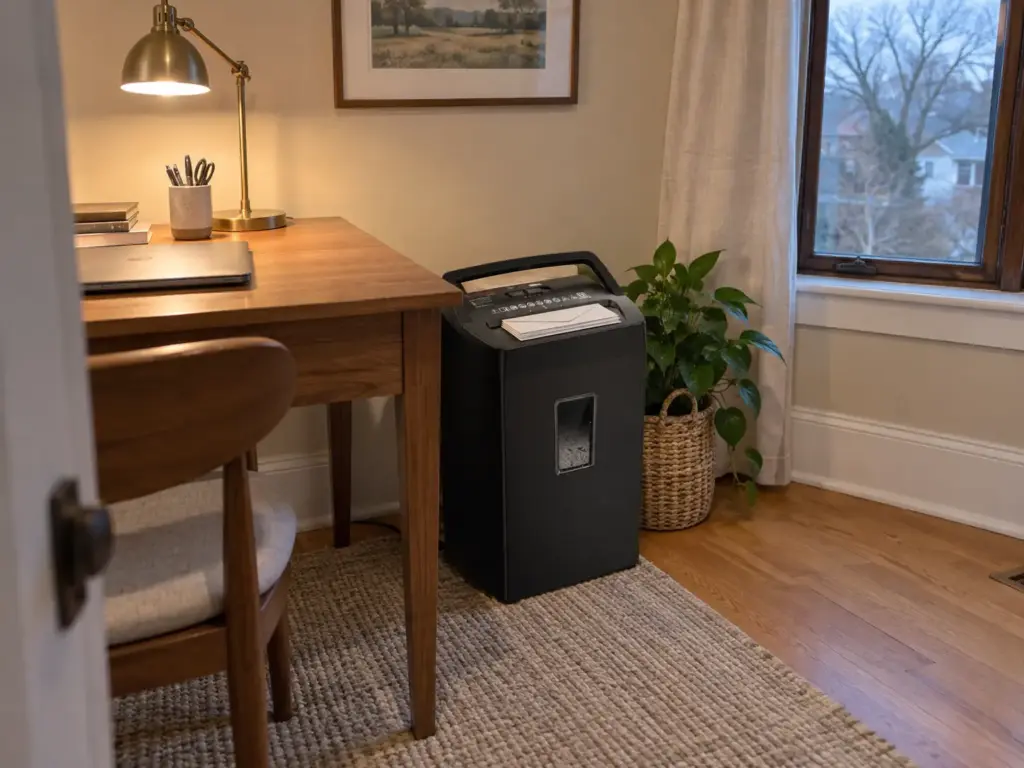
Shred anything that carries an account number, plus anything that pairs your name and address with financial details, like a prefilled credit offer. Everything else recycles. That line matters because the personal data pile is the one people stall on, and it’s exactly what the commenter with dozens of pieces a week was describing: mail too sensitive to toss and too tedious to deal with one at a time.
Use the shredder you already own if there is one. If there isn’t, the Bonsaii 12-Sheet Cross Cut Paper Shredder is one reviewers call a daily essential for credit card offers: P-4 cross cut (5 x 20 mm), a 5.5-gallon bin, about 12.6 by 7.91 by 18.3 inches, and it takes staples and cards. It runs about six minutes before needing 40 minutes to cool. Owners say it’s loud while running, some find the real capacity closer to four to six sheets than twelve, and a few report units giving out around nine months.
If the shredder lives in another room, keep a lidded shoebox right next to the recycle bin and drop personal-data paper in it at first touch. Shred the box on clearing day. What matters is that those pieces never sit loose on the recycling stack, where they tend to stay.
Mail for Someone Who No Longer Lives There
Moving into a new place means getting a stranger’s mail for a while, and the temptation is to open it to figure out who to tell. Don’t. The USPS Domestic Mail Manual lets an addressee mark an unopened piece “Refused” and return it within a reasonable time, while registered, certified, insured, COD and adult-signature mail can’t be refused that way and has to be re-enveloped with new postage to go back.
For letters addressed to someone who used to live there, leave them sealed and ask your carrier or the local Post Office how they want them handled. The catalogs are simpler, since Catalog Choice takes opt-outs for a previous resident by name.
Handwritten and Sentimental Mail
A handwritten card doesn’t take a lane. It isn’t something to pay, act on, file or toss, so once it enters the system it circles the act lane for months. Give sentimental mail its own box, somewhere away from the kitchen, and make the decision once: cards and letters go in the box, and the box gets opened whenever you feel like it.
Keep the Box From Becoming the Weak Spot
The pile on the counter is mostly a nuisance; the mailbox outside is where mail theft is a genuine risk. The Postal Inspection Service’s mail-theft tips say to pick up mail promptly, not to leave letters or packages in the box or at the door for any length of time, and to contact the sender if a check or card you expect doesn’t arrive. By the agency’s count, postal inspectors arrested almost 9,300 suspects for mail and package theft from 2019 to 2024.
USPS Informed Delivery is free once you verify your identity, and it sends grayscale images of the address side of incoming letter-size mail, so you know what’s coming before you open the box (packages and large envelopes don’t get pictures). A letter that appears in the digest and never in the box is your cue to call the sender. And if checking the mail is the chore you skip, take it from the r/Xennials commenter who checks so rarely that their mail carrier once came to the door to do a wellness check.
The Weekly Clear That Keeps the Tray Honest
Three weeks in, the system has worked, and then a busy month arrives, the act lane overflows, and the counter starts collecting again. That isn’t a character flaw. It means the weekly clear slipped, and restarting it is a short job, not a confession.
A Weekly Empty Date and a Hard Cap
Pick one fixed day for the weekly mail review and sit at the landing spot for ten minutes. Make it fifteen if two adults share the act lane, since part of the time goes to agreeing on who pays what. Work the act lane first, by due date, then move the keep pile on to the To File hand-off.
When the tray hits its cap before the day comes, the clear happens that day.
While the calendar is open, add two long-range reminders: one for the fifth year of the prescreened opt-out and one for the tenth year of the DMAchoice registration. Both run out on their own schedule. And nobody remembers either date unaided.
Tie the weekly clear to something that already happens on a fixed day, like the night the recycling goes out. The bin is already open and half your decisions end in it, so the clear piggybacks on a habit you never have to remember.
What to Do When You Fall Behind
With a big backlog, the instinct is to work it oldest to newest, like an inbox. Skip that. Pull out only what has a due date or an action and put it in the act lane, sweep everything else into a single box, and start the four answers fresh with tomorrow’s mail. That box is a backlog now, not mail, and it gets the paper-clutter treatment on a free afternoon instead of blocking the daily system.
The Low-Inflow Version
Some homes barely need the system at all. One commenter with every bill electronic and almost everything else junk runs the entire thing as “a box by the fireplace for starting fires.” Without a fireplace, the same idea is a folder in a drawer for the rare keeper and the recycle bin for everything else. If that describes your mailbox, keep the four answers and skip the hardware.
Four Answers at the Door and One Date on the Calendar
Cut what arrives first, because every opt-out is a stack of envelopes you’ll never have to touch. Choose one landing spot by who opens the mail in your home, not by what looks tidiest on the counter. Give each piece one of four answers at first touch, cap the tray, and empty it on the same day every week.
Three months from now, look at which lane never empties: it tells you either what to opt out of next or that the landing spot sits in the wrong place.
Tonight, put a folder in a drawer near the door, set the recycle bin beside it, and run this week’s mail through the four answers. By next weekend, notice whether anything is still sitting on the counter, and which pile it came from.
Frequently Asked Questions
01What is the best system for organizing mail?
The best system for organizing mail is one landing spot, four answers at first touch (pay or act, keep, recycle, shred) and a weekly clear on a fixed day. A hard cap on the tray keeps it from turning into a new pile.
02What is the best mail organizer for home?
The best mail organizer for home matches who opens the mail, and a folder plus the recycle bin is the free place to begin. A wall pocket suits one adult, a drawer file suits people who dislike visible paper, and counter lanes suit shared homes.
03How do I stop junk mail?
Opt out of prescreened credit and insurance offers through the service the FTC names, register with DMAchoice, and cancel individual catalogs through Catalog Choice. Expect a thinner pile, not an empty mailbox: resident-addressed flyers and mail from companies you already use keep coming.
04What do I do with mail addressed to someone who moved out?
Leave mail addressed to a previous resident sealed, and ask your carrier or the local Post Office how they want it handled at your address. USPS rules only allow refusing a piece that is still unopened, and Catalog Choice can stop that person’s catalogs by name.
05What is the best paper organizing system?
The best paper organizing system pairs a short intake routine for incoming mail with a simple filing setup, so every page has one next stop. For the long-term structure, pick the filing setup that matches how your household looks for paper later, and let the To File tray feed it.
Disclaimer: ClutterlessNest is a participant in the Amazon Services LLC Associates Program. As an Amazon Associate we earn from qualifying purchases. This article may contain affiliate links — if you buy through them, we may earn a small commission at no extra cost to you. We only recommend products we have tested or genuinely believe in.