











In this article
You found the perfect sofa bed online. It converts in seconds, fits three people, and costs less than you expected. You ordered it. It arrived. You opened it — and it touched both walls.
I’ve set up multi-functional living rooms in apartments ranging from 120 to 400 square feet. The single most common mistake isn’t picking the wrong style. It’s buying a piece without knowing how much floor space it needs when it’s actually in use.
This guide covers eight pieces that consistently earn their square footage in small living rooms — with the exact dimensions you need to check before ordering. If you’re working through small living room layout rules, these pieces are the ones that survive the measurement test.
Quick Answer: The multi-functional living room furniture pieces that consistently work in small spaces:
- A click-clack sofa bed (not pull-out) for rooms under 12 feet deep
- A lift-top coffee table with hidden storage for work-from-sofa setups
- Round nesting tables when walkway clearance is the binding constraint
- A storage ottoman with a firm tray as a soft coffee table alternative
- A narrow 13-inch-wide bookshelf for dead zones beside the TV stand
- A drop-leaf table that collapses to a 13-inch console against the wall
Your First Multi-Functional Living Room Purchase Should Be the Sofa

Most people shop for a sofa by style. In a small living room, the sofa is a math problem first. The sofa’s open state — not its closed state — decides whether the rest of your layout works or falls apart.
The Clearance Math Sofa Bed Buyers Skip
A standard pull-out sofa bed extends 85 to 90 inches from the back when fully open. Add the sofa’s own depth (35 to 37 inches), and you need roughly 125 to 130 inches of room depth — over 10 feet — just to open it. In a 120-square-foot living room (the classic 10-by-12 apartment layout), a pull-out sofa bed cannot be fully opened without pushing the coffee table into the hallway.
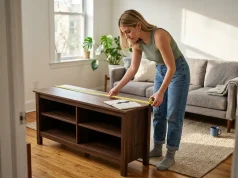
This is the measurement nobody takes before ordering. You measure the sofa’s closed width, confirm it fits the wall, order it, and discover the problem six weeks later when your sister visits and the bed can’t open past the coffee table. That’s when you learn the difference between “fits the room” and “works in the room.”
A click-clack mechanism fixes this. It converts by reclining backward, not by extending forward. Total depth when converted: 60 to 65 inches. No floor space required in front of the sofa. If your room is under 12 feet deep, click-clack is the correct choice — not pull-out.
For rooms under 100 square feet, a chair-bed folds from a single chair to a twin sleeping surface in the same footprint. It won’t seat three people, but it converts without touching anything else in the room.
Pro tip: Measure your room’s full depth before looking at any product listings. That one number — back wall to the nearest obstruction in front — eliminates most sofa bed options that would become furniture regret.
Sofa Mechanism Guide for Small Rooms
Pull-out works best for occasional guest use when the room is deep enough to open it fully. The mattress is always the weak point, not the mechanism. Foam density below 1.8 lbs per cubic foot flattens in 6 to 9 months under regular use. Look for pocket-spring construction or foam density listed in the specs — if the listing doesn’t mention either, the mattress is the cheapest part of the build.
Click-clack works for studios and rooms under 12 feet deep. One motion, no lifting. The COMAX Futon Sofa Bed 4-in-1 Convertible handles the click-clack conversion in a compact frame that fits small living room dimensions. Budget models are fine here because the mechanism itself is simple — there’s less hardware to break.
Loveseat sleeper format runs 47 to 68 inches wide when closed. In a 10-foot-wide living room, that’s the only convertible sofa format that leaves room for a coffee table alongside it. A standard sofa at 72 to 84 inches eats the entire focal wall.
If a full sofa bed isn’t feasible and you just need compact seating, the LINSY HOME 58″ Loveseat Sofa at 58 inches wide by 26.1 inches deep preserves more floor space than any standard sofa while seating two. It’s not a sleeper — it’s the right starting point when budget is the constraint and guest hosting isn’t the priority.
Renter Considerations for Convertible Seating
Convertible sofas are fully renter-safe — no wall modifications needed. But two problems come up that product listings don’t mention. First, casters on some click-clack models cause the sofa to slide backward every time someone sits down hard. Secure it with felt floor pads or buy a model with stationary legs. Second, thick rental carpets jam pull-out extension tracks. Test the mechanism on your actual floor before relying on it for guests.
Delivery is the other measurement people forget. Standard interior doorways are 32 inches wide. Any sofa over 78 inches needs to be angled through, which requires at least 8-foot ceiling clearance in the hallway. For more on fitting furniture into tight apartments, see our guide to small apartment living room layout.
Three Coffee Table Formats That Do Double Duty in Small Living Rooms
The coffee table is the most contested square footage in a small living room. It has to be close enough to reach, far enough away to walk past, and useful enough to justify the permanent floor space. Three formats genuinely work. Two of them fail when people skip the sizing math.
Lift-Top Coffee Tables as a Work Surface
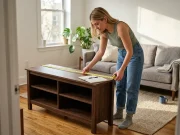
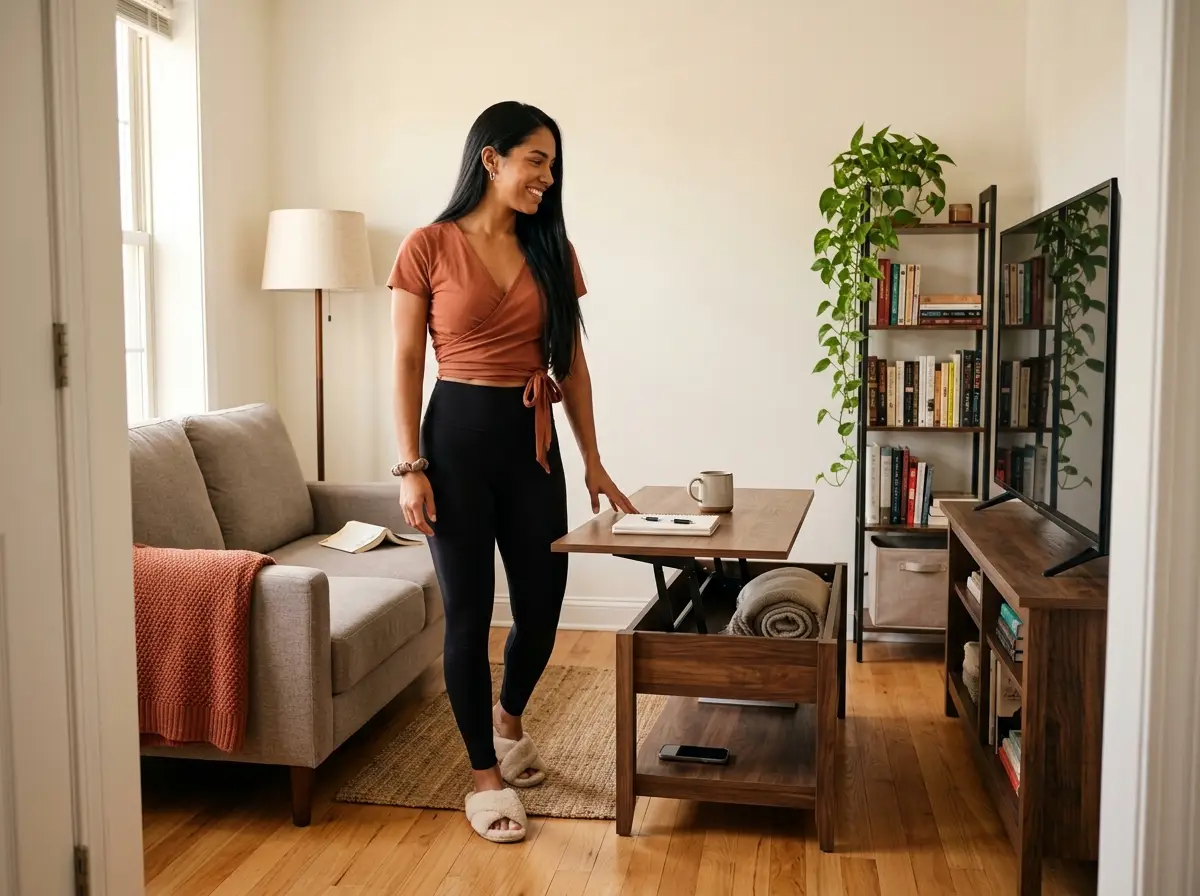
Budget lift-top coffee tables raise to 27 to 29 inches — the correct height for eating, laptop work, or anything that needs to be above sofa seat level. Before buying one, measure the distance between your sofa seat and the bottom of the lift-top frame at working height. Less than 3 inches of clearance means your knees hit the table frame every time you stand up.
Size the lift-top using the 2/3 rule: table length should be two-thirds your sofa length. A 72-inch sofa gets a 48-inch table. A 66-inch sofa gets a 44-inch table. Keep the sofa-to-table gap at 16 to 18 inches — closer and your knees hit the table constantly, farther and you have to lunge forward to set down a glass.
Here’s the failure mode product listings won’t tell you about: the gas piston that holds the lift-top weakens under body weight. Use it as a table — set things on it, eat at it, put your laptop on it. Don’t lean your forearms into it while typing for eight hours a day. Daily lean-weight use collapses cheap single-piston mechanisms within 12 months. You’ll know yours is failing when the top starts drifting downward on its own, like it’s tired of holding your coffee.

Nesting Tables When Floor Space Is the Real Constraint
Nesting tables solve a specific problem: you want a surface when you’re sitting on the sofa, but not a permanent obstacle in the walkway when you’re not. The smaller table slides under the larger one and disappears.
The detail most people miss: the two tables need at least 6 inches of height difference to nest properly. Most cheap nesting sets have only 2 to 3 inches of height gap — they don’t actually nest, they just sit next to each other at slightly different heights and take up the same floor space either way. The VASAGLE Round Nesting Coffee Tables have the height clearance for real nesting. Round tables also take less visual weight in small rooms — a rectangle has hard edges at every angle, while round reads lighter and leaves more walkable corners.
When both tables are deployed, check the 30-to-36-inch walkway clearance from the nearest seating edge to the wall. If deploying the second table kills your walkway, the tables stay nested and you need a different solution.
Pro tip: Use one nesting table as a permanent side table at the sofa end. Slide the second one out only when guests visit and you need a second surface for drinks. That way you get a coffee table and a side table from one purchase.
Using an Ottoman as a Coffee Table
An ottoman replaces a coffee table when you have kids who run into hard corners, pets who climb everything, or a sofa under 60 inches where a rectangular table would dominate the room visually.
The tray is not optional. A firm 16-by-20-inch tray (minimum) converts the fabric top into a stable surface. Without it, your drinks tip every time someone shifts their weight on the sofa. Every ottoman-as-coffee-table setup that looks good in magazine photos has a tray on it. The ones that skip the tray last about two dinner parties before someone regrets the choice.
Same 2/3 rule applies to ottoman sizing: ottoman length should be roughly two-thirds your sofa length. The sofa-to-ottoman gap stays at 16 to 18 inches.
The storage trade-off is real. Hinged-lid ottomans give you one deep cavity for blankets, pillows, or board games. But the tray has to come off every time you want to open it. If you’re reaching for stored items daily, the tray routine gets old fast. If you’re storing seasonal blankets you access once a month, it works perfectly.
Ottoman weight capacity matters more than people expect. Quality builds hold 250 to 300 lbs. Budget ottoman lids with single piano hinges fail when adults sit on them — and everyone will sit on it, because it’s in front of the sofa.
That’s what ottomans are for. Buy one with reinforced corner hardware or a weight capacity listed in the specs.
For broader storage options beyond the coffee table zone, see our roundup of small living room storage options.
Vertical Storage for the Living Room That Earns Its Square Footage
The average small living room has 8 to 10 feet of vertical space, but everyone plans furniture at the 3-foot level. A narrow bookshelf beside the TV or in the corner beside a door reclaims square footage that was just dead air. A TV stand with closed storage replaces the trip to the wall-mount installer — and the deposit conversation with your landlord.
Narrow Bookshelves in the Living Room Dead Zone
Every small living room has a dead zone: the 12-to-16-inch gap beside the TV stand, or the 12-to-18-inch gap beside a doorway. Too narrow for most furniture. Wide enough for a vertical bookshelf that gives you five shelves of usable surface where there was nothing.
The VASAGLE 5-Tier Narrow Bookshelf at 13.3 inches wide by 11.8 inches deep by 66.9 inches tall fits most of those dead zones. Five tiers holding books, baskets, plants, and small bins — that’s storage occupying about one square foot of floor space while capturing nearly five square feet of vertical surface. You’ll know the dead zone was the right call the first time you walk past and realize the bookshelf was always supposed to be there. That gap was waiting for something that fit.
Mix open and closed storage on the shelves: books and display items on the upper three tiers (visible, low-maintenance), fabric bins or baskets on the lower two tiers (hiding the functional stuff — blankets, charging cables, board game boxes). The lower shelves hold what you actually use. The upper shelves hold what you want people to see.
Any freestanding bookshelf taller than 48 inches needs anti-tip anchoring. For renters, furniture anchor straps that attach via adhesive strips to the wall and to the shelf’s top rear edge hold against tip-over force without drilling. No permanent holes, no deposit risk. This aligns with CPSC tip-over prevention guidelines — especially if children live in or visit the home.
For more ideas on using vertical surfaces across every room, see our guide to vertical storage approaches for apartments.
TV Stands with Storage Instead of Wall Mounting
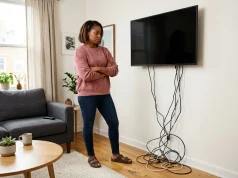
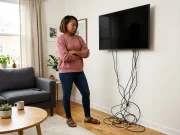
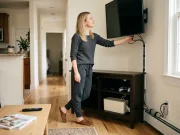
Wall mounting a TV requires locating studs (spaced 16 inches apart in standard construction), drilling into drywall, and securing hardware rated for 50 or more pounds. For renters, that means holes to patch on move-out and a conversation with the landlord that most people avoid entirely. The result: a 55-inch TV balanced on a dresser, or propped on a stack of textbooks from college. Neither is a long-term plan.
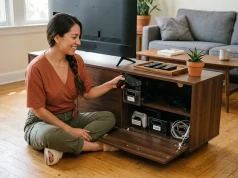
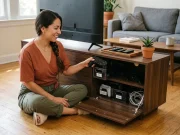
A TV stand with closed storage solves it without touching the wall. The Bestier 70 Inch LED TV Stand holds TVs up to 75 inches on top, with closed-door cabinets below for streaming boxes, game consoles, remotes, and cable clutter. Cable management openings route wires through the back of the stand so nothing hangs visible. That eliminates 90% of the reason people cite wall-mounting as their goal — the real problem was never height, it was hiding the mess behind the screen.
The measurement to check: your TV stand should be at least as wide as the TV, but not wider than about 60 inches in most small living rooms. Wider than that and it crowds the seating area.
How to Add a Dining Zone to a Living Room Without a Dedicated Table
Most small apartments have no dining room. The living room is the dining room, the home office, and sometimes the guest room. The answer is not squeezing in a dining table — it’s using a piece that works as a dining surface when needed and goes flat against the wall when you’re done eating.
Console Tables as the Living Room’s Hidden Multi-Tasker
A console table (typically 10 to 16 inches deep, 30 to 48 inches wide, 28 to 34 inches tall) can function as a desk at bar stool height, a dining surface for two, a display shelf, or a charging station. When placed 1 to 2 inches behind the sofa back, it fills the gap between the sofa and the wall that most people leave empty — typically 16 inches of floor doing nothing.
When placed against the wall instead, a 10-inch-deep console adds a usable surface with almost no room footprint. Pair it with two counter-height stools tucked under it and you have a dining station for two that requires 20 inches of floor depth total. A power strip attached to the back leg turns it into a charging station as well. Three functions, one piece, and zero visual weight in the room.
Drop-Leaf Tables That Collapse to a Console Footprint
The drop-leaf format uses hinged leaves that fold down to reduce the table to a narrow console depth (10 to 15 inches) against the wall. When you need to eat, raise one or both leaves.
The COMUHOME Extendable Drop Leaf Folding Table collapses to roughly 13 inches deep as a console, then expands to 60.2 by 31.5 inches for dining. It has a built-in storage drawer for menus, mail, or charging cables, and wheels so you can roll it away from the wall for dinner and back when you’re done. For renters: put furniture pads under the wheels to protect hardwood floors.
If you don’t need the drawer or wheels, the VASAGLE Drop Leaf Folding Dining Table handles the same basic drop-leaf function in a simpler and more affordable format. Same collapse-to-console footprint, fewer features, lower price.
Clearance required: 60 inches of clear space in front of a fully expanded drop-leaf table. Measure this before buying. A 60-inch table in a room with only 48 inches of clear space in front of the wall is a table you can never fully open — and a purchase you can’t undo once you’ve assembled it.
For how these pieces fit into a broader apartment setup, see our guide to multi-functional furniture choices across the apartment.
Why Multi-Functional Furniture Fails After Three Months
Multi-functional furniture promises one piece doing two jobs. The reality is that most pieces do two jobs tolerably for a few months and then revert to doing one job badly. This section covers why — and what to check before buying so you don’t end up there.
The Three Failure Modes (and When They Happen)
The gas piston. Lift-top tables use a gas piston to hold the raised position. In budget models, daily body-weight pressure — leaning on the table while typing, resting your forearms on it during a video call — degrades the piston in 8 to 14 months. The table stops holding position and slowly sinks.
You’ll start propping it with books. Then you’ll stop lifting it entirely and wonder why you didn’t just buy a regular table. Fix: use the lift-top as a table (setting items on it), not as a desk you lean your weight into. Good posture protects both your back and your piston.
The sofa mattress. Sofa bed foam below 1.8 lbs per cubic foot density flattens with repeated use. The spring mechanism works perfectly; the mattress turns into a firm board with a permanent dip where the sleeper lies. This happens at 6 to 9 months with budget models.
I’ve watched it happen three times in different apartments — the sofa looks fine, the mechanism is smooth, and the person sleeping on it wakes up stiff because the foam has lost its give entirely. Check the specs: “pocket spring” or “foam density 1.8+” in the listing before buying.
The ottoman hinge. Piano-hinge lids (one long hinge along the back edge) fail faster than bi-fold lids because all weight pivots from a single edge. Budget ottoman lids break when adults sit on them — and if your ottoman sits in front of the sofa, everyone who visits will sit on it. That’s a guarantee, not a risk. Buy one with reinforced corner hardware or a rated weight capacity of 250 lbs or higher.
The Three-Month Test for the Pieces You’re Considering
Before buying, ask one question: “What is the failure mode of this specific piece under my actual daily use — not the catalog use case?”
Lift-top + home office use: check for dual-piston mechanisms (single pistons weaken faster) and commit to using it as a table surface, not a desk you lean into. Sofa bed + weekly guest use: check mattress foam density or spring type — avoid pure memory foam, which feels great initially but sags after six months of regular weight. Storage ottoman + family room: buy linen or performance fabric with a removable washable cover, because a fabric ottoman without a removable cover absorbs spills permanently. Narrow bookshelf + heavy loads: check weight capacity per shelf — most engineered-wood shelves hold 25 to 30 lbs, and 10 average hardcover books weigh about 15 lbs.
What to Buy First in a Small Living Room
Priority order: (1) Get a right-sized sofa first — without conversion features, unless you’re certain you need them. (2) Add a coffee table format that matches your actual behavior: lift-top if you work from the sofa, ottoman if you have kids or pets, nesting tables if floor clearance is the binding constraint. (3) Vertical storage comes last, after you’ve lived in the space long enough to see where the dead zones actually are.
The worst buying pattern is ordering everything at once from a floor plan. Every small living room has a unique dead zone — the gap the floor plan doesn’t show, the corner that catches afternoon glare, the wall that’s 2 inches shorter than the listing said. The piece that fills it perfectly is discovered by living in the space for two weeks, not by guessing from measurements you took during a walkthrough.
Pro tip: Order your sofa first. Live with it for two weeks before buying a coffee table. That’s how you discover whether you need a lift-top (you work from the sofa), an ottoman (you put your feet up every evening), or nesting tables (the clearance is too tight for anything permanent).
For the next step after buying, see our guide to furniture arrangement sequence for a small living room.
Conclusion
Three things to take away from eight pieces of tested furniture:
- Measure the open state before buying. The open state of a convertible piece — not the closed state — determines whether it works in your room.
- Match the coffee table format to your actual sofa habits. Work from the sofa: lift-top. Kids or pets: ottoman. Tight clearance: nesting tables.
- Buy the sofa first, then wait two weeks. The dead zones reveal themselves once you’re living in the space. That’s when you’ll know which coffee table and storage pieces actually belong.
Three-Month Check: At three months, pull out the sofa bed and test the mattress firmness, check that the lift-top holds position under normal use, and sit on the ottoman lid to test the hinge. Anything showing wear at three months will fail completely by twelve.
Start with the sofa and a tape measure. Everything else follows from those two things.
Q1 What furniture works best for a multi-functional small living room?
Start with a compact sofa (58 to 72 inches wide), add a lift-top coffee table or storage ottoman for the coffee table zone, and a narrow bookshelf for vertical storage. These three pieces handle seating, work surface, and storage without competing for floor space.
Q2 Can a storage ottoman replace a coffee table in a small living room?
Yes, but only with a firm 16-by-20-inch tray on top. Without one, drinks tip on the fabric surface. A storage ottoman works better than a standard coffee table in homes with young children or pets, where soft edges matter more than a hard surface.
Q3 How much space does a sofa bed need to open fully?
A pull-out sofa bed needs roughly 125 to 130 inches (about 11 feet) of room depth from the back wall to the nearest obstruction. In rooms shorter than that, choose a click-clack mechanism instead — it reclines backward and needs no floor clearance in front.
Q4 What is the best lift-top coffee table for a small living room?
Look for dual gas pistons (not single), a locking raised position, and hidden storage below. Size it to two-thirds your sofa length — a 72-inch sofa gets a 48-inch table. Keep the sofa-to-table gap at 16 to 18 inches.
Q5 How do I make my living room work as both a living space and a guest room?
A click-clack sofa bed converts with one motion and needs no floor clearance to open. Pair it with a storage ottoman that hides guest bedding, and keep the coffee table easy to move — rolling or nesting format. The guest setup becomes a 90-second operation.