










In this article
You bought a shoe rack. For two weeks it looked great. Then the pile came back, this time next to the rack instead of on it. I’ve watched this happen in four different apartments, mine and friends’, and it’s almost never a discipline problem. It’s that the shoes in a small home don’t all belong in the same place, and most small-space shoe advice treats your entryway, closet, and bedroom as if they were one spot. This guide walks your whole home one location at a time, with the measurements that decide what actually fits, and it builds on the whole-home shoe organization system we use across the site.
Quick Answer
Small-space shoe storage works when you assign each pair to a location, then match that location to a measurement:
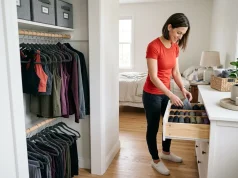
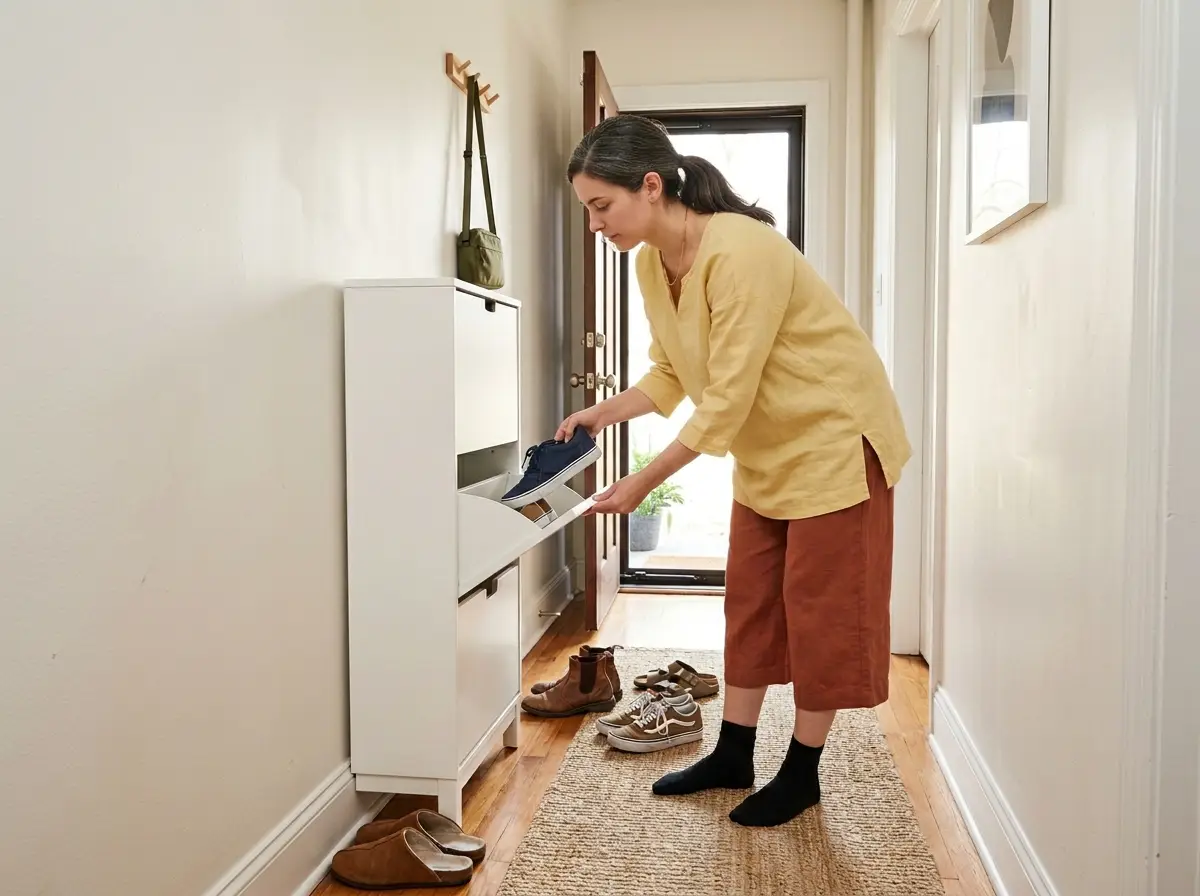
- Daily wears: a slim 9–12″ flip-drawer cabinet at your drop point
- Closet shoes: two tension rods or a narrow 11.5″ tower
- Closet door: an over-the-door organizer (wide pockets for sneakers)
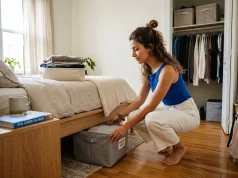
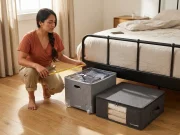
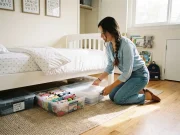
- Seasonal pairs: a 4.5″-tall flat bin under the bed
- Tall boots: a hanging boot file or under-bed boot slots
- Always measure first: keep a 36″ walkway and check bed clearance
Why Your Shoe System Keeps Reverting

Here’s the part nobody selling you a rack wants to admit: the rack was never the problem. You can buy the best-reviewed organizer on the page and still end up with a pile by Friday, because a shoe system fails for structural reasons, not because you lack willpower. Once you can name the three things that actually break these systems, you stop buying the wrong fix.
There are exactly three of them. Wrong placement, wrong capacity, and wrong storage type for the way your household actually behaves. Get any one of them wrong and the pile comes back, no matter how nice the rack looked in the listing.
The Drop-Point Problem — Your Storage Is in the Wrong Location
Your drop point is wherever your shoes land the second you walk in the door. Not where you wish they’d land. The actual spot, three feet inside the door, where your body stops and your shoes come off. That is the only place daily-wear storage works, and it’s the spot people almost always skip when they place a rack.
I once helped a friend who’d spent good money on a five-tier rack and tucked it into a little alcove about eight feet down the hall, because that’s where it “looked right.” The shoes never made it there. Every single day they came off at the door and stayed at the door, and within two weeks the alcove rack held three pairs while the floor by the entrance held nine. We moved the rack to the wall right beside the door and the floor pile disappeared in a day. Same rack. Different three feet.
So before anything else, watch where the shoes actually pile up for a few days. That spot, the one you find a little embarrassing, is where the storage goes. If your apartment has no real entryway at all, a low boot tray sitting directly on the mat counts as a perfectly valid drop point.
Don’t guess your drop point — find it. For three days, leave your shoes wherever they naturally land and notice the spot. Measure from the door to that spot. If it’s more than about four feet to your current rack, the rack is the reason the pile keeps regrowing, not your habits.
The Capacity Mismatch — Count Before You Buy
The second failure is pure math. A rack holds eight pairs. Two adults in the home wear twelve pairs each in regular rotation. That’s twenty-four pairs competing for eight slots, and no amount of tidying fixes a number that doesn’t add up. People read the overflow as a personal failing when it’s really a spreadsheet problem.
The fix is to count before you buy, and to count the right thing. Active rotation is not every shoe you own. It’s the pairs you’ve actually worn in the last thirty days. Walk the home, gather those pairs per person, and add them up. The number tends to surprise people, usually on the high side, and it’s the single figure that tells you what capacity you need.
There’s a simple formula worth writing down: active pairs per person, times the number of people, equals your minimum daily-storage capacity. Everything above that line has to live somewhere else, which is exactly what the next section is about. This is the same counting step the frequency-based zoning approach leans on, and it’s worth doing on paper before you open a single product page.
Open vs. Closed Storage — Why Household Behavior Matters
The third failure is the one almost no one warns you about. Open racks demand that every person in the home returns every pair to a specific slot, every time. Closed cabinets don’t. You open a drawer, the shoes go in, the door hides whatever mess happened inside. And in a real household, that difference decides whether the system survives.
I used to recommend open racks to basically everyone, because they’re cheaper and you can see what you’ve got. After watching them fail in homes with kids and in homes where one partner just won’t play along, I changed my mind. An open rack in those homes looks chaotic within days, the chaos reads as “this isn’t working,” and people abandon it. A closed flip-drawer cabinet absorbs the imperfect placement and still looks calm on a bad week.
According to the National Association of Productivity and Organizing Professionals, the systems that last are the ones built around how people already behave, not the ones that require everyone to suddenly become tidier. So match the storage type to your actual household. Live alone and keep things in order? Open is fine, and cheaper. Share the space with anyone less fastidious than you? Buy the door.
The Location-Assignment Framework — Which Shoes Go Where
Shoes spread across every room of a small home for one reason: there’s no rule for where each pair lives. You don’t have a shoe problem so much as an address problem. Give every pair an address before you buy any storage, and the products almost pick themselves.
The framework is three zones, sorted by how often you actually wear something. This is the piece the listicles skip entirely. They’ll show you fifteen products for “the bedroom” and fifteen more for “the entryway” without ever telling you which shoes belong in which room. Assign first. Shop second.
Zone 1 — Daily Wears at the Drop Point
Zone 1 is one to two pairs per person, full stop. The shoes you’re wearing this week and nothing else. This zone lives at the drop point, in a boot tray, a small mat, or the bottom flip drawer of an entryway cabinet, and its whole job is to make putting today’s shoes away effortless.
The rule that keeps it honest: if more than two pairs per person are piling up here, Zone 1 has been violated and a pair needs to move back to the closet. That’s it. When the entryway creeps up to six pairs, you don’t need a bigger entryway — you need to evict four pairs to Zone 2.
Zone 2 — Regular Rotation in the Closet
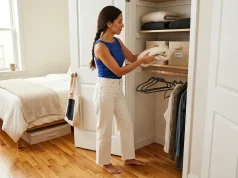
Zone 2 is the closet, and it holds the six to twelve pairs per person you’ve worn in the last month. This is where tension rods, over-the-door organizers, and narrow towers earn their keep. The closet is also the zone that physically moves twice a year, because what counts as “regular rotation” in July is not what counts in January.
In my experience this is the zone people undersize, because they’re thinking about the entryway and forgetting that most of their shoes aren’t daily wears at all. Give the closet the bulk of your real storage budget. It’s doing the heavy lifting.
Zone 3 — Seasonal and Archive Storage
Zone 3 is for the pairs you wear fewer than a handful of times a year: snow boots in summer, strappy sandals in winter, the formal shoes that come out twice. Under-bed bins, sealed bags, and labeled top-shelf boxes are home here. You touch this zone in October and again in April, and otherwise you forget it exists.
Watch for what the organizing community calls clear box creep — when shoes that should be in active rotation drift down into the under-bed seasonal zone, the bottom layer becomes permanently buried and you stop using half of what you own. If you’ve worn something recently and it’s in Zone 3, it’s in the wrong zone. The whole thing only works if the zones stay separated. The pair-count framework that makes zone assignment work is the backbone here, and it’s worth reading alongside this.
Entryway Shoe Storage for Small Spaces
The entryway is Zone 1 territory, and it’s where the dimensional reality bites hardest. Most small apartment entryways give you somewhere between twelve and twenty-four square feet of floor, and most shoe furniture is sized for a suburban foyer, not a hallway. Buy for the foyer and you end up with a beautiful bench that turns your hall into a squeeze.
Measuring Before You Buy — The 36-Inch Clearance Rule
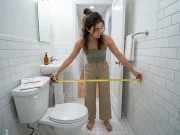
The number that governs everything here is thirty-six inches. That’s the walkway you need to keep clear for comfortable passage, and it’s also the figure most people forget until the new cabinet is already blocking the hall. Measure your hallway width, subtract thirty-six, and whatever’s left is the maximum depth you can give to any entryway storage.
So a forty-eight-inch hallway supports a cabinet about twelve inches deep, and not an inch more. A sixty-inch hallway can take an eighteen-inch bench. A hall under forty-two inches wide has no room for anything that sits on the floor — your only moves there are an over-the-door organizer or a very slim cabinet. These aren’t my numbers, by the way; they line up with standard shoe storage dimensions used across the furniture industry.
Write your three numbers down before you shop: hallway width, the depth you have to spend, and the number of daily pairs from your Zone 1 count. Those three numbers rule out about half of what’s for sale, which is the point.
Slim Cabinets, Benches, and Over-the-Door Organizers — Matching Product to Hallway Width
Three product types serve three different hallway widths, and the trick is matching the product to your measurement instead of to the photo. For most narrow halls, a slim flip-drawer cabinet is the answer, because it preserves the walkway and closes completely so the shoe pile goes invisible.

If your hallway is wide enough to spare the depth, a bench buys you a place to sit while you deal with laces, plus storage underneath. The threshold is real, though: a bench needs about fourteen inches of depth to be comfortable to sit on, and that depth only works in halls around fifty-four inches and wider.
The third option costs nothing in floor space at all, because it hangs on the door. An over-the-door organizer hooks over the top of the door and damages nothing, which makes it the universal fallback when the floor is simply spoken for. The SimpleHouseware Over-the-Door Shoe Organizer (64″H × 19″W) holds flats, sandals, and low sneakers in its pockets and lifts off in seconds when you move. The catch is pocket size: standard pockets run five to six inches, so chunky sneakers and any boot won’t fit there. If you want the full breakdown of which racks suit which hallway, we ranked them in apartment shoe racks ranked by clearance depth, and the bench math gets its own treatment in shoe storage bench options that fit narrow hallways.
When You Have No Entryway — Apartment Doorway Solutions
Plenty of apartments open straight into the living room with no hall, no closet, no logical place for shoes at all. You’re not stuck. You’re just working with eighteen inches of wall instead of a foyer.
Put a low boot tray on the floor right where the door swings, add a two-hook adhesive strip on the wall beside it for bags, and if even the tray feels like too much floor, move the whole operation to the door itself with an over-the-door organizer. The drop point still rules here. Whatever you set up has to sit exactly where your shoes already land, or you’re back to the pile.
Closet Shoe Storage Without Wasting Floor Space
The closet floor is the default place people dump shoes, and it’s one of the worst options going. Shoes on the floor crowd the one usable surface, bury the back pairs where you forget they exist, and waste the sixty-odd inches of vertical space above them. The shoes you stop seeing are the shoes you stop wearing. Here’s how to move them up and off the floor.
The Tension Rod Method — A Renter-Safe Extra Shelf Without Drilling
Before you spend anything, look at what two tension rods can do. Set a pair of spring-loaded rods across the closet at the same height, with the front rod about half an inch lower than the back one, and you’ve made a shoe shelf out of thin air. Shoes rest toes-down between the rods, heels caught on the back rod, the slight tilt keeping them from sliding off. It works in any closet twenty-four inches or wider, holds no tools, leaves no holes, and costs about what a coffee does.
The honest limit: this holds flats, heels, loafers, and low-profile sneakers, but anything with a sole thicker than about an inch and a half rocks off the rods. So it’s a Zone 2 solution for your slimmer shoes, not a catch-all. For the chunky stuff, keep reading.
Buy tension rods rated a few inches longer than your closet is wide, then compress them to fit. A rod set near the bottom of its range grips the side walls far harder than one stretched near the top of its range — and the under-stretched ones are the ones that let go at 2 a.m. and dump your shoes.
Over-the-Door Organizers for Closet Doors
The inside of the closet door is free real estate most people ignore. A hanging organizer over it turns a flat surface into pockets, and the only decision that matters is pocket width. Standard five-to-six-inch pockets hold flats and sandals beautifully and choke on anything bigger.
If your collection leans toward sneakers, the standard pockets fail you. The MISSLO 10-Tier Wide Pocket Over-the-Door Organizer (30 pairs) uses pockets over nine inches wide that actually swallow a running shoe, which the narrow ones can’t. It hangs lower and bulkier than a flat organizer, so check that the door still swings fully open against the adjacent wall before you commit — you need about two inches of clearance from the door edge. If you want to go deeper on door types and weight limits, we cover choosing the right OTD organizer for your door type in its own guide.
Vertical Towers and Narrow Racks for Closet Corners
When the floor has a corner to spare, a narrow vertical tower puts that dead corner to work. The LANTEFUL 10-Tier Narrow Shoe Rack (11.5″D × 11.5″W × 66.9″H) tucks into a closet corner or behind the door without overlapping your hanging clothes, and ten tiers gives you everything from sneakers to heels in a footprint barely wider than a shoebox. It won’t help in a closet with under about fifteen inches of free floor width, though — there’s simply nowhere to stand it.
Every method in this section is renter-safe by design: no drilling, no brackets, nothing that costs you a deposit. If you want to extend that no-damage approach to the rest of the closet, the full no-drill closet toolkit for renters picks up where the shoes leave off.
Bedroom and Under-Bed Shoe Storage
The bedroom is where Zone 2 overflow and Zone 3 seasonal storage live, and the space under the bed is one of the most valuable storage zones in a small home. It’s also one of the most misunderstood. People buy the wrong bin constantly, and it’s almost always because they bought before they measured.
Measuring Your Bed Clearance Before Buying
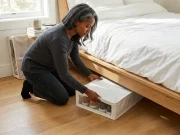
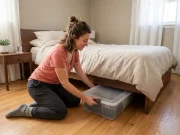
Step one, before you look at a single container: measure from the floor to the bottom of the bed frame or platform. This one number decides everything, and it varies wildly. Platform beds typically give you four to seven inches. Standard metal frames give you seven to thirteen. Most people skip this step, buy a bin sized for a generous metal frame, and then return it when it won’t slide under their platform bed.
I learned this one the embarrassing way. I used to buy the tallest under-bed bin on the page, figuring more height meant more shoes per bin. Then I moved to a low platform bed and not a single one fit — I had a stack of perfectly good bins and nowhere to put them. Now I measure the clearance first and buy the flattest bin that still holds what I need.
Under-Bed Containers That Fit Platform Beds vs. Metal Frames
For a low platform bed, height is everything, and most bins lose at exactly the point you need them. A flat bin slides into that dead zone where nothing else fits. The storageLAB Under Bed Storage Container with Lid (33″L × 17″W × 4.5″H) clears platform beds with as little as five inches under the frame, which is the height where most bins simply stop fitting. Because it’s only four and a half inches tall, it holds shoes lying flat in a single layer, so treat it as a one-deep tray rather than a deep bin.
A metal frame gives you more room to work with, and you can spend it on capacity. The Woffit Under Bed Shoe Organizer (43″L × 14″W × 5.5″H) holds sixteen pairs plus four dedicated boot slots, which the flatter storageLAB has none of. It needs five and a half inches of clearance, so it’s out for the lowest platform beds — measure first or you’ll be repacking it into something shorter. And if clearance runs over seven inches, honestly, almost any standard under-bed bin will work, so buy on capacity and price.
If clearance comes in under four inches, there’s no workable under-bed shoe solution at all, and you should move those pairs to a corner tower instead. The full bed-by-bed breakdown lives in our guide to under-bed shoe storage by bed type and clearance, with more sizing help in under-bed storage for small bedrooms.
Seasonal Shoe Rotation and Humidity Control
Zone 3 runs on a calendar. In October, summer sandals go under the bed and the boots come out. In April, you reverse it. Two swaps a year, fifteen minutes each, and your daily zones never clog with shoes that are out of season.
The detail people learn the hard way is humidity. Under-bed space against an exterior wall, or a closet that shares a wall with the bathroom, runs damp, and leather stored damp for a season cracks or grows a film on the soles. I lost a pair of good leather boots this exact way, stored in a fabric bag against a cold outer wall over one winter, and pulled them out in spring with a haze across the leather that never fully buffed out.
For leather you’re storing through a season, use a sealed plastic bin, not a fabric bag, and toss in a couple of silica gel packets — the ones that come in shoeboxes and supplement bottles. Fabric breathes, which sounds good until the wall behind it is cold and damp. Sealed plastic plus a desiccant keeps the leather dry between rotations.
Boot Storage in Small Spaces — Why Everything Else Fails
Boots are the reason most people give up on shoe storage entirely. They try rack after rack, nothing works, and they conclude they’re just bad at this. They’re not. The product was built for shoes that aren’t boots, and the numbers were never going to work.
Why Standard Shoe Racks Always Fail for Boots
Here’s the math that explains years of frustration. A standard shoe rack tier is about five and a half inches tall. Knee-high boots need sixteen to eighteen inches of vertical clearance to stand up. Ankle boots need ten to twelve. Booties want six to eight. Only the flattest booties fit a standard tier, which means a normal rack holds essentially zero of your real boots.
This isn’t a storage philosophy you can fix with more discipline. It’s a dimensional mismatch, and buying yet another five-and-a-half-inch rack changes nothing. Once you see the gap between five and a half inches and eighteen, you stop blaming yourself and start looking for the right category of product.
You probably already have a boot graveyard somewhere: the closet floor corner where tall boots fall on their sides, collapse, get crushed under other shoes, and never get worn because reaching them means excavating. That graveyard is the single most common boot failure, and it’s completely preventable.
Boot Storage Solutions That Respect the Clearance Math
The fix is to give boots a category of their own instead of forcing them onto a shoe rack. For knee-high boots, a hanging boot file over the closet rod uses the forty-plus inches of vertical space from rod to floor, no drilling required, and keeps the shafts upright. The Woffit under-bed organizer’s four boot slots handle seasonal knee-highs lying flat, which is the better move when the boots are off-season anyway.
For ankle boots, any closet shelf with a foot of clearance does the job, or the top tier of a narrow tower if the spacing allows. Booties are the easy case — they fit a standard six-tier rack like any other shoe. Match the boot height to the clearance, and suddenly the storage that felt impossible becomes obvious.
Preventing Boot Collapse During Off-Season Storage
Most boot damage doesn’t happen while you’re wearing them. It happens in storage, when a tall shaft folds over on itself and sits creased for six months. On leather, that crease is permanent — once the fibers fold and set, they don’t recover. The shape has to be supported before you put the boots away, not after you find them flattened.
The free version works as well as anything you can buy: cut a pool noodle into shaft-length pieces and slide one into each boot. That’s it, and it costs a dollar. If you’d rather have the purpose-built version, Boot Shapers / Boot Tube Inserts (15–17″ tall) hold the shaft straight without the foam gradually sagging over time. Neither one shrinks the storage footprint at all — they only stop the crease, which is the part that actually ruins the boots. For the full seasonal calendar, our seasonal boot and sandal rotation schedule lays out when to swap what.
Measure the tallest boot you own from heel to the top of the shaft before you buy any boot storage. That single number tells you whether a hanging file, an under-bed slot, or a dedicated shelf will actually clear — and it’s the measurement everyone skips right up until the boots fold over again.
How to Build Your Small Space Shoe System in One Afternoon
You now have the failure modes, the three zones, and the products that fit each location. Putting it together takes one afternoon, and the most important rule is that you don’t buy anything until you’ve done two things first: counted, and measured. Skip those, and you’ll be returning half of what you order.
Step 1 — Count Your Shoes and Assign Zones Before Buying Anything
Give this thirty minutes and zero dollars. Gather every pair, then sort by how often you actually wear it: Zone 1 for this week’s daily pairs, Zone 2 for the last month’s rotation, Zone 3 for the seasonal and rarely-worn. Write down the active-rotation count per person, multiply by the number of people, and you’ve got the minimum capacity your closet zone needs.
If that number lands above twenty pairs per person, Zone 3 isn’t optional — it’s load-bearing infrastructure, and skipping it guarantees the overflow you’re trying to escape. Assign every pair an address before you shop. The shopping gets easy once the addresses exist.
Step 2 — Measure First, Buy Second
Ten minutes with a tape measure rules out half of what’s for sale. Three measurements do the heavy lifting: hallway width (which sets your entryway depth), closet floor width plus door swing clearance, and bed-frame clearance. Write all three on your phone before you open a single product page.
And measure twice, because the one you eyeball is the one that arrives too tall for the bed or too deep for the hall. This is the step that separates the people whose systems hold from the people with a closet full of returns.
The Three-Month Shoe System Check
Set a reminder for ninety days out, because that’s when a shoe system either holds or quietly fails. When the reminder hits, look at where shoes have started piling up. That spot is your diagnosis, not a sign you failed.
A pile back at the entryway usually means Zone 1 capacity was too small for your real daily wears. A jammed closet usually means pairs that should have moved to Zone 3 at the October rotation never did. Fix the structure, adjust the zone, and the pile resolves. This is the same maintenance logic behind a closet system that still holds in three months, and it’s worth pairing with a solid entryway shoe organization framework so the drop point stays handled.
Conclusion
Shoe systems in small homes fail for structural reasons, not character flaws. Wrong placement, wrong capacity, wrong storage type for your household — name which one is breaking yours and you’ll stop buying the wrong fix. That reframe alone solves more shoe piles than any product.
The three-zone framework is what makes the whole home work together instead of fighting over the entryway: daily wears at the drop point, regular rotation in the closet, seasonal pairs under the bed. And boots get their own rules, because a five-and-a-half-inch tier and a knee-high boot were never going to coexist — that’s a measurement problem, not a motivation problem.
In ninety days, look at wherever shoes have collected and treat that spot as information about which zone or placement slipped, then adjust the structure rather than scolding the habit. Start tonight with the one number that drives everything: count the pairs each person actually wears in a week. That single figure tells you exactly what to buy before you look at a single listing.
Frequently Asked Questions
01What is the best shoe storage for a small apartment?
The best setup splits shoes across three zones: a slim flip-drawer cabinet at the entryway for daily pairs, tension rods or a narrow tower in the closet, and a flat under-bed bin for seasonal shoes. No single product wins — matching each pair to a location does.
02How do you store shoes in a small space without a closet?
Use the door and the floor by the entrance. An over-the-door organizer holds daily pairs with zero wall damage, and a low boot tray at your drop point catches what you wear most. Under-bed bins absorb the rest.
03How can I store a lot of shoes in a small closet?
Go vertical. Two tension rods add a shoe shelf for almost nothing, an over-the-door organizer claims the door, and a narrow 11.5-inch tower fills a corner. Together they triple a closet’s floor-only capacity without drilling.
04What can I use instead of a shoe rack?
Two tension rods set half an inch apart make a renter-safe shelf for flats and low shoes. An old bookcase with 12-inch shelves works just as well, and an over-the-door organizer needs no floor at all.
05How do you store shoes in a small bedroom?
Measure your bed clearance first. Platform beds take a 4.5-inch flat bin; metal frames fit a taller 5.5-inch organizer with boot slots. A narrow corner tower handles overflow when clearance runs under four inches.