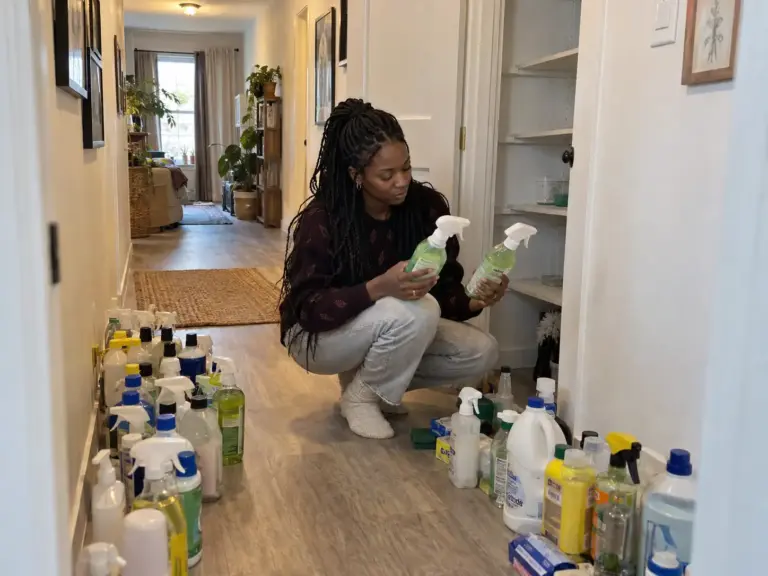

Pull everything out from under the kitchen sink, off the laundry shelf and out of the bathroom cabinet, and the count lands at several times what you would have guessed. Almost none of it is a different job. It is the same job in another scent, another room’s set, a bottle bought for a problem that never came back.
A cleaning supply checklist for home goes wrong for that reason: the length of the list is the problem, not the items on it. This one stops at four bottles, puts a number beside every tool, and covers what to skip, what the kit costs to keep and the shelf it settles on, which leads straight into organizing cleaning supplies with or without a closet.
Quick Answer
Four bottles, a dozen cloths and a handful of tools cover a home.
- One all-purpose spray, one glass cleaner, one toilet bowl cleaner per bathroom, and dish soap
- Baking soda and white vinegar as pantry staples, never mixed with bleach
- 12 microfiber cloths in two colors and a small pack of sponges
- One mop and bucket, one broom and dustpan, a toilet brush, a scrub brush, rubber gloves and trash bags
- The vacuum you have
- Anything else waits until a room proves it needs it
A Cleaning Supply Checklist for Home Should Start by Cutting the List
Why a long list becomes a cabinet of half-used bottles
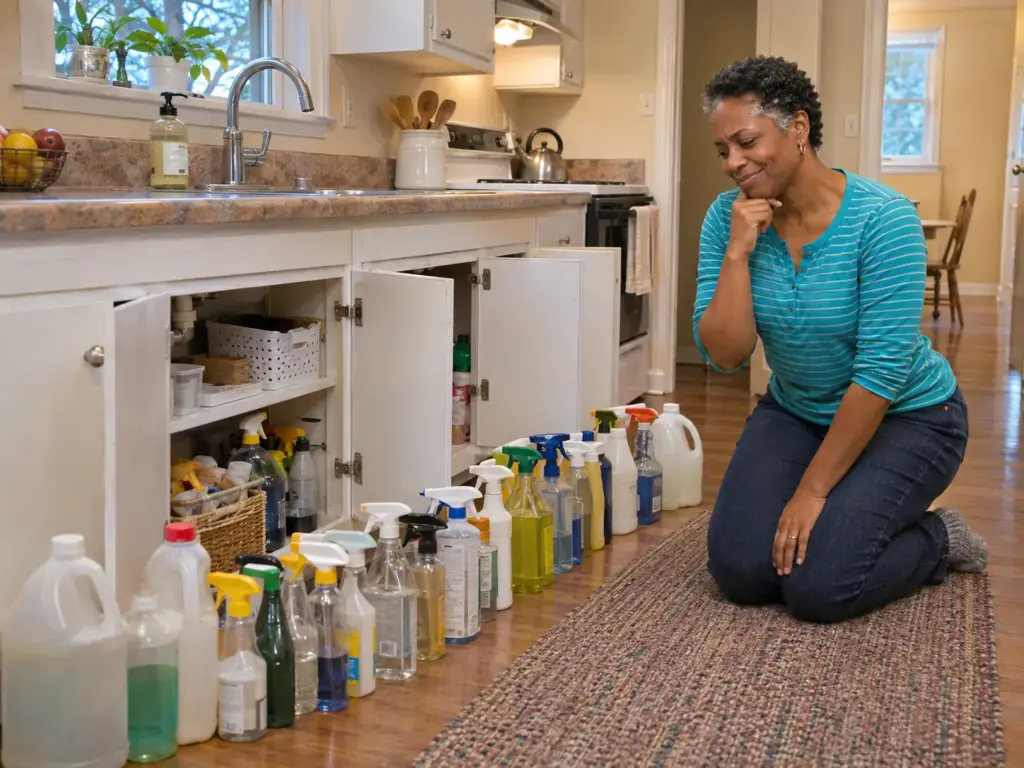
You are in the aisle with a checklist of two dozen lines in one hand and a basket in the other, and at home a cabinet already holds a bottle nobody can identify. The two facts are connected.
A long list gets bought as a long list, and a bottle only gets used up if its job comes back every week, which most of the lines on a thirty-item cleaning supplies checklist do not. A first count of the stock in one apartment that expected a dozen products and reached 38 is not unusual. Finishing what is already in the cabinet takes years, so the old bottles are the reason a new, tidy kit never fits when it arrives.
The duplicate sets that buy the same bottle three times
The mechanism is simple. A kitchen set, a bathroom set and a floor set each arrive with their own all-purpose cleaner, so one job gets bought three times in three scents, and the second bottle of any job has no fixed spot. It goes wherever there is room, and that is how a cabinet fills.
Stocking like a store, three of everything for a shop that does not exist, is the habit underneath. The rule that interrupts it is short enough to remember: do not pre-buy. A product earns a place when a job turns up that the current bottles cannot do, and the organization ideas that stop the rebuying attack the same failure from the storage side.
Count what you own before you add one item
Pull every bottle out, group them by job, and find the ones that do the same one. Two all-purpose sprays are one job. A bathroom spray, a kitchen spray and a stainless steel spray are one job in three costumes.
The step-by-step purge belongs to the purge-and-count method organizers use for cleaning supplies, so this page stays on the list. The measure of success is plain: every bottle in the final kit has one job and one spot, and nothing comes home just in case.
Four Bottles Do the Work of a Whole Cleaning Aisle
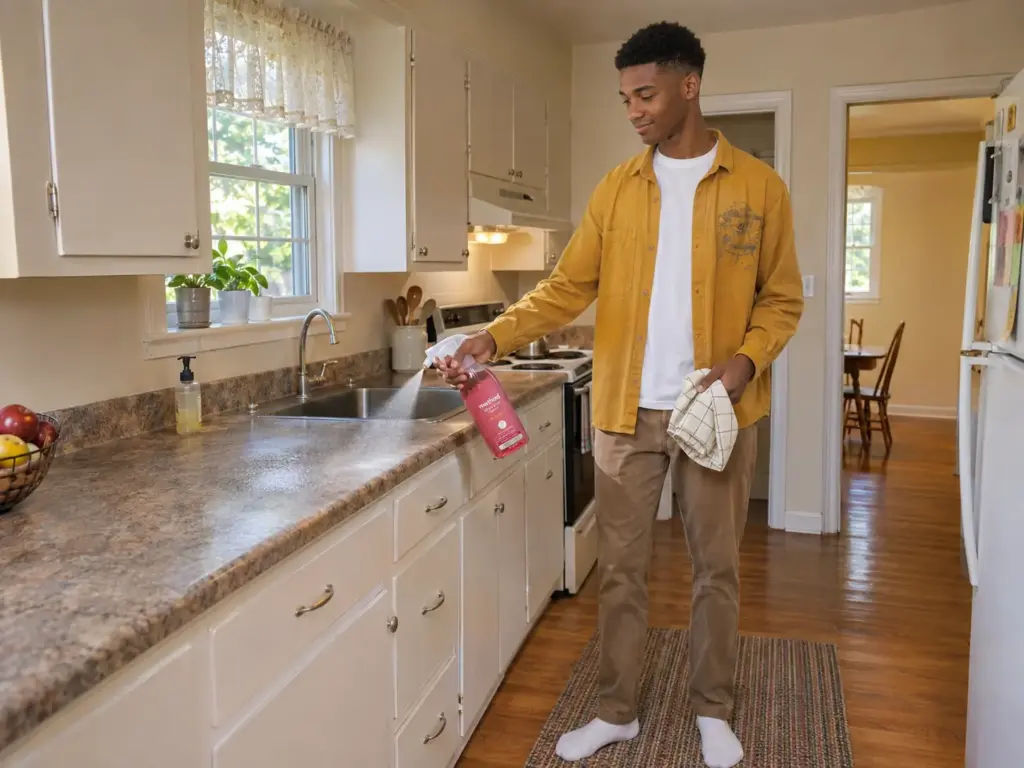
Stand in the cleaning aisle with a bottle for the kitchen, one for the bathroom, one for stainless steel and one for the mirror in the cart, and most of them are the same chemistry under a different cap. House cleaning supplies come down to four jobs: an all-purpose spray, a glass cleaner, a toilet bowl cleaner and dish soap. Two of them do most of the work, the all-purpose and the glass cleaner. The toilet gel comes third because nothing else clings to a bowl, and dish soap handles grease and, heavily diluted, a floor wash.
One all-purpose spray does counters, tile, sealed wood and glass
Method All-Purpose Cleaner in pink grapefruit, 28 fl oz is the multi-surface cleaner that covers four surfaces: kitchen counters, bathroom tile, sealed wood and glass. It stands about 9.5 inches tall and 3.3 inches wide, so it slides into nearly any cabinet, and its 200-plus sprays last roughly four to six months of a weekly clean in one home. It is also among the cheapest per ounce of the common brands, so a premium fragrance-free bottle is not a starter-kit purchase. The scent splits households, and on glass it can leave streaks, which is a good argument for the second bottle below. The budget version is a DIY cleaner of vinegar, water and a few drops of dish soap in a reused spray bottle: it handles counters, and it carries no certified label.
One glass cleaner is the one DIY swap not worth making
Vinegar and water is the usual answer for glass, and on a plain bathroom mirror it works. Then the exceptions show up: low-emissivity and tinted windows, and anything near natural stone, are where an acid mix is better kept off. For those, Windex Original, 23 oz dries streak-free, and glass is the one item in the kit worth buying instead of mixing. The trigger can drip or leak on some bottles, so spray it once into the sink before it goes under the cabinet.
Write the bottle’s job on the cap with masking tape, not the brand. When a second bottle comes home with the same job on its tape, one of the two is a duplicate before it ever reaches the shelf.
One toilet bowl cleaner per bathroom
Clorox Clinging Bleach Gel in Ocean Mist comes as a two-pack of 24 fl oz bottles, the right size for a two-bath home: one bottle lives in each bathroom and never travels. The gel clings under the rim and lifts the ring without scrubbing. It is also the harshest thing in the kit. The label warns of eye and skin irritation, and it needs 5 minutes of contact to disinfect, so use a timer and skip the guess. A store-brand clinging gel does the same job for less; keep the 5-minute wait either way.
Dish soap, baking soda and vinegar, and what never shares a bottle with bleach
Dish soap, baking soda and white vinegar are pantry staples, so none of them needs a link. One vinegar bottle and one box of baking soda last a year or more. The hard line is chemical: bleach mixed with an acid (vinegar, lemon juice, many descalers) rapidly produces chlorine gas, and what happens when bleach meets an acid is spelled out by a university biosafety office. That makes the one-bottle-with-everything idea the hazardous one.
A refillable spray bottle holds vinegar and water, or the all-purpose cleaner, and never a bleach mix. The minimalist version (vinegar, water, a few drops of dish soap) is a real kit, but it cannot cling to a bowl, disinfect or clear a tinted window, and those gaps are why there are four jobs and not one.
The Tools and How Many of Each
Open the drawer of rags, smell the mop head, count the sponges in their different stages of decay, and the question is how many of anything is enough. The answer carries a number on every line.
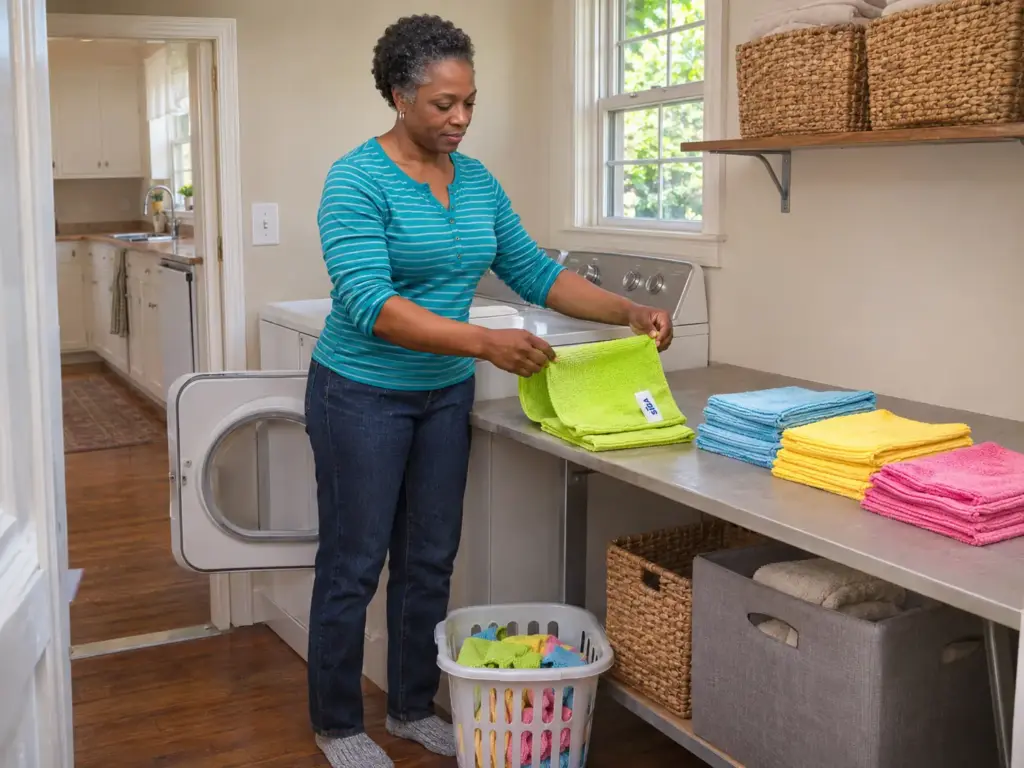
A dozen microfiber cloths in two colors
A professional cleaning crew runs a whole home on about 10 cloths per visit, according to Reno Custom Cleaning: 3 to 4 for the bathroom, 2 to 3 for the kitchen, 1 for dusting, and a spare for each extra bathroom. A home starter kit runs 10 to 14, and StyleBloom’s microfiber care guide splits it into 4 general cloths, 2 flat-weave cloths for glass, 2 for the kitchen, 2 for the bathroom and 1 or 2 plush ones for dusting.
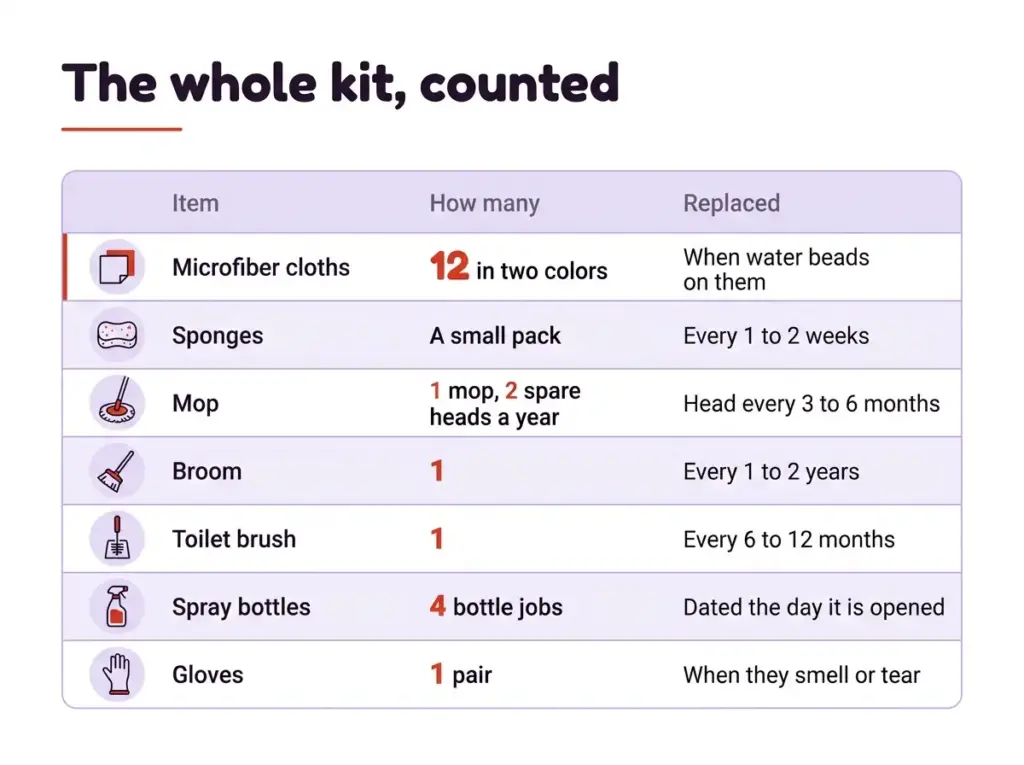
MR.SIGA’s 12-pack of microfiber cloths is exactly that dozen. The cloths measure 12.6 x 12.6 inches, are 85% polyester and 15% nylon, and come in colors that keep kitchen and bathroom apart. Twelve cloths and one weekly wash is a single load. Twelve is the number for a two-bath home; a one-bath apartment gets by on ten, and each bathroom past two adds a spare. The cloths are thin, so they suit wiping and glass better than scrubbing, and a thicker plush cloth is the upgrade for dusting. A bigger pack of thinner cloths is a fine budget-friendly move for dusting and nothing else.
Give the bathroom one color and the rest of the home the others, so cross-contamination between rooms never starts. A cloth in the bathroom color that has touched a toilet stays in that room for life, even once it is too worn for wiping. A rule that blunt survives a rushed Saturday, and a rule about which cloth is clean enough does not.
Sponges, brushes and gloves in small packs
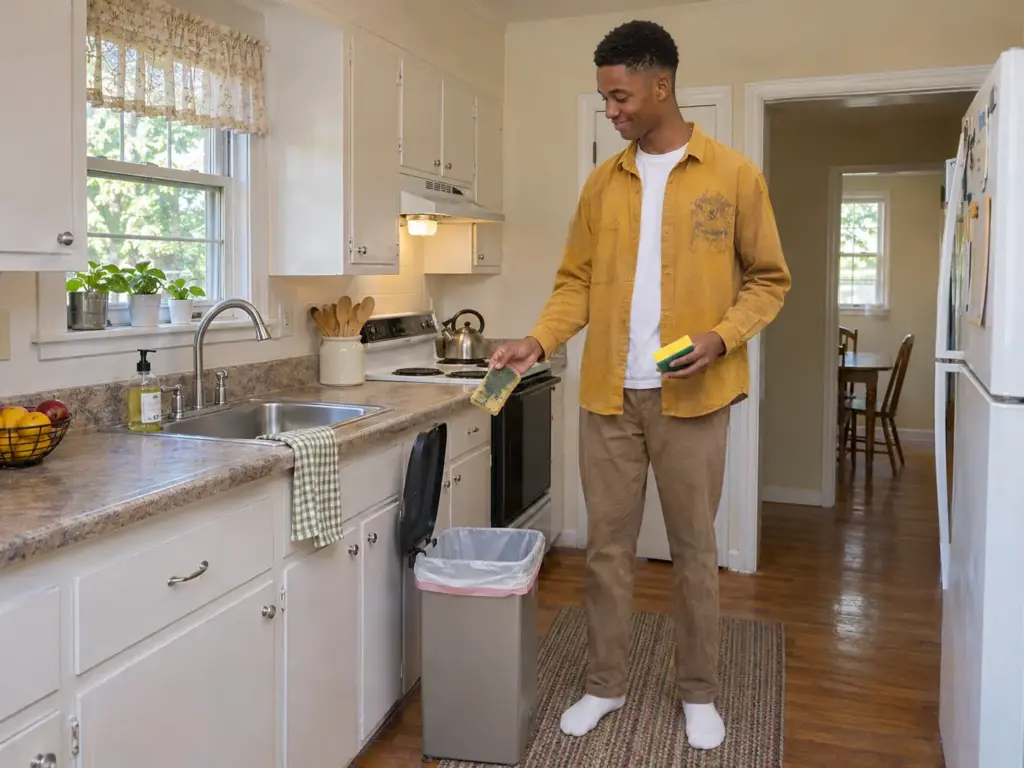
Buy sponges in a small pack, because you replace sponges every one to two weeks in a kitchen (the clock is laid out in the section on keeping costs). Scouring pads follow the same small-pack rule. A scrub brush, a toilet brush and a grout brush are one of each. One pair of rubber gloves is enough unless the bathroom and the kitchen are cleaned by different people, and then it is two pairs in different colors, for the same reason as the cloths.
One mop and bucket, one broom, the vacuum you already own
One mop is the whole floor tool. The O-Cedar EasyWring spin mop and bucket has a handle that extends to 48 inches and a 19.4 x 11.9 x 11.5 inch bucket. A foot pedal does the wringing, so hands never touch the dirty water, and the head goes in the washing machine.
Durability is the soft spot: the handle can fold and the pedal wheel can fail, which makes a flat mop with washable pads a fair alternative for less: a microfiber mop wrung by hand, or a spray mop that skips the bucket.
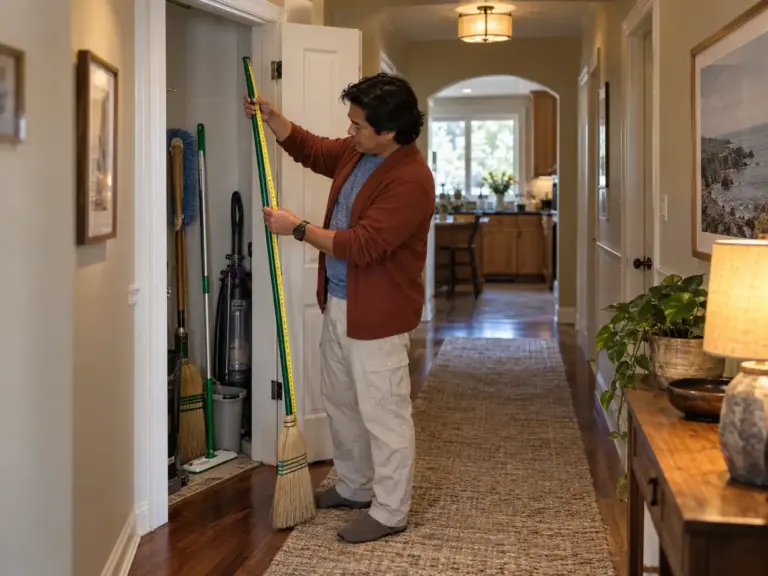
A broom with a dustpan, a toilet brush and a squeegee fill out the rest. The vacuum cleaner is the one big-ticket item any list names, and most homes have it; a HEPA filter or a robot vacuum is an upgrade, not a starter item. Where the mop and broom end up standing is a tall-handle question, and broom closet organization sized to the tallest handle answers it.
Spray bottles, trash bags and what a caddy really holds
Two to three spray bottles is the total: one all-purpose, one glass, and one labeled spare for a refill. Trash bags come by the roll. A caddy holds one set, meaning a spray each, a toilet gel, cloths and gloves, and nothing in it is duplicated. One mop and one broom are all the long-handled tools a home needs, and anyone who follows that rule never buys a second mop.
Room-by-Room Extras Worth Adding, and the Skip List
A list that adds a bottle for every room is describing a store, not a home. The extras worth owning are few, and each earns its place when the room proves the need.
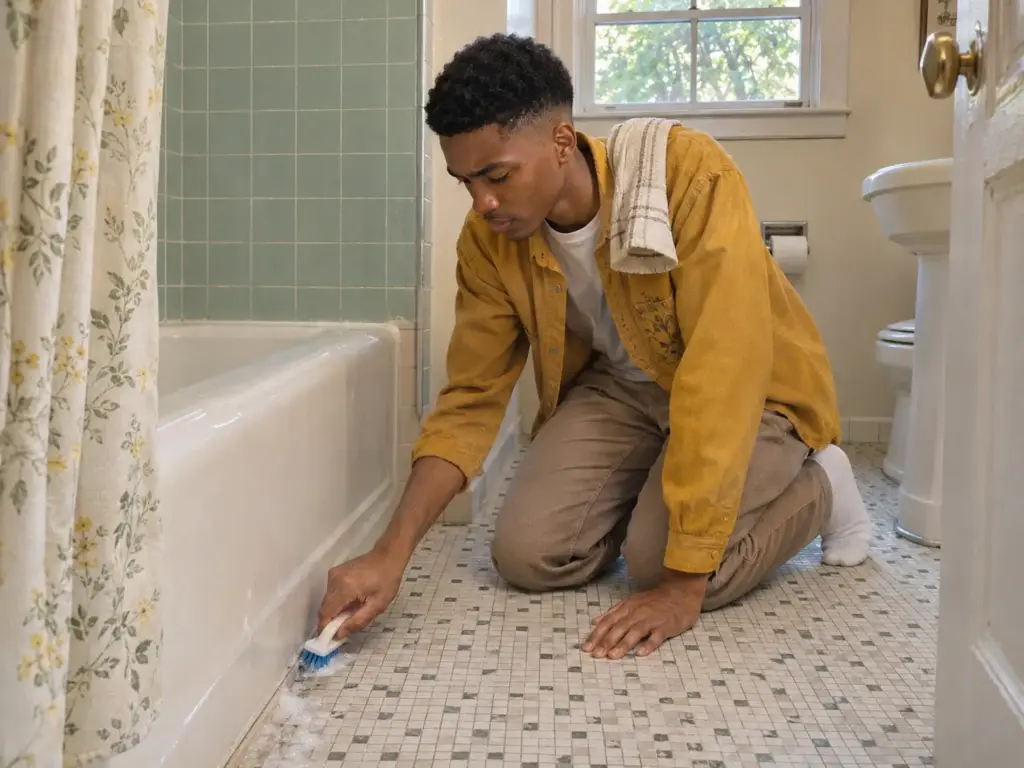
Kitchen and bathroom extras that earn their place
In the kitchen: a degreaser for the stove hood, oven cleaner once an oven gets dirty enough to need it, and a grout brush. In the bathroom: a tub and tile cleaner or a mold and mildew remover, but only after the all-purpose spray and a scrub brush have failed on soap scum, hard water stains or limescale, plus a small brush for corners and, only if the grout has darkened, a grout cleaner. Each of these waits for a real stain, and none of them goes in a basket on a hunch.
Bedroom, living room and laundry
The bedroom and living room need an extendable duster and a lint roller. Upholstery cleaner waits for the day a stain arrives. The laundry needs laundry detergent and one stain remover, and the stain remover is the extra most homes use up; fabric softener is a skip. If the laundry corner is tight, where laundry supplies live in a small laundry room shows what the shelf can hold.
What you can genuinely skip
The skip list is where a kit shrinks fastest:
- Furniture and wood polish (a damp cloth and a drop of oil does the job)
- Separate kitchen and bathroom sprays (the all-purpose does both)
- Stainless steel cleaner (the all-purpose and a dry cloth)
- A separate floor cleaner (diluted dish soap in the mop bucket covers hard floors)
- Carpet cleaner, until a stain actually lands
- Castile soap and essential oils (a few drops of dish soap fill the same slot in a DIY mix)
- Fabric refresher
- Disinfectant wipes, when a disinfectant spray and cloths are already in the kit
- Any second bottle of the same job in a different scent
Disinfectant is a deliberate, dated purchase and not a default: it runs on a one-year clock, and it earns its place on high-touch surfaces such as door handles and light switches.
A third bottle also loves to hide in the pantry corner, which turns the pantry into an off-label cleaning shelf. On budget, the dollar store version of a cloth, a brush and a spray bottle is fine. Pro-grade cleaners are built for daily commercial use, and a home does not need them. The places worth spending are the glass cleaner, the mop and the toilet gel.
Fitting the List to Your Home, Your Surfaces and Your Budget
Some homes are not the average one: a rental where all of it lives in a single sink cabinet, or a three-floor house where the supplies are never where the mess is. The list bends, and it bends in opposite directions.
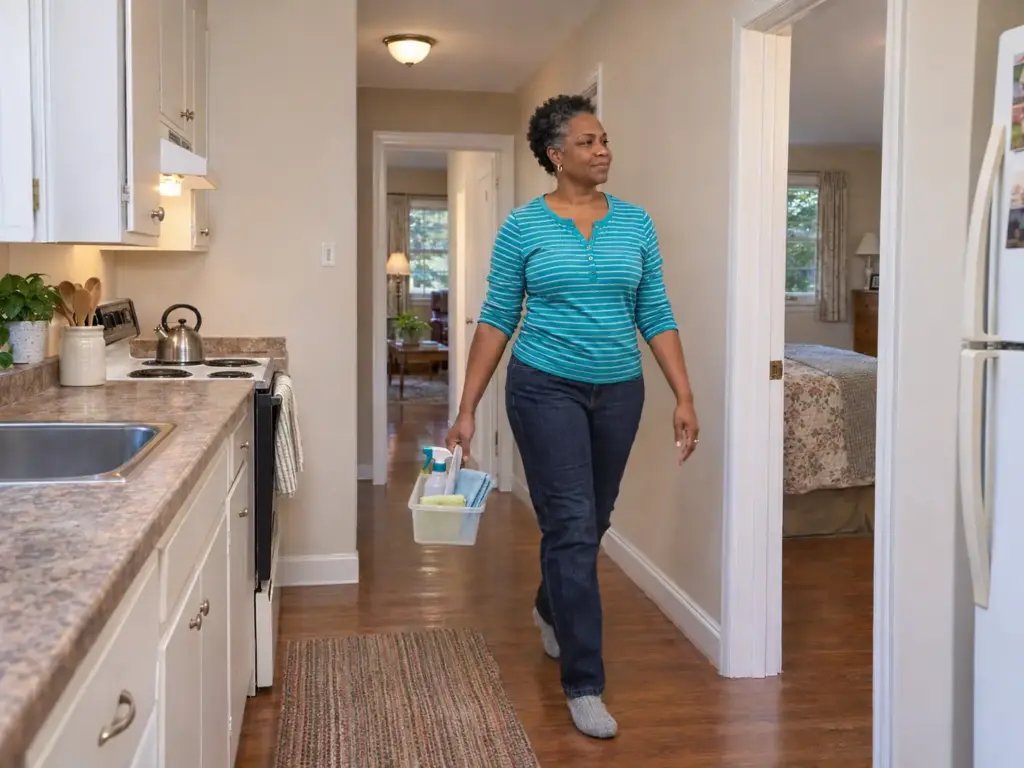
One kit per floor, not a second set of everything
In a large home the problem is distance. The answer is one portable bin or cleaning tote pre-set for the weekly clean, with cloths, a small duster, a spray and a pad, carried from room to room. A second kit makes sense only on a different floor, and even then it holds cloths, a spray and a duster, not a duplicate of every bottle. Cleaning caddy options built for square and tall bottles cover the buying decision for the bin that travels.
A rental with no closet, a large home with three floors
A small rental with no utility closet, no linen closet and no coat closet keeps everything in one under-sink cabinet or on one rolling cart beside the fridge, which becomes the whole cleaning station. Keep it away from pantry food and from any gas wall heater. Nothing here needs drilling or wall hooks. The large home has the opposite temptation: so much room that three backstock bottles hide on every floor and nothing is within reach of the mess.
Surfaces, kids and pets
Sealed wood, tile and glass take the core kit. Natural stone (marble and granite) and tinted or low-emissivity glass are where a vinegar mix stays off. Hardwood floors get a mop with a well-wrung head,
Child-safe, pet-safe storage means out of reach, since every label on these products carries that warning. A pet household adds one enzyme cleaner sold as a pet stain and odor remover, the single extra that earns a place.
Eco-friendly, non-toxic and budget: the one label you can check
Eco-friendly, non-toxic and biodegradable have no owner and no standard, and makers of chemical cleaning products are not required by law to list their ingredients. The label that answers the question is the EPA’s Safer Choice label, carried by nearly 2,000 products. According to the EPA, “Every chemical, regardless of percentage, in a Safer Choice-certified product is evaluated through EPA’s rigorous scientific process and only the safest ingredients are allowed.”
If you want a greener bottle, look for that label and ignore the leaf on the front. The budget comparison runs the same way: a certified bottle is the best option if money is no object, and the vinegar-and-water mix in a reused bottle does most of the job on most surfaces for a fraction of that spend.
What the Kit Costs to Keep and When Each Piece Has to Go
The sponge looks fine and the bottle is still full, and neither has ever been asked how old it is. Both are on a clock.
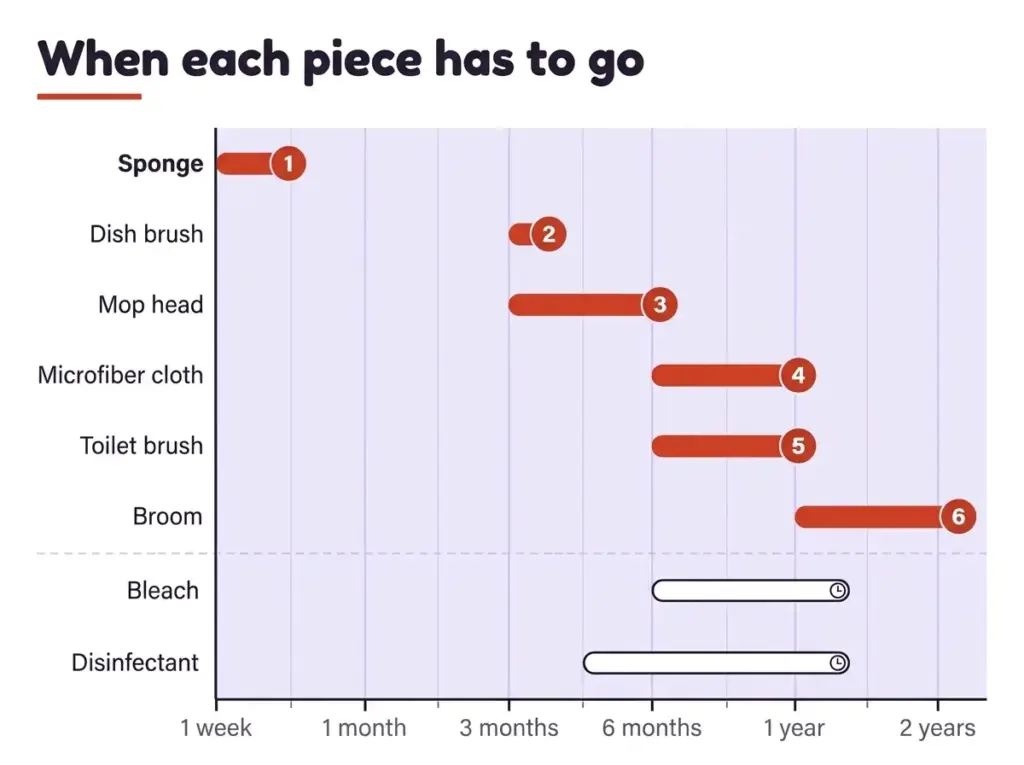
The replacement clock for sponges, cloths, brushes and mop heads
According to Consumer Reports, how often cleaning tools actually need replacing runs like this: kitchen sponges every 1 to 2 weeks, dish brushes every 3 to 4 months, microfiber cloths every 6 to 12 months, mop heads every 3 to 6 months on busy floors, brooms every 1 to 2 years, toilet brushes every 6 to 12 months, and rubber gloves when they smell or tear. A cloth lasts 300 to 500 washes, and one that beads water instead of soaking it is finished.
The reason sits in a swab study by NSF International, where 75% of household sponges and rags carried coliform bacteria, the family that includes Salmonella and E. coli. A sponge past its date spreads what it was bought to remove. The cheapest item in the kit is the one replaced most often, which is why it comes in a small pack and not a single sponge.
Mark the date on a new sponge with a marker the day it leaves the pack. The swap becomes a glance at the corner of the sponge instead of a decision about whether it still looks clean.
Dating the bottle: bleach and disinfectant have a clock
A full bottle is not the same as a good bottle. According to the University of Utah’s biosafety office, “Undiluted household bleach has a shelf life of six months to one year from the date of manufacture.” After that it loses about 20% of its strength a year, and a 1:10 bleach mix is spent in 24 hours, so it gets mixed fresh on the day it is used and never stored.
Bleach belongs at 50 to 70 °F, which rules out a garage that freezes in winter and a shelf beside the oven. The American Cleaning Institute, the cleaning industry’s trade group, puts a disinfectant’s shelf life at about one year. The rule that settles all of it is one line: write the date on the bottle the day it is opened.
A mop head is the consumable, not the mop
O-Cedar says the EasyWring head should be replaced every 3 months, and one refill covers about that long, so two heads a year is the running cost of the mop once the bucket is bought. The O-Cedar EasyWring refill two-pack, two 5 x 5 inch heads, turns “change the head” from advice into one purchase. It is optional if you have the mop already or use a different model, and a washed head can be stretched toward six months while it still smells clean. Wash it on a gentle cycle, since some heads come apart after a single wash.
The first year is the kit. After that the maintenance spend is cloths when they bead, two mop heads and a small pack of sponges every couple of months. A concentrated cleaner and refill bottles shrink the footprint and the running cost only when they get used up, and a refill bottle sitting in the cabinet is just a second bottle.
Where the Finished Kit Lives Without Becoming a Mess Again
The list is finished and the cabinet is still full of the old bottles, with a pipe running through the middle of the shelf. The kit needs a home, whether under-sink storage or a cleaning closet, that survives a normal week.

Three rules for the shelf: temperature, food and reach
Temperature: 50 to 70 °F and out of direct sun. An unheated, uninsulated garage is the wrong place for liquids, and a shelf beside the oven shortens the life of everything, not just the bleach. Food: chemicals never sit beside food, which is a health rule and not a preference, so the pantry is no place for a third bottle. Reach: out of the reach of children and pets, because every label on these products carries that warning, and safe storage for cleaning supplies under a bathroom sink covers the locks and the shelf life.
One caddy, one backstock, one spill tray
The kit lives in one cleaning caddy: a spray each, a toilet gel, cloths and gloves. Backstock sits in a separate spot, in a storage bin labeled with a label maker or masking tape, and a spill tray goes under the bottles. The weekly reset is bringing the caddy back to the same place.
Storing like a store, with multiples of everything on a shelf that bows under the weight, is what a list with no limits produces. A sagging shelf is the signal to cut the list.
Where to go for the cabinet measurements
The renter with one cabinet and the owner with a closet use the same list, and only where it sits changes. The cabinet with the pipe in it gets measured on fitting the kit around the pipes under a sink. If the kit lives on shelves instead, the cleaning supply organizers that suit the space you have sorts out cabinet, door, wall and shelf.
Cut the Duplicates First, Then Put a Date on What Stays
Four bottle jobs cover a home: an all-purpose spray, a glass cleaner, a toilet gel per bathroom and dish soap. Add a dozen cloths in two colors, a small pack of sponges, one mop, one broom and the vacuum you have, and the kit is done. Extras wait until a room proves it needs one, anything with a clock gets a date, and the whole kit stays away from food, heat and small hands.
After a month of ordinary weeks, look for the bottle nobody has touched. That is the one to stop buying, and by then the first sponge will already have been swapped.
Today, declutter the cabinet: pull every cleaning product out, group the bottles by job and set the duplicates aside before anything goes in a basket. Then write the opening date on the bleach and the disinfectant. You will know the list worked when the cabinet door closes on the first try.
Frequently Asked Questions
01What belongs on a cleaning supply checklist for a home?
Four bottle jobs (all-purpose, glass, toilet and dish soap), a dozen microfiber cloths, one mop, one broom, a toilet brush, a scrub brush, gloves and trash bags cover a home. Add a small pack of sponges, and add a room extra only when that room proves it needs one.
02What is the 5-5-5 rule for cleaning?
The 5-5-5 rule is a popular short daily tidy, often five minutes, five items or five spots, and the versions differ from one source to the next. It has no official definition and no health agency behind it, so treat it as a habit, not a standard.
03What should I include on my regular house cleaning list?
A regular house cleaning list works as a cleaning schedule with three layers: a daily reset where you clean as you go, a weekly pass over the bathrooms, kitchen and floors, and a seasonal deep clean. The supplies on this checklist cover all three layers without adding another bottle.
04Do cleaning supplies expire?
Yes. A disinfectant’s expiration comes about a year from the date of manufacture, and undiluted household bleach keeps its strength for six months to a year. Sponges and mop heads run on a shorter clock, so write the date on each bottle the day it is opened.
05How many cleaning supplies does a large home need?
A large home needs one kit per floor and a single backstock spot, with nothing tripled, because a second floor only needs cloths, a spray and a duster. A bin pre-set for the weekly clean can travel between rooms.
Disclaimer: ClutterlessNest is a participant in the Amazon Services LLC Associates Program. As an Amazon Associate we earn from qualifying purchases. This article may contain affiliate links — if you buy through them, we may earn a small commission at no extra cost to you. We only recommend products we have tested or genuinely believe in.