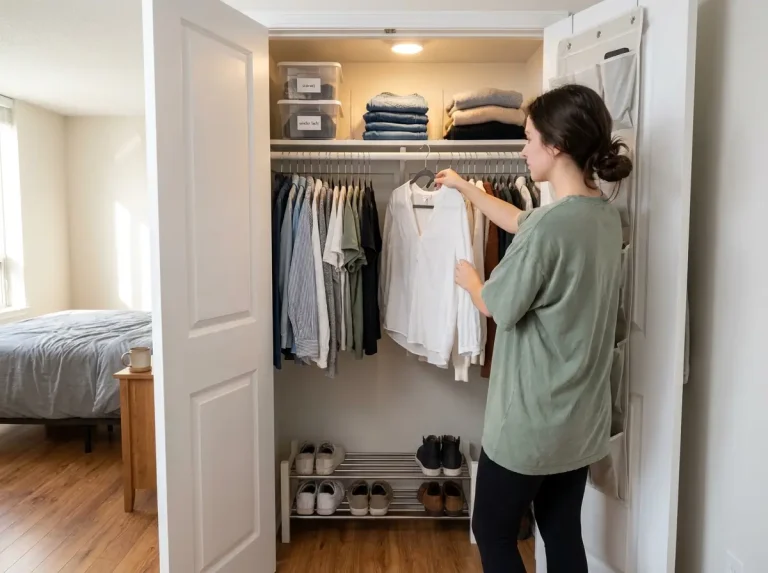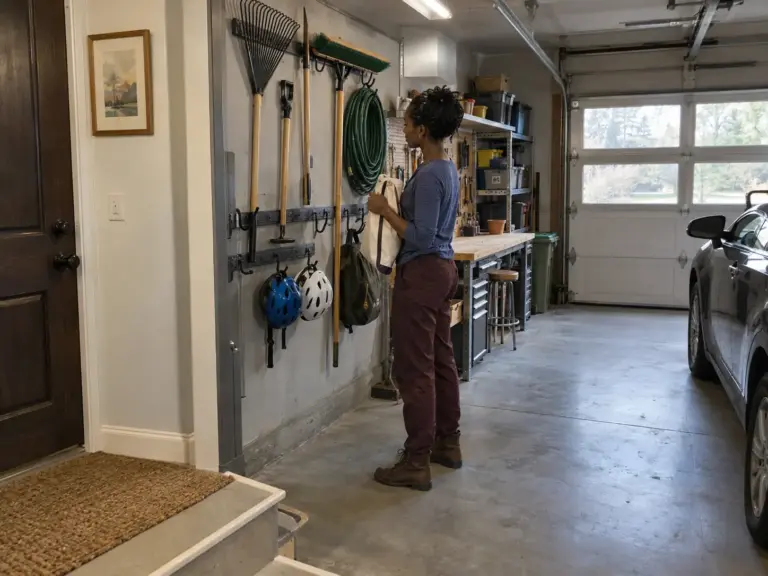
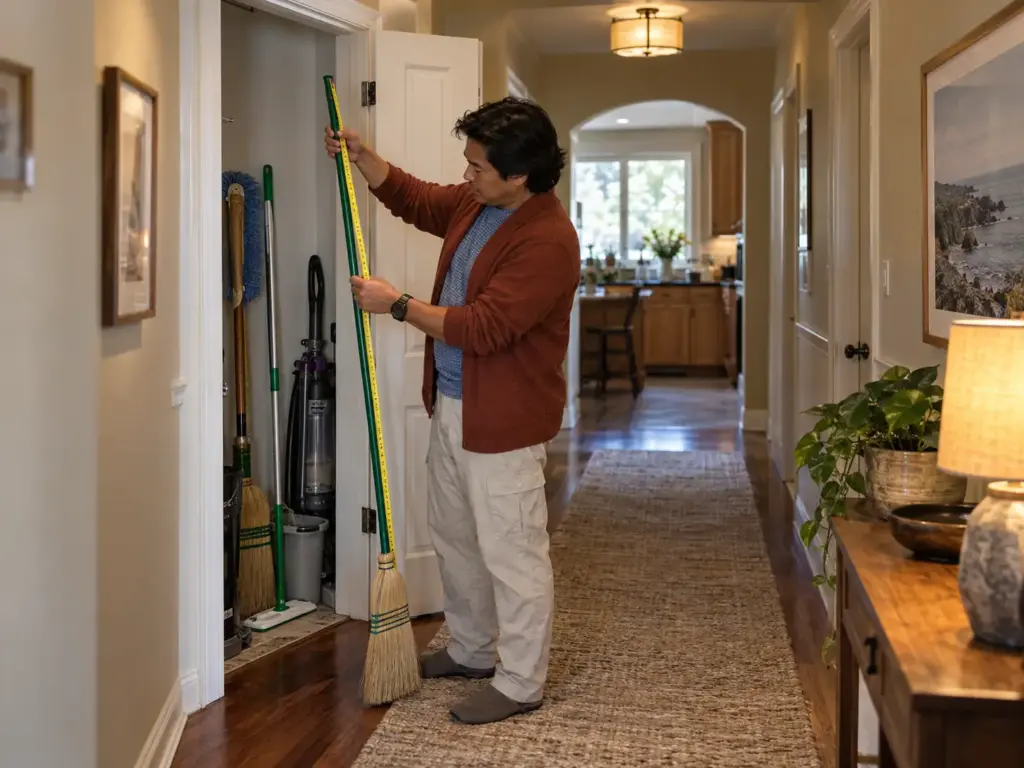
You open the closet door and a broom slides out before you have touched anything, with the mop that was leaning on it close behind. You catch one, prop it back against the wall, and shut the door a little faster than you opened it. Handles fall because nothing in the closet was sized to the longest tool inside it, which makes broom closet organization a measuring job before it is a tidying one, and the numbers below come from your own tape measure, checked against a retailer’s closet-dimension guidance and federal anchoring advice. This guide starts from the tallest handle you own, works down to the floor, and ends with a route for owners, one for anyone who wants furniture and one for renters who cannot drill, while the wider view of the room lives in the utility closet guide.
Quick Answer
Size the closet from the longest tool in it, then give every tool one place to return to.
- Measure your tallest handle from the floor end to the top.
- Check closet height, depth and door swing against that number.
- Give each long tool one fixed spot off the floor.
- Keep the bucket, vacuum and wet mop low, and sprays on a shelf.
- Choose wall, cabinet or no-drill, then set one return rule.
Why Broom Closet Organization Slides Back to Leaning
A closet that looks right after a Saturday tidy and sloppy again by the third week has not failed on effort. It failed on design: the tools never had addresses, so they went wherever the last hand left them.
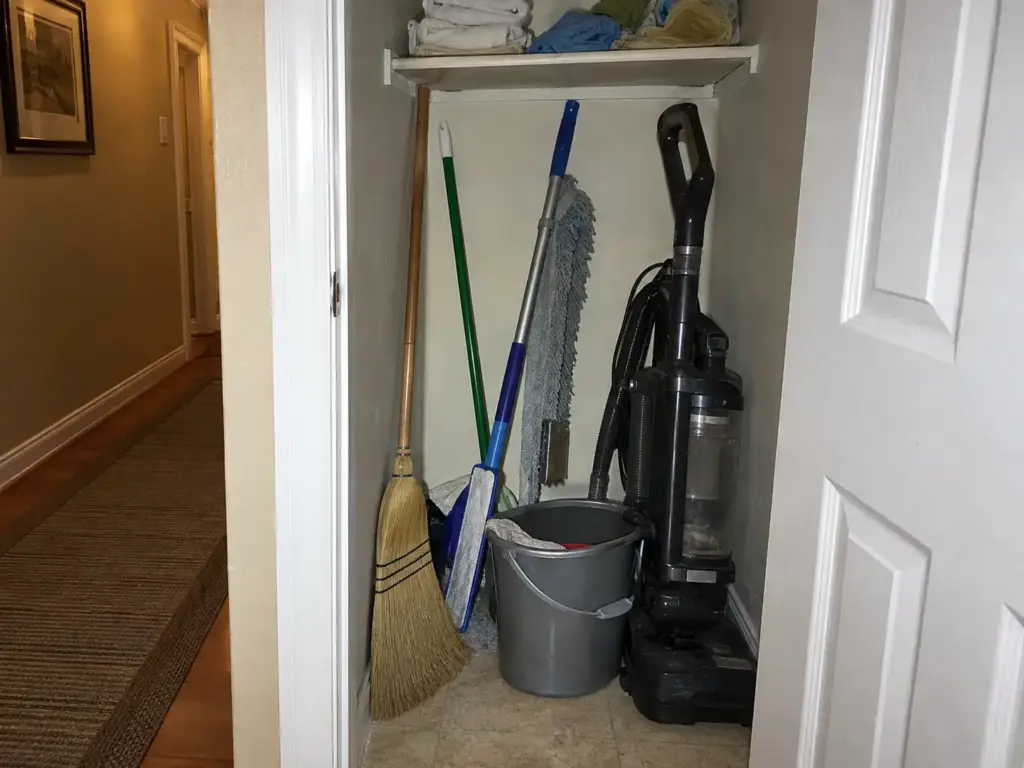
A broom with no fixed home leans on the nearest wall
A leaning handle rests on two points, the foot on the floor and the top against the wall, and nothing at the bottom stops the foot from sliding. On a smooth floor, friction is the only thing holding it. Then the door moves, or a neighbor tool gets pulled out, the foot shifts an inch, and the whole stack follows. A broom left standing on its bristles also bends them into a permanent curve, which you pay for later in crooked sweeping instead of in a crash.
The nearest wall wins because that is where a hand puts a tool when it has no better instruction. “Just for now” is the longest-lasting storage system in most houses.
Why the floor catches everything else
Once one handle slides, it lands on the bucket, the vacuum cord or whatever else lives down there, and the floor fills with things that were standing a minute ago. The next tool has nowhere to stand, so it leans against the pile. Read the lean as a symptom: five tools and two slots means three tools are leaning, however carefully the closet was arranged.
People name this setup in their own words. One r/organization thread is titled around keeping bulky cleaning items off the floor with Command hooks, and another asks for rental friendly suggestions for a walk-in closet. “Bulky cleaning items” is a fair name for the problem: long, awkward, and in need of a home that is not the floor.
What a closet built for one rod and one shelf never planned for
A builder-grade closet arrives with a shelf and rod, a layout drawn around hangers. There is no place in that plan for a tool taller than the gap under the shelf, so the broom gets the corner by default. It is the same starting point that makes a small closet get messy again, only here the item without a place is the longest thing in the house.
Run the three-month test on your current setup: with normal use, will every tool still have somewhere to go in week twelve? If a tool has no named spot, the closet reverts within weeks, and nothing you buy changes that.
Measure From the Tallest Handle Down
The slim cabinet looked right online. At installation the handle hits the shelf above, or the door will not shut over the bucket, and the box goes back. Both problems come from one missing number, and it takes a tape measure and a minute to get.
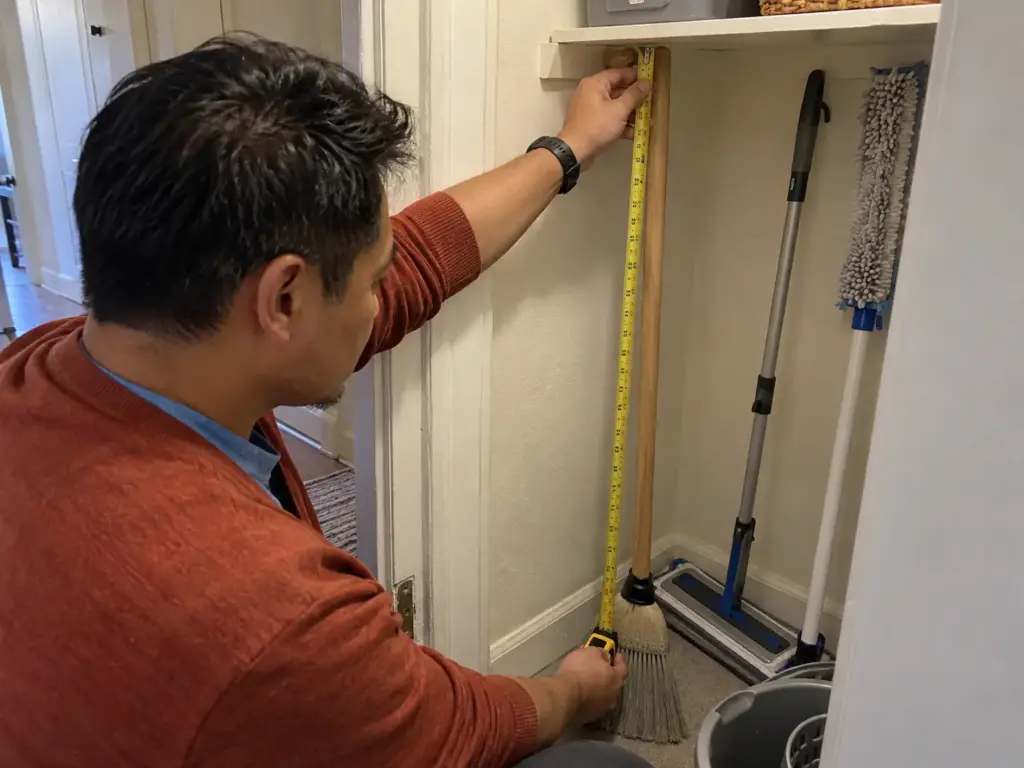
Start with the tool you already own
Measure the tallest handle you have, whether that is the broom, the mop or the dust mop, from the floor end to the top, and write the number where you will see it. Do not look up a standard handle length. A commercial supplier of mop and broom handles lists 60 inches as the most common length in commercial use, with 54 and 48 inches also sold, but that is a janitorial figure and says nothing about the broom behind your door. The tape in your hand is the authority here.
While it is out, note the footprint of the two biggest floor items, the mop bucket and the vacuum base, as width by depth. Those two measurements plus the handle are the whole input for everything below.
Closet height and depth against that handle
A closet-dimension guide from a home retailer puts a typical reach-in closet at about 24 inches deep, 3 to 8 feet wide and 84 to 96 inches tall. Use those as a frame for one question, whether a handle fits upright, and not as a promise about your closet, which may sit on either side of them.
Closet width draws the eye first, since it decides how many tools can hang side by side, but depth is the number that bites. The mop bucket and the vacuum base set the floor footprint, so a closet at the shallow end has no room to stand a bucket against the back wall and still close the door. Work it as subtraction: closet depth, minus the bucket’s depth, minus whatever the door needs to swing shut over it. If the answer is close to nothing, the bucket lives somewhere else.
Then look up. Measure from the underside of the lowest shelf to the floor. If that gap is shorter than your tallest handle, the handle cannot stand straight under the shelf: it goes in at an angle, hangs somewhere else, or stays out of the closet.
Four tools may clear a shelf that the fifth does not. And the fifth is the one on the floor a month later.
Door swing and what is left of the floor
The same guide says a swinging door needs about 36 inches of open floor in front of it and a folding door about 24 inches. That floor is where you stand to reach a tool, and any holder mounted on the door has to clear the swing too, so closet depth, bucket footprint and door arc are all competing for the same floor space.
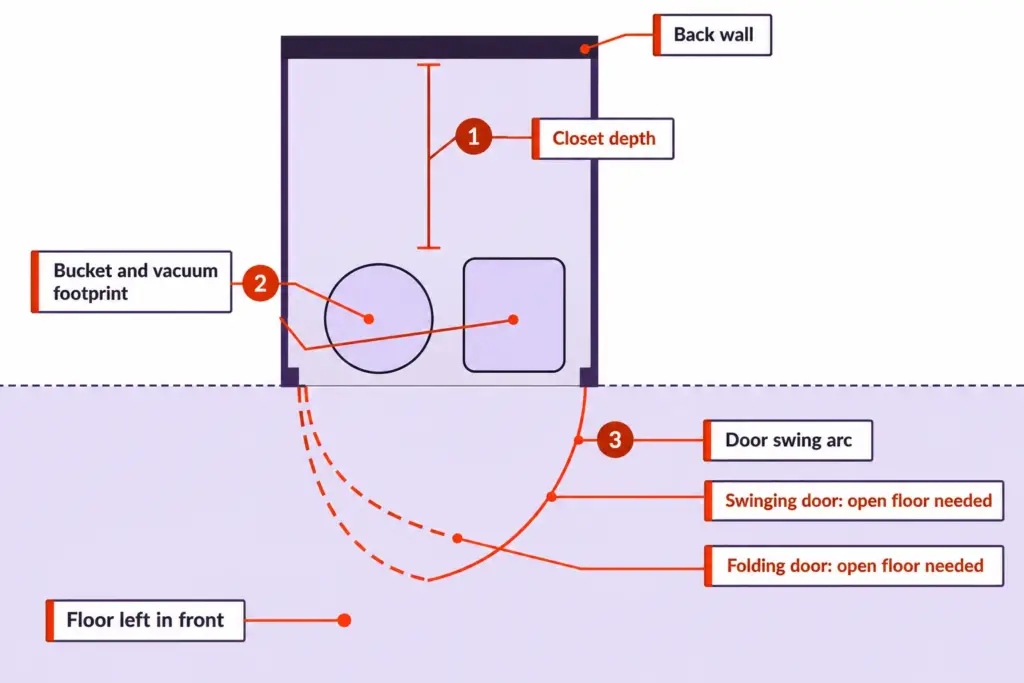
Door clearance has its own walkthrough in the guide to organizing a utility closet that still shuts, so this guide only needs the number from it. The measuring costs nothing, and it decides whether the right buy is a cheap holder or a pricier cabinet.
Write three numbers on a strip of painter’s tape inside the closet door before you shop: your tallest handle, the height under the lowest shelf, and the floor the door swing leaves. Comparing listings against numbers you can see beats comparing them against memory.
Give Every Long Tool One Fixed Spot Off the Floor
Count your long-handled tools, then count the places they can hang. The gap between those two numbers is how many are leaning right now. Vertical storage closes that gap, but only when every tool gets a slot of its own.
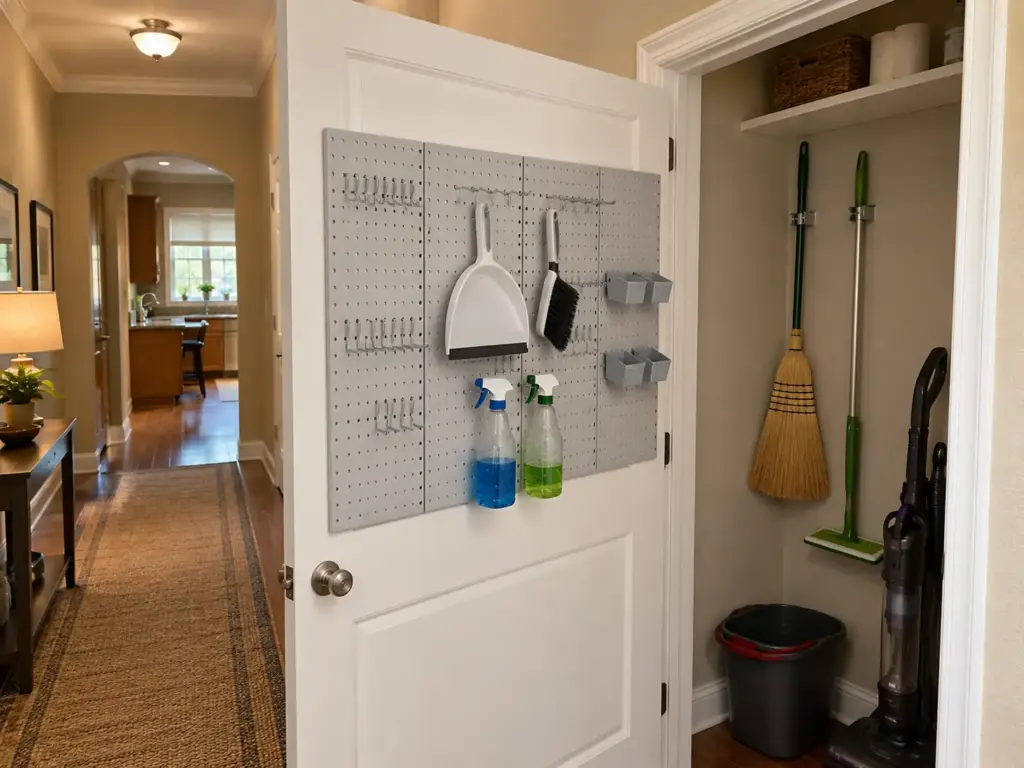
Hang by the handle, upright, off the floor
Free first. A hook or a rail you already own, or a rod already in the closet, costs nothing to try for broom and mop storage, and plenty of households have a stray hook in a drawer. Hanging beats standing for the same reason the lean happens: a hung handle has a place to be and cannot slide, and the bristles stay clear of the floor.
If the wall is solid or drillable, a rail, a wall-mounted broom holder or a mop holder takes the long tools. Anything heavy goes into a stud or a backing, not into drywall alone, and the hook ratings and stud-finding details sit in the piece on a wall that holds up past month one. Placement follows length: the longest handle goes on the side with the most headroom and the shortest tools hang lower, the same logic as placing each tool by its length in a garage.
One slot per tool, grouped by the job it does
Group by task, not by size. Sweeping gets the broom, dustpan and hand brush together; wet cleaning gets the mop and its wringer; the vacuum gets its wand and attachments. Each tool has its own slot, so the return trip has an obvious answer. Two tools on one hook is where this system quietly dies (one of them will be leaning again by the weekend).
The back of the door for the small stuff
The back of a closet door is wall you are not using. Any over-the-door hooks you already own will take a dustpan and a hand brush today, so try those before buying anything. If you want a full grid, the Amazon Basics Rectangular Metal Pegboard Wall Organizer 48 Piece Kit in gray gives you hooks for the dustpan, the hand brush and spray bottles, all off the floor.
Panels like this normally mount with screws, which makes it the owner route, and a hollow-core door, a thin shell, is a poor place to drive them. Check the panel size on the listing against the back of your door, and confirm the door still closes with the panel and a loaded hook on it. Renters should skip ahead to the no-drill route.
The Floor Zone Is for the Bucket, Wet Mop and Vacuum
You mop on a long day, wring the head out, and put the mop back in the closet while it is still damp. The door shuts. A month later the closet smells like it, and you cannot say when it started.
Give the bucket and vacuum a marked footprint
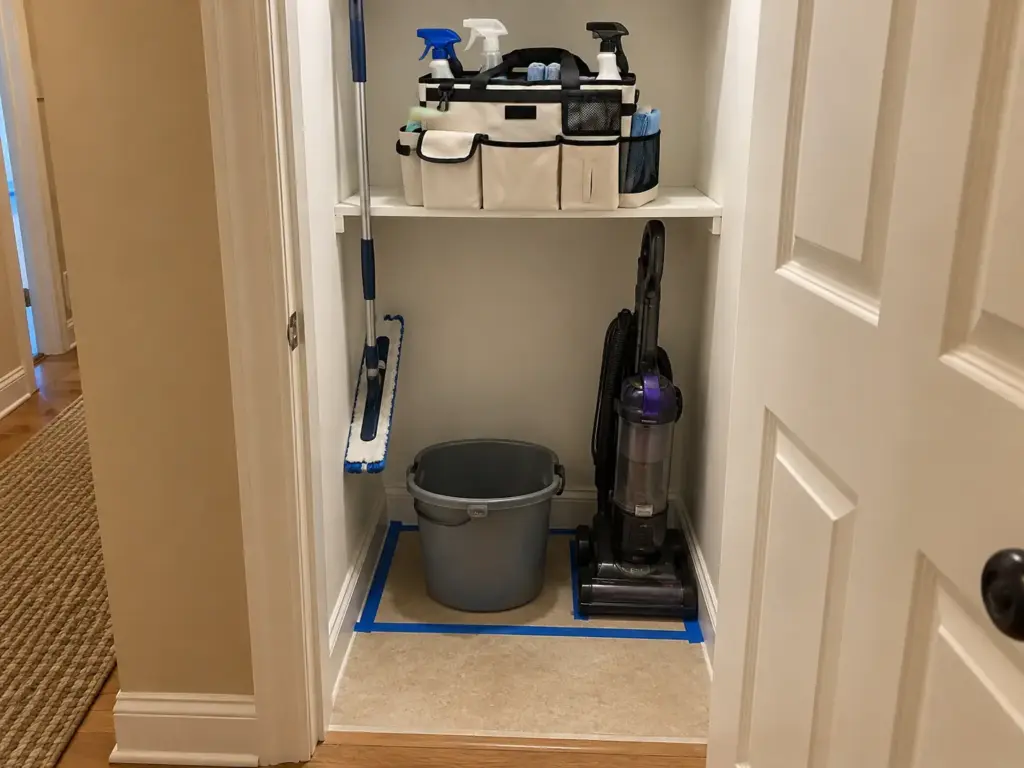
The floor is the one place in the closet where low items belong, so draw its edge. A strip of tape on the floor works, and so does the shelf above acting as a ceiling, as long as the bucket and the vacuum base have an outline to stay inside. The test is the door (it has no opinion about how neat the zone looks): if it closes with both parked, the zone works. The vacuum base is the heaviest thing down there, so the wand and attachments can ride on a hook on the door back while the base stays put.
Dry the mop head before it goes back in
A damp mop head in a shut closet stays damp, because nothing moves the air and the moisture has nowhere to go. Hang the head up or out to dry in the open before it enters the closet. According to the EPA’s guidance on mold cleanup, “Dry all items completely.” That line is general cleanup guidance, not a statement about mop heads, but the principle carries over: a wet item sealed into a small closed space is the setup for a smell.
Give the mop a drying hook outside the closet, on the laundry-room wall or by the back door, and make the closet its second stop. A mop with one extra stop to make is a mop that dries.
Sprays and cloths go on a shelf, not the floor
A plastic dish tub or any box with a handle, already in the house, gathers sprays and cloths and lifts them off the floor. If you want a purpose-made one, the Cleaning Caddy Organizer with Handle, 15 x 8 x 10.5 inches carries sprays and microfiber cloths in one grab. Check its height against the gap under your shelf before ordering, since a caddy that touches the shelf above has to be tilted out each time. Its job here is the shelf zone: sprays and cloths up, bucket and vacuum down.
The supply side of this has its own guide on cleaning supplies you keep rebuying. If children live in the house, a shelf is not a lock, and the advice on storing cleaning supplies safely covers chemical zones and child locks.
Built-In, Freestanding or No-Drill: Which Route Fits Your Closet
“Install a rail” is easy advice to give and hard to follow in a rental whose lease says nothing about screw holes. The renter ends up waiting for permission while the tools lean. The three routes below split by what your wall and your lease allow.
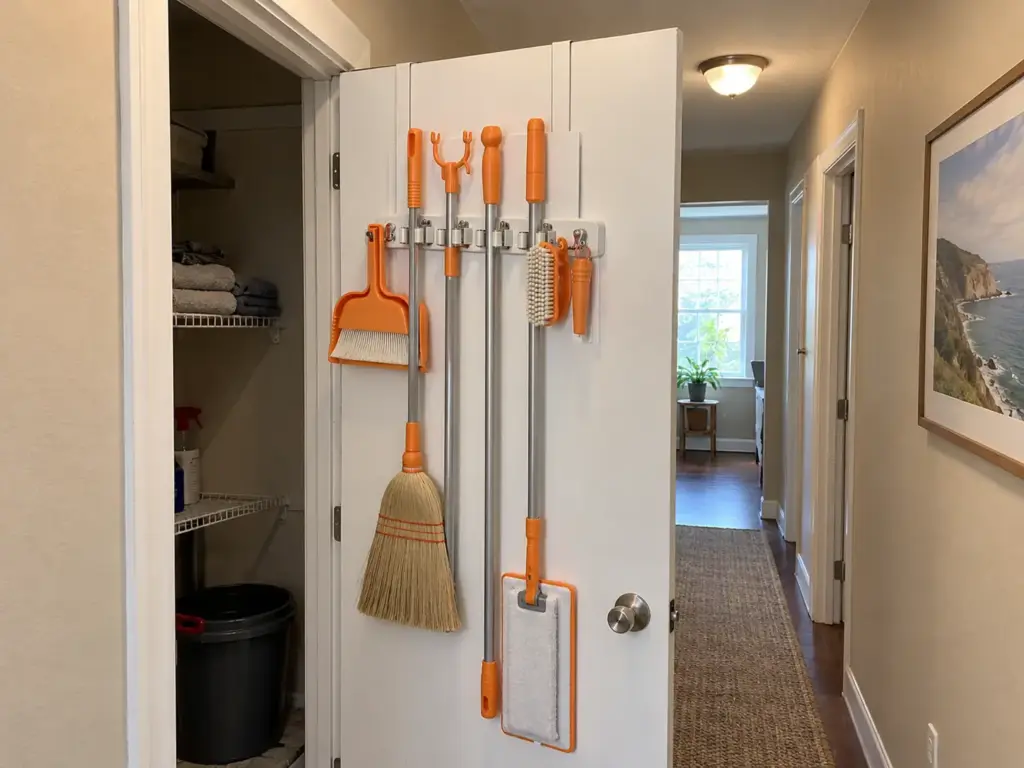
If you can drill: a rail or holder on a solid wall
Everything in the long-tool section above applies here: a rail or holder on a solid wall, with heavy loads into studs or backing. No extra steps are needed. This is the route with the fewest moving parts, provided the wall is yours to drill.
If you want furniture: a freestanding cabinet, anchored
A tall cabinet with doors and shelves takes the whole problem in one piece. Handles stand inside, doors hide the lot, and it is the answer when the closet is too shallow for a mop bucket or when there is no broom closet at all and the cabinet goes in a hall or laundry nook. Sold as a freestanding broom closet or a slim broom cabinet, it is the route for anyone who wants furniture.
But it is furniture, and tall furniture tips. According to the U.S. Consumer Product Safety Commission’s Anchor It! campaign, “Anchoring all furniture with drawers, doors, and shelves to the wall prevents tip-over injuries and deaths.”
Anchor it. The tip-over side of freestanding units is covered in the guide to freestanding shelving that will not tip. The renter’s catch is that anchoring needs a fixing in the wall, so this route is not automatically drill-free.
If you rent or cannot drill: what stays removable
Two things come off without a hole. A spring tension rod pressed across the closet carries light hanging items on loops or S-hooks, and the ALLZONE Tension Curtain Rod (83-123 inches) is the rod in this guide.
This article states no load for it, because the number to trust is the rated load on the listing, checked against the weight of what you hang. A rod is for light things, and a mop with a wet head is not light. Mind the span too: it starts at 83 inches, close to seven feet, so it suits the wide end of the closet range above or a long alcove. A narrower closet needs a shorter rod, which is a different listing.
The second is a door-edge holder, a cousin of the over-the-door rack. The Vosturdy Mop and Broom Holder in white carries a listing title that reads “Wall Mount, No Drill Over the Door” with 4 slots and 4 hooks, so for a renter it is the no-hole option that hangs on the door edge.
Check two things on the listing first: the load rating and slot width against your handles. And check the door, because this holder only works if the door still closes with the handles in it. For more over-the-door and bin options across different closet shapes, see the options for the space you have.
Neither piece replaces a wall rail for heavy loads. The comparison is plain, though: the rod and the door holder cost a fraction of a cabinet and take the lease out of the question, and the cabinet holds the most but needs the wall. The wider renter playbook sits in no-drill closet organization that protects a deposit.
The Daily Return Rule That Holds Past Month Three
One person uses the broom closet daily and sets it up the way it should be. Everyone else drops things in “somewhere,” because somewhere is closer than the right place. The system lasts exactly as long as the sloppiest user.
One slot per tool, and the slot is the rule
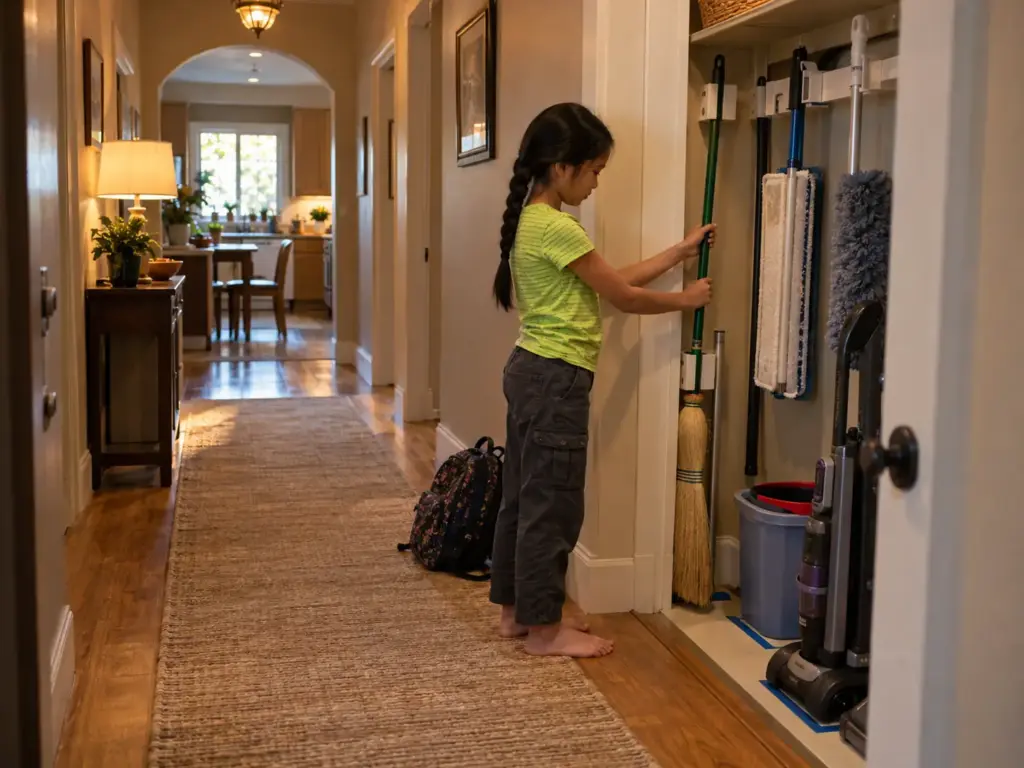
The test is simple: can a person who did not set the closet up put every tool back without asking? If a tool has no obvious slot, the closet has no rule. Make the slot visible, with a strip of tape marking the outline on the wall or a labeled hook, and keep the rule to one sentence the whole household can repeat. The tape costs nothing and works before any holder is bought.
When a second person puts things away
Kids and partners (the people most likely to be handed the mop) put things where it is easy, so make the easy place the right place: a low hook for the dustpan, handle slots at a height anyone can reach. After a few weeks one tool will have drifted to a new spot, and the better response is to move the slot there, not to scold anyone. A slot people keep ignoring is a slot in the wrong place.
Put the return rule on the inside of the door in one sentence, in the household’s own words. A second person follows a sentence faster than they follow a system they were never shown.
Measure the Handle, Name the Spots, Look Again at Month Three
Three things carry the whole closet. Measure the tallest handle first, because every other decision is sized from it. Give each long tool one fixed spot off the floor, and keep the heavy and wet items in a marked floor zone with the small supplies on a shelf. Then pick the route by what the wall and the lease allow, not by what looks neatest in a photo.
Around month three, check three things: which tool has drifted out of its slot, whether the mop still dries before it goes in, and whether the door still closes without a push. Those three tell you whether the system held.
Today, with what you already own, take the tallest handle, measure it, and tape the number to the inside of the door. When you open the closet tomorrow, notice which tool has nowhere to go. That tool is where the rest of the plan starts.
Frequently Asked Questions
01How do I organize my broom closet?
Organize a broom closet by measuring your tallest handle first, then giving every long tool its own hung spot off the floor. Keep the bucket and vacuum in a marked floor zone, put sprays on a shelf, and set one return rule everyone can repeat.
02What is the best way to store brooms?
Store brooms upright and off the floor, hung by the handle in one fixed spot each, with the bristles clear of the ground. Leaning has no stop at the bottom, so the foot slides and the tool falls.
03What is the best closet organizer for brooms and mops?
The best organizer depends on your route: a wall rail if you can drill, an anchored cabinet for furniture, a tension rod or door-edge holder if you rent. Check the load rating on any listing against what you plan to hang.
04Can you organize a broom closet without drilling?
Yes, a spring tension rod and a door-edge holder can organize a broom closet without a single screw hole. Check the rod’s rated load on its listing, and make sure the door still closes with the handles in the holder.
Disclaimer: ClutterlessNest is a participant in the Amazon Services LLC Associates Program. As an Amazon Associate we earn from qualifying purchases. This article may contain affiliate links — if you buy through them, we may earn a small commission at no extra cost to you. We only recommend products we have tested or genuinely believe in.