
You push the utility closet door shut and it bounces back at you, held open by a coat sleeve, the vacuum hose or the corner of an ironing board that slid out of its spot. The closet is also the coat closet, a dual-purpose closet where nothing gets a free pass. A renter in an r/organizing thread described the one over-the-door setup that works: whatever hangs on the door has to hang shallow, an inch or two, so the door still closes over what is behind it. That rule sets the order of everything below, from brooms to the ironing board, and this guide is about the shared-door case of utility closet organization while the full utility closet system covers the rest of the closet.
Quick Answer
Work from the door inward, not from the shelves out.
- Close the door on the empty closet and find what stops it.
- Sort everything into daily, weekly and rare.
- Give long handles a home that adds no depth to the door.
- Keep heavy things low and anchor anything tall.
- Test the door shut once a month.
How to Organize a Utility Closet When the Door Has to Close
A closet that doubles as the coat closet, the linen shelf and the vacuum’s parking spot fails at the door first. The pile of stuff behind the door is rarely the problem. The problem is the extra inch that sits on the inside face of the door, and the shelf edge that creeps toward the hinge side a little more each week.
What actually stops the door from shutting
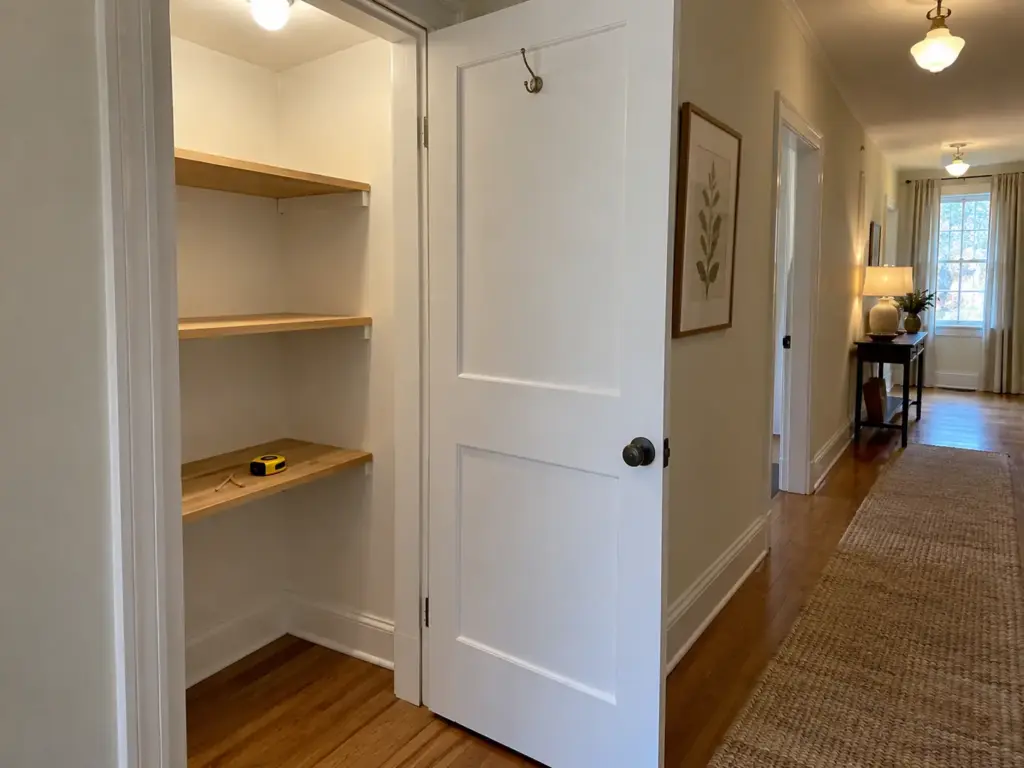
Two things add up. Anything hung on the back of the door adds depth, and anything on the shelves nearest the hinge side fights the door swing. The door shuts only when those two together are smaller than the room the closet has left.
That is why a closet can look tidy with the door open and still refuse to close. Door clearance is the first thing to measure, and buying a rack before measuring is the most common way to make it worse.
The number people quote for this is also less fixed than it sounds. One commenter in the r/organizing thread wrote that anything sticking out more than three or four inches from the wall will catch the door. Treat that as a prompt to check, not a rule. Where the hinges sit, where the latch is and how far the shelf stands from the frame all move the line, and only your own closet can tell you where it falls.
Empty it and sort into piles before you touch the walls
Empty and sort first. Take everything out, including the half bottle of something under the bottom shelf, then sort into three piles: daily (the dustpan, the spray you grab without thinking), weekly (refills, the mop, the vacuum) and rare or seasonal (spare bulbs, the box of holiday lights). Rare goes out of the closet or up top, and it hands the next section its input.
Be strict about the daily pile. It is the one that decides the door, because daily things are the ones that end up hung on it. If you reach for something once a day, it earns a spot at hand height; if you reach for it once a week, it can live one shelf lower or deeper.
If you cannot remember the last time you used something, it is already in the rare pile whether it likes it or not. A stepladder you use for the smoke detector twice a year is rare. A lint roller is daily. Most closets have the two swapped.
One commenter’s advice for this stage was to “do some Tetris”: lay what you own against the closet before you buy anything, so you know how many spaces of which height and width you need. It costs nothing, and it keeps you from owning a rack whose job nobody defined.
Measure the gap your door has left
Close the door on the empty closet. Slide a hand or a ruler in at the shelf edge and along the line where hooks would hang, and note how much room each zone really has. Do it with the door shut, because a measurement taken with the door open measures the wrong closet.
Take three readings, not one: at the front edge of the lowest shelf, along the hook line at about shoulder height, and at the top shelf. Closets are rarely square to their doors, so the three numbers differ, and the smallest one is your door budget. If the shoulder-height reading is the tight one, the hooks need to hang shallower than anything on the shelves, or they do not go on the door at all. Write the three numbers down before you close the closet again; they are the only part of this job you will need to look up later.
For the full measuring routine, the three-measurements test in the main guide still applies. This step only adds the door.
Stick a strip of painter’s tape on the inside of the door at hook height and write the gap on it in marker. The number is then in front of you when you are standing in a store aisle or scrolling a product page, which is exactly where people forget it.
Sort by Reach, Not by Category
You will not crouch to the floor for the dustpan twice a day, and you will not climb for the iron once a month. How often something gets reached decides where it lives, far more than what kind of thing it is.
Daily items at hand height, at the front
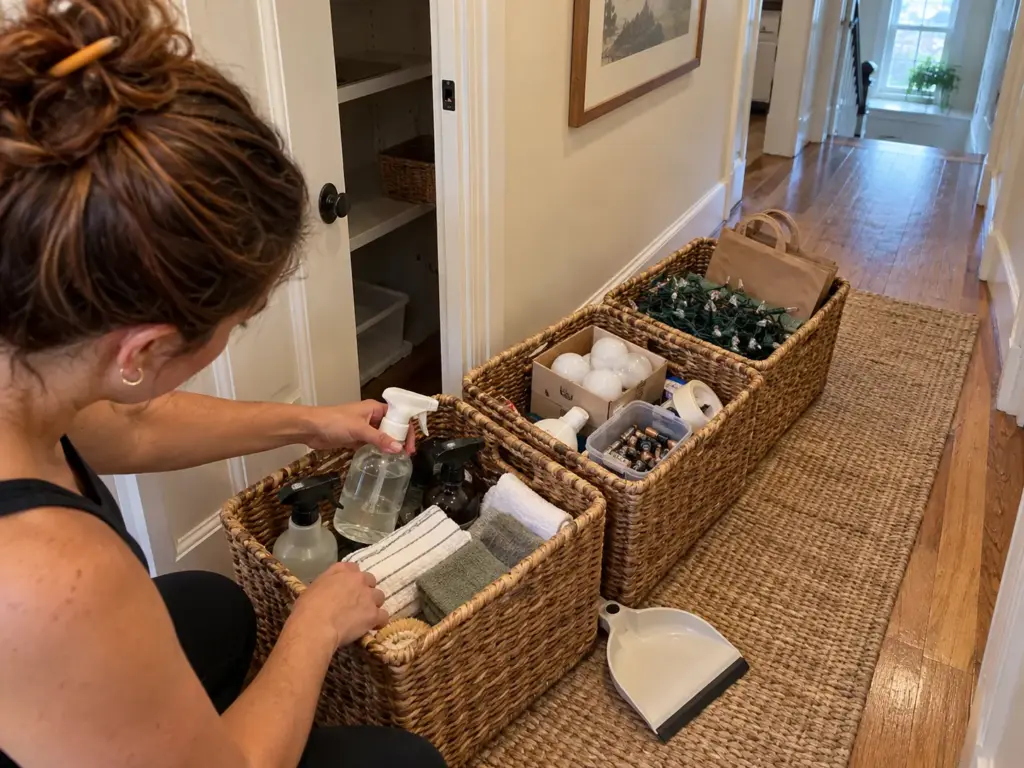
Daily things go at hand height and at the front of their shelf (frequency zoning, if you want a name for it): the dustpan, the spray bottle, the cloth you use after every meal. Weekly things go one zone away, at mid height or lower, and the vacuum belongs here too. Rare and seasonal things go high or out. A closet sorted this way stays shut more easily, because the stuff that moves the most is the stuff that no longer needs the door held open while you search.
Heavy things low, rare things up top
Put the mop bucket and the toolbox on the bottom shelf instead of the floor, since, as one renter put it, the floor is where the mop drips. Weight low also keeps the top shelf light, which matters if a child can climb. A February 2024 Consumer Product Safety Commission release advises people to “store heavier items on lower shelves,” and the same release says children under 18 suffered 44 percent of injuries from furniture, TV and appliance tip-overs. The release is about furniture in general, not about closet shelving, but the advice carries over: heavy low, light high.
What to carry out of the closet
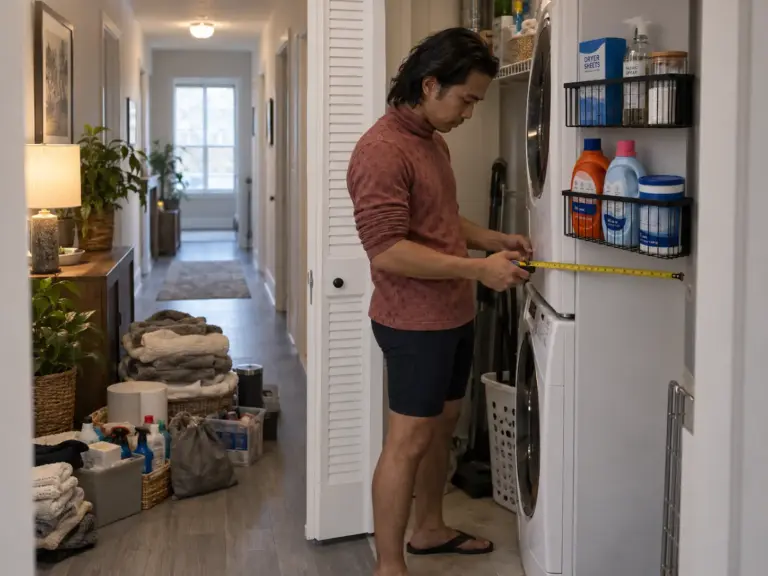
Seasonal storage and overflow with no daily or weekly job are the first to go, and where they go is your call. If they need a home, a commenter pointed out that small cabinets and bookshelves sometimes turn up as free shelving on Facebook Marketplace, which beats buying a rack for things you touch twice a year. Another shared-use space, a laundry closet that has to hold the same mix of cleaning gear and everything else, runs on the same daily, weekly and rare split.
Brooms, Mops and the Vacuum Without Adding Depth to the Door
In a broom closet that is also the coat closet, long handles are the first things to lean against a wall and slide into the door’s path. An over-the-door hook rack is the answer only if the door and the gap both allow it, so start with what costs nothing.
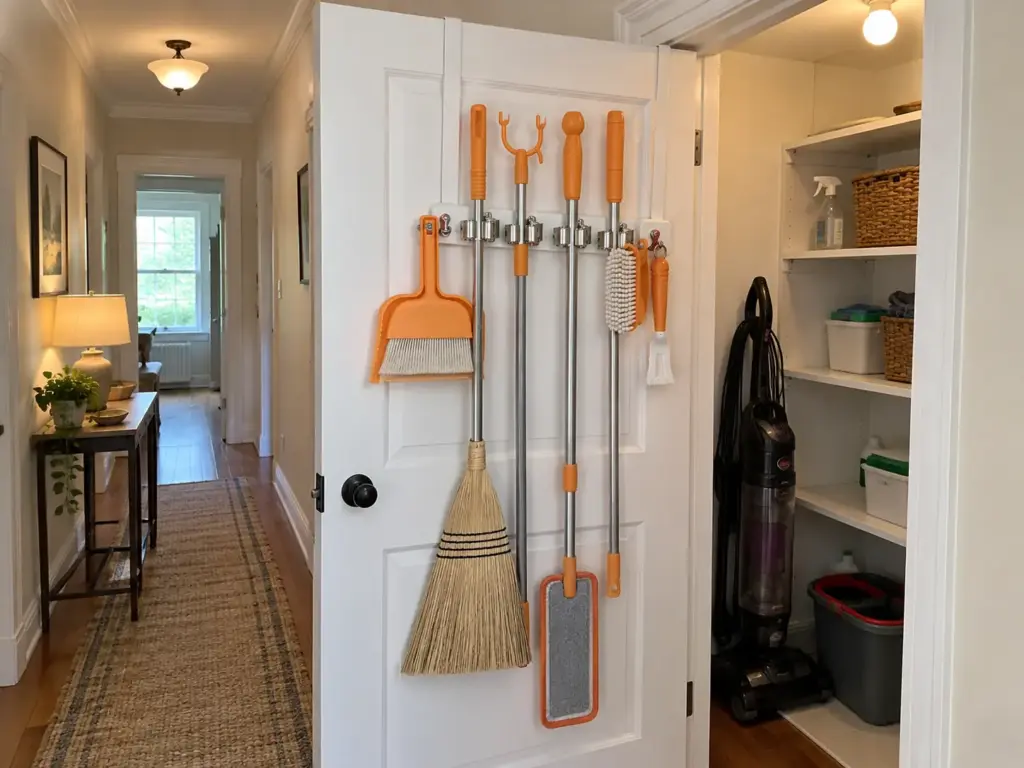
The free fix first: a corner, a bucket and a hook
Stand the long handles head up in one corner of the floor zone, or in an empty bucket so floor clutter stops sliding into the door’s path. Hang the dustpan on a single light hook (a commenter’s line for rentals was command hooks for brooms and such, which only works for the lightest things). For the vacuum, the renter advice was to leave it standing on the floor in the gap beside the shelf, with the cord wrapped and clipped to its own hook so it does not drape across the door opening. The same commenter put a full-size upright at 15 to 20 pounds, which is more than adhesive hooks will hold.
An over-the-door rack: what the door can carry
The usual advice is to put a rack over the door and be done. It breaks the moment the door is hollow-core, because the rack’s weight rating on the box is not the door’s rating. One home-improvement estimate puts a hollow-core door at around 20 to 30 pounds, and a rack with two mops, a wet mop head and a dustpan can use a lot of that before a single coat goes on. So the door is the limit, and the rack is only as good as the door behind it.
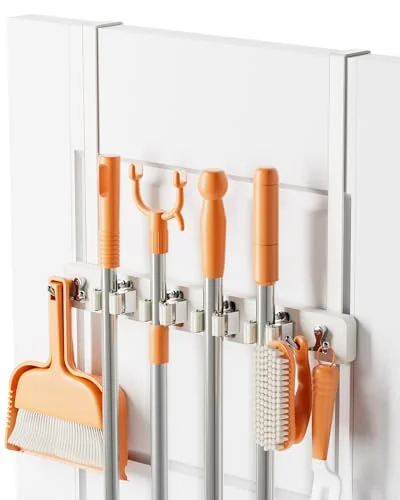
Then the depth. Measure the door’s thickness and the rack’s depth, and subtract the depth from the gap you measured earlier. The Vosturdy Mop and Broom Holder, a four-slot broom and mop holder, is listed at 2.6 inches deep and 17.32 inches wide, with four slots and four hooks, and it fits doors up to 1.9 inches thick. It hangs over the door with no drill, which is why it suits renters.
The shelf rating of 30 pounds is the seller’s claim, and the one 3-star reviewer wrote the holders were “a bit too small to accommodate most poles” and had to bend them to fit a rod. Check your pole diameter against the slots before ordering.
Where the vacuum goes
An upright vacuum is too heavy for most doors and too awkward for most racks, so it stays on the floor, in the gap beside the shelf, with the cord clipped. If your closet backs onto a solid wall and you own the place, a wall-mount broom holder, like a wall-mounted rack for long-handled tools, takes the handles off the floor without touching the door at all. That is the owner’s route; the renter’s is the corner and the bucket.
Shelves and Bins for the Weekly Stuff
The weekly bin is the one that fails: sprays, cloths and bulbs in one pile that nobody can search. A bin with a fixed job and a front that faces out ends the pile.
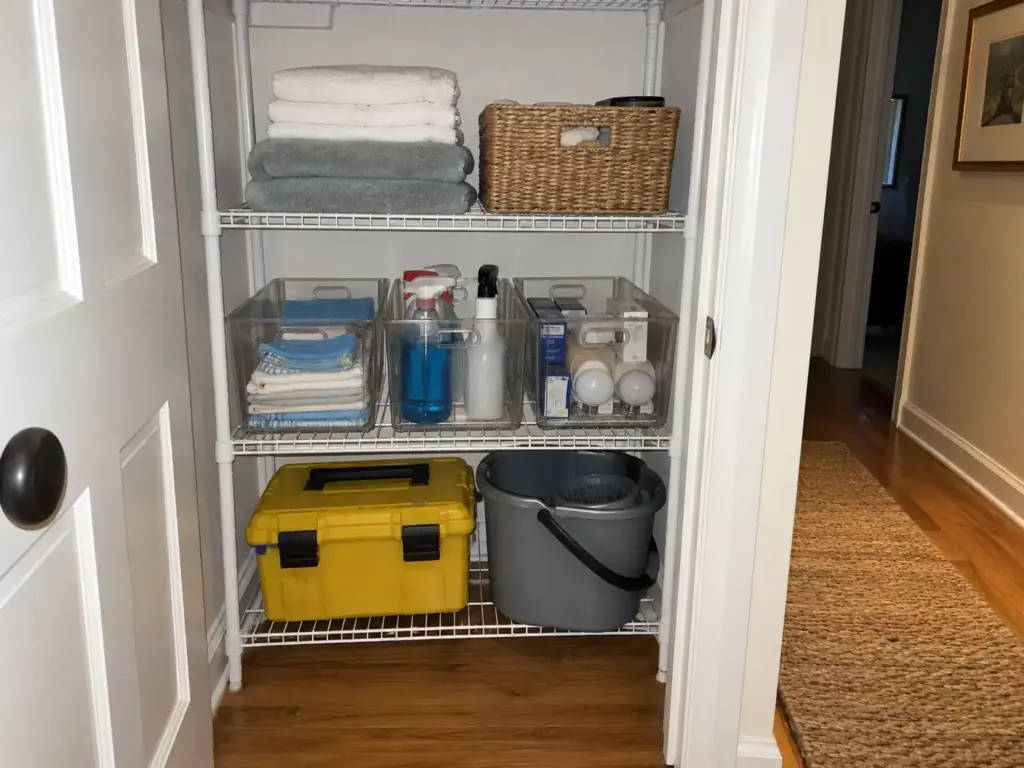
Freestanding unit or the shelves you have
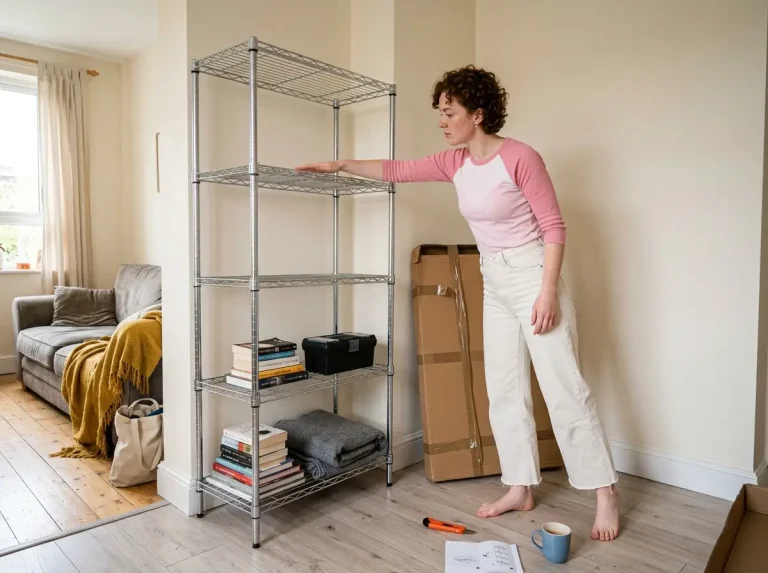
Use the shelves already in the closet before you buy anything. If you need more, a freestanding unit goes in without a drill, and the original poster of the r/organizing thread was in exactly that spot: a tenant who could not install shelves into the wall and had to find a standing shelf instead. Owners can fix shelves to the wall, and freestanding shelving units that won’t tip over are the better pick when the closet sits against a wall you do not want to drill. If the closet backs onto the garage, garage shelving units that fit totes are worth a look too.
Measure the shelf and the gap in front of it before you buy a unit, because a shelf depth that suits your bins can still eat the walking room. The tallest, deepest unit is not automatically the better one, since the room in front of the shelf is what lets you reach the back row and still close the door.
Weight is the other limit. A landlord on BiggerPockets described a tenant who overloaded two sets of closet shelves with clothes on hangers, and they collapsed the following month. The repair showed some clips had pulled their anchors out of the wall. Hanging weight and heavy loads are what drag shelves down, not the bins.
Bins for mixed small items, front-facing
One job per bin, front facing out, labeled. Labeled bins only work if the label names a job. A bin labeled miscellaneous is the one the main guide warns about, because it becomes the new pile within a month.
Clear bins let you see the job from the doorway; solid ones hide a mess, so choose by how your household searches.
Name every bin for its job: bulbs and batteries, cloths and sponges, refills. If a bin cannot be named in two words, split it. And keep the label on the front where you can read it from the doorway, since a label on top is a label nobody sees. For bins that fit the shelf you have, start with storage bins that fit real closet shelves, and match them to the shelf and the gap before you choose a size.
Trace each bin’s footprint on the shelf with masking tape once you have placed it. When a bin comes back from the kitchen it has a spot to return to, and the front edge stays flush instead of drifting toward the door.
Anchor anything tall
A tall unit in a closet a child can open needs to be anchored. According to CPSC’s Anchor It! campaign, “Anchoring all furniture with drawers, doors, and shelves to the wall prevents tip-over injuries and deaths.” Renters can relax about the hole: the same campaign says covering the holes from anchors won’t be a problem when you move out.
Coats and Bags in a Closet That Isn’t a Coat Closet
Coats are the first thing to break the shut-door promise. A sleeve in the hinge gap, a bag on a hook that hits the shelf behind it. Decide first whether coats belong on the door or on a side wall.
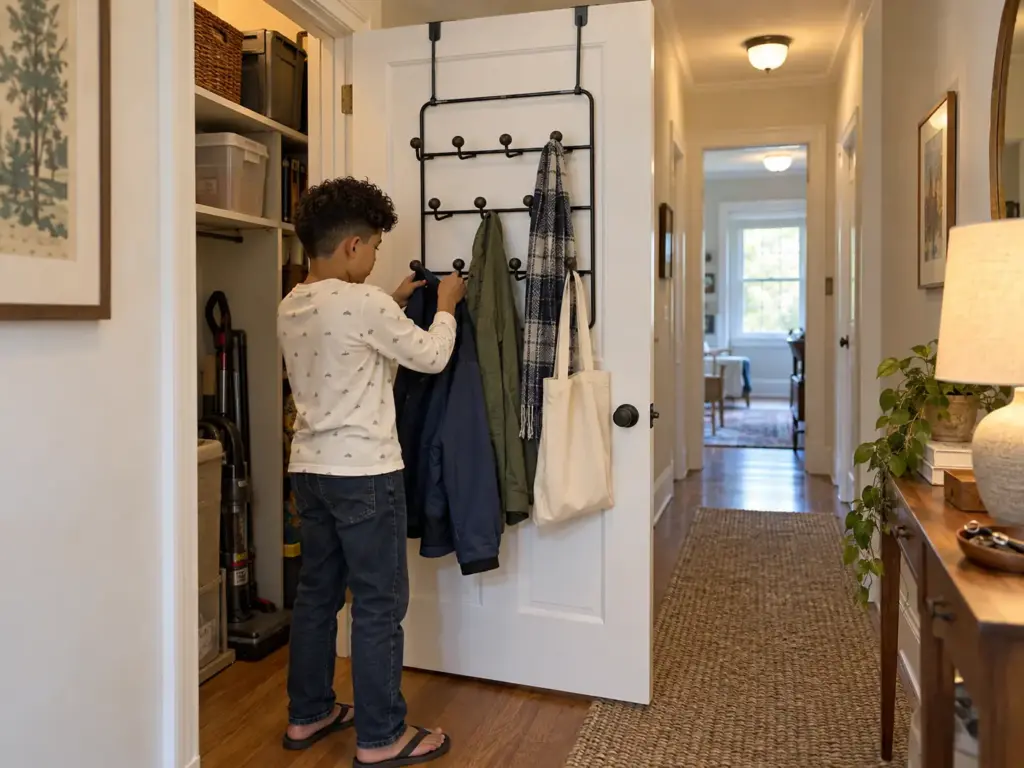
The back of the door: what it can take
Start with the free option: fewer coats on fewer hooks. One commenter in a shared closet kept the heavy winter coats on the top shelf and two everyday coats on the door, and that split is the one that survives a busy week. If the heavy ones do not fit anywhere else, bulky winter coats in a small space covers where they go.
The clearance maths is plain subtraction. Take the gap you measured at the start and subtract the rack’s depth.
The Umbra rack is listed at 4.25 inches deep, the Vosturdy holder at 2.6 inches, and the Xabitat ironing board folds to 0.8 inches. Put those three side by side and the door budget decides the winner before hooks or looks do. A rack deeper than the gap means the door will not shut, and a hollow-core door may not carry a full load of coats either.
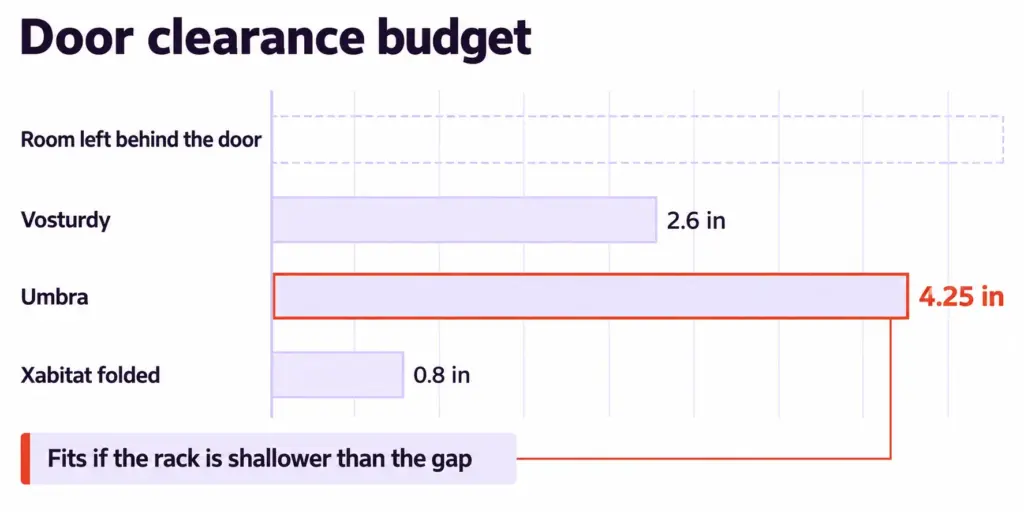
The obvious pick for the back of the door is the rack with the most hooks, and in a closet with a generous gap it is the right call. When the gap is tight, the better choice is fewer hooks that hang shallow, or moving coats to the side wall altogether.
The Umbra Estique Over-the-Door Organizer has 14 hooks, measures 14.25 x 4.25 x 23.75 inches, and fits doors up to 1.5 inches thick, so measure the door’s thickness first. Reviewers wrote that the frame wobbles and “bumps against the door when the door opens and closes,” and one found the bracket too narrow for a standard door and returned it. For more options, see over-door organizers that fit your door.
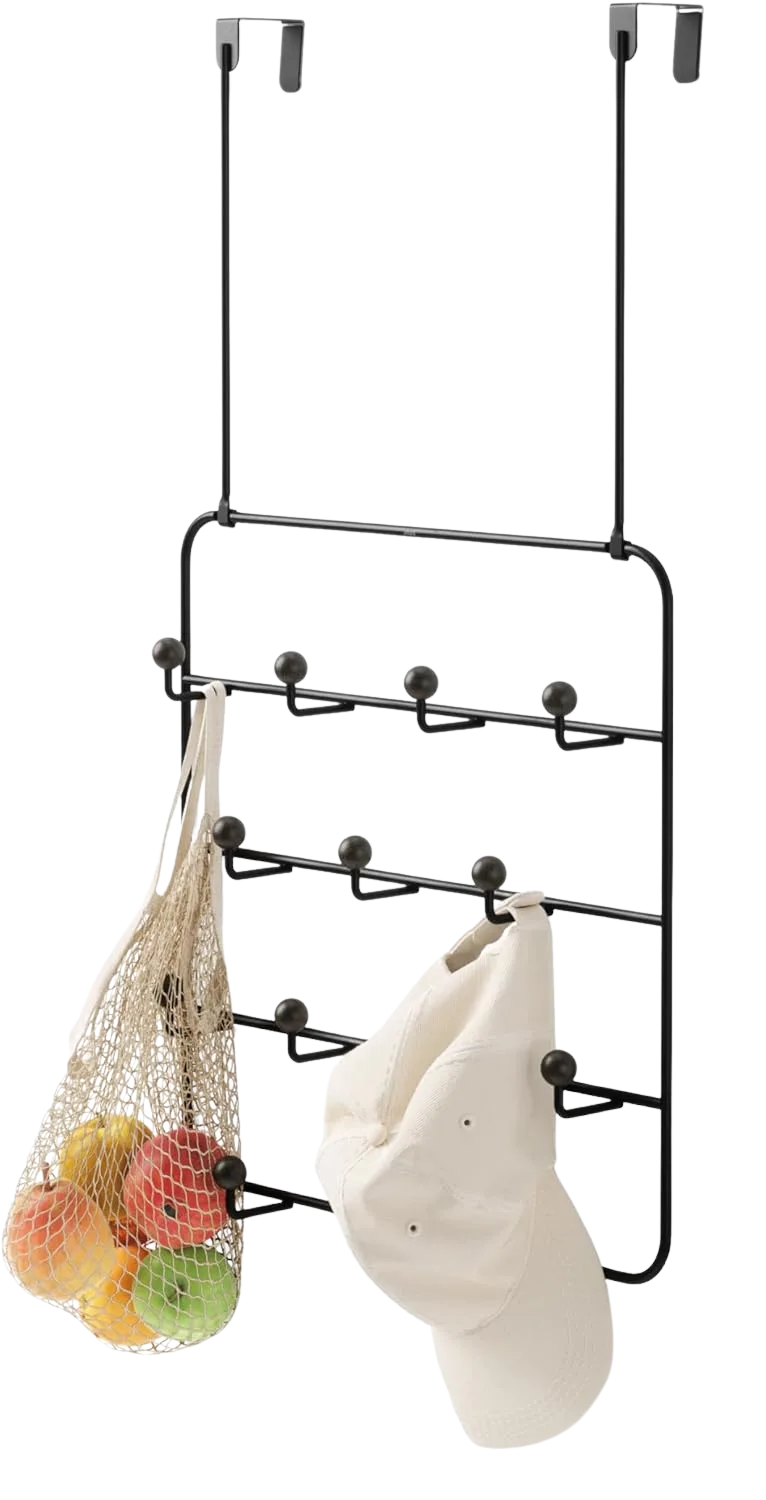
Whichever rack you choose, load it with the coats you actually wear, then close the door and open it twice. If it bounces, the rack is too deep or the coats are too many.
A side wall when the door cannot
When the door has nothing left to give, move coats to a side wall. The Dseap Coat Rack Wall Mounted (5 tri hooks, two in the pack) is screwed in, so it is not renter-safe, and it only makes sense for an owner who can drill. Two-star reviewers were frank about the hardware: all 12 screw covers broke in half for one, another found it impossible to keep the rack from wobbling, and a third called the hooks flimsy plastic colored to look like stainless steel. Check how firmly it sits in the wall before you load it with winter coats, and keep the heaviest coat on a shelf instead.
Mark the hook height with the coats you actually own, not with the coats the product photo shows, and check that the open door does not swing into them.
Renters and owners: which route
Renters get the door route, with the thickness check first. Owners get the side wall, and the door stays clear. One caution applies to both: the door carries only so much, which is why over-door shoe storage that won’t wreck your door is worth reading before you stack a shoe rack on top of a coat rack.
Ironing Gear and Linens Without Crowding the Door
The ironing board is too tall to hide and too awkward to hang. Leaned against the door, it keeps the door open all by itself. Folded flat against a side wall, it adds almost nothing.
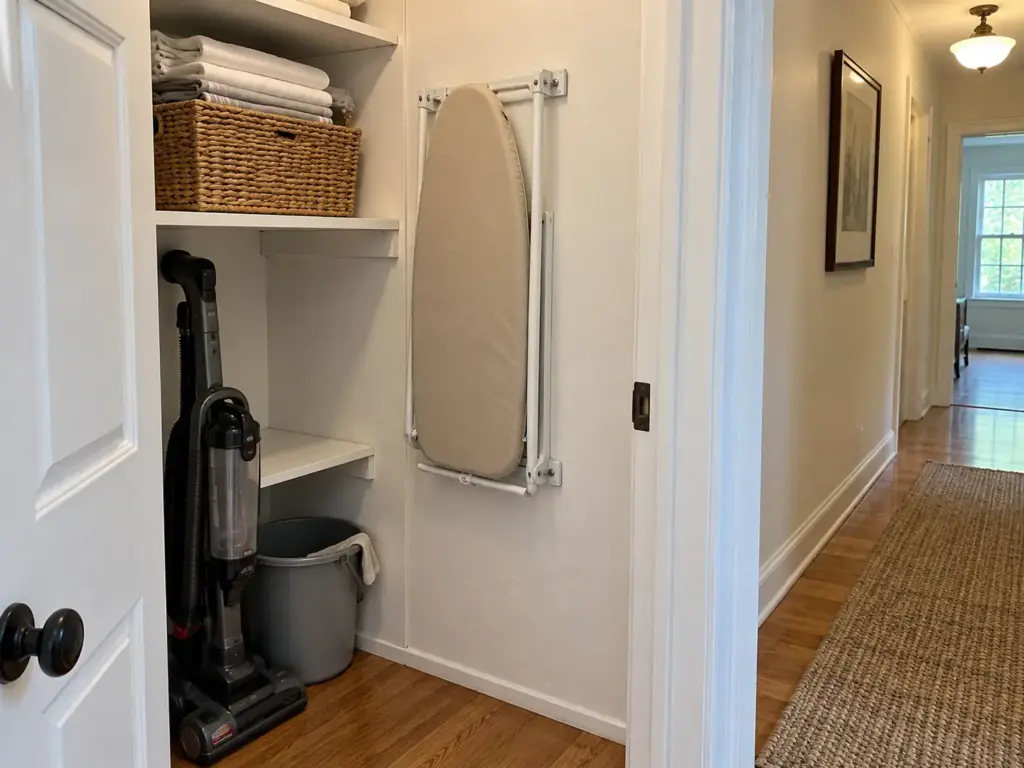
Ironing board: fold it flush to a side wall
If you already own a tabletop board, keep it on the upper shelf, since it takes no wall and no door. That is the free option, and for most renters it is the right one. If you own the place and want the board off the shelf, the Xabitat Wall Mounted Ironing Board is a 36.2 x 12.2 inch fold-down board that is 0.8 inches thick folded and rated at 25 pounds. It folds flush to a side wall, so it never hangs from the door.
The flaw is the hardware. The listing itself says “Not to be mounted on a non load bearing dry wall,” and several two-star reviewers wrote that the included anchors are not made for drywall. One reviewer pointed out that the mounting holes are 12 inches apart while wall studs in the US are 16 inches apart, so it needs a stud or a solid wall. See the Xabitat board only if you can drill; if you cannot, no-drill ironing station organization covers the surface route.
Linens on the upper shelf
Spare sheet sets go on the upper shelf, folded into a bin, out of the daily reach zone from earlier. A set you use a few times a year does not need to sit at hand height, and a linen closet that stays neat shows how to fold them so they stack flat and stay that way.
Keeping It Shut: The Monthly Door Test
Maintenance here is one habit. The closet does not fail in a day: it fails one extra bag at a time, until the door stops closing and the household starts leaving things in the hallway instead.
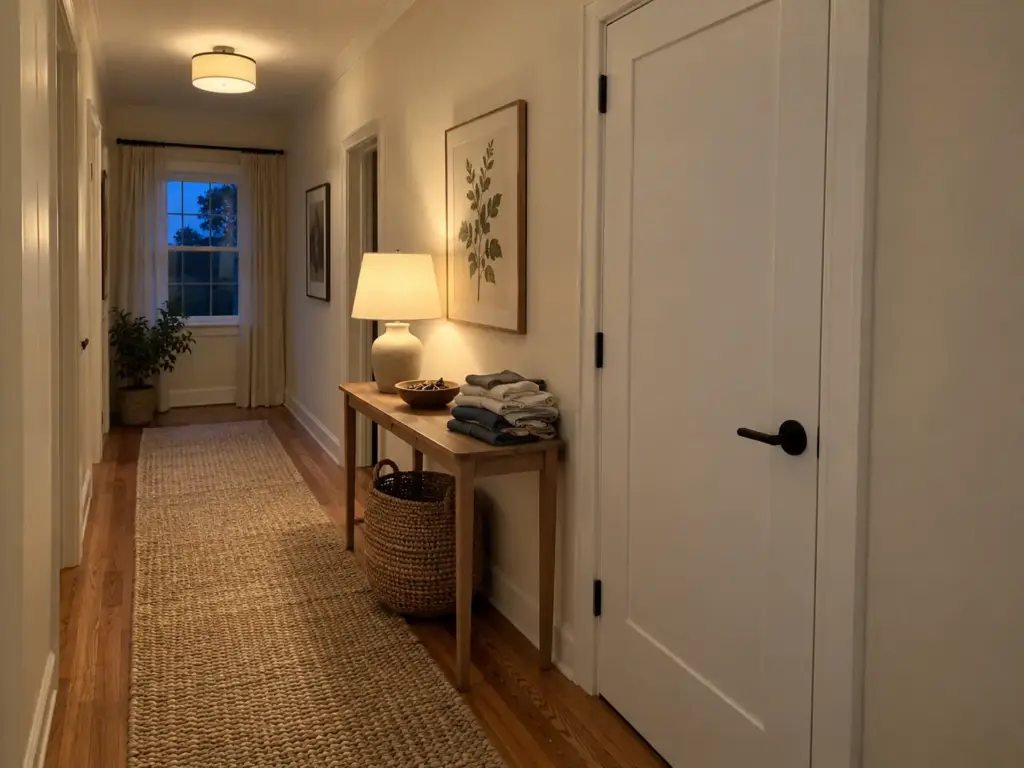
Run the door test once a month
Close the door, open it twice, and check the hook line and the front of the lowest shelf with a hand. If the door bounces, something has crept forward. Front-facing is the other rule: every bin shows its front, and whatever sits at the back is whatever nobody is using. Pull one thing from the back each month and ask whether it earns the spot; the closet shrinks that way without a big reset.
If the door bounces, look at the hooks first: the wet umbrella, the bag hung on the way out and the guest coat all land there.
Pick a fixed day for the door test, the first of the month or whenever the trash goes out. A check tied to a chore you already do gets done; a check tied to an intention does not.
Chemicals stay up, away and locked
Cleaning chemicals follow their own rule: up, away and locked. The daily kit does not need to live in this closet at all, and cleaning supplies you keep under the sink has its own article.
When the closet fills up again
It will. When it does, empty it and start again from the sort in the first section.
One commenter’s order of work still holds: “Declutter. Then shelves bins and hooks.” Overflow that has no job in the closet belongs somewhere else, and if that somewhere is the garage, organize the garage so nothing gets lost again is the place to start.
Let the Door Set the Order
Three things carry this guide. The door sets the order, so measure the room it has left before you buy a rack. Sort by reach, with heavy things low and light, rare things up top. And subtract each rack’s depth from the room left, because a rack that does not clear the gap is a door that does not shut.
Three months from now, run the door test again and put a hand on the heaviest shelf. If the door bounces or the shelf has started to bow, something crept forward, and the monthly check will have caught it earlier than you would have noticed.
Today, with what you already own: close the door on the closet exactly as it is, and see what stops it. Write that one thing down. It is the first item on the list, and it costs nothing to find. When you are ready for the rest of the reset, the full utility closet system picks up from there.
Frequently Asked Questions
01What is the best way to organize a utility closet?
Empty it, sort everything by how often you reach for it, and give every long handle a home that does not push the door open. Keep heavy items low and light, rare ones high, and test the door shut before you buy anything.
02What do you put in a utility closet?
A utility closet holds the floor tools you use daily, a weekly cleaning kit and a few rare spares. Medicine and seasonal décor belong elsewhere, and cleaning chemicals follow the up, away and locked rule from the full utility closet guide.
03What are common closet mistakes?
The common mistakes are an over-the-door rack deeper than the gap behind it, heavy items on the top shelf, a miscellaneous bin, and a rod or cart nobody ends up using. Most come from buying before measuring.
04What is the best order to organize a closet?
Empty the closet, sort it, measure the space, and only then buy. Shelves, bins and hooks come last, and hooks come last of all, because they are the pieces that add depth to the door.
05Can you organize a utility closet without drilling?
Yes. An over-the-door rack, a freestanding shelf unit and a tabletop ironing board all go in without a drill. The wall-mounted ironing board and the side-wall coat rack in this guide both need screws, so renters should skip them.
Disclaimer: ClutterlessNest is a participant in the Amazon Services LLC Associates Program. As an Amazon Associate we earn from qualifying purchases. This article may contain affiliate links — if you buy through them, we may earn a small commission at no extra cost to you. We only recommend products we have tested or genuinely believe in.