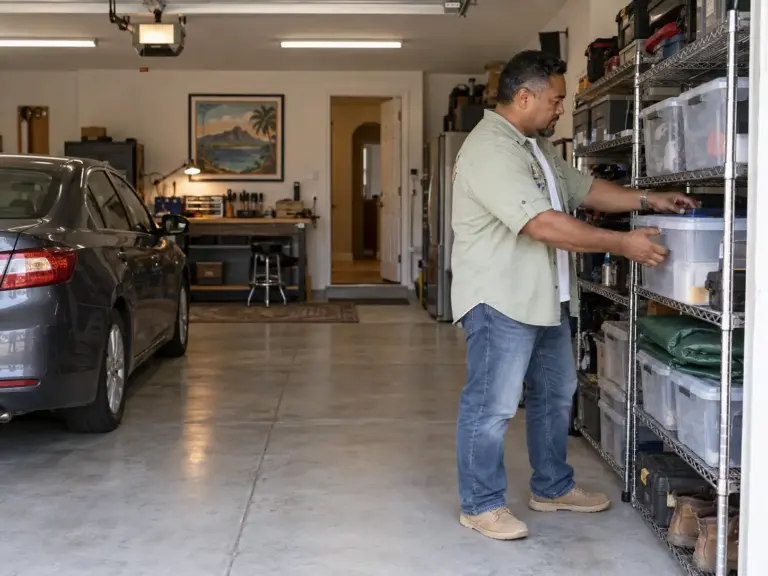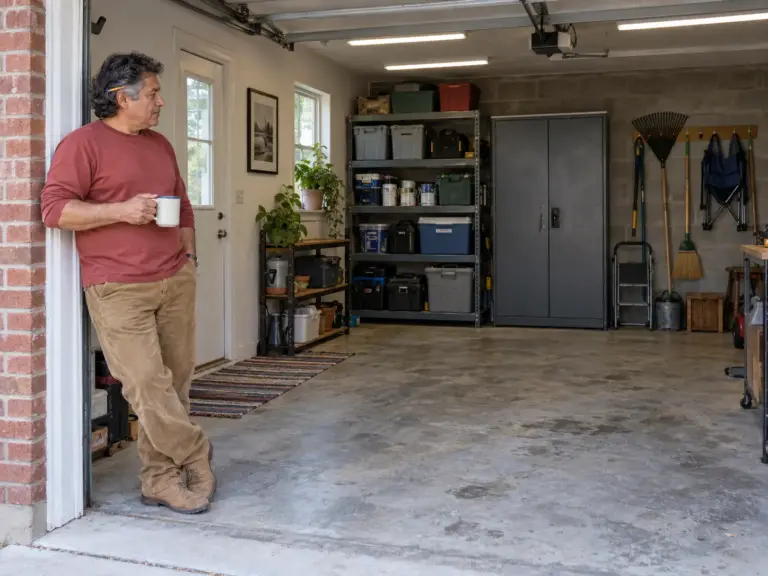
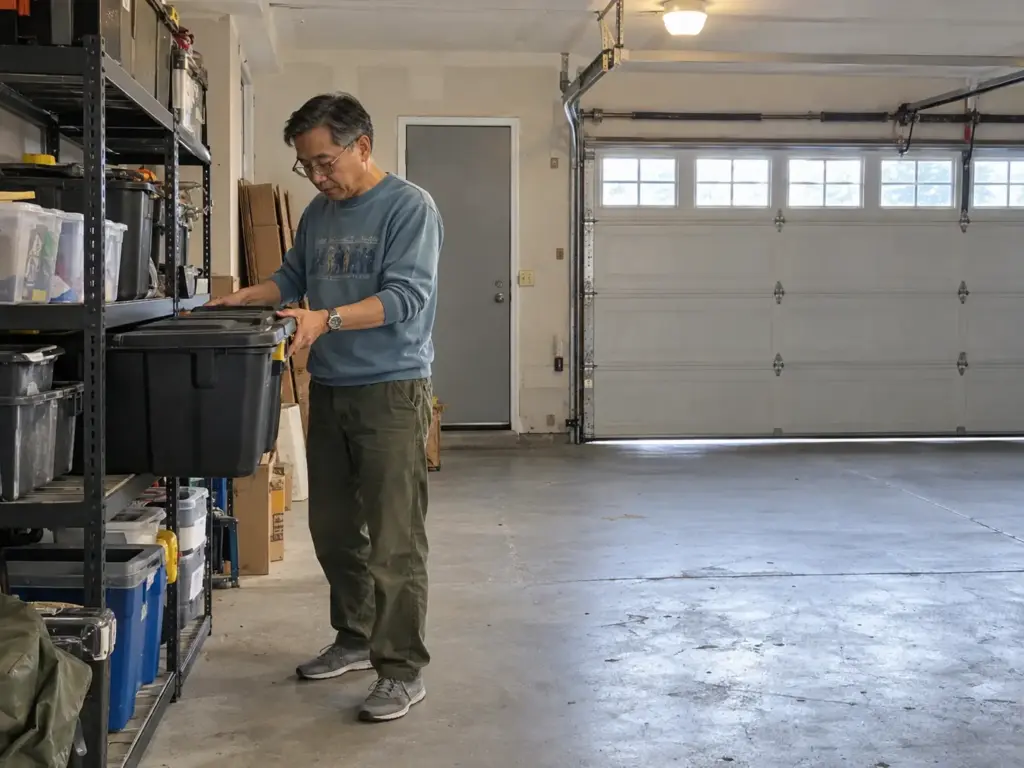
You slide a lidded 27 gallon tote onto the new shelf long side out, and the front of it hangs in the air past the edge. The second tote you planned to park beside it has nowhere to go, and the lid will not clear the shelf above anyway. The shelf is not too small for the tote, it is shallower than the tote is long, and that single number decides which of the best garage shelving units is worth buying for your bay. By the end you will know which material, depth, load rating and floor fix suit the totes you own, using the tote maker’s own spec and the failures buyers report, so the shelves fit into your plan for organizing the whole garage instead of fighting it.
Only one of the three units picked here is deep enough to take a standard 27 gallon tote long side out, and the table shows what the other two are still good for.
| Pick | Shelf depth | 27 gal tote, long side out | Best for |
|---|---|---|---|
| WorkPro 5-Tier 48 x 24 x 72 | 24 in | Clears, 4 3/8 in to spare | Heavy totes and tools |
| Seville Classics UltraDurable 5-Tier 36 x 18 x 75 | 18 in | Hangs over by 1 5/8 in | Small and mid-size bins; wire with leveling feet |
| Amazon Basics 5-Shelf 36 x 14 x 72 | 14 in | Hangs over by 5 5/8 in | Light small bins only |
Wire, Steel and Plastic Garage Shelving Units, and Where Each One Gives Out
A box that says heavy duty garage shelving tells you almost nothing about how the shelf will fail. Metal garage shelving splits into wire and stamped steel, plastic is the third common type, and each gives out in a different place: wire at the feet and in the wide gaps between its slats, board shelves on a steel frame at the rails, plastic on load.
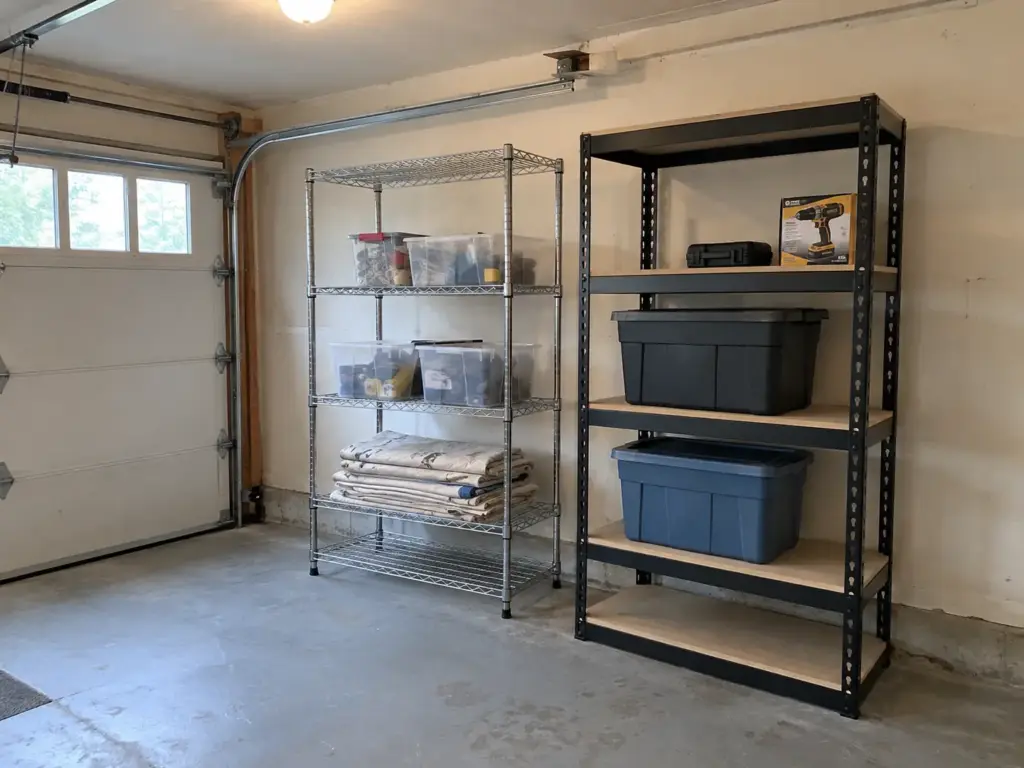
One editorial test of garage storage points out that most garages are neither heated nor cooled, so whatever you buy has to put up with temperature swings, humidity and blown-in debris. That is the test each material below has to pass.
What wire shelving does in a damp garage
A wire shelving unit has one real advantage in a damp garage: it is open. Lowe’s buying guide says the open construction lets air circulate around stored items and helps decrease mold and mildew in moist climates, and that some systems add a plastic coating against rust. That matters more than the finish name on the box, because cardboard and fabric bins soak up moisture long before the shelf itself shows a mark.
The rust question is where the sources split, and the split is useful. One commenter in an r/garageporn buyer thread says chrome wire “won’t ever rust,” while another buyer who has owned the three steel racks the poster was weighing says they “seem to rust eventually.” Read the maker’s wording before you trust either claim.
The Seville Classics listing for its steel wire unit says the shelves and poles are plated steel for protection against corrosion “in dry environments,” which is a narrower promise than rust-proof. An unheated garage or a basement with a damp slab sits outside that sentence. No test shows how long chrome lasts in such a room, so treat “won’t ever rust” as one buyer’s report, and watch the feet first, since they are the part touching the slab.
Shelf spacing is wire’s other weakness. An Amazon Basics reviewer notes that the spacing is large, so bottles and other small items tip over easily. A commenter who runs wire racks in the thread answers that with a shelf liner on only the shelves that need one, because everything else lives in bins and a bin does not care about slats.
Where stamped steel with board shelves gives out
Stamped steel shelving with board shelves looks like the sturdier choice, and in the garage it feels it: solid surface, nothing tips through. Its failure point is the rail. A buyer in the same thread who owns board-shelf racks bought on sale calls the metal-and-particle-board shelves “very thin and flimsy” and says they have “a tendency to pop in between the front/rear rails and fall through,” so they have to be careful loading them. The same buyer says their chrome wire racks “seem more sturdy” and do not ask for that care.
But that is one owner’s report, not a load test, and it is no reason to write off board shelves. It changes what you check: with a board shelf, find out how thick the board is before you read the load rating, because the number on the box says nothing about how securely a thin board sits in its seat. One editorial test of garage storage adds that the better units carry a powder coating that helps ward off rust and corrosion, so powder-coated steel is the finish to look for on a steel frame.
Plastic and wood: the other two types
Plastic shelving takes the rust question off the table, which is its case for damp rooms, and it sits at the low end for load. The HDX 5-Tier Plastic Garage Storage Shelving Unit (36 x 18 x 74 inches) is listed at 150 pounds per shelf, a fraction of what the steel units here carry. It is out of stock on Amazon right now, so it gets no link and no card. Treat it as the example of the type, and check the rating on any plastic unit before you trust it with heavy totes.
Wood shelving is the one material you build rather than buy. Lowe’s describes it as lumber and plywood on brackets, and the trade is plain: you choose the exact depth, so a 20 or 24 inch shelf is yours for the cutting, and in exchange you supply the labor and the saw.
Cabinets, wall rails and overhead garage storage racks are different tools with different failure points. Cabinets and rail systems get their own guide, so this one can stay on shelves.
How Deep a Garage Shelf Needs to Be for Your Totes
Most shelves get bought by bay width: the wall is this wide, so the unit is this wide. Depth gets read later, if at all, and it is the dimension listings bury in the product title. The original poster in that r/garageporn thread chose a 24 inch rack to fit more than the 18 inch racks allowed, and still reported that their 27 gallon totes “barely fit when I spaced the racks out evenly” and that they had to “line them up just right to slide them in.”
What a 27 gallon tote needs from the shelf
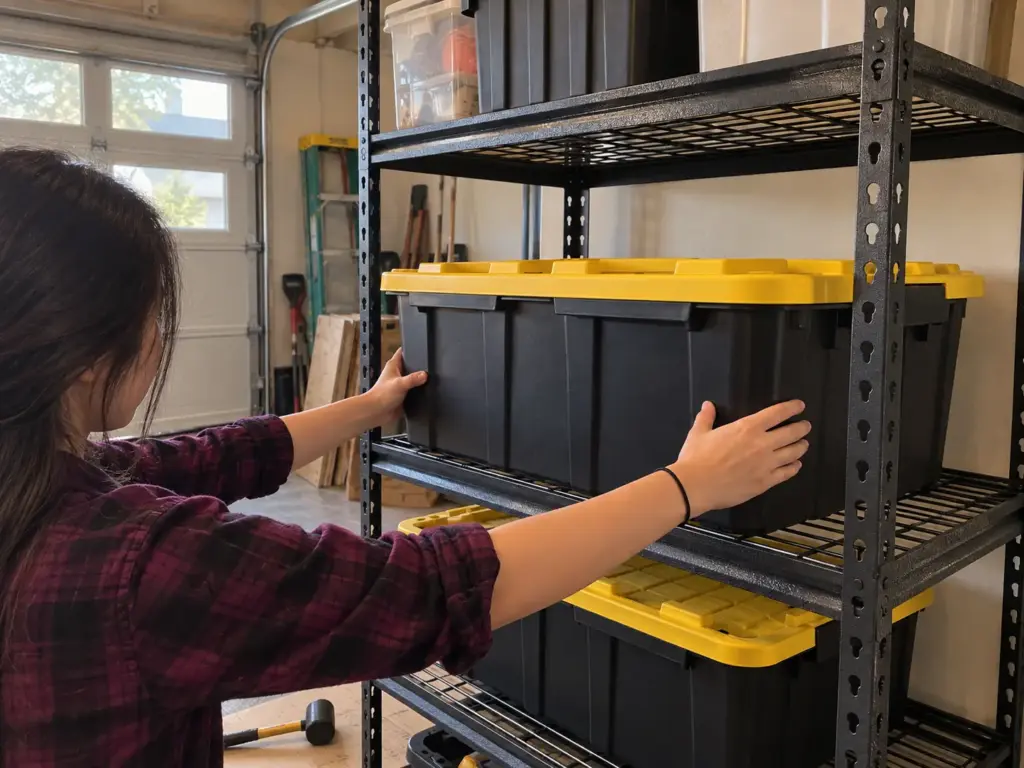
Sterilite lists its 27 gallon industrial tote (model 5076) at 28 1/2 x 19 5/8 x 15 1/2 inches, outside dimensions. Stand it long side out, the way nearly everyone loads a shelf, and the tote depth you have to clear is about 19 5/8 inches. One commenter describes the result on shallow racks in two short lines: “Long side out. So they stick out a few inches.”
Width is the other half. Two totes side by side long side out need about 57 inches. A 36 inch bay holds one with 7 1/2 inches left over, and a 48 inch bay holds one with 19 1/2 inches left, which is not enough for a second. So the common 48 inch unit is a one-tote-wide shelf for these totes (plan the bin count by the shelf, not by the wall).
Measure the tote you use most with its lid snapped on, then write down the front-to-back number it needs when it sits long side out. A spec sheet gives the maker’s outside dimensions; your tape gives the one that matters on your shelf.
Why 14 and 18 inches miss, and 24 inches clears
Eighteen inches is the depth most people quote for wire shelving, and for hardware, paint and small bins it is plenty. A commenter running chrome racks concedes they are “not quite as deep at 18” and adds that “they’re half the price,” which is a fair trade for the right contents. For a 27 gallon tote it is simply the wrong number.
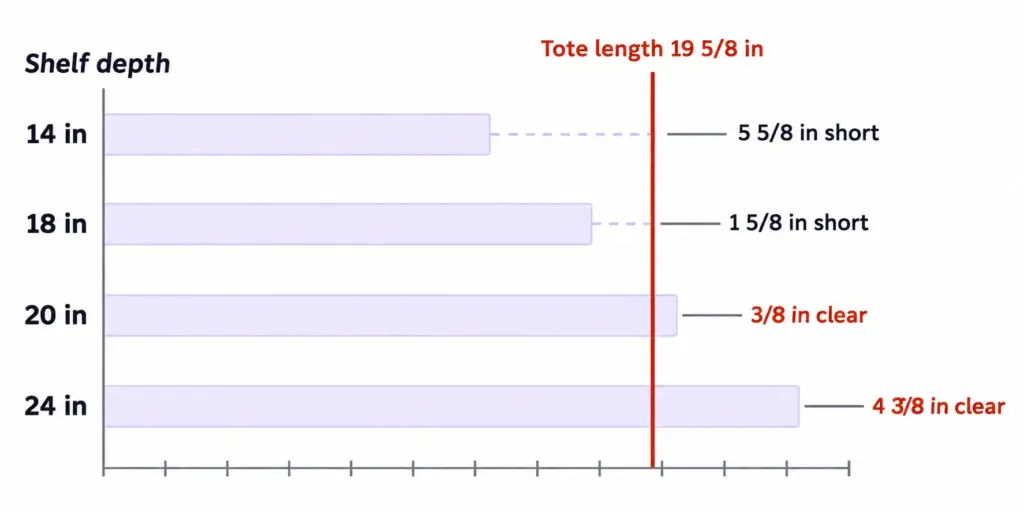
Here is the arithmetic against the 19 5/8 inch tote. A 14 inch deep shelf is 5 5/8 inches short, and an 18 inch deep shelf leaves the tote hanging 1 5/8 inches over the front.
And a 20 inch shelf clears it by 3/8 of an inch, a pass on paper and a squeeze with a lid and your fingers in the way. A 24 inch deep shelf clears it by 4 3/8 inches, enough to slide the tote in without lining it up like a puzzle.
The best garage shelving unit for deep totes
Start with the free move, which applies if your units are already bought. Do not turn the totes short side out to save depth: stood that way, a tote reaches back 28 1/2 inches, which is worse.
Go the other direction instead. Put smaller bins that fit real shelves on the shallow units and keep the 27 gallon totes for a deeper shelf. The cost is more containers to handle in exchange for no overhang.
When the totes are the point, 24 inches is the depth to buy, and the only unit here at that depth is the WorkPro 5-Tier Metal Shelving (48 x 24 x 72 inches). It clears a 27 gallon tote long side out with 4 3/8 inches to spare, and at 48 inches wide it carries one tote with 19 1/2 inches beside it. The price of that depth is garage floor space, so check the car bay clearance (the door swing and the mirror line) before you commit to 24 inches.
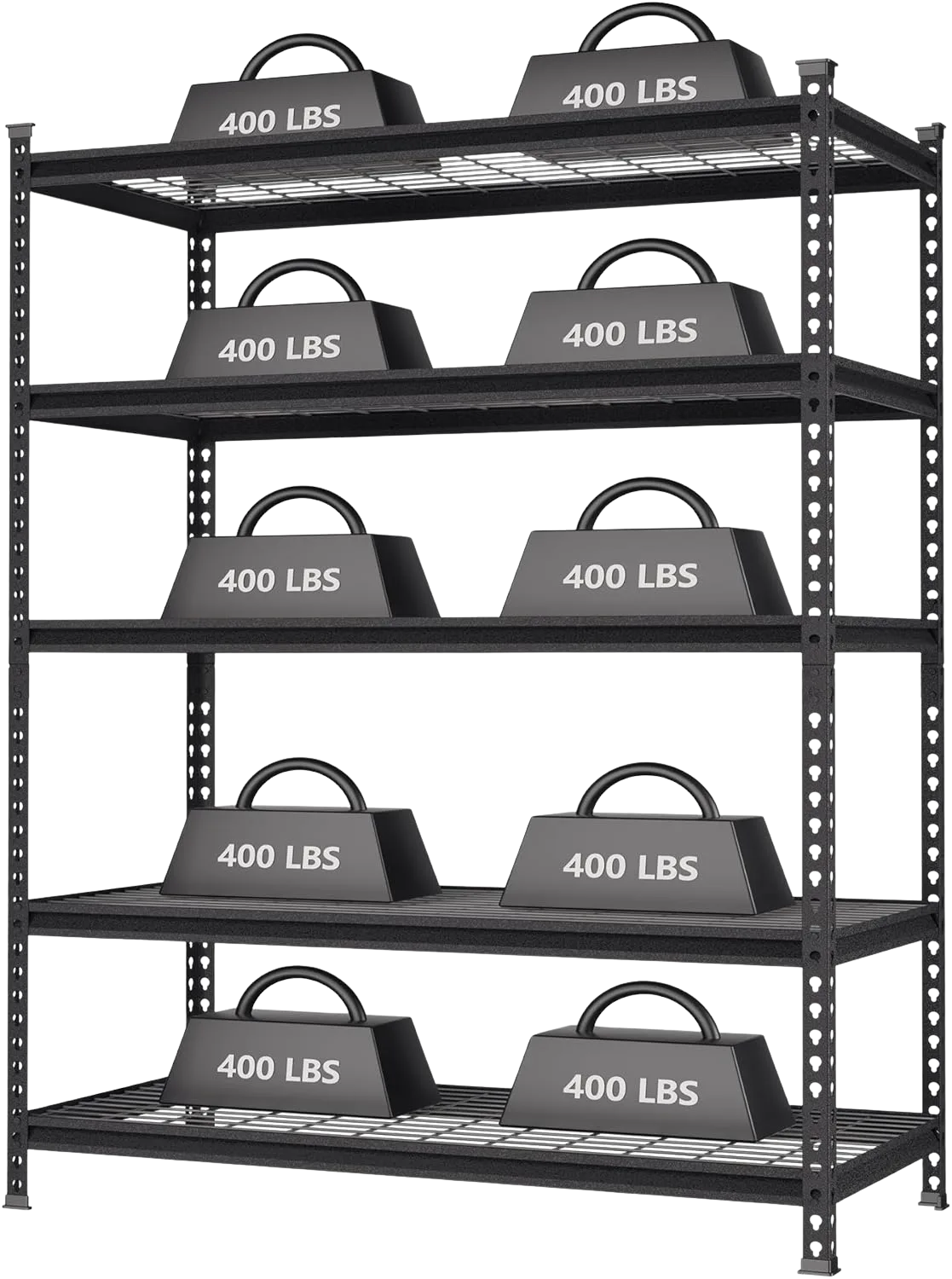
Its flaws are specific. A reviewer says the plastic end caps for the corner posts “simply DO NOT fit” and that the steel has to be “persuaded” back into shape during assembly, and the shelves are particle board per the title. The listing also disagrees with itself on load, 2500 LBS in the title and 800 pounds per shelf in the bullets, so work from the per-shelf figure and check it against the box.
How Much Weight a Garage Shelf Really Holds
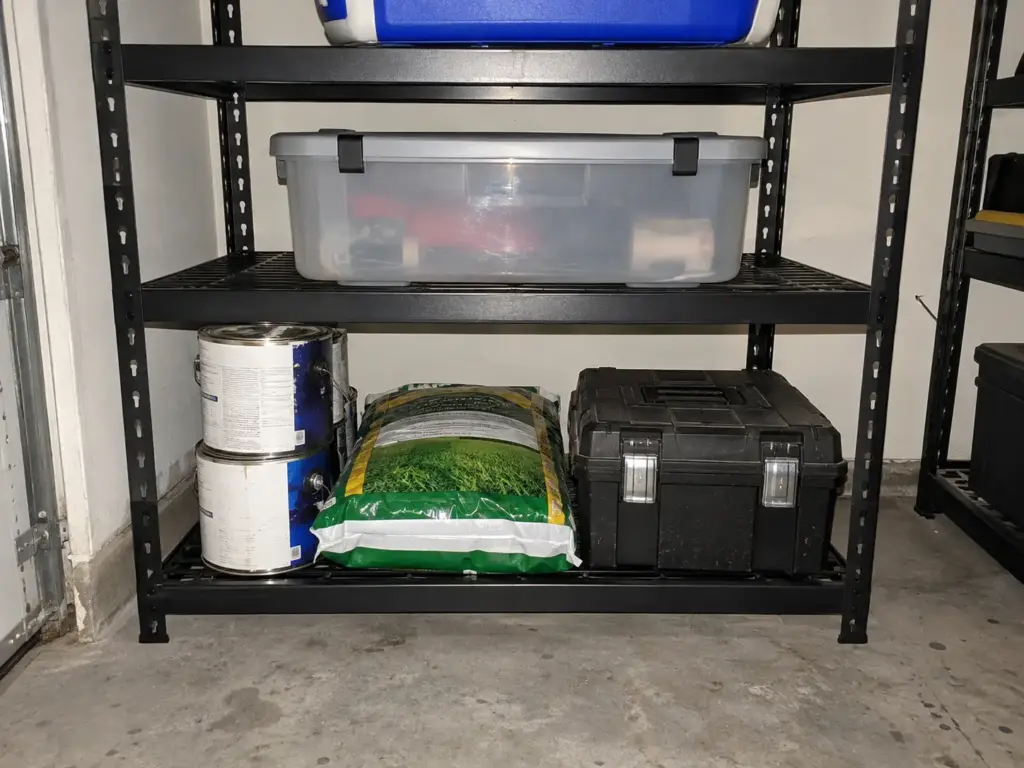
The weight capacity on the box is the number that sells the shelf, and it tells you the least. A rating comes from a load spread across the shelf. A toolbox parked on the front edge is an edge load, a different job, and the sections below deal with where weight really sits once the shelf is in use.
Why a rating assumes spread-out weight
Paul Callomon, a collection manager at the Academy of Natural Sciences of Drexel University, put the mechanism plainly in a collection manager’s warning about shelf deflection, posted to a museum conservation list: “Deflection depends on how numerous and evenly-spaced the load bearers are.” It is one professional’s post, not an institutional standard, and it describes what happens on a garage shelf all the same. The fewer points holding a shelf, the more it bends, which is the shelf sag you notice in the middle of a loaded board, and a concentrated load matters more than the capacity printed on the box.
That is why a rating arrives with its condition attached. A six-tier wire unit in one editorial test is listed at 650 pounds per shelf “if evenly distributed,” and the condition sits in the same sentence as the number. Sliding counts too: an Amazon Basics reviewer warns that “if you’re dragging heavy boxes on and off the shelves the whole thing can flex,” and no rating describes that load.
A listing can give you two numbers, a per shelf capacity and a total weight capacity, and your boxes meet the first. The WorkPro listing shows why it matters: its title and its bullets give different load figures, so read the per-shelf one and check it against the box.
Lift heavy boxes onto a shelf and set them down in the middle instead of dragging them across the wire or board. Sliding adds a sideways push the rating never counted, and the frame is what takes it.
Heavy and dense low, light and bulky high
Sort by density, not by category, because load placement decides how a shelf behaves. Put heavy items low: paint cans, tools and bags of fertilizer go on the lowest shelves and toward the middle of each shelf, where more of the supports share the load. Empty coolers, holiday bins and anything bulky but light go up high.
The mechanism is plain: low weight keeps the center of mass near the floor, and a centered load presses evenly on both rails instead of tilting onto one. Deciding which tools belong on a shelf and which belong on the wall is a separate sort, and it pays off here because it shrinks the heavy pile.
The shelf that pops out between the rails
Shelf pop-out is how a board shelf escapes its seat. The owner of the board-shelf racks in the r/garageporn thread says the shelves pop in between the front and rear rails and fall through when loaded carelessly. They say they have “considered getting some 1/4 or 3/8 all thread and some nuts to brace the centers so they can’t flex outward.”
That is a plan they considered, not one they report testing, so file it as an idea and not a repair. The same buyer finds their chrome wire racks more sturdy and says those ask for less care while loading.
If what you need to store is short, dense and heavy, freestanding shelving is the wrong tool altogether. Shelves that mount to the wall spread that load differently and keep the floor clear for the units that handle bulk.
Uneven Floors, Leveling Feet and Adjustable Shelves
Garage floors are rarely dead level, and on an uneven garage floor a tall unit with four feet will tell you. One editorial tester had to level a garage cabinet before its doors would line up, and a wire shelf has no doors to warn you: it just rocks.
Why a wire unit rocks on a slab
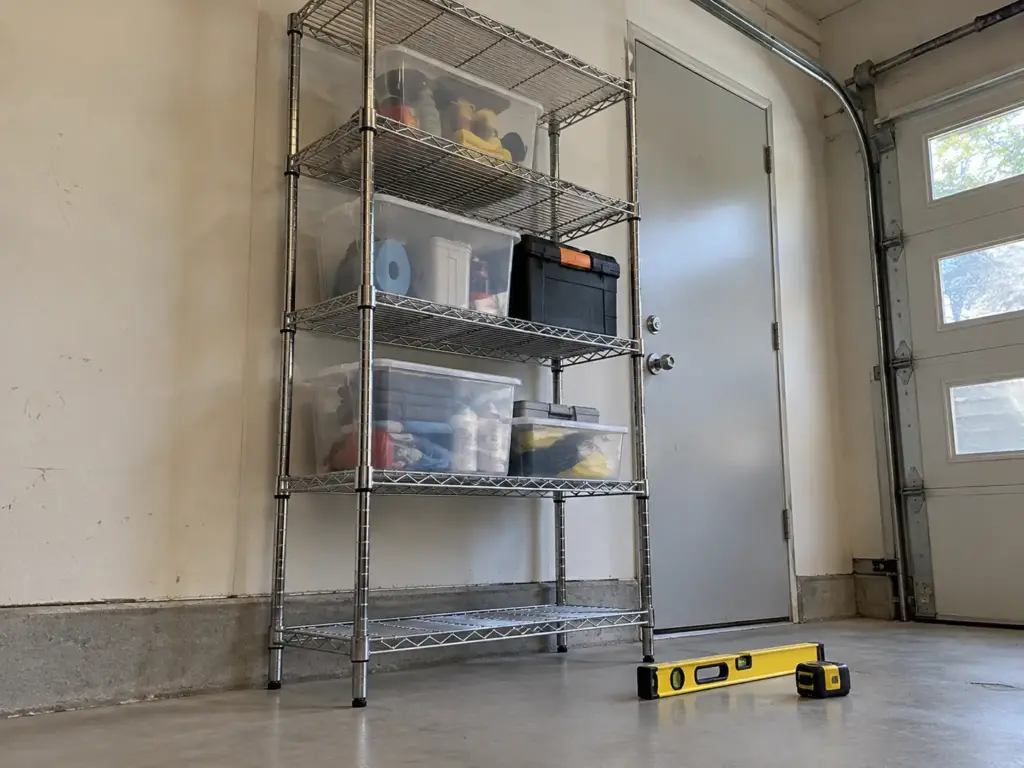
One Amazon Basics reviewer calls the unit “very wobbly with nothing on it.” A freestanding unit stands on four feet, and four points only share a plane on a flat floor. On a sloped slab or one with a low spot, one foot hangs a hair above the concrete and the unit rocks across the diagonal. Stacking weight on top does not cure that, it flexes the frame through the rock.
A tall, loaded unit that rocks is also a tip-over risk. According to the Consumer Product Safety Commission’s Anchor It! campaign, “Anchoring all furniture with drawers, doors, and shelves to the wall prevents tip-over injuries and deaths.” A unit that rocks has the strongest case for it, and freestanding units that won’t tip over covers the tip-over side in detail.
One tester who used a wire unit’s adjustable feet and then wood blocks as shims still said it feels like it should be “stabilized or anchored (or both).” How you anchor depends on your wall, and a wall plan for the garage sorts out wall types and mounting.
Feet first, shims second, casters only for units that move
Start with the feet. The Amazon Basics listing gives its unit four leveling feet “for stability,” and the Seville unit has four adjustable leveling feet as well. Turn them until the unit stops rocking with a level on the top shelf.
Where the dip is larger than the feet can travel, slip a wood block under a foot as a shim, which is what that same tester did. It is one reviewer’s method rather than a standard, but the order makes sense: adjust what is built in before you add parts.
Check levelness in both directions before the first box goes on, then again after the first heavy load. A unit that is square when empty can settle once it carries weight, and the second check costs a minute.
Casters get recommended for garages because they promise flexibility, and on one of these units the price is written in the spec. The Seville UltraDurable lists 800 pounds per shelf and 4,000 pounds total on leveling feet, but 500 pounds total on wheels, an eighth of the total. Lowe’s draws the same line: feet suit units that stay put, lockable casters suit units you move.
Wheeled shelving earns its place in one case from the thread: a buyer keeps all but a couple of their units on casters so they can reach wall components such as electrical and plumbing, in a fully underground cellar. A rolling shelf needs a reason to move. If nothing behind the unit needs reaching, leave the wheels off.
The Amazon Basics 5-Shelf Adjustable Heavy Duty Steel Wire Rack (36 x 14 x 72 inches) is the budget route to leveling feet, with four of them and 350 pounds per shelf. At 14 inches deep it is a small-bins shelf, 5 5/8 inches short of a 27 gallon tote.
Its reviewers report two real problems. One calls it “very wobbly with nothing on it,” and a one-star review says “the brackets do not hold and they will suddenly disengage without warning.” So level it, seat every bracket fully, and give each one a firm tug before loading. It is the budget pick, so there is no cheaper unit to send you to.
Adjustable shelf height, and what it buys you
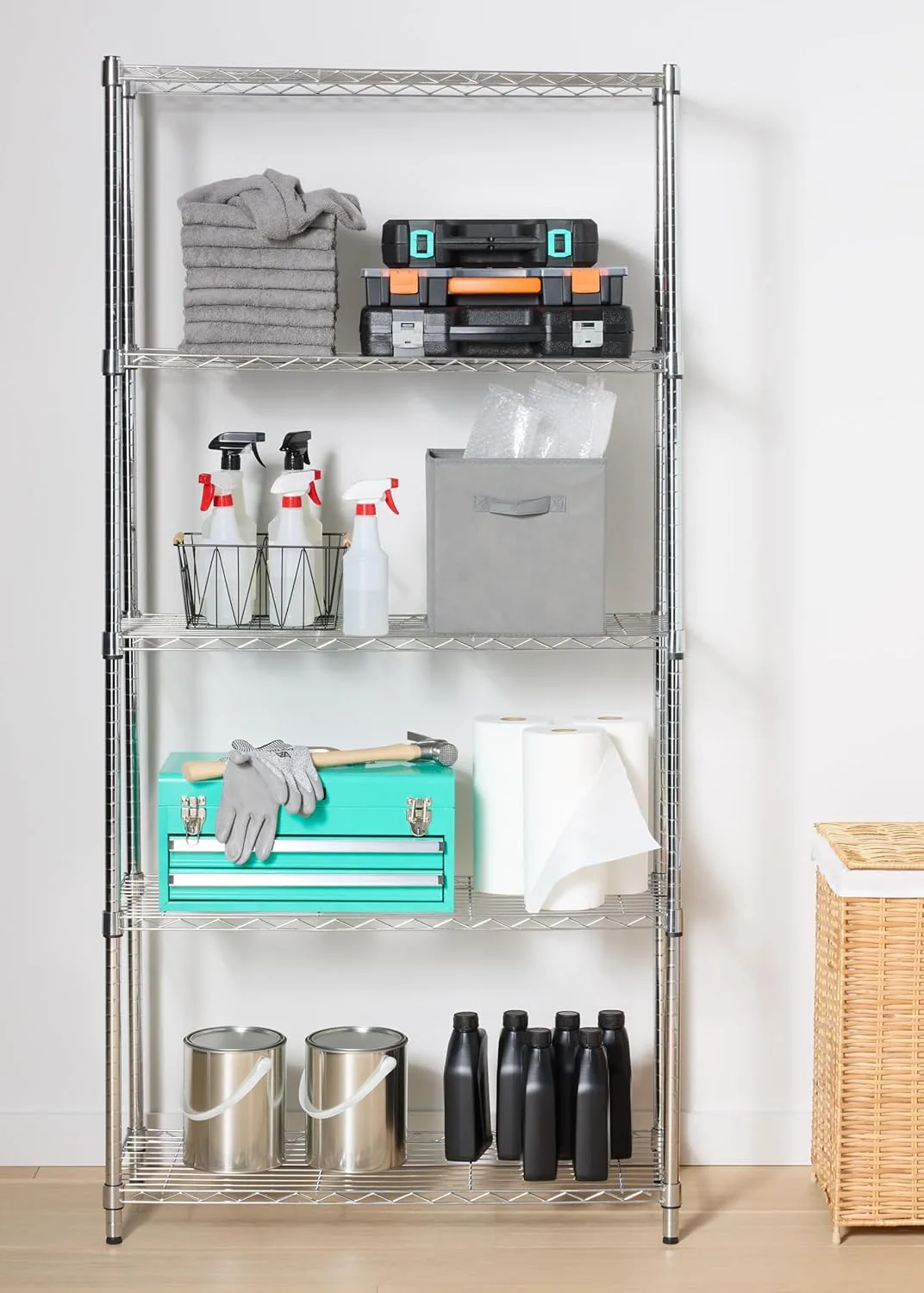
The Seville unit adjusts in 1 inch steps, and one tester’s five-shelf unit had shelf height you could customize as well. What adjustability buys you is the tall tote with its lid on. A 27 gallon tote stands 15 1/2 inches tall, and it needs that height plus room for your hands to get it out. Set the shelf that holds the tallest tote first, with the tote and lid in place under it, then space the rest of the shelves around that gap before you finish assembling.
Putting It Together, and Buying a Unit You Can Match Later
You build the first unit on a Saturday and go back for a second one a year later, only to find the product line has changed. Both halves deserve a minute before you order.
What assembly asks of you
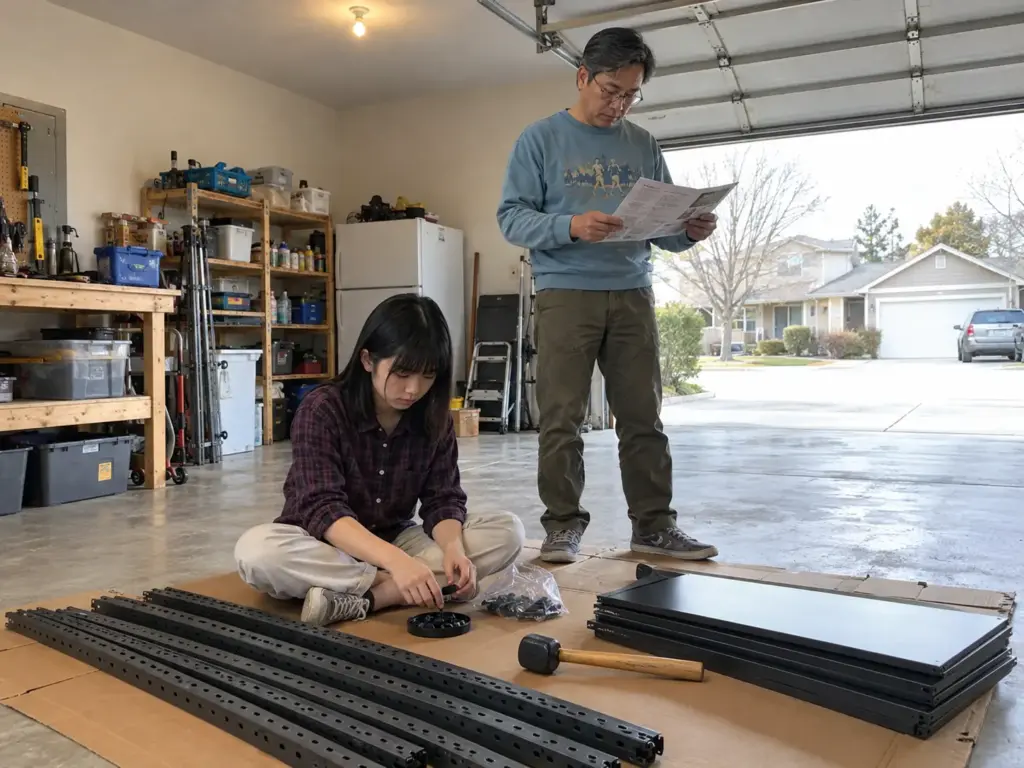
Plan on two-person assembly. One editorial test of a 24 inch, five-shelf steel unit found assembly straightforward with two people, though the testers used a rubber mallet to seat parts and the mallet was not in the box. A wire unit in the same test took about 45 minutes with two people, which is a fair assembly time to budget.
WorkPro’s reviewers describe the other kind of build, with end caps that do not fit and pieces that “don’t lock into place.” Check every part against the list on arrival while a return is still easy, and again before the load goes on, because a part that is not fully seated shows itself under weight, not on the assembly floor.
Spacing is its own design problem. The original poster in the thread found the two joining pieces landed right where they wanted the third rack. Lay out every unit on the floor with painter’s tape before you build, and you will see that kind of conflict while it is still free to fix.
Matching over time: buy extra now or buy a standard
The same thread splits on whether a set can match in the long run. The original poster wanted racks that would “likely be available in the next 5-10 years or more” because they were “very particular about them matching.” One commenter answers that they doubt any heavy floor racks bought now will still be “matching” in 10 years, “no matter who you buy from,” and says that if you are married to the idea of everything matching, “best to buy extra now.”
Another commenter takes the opposite route: chrome wire is “standard over any manufacturer so you can always buy posts and shelves separately as you need them.” Buying extra now means spare posts and shelves waiting in a corner. Buying the standard means they are a purchase away, which is the only way a matching system stays matching.
Those two views are the decision. Buy extra now if your unit comes from a product line that may change, or buy the standard design and buy parts later. When buying extra now meets a tight budget, buying in the right order on a budget shows what to purchase first.
Either way, write down the model, the depth and the width on the inside of a cabinet door the day you buy, and photograph the box label (a note on your phone is enough). Nobody in the thread reports coming back a year later to say which view held, so this is a method for protecting a five-year purchase, not a finding.
Which Garage Shelving Unit Fits Which Garage
This is one decision per garage: the shelf that works, and the one that does not.
For the bay that holds big totes
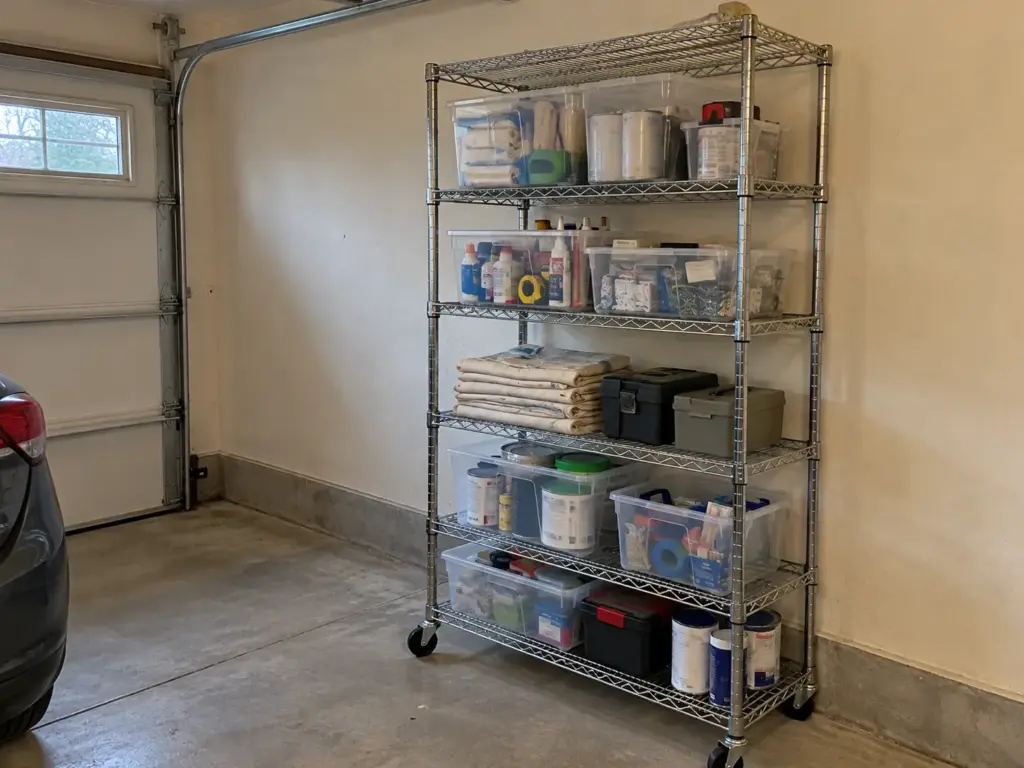
If you store 27 gallon totes and heavy tools, buy depth first. The 24 inch WorkPro covered above is the unit for that bay, with its flaws known in advance: check the end caps and pieces on arrival and work from the per-shelf rating.
For small bins and a tight budget
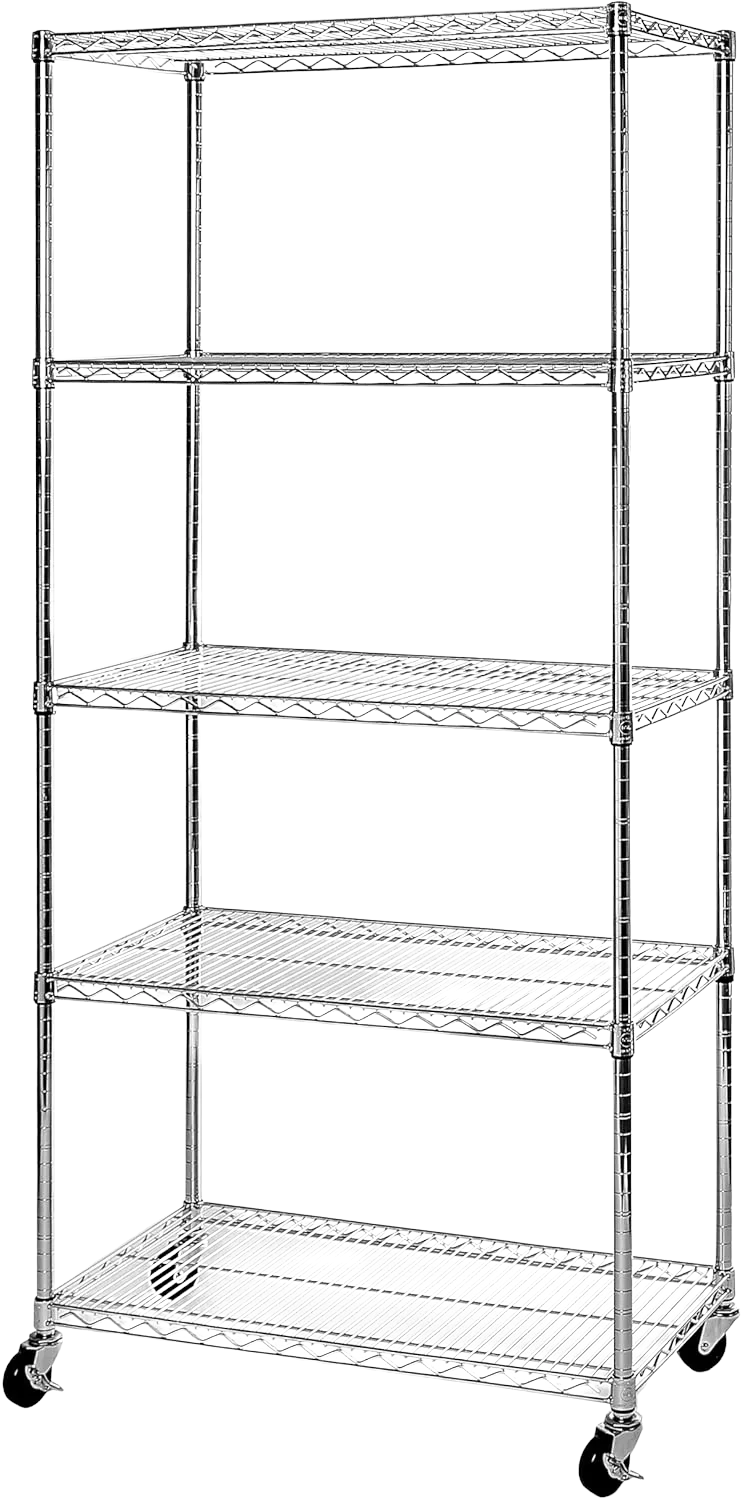
Hardware, paint and small bins fit an 18 inch shelf with room to spare, and that is where the Seville Classics UltraDurable 5-Tier NSF Steel Wire Shelving (36 x 18 x 75 inches) earns its place. State its limits first. At 18 inches it leaves a 27 gallon tote hanging 1 5/8 inches over the front, and the maker’s corrosion claim covers dry environments only. Within those limits the Seville unit gives you steel wire with leveling feet, 1 inch shelf adjustment, 800 pounds per shelf on the feet and 500 pounds total on wheels.
And budget garage shelving comes down to the 14 inch Amazon Basics covered above, which does most of the same job for light bins.
The unit I would skip for a damp garage
The WorkPro is the pick for totes, and it is also the one I would rethink if your garage is damp. A steel unit with board shelves leans on two things buyers report, rust over time and shelves that pop out of their seat, while an open wire or plastic unit set a little away from the wall, so air moves around it, sidesteps the board problem. That is the Lowe’s airflow point put into a layout.
One honest limit: there is no durability test behind this, only what buyers and retailers report. If the garage is dry, the depth math wins and the WorkPro stays on the list.
Measure the Tote Before You Measure the Shelf
Three things decide whether a garage shelf earns its floor space:
- Measure the tote you use most, lid on, and compare it to the shelf depth before anything else.
- Read the per-shelf rating together with where the weight will sit, low and centered.
- Level the unit before the first box goes on, and check it again after the first heavy load.
Three months after you build the unit, look at whether it still sits square, whether every shelf is still seated in its rails, and whether anything has started to rust at the feet. Those three checks tell you whether the choice held or whether the floor or the load is winning.
Today, take a tape to the tote you reach for most and write the number down. Then look at your current shelves and notice which ones that tote would not clear. That list is what the next purchase has to fix.
Frequently Asked Questions
01What is the best quality garage shelving unit?
The best quality garage shelving unit is the one deep enough for your largest tote and rated per shelf for what you actually store on it. For 27 gallon totes, that means a 24 inch deep unit with a per-shelf rating you have verified. See the depth and load sections above for the numbers.
02Which garage shelving units are best for storage totes?
The best units for storage totes are at least 20 inches deep, since a 27 gallon tote needs about 19 5/8 inches long side out. Choose 24 inches for margin: it clears by 4 3/8 inches, while 18 inches leaves the tote hanging 1 5/8 inches over the front.
03Is it cheaper to build or buy garage shelving?
Neither route is always cheaper, because building trades your time and tools for an exact depth, while buying saves the labor. Lowe’s notes you can build from lumber and plywood on brackets or buy a unit. Build when your tote needs a depth no unit offers; buy when speed matters.
04Should garage shelving be anchored to the wall?
Yes, tall units with shelves should be anchored to the wall, according to the Consumer Product Safety Commission’s Anchor It! campaign, which says anchoring prevents tip-over injuries. A unit that rocks on a slab is the strongest reason.
Disclaimer: ClutterlessNest is a participant in the Amazon Services LLC Associates Program. As an Amazon Associate we earn from qualifying purchases. This article may contain affiliate links — if you buy through them, we may earn a small commission at no extra cost to you. We only recommend products we have tested or genuinely believe in.