A pound figure sits in bold at the top of the product page, 4,000 of them, while a garage full of boxes waits at home for something to hold it all. That number is five shelves added together, and no single shelf ever carries it, which is why the best garage storage systems get chosen by a smaller spec printed further down the page. Review sections keep telling the same stories: a shelf bowing under one heavy item, a rail kit with holes an inch off, an overhead frame that sways.
This guide sorts the system types by what you store, reads each one by the spec that gives out first, and finishes with the cheap version that does most of the job. If you haven’t measured the bay or mapped your zones yet, the full garage organization plan covers that part first, and this page assumes it is done.
What you store decides the answer, so this table pairs each system type with the pile it suits and the spec that fails first.
| System type | Best for | The spec that fails first | Needs a stud, joist or block wall? |
|---|---|---|---|
| Freestanding steel or wire shelving | Heavy, bulky, frequent: paint, tools, big bins | Load per shelf, not the total | No, but anchor tall units |
| Freestanding cabinet | Fluids, chemicals, sharp tools behind a lock | Panel quality and tip-over | No, but anchor to a stud |
| Wall rails and hooks | Hanging tools, cords, bags | The hook rating, not the rail | Yes, studs at 16 in |
| Overhead rack | Light, bulky, rarely used: seasonal totes | Joist spacing and the ceiling | Yes, wood joists or concrete |
| Wheeled wire unit | Light loads in a garage you can’t drill | Rating drops once it rolls | No |
Best Garage Storage Systems Start With What Goes Inside Them
The system is the last decision in a garage purchase, and most carts get built in the wrong order: a rack, a cabinet, a set of hooks, and the same boxes still on the floor because nobody sorted them first.
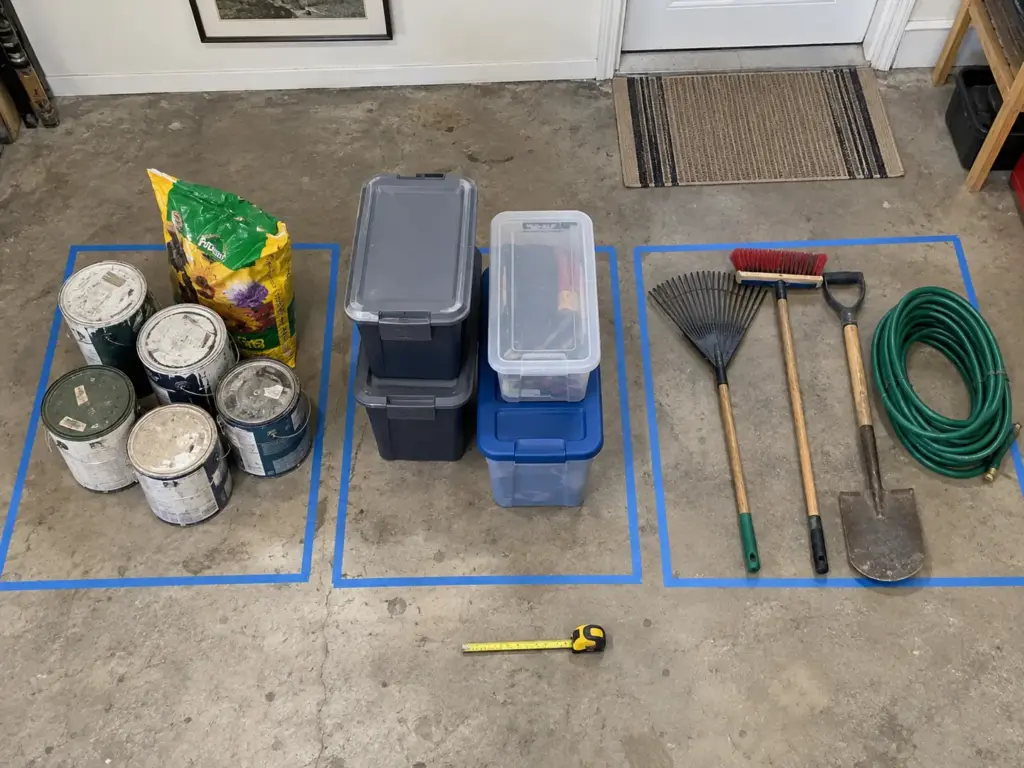
In an r/garageporn thread about this exact purchase, answering a poster with “a two car garage without any storage,” the first reply was a question instead of a product: “What kind of stuff are you storing. That will dictate a lot.” The poster’s own shortlist was a workbench with storage underneath, a pegboard or French cleat wall, and overhead shelving. A second commenter, planning a detached 24×24 garage with unfinished walls and scissor trusses, listed ceiling height, wall finish, rafter or truss roof, and what gets stored.
Sort by weight and by how often you reach for it
Two questions sort the whole garage: how much does it weigh, and how often do your hands go to it. Heavy and frequent belongs at floor level, never overhead. Light, bulky and rare (seasonal totes, luggage, off-season gear) is the overhead pile. Long-handled and hanging things go on the wall, and fluids and chemicals get a closed, lockable cabinet off the floor.
A pile that fits none of the four is usually something to let go of, and since the garage is the room most people declutter last, decluttering first is the cheapest storage upgrade there is and the sorting pass doubles as the donation pass. The whole-house method, garage saved for the end, is in the guide to decluttering your home room by room.
Match each pile to a system type
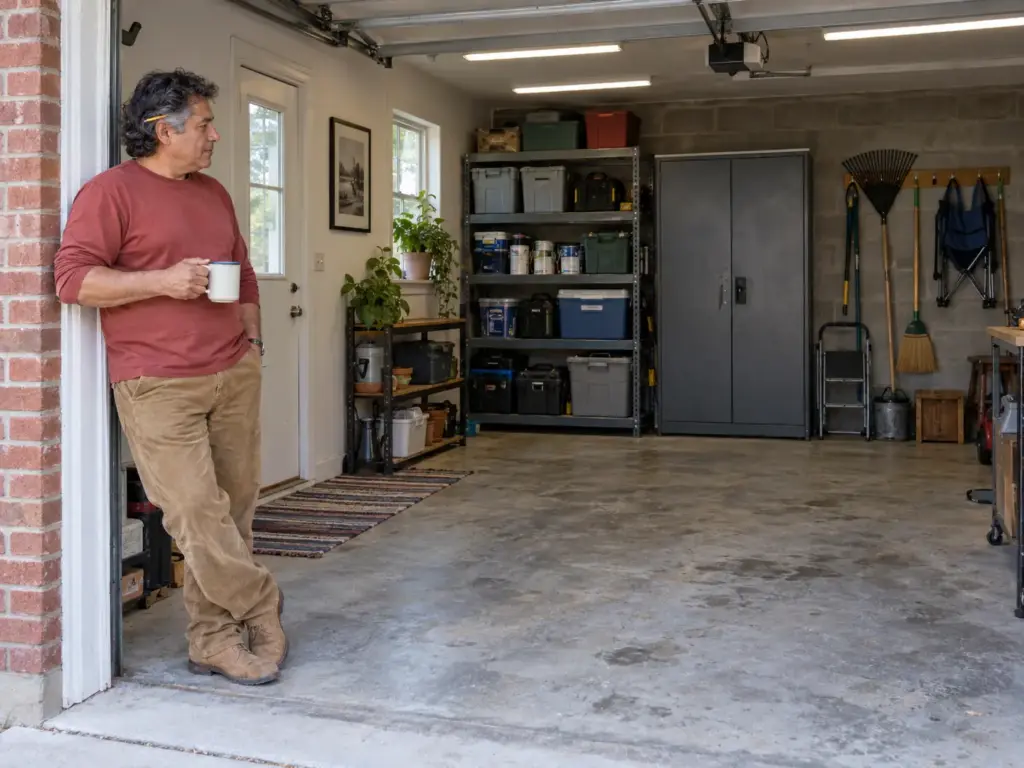
Heavy and frequent goes on steel shelving, fluids in a cabinet, hanging on a rail, slat wall or French cleat, light and rare overhead. The fifth type, wheeled wire shelving, is for a garage where you can’t drill.
Before any of that, measure the depth the car bay allows. Garage shelving and cabinets typically run 16 to 24 inches deep, and the swing of the car door and the line of the mirror decide how much of that you can spare. Park where the car lives, open the driver’s door as wide as you do every day, and measure from the wall to the door edge. Cabinets commonly run 18 inches deep and shelving about 18 to 24, so that one storage depth tells you which shelf depth fits and which is a scraped door.
Why buying the system first sends half of it back
Several of the two-star reviews quoted below are fit problems, not build problems: the wrong depth for the bay, joists wider than the rack allows, a wall that can’t take the fixings. A tape measure and a knuckle on the wall answer each of those before the order goes in.
And a free version of the experiment exists. Milk crates and an old bookcase will hold the light pile while you find out what the heavy pile weighs. Then buy for the piles that stayed.
Per-Shelf Capacity Beats the Total on the Box
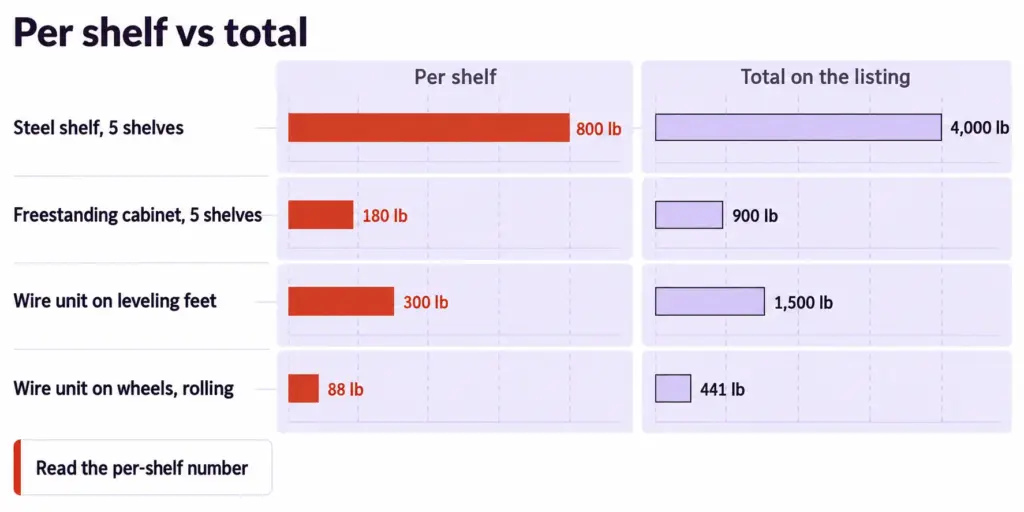
The biggest number on a shelving listing is a total. The number that matters is that total divided by the shelf count, and it sits in the specs a few scrolls down.
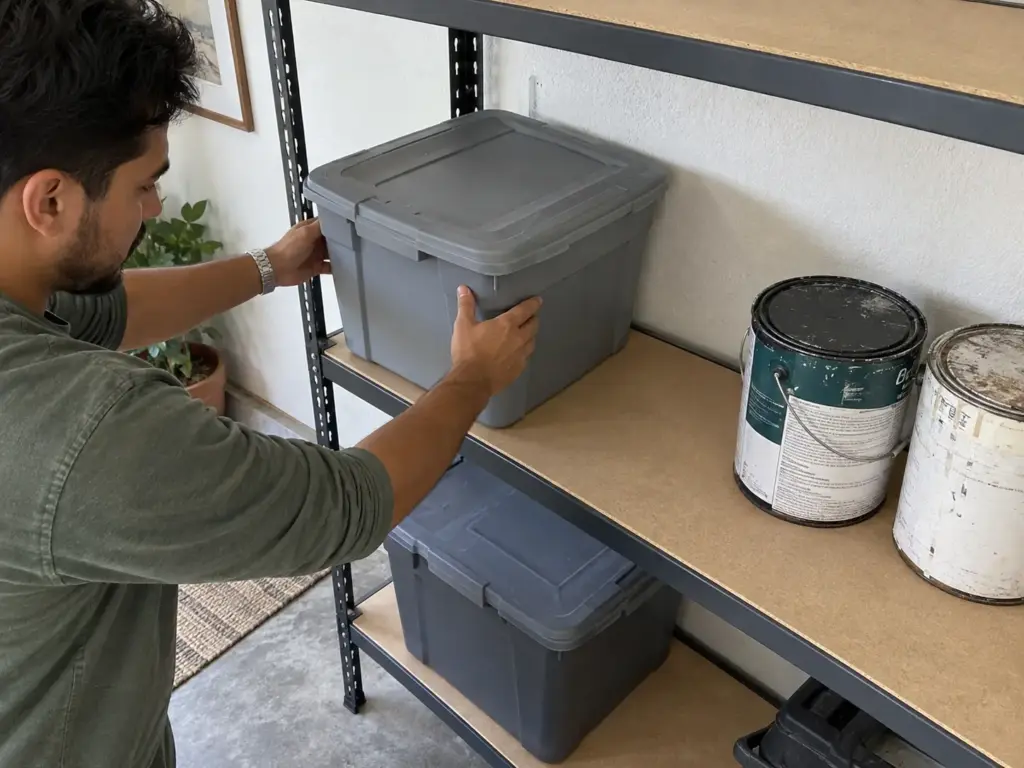
A 4,000-pound shelf holds 800 pounds at a time
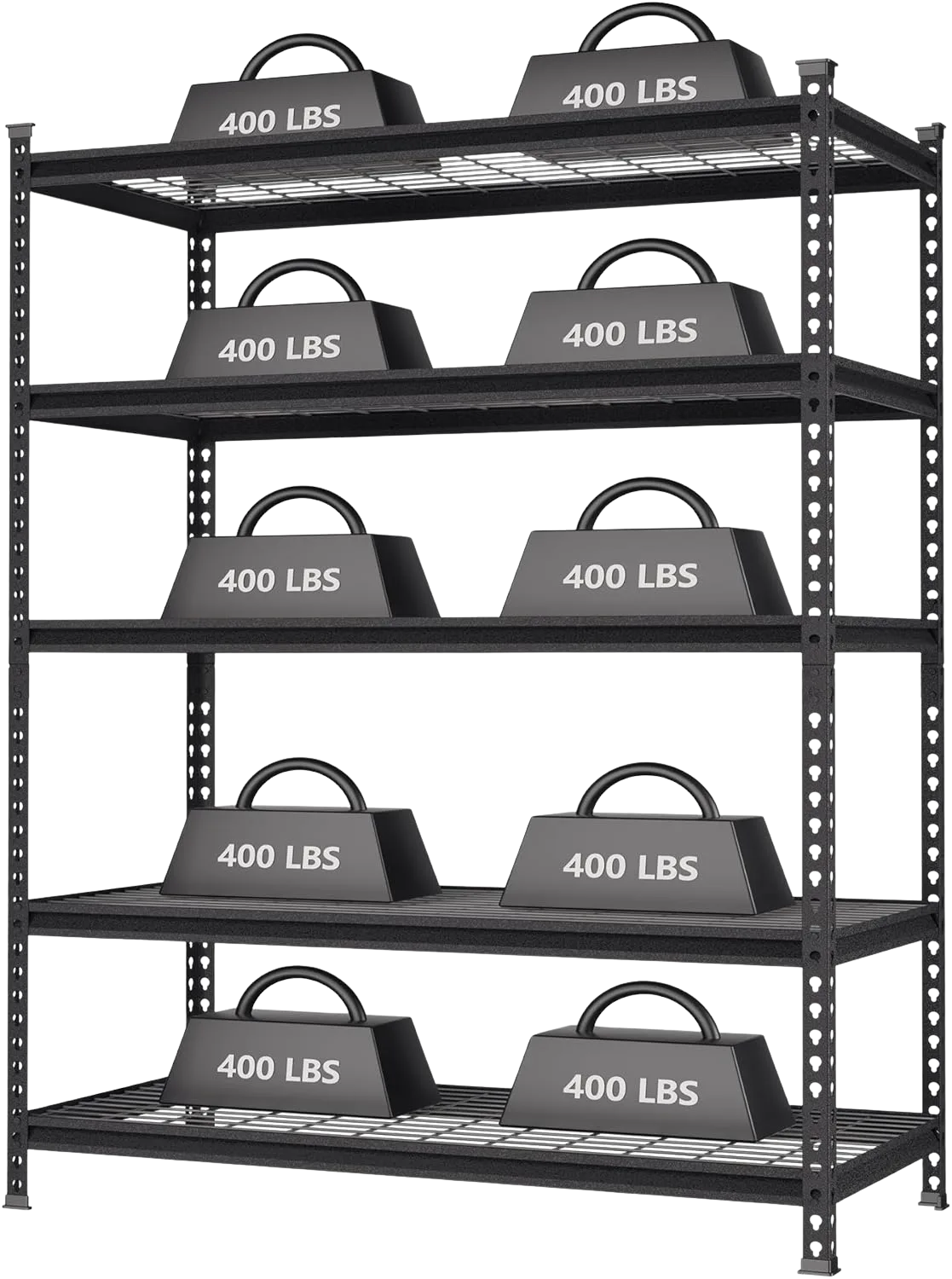
Take one steel unit with five shelves. Its page says the maximum capacity is 4,000 pounds in total, 800 per shelf, while the title of the same listing quotes a different, lower total of 2,500.
Five shelves at 800 pounds is the 4,000, so that total weight capacity only exists if every shelf is loaded to its limit at once. You never load a unit. You load a shelf.
A freestanding cabinet listing does the same arithmetic smaller: 180 pounds per shelf, 900 in total. Read the 180 as the load rating for one shelf of paint cans or tools.
Same width does not mean same strength. Two cabinets about 36 inches wide carry shelf ratings of 150 and 45 pounds on their listings.
One reviewer on a five-shelf unit put an 85-pound item on a shelf and wrote that it was “bowing slightly after about two hours.” That is the failure at its earliest stage: nothing snaps, the shelf just starts holding a shape it will keep. A forum poster boiled it down: “Weight capacity per shelf matters more than total capacity in my experience.”
What wheels do to the rating
Wheels on shelving are where per-shelf ratings go to be cut. The listing for a five-shelf unit, quoted in a two-star review, gives 300 pounds per shelf on leveling feet, 132 with the wheels not in motion, and 88 with the wheels in motion. Overall figures fall the same way: 1,500 pounds, then 661, then 441. Casters take the shelf rating to under a third of what the feet carry.
A forum voice frames the first decision of a rolling unit as a plain question: “First decision is if you need the unit to be mobile.” It is a real trade. Mobility lets you shuffle the garage around the car, and the shelf holding the paint is now rated for under a third of its footed number.
If the unit never has to move, keep it on its feet, or lock the wheels and plan around the locked figure, which is still lower. Ratings shift with the way a unit is supported in every room, and how the mounting method changes what a shelf can carry gets its own treatment for apartment walls.
Turn the rating into what fits on one shelf
A rating is abstract until you convert it into your own stuff. A gallon of paint weighs roughly a dozen pounds, so a full row of four on one shelf comes in under 50 pounds, comfortably inside a modest cabinet shelf. A lidded tote of tools can cross 100 pounds by itself, and that single tote decides which rating you need. (Rough figures, so weigh your own.)
The usual advice is to buy the biggest total and stop thinking about it. The better call is to find the heaviest single thing you own and buy the shelf that carries it, because everything lighter then comes free. The average of your pile never breaks a shelf. The outlier does.
When a listing gives only a total, divide it by the number of shelves and treat the answer as a ceiling, not a promise. A listing that never says per shelf anywhere is telling you something.
Freestanding Shelving and Cabinets: Floor Storage That Needs Anchoring
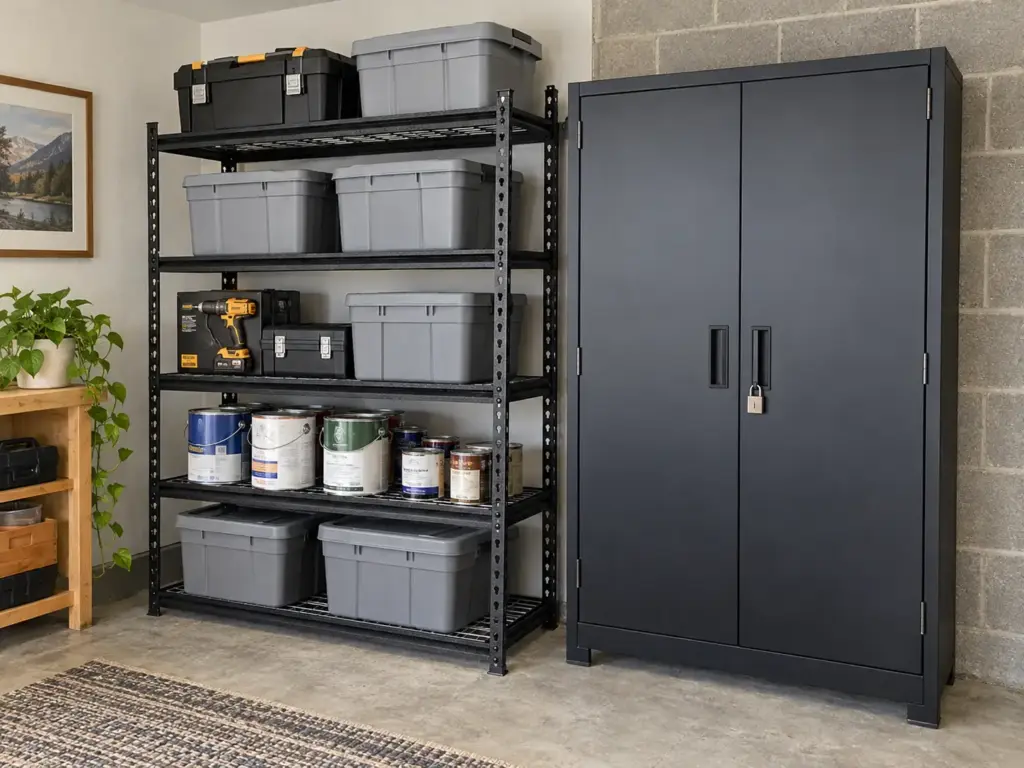
Paint on the concrete, a bag of fertilizer leaning on the wall, a case of fluids behind the car: the two floor-standing types, steel garage shelving and the freestanding garage cabinet, exist to get those off the floor without leaving a tall box waiting to tip.
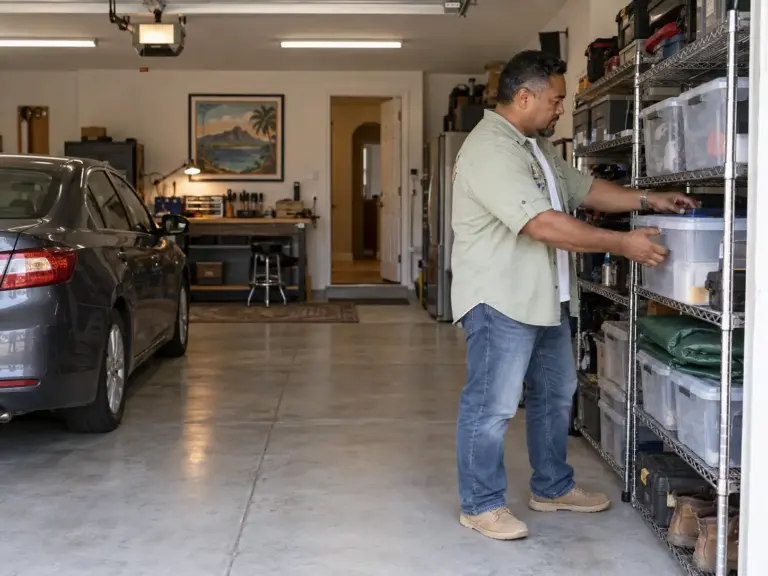
Steel shelving for heavy, bulky things
Steel shelving suits heavy, bulky and frequent: paint, tools, big bins. First, the free upgrade for open wire shelving is a sheet of plywood. A contractor in a Fine Homebuilding thread (December 2025) described it: “Cut and laid 1/4″ plywood on the wire shelving so nothing would fall through.” Another poster added, “I like the wood shelves so small stuff doesn’t get lost.”
For the shelving itself, the WorkPro 5-Tier Metal Storage Shelving Unit in 48 x 24 x 72 inches is the heavy-floor garage shelving unit to look at: five shelves, 1-inch height adjustments, 800 pounds per shelf on its page (plan with that, not the 4,000 total on the page or the 2,500 in the title). A two-star reviewer from January 2023 wrote, “The wire shelves do flex A LOT and require additional bracing,” and said the second unit “immediately made the shelving drop from the side bars.”
Amazon pools reviews across sizes, so that comment may describe another version. Brace it and level it before the paint goes on.
Closed cabinets for fluids and chemicals
Fluids and anything sharp belong behind doors and up off the floor, and a lock earns its place the first day a child wanders in.
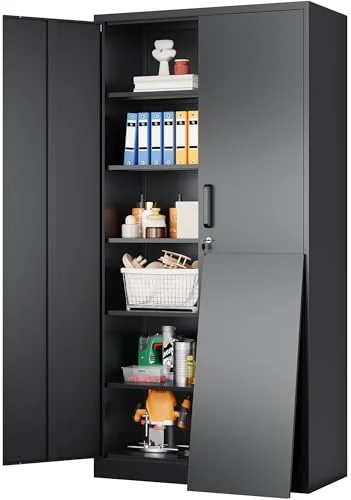
The SISESOL Wide and Deep Metal Storage Cabinet in 72 x 36 x 18 inches is a garage storage cabinet built for it: two lockable doors, five adjustable shelves, 180 pounds per shelf and 900 in total, and 91 pounds empty before anything goes inside. Its reviews carry two flaws worth knowing before you order. One two-star reviewer opened with “Nearly every single piece arrived warped, and screw holes were missing” (October 2025), and another wrote that “the doors do not remain closed unless they are locked” (December 2024). Plan a second pair of hands for the move, and lock it every time.
Tall and light means it tips: anchor it
A 72-inch cabinet with a few light things on its upper shelves has a high center and little holding it down. According to the Consumer Product Safety Commission’s tip-over rule announcement, the agency knew of 234 people who died in clothing storage unit tip-overs between January 2000 and April 2022, 199 of them children, plus an estimated 84,100 emergency-room-treated injuries from 2006 to 2021. Those numbers are for dressers and wardrobes, not garage cabinets, and the federal standard (ASTM F2057-23, effective 1 September 2023) covers bedroom clothing storage without naming garage units.
My reading, and it is inference, is that the tipping risk carries over: a tall, light box and a person pulling on it. The agency’s instruction applies to any tall unit: “CPSC recommends that consumers anchor furniture, including dressers, securely to the wall.”
Anchoring doesn’t have to be a big project. CPSC’s Anchor It! guidance on anchoring furniture puts it plainly: “Existing furniture can be anchored with inexpensive anti-tip brackets.” If the lease forbids drilling, the stopgap is in the no-drill section below.
A sloped garage floor adds its own trouble. Leveling feet and shims keep the unit plumb, and a cabinet that leans a few degrees will swing its doors open or shut on its own, so shim until the doors stay where you leave them. For the shelving side of the same worry, freestanding shelving that is built not to tip over has its own guide.
Your Wall Type Decides Which Storage Systems Survive
Tap along a garage wall and you can get three different sounds in six feet: hollow, solid, and a dull thud where the block begins. One wall can be three materials, and the fixings that hold on one fail on the next.
Hollow drywall: toggles beat the anchors in the box
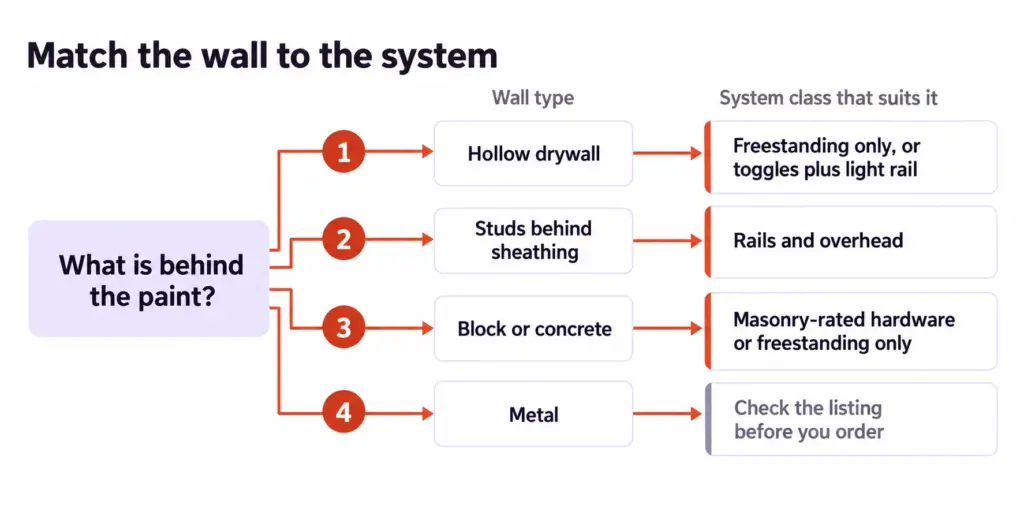
Four things can sit behind the paint: hollow drywall, studs behind sheathing, block or concrete, and metal. Which one you have decides the system class.
Hollow drywall takes freestanding units or a light rail on toggles. Studs take rails and overhead racks. Block or concrete takes masonry-rated hardware or freestanding units. Metal takes freestanding units only, since most listings exclude it.
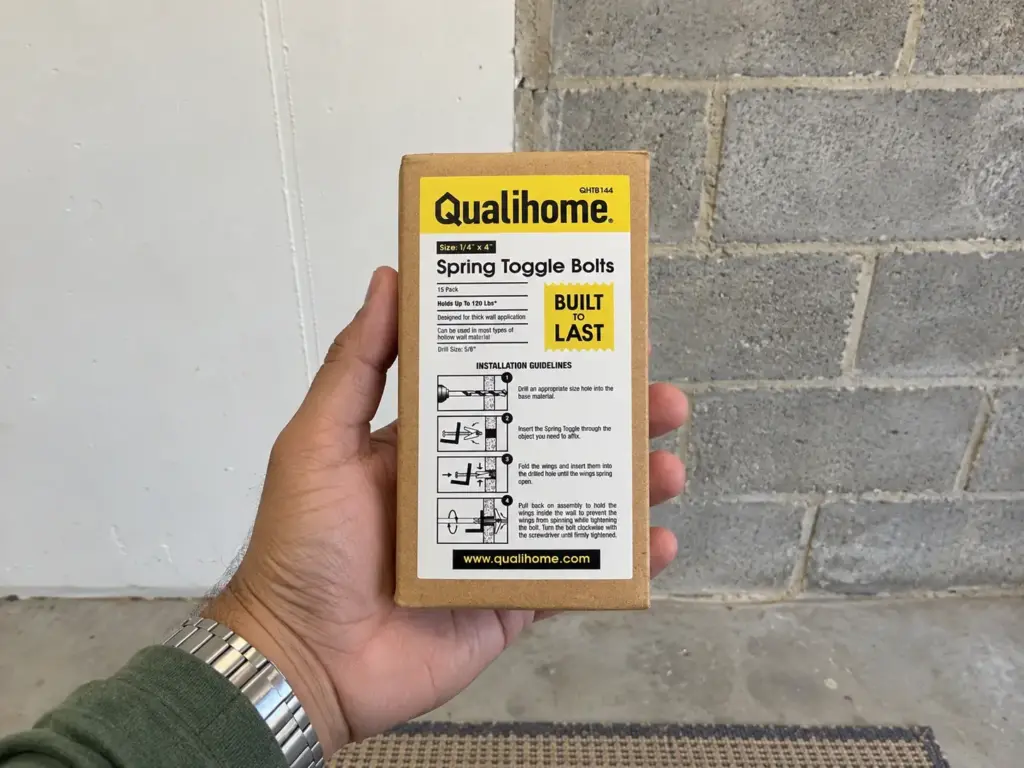
The hardware in the box is the first thing to swap on a hollow wall. At least one 13-piece wall tool rack ships with drywall anchors described as low quality, so treat any bundled anchor as a placeholder. The QUALIHOME Spring Toggle Bolt Anchors (1/4 x 4 inch, 15-pack) are the usual replacement.
Their flaw is in the title: a two-star reviewer in June 2025 noted “but they are not stainless steel,” though the title says stainless, and plain steel in a damp garage is a rust risk. They are for hollow walls only, not block or concrete, and no block-rated anchor was verified here. Keep the heavy pile on floor units either way.
Studs and unfinished walls: rails first, cleats after sheathing
Rails expect studs where the instructions say, and the wall-mounted shelves guide explains why the box rating assumes a stud and how real capacity depends on the mount.
Unfinished walls, usually a detached garage, are their own case. The r/garageporn commenter with the 24×24 build planned the sequence in one line: “As soon as interior walls are sheathed I’ll be putting in french cleats.” Studs and sheathing first, cleats second. Before the sheathing goes up, exposed studs will hold a rail and nothing that needs a flat, solid face.
Run a strip of painter’s tape across the wall at the height a rail would sit and mark each stud on it before you compare kits. One glance then tells you whether a kit’s hole spacing lands on your studs.
Block, concrete and metal: read the fine print before you buy
Compatibility is printed on the product page, and it is blunt. The overhead rack covered later says it is “Suitable for wood studs/joists and concrete wall” and that it “Can NOT be mounted to metal wall.” Metal-sided garages and steel-stud walls are the cases most listings exclude, so check before ordering rather than after the box arrives.
Block and concrete need masonry-rated hardware, expanding bolts among it, rather than toggles, and the toggle recommendation above does not cover them. Follow the manufacturer’s instructions for the hardware that matches your wall, and if you aren’t sure what the wall is made of, get a pro to look. Anything freestanding ignores what is behind the paint, which makes it the fallback for every wall that fails these checks.
Wall Rail Systems: Getting Tools and Bags Off the Floor
Rakes, a cooler, extension cords: they live on the floor of the bay because the floor is where they were last put down, and wall-mounted garage storage is how they stop.
What the rail carries and what the hook carries
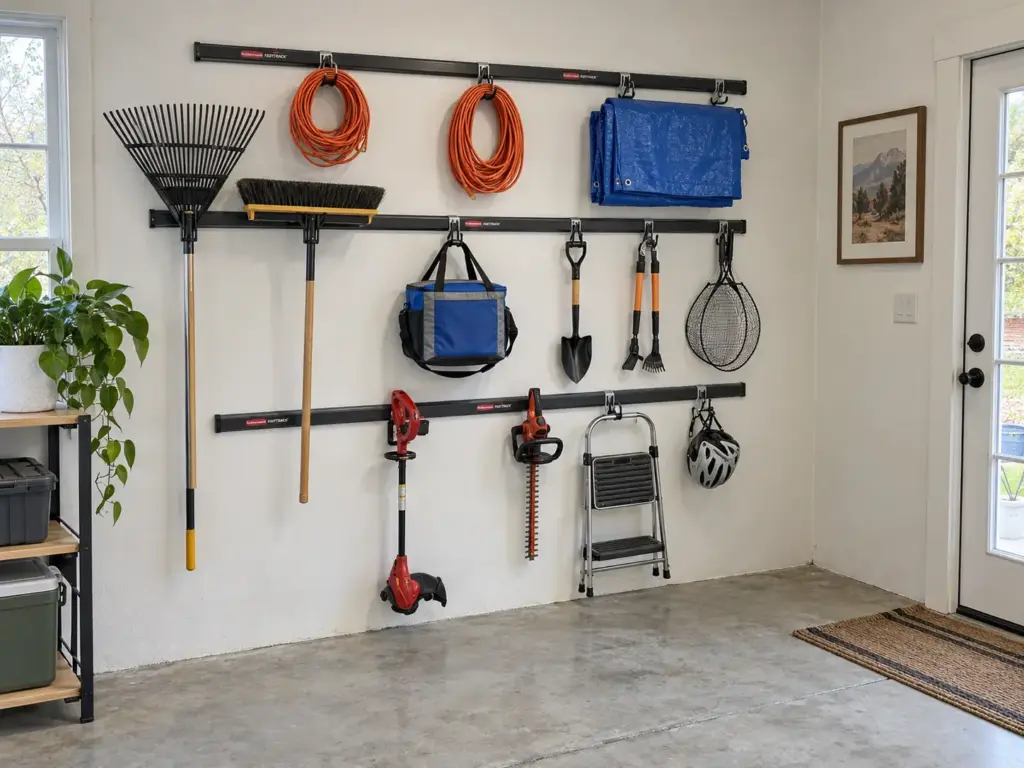
A rail or track system is a set of horizontal rails fixed to studs, with hooks that slide along them. The rail gets the headline: one kit’s page says its rails “withstand up to 1,750lb.”
The hook is the real limit. Locking hooks hold 50 pounds and non-locking hooks hold 25, whatever the rail can take. Garden tools such as a rake or a coiled hose are a 25-pound hook’s job, and so is a broom holder; a full bag of soil is not.
Hang the heavy items at waist height on locking hooks, and keep the very heavy ones off the wall. The maker says one person can install a kit in minutes, and the hooks slide wherever the garage changes.
Rails, slat wall or French cleat
A rail kit is one of three ways to get a wall of hooks. A slatwall panel and a French cleat are the other two, and a pegboard sheet is the light-duty cousin, fine for hand tool storage and little else. In the r/garageporn thread, one commenter (Jstpsntym) wrote, “Best bang for buck square foot wise is probably a slat wall based system.” Another (Pestelence2020) said, “French cleat would be my choice for wall mounted stuff.”
The obvious pick, a permanent system, stops being obvious when you move often. The same cleat fan put the trade plainly: “If I were to do it again, I’d go [the modular one] exclusively because it’s easy to move (I move a lot),” while the permanent one is “just really hard to move.” A wall you are keeping ten years can take the fixed system. A wall you may leave in three should get something that unclips.
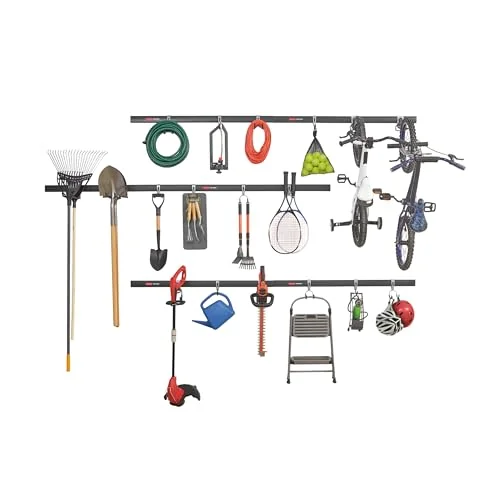
The worked example of a rail system here is the Rubbermaid FastTrack Garage Wall-Mounted Storage System, a 24-piece kit with six 48-inch rails and 18 hooks.
The flaw to check before you order
The kit’s instructions call for four studs at 16-inch spacing, and a verified two-star review from 12 October 2025 reports that the rail holes come up one inch short: “47 holes. Should be 48 (3 x 16″ studs).” A rail that doesn’t land on every stud it was built for carries less than its rating. Mark your studs, measure the span, and compare it to the hole spacing before you commit.
Two more things to settle. This is a stud-and-drill system, so a renter or a shared garage should skip to the next section. And a wall of hooks keeps everything on display, which is the opposite of what a reader who wants visual clutter hidden is after. For that reader, the cabinet from earlier does the job better.
No-Drill Garage Storage for Renters and Shared Garages
Some readers can’t drill: a lease, a shared garage, a condo with rules. Wall rails and overhead racks are out for them, and what remains is freestanding, which is all a renter-friendly garage is made of.
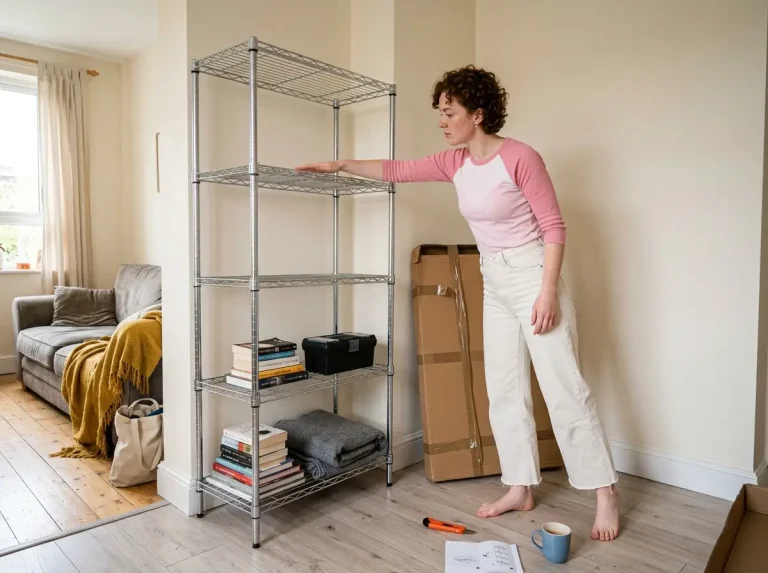
Wire shelving needs no fixings
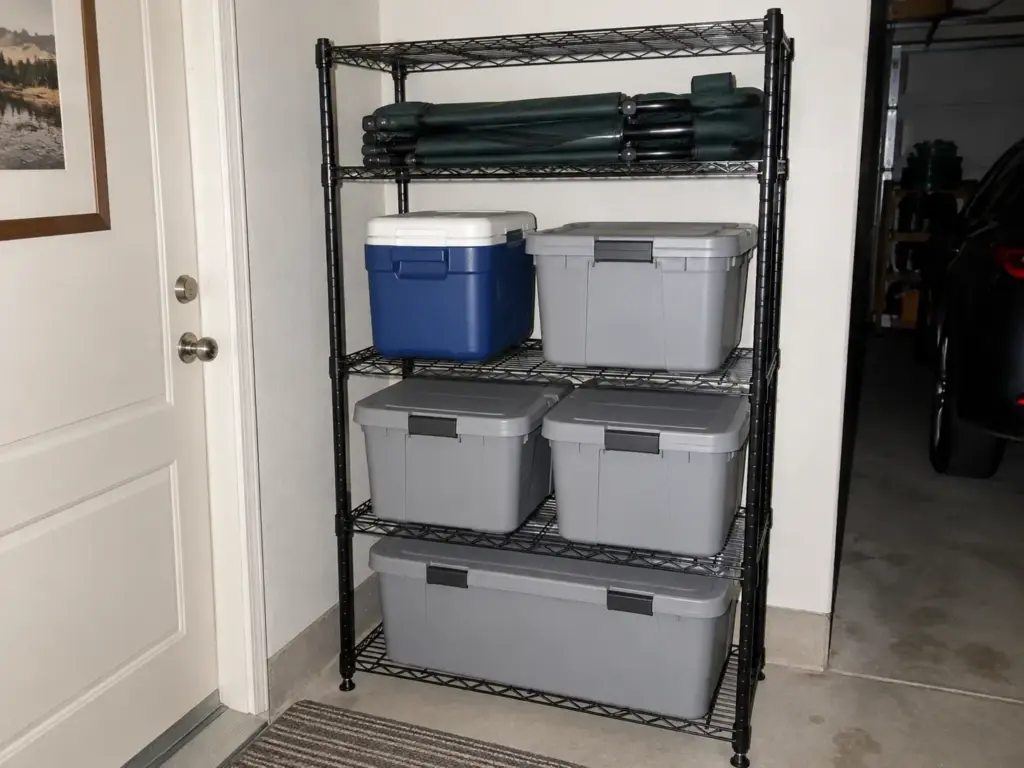
Freestanding wire is the no-drill answer, and it moves when you want it to. One r/garageporn commenter (Specific-Pipe-10) said it directly: “I like the idea of not having to drill into the studs and having the flexibility of getting a simple / heavy duty wire shelving unit on wheels.”
The Amazon Basics 4-Shelf Steel Wire Storage Shelves (23.2 x 13.4 x 48 inches) are the cheapest honest version for light loads: freestanding, no fixings, rated at 200 pounds per shelf. The flaw is the same as the strength: nothing fastens it together. A two-star reviewer from 13 September 2026 wrote that “It completely fell apart and it wasn’t easy to put together in the first place,” a month after buying, when picking the unit up to move it.
The same review adds, “there’s no screws or anything to actually secure the parts together. It’s more so held together by pressure.” Build it where it will stay. For the other no-drill families, the shelving and racks hub lists the weight limits and the four no-drill renter families.
Wheels buy mobility and cost capacity
The per-shelf section has the numbers: on the listing quoted there, a rolling shelf fell to 88 pounds against 300 on feet. For a renter that trade is often worth making, because rolling the unit out to reach the back wall beats stacking boxes in front of it.
Wheeled wire suits light bins and the pile you shuffle. The paint and the tote of tools belong on a unit that stays put. Once a unit is built, roll it rather than lifting it; the reviewer whose unit came apart was carrying it.
Keeping a freestanding unit from tipping when you can’t drill
Freestanding and tall is the combination the tip-over section warned about, and a renter still needs an answer. A two-star reviewer from July 2026 on a 4-shelf unit in 36 x 14 x 54 inches (a different size from the one above) found a workaround: “Since I am not allowed to drill holes in the walls, I am using long, strong zip ties looped through other bracing to hold it up from tipping over.”
Treat that as a stopgap from a reviewer, not a rated anchor. For a unit tall enough to hurt someone, the wall anchor is the real answer, and asking the landlord whether a bracket in a stud is allowed beats hoping. Until then, keep the heaviest things on the bottom shelves.
And be clear about what no-drill can’t do. There is no overhead rack and no rail system without fixings, so don’t spend an evening searching for a loophole. The no-drill garage is shelving, a cabinet and bins, and it can still be a good garage.
Overhead Racks: Check the Joists Before You Buy
The empty air above the car looks like the free space in the house, and ceiling-mounted storage is only as good as the ceiling holding it up.
What goes overhead and what stays at floor level
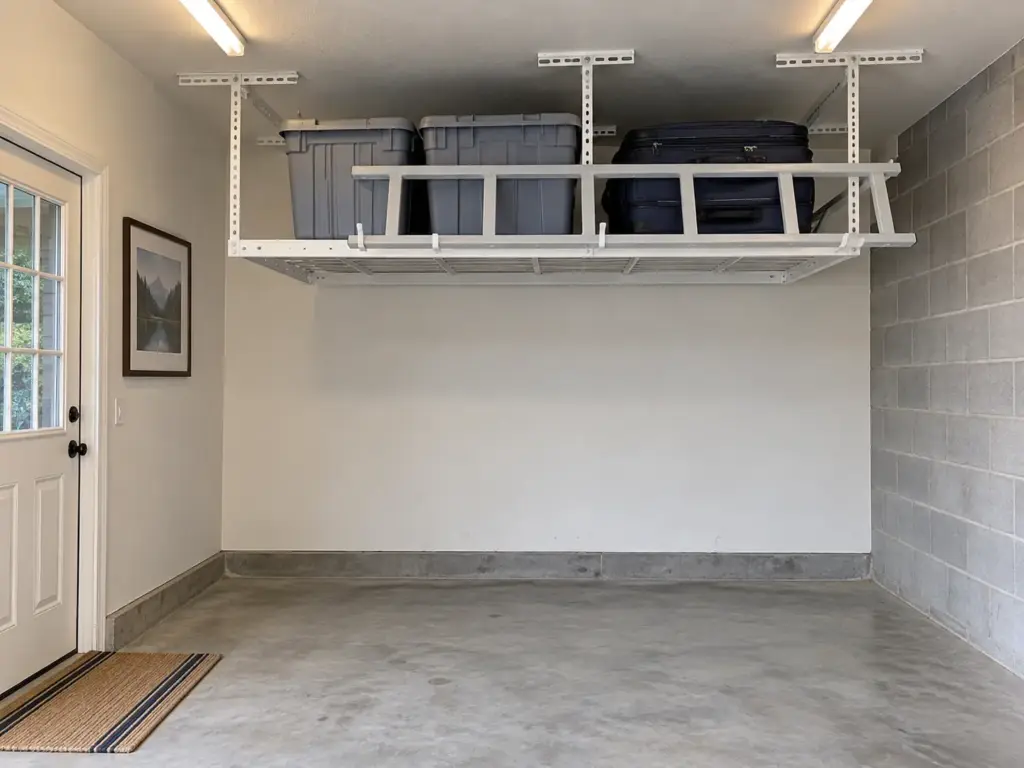
What goes up is light, bulky and rarely reached, which makes it seasonal storage: totes, luggage, off-season gear. What stays down is anything heavy or touched weekly. The r/garageporn commenter with the detached 24×24 garage wanted “a large shelf at one wall, well overhead, for tubs” and cabinets for fluids on the floor, which sorts the piles correctly. A shelf you can’t reach without a ladder is the wrong place for anything you lift often or that would hurt if it fell.
Joist spacing and ceiling material come first
The FLEXIMOUNTS 4×8 Overhead Garage Storage Rack tells you its own rules. It measures 96 x 48 inches with a drop of 22 to 40 inches, and the page says it fits joist spacing of 24 inches or less; if the spacing is wider, it fits only at 48. Measure the joists above the car before ordering.
The page rates the rack at 750 pounds, tested to 1,200, while ratings in this size class are quoted anywhere from 600 to 1,000 depending on the model, so read the page of the exact rack you buy.
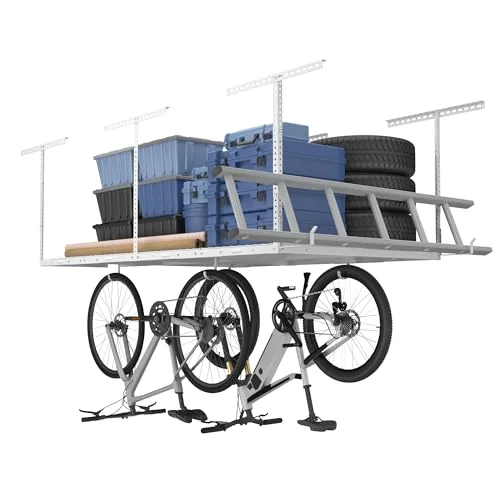
Measure joist spacing at both ends of the rack’s footprint, not once in the middle. A joist that wanders an inch or two across eight feet decides whether the rack lands on its brackets, and you want to learn that standing on the floor.
The install is the hardest of all five types
A two-star reviewer from March 2023 wrote that the floor grids “deform and sag with even modest weight placed on them” and that the assembled frame is “far from rigid” and “sways significantly.” The same reviewer said “it took about 4 hours to install working alone.” Another, in October 2021, was lifting a full 4×8 into place and “dropped one on my helper.”
Two budget fixes come out of those reviews. One reviewer laid a sheet of plywood over the frame so the load sits on the framing, not the wire grid. Another found two smaller racks cheaper and easier to install than one 4×8, though that is the reviewer’s claim and wasn’t checked as a listing here. A single 4×8 is the default, and the pair of smaller ones wins when your joists run uneven or you have one helper.
It is a two-person job, on a ladder, with weight overhead, so hire help if you aren’t sure. Nothing heavy goes up there, ever.
Value Per Usable Shelf: Where to Spend and Where to Save
The cheapest unit on the page isn’t cheap if only two of its five shelves can carry what you own.
Count the shelves you can reach, not the total
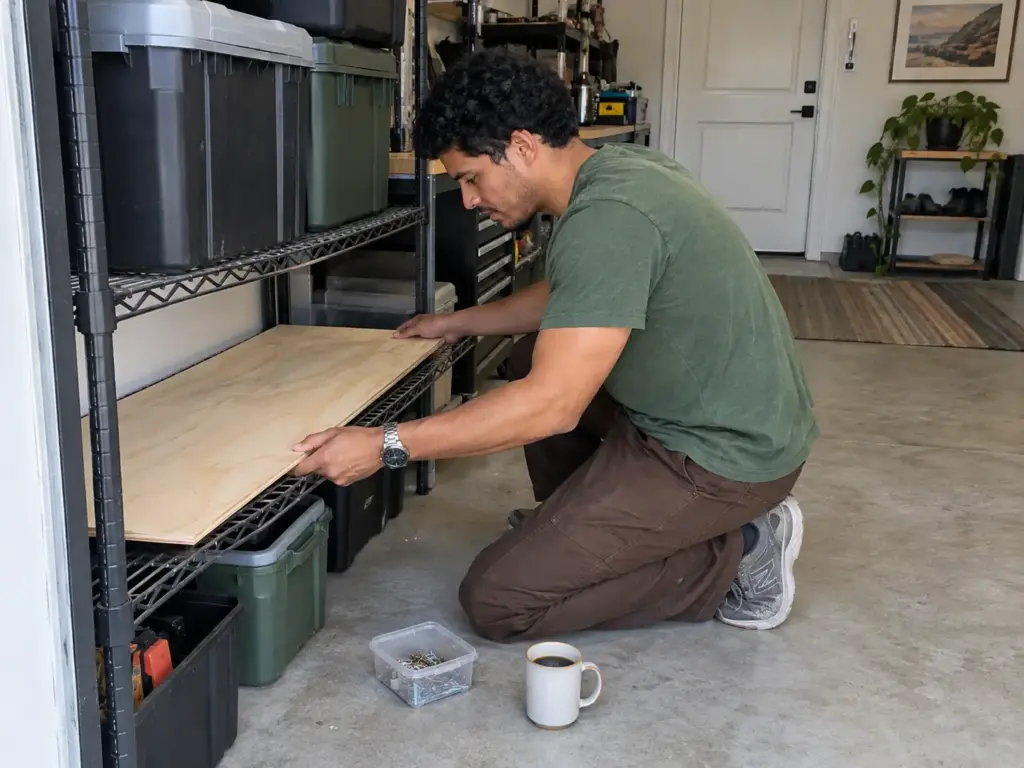
Think in cost per shelf you can actually use, not cost per unit. Usable capacity is the per-shelf rating multiplied by the shelves at a height you can actually use, which means not above your head and not at your ankles. A five-shelf unit rated at 800 pounds per shelf, with one shelf over your head and one at the floor, gives you three working shelves: 2,400 pounds usable against a printed 4,000.
A lighter unit rated at 200 pounds per shelf can match what you own if your heaviest tote is 100 pounds. Compare systems on that basis and the ranking changes: the lowest sticker may carry what you own without strain, and the biggest total may leave your heaviest tote on a shelf that bows.
Cheap options that do most of the job
The free versions of budget garage storage deserve a fair test first. Plywood on open wire shelving costs a fraction of replacing the shelves, and milk crates and an old bookcase hold the light pile.
Slat wall earns community praise as the best value per square foot of wall (Jstpsntym, r/garageporn). Two smaller overhead racks can beat one large one on cost and installation effort, per the reviewer quoted earlier. And a cheap wire unit does the job for light loads, which is the honest anti-sell: the steel system is for the heavy pile only. The order in which to spend once the free fixes run out belongs to the sibling guide on the order to buy things on a tight budget.
When it’s worth paying for the closed, permanent version
Two places justify paying more. The first is a closed, lockable cabinet for fluids, because the lock and the doors are the product. The second is a permanent wall system on a wall you won’t leave soon.
The commenter who found the permanent system hard to move still conceded its strength: “if you’re not going anywhere for 10+ years … it’s the better product for a permanent install.” Everywhere else, the cheap option plus a little care wins. Spend on what keeps fluids away from children and weight away from people.
Install Time, Helpers, and What to Recheck After Six Months
The weekend that began as a shelf kit and turned into a four-hour ceiling job is a common one, and knowing the labor in advance changes which type you buy.
Time and helpers by type
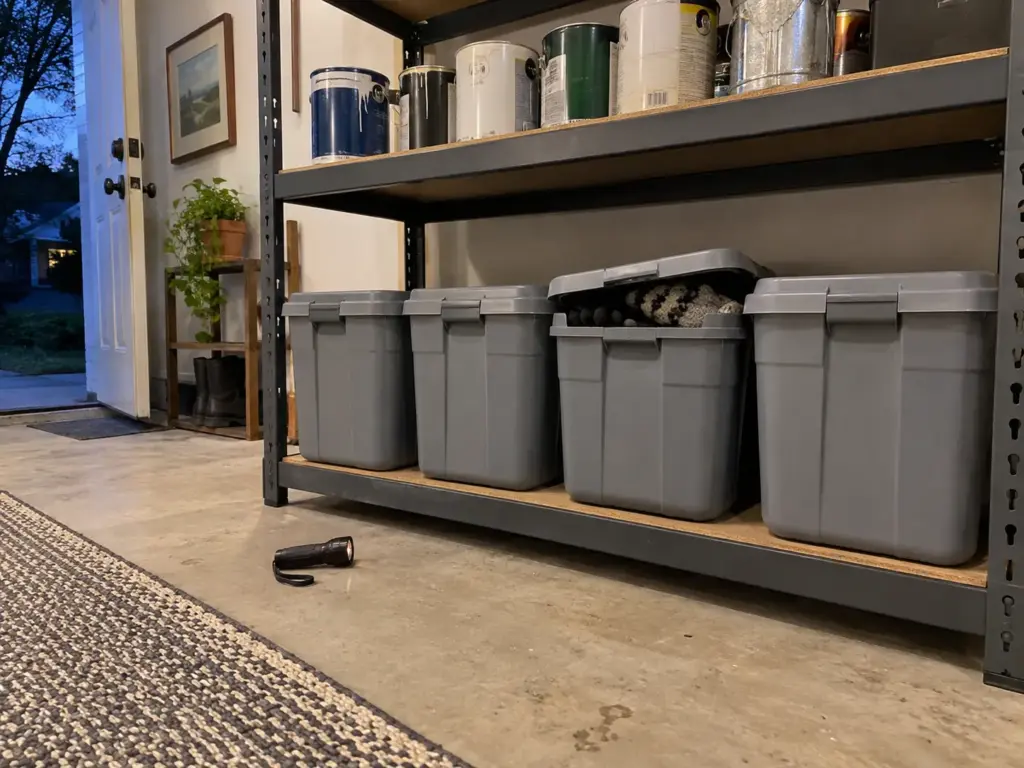
Assembly time differs a lot by type. A wall rail kit is a one-person job once the studs are located, and the maker claims minutes. Steel shelving wants a second person and goes together faster than anything else here.
An overhead rack is the long one: a reviewer logged about four hours alone, and lifting it into place is where the second person earns their keep. A cabinet arrives flat or assembled depending on the model, and a flat-packed one with warped panels takes longer than any estimate. Treat these as what reviewers report, not promises.
What to recheck once it has been loaded for a while
A loaded system shows its habits within a few weeks. Look for shelves starting to bow (the 85-pound item bowing after about two hours is the early version of that sign), wheels that aren’t locked, an overhead rack swaying more than before, hooks that have crept along their rail, and a unit moved after assembly that has loosened.
Sealed plastic bins hold up in an unheated garage with swings in humidity better than cardboard or open fabric, and powder-coated steel gives you more rust resistance than bare steel in the same damp air, as the comparison of fabric and plastic storage bins explains. The garage is the room nobody revisits, so a recheck needs something to hang on that already repeats.
Tie the recheck to something that already happens twice a year, such as the clocks changing or the first cold week. Ten minutes with a hand on each shelf and each hook is enough.
Pick by the Pile, Then Read the Shelf Number
Three things to carry out of this guide:
- Match the type to the pile: heavy and frequent on steel shelving at floor level, fluids in a locked cabinet, hanging on the wall, and only light, rare things overhead.
- Read the per-shelf number first, and subtract more if the unit rolls.
- Check what is behind the paint, or above it, before ordering: studs for rails, joists for the rack, toggles for hollow drywall, masonry hardware for block.
Three months after you load a system, look at the middle of the shelf that carries the most. A bow that wasn’t there on day one means that pile belongs on a lower, stronger shelf, and a unit that was moved after assembly gets its feet and fasteners checked again.
For today, weigh the heaviest tote or toolbox you own on a bathroom scale and write the number on the lid. That figure is the per-shelf rating you are shopping for, and you will notice how few of the shelves on any product page clear it with room to spare.
Frequently Asked Questions
01Who makes the best garage storage systems?
No single maker wins every category, because garage storage is five different jobs: floor shelving, cabinets, wall rails, overhead racks and wheeled wire. Pick the type for what you store, then read that type’s deciding spec, such as load per shelf, wall type or joist spacing, before you look at brands.
02What is the best wall storage system for a garage?
It depends on the wall behind the paint, since a rail, slat wall or French cleat all need studs behind them. Hollow drywall takes light loads on spring toggles, and block or concrete needs masonry-rated hardware. If you can’t confirm the wall, a freestanding unit is the safe fallback.
03What are the best storage solutions for a garage?
Match the solution to the pile: steel shelving at floor level for heavy things, a closed lockable cabinet for fluids, wall rails for hanging tools and bags, and an overhead rack for light seasonal items. Keep heavy items off the ceiling, and read the per-shelf rating rather than the total.
04Which garage storage lift system is the best?
A lift or hoist rack is overhead pulley storage, an overhead rack on a pulley, so it needs the same joist and ceiling check as a fixed one. The lift changes how you raise the load, not what the ceiling must carry, so choose by joist spacing and rated weight, and get help if unsure.
05Can I add garage storage if I can’t drill into the walls?
Yes, freestanding wire shelving needs no fixings, and wheeled versions let you rearrange the garage. Wheels cut the rated load per shelf and tall units can tip, so keep the heaviest items low. Wall rails and overhead racks aren’t options without drilling.
Disclaimer: ClutterlessNest is a participant in the Amazon Services LLC Associates Program. As an Amazon Associate we earn from qualifying purchases. This article may contain affiliate links — if you buy through them, we may earn a small commission at no extra cost to you. We only recommend products we have tested or genuinely believe in.