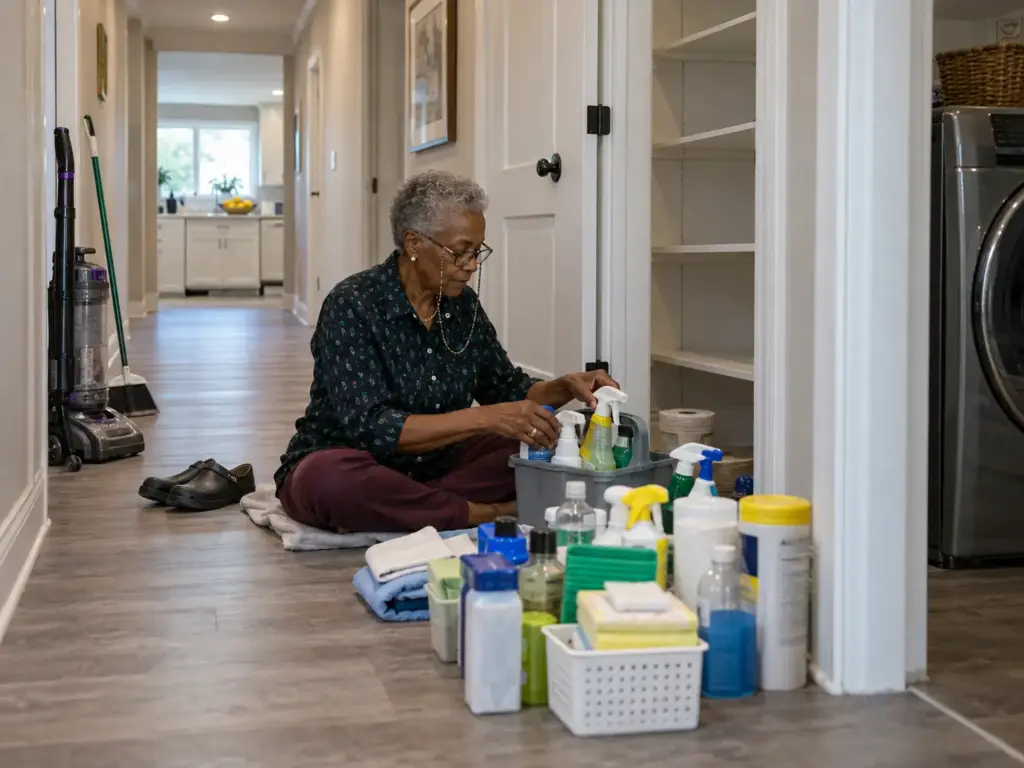
You open the door for the mop and have to lift the vacuum hose off its handle first, then shove aside a bag of bags that wasn’t there last spring. The reset you did back then is gone, and what remains is the same utility closet organization problem with more stuff in it. One r/organization poster called their closet “really poorly laid out” and admitted it had never been kept organized, which is how the people who own these closets tend to describe them. This guide covers why the closet slides back to a catchall, what belongs in it, how to hang tools with or without a drill, how to keep chemicals and weight under control, and how to make the reset last.
Quick Answer
Reset a utility closet in four moves, in this order, before you buy any storage:
- Empty the closet completely and sort everything into task groups.
- Clean the shelves and floor while the closet is bare.
- Set up storage by task: daily tools at hand height, heavy items low.
- Stop stuffing: give every item one spot and send the overflow out.
Why Utility Closet Organization Reverts to a Catchall
A utility closet, or cleaning closet once it has turned into one, is the one storage space that holds things used daily (the broom), weekly (the mop), yearly (spare bulbs) and never (the leftover bag from a project that ended years ago), all behind a single door. Those items run on different schedules, so none of them has a natural home. When a thing has no fixed spot, the nearest open surface wins, and in a closet that surface is the floor or the top shelf.
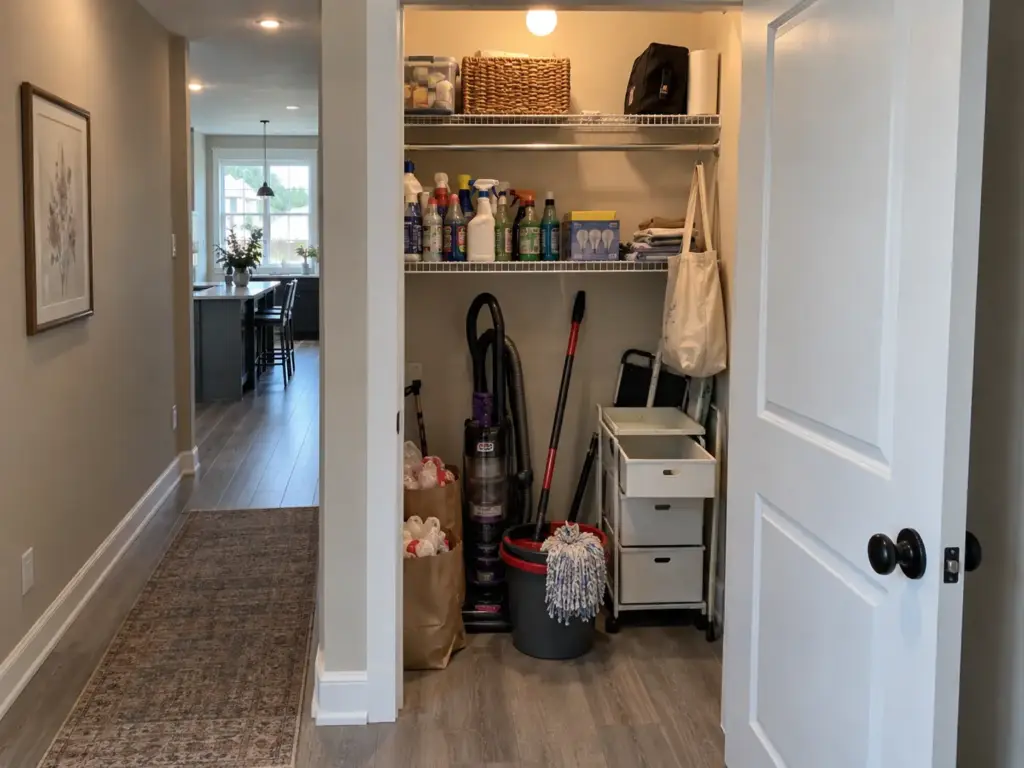
Items used on different days share no fixed spot
The mechanism is simple and a little unfair. The broom gets used so often that it ends up leaning wherever it was dropped last. The spare filters get used once a year, so nobody remembers where they live, and a new box goes in front of the old one. Within a few weeks the closet has no layout at all, only a pile ordered by whenever each thing arrived.
You can see it in the r/organization thread. The poster’s closet had an unused clothing rod eating space, and commenters flagged the clutter on the floor and asked for the line of sight into the closet to be cleared. They also pointed at a rolling cart of drawers with a pointed question: is this being used? A rod, a cart or a shelf that nobody uses is storage working against the closet, because it takes the room the daily tools need.
The “miscellaneous” bin restarts the cycle
A miscellaneous bin feels like a compromise. It is actually a legal parking spot for every decision you did not make. Everything undecided goes in, the bin fills, and a month later you are digging through it for a lightbulb while a second bin starts forming next to it.
The same thing happens in the hall closet, where a small linen closet fills up again in weeks for exactly this reason: nothing in it has a job. The utility closet just has more categories to lose track of. The rule that breaks the cycle is that every bin has a named purpose, and anything that doesn’t fit a purpose leaves.
The floor becomes a parking spot
Once one item lands on the floor, the next one joins it, because the floor already looks like where things go. The mop bucket, the box of paint supplies and the bag you meant to return form a barricade between you and the shelves. Picture reaching for the broom over all of it: you lift, twist, put one foot between two boxes, and decide that next time you’ll leave the broom wherever it ends up.
That is the real cost. The closet doesn’t fail on the day you stop caring. It fails slowly, because the daily tools get harder to reach than the clutter is to add to. The fix this guide builds toward is a home for each task group, not a prettier bin.
What Belongs in a Utility Closet, Sorted by Task
Decide by what you do with something, not by what it is. The things you use to clean the floor, the things you use to clean surfaces, and the household spares are three different jobs, and each gets its own zone. Sorting by item type (all the bottles together, all the cloths together) sounds tidy and puts the mop on one side of the closet and the floor cleaner on the other.
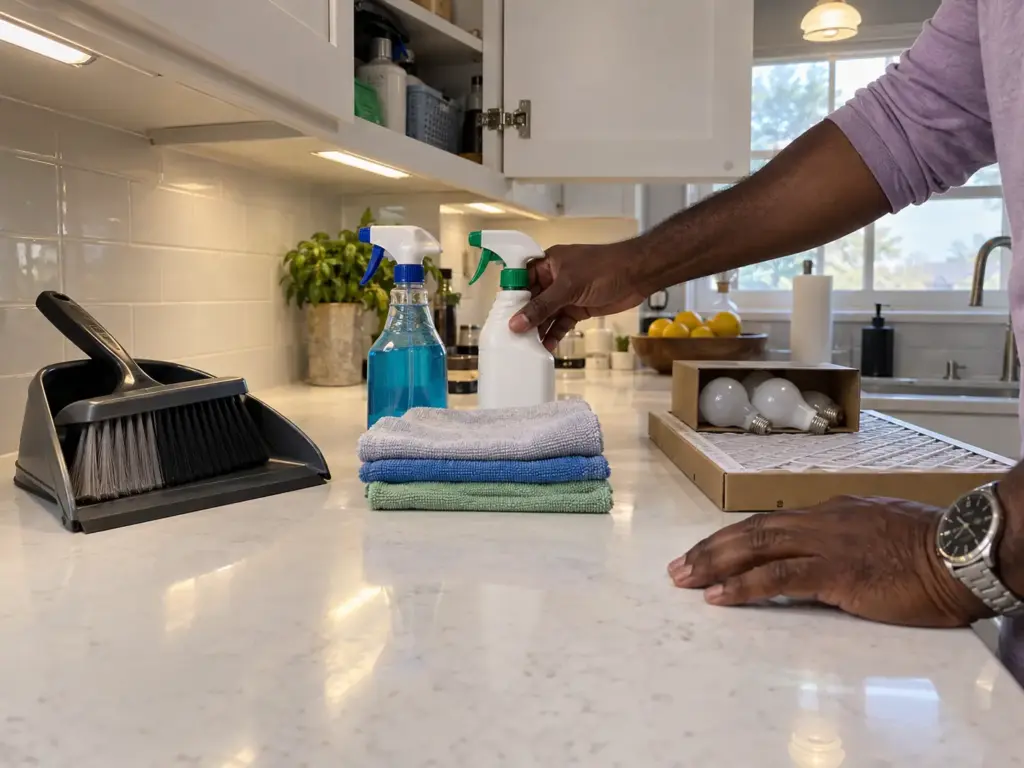
Long-handled tools: broom, mop, dustpan, vacuum
The floor group is the tall one: broom, mop, dustpan, and the vacuum if it lives here. These need a vertical home near the door, because they come out every time. A commenter in the r/organization thread suggested keeping the vacuum, mop and other uprights in one place under the shelf of the back wall, and the logic holds: tall things together leave the shelves free for shorter things.
Cleaning supplies and the kit you carry
Surface cleaning is the second group: sprays, cloths, sponges, the scrubber. Keep similar items together and cut the duplicates, which is the other piece of advice that thread kept returning to. Three nearly empty bottles of the same spray are one bottle and some clutter. For the daily-use bottles, the cleaning supplies you keep under the sink already have their own system, so this closet is the bulk store and the sink cabinet is the working shelf.
The third group is household spares: bulbs, furnace or HVAC filters, batteries. They are small and rarely touched, which makes them the first things to vanish into the miscellaneous bin. Give them a labeled spot of their own.
Overflow that does not belong here
Seasonal items such as decor, clothing on a rod, and the half-used paint cans (more on those in the shelf-load section) are the usual intruders. Medications belong somewhere apart from cleaners, not on the same shelf at any height. If you aren’t sure what stays, declutter the closet before you buy any storage, because storage bought for items that should have left is storage you will keep feeding.
Where Your Closet Sits Changes What Can Go In It
The same broom closet is a different closet in a damp basement than off the kitchen. Location decides what lasts, what you reach for daily, and what you shouldn’t store at all.
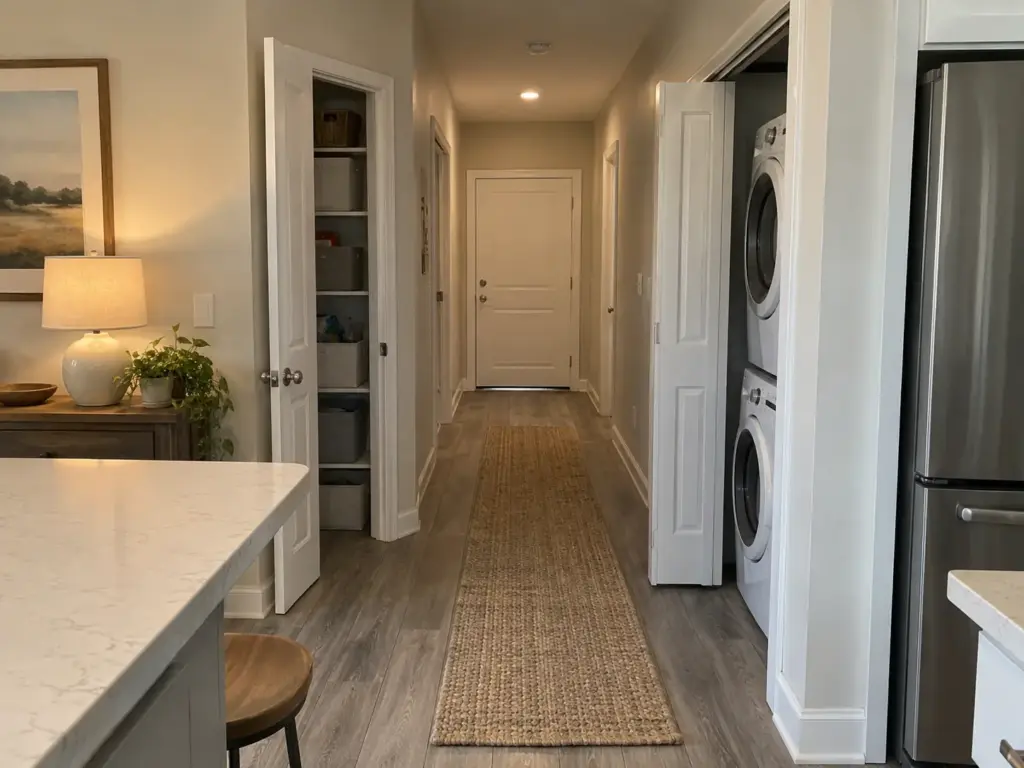
Kitchen, hallway and laundry closets
A closet off the kitchen or laundry room gets daily traffic. That puts the broom, dustpan and the carry kit at hand height, and everything seasonal at the top. These are the easiest closets to keep organized because you pass the door constantly and feel it when something is wrong. An under-stairs closet follows the same logic: keep the tall tools under the high end and save the low end for light bins.
Basement and garage closets
Damp air and temperature swings change what survives. Cardboard boxes soften, some adhesives lose their grip, and certain plastics get brittle over a season. If your closet is in a basement or backs onto a garage, watch for those three before you trust a product that works fine upstairs. Anything that must stay dry goes in a lidded bin on a shelf, not on the floor.
When the closet backs onto a garage, treat the two spaces as one storage plan. You can organize the garage the closet backs onto so rakes, long-handled tools and bulk supplies have a place that isn’t this closet.
A closet that shares space with a water heater or furnace
This is the case that most general advice skips, and the honest answer is short. The appliance manual and your local building code decide what may be stored next to a water heater or furnace and how much space the appliance needs around it. Water heater clearance and HVAC clearance both come from the manual and the code, and no number appears in this guide on purpose, because a clearance copied from a general article can be wrong for your unit. If you can’t find the figure in the manual, ask the installer or your local building department.
What you can do without a number is plan around the appliance: keep the daily tools on the side away from it, and keep chemicals and anything flammable out of the cluster until you have the manual’s answer. A closet that combines laundry sorting on one side with totes and tools on the other, as the r/organization poster’s did, still has to leave the appliance its room first.
Measure the Closet and the Gear Before You Buy Anything
Products fail on a number that was on the listing the whole time. The bin that’s one inch too wide ends up on the floor, and the hanger that doesn’t fit your mop handle goes back in the box. Ten minutes with a tape measure and your phone’s notes app saves the return trip.
The three closet measurements: door opening, shelf depth, floor space
Write down three measurements: the width and height of the door opening, the depth of each shelf, and the floor footprint. The door opening tells you what can physically get in and out.
The shelf depth decides which bins fit. The floor footprint tells you whether a bucket, a vacuum or a rolling cart can live there at all. No closet dimension is quoted as a standard here, because yours is the only one that matters.
The product limits to check against them
Every product in this guide has a limit on its own listing. The no-drill grippers fit handles from 0.67 to 0.98 inches across, and the listing says not to hang anything over 6 pounds. The magnetic cabinet locks are not recommended for doors thicker than 1.2 inches or made of metal. The cleaning caddy measures 15 x 8 x 10.5 inches, so measure the shelf it will sit on before you count on it.
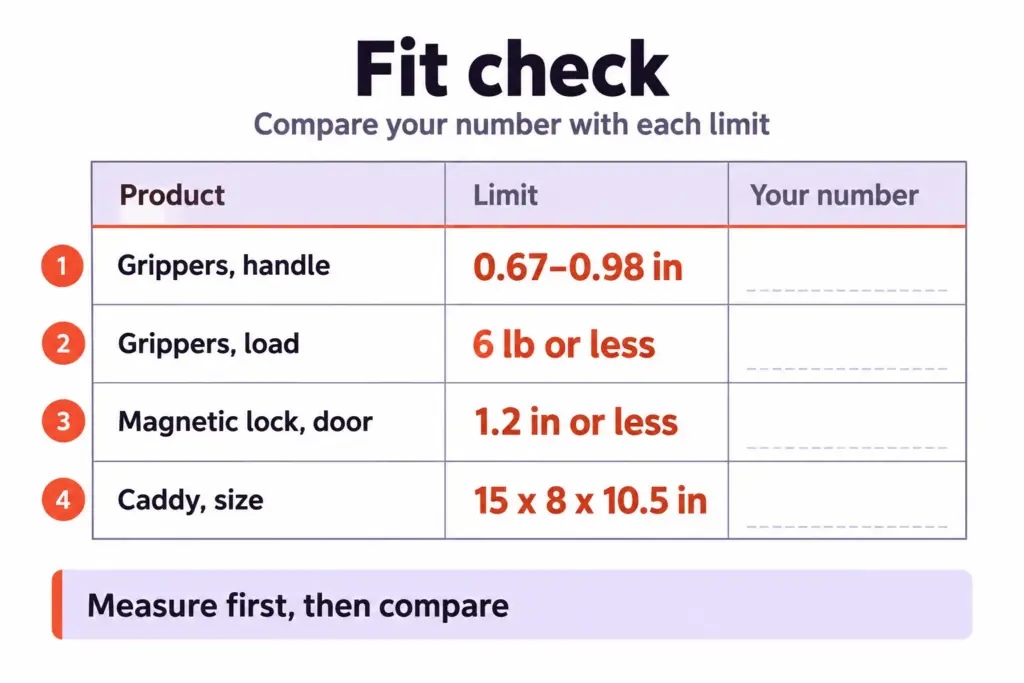
Put your own number next to each limit before you order. If your broom handle is wider than the gripper range, the gripper is the wrong product, no matter how good the photos are.
Why depth decides more than width
Width is easy to see. But depth is easy to forget. A deep shelf swallows small items at the back, and a shallow one can’t hold a tote. One commenter in the r/organization thread proposed an extra-deep shelf, 18 inches instead of 12, so rubber totes could slide under it.
That is one person’s idea for one closet, not a standard, and it works only if the bottom shelf clears the totes. Before you copy it, picture what happens to the back eight inches: unless something forces you to look back there, it becomes the place cans and spare bulbs go to be forgotten.
The Four-Step Reset: Empty, Clean, Set Up, Stop Stuffing
An empty closet shows you how little the daily tools actually need. This section is the process in one pass; it’s the same four steps from the Quick Answer, with the reasoning attached.
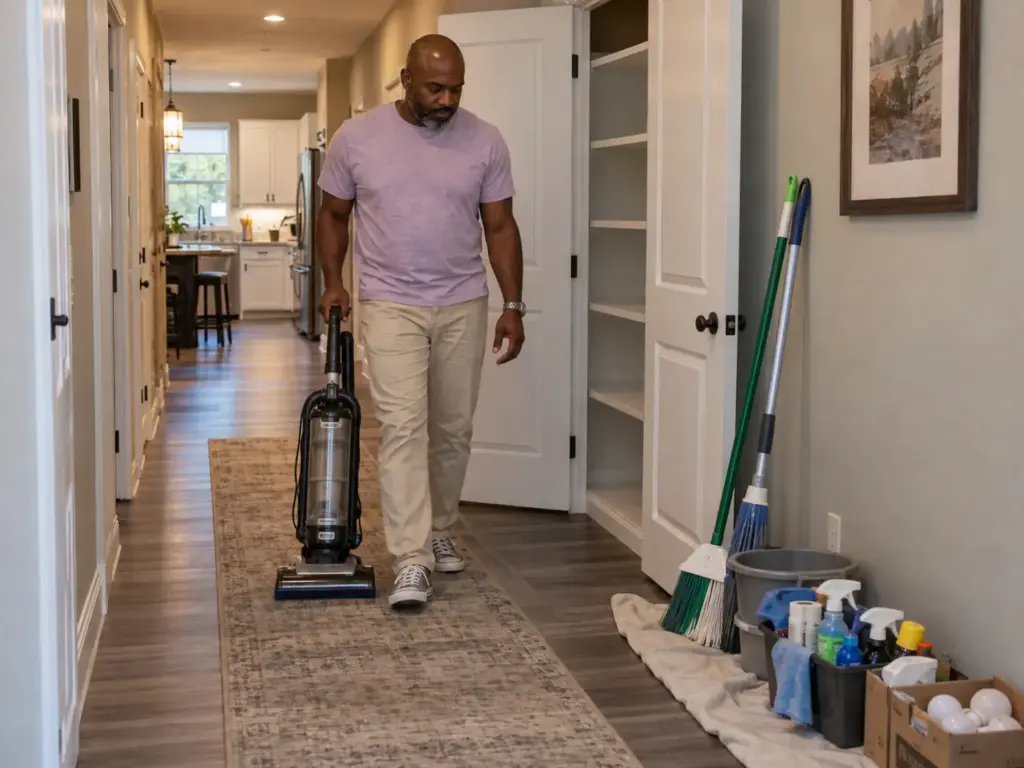
Step 1: take everything out and sort by task
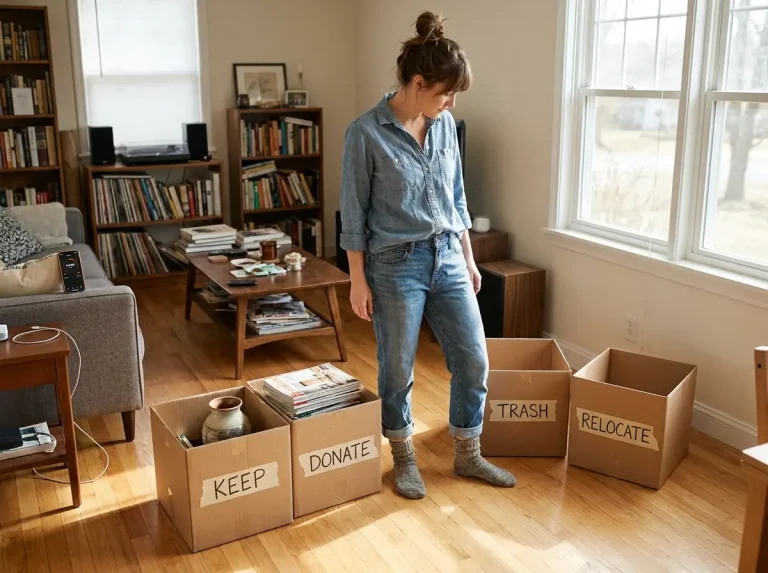
Empty it out completely, carrying everything onto the floor or a table. Sort into the groups from the earlier section: floor tools, surface cleaners, household spares, and a pile for things that leave. Doing it all at once matters, because sorting a closet in place just rearranges the same clutter.
Step 2: clean the empty closet
Wipe the shelves, vacuum the corners, and mop the floor while it’s empty. This is the only time you can reach the back of every shelf, and a closet that’s clean tends to stay respected longer than one that’s only tidy.
Photograph the empty closet from the doorway before anything goes back in. Three months from now, that picture is the quickest way to tell whether the floor and shelves still look the way you left them.
Step 3: set up storage in zones
Establish storage by zone: daily tools at hand height, rarely used items high, and heavy things low. Adjustable shelf dividers let the zones change size as the stuff changes, which one commenter recommended because they’re easy to move around. The next sections cover how to hang and contain what you have.
Step 4: stop stuffing
Every item has a spot, nothing leaves its group, and the overflow leaves the house instead of finding a new corner. The shelf-load section explains why the top shelf is the wrong place for the overflow.
Hang Brooms and Mops: The No-Drill Way and the Drill Way
Long-handled tools take up the most floor and cause the most reversion, so they deserve a wall. The route depends on whether you can drill. A renter can’t put a rack in the wall, and an owner can, which changes both the product and the failure.
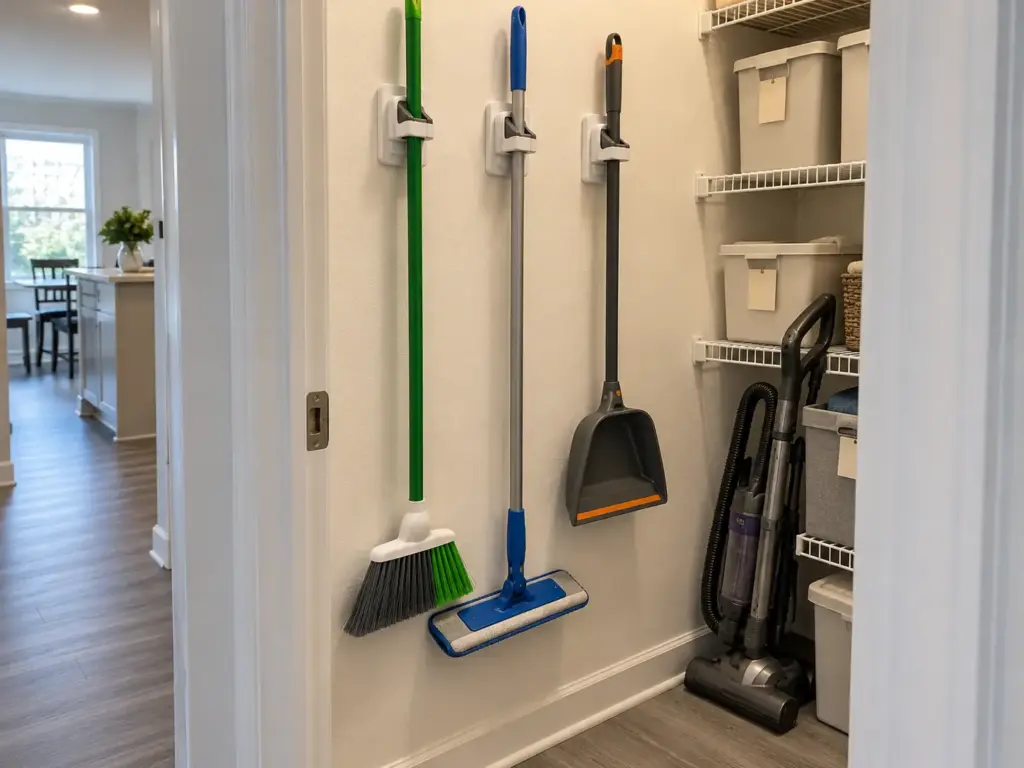
No-drill grippers and their real limit
Try the free options first. The corner behind the door works for a broom if it has somewhere to rest, and a door hook or an over-the-door organizer takes the dustpan and a few cloths. A hook that is already in a stud takes a mop, and a bucket holds the mop heads.
If none of that fits, a no-drill gripper is the next step. The Tinkeep 3-pack broom and mop holder is the only no-drill option with a published rating and handle range, which is why it earns a spot here. A grip hanger like this one holds the handle, so the head hangs clear of the floor.
It fits handles between 0.67 and 0.98 inches across, and the listing says plainly not to hang anything over 6 pounds. Amazon’s review summary reports it “falls off after a month,” with some reviewers saying it can’t hold even their broom. A wet mop head is the heaviest thing you’ll hang, so check the weight as well as the diameter.
Hang the mop first and check the gripper again after a week before you trust it with the rest of the tools. The mop is the heaviest thing it will hold, so it fails there first.
For a renter, the no-drill route has a weight ceiling and the drill route has a wall that stays marked. Pick which one you can live with. The same logic runs through no-drill closet organization in a bedroom closet.
Pegboard for what a broom hanger cannot hold
If you can drill, a wall-mounted rack or a pegboard holds the odd tools a broom hanger can’t: the dustpan, the squeegee, the brush with a short handle. The Amazon Basics 48-piece pegboard kit is the owner’s option. Its listing recommends a maximum of 40 pounds, and that figure is for the whole board, not each hook, so a heavy vacuum hose doesn’t belong on a single peg.
Reviewers report pegs that fall out when you pull something off the board, and screws too short for the drywall anchors, so check the hardware before you commit the wall. Reviews also say the pegboard is small for common sizes. It is the wrong choice for a renter, and it asks you to check what the wall behind it is made of first. If you want to see how a larger wall system is built, the wall system the garage uses shows the same logic at full scale.
Which route fits which closet
The obvious owner pick is the pegboard, and for most owners it’s right. The exception is a closet with only a few long tools: a pair of grippers or a single hook does the job without a wall full of holes. A pegboard in a closet that holds a broom and a mop is a lot of wall for little gain.
If the long tools are more than a broom and mop, rakes and shovels that live nearby may fit better under garage tool organization than in this closet at all.
Bins, Caddies and Dividers That Fit Real Shelves
Containment is for the small stuff: spray bottles, cloths, spare bulbs, batteries. The container has to match the shelf you measured, not the picture it came with.
Open bins for daily items, lidded bins for the rest
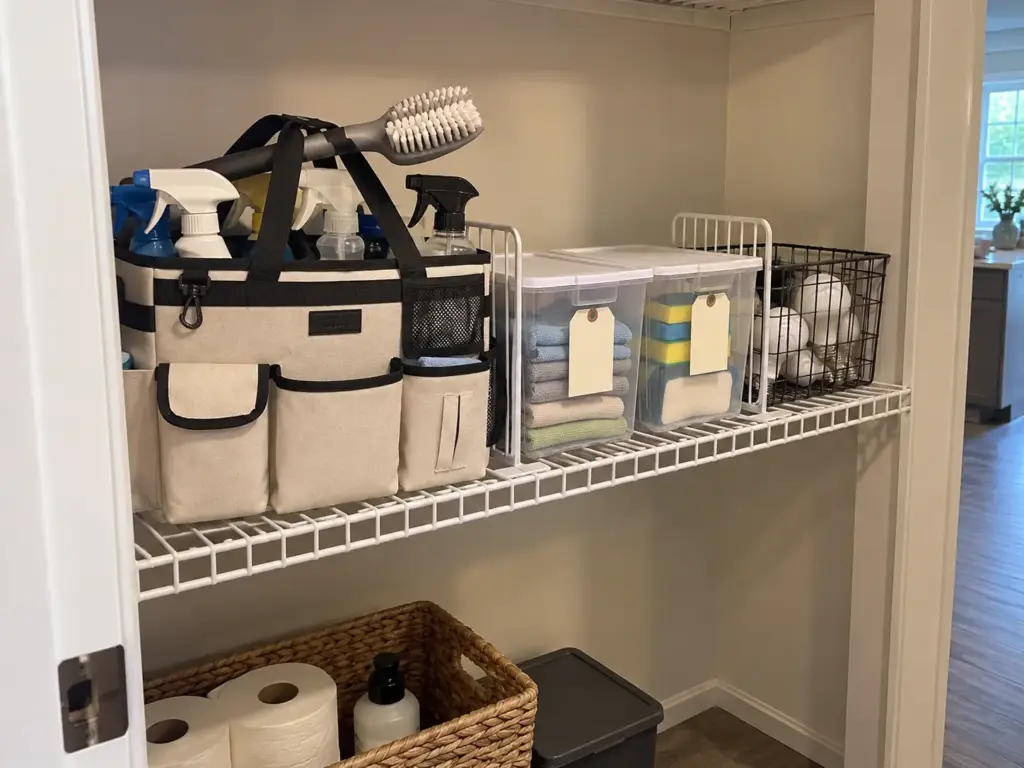
Open bins suit the things you reach for daily, because a lid is one extra step that adds up. Lidded bins suit the rarely used, which stay clean and out of sight. Clear totes and labeled bins help where you need to see what is inside and how much is left.
If a bin is a little too wide for the shelf, it is the wrong bin, and a cheap one that fits beats a boutique one that doesn’t. The guide to storage bins that fit real closet shelves goes through the selection in more detail.
A caddy for the kit you carry out
A caddy lets the supplies go to the job and come back as one unit. The cleaning caddy with a handle is listed at 15 x 8 x 10.5 inches, a carry bag rather than a shelf unit, and its size decides how many products leave the closet at once. One Amazon reviewer wished it were larger because not all their supplies fit, so a household with a long list of products should plan on more than one trip or pick a bigger caddy.
Dividers and labels that hold the zones
Adjustable shelf dividers are the budget way to keep zones from running into each other, and they move when your stuff changes. Labels aren’t decor. They tell the person who doesn’t know the system where the dustpan goes. Without them, in a shared household, the mop goes wherever it fits.
No Closet? A Rolling Cart Does Part of the Job
Some homes have no usable closet, or a closet already claimed by a water heater. A rolling cart can carry one task kit, and that is all it should be asked to do.
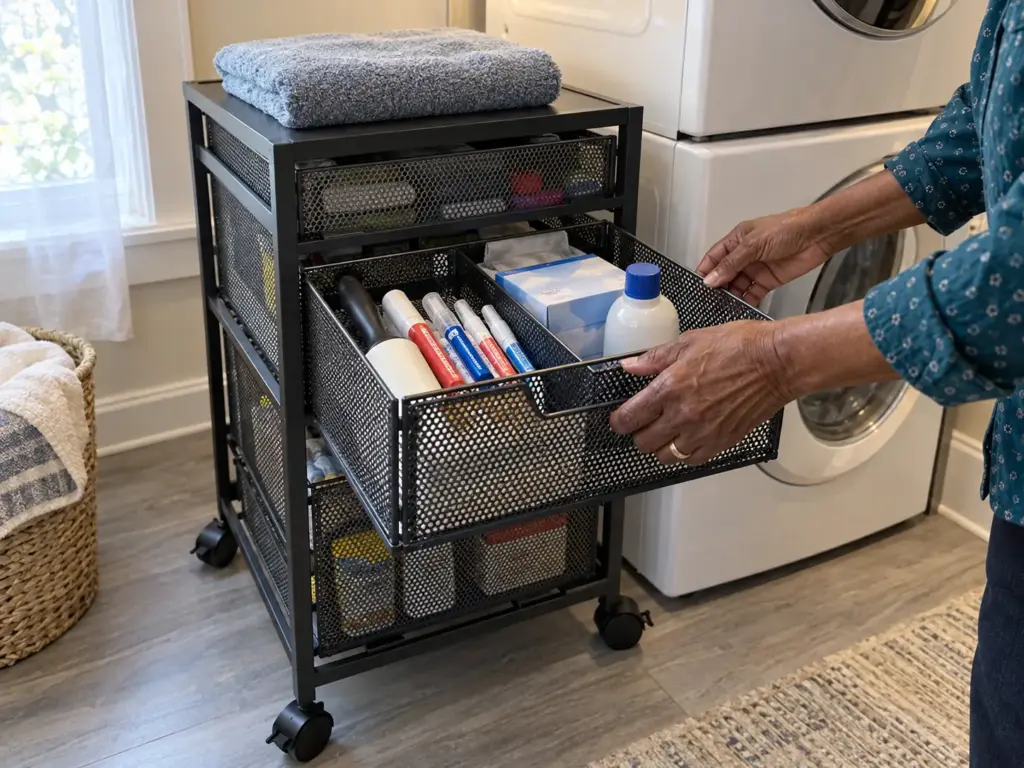
When a cart works and when it becomes a parking spot
A cart works when it holds a single kit and lives where that kit is used. It fails as extra storage. A narrow freestanding cabinet is the other option, and a pull-out cabinet suits a gap in a kitchen or laundry room, but each follows the same rule: one kit, one place.
Remember the commenter’s question about the rolling cart of drawers in the r/organization closet: is this being used? A cart that has become a surface for things with no home is dead storage that looks like storage.
What the cart reviews report
The rolling utility cart with three drawers has lockable wheels and a listing claim that each drawer holds up to 20 pounds. That is the seller’s claim, not a test. In reviews, drawer movement is the problem: about 8 of 18 mentions are negative, with one reviewer describing rails that aren’t wide enough to keep the drawers on their tracks, and another finding it smaller than expected. Treat the drawers as light storage for small cleaning items, not as a place for anything heavy.
A common alternative exists in the RASKOG cart, but its reviews weren’t read for this guide, so read them yourself first or skip it.
Freestanding units and tipping
A tall freestanding unit can tip, and that matters most if children or pets live in the house. Anchoring is covered in the shelf-load section below, and the guide to freestanding shelving units that will not tip over goes through what to look for before you buy.
Chemicals in a Shared Closet: Up, Away and Locked
The utility closet is the one place a toddler or a pet is most likely to open. That changes how chemical storage should work, and pet-safe storage follows the same rule: up, away and closed. It isn’t the same problem as a locked medicine cabinet, because the closet door is a door everybody uses.
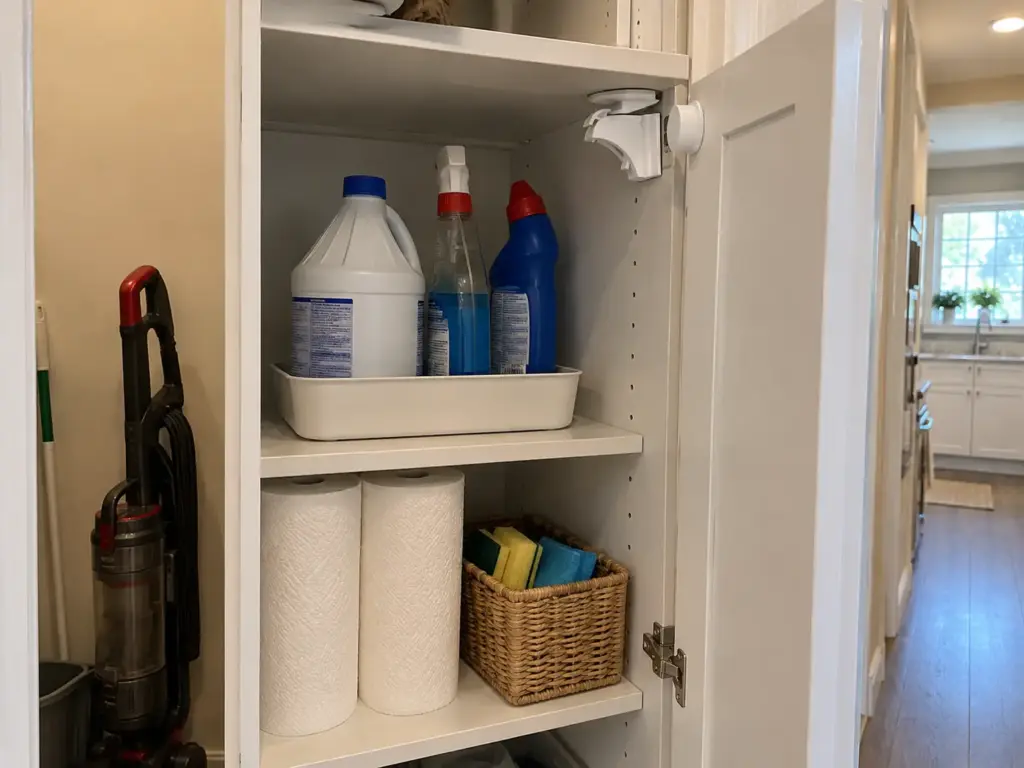
The every-time-after-use rule
According to the Oregon Poison Center’s household products guidance, “Store these items up and away and out of reach of children every time after use.” The words that matter are every time after use. The risk isn’t at the store or at the shelf; it’s the bottle left on the counter while you answer the door.
The same guidance says to use a lockable cabinet or a child-resistant lock, and to keep household products separately from food and drink to avoid mix-ups. In practice that means the bleach and degreaser go high, away from the pantry shelf, in their original containers.
A second layer on the cabinet door
A child lock is a second layer, not a substitute for putting the bottle high. The Norjews magnetic cabinet locks install without a drill, which makes them a fit for renters, and the pack of 20 covers every door you might need. The listing asks for a 24-hour wait so the adhesive can firm up before anyone uses the lock.
They have real limits. The listing says doors thicker than 1.2 inches or made of metal are not recommended. One reviewer reported that their two-year-old pulled the cabinet and the top popped off, and installation shows up among the complaints.
So the lock slows a child down, and the high shelf keeps them from reaching the bottle in the first place. And a magnetic lock is not a seal.
What to post on the door
Post the Poison Help line on the closet door: 1-800-222-1222, available 24 hours a day, every day. When something is swallowed, nobody wants to search for the number.
Save the Poison Help number in your phone as well as on the door, so a grandparent or a sitter finds it in the same place you do.
Shelf Load: What Stays Off the Top Shelf
Heavy things belong low. This sounds obvious, and a closet is where it breaks first, and paint storage is the usual cause: the cans land on the top shelf because nothing else has a spot. In the r/organization thread, a commenter told the poster to take the gallons of paint off the top shelf because “those shelves aren’t really designed to support the kind of weight” paint and clothing add.
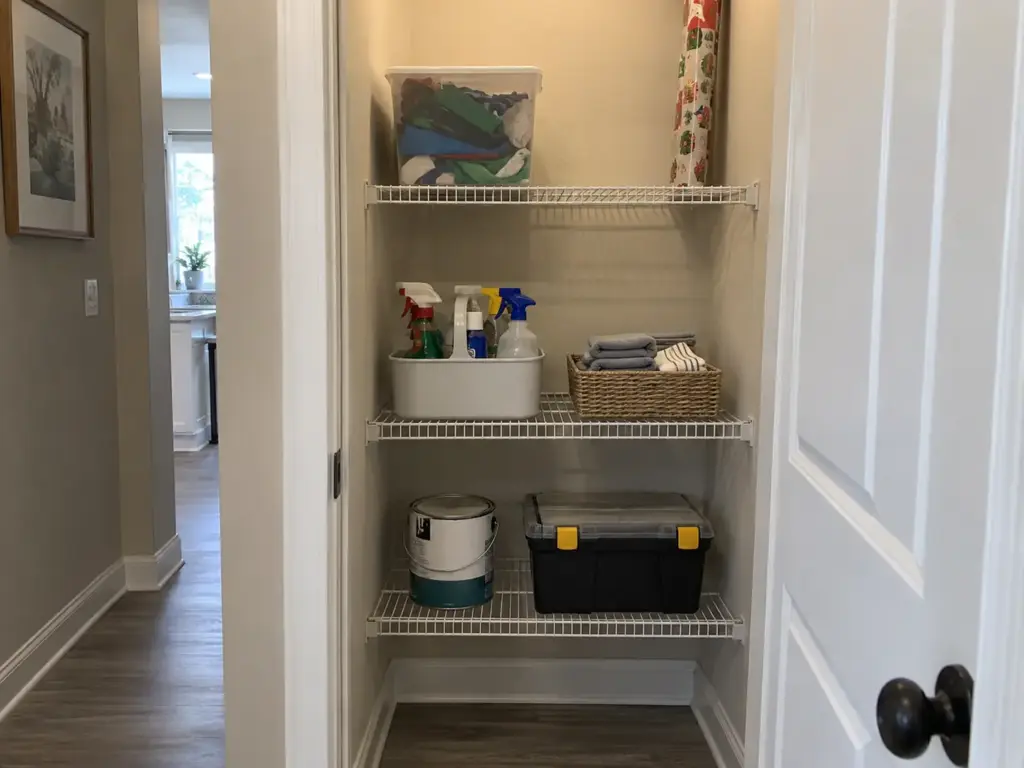
Heavy low, light high
The rule is simple: heavy items on the bottom shelf, daily tools at hand height, light and rarely used items on top. The top shelf is for the things you can lift with one hand while standing on the floor. A full gallon of paint isn’t one of them, and a shelf that bows under it eventually lets go of everything on it.
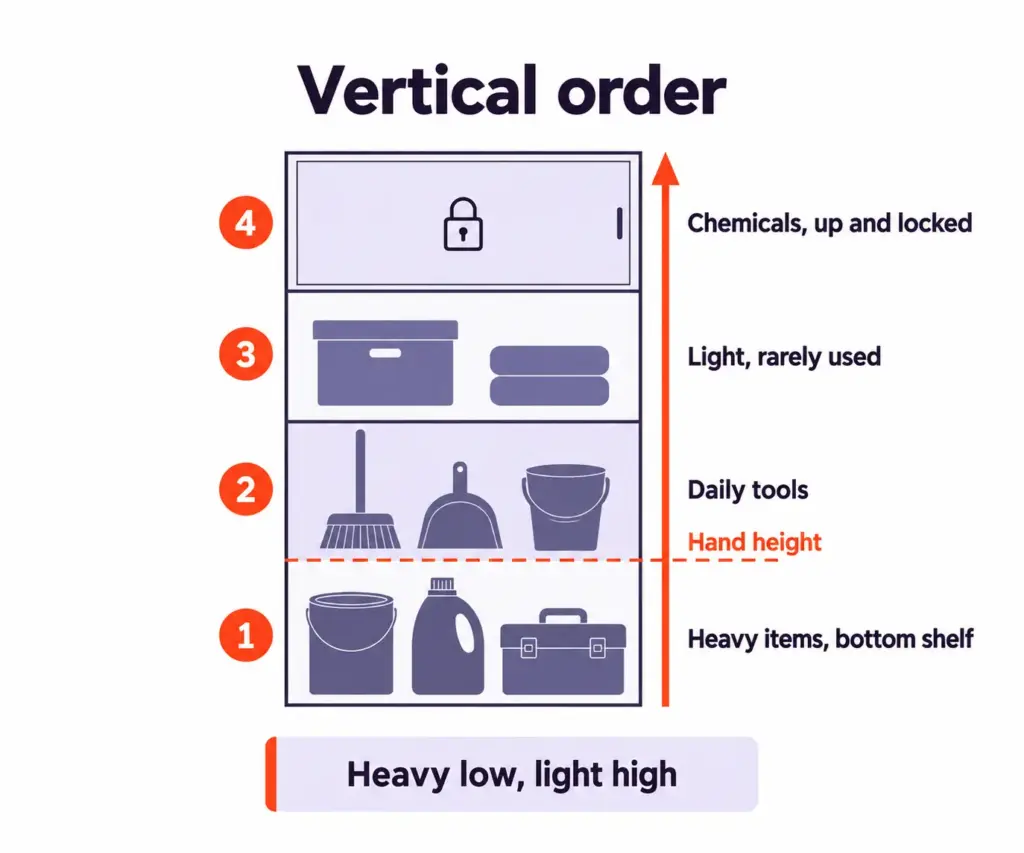
The chemical shelf is the one exception to “heavy low.” The guidance says up and out of reach, so buy the smaller container: a jug you can lift down one-handed is one you can keep on the high shelf or in a locked cabinet, in its original container.
Read the rating before you stack
Every rating is a weight limit, and the same number means different things on different products. The pegboard’s 40-pound figure is for the board, not per hook. The cart’s 20 pounds per drawer is a seller claim. The gripper’s 6 pounds is a limit, not a goal.
If a shelf has no rating, treat it as light-duty. For sturdier options, garage shelving units are the place to compare load ratings.
Anchor tall freestanding units
A tall unit that isn’t anchored can tip when a child climbs it or a top shelf is overloaded.
The CPSC’s Anchor It! release states, “CPSC recommends that consumers anchor furniture, including dressers, securely to the wall.” Read the U.S. Consumer Product Safety Commission’s Anchor It! guidance for the details.
The release names dressers, armoires, wardrobes and other clothing storage units, not shelving, so treat anchoring a tall shelf as good practice rather than a rule you’re required to satisfy.
Keeping the Closet From Sliding Back
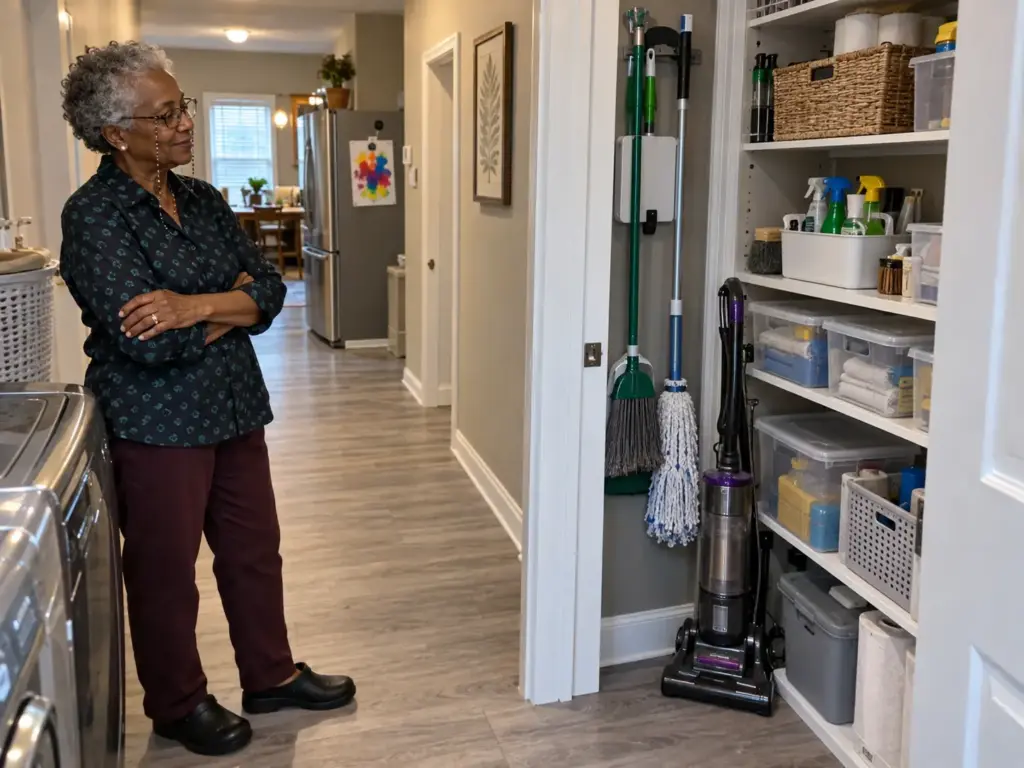
The system has to survive a Tuesday, not just the weekend you built it. Maintenance is small and regular, or it doesn’t happen.
A five-minute monthly reset
Once a month, return strays to their zones, check the floor, and empty the miscellaneous bin if one has crept back. Five minutes of this is cheaper than the full reset you’d need after a year of skipping it.
The one-spot rule for everyone in the house
Every item gets one spot, and anyone, whether a roommate or a family member, can find it. Imagine the person who doesn’t know the system: they will put the mop wherever it fits, and the closet will drift from that day on. Labels and a visible zone map on the door give them a chance. If you want a model for keeping a shared space orderly, see how to keep a shared closet neat.
The seasonal check
Once a season, do a short seasonal reset: press on the lock adhesive, test whether the gripper still holds a handle, and look at the top shelf for anything that has crept up in weight. Basement and garage closets need this most, because temperature swings can loosen adhesives.
Heavy Low, Chemicals Up, and a Date to Look Again
Three things carry the rest. Give each task group a fixed home, because items with no home are what turn the closet into a catchall. Measure the door, the shelves and the floor before you buy, because every product here has a limit on its listing. And put chemicals up, away and locked, with the heavy things low and the light things high.
Three months from now, the test is whether the daily tools are still within reach without moving anything, and whether the floor is still clear.
Today, with what you already have, take the heaviest thing off the top shelf and set it on the floor shelf, and move the bleach out of a child’s reach. Then open the door once and notice how long it takes to find the broom.
Frequently Asked Questions
01What is the best way to organize a utility closet?
Empty it, clean it, set up storage by task, then stop stuffing it. Put daily tools at hand height, heavy items low, and give every item one spot so nothing lands on the floor.
02What is the best order to organize closets?
Take everything out, sort it by task, clean the empty space, set up zones, and buy containers last. Measuring before you buy keeps you from paying for bins the shelves can’t hold.
03What is a utility closet in an apartment?
It is the closet that holds cleaning tools and supplies, and sometimes the water heater or HVAC unit. If an appliance is inside, check its manual and local code before storing anything next to it.
04Can you hang a broom and mop without drilling?
Yes, with a no-drill gripper, if the handle is within the listing’s range and the load stays under 6 pounds. Some reviewers report the grippers falling off over time, so check the hold regularly.
05How do you keep chemicals away from children in a utility closet?
Store them up and away every time after use, in a lockable cabinet or with a child-resistant lock. Post the Poison Help line, 1-800-222-1222, on the closet door.
Disclaimer: ClutterlessNest is a participant in the Amazon Services LLC Associates Program. As an Amazon Associate we earn from qualifying purchases. This article may contain affiliate links — if you buy through them, we may earn a small commission at no extra cost to you. We only recommend products we have tested or genuinely believe in.