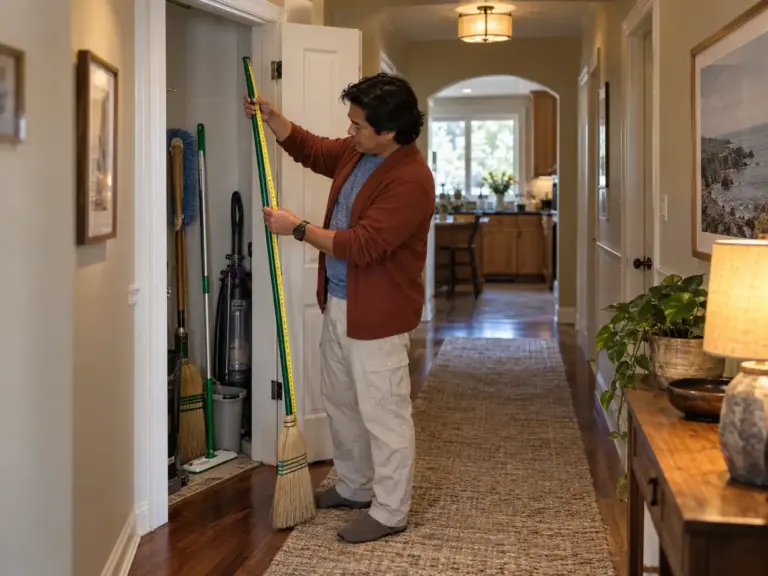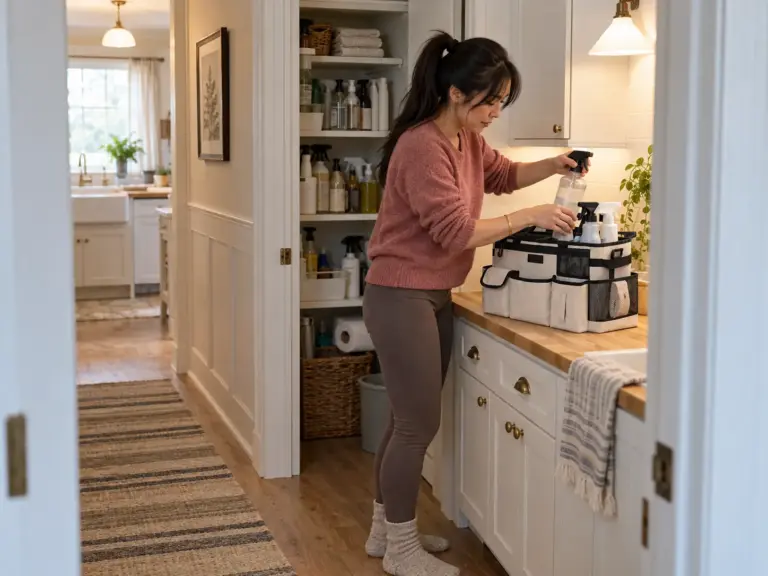

You lift the caddy out of the cabinet and the trigger heads catch on the door frame. One square bottle has tipped halfway out of its round slot, and the whole load turns out to be taller than the shelf you bought it for.
Caddies get picked by brand and by photo, but the fit is decided by two numbers, the widest bottle and the tallest bottle with its sprayer on, plus the door the caddy has to pass through on the way out. This guide measures those first, then matches a shape to your home. It sits inside the larger job of organizing cleaning supplies with or without a closet: the best cleaning caddy organizers by shape, why a caddy drifts into the junk-drawer role, the under-sink lane, where a loaded caddy breaks, and what to use when there is no closet at all.
Measure the widest bottle and the tallest one with its sprayer fitted, then pick the shape from the table.
| Caddy shape | Best for | Watch for |
|---|---|---|
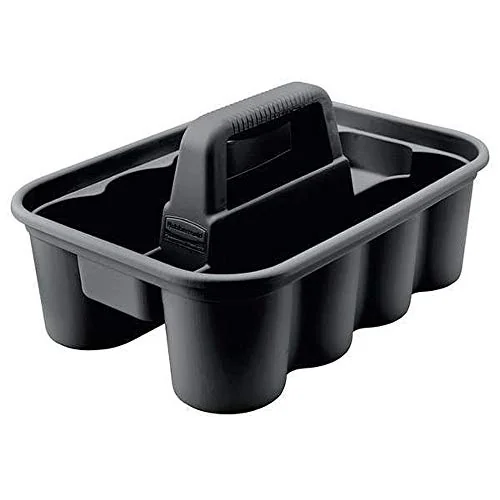
| Open tray (Rubbermaid Deluxe) | Eight round 32 oz sprays on one daily round | Molded slots turn away wide tubs |
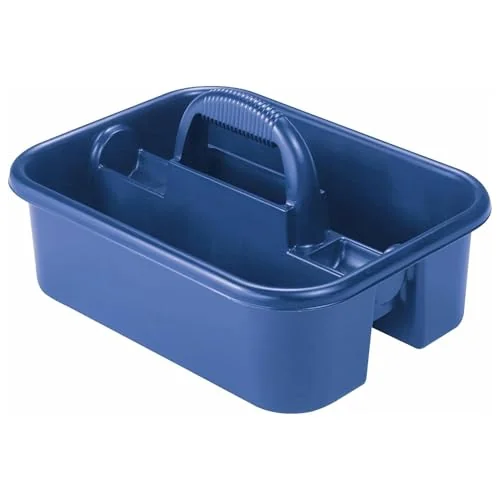
| Big hard tote (Akro-Mils 09185) | Full jugs and paper towels for a whole-house kit | Wider than most sink cabinet floors |
| Rolling lane (YouCopia RollOut) | Pulling the back of a base cabinet into reach | Only 5.3 in high, tall triggers sit beside it |
| Wearable (SCAVATA) | Stairs and long rounds with both hands free | Reads smaller than it looks |
| Counter caddy (MobileVision bamboo) | Bathrooms and laundry rooms with no cabinet | Dry it after a damp cloth goes in |
| Budget plastic tote (JiatuA) | A small daily kit that moves | Low walls leave sprayers above the rim |
How to Choose the Best Cleaning Caddy Organizer Before You Look at Any Product
Lay your bottles on the counter before you open a single product page. The caddy you were about to order probably has slots for a bottle that is not yours, and the only way to catch that is with a tape measure in your hand.

Measure the widest bottle and the tallest one with its sprayer on
A standard 32 oz trigger spray bottle stands 13 in tall with the sprayer fitted and measures 3 1/4 in across. Even a 16 oz bottle reaches about 10.3 in once the trigger is on. Most caddy walls are far lower than that, so the shell already sticks out of the caddy, and the trigger head is the part that catches on a door frame and tips the load.
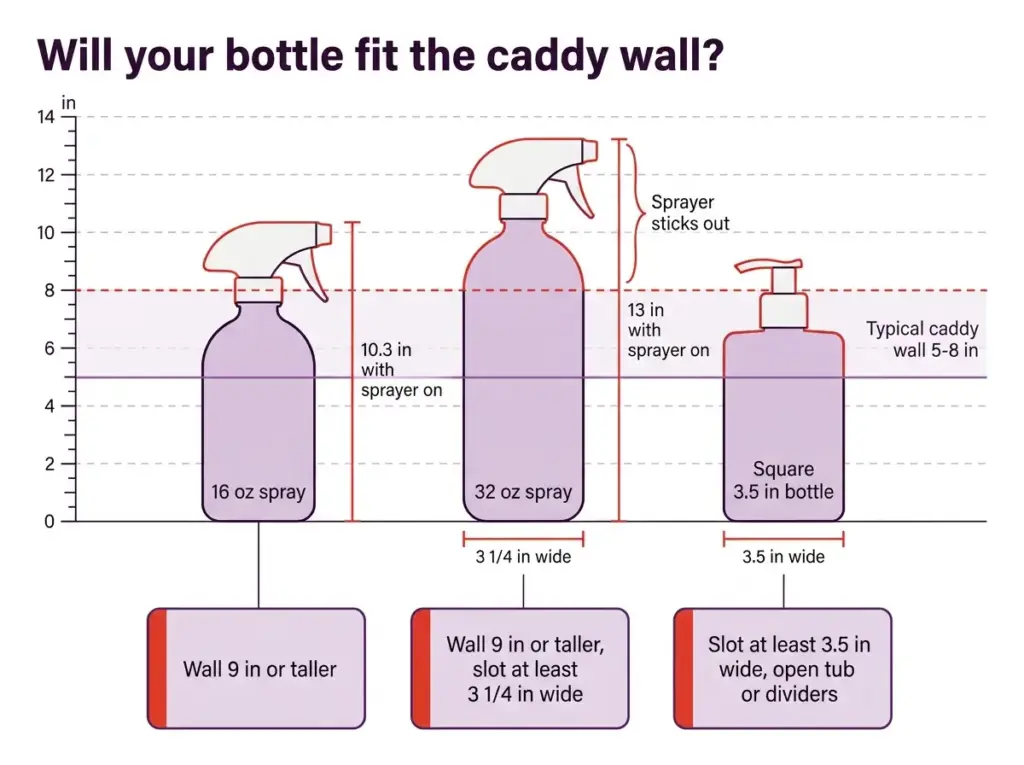
That gives you a rule with two numbers. Find the widest footprint and the tallest bottle with the sprayer on, then hold both against the caddy. A compartment narrower than about 3 1/4 in lets a full-size spray lean, and a wall under about 9 in lets it tip out when the caddy swings on a stair.
A caddy that fails either number does not improve with use, whether it is a utility caddy, a divided caddy or a plain tote. It simply becomes the caddy you stop carrying.
Height gets a second check once there is a handle involved. A tray 7.4 in tall with a 13 in bottle standing in it is still 13 in tall, and the handle adds to that when you lift it. So the number to compare against the shelf height, a cabinet or the space under a sink bowl is the bottle’s height, not the caddy’s. Plenty of caddies clear a shelf empty and then bump the bottom of the bowl, a cabinet frame or the shelf above the moment the sprayers go in, which is why cabinet clearance has to be measured with the bottles standing in the caddy.
The footprint check works the same way. Count your bottles by width, not by number: five round 32 oz sprays take about 16 in in a straight row, so a 15 in caddy has to stagger them in two rows, and the back row is where a trigger head jams against the front one. Add up the widths of the bottles you actually use each round, and that total, not the bottle count on the box, tells you how many compartments you need.
This is the same habit as sizing a broom closet to your tallest handle: the tallest item sets the height, and everything else is arranged underneath it.
Stand your tallest bottle in the caddy with the sprayer on, then lift the caddy by its handle and tilt it a few degrees, as you would on the stairs. If the bottle leans out, the wall is too low. If it jams against its neighbor, the compartment is too tight.
Why square bottles rock in a round-slot tray
Square designer bottles, the Method-style kind, run about 3.5 in across, a little wider than a round 32 oz bottle. Drop one into a slot molded for a 3 1/4 in cylinder and the corners wedge on the rim, the bottle rocks with every step, and it shoves into the slot next to it. The Rubbermaid tray further down is molded for eight round 32 oz bottles. Eight is the mold’s arrangement, not a weight anyone should carry, and the layout was never drawn around your shelf of cleaners.
If your sprays are square, an open tub or a caddy with adjustable dividers takes them, and a molded round-slot tray does not. A tray that fits half your bottles is worse than no tray, because the leaning half makes the whole caddy unstable when you carry it.
The compartment layout comes in three kinds, and each one suits a different set of bottles. Fixed slots hold a known bottle upright and nothing else. Adjustable or removable dividers, the idea behind a divided caddy, let you build the layout around today’s bottles and rebuild it when the brand changes.
An open tub has no layout at all, which suits mixed shapes and wide containers but lets bottles slide into each other on a stair. If you buy refills in whatever brand is on sale, dividers or an open tub will outlast a molded tray, because the next bottle will not be the shape the last one was.
Try the dishpan you already own first
A plastic dishpan, a dollar-store bucket or a tool tote from the garage is the baseline every product here has to beat. It has no slots, so round and square bottles sit together without argument, and its only weakness is a wall that may sit lower than your tallest sprayer. Carry it through one full cleaning round and watch which bottle leans, which sponge goes missing, and whether your hand ever wants a handle.
Buy only when one of your two numbers fails. If the dishpan holds the widest bottle and the tallest one stays upright, you have already solved the fit problem for free.
What the dishpan cannot do is stay organized. Microfiber cloths slide under the bottles, the sponge sits in whatever leaked, rubber gloves go missing and the cleaning brushes lean across everything. A product starts earning its price when it gives each of those a fixed place and a way to drain, which is what separates a tray with pockets from a bucket with a handle.
Open Trays and Big Totes That Carry a Whole Round of Cleaning
Think of the cleaner who makes two trips because the caddy holds the spray bottles but not the cloths, or the one who wonders whether a single deep tote beats two smaller ones. As a hand-carried cleaning supplies organizer, a caddy comes in two shapes that hold a full set of bottles, trays and big totes, and each one fails in a different home.
Molded and open trays for one daily round
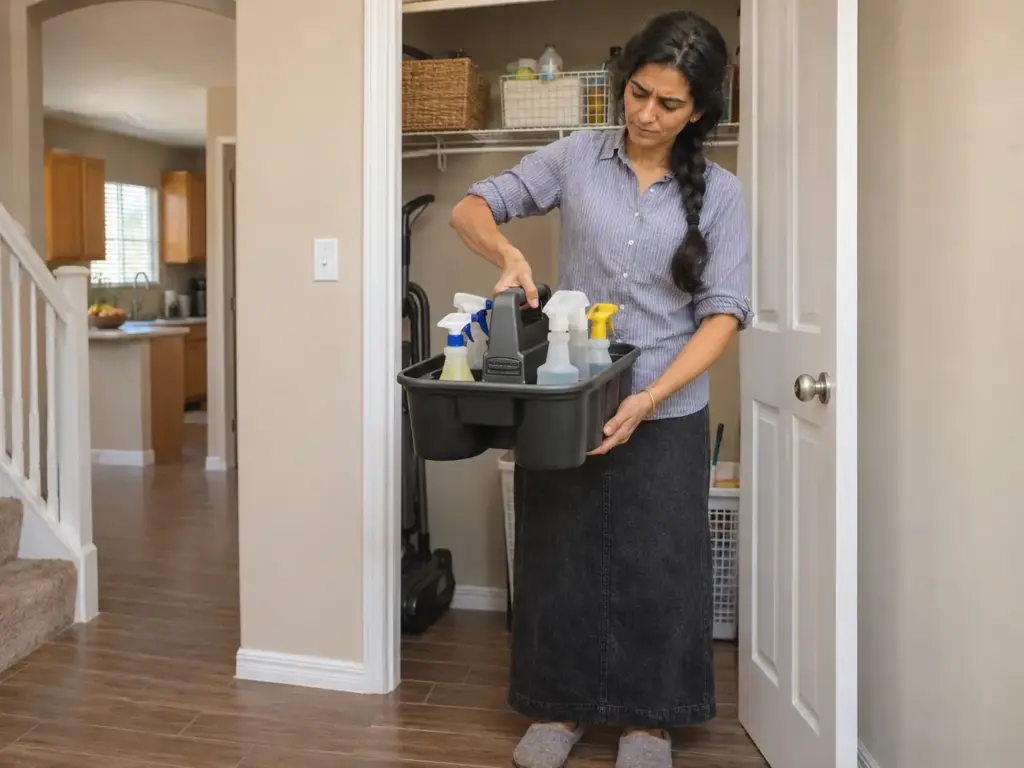
A tray is the right size when one round of cleaning, a few sprays, a cloth and a scrub brush, fits and nothing else tries to. Weight when full is the limit that matters here: eight 32 oz bottles that are half full still add up to a carry that strains one wrist, so a tray is a one-room-at-a-time tool, and the caddy should come back to its shelf between rooms. The Rubbermaid Deluxe is a molded plastic caddy for eight round 32 oz bottles, and its center handle keeps a full load balanced, so the sprays stay upright as long as they are the shape the slots expect. Its slots are too narrow for wide tubs, so a canister of wipes will not go in, and a square bottle rocks in it.
The Casabella is the open-tub answer to that problem: clear, with no molded slots, so it takes wide containers and square bottles alike. It nests on its matching 4-gallon bucket, which makes it a bucket caddy, the paid version of the dollar-store trick of carrying a bucket with a tote nested inside it, and the bucket is sold separately. Its open top has no lid, so a full tub collects dust and splashes.
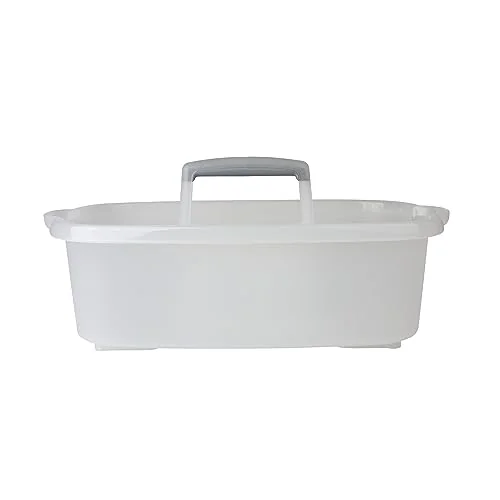
Pick the Casabella over the Rubbermaid whenever wide containers are in the kit. If you want the free version, two square buckets nested together with the inner handle removed does the same job: the outer one stays for water, the inner one holds product.
Big totes for a whole-house kit
The tote is the shape for a kit of housekeeping supplies that has to cover a whole floor in one trip: full jugs, paper towels, a toilet brush and a stack of cloths. The first part to go on a loaded tote is the handle, and a tote with no pockets or dividers lets bottles leak against each other, which is the failure the pockets exist to stop.
The Akro-Mils 09185 is the largest of the group, with two deep pockets and two small compartments that take full jugs and paper towels. Its 18.4 x 13.9 in footprint is wider than the clear floor of most base cabinets, so it lives on a shelf or the closet floor.
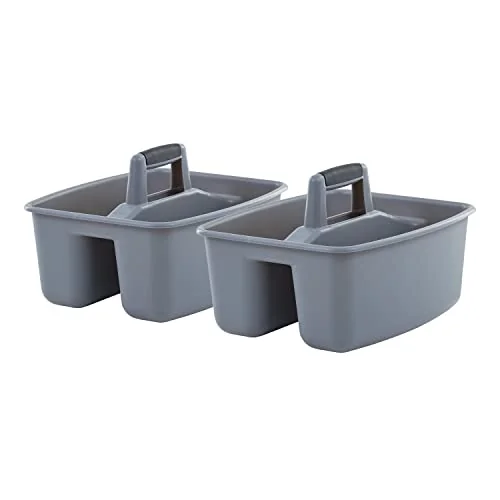
The Mighty Tuff comes as a pair, and it is deep enough that short bottles disappear below the rim. A pair is useful for one specific reason: it is the two-kit split from the next section in a single purchase, one tote for the daily round and one that stays put.
If a fixed system suits your home better than a portable one, shelf, door and wall organizers do the same storage job with nothing to carry.
Why a Cleaning Caddy Turns Into a Junk Drawer, and the Two-Kit Fix
A caddy that sits in the last room you cleaned for a week has stopped being a caddy. It has become furniture, and the next job begins without it.

Supplies never travel back
The pattern is mechanical. The caddy gets left where the last job ended, the next job starts without it, a second bottle of the same spray gets bought on the way home, and now there are two partial bottles and a caddy nobody wants to carry. Run that loop for a season and a household ends up with three glass cleaners, two half-empty disinfectants and a caddy holding the oldest of them, and it is the same loop behind rebuying the same cleaning supplies month after month.
A working cleaner solves it by rebuilding the caddy around two trips, so nothing ever has to be stretched across one load. A household caddy that is lifted once a month is already a shelf.
The size of the caddy sets the odds. The bigger and heavier the caddy, the more a person hesitates to pick it up for a five-minute wipe of one bathroom, and that hesitation is what leaves it parked in the laundry room. A caddy small enough to grab with one hand gets grabbed. A caddy that needs both hands and a plan gets skipped, and then the cloths go into the wash without it.
A small daily kit and a bigger deep-clean kit
Split the load in two. The daily cleaning kit is a spray, a cloth, a sponge and gloves, small enough to fit the budget tote below, and it moves. The deep-clean kit holds the heavy jugs, the scrubbers and the backstock, and it stays in the utility closet or on a closet floor. It comes out for a deep clean or a spring cleaning weekend and goes back the same day.
Build the return trip into the end of every job so the daily kit goes back to its spot before you put the cloths in the wash. The whole-home system this caddy plugs into is covered in how to organize cleaning supplies.
The two kits should not duplicate each other. If both hold a glass cleaner, the deep-clean kit has taken over the job of the daily one, and the daily kit will drift empty. Give each kit a short list on a sheet of tape inside its lid or on its closet shelf, and the duplicates have nowhere to hide.
The second kit does not need to be a purchase. A bucket and a dishpan do it, and the Mighty Tuff pair from the previous section only earns its place if both kits will really be used.
One kit per floor in a bigger house
In a two-floor house, the heavy caddy gets carried up the stairs for one bathroom and comes back down never. One light caddy per floor, which is zone cleaning with a caddy for each zone, works better, with a single heavy kit parked in the utility closet where the backstock already lives. Renters with no utility closet scale the same idea down: one small caddy under the kitchen sink, and the backstock in a lidded bin on a closet floor.
Keep a pencil mark or a strip of tape on the daily kit’s home shelf. When the shelf is empty at the end of the day, the caddy is still in the last room cleaned, and you know where to look.
Rolling Caddies for Under the Sink, and the Door Test That Decides It
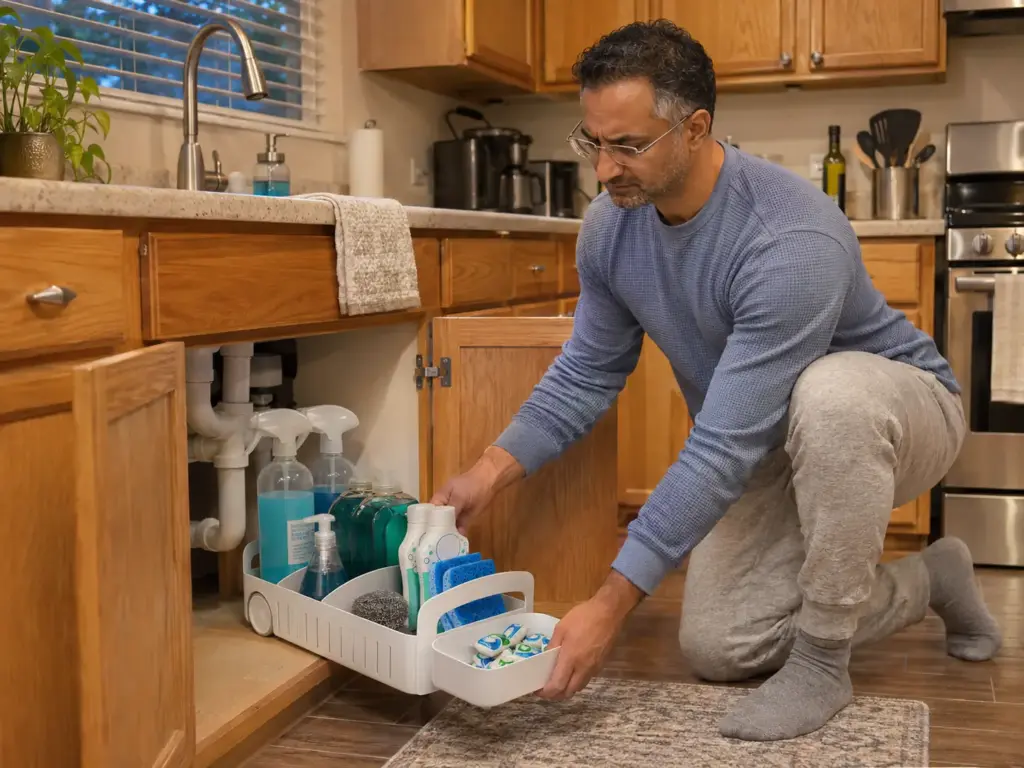
An under sink caddy that slides in empty and then jams at the hinge once it is full is the classic under-sink failure. The cabinet decides the fit by its door opening and its depth, not by its inside width.
Measure the door opening, the depth and the trap
A standard base cabinet is a 24 in deep box with an interior closer to 22 or 23 in, per the NKBA’s standard cabinet sizes. A sink base is commonly 21 in deep, so a caddy that fits the pantry shelf can stop the door from closing here. The door opening is typically 1 to 2 in narrower than the cabinet at the hinges, and a loaded caddy has to pass that narrowest point and still clear the P-trap. Spray bottles stand 9 to 11 in tall and usable depth runs 18 to 22 in once the pipes are in, so inside width alone is not a fit test.
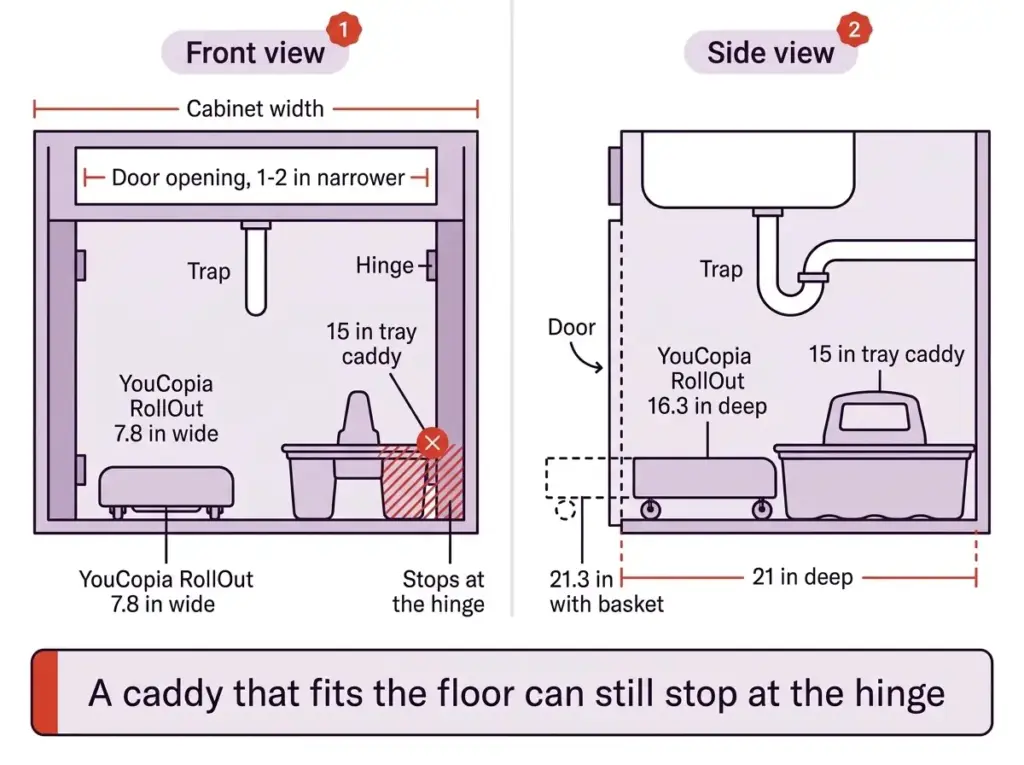
Height is the dimension people forget under a sink. The bowl and the garbage disposal, if there is one, sit above the cabinet floor, and a tray 7.4 in tall plus a 13 in spray is a 13 in object that has to turn a corner to leave. If the sprays do not stand under the bowl with the sprayer on, they lie down, and bottles stored on their side leak.
Measure your cabinet on your knees with the door open, in three readings: the opening between the hinges, the depth to the back wall and the clear floor beside the P-trap. The full pipe-and-door measuring routine is in fitting real pipes under the kitchen sink.
Cut a cardboard template to the caddy’s footprint and slide it through the door opening and onto the cabinet floor before you order. If it clips the hinge or lands against the pipes, no rearranging will rescue the real thing.
Two rolling lanes compared
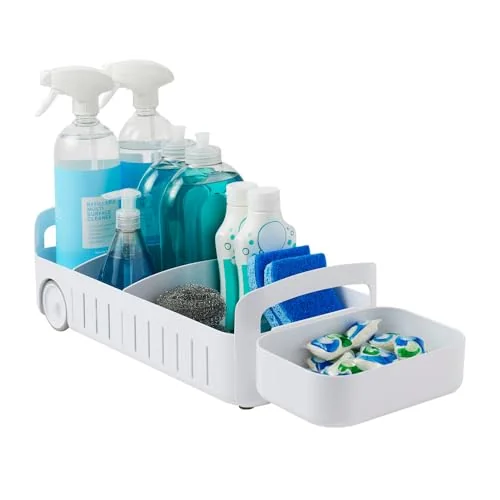
A rolling lane earns its place when the problem is the back of the cabinet, where the one bottle you need always hides behind everything else. The free version is a dishpan sized to the cabinet floor and slid out by hand, which does the same job with no wheels. If you want the wheels, the YouCopia RollOut is the sturdier of the two lanes. Whichever lane you choose, the floor of the cabinet has to be flat and clear, because wheels stop at the first raised edge or leftover water ring, and the lane that rolls on day one sticks by the end of the month.
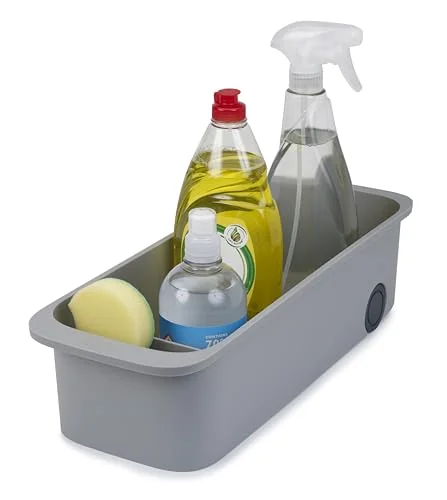
The Joseph Joseph CupboardStore is the cheaper lane. It holds a large bottle in one section and sponges in the front one, and it suits a cabinet with short sprays and a lot of small things.
Kitchen cleaning supplies and bathroom cleaning supplies overlap less than you would think, so a vanity usually wants its own smaller kit. Where the cabinet is a bathroom vanity instead of a kitchen base, the same door test applies, and storing supplies under the sink safely covers the safety side of putting chemicals in a low cabinet. If you would rather bolt a system in, fixed under-sink organizers for bathroom cabinets compare directly with a rolling caddy, since each is an under sink cleaning supplies organizer of a different kind.
Where Cleaning Caddies Break, and How to Keep One Safe
You lift the caddy by one finger and feel the handle bow. That small flex is the first sign of what gives out on a loaded caddy.
The handle and the full load
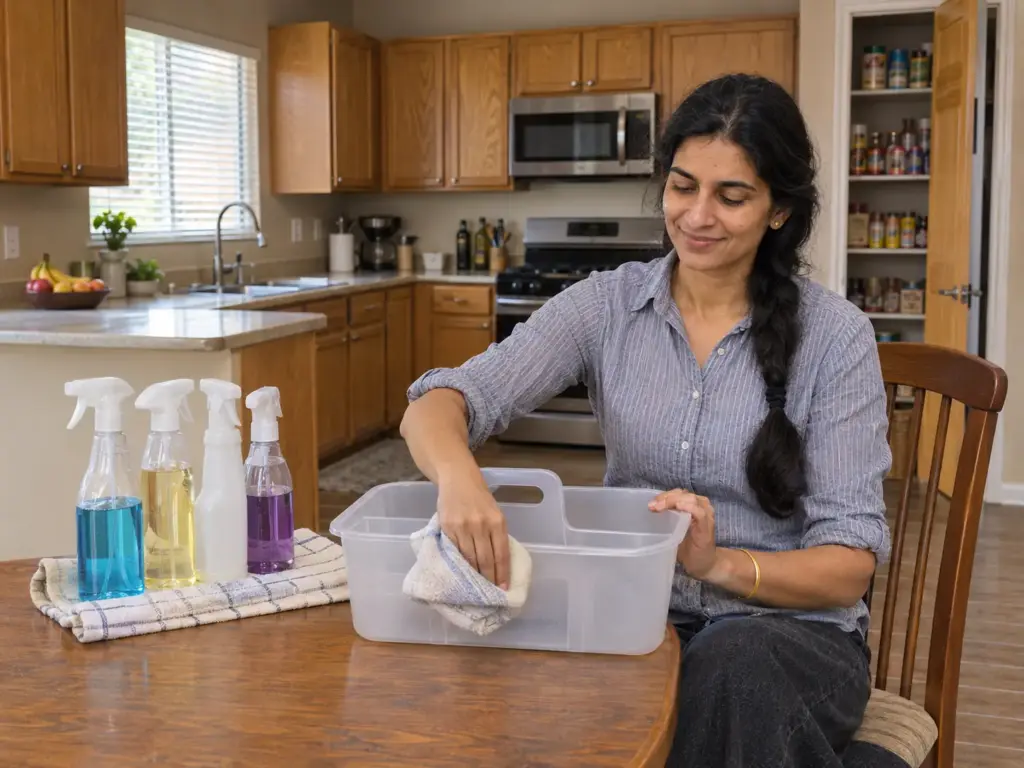
A full 64 oz jug of laundry liquid weighs 4 to 5 lb, so a shelf or rack rated for 15 lb holds three or four of them and no more. A caddy of refills is a lifting job, not a storage job, and the parts that fail first are the handle joint, the stitched strap and the thin clip. On a tote, the handle is the first to go. A caddy that carries refills for more than a short walk wants a rigid handle and a deep pocket, not one of the flexible handles that break under a full jug.
Keep the weight in the deep-clean kit that stays put, and carry only what the round needs. If a handle bows when you lift the caddy with one finger, take a bottle out; the next step is a crack at the joint, usually mid-hallway.
Leaks, drainage and wiping it down
A tote with no pockets or dividers lets bottles leak against each other, and a leaking bottle soaked into a fabric cleaning tote ends that tote. Bottles stay upright, never lying on their side, even if the cap seems tight. Drainage holes or a removable base plate keep water from pooling at the bottom, and a caddy that never gets wiped down becomes the dirtiest object in the cleaning routine. Wipe and dry it on a regular cycle, and dry bamboo as soon as a damp cloth has been in it.
Out of reach of children and pets
Keep every product in its original container: the EPA’s rule for storing cleaners around pets says it plainly, “Keep all products out of the reach of pets and children.” The original label is also what tells a poison center what was swallowed, so decanting into a nicer bottle throws it away.
Height matters as much as the container. Poison control’s warning about low, unlocked cabinets is blunt: an unlocked, low kitchen or bathroom cabinet is one of the riskiest places to keep cleaners. A child-resistant latch closes that gap, and so does a high shelf. The CDC’s guidance on cleaning and disinfecting safely adds ventilation while you work and storage out of reach afterward.
The caddy is never a storage decision on its own: the rule is to keep out of reach of children and pets whatever is in it, which means high, latched or locked.
Wearable, Counter and Budget Caddies for Homes Without a Utility Closet
Picture a renter with a one-bath apartment and no closet, and an owner on two floors. Each has the same question: where does the caddy live between jobs?
A wearable tote for stairs and long rounds
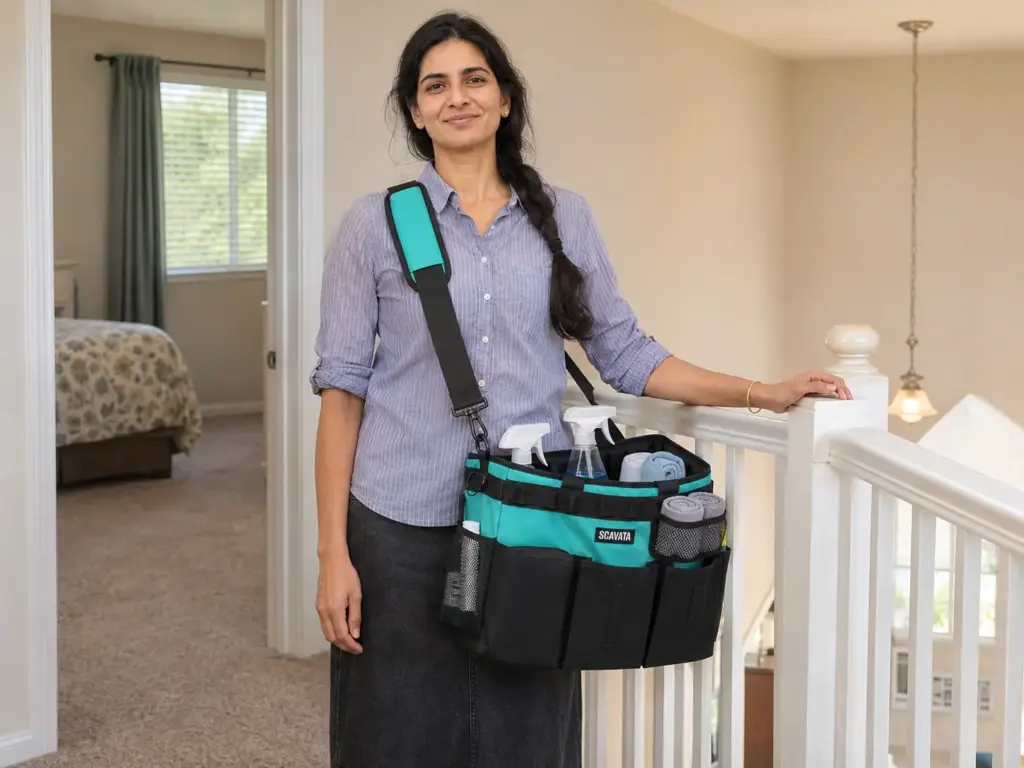
On a staircase, a hand-carried caddy costs you the railing. A wearable bag, really a shoulder strap caddy, goes on the shoulder or the waist, which leaves both hands free, and the foil-lined base of the SCAVATA keeps wet rags from soaking through to a stairwell carpet.
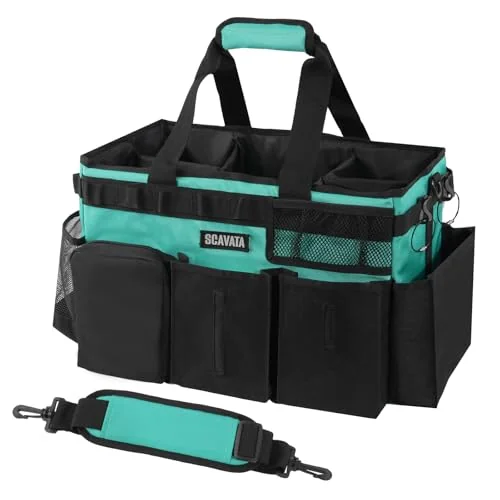
Stairs change the numbers. A caddy swings against your leg on every step, so the bottle that stayed upright on a flat floor starts to rock, and a wide caddy bumps the wall on a narrow landing. A bag worn at the waist keeps the weight close to the center of your frame, and the foldable dividers hold the bottles still while you climb.
A budget alternative is a generic canvas tote or fabric housekeeper’s bag, the kind sold as caddies for housekeepers, which gives you the same shape with fewer features. Fabric holds its shape with a stiff base board, but a bottle that leaks into it is the end of it, which makes upright bottles non-negotiable here.
The caddy you leave on the counter
If there is no cabinet at all, the caddy has to look acceptable on a counter, and the bamboo caddy from MobileVision is the only one here that does. It suits a bathroom or a laundry room where the supplies would otherwise sit in a pile.
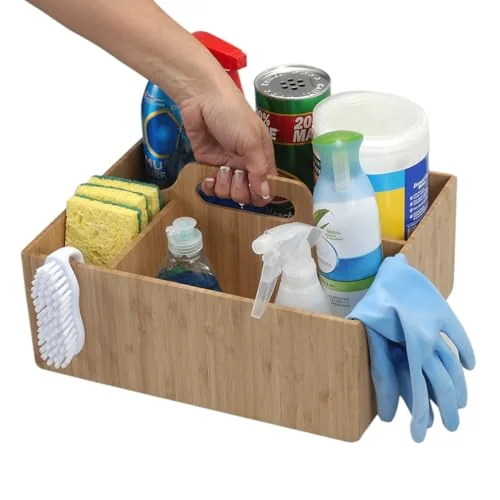
For a home with no utility closet at all, a rolling spot beside the fridge or a hall closet shelf keeps the caddy from ever having to be lifted, and the broader plan for organizing a small apartment so it stays neat covers where the rest of the supplies go. A plastic tote does the same job as bamboo if looks do not matter.
A counter caddy changes the question from “can I carry it” to “can I stand to see it.” In a one-bath apartment, the caddy sits next to the toilet or the sink every day, so a quiet material and a compact footprint count for more than carrying capacity. Keep it light, because it only has to hold the day’s spray and cloth, and park the heavier backstock where it cannot be seen.
The budget plastic tote that does most of the job
The JiatuA is the daily kit of the two-kit system in its cheapest form: a 16.5 in long tote, wide enough for sprays, with a grooved handle.
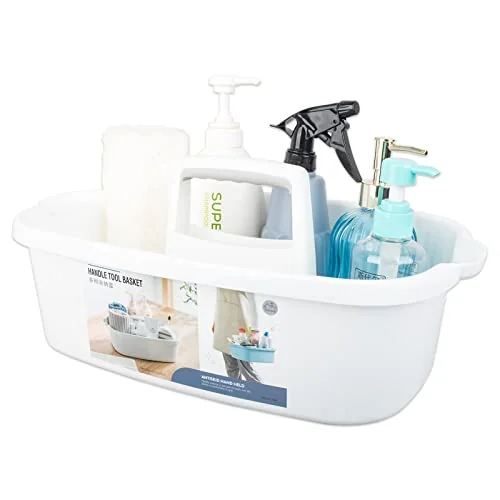
Carry the dishpan first and buy this only if the dishpan fails a number. Once it holds the daily kit, it needs a parking spot. Vertical storage that lasts is where a caddy hangs when no closet shelf is left.
Two Numbers, One Shape and a Dishpan to Test Them
Two measurements decide almost every caddy: the widest bottle and the tallest bottle with its sprayer on. After that, the cabinet door picks the shape for the sink base, the stairs pick it for a two-floor house, and a small apartment with no closet picks the counter or the budget tote. Split the kit in two, a light one that moves and a heavy one that stays, and keep everything in its original container and out of reach of children and pets.
After the first full week of use, look at where the caddy is sitting. If it is in the last room you cleaned, the kit needs splitting, or the return trip needs a spot. A caddy that is back on its shelf and a cabinet that closes without a push mean the numbers were right.
Today, carry the dishpan on your next round and note which bottle leans. That single bottle tells you what the caddy has to be.
Frequently Asked Questions
01What should go in a cleaning caddy?
A daily caddy holds one spray, a cloth, a sponge, a scrub brush and gloves. Heavy refills and backstock stay in the closet. Keep every bottle upright in its original container so the label stays readable.
02Will square spray bottles fit a cleaning caddy?
Square bottles fit an open tub or a caddy with adjustable dividers, but not a round molded slot. A square designer bottle runs about 3.5 in across and rocks in a slot built for 3 1/4 in. Measure the footprint first.
03Does a cleaning caddy fit under the kitchen sink?
Often yes, if it is low and narrow. A sink base is commonly 21 in deep with a door opening 1 to 2 in narrower than the cabinet, so a rolling lane about 5.3 in high passes, while an 18.4 x 13.9 in tote does not.
04What is the best cleaning caddy organizer for a small apartment?
One small daily caddy kept under the sink, with backstock in a lidded bin on a closet floor, covers most apartments. A JiatuA-size tote suits that job, and a wearable bag helps if there are stairs.
05Is it safe to keep a cleaning caddy under the sink with kids or pets?
Only with a child-resistant latch on the cabinet and every product left in its original container. A high shelf or a locked cabinet is safer than any caddy under a low sink.
Disclaimer: ClutterlessNest is a participant in the Amazon Services LLC Associates Program. As an Amazon Associate we earn from qualifying purchases. This article may contain affiliate links — if you buy through them, we may earn a small commission at no extra cost to you. We only recommend products we have tested or genuinely believe in.