

You know the book is somewhere in the house. You also know it is not on the shelf where it belongs, because that shelf now has a second row, a stack leaning against the end, and a box under the desk that nobody labeled. Book organization usually breaks at exactly this point, and rarely because of the shelf: nobody ever decided how a book would be found, and a method that works for 200 books has a different job at 2,000.
A home library is a system whether or not anyone designed it, and this guide goes through that decision first, then the shelf measurements, the homes (small and large) and the habits that keep a personal library from sliding back. For the shelf-loading side of the story, the full guide to organizing a bookshelf goes deeper than this page does.
Quick Answer
A book collection stays findable when the system is built in this order, whatever the size of the home.
- Decide how you look for a book: author, subject, size, series or mood.
- Sort by one primary rule and one tie-breaker, never three.
- Measure shelf height, depth and span before moving a single book.
- Give arriving books a landing shelf so they never become a second row.
- Cull on a schedule: keep, sell, donate or swap.
- Reset the shelves once a season and watch for double-stacked rows.
Book Organization Starts With How You Look for a Book
Most people buy shelves first and pick a sorting rule second. Then comes a weekend of shelving by a rule that has nothing to do with how they actually reach for a book, and by the second week the shelf looks the way it did before. The order that holds for bookshelf organization is the reverse.

Book retrieval is the job, so decide how you search, test that choice on a small pile, and only then worry about furniture. A system earns its keep by letting you find a book fast on an ordinary evening, not by looking tidy on the day you finished it.
The Question That Picks Your System
Ask yourself how you look for a book when you want one. Some people go by author, some by subject, some by size, some by series, some by mood, and some by a mental picture of the spine (“the blue one near the window”). Whatever you answered is your primary sort. Everything else is a tie-breaker.
This also explains the two informal systems most homes already run. Shelving wherever they fit is size-first sorting disguised as having no system, and going by vibes is mood-based grouping. Both are fine for a while. They stop working the day the collection outgrows what you can hold in your head, which is the subject of the third section below.
A 30-Book Test You Can Do in Ten Minutes
Pull 30 books at random from the pile, the floor or the shelf. Sort them by the rule you think you want. Then pick any five and ask whether you could put a hand on each one in under a minute.
The useful number is the count of “where does this one go” books. If five or six out of 30 have no obvious home, that rate scales: it leaves hundreds of homeless books at 2,000. A rule that sorts 28 of the 30 cleanly can be trusted with the rest of the house. Once the rule survives the test, organizing bookshelves with it is its own skill, and how to set up a bookshelf so it stays that way takes it from there.
Write your sorting rule as one sentence on an index card and tape it inside a cupboard door. If the sentence needs an “except” or an “unless,” the rule has a third tier hiding in it, and that is the part that will not survive a partner or a guest putting books back.
What a Library Scheme Gets Right and Wrong at Home
Libraries solve a problem a home does not have: strangers who rely on shelf browsing by subject. The Dewey Decimal System (Melvil Dewey, 1876) splits knowledge into ten main sections, and the Library of Congress classification (1904) uses letters and numbers built for research collections. Both are excellent at what they were made for, and any classification system is a trade: it buys easy browsing for strangers and pays for it in labeling work.
Dewey sounds like the proper way to do it, and in most homes it is the wrong call. A household collection that is mostly one subject, say mostly fiction, lands almost entirely in the same run of numbers, so the scheme adds labeling work and no findability. Sets that belong together get scattered across the shelf because each volume carries a different number.
The Library Company of Philadelphia’s own method (the Smith system, devised by Lloyd P. Smith) gives only broad categories and then shelves by date received, which is acquisitions order, and by size, which is closer to what a household does without trying. The pattern worth borrowing is that a home system survives when it keeps whatever the collection already groups by and takes one or two library ideas, usually size and date of publication, as tie-breakers.
Sorting Methods Compared: Genre, Author, Size, Series, Color and Mood
A shelf sorted by color photographs beautifully. Then you want the novel you read last month, you remember the author and not the cover, and it could be anywhere along a rainbow. Each sort has a job it does well and a job it does badly, and the useful move is to pick one for finding and, at most, one for tidying up.

Genre or Subject, With a Rule for the Strays
Genre is the most common home sort and it works best when every genre gets its own shelf, so the boundary between mystery and history is a shelf edge you can see. Subject clusters inside a genre (cooking inside non-fiction, say) follow the same rule of one shelf and one boundary you can see. It fails on strays: a memoir about gardening, a novel built around cooking, a biography of a chemist.
Decide once where strays go. Either give them a dedicated shelf or file by the reason you bought the book, and write that choice down so the next book does not reopen the argument.
Author, Series and Chronology
For fiction, alphabetical by author is the closest a household gets to a library scheme without call numbers, and it needs no labels at ordinary sizes. Alphabetical by title suits only a small shelf of single volumes where the author does not matter. Non-fiction usually reads better in subject groups, with authors alphabetical inside each group. Series are the exception to alphabetical order: they sit together in publication order, because nobody reaches for book four before book one.
Chronological sorting, either by publication date or by the period a book is set in, suits history and classics. It puts a literature shelf in an order you can read as a timeline, which is the one reason to choose it. A sort by publisher is the oddball option: it suits a press you collect and few other shelves.
Size and Color: Tidy to Look At, Harder to Search
Size is the practical sort, and you will use it whether or not you choose it. Oversized art books lie flat on the bottom shelf, trade paperbacks and mass-market paperbacks take their own shelves, and shelf height follows from all of this (more on that in the measuring section). Sorting by height within a shelf puts the tallest volumes at one end and makes the row look settled, though that is a tidying rule and not a search rule.
Color is calm in a photo and slow in daily life. It works as a display layer on a single shelf, a deliberate gradient that you do not need to search. Put it on one shelf and keep the rest of the case searchable; styling a shelf after the sort is settled is a separate job from finding things.
One Primary Rule, One Tie-Breaker
Combine on purpose. One rule is the thing you search by; one tie-breaker settles the books that tie on the first rule, and it is usually size or date. A third rule is where systems collapse, because each added rule creates another place a book could be.
Read and unread sections, genre sections and a few dozen boxes of fiction that may or may not be labeled correctly cancel each other out. The cull never happens, since there is always one more category to check first.
When Memory Stops Working: 200, 1,000 and 5,000 Books
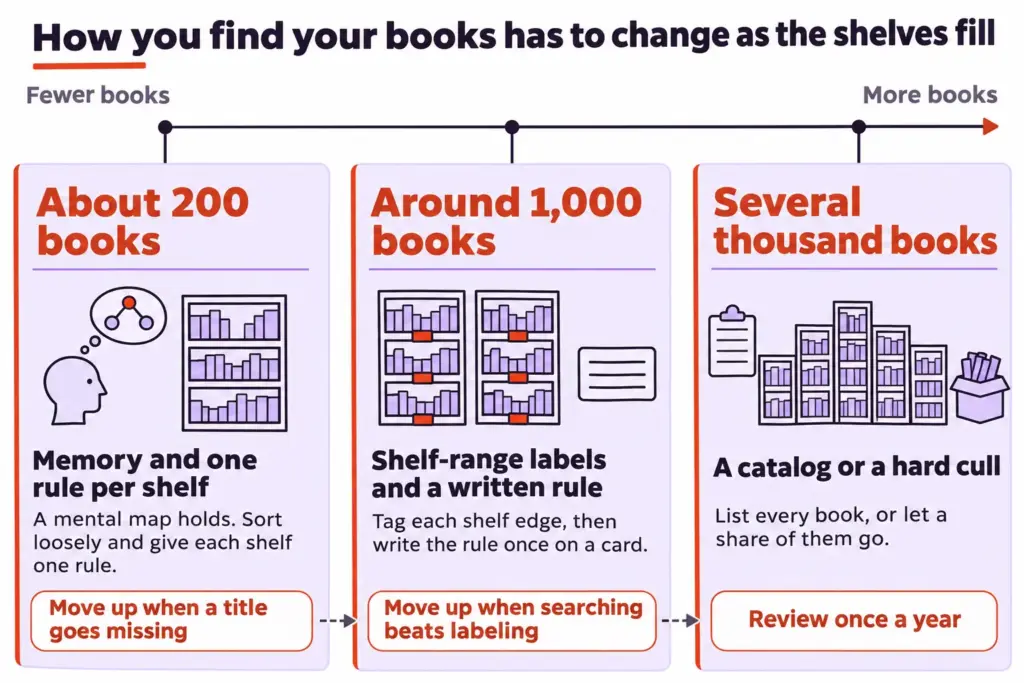
Collections creep up on you. A couple of boxes after college become a library twenty years later, and nobody decided anything along the way. The same system cannot serve every size, and the useful question is where the thresholds sit: a mental map is enough up to about 200 books, shelf-range labels and a written rule carry you to around 1,000, and past a few thousand you either keep a catalog or cap the collection.

Up to About 200: A Mental Map Is Enough
Under about 200 books, you do not need labels. One rule per shelf and your own memory hold, and the sort can stay loose. This is the size at which the 30-book test above will pass almost any rule you choose, so do not spend a weekend building a system the collection does not need yet.
Around 1,000: Shelf-Range Labels and a Written Rule
The mental map fails first on the books you read years ago, the ones that left no recent trace in your head. At this size, shelf labels do the work, and the useful ones are ranges (shelf-range labels): a subject word on the shelf edge, or a range such as A to F, or a simple numeric range in the style of the 600s and 700s. Write the rule down once, on the card from the earlier tip, so a partner or a house guest can put a book back where it came from.
5,000 and Up: A Catalog or a Hard Cull
Several thousand books is the point at which searching costs more than organizing. There are two honest answers. One is a home library catalog: an app such as LibraryThing or Libib costs far less than the hours spent hunting.
The other is a cap, and some readers keep a deliberate limit as low as 150 to 237 volumes, while Samuel Pepys capped his library at 3,000. At 10,000 books the owner is navigating by memory, and the system is a house rule, not a method.
If a cap appeals, the cull is the other half of the decision, and deciding which books to let go is easier with a rule than with a mood. To declutter books without regret, write the rule first.
The warning signs that a system has outgrown its size are easy to spot: books in boxes, on top of cases and in drawers; a second row hiding the first; “I’ll find it” turning into a weekend. None of these is a numbers rule. The threshold is the point where the cost of searching passes the cost of labeling, and you will feel that point before you can name a number for it.
A household of 200-plus books bought over decades, say, is usually too broad to sort by genre on the first pass. The first cut there is a keep-or-donate pass, not a shelf.
Measure the Shelf Before You Move a Single Book
A perfect sort on the wrong shelf is a sort that lasts a month. Four numbers decide whether the shelf can hold the sorted collection: the height between shelves, the usable depth, the span between supports, and the weight on that span. The first two are about fit. The last two are about what sags.
Shelf Height: The Tallest Book Plus a Thumb
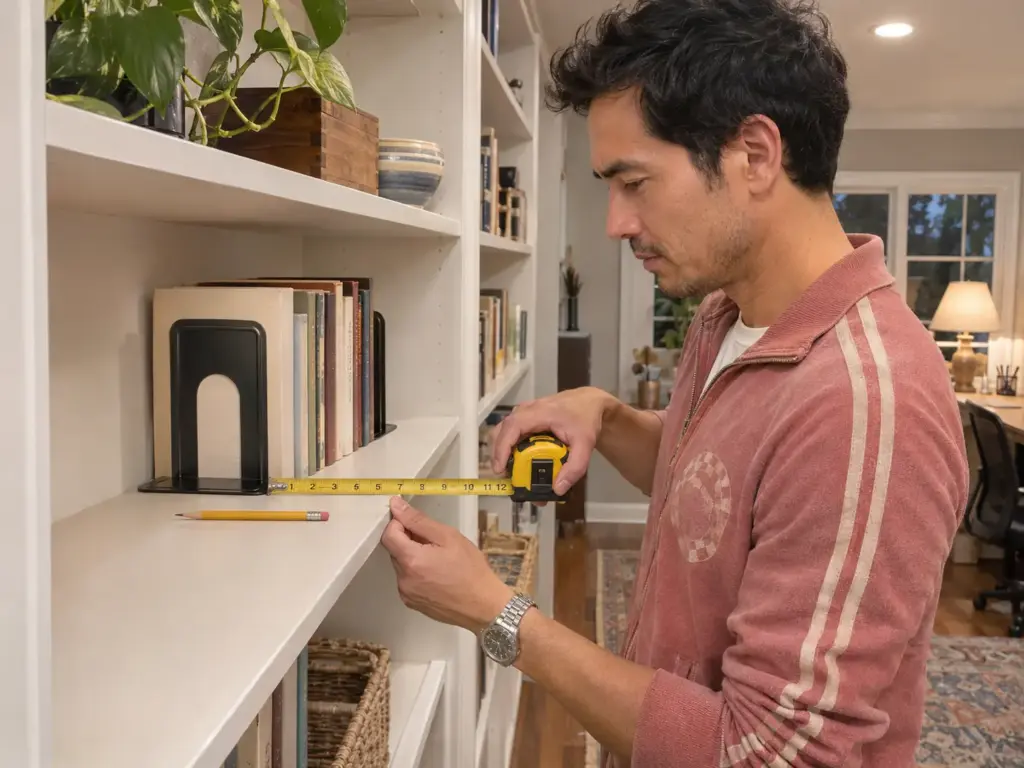
Measure the tallest book that will live on the shelf and add a thumb’s width, so it lifts out without scraping the shelf above. Library shelving runs at least 8 inches between shelves (9 for periodicals). Eight inches clears most paperbacks and 12 clears art books. A standard residential bookcase is about 31.5 inches wide, 11 inches deep and 79.5 inches tall, so its adjustable shelves, spaced for the average book, will fight you the moment an oversized volume enters the plan.
Depth: Why a 12-Inch Shelf Gives You 11
Standard residential bookcases run about 11 inches deep, and library shelves run 8 to 12. Measure shelf depth yourself, because the number to trust is the usable depth, which on an adjustable shelf is about an inch less than the nominal depth. So a 12-inch art book overhangs a “12-inch” shelf at the front edge, where a shoulder or a door will catch it.
Deeper is not better, either. The common advice is to buy the deepest shelf you can, and that advice fails the moment a deep shelf is filled with paperbacks: a second row appears behind the first, and the back row is lost. Depth should be matched to the books that will use it. Keep the 12-inch shelf for the art books, and let the rest of the case be shallower.
Span and Weight: The Particleboard Sag Line
Books are heavy in a way a pantry shelf is not, and shelf sag is the first failure. The Composite Panel Association’s shelving-span bulletin explains why a shelf rated for cans is not rated for books: “For example, kitchen cabinet loads can reach up to 25 or 30 psf, while bookshelf loads can easily reach 50 psf.” Its tables put a 3/4-inch particleboard shelf, supported only at its ends and held to a sag limit of span divided by 240, at about 34 inches for a 10 psf load, 30 inches at 15, 27 inches at 20 and 25 inches at 25. A 30-inch span of books is already at the limit.
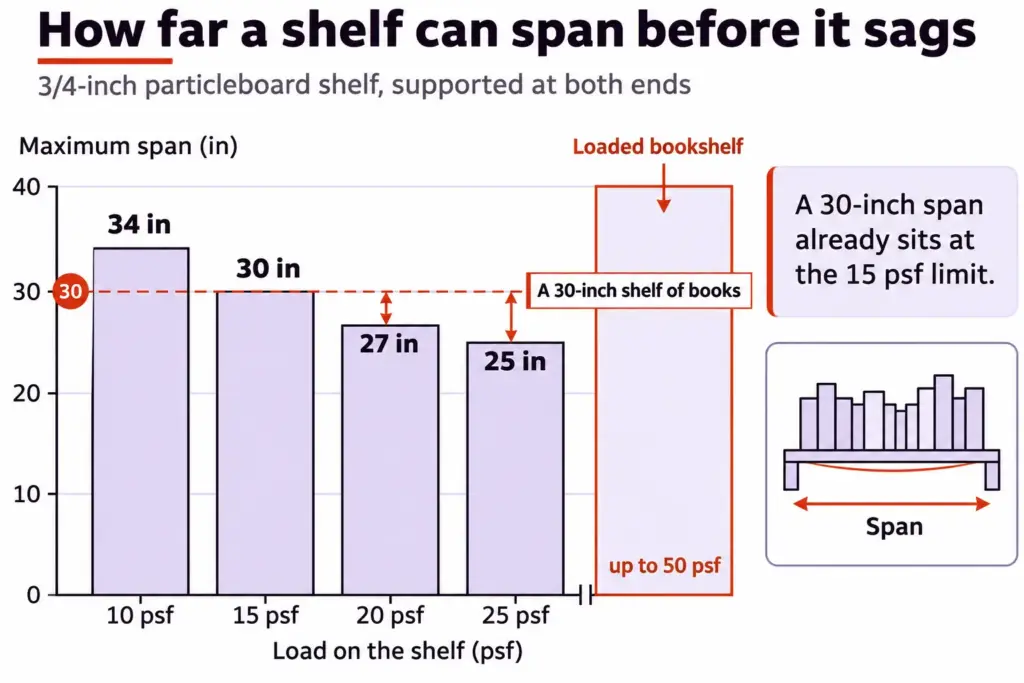
Book weight adds up faster than most people expect. About 8 fiction volumes fit per linear foot, and one linear foot of books can weigh up to 20 pounds. That means a 30-inch span can reach about 50 pounds.
A 31.5-inch IKEA Billy shelf is rated 66 pounds, and the 15.75-inch one 31 pounds, and IKEA’s own buying guide points owners of very heavy books to the narrow unit. Thirty hardcovers in one spot weigh roughly 31 pounds, so one dense run is enough to reach the narrow rating.
A narrower bookcase sags less, which is the one place where smaller is stronger. Shelf weight limits differ by type, and the shelving and racks guide sorts the families by what they carry.
Shelf sag shows first on the shelf with the heaviest sort: art books, hardcover runs. If you have the shelf, you do not need to replace it. A 3/4 by 3/4-inch aluminum L-angle from a hardware store, screwed along the back edge of the shelf and cut an inch shorter than the shelf so it does not show, turns a bowing shelf rigid.
A center support does the same job for a long span. And the heaviest rows belong on the lowest shelves anyway, for the sake of the case as much as the shelf.
Press a ruler across the middle of a loaded shelf and look for daylight under one end. A bow you can see is already permanent in particleboard, so brace the shelf now instead of waiting to see whether it levels out.
Bookends and the Half-Full Shelf
A shelf that is half full leans. The books at the end of a run tilt into the gap, and spines that lean strain at the joint. A pair of stacked books lying flat at the end of the run is a free bookend, and for a lightly loaded shelf it is enough.
For a shelf that stays partly full, a real bookend earns its place. The MaxGear 8.5-inch Heavy Duty Metal Book Ends come as two pairs in a tree design, with non-slip pads that keep them from sliding when a row leans on them. They hold a full run of novels well.
Their 8.5-inch upright is shorter than the 10 inches usually suggested for oversized art books, so the large volumes will tip past them. Dividers and bookends that keep a row upright cover the other families, and the shelf-edge measuring that applies to them is the same one used here.
Fitting Books Into the Home You Have, Small or Large
Two writers moving two libraries into one small apartment tend to end up with books stacked in boxes on the floor and shoved into the one closet while they argue about culling. A house with a spare room has the opposite habit: the spare room becomes the place books go to be forgotten. The same sorted collection needs a different answer in each, and some of the best answers have nothing to do with a bookcase.

Small Apartment: Go Vertical, Not Wide
Floor is the scarce thing in a small apartment, and height is the cheap one. A tall, narrow case uses vertical space instead of floor. The Bear Qiaqia Rotating Bookshelf puts up to 150 books on a 17.3-inch footprint: it stands 63 inches tall, with 11.8 inches per layer, and turns so you can reach every layer from one spot. As a tower bookcase it trades width for height.
Its flaw is built into those numbers. With a fixed 11.8-inch layer height, nothing taller than that stands upright, so oversized art books have no home on it.
For a collection with art books, a straight-wall case is the better call. The VASAGLE 5-Tier Bookshelf measures 15.7 inches wide, 11.8 inches deep and 60.2 inches tall, so its depth takes a standard hardcover and its height uses the wall. In a narrow space such as a hallway wall or the gap beside a window, a case this slim is also easier to place than a wide one. Its 91.5 pounds in total work out to about 18 pounds per shelf, which suits paperbacks and mixed shelving but not a dense hardcover run.
Narrow bookcases that resist sagging are compared on that spec if you are shopping, and what to do when a small apartment runs out of shelf space goes through the in-between steps.
A Big Room: Floor-to-Ceiling and the Wall It Wastes
A standard 79-inch bookcase leaves the top of a tall wall empty. A floor-to-ceiling bookcase uses that height, and it reads almost like wallpaper once it is full, which makes a large wall look intentional. Built-in bookshelves do the same job permanently, which suits an owner and rules out a renter.
The risk in a big room is the opposite of the apartment: all that space swallows books without a rule, and the collection slides toward the thresholds in the third section. A big room needs the retrieval rule more, not less.
Beyond the Bookcase: Benches, Stairs, Over the Door and Nightstands
Book storage ideas that suit a real home begin with dead space, and creative book storage is mostly the habit of seeing it. A bookcase is not the only home for books. Short upright rows work as décor on a bench or a table. A storage bench holds a few dozen paperbacks under the seat, and furniture that doubles as storage is where benches like that get compared.
Other homes include a nightstand with storage such as a cubby, staircase storage in the form of stair-side shelves, over-the-doorway shelves, runs above kitchen cabinets for rarely read volumes, and rain-gutter shelves that show the covers of children’s picture books. Cookbooks in the kitchen belong away from heat and steam.
The free route is a piece of furniture that has stopped doing its old job: a breakfront or a media console that no longer holds dishes or discs is a bookcase. Plenty of storage problems framed as needing more bookcases are really needing a cull, and this is the cheapest test of which one you have.
Renters should treat walls differently. Floating shelves and adhesive mounts are for light loads only, and books are among the heaviest things people hang on a wall. Weight limits by mounting method are worth reading before anything goes up, and wall shelves for overflow covers the light end.
Anchoring a Tall Bookcase: Renters, Owners and What Holds
A tall bookcase is a tip-over risk, and the risk grows as it fills. Anchor It!, the CPSC’s tip-over prevention campaign, puts the case directly: “Anchoring all furniture with drawers, doors, and shelves to the wall prevents tip-over injuries and deaths.” If a bookcase is going to stand unanchored, freestanding units built not to tip are the better starting point.

Why a Full Bookcase Is a Tip-Over Risk
Books add weight at the height where it does the most harm. If the heavy runs go on the top shelves because it looked better, the case becomes top-heavy and leans forward the moment a child or a pet climbs a shelf. Heavy volumes go on the bottom shelves, and light paperbacks and display pieces go high.
The standards are thinner than people assume. The tip-over standard for clothing storage units covers units taller than 30 inches, and the CPSC states that bookcases are not covered by it. The restraint standard sets a 50-pound pull on the strap but no strength requirement for the wall anchor, so the part that fails is the anchor in the wall, not the strap.
Owner: Studs and a Strap Kit
If you own the wall, anchor the case to a stud with a strap or bracket kit, following the maker’s instructions. Drywall anchors are usually not supplied with these kits, and the CPSC’s analysis of why drywall anchors fail tip-over tests explains why: drywall cannot typically withstand the 50-pound pull the voluntary standard requires. For heavy rows hung on the wall instead of standing on the floor, the same stud reality applies, and studs versus toggle bolts for heavy shelves lays out what each can hold.
Renter: What Adhesive Anchors Can and Cannot Hold
For a renter, a stud-mounted strap kit is still the right answer for a tall, top-heavy case, and it is worth asking the landlord about before ruling it out. Where no stud is available and the case is low or narrow, adhesive anchors are the renter-friendly, no-drill route. The No Drill Anti Tip Furniture Anchors come as six pairs of 2.8 by 2.8-inch brackets that suit a wall gap of up to about 2 inches. Their flaw is the adhesive itself: it can pull paint off the wall, and a heavy load can break the bond.
Nothing tall and top-heavy gets adhesive alone. A 60-inch bookcase filled with hardcovers is exactly that, and the right spend is the strap kit, not a second set of stickers. Follow the manufacturer’s instructions for placement, because how it goes on the wall is theirs to specify.
The Landing Zone and the Annual Cull
The new books on the nightstand, the bag from the used-book sale by the door, the gifts, the borrowed ones: that pile is what breaks a system in week two. A shelf plan covers the books you already have. Nothing in it covers the book that arrived yesterday.

One Shelf for Books That Haven’t Been Placed Yet
Give arrivals a home on purpose. A landing zone is one shelf, or one table, sized for about one shelf of overflow: 8 books per linear foot times a 2.6-foot shelf comes to roughly 20 to 21 average hardcovers. Anything beyond that is the system telling you something. The idea has a name in classification: Georges Perec distinguished provisional order from stable classification, and the landing shelf is the provisional pile with a boundary around it.
The rule that keeps it honest is simple. When the landing shelf is full, shelve or cull before anything new comes in. A book that has sat on the landing zone for months is a candidate to go, because a book that never earned a spot probably never will. For a small collection, a basket by the reading chair can be the whole landing zone, until the books hide below its rim.
For books in progress, a small piece of bedside furniture keeps the main system undisturbed. The YAMAZAKI Home Plain Side Table with Open Storage Shelf measures about 16 by 16 inches and stands 22.6 inches tall, and its open shelf holds roughly eight average novels lengthwise. It is small and low, which limits it to a few books at a time. A used nightstand is the budget route, and bedside books and under-bed overflow fit together in a small bedroom.
Make the landing shelf the one you can see from your reading chair. If it sits behind a door, it becomes the place books go to be forgotten, and the second row you were avoiding shows up there instead.
Keep, Sell, Donate, Swap: A Four-Way Pass
When the landing shelf overflows, sort what comes off it into four piles. Keep what earns a place under the rule you chose.
Sell what a used bookstore, an online listing or a yard sale will take. Donate the rest: a library book sale or a thrift store takes them, and book donation of this kind keeps them in circulation. Swap whatever someone else will want, as a book swap through PaperbackSwap or BookCrossing or a drop in a Little Free Library.
A container for the pile that is about to leave is worth more thought than it gets, since a pile with no box tends to migrate back onto the shelf.
The cheapest option costs nothing and needs no shelf at all: a library card at the public library. A book you will read once is better borrowed, and the volume you do not own needs no room.
How Often to Cull
An annual cull is enough for most homes, and a seasonal skim keeps it small. Libraries call this pass weeding, and to weed books is simply to remove the ones nobody has opened in years. The annual pass is the big sort; the seasonal one is just a look at the landing shelf and the oldest unread stack. Decluttering methods that hold past the first week can supply the structure for the annual pass, and the book-specific decisions are the four piles above.
Book Care and the Seasonal Reset That Keeps the System Alive
Every placement has a cost for the books themselves. Shelving them wrong causes spine damage over years, and a window or a kitchen does it over a few seasons. A good system accounts for both, and then includes a short reset so it does not need a rescue.

Upright, Stacked or Flat: What Each Does to a Spine
Upright is the default. Leaning books strain their spines, so a tight adjustable shelf is safer than squeezing extras on top of a row. Horizontal stacks on top of upright books press on the spines below them, and too many stacked flat can warp the lower ones.
Oversized books, art books above all, lie flat on the bottom shelf, never upright, and a shelf about 12 inches deep is the cost of owning them. A dust jacket tears at the fold when a book is pulled out by the top of its spine, so tip the neighbors back and take the book by the middle.
Sun, Moisture and Dust
A windowsill is not permanent storage, because direct sunlight, with its UV, and temperature swings fade covers and loosen glue. Kitchens and bathrooms are poor long-term homes because of heat, steam and high humidity, with cookbooks the exception since they get used, though they are best kept off the range side. Dust is the quiet one: it can damage books, attract insects and affect your health, so a dry cloth along the shelf edge each season, with books tilted gently to dust the top edge, is plenty. Where most bookcases sit, in the living room, storage ideas for a small living room help decide what else shares the wall.
The Seasonal Reset and the Signs of Reverting
Give each shelf ten minutes once a season. Empty the landing zone, check for double-stacked rows, do a seasonal rotation of which books sit near the window, and skim for any book you will not read again. For a small home, keeping a small apartment organized past the first week is the same habit applied across rooms.
The signs that a system is reverting are visible: shelves slipping back into double-stacked rows, books migrating to the floor, a landing zone that has been full for a month. These mean the system is full, not that you failed. The system that survives is the one with a place for arrivals and a date for review.
Empty One Shelf Today and Watch the Second Rows
Retrieval decides the sort, so pick the rule you actually search by before you shop or move anything. One rule and one tie-breaker are enough. Measure height, depth and span first, because the shelf that sags in a month was the one nobody measured. Give arriving books a landing shelf, cull on a schedule, and reset each season.
When the season changes, look at two things: the landing shelf and the second rows. If the landing shelf is empty and the front rows are single, the system held. If books have drifted back onto the floor, the system is full, and the answer is a cull or a new threshold from the third section, not a bigger shelf.
Today, empty one shelf and run the 30-book test on whatever comes off it. Notice how many of the thirty had no obvious home. That number tells you whether you need a new rule or only a place for the books that arrive.
Frequently Asked Questions
01How do you organize a large book collection?
Pick the rule you search by, sort on it, and add shelf-range labels once the collection passes about 1,000 books. Past several thousand, move to a catalog app or a hard cull. Memory carries the first couple hundred; after that the system has to be written down.
02How do you store books without a bookshelf?
Storage benches, nightstands with an open shelf, stair-side shelves, over-the-door shelves, runs above cabinets and a repurposed console all hold books without a bookcase. Keep the heaviest volumes low, and keep cookbooks away from heat and steam.
03Is it better to organize books by color or by genre?
Genre or author is better for finding a book, because most people remember what a book is about or who wrote it, not the color of its cover. Use color only as a display layer on a single shelf.
04How many books fit on a shelf?
About eight average fiction volumes fit per linear foot of shelf, so a 31.5-inch shelf holds roughly 20 to 21 hardcovers. Oversized art books take far more room and want a shelf about 12 inches deep.
05How do you stop bookshelves from sagging?
Keep spans under about 30 inches for books, add a back-edge aluminum L-angle or a center support, and put heavy hardcover runs on the lower shelves. A narrower bookcase sags less than a wide one under the same load.
Disclaimer: ClutterlessNest is a participant in the Amazon Services LLC Associates Program. As an Amazon Associate we earn from qualifying purchases. This article may contain affiliate links — if you buy through them, we may earn a small commission at no extra cost to you. We only recommend products we have tested or genuinely believe in.