

Your books are back on the window sill, stacked in leaning towers that grow a little each week, while a browser tab of near-identical shelves refuses to say which one fits the wall you actually have. The listing photos never show the numbers that decide it: how many inches of wall are free, how much your books weigh, and what the lease lets you do to the plaster. The best bookshelves for small apartments are the ones chosen in that order, wall first, load second, anchoring third, and the sections below sort the options by the width of the gap you are working with. If the collection keeps outgrowing every shelf you look at, the full book system for a collection that keeps growing covers what to do beyond furniture.
The wall gap picks the format, and the trade-off beside each pick is the reason to read its section before you add anything to a cart.
| Wall gap or situation | Format that fits | Pick from this guide | Trade-off |
|---|---|---|---|
| 13 to 14 inch gap | Narrow ladder or slim tower | Hzuaneri 5-Tier (13.4 in wide) or TUTOTAK 6-Tier (14.5 in) | The ladder needs wall contact; the tower is only 10.7 in deep and 65 in tall |
| 22 to 24 inch gap | Ladder or closed-back tower | VASAGLE BARNET (22 in) or VASAGLE 5-Tier Narrow (23.6 in) | Open back on the ladder; closed back on the tower |
| A sliver under 15 inches with almost no depth | Tree shelf | SUNMORY 6-Tier Tree (7.9 in deep) | Large books overhang the branches |
| An empty 90-degree corner | Corner or rotating tower | HOOBRO 5-Tier Corner (11.8 in a side) or MAHANCRIS Rotating | Size splits opinion; the rotating base ships with short screws |
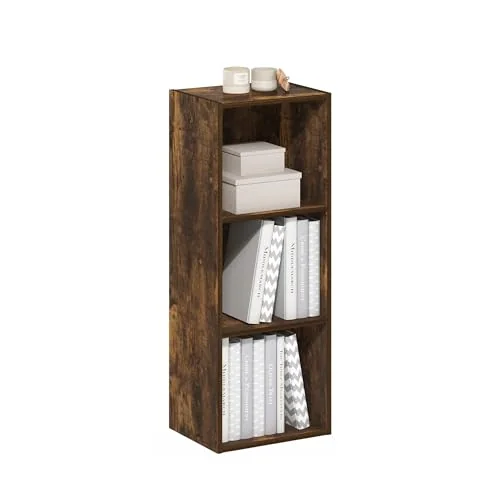
| Under a window or beside the sofa | Low three-tier case | Furinno PASIR (40 lb per shelf, 31.5 in tall) | Shallow shelves, no big hardcovers |
| A small collection on a tight budget | Three-cube grid | Furinno LUDER 3-Cube | Cubes too small for standard storage boxes |
| A bay that also has to divide a room | Seven-cube grid on legs | LEYAOYAO 7-Cube | Plastic legs |
Whatever you pick, load the heavy books on the bottom shelves and anchor every case taller than a nightstand.
Best Bookshelves for Small Apartments Start With Four Measurements
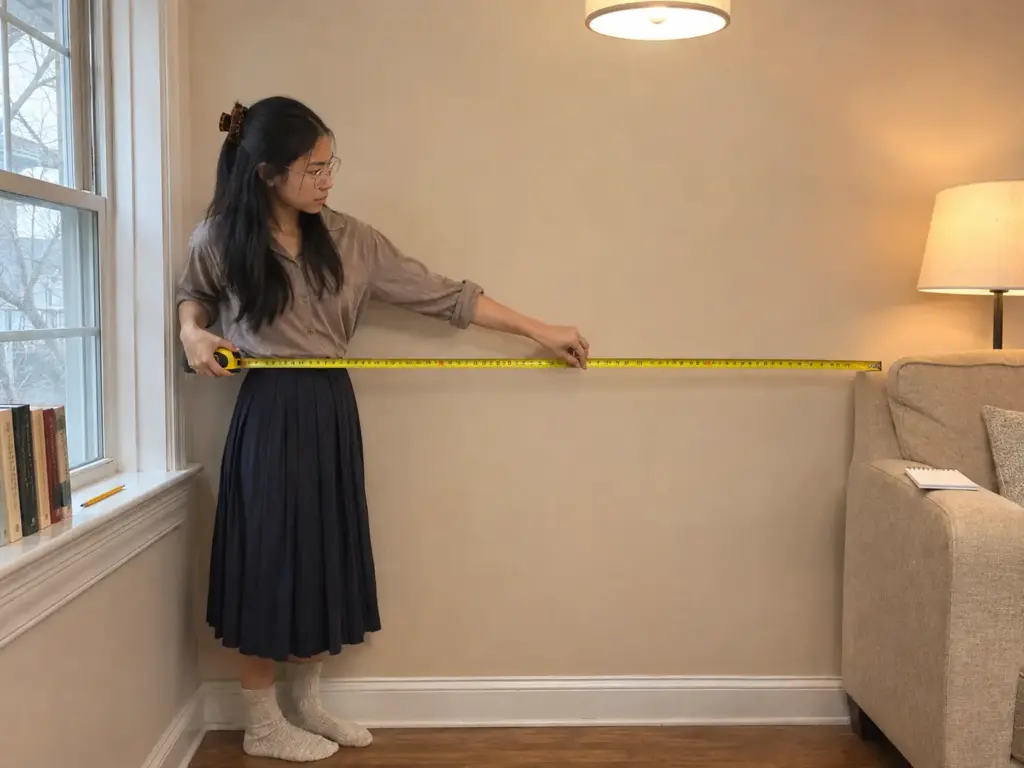
A shelf that fails in a small apartment usually fails before it is delivered, on a number nobody wrote down. Four of them rule out most of what you will scroll past: the free run of wall, the depth the room can spare, the height of your tallest book and the count of books that need a home. Take them with a tape measure and a pencil, then shop by gap instead of by photo. A small apartment bookshelf is a measuring job long before it is a style choice.
The Wall Gap, the Walkway and the Thirty Inches Left in the Path
Start with width: the clear run of wall between the door frame and the radiator, or between the corner and the arm of the sofa, measured at floor level and again at shoulder height, because baseboards and trim quietly take an inch or two. Then decide how much depth the room can give. A main walkway needs about 30 inches clear, so a case 12 inches deep along a hall that is 40 inches wide leaves 28, and you will turn sideways every time you carry groceries past it. Depth gets paid twice, once on the wall side and again in the path, and that walkway clearance is the number most shoppers skip.
A freestanding bookcase eats floor space but asks nothing of the wall; a wall-mounted bookshelf gives the floor back and wants a lease that allows screws, so this guide stays with the first kind and sends the second to floating shelves that hold up in small spaces.
Subtract one inch from every measurement you take. A tall case is usually assembled on the floor and then tilted upright, and a case that matches the gap to the last millimeter jams against the ceiling or the trim on the way up.
The Tallest Book, the Deepest Book and What Fits Between Shelves
The tallest book you own sets the opening: add about an inch to its height and that is the clear gap a shelf needs, with 10 to 12 inches the normal spacing and 13 to 15 inches for art books. The deepest book sets the bookshelf depth, and the tallest sets the shelf height. Put a wall of paperbacks and one oversized photography book on the same shelf plan and the shelf bought for the first group refuses the second, so the purchase happens twice.
Pull the biggest book from the pile, measure it, and write that number next to the wall width. Two numbers, one pencil.
Before You Buy: Count the Books and Use What You Already Own
Count in feet of shelf rather than in titles. A foot holds roughly 8 to 10 hardcovers or 12 to 14 paperbacks, so 300 paperbacks need about 25 feet of shelf. A six-shelf tower 14 inches wide gives you about seven of those feet, which settles the question of whether one tower is enough: three or four of them, or a much wider case.
The free routes come first, and they work better than their reputation. Cinder blocks and a plank make a tower in an afternoon, milk crates stacked two high are the zero-budget version, and snap-together metal mesh cubes can be bought cheap and extended upward as the collection grows. Books stacked sideways on the lowest shelf of whatever furniture already stands in the room take the overflow while you decide. The guide to storing books in small spaces without floor piles covers where books go while there is no shelf at all.
And a pass through the stacks changes the count itself. The books that have not been reopened in years leave the number, a smaller number means a smaller and cheaper shelf, and how to declutter books and actually finish the job walks through that cull.
Tape the footprint of the case you are eyeing onto the floor, using the listed width and the depth of the base, then walk your usual route with a laundry basket in your arms. If the basket brushes the tape, the case is too deep for that spot, whatever the listing says about space saving.
Ladder Shelves for Wall Gaps Between 14 and 22 Inches
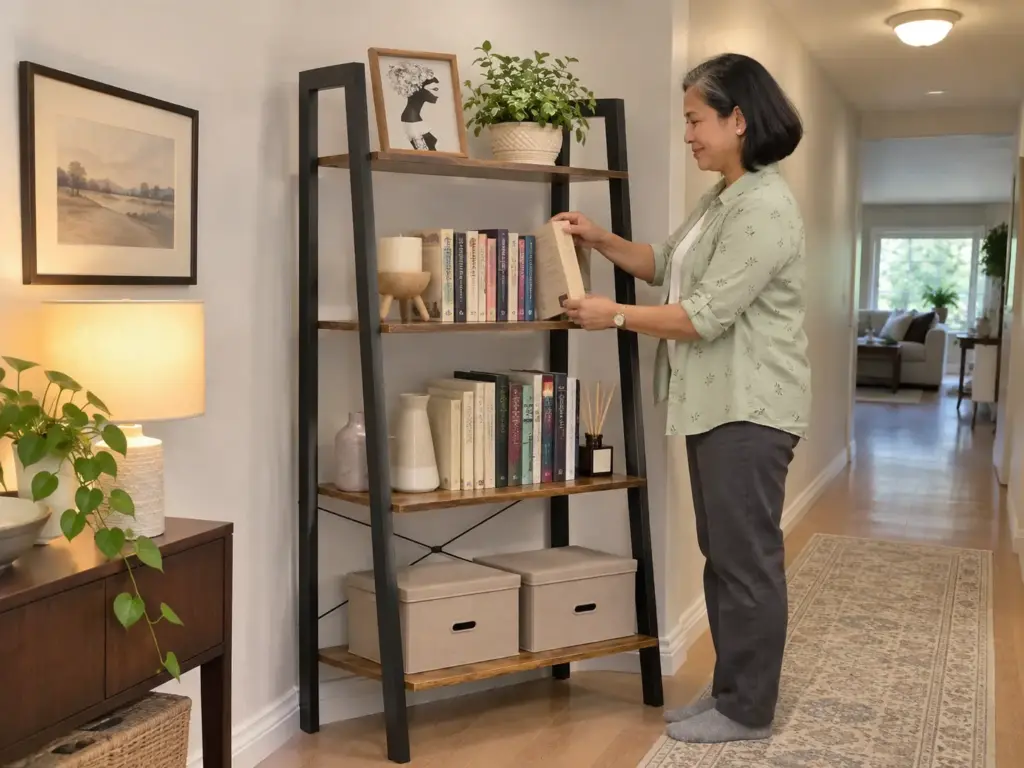
A ladder shelf is the format in every apartment photo: height without bulk, a lean against the wall, no drilling to stand it up. It earns that reputation in a hallway or beside a sofa, where a straight case would feel like a wall of its own.
Why a Ladder Leans and What It Costs in Floor
The lean makes the base deeper than the top, so the walkway math from the measurements above has to use the base, not the top shelf. Leave a sliver of space between the wall and the back so the bottom rail sits flush instead of tilting the whole frame.
This is where the popular advice needs a correction. Ladder shelves get recommended as the space saver for narrow apartments, but in a tight hall the angled base can take as much floor as a straight case of the same capacity. A ladder wins when the wall is the scarce thing and the floor is not; where the walkway is the scarce thing, a slim tower with a smaller footprint is the better call.
The 22-Inch Gap and the 14-Inch Gap
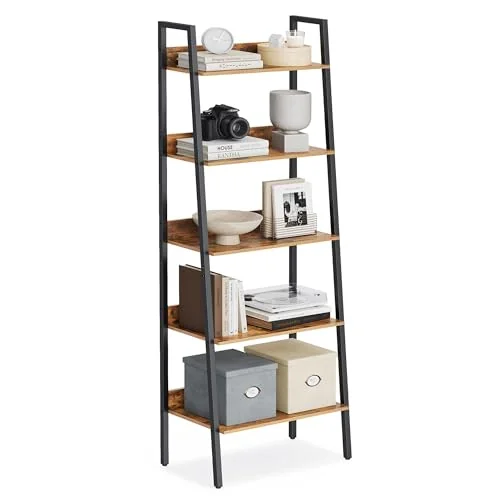
For a 22-inch gap, the default pick is the VASAGLE BARNET 4-Tier Ladder Shelf. It stands 54.1 inches tall and 13.6 inches deep at the base, and the steel frame carries X-bar bracing. The spacing is about 13 inches between shelves, which takes most standing hardcovers without tilting them.
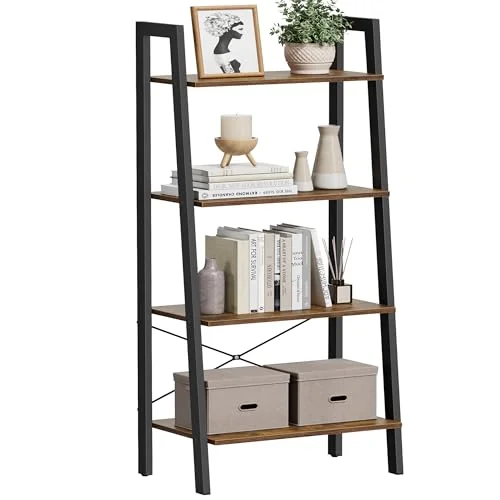
When the gap shrinks to 14 inches, the Hzuaneri 5-Tier Ladder Shelf is the narrowest ladder in this group at 13.4 inches wide. It runs 63 inches tall and 11.8 inches deep, and each shelf is rated at 30 pounds, about 18 inches of hardcovers. It is the right answer only for that tight a gap; wider than that, the VASAGLE costs less and holds more.
Open Backs, Wall Contact and What the Lease Allows
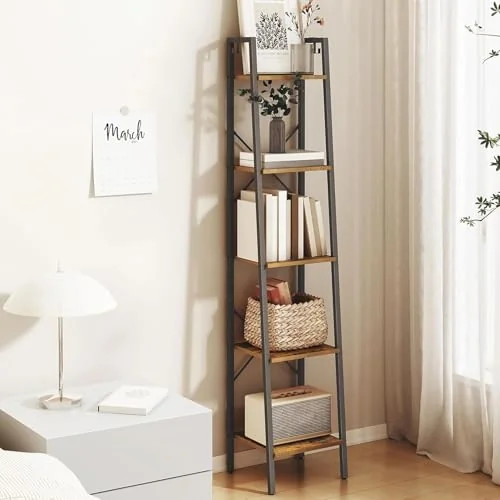
An open back means the wall shows through, and small things (a phone charger, a bookmark, a loose card) slip behind the shelves and disappear until moving day. A ladder also depends on wall contact to stay put, so a freestanding ladder needs no drilling to stand, yet the anti-tip kit in the box still wants a screw in the wall. What a renter does when the lease says no is covered in the anchoring part of this guide.
On budget, the BARNET is the lower-cost of the two ladders, and the Hzuaneri is worth its extra trouble only when the gap really is 14 inches.
Book Weight and Shelf Span: Why Cheap Shelves Bow
The shelf that looked perfectly straight in the store and has turned into a hammock a year later was not defective. It was loaded at double its rating, and the board gave way slowly instead of cracking, which is why nobody notices until the books lean toward the middle.

A Foot of Hardcovers Weighs About Twenty Pounds
A linear foot of hardcovers weighs about 20 pounds, paperbacks run 10 to 15 pounds, and art and reference books reach 25 to 30. Multiply by the length of the shelf: a 24-inch shelf of hardcovers carries about 40 pounds and a 36-inch shelf about 60. Consumer bookcases are rated for roughly 20 to 50 pounds per shelf, so a long shelf full of hardcovers can land at double what the board was made for. Weight capacity per shelf is the first number to read on any listing, and shelf sag is what the rest of this section is about.
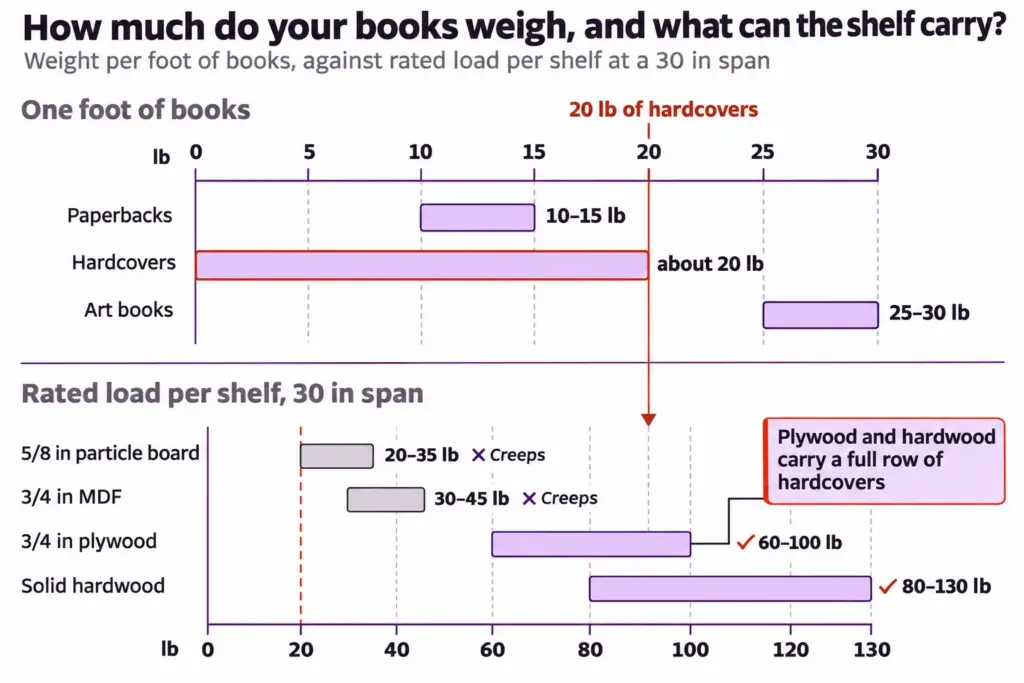
The same arithmetic is why the picks in this guide are listed with a per-shelf rating wherever the maker publishes one. For sag-resistant options in the neighboring room, bookshelves for small spaces that resist sag covers the living-room side of the same problem.
Divide a shelf’s rated pounds by 20 and you have the feet of hardcovers it carries. A 30-pound rating is a foot and a half, 18 inches of spines, and then it is full. Paperbacks stretch the same rating further, since a foot of them weighs 10 to 15 pounds.
Particle Board, MDF and Plywood at a Thirty-Inch Span
At a 30-inch span, 5/8-inch particle board is good for 20 to 35 pounds and creeps, 3/4-inch MDF handles 30 to 45 pounds and creeps, 3/4-inch plywood takes 60 to 100, and solid hardwood 80 to 130. Creep means the board deflects under a steady load and never comes back, so failure arrives as a slow smile along the shelf. A 3/4-inch red oak shelf is safe at about 49 pounds per foot over a 24-inch span, 21 at 30 inches and 9 at 36, according to Fine Woodworking’s sag table, and the same board loses most of its capacity just by getting longer.
Doubling the unsupported length multiplies the sag by about sixteen. A thicker board is the expensive answer, and a centre support or a vertical divider is the cheap one. Shortening the span is the only free fix.
Heavy Books Low, Light Books High, Span Shorter
Three other early failures are worth looking for. A case with no back panel racks sideways into a parallelogram once someone leans on it. A heavy run of books on small shelf pins crushes the board around the holes, and the shelf tilts toward the wall. And the heaviest books on the top shelf recreate the exact configuration the tip-over figures describe, a tall frame with its weight at the top.
Read a rating the way you would read a spec on a ladder. The Furinno PASIR is rated at 40 pounds a shelf, which is one full row of hardcovers on a 24-inch shelf with nothing left over, so spread the heavy books across several shelves rather than stacking a second row.
Tall Narrow Towers and Tree Shelves for a Sliver of Wall
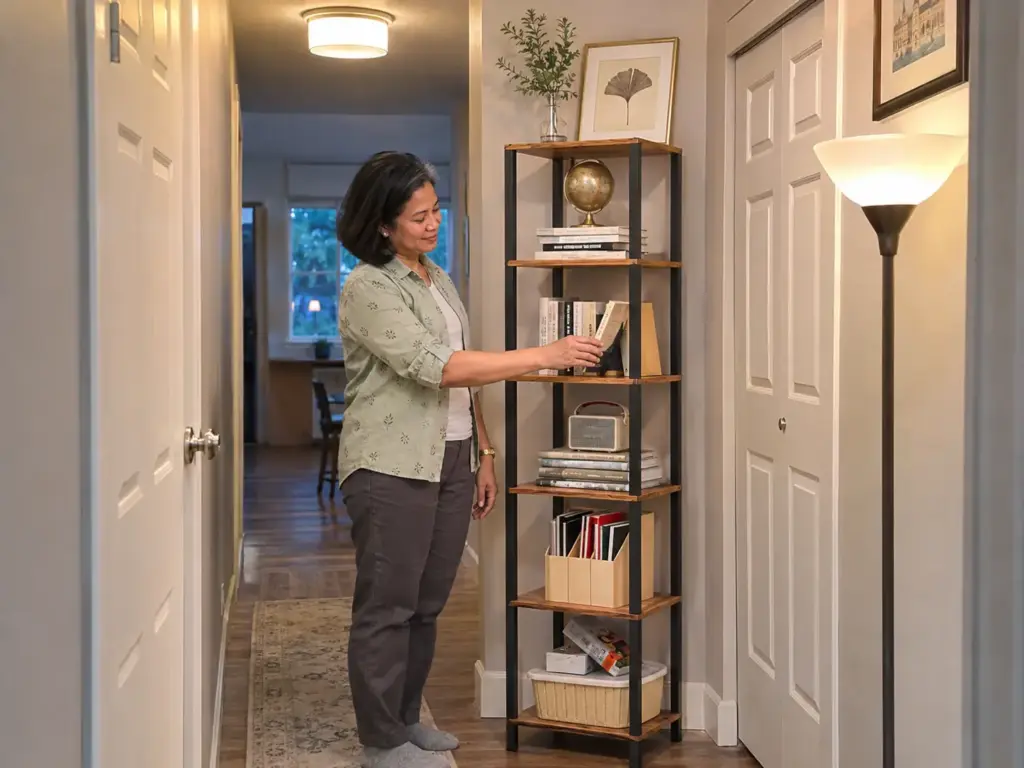
When the only free space is a 15-inch sliver between a door and a closet, height is the one direction left. Every tower stands on the same small base, which is exactly why each one needs anchoring and a load that sits low.
When Height Is the Only Direction Left
A tall narrow bookcase trades floor for wall, which is vertical storage in its plainest form and the best use of a dead space beside a door. Its footprint is small, so the shelves have to go up, and every inch of height raises the leverage on that small base. Weight the bottom shelves, keep the top for light things, and treat anchoring as part of owning the case, not an upgrade. The same logic applies to a corner bookcase, which stands lower but sits on an even smaller base.
Three Slim Towers Compared by Footprint and Load
The TUTOTAK 6-Tier Tall Narrow Bookshelf puts six shelves on a footprint smaller than a pizza box.
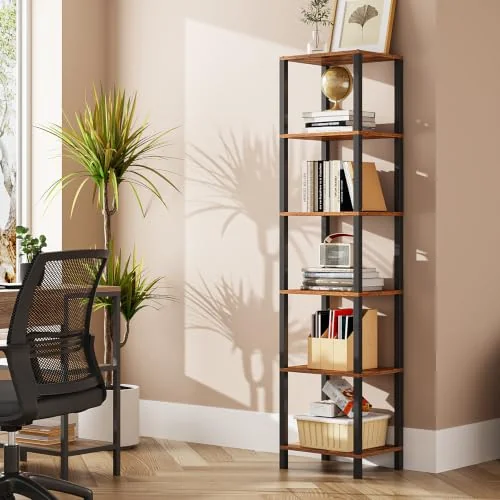
If the gap is closer to 24 inches, the obvious pick stops being the right one. The VASAGLE 5-Tier Narrow Bookcase is 23.6 inches wide, 11.8 inches deep and 66.9 inches tall, and it stores the most books per inch of floor of the three. Back panels give it rigidity, and the maker lists 110 pounds for the whole unit.
The rule is the same for both: weight low, light things high, anchor it. A 65-inch tower is light enough to move across a room and light enough to tip. On budget, the TUTOTAK is the lower-cost of the two; the VASAGLE costs more and holds more.
The Tree Shelf and Its Shallow Trade-Off
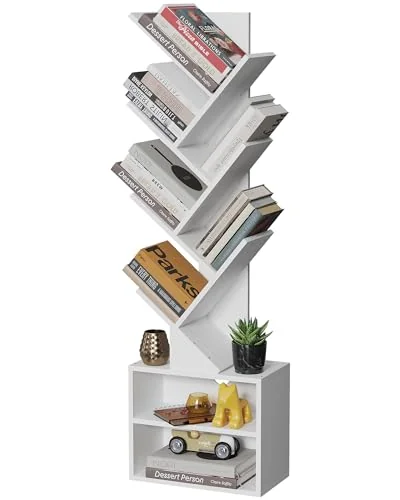
A tree shelf is a tower with branches, and the trade is depth for capacity. The SUNMORY 6-Tier Tree Bookshelf is only 7.9 inches deep, the least floor of anything here, so it works for a wall strip where a 10-inch tower would block a door swing.
Depth Honesty: Match the Shelf to the Deepest Book You Own
Two opposite things go wrong here. The narrow case arrives and does not take the hardcovers that made you shop. Or the deep case arrives, pushes paperbacks to the back, and a second row ends up hiding the first.
Listed Depth Is Exterior Depth
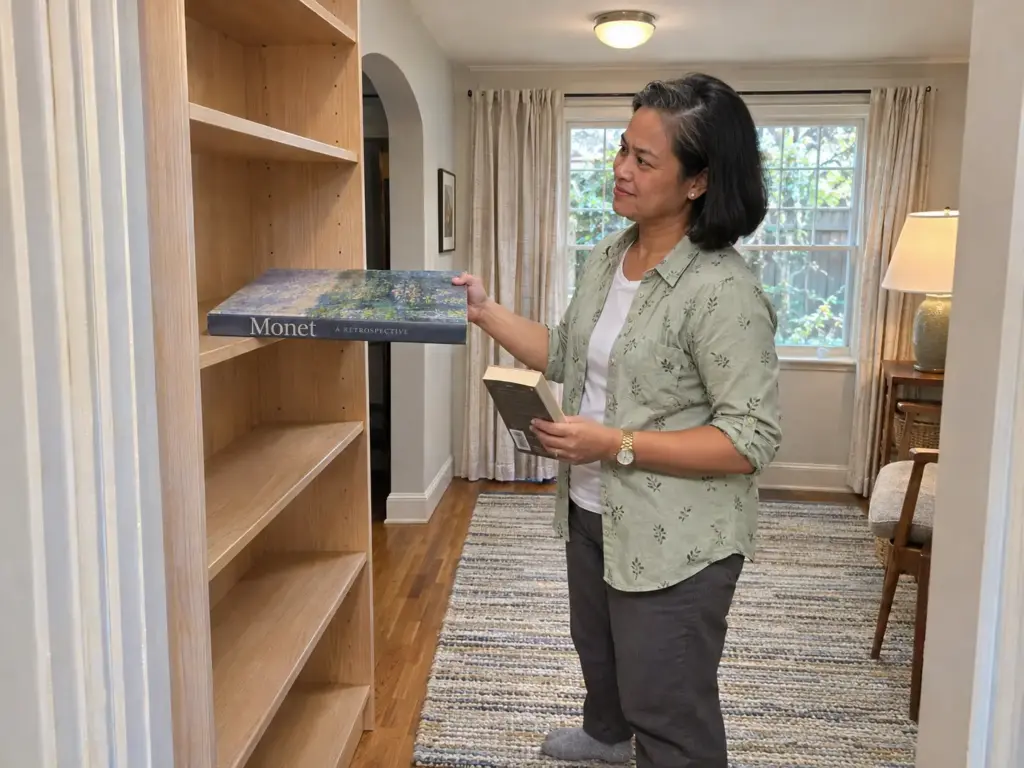
Standard bookcase depth is 11 to 13 inches because a hardcover is 9 to 10 inches deep. What is for sale does not follow that logic: Alcovio’s guide to bookshelf dimensions counted 109 listings, found a median depth of 17 inches, and none under 14. The market sells cabinet depth, not book depth, so budget about 18 inches of floor or shop the shallow end on purpose.
Then comes the part the listing hides. The number is exterior. A 12-inch case gives 10.5 to 11 inches of usable shelf once the back panel and the frame come out, so knock an inch to an inch and a half off every listing.
The 12-inch figure everyone quotes is also the wrong target for some readers. If most of your books are paperbacks, 8 inches of usable shelf is plenty and the extra four inches of depth is floor you pay for twice; if you own art books, even 12 is tight.
Book Sizes Against Shelf Depth
Books come in a narrow set of depths: a mass-market paperback runs about 4.25 inches, a trade paperback 5.5 to 6, a hardcover 6 to 8, an art book 10 to 12, a binder 11 to 12 and an LP 12.4. Eight inches takes paperbacks, 10 takes nearly every hardcover, and 12 takes large formats.
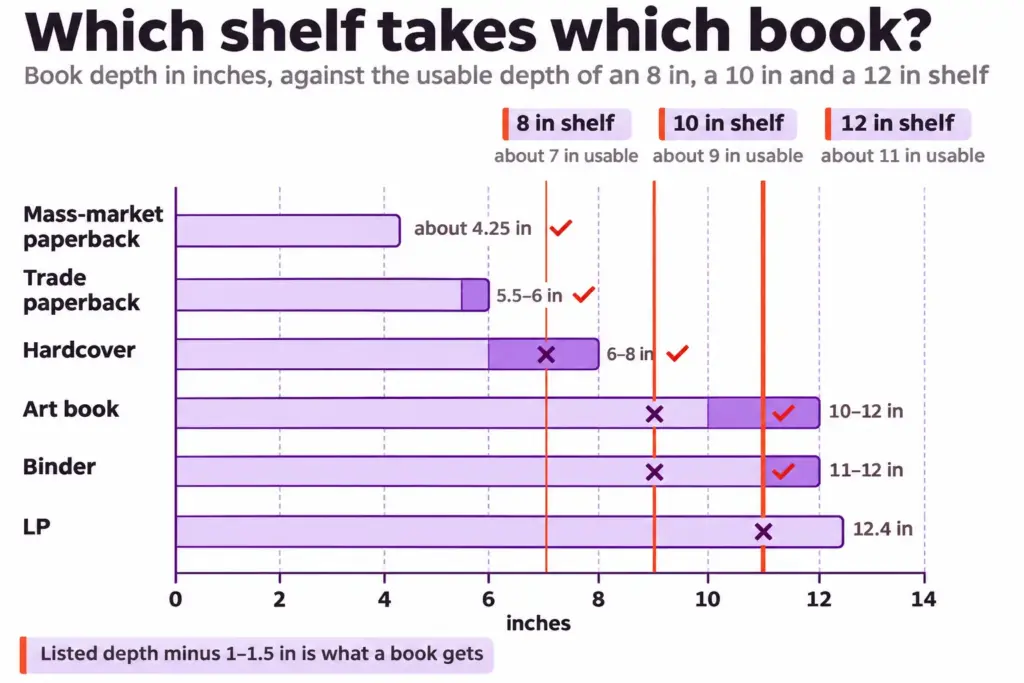
A 9.7-inch outer depth does not take ordinary hardcovers, and a 7.9-inch tree is a paperback shelf. Both are fine for what they are; the mistake is buying one for the other job.
Cut a cardboard rectangle as wide as the shelf and as deep as the listed depth minus an inch and a half, then stand your widest hardcover on it. If the spine overhangs the edge, that shelf is a paperback shelf for you.
How Many Books a Foot of Shelf Really Holds
Capacity runs about 8 to 10 hardcovers or 12 to 14 paperbacks per foot. A 23.7-inch shelf therefore holds 16 to 20 hardcovers, which weighs about 40 pounds, the exact rating of the Furinno PASIR. That is the point where width, weight and depth finally agree.
Where depth is generous, the alternative is to double-stack paperbacks front to back and accept that the back row becomes storage you only visit when you rearrange. It works, but a case that deep is a different purchase from the narrow ones in this guide.
Corner and Rotating Shelves for the Dead 90-Degree Corner
The corner behind the door or beside the TV is the space nothing else fits, and it makes a corner unit look like a bargain. A corner shelf holds less than it appears to, and that is worth knowing before it gets carried upstairs.

What a Corner Shelf Gains and What It Gives Up
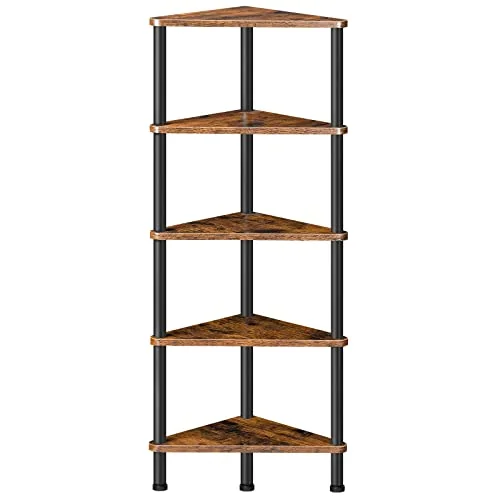
A triangular or L-shaped corner unit takes a small bite out of each wall, 11.8 inches on each side for the HOOBRO 5-Tier Corner Bookshelf, and it stands braced against two walls rather than one. The gain is height in a spot that was wasted. The cost is that the shelves are triangles, which holds paperbacks and small hardcovers well and art books not at all.
The Rotating Tower and Its Screw Problem
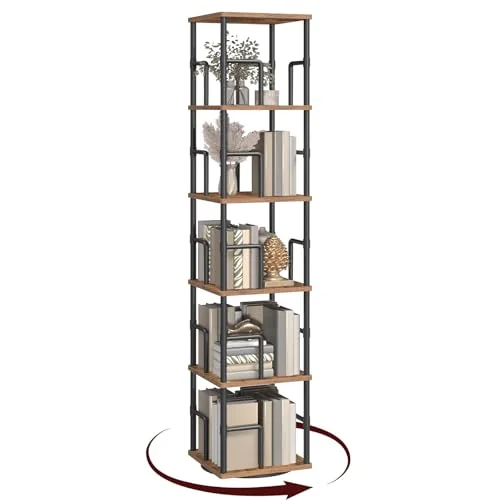
A rotating tower spins on a 360-degree base, so you can read the spines on all four sides without pulling a book out. The MAHANCRIS 5-Tier Rotating Bookshelf sits in an 11.8-inch square and rises to 62.5 inches. It needs reach on at least two sides, so it earns its place in an open corner and loses its point against a flat wall.
Bracing Against Two Walls Without Drilling
A corner unit has a built-in advantage over a freestanding case: two walls to lean on. Corner shelf ideas for small rooms goes into the two-wall bracing trick and corner depth by room, and the maker’s instructions rule the fixing for each unit. Budget route: the HOOBRO is the lower-cost corner; the MAHANCRIS costs more and adds reach.
Anchoring a Bookshelf Without Wrecking Your Security Deposit
A loaded tower on carpet comes forward when a child climbs it, or when the top shelf is the heavy one. Skipping the anchor because anchoring sounds like a handful of large holes is the renter’s most common mistake, and it is based on a wrong picture of the hole.
The Furniture the Law Forgot
The numbers come from the Consumer Product Safety Commission’s tip-over figures: 2020 to 2022 averaged 17,800 tip-over injuries a year, 44 percent of the victims under 18, and 2013 to mid-2023 counted 217 fatalities, 71 percent of them children aged one to three. The 2023 STURDY standard covers dressers and armoires, not bookcases, so anchoring one falls to the owner or the tenant. According to the CPSC’s Anchor It! campaign, “Anchoring all furniture with drawers, doors, and shelves to the wall prevents tip-over injuries and deaths.”
When the Lease Allows One Screw and When It Does Not
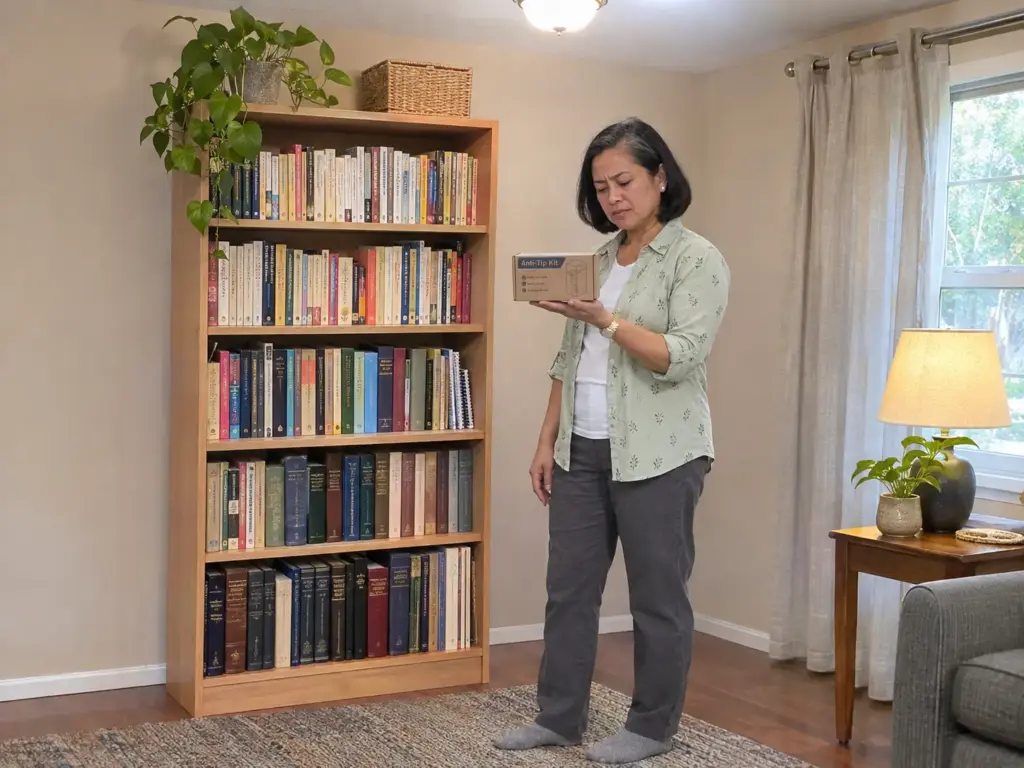
Where the wall allows it, an anti-tip strap kit uses two straps: one plate on the furniture, one on the wall. The hole is small, and Anchor It! says covering it at move-out is not a problem. An anti-tip kit costs less than the shelf it saves and takes minutes to fit, which makes it the cheapest line in the whole project.
Wall type changes what the fixing needs: on drywall and plaster the kit wants a stud, which a stud finder locates in seconds, and a drywall anchor belongs only where the maker’s instructions allow it. Brick and tile each want something different, and the campaign’s page covers each one.
The advice to simply screw it to the wall assumes a lease that allows a screw, and a no-drill route is only renter-friendly when the case is stable on its own. Many do not, and the right call then depends on which constraint is firm: a hole in writing from the landlord is often easier to get than renters expect.
Freestanding Choices That Stay Put on Their Own
Where the wall is truly off limits, the honest fallback is a unit that is stable when empty, loaded bottom-heavy, and strapped to a heavy piece of furniture instead of the wall. That is second best, because a strap to a wall stud beats it every time, but it beats nothing. Freestanding shelving units that won’t tip over covers the tip-over risk for units of every height.
Low Cases and Cube Grids for Under the Window or Beside the Sofa
A few dozen books, a window with a low sill and a sofa arm that wastes a corner: that is a low case, and the low case is the one that never needs the anchoring conversation. In a small bedroom it sits beside the bed, in the living room it goes under the window, and a home office can use the cube grid for binders and reference books.
Low Cases Trade Height for Stability
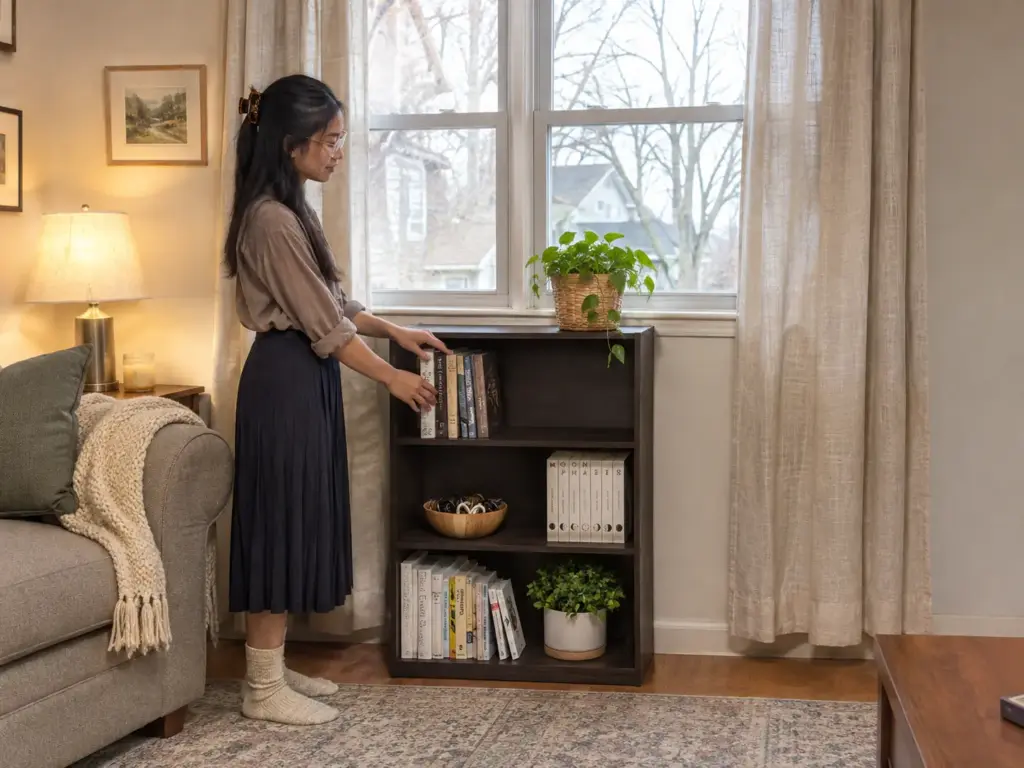
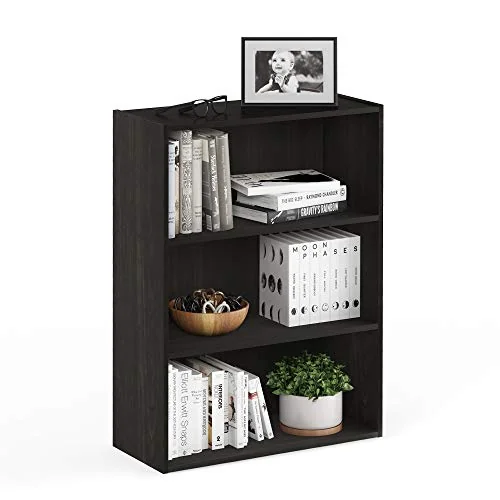
A case that stops at 31.5 inches does not tip the way a 65-inch tower does, a low shelf under a window keeps the light, and the same height works as a kids bookshelf, though a child’s room still earns an anchor. The Furinno PASIR 3-Tier Bookshelf carries 40 pounds on each shelf and 120 in total, the best per-shelf rating of the cheap group.
Cube Grids and the Storage-Box Problem
A cube storage organizer is the format everyone knows from IKEA’s KALLAX, and IKEA’s BILLY and EKET are the usual yardsticks too, but all three are sold at IKEA rather than on Amazon, so they stay out of the picks here. Cube grids hold paperbacks well and hardcovers badly. A cube about a foot square takes a row of paperbacks, not a stack of art books, and the cubes are rarely a size that takes the storage boxes sold for them. The Furinno LUDER 3-Cube Bookshelf is the budget version, closed at the back, which gives it rigidity.
The Mid-Century Cube as a Low Room Divider
In a studio, a seven-cube grid on slanted legs can stand between the bed and the living area, books on one side and decor on the other. The LEYAOYAO Mid-Century Cube Bookshelf is 31.5 inches wide and 43.3 inches tall. For where it sits, room divider ideas for studio apartments sorts the options by light and lease rules.
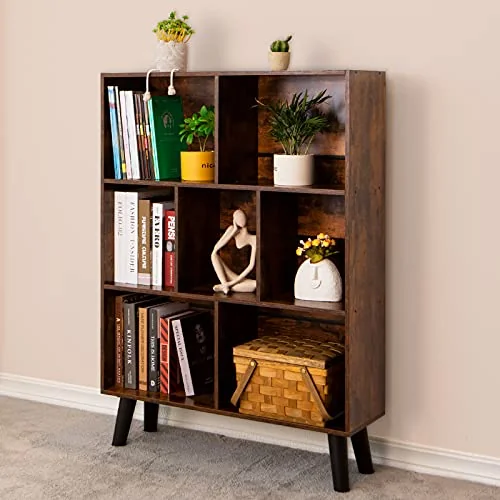
On budget, the LUDER is the lower-cost; the PASIR carries the heavier load; the LEYAOYAO is for the room that needs a divider.
What to Check Once the Shelf Is Loaded
The shelf is up and full, and nobody looks at it again until it has already bowed. The check takes a minute with a ruler.

The Bow Check and the Lean Check
Lay a straight edge along the underside of the longest shelf after the first month and again after the first season. Any visible curve under a full row of hardcovers means the load is above the rating or the span is too long. A case that has begun to lean has lost its back panel or its feet: level the feet and lighten the load. How to organize a bookshelf that stays that way covers load and span limits in more detail.
On the day you load the shelf, photograph the longest shelf with a ruler held against its underside. A phone picture taken from the same spot a season later makes a one-millimeter smile obvious, long before the books lean.
Loading Order That Survives a Year
Hardcovers and art books go on the bottom shelves, paperbacks in the middle, light decor on top. The heaviest run never goes at the top, because that is the arrangement the tip-over figures describe. A new shelf should fill only to its rated foot-count; the last few inches stay empty on purpose.
When to Move the Heavy Books Down
Maintenance of a book collection is mostly this: re-sort twice a year and take out what has not been opened. Moving the heaviest volumes lower is the cheapest fix a shelf ever gets. Once the books are up, styling ideas that survive real life cover what to put on the shelf beside them.
Measure the Wall, Weigh the Books, Then Choose the Shelf
The wall gap picks the format, so the ladder, tower, tree or corner unit follows from a number you have already taken. The weight of your books picks the rating: divide a shelf’s pounds by 20 and you have the feet of hardcovers it carries, which rules out most of the cheap grids for a serious collection. The deepest book picks the depth, and the lease picks how the case stays upright, a strap to the wall where it is allowed and a bottom-heavy load where it is not.
Over the first season of full use, lay a straight edge under the longest shelf and look at the tallest case from the side; a visible curve or a lean is the signal to unload the top and level the feet.
Today, before opening a single listing, tape the free stretch of wall on the floor, measure the tallest and the deepest book on the pile, and see how many of the formats above survive. If the numbers say a shelf is the wrong answer for this room, creative book storage ideas worth doing and ones to skip covers what to do instead.
Frequently Asked Questions
01What is a good bookcase for a small apartment?
A good small-apartment bookcase matches your wall gap: a ladder shelf for 14 to 22 inches, a tower or tree for a sliver, a corner unit for a dead corner. Then check the shelf rating against the weight of your books and the depth against your deepest one.
02Where should you put a bookshelf in a small apartment?
Put it beside the sofa, under a window, in a dead corner or along a hall that still leaves 30 inches clear. Keep it out of the main walkway and away from heat vents.
03Is it cheaper to buy or build bookshelves?
For a small unit, buying a flat-pack case is usually cheaper than building one, because lumber, hardware and tools add up quickly. Building makes sense when you need a custom depth or want solid wood that outlasts particle board.
04How deep should a bookshelf be for a small apartment?
Eight inches takes paperbacks, 10 inches takes nearly every hardcover and 12 inches takes large formats. Subtract an inch to an inch and a half from the listed depth, because the listing counts the back panel and frame.
05Do you have to anchor a bookshelf in a rental?
Anchoring is the safe default for any bookcase taller than a nightstand, and the small holes from a strap are easy to patch at move-out. If the lease says no, ask for one hole in writing or choose a case that is stable empty and load it bottom-heavy.
Disclaimer: ClutterlessNest is a participant in the Amazon Services LLC Associates Program. As an Amazon Associate we earn from qualifying purchases. This article may contain affiliate links — if you buy through them, we may earn a small commission at no extra cost to you. We only recommend products we have tested or genuinely believe in.