You pinned a photo of books climbing a staircase, or a wall of spines graded from red to blue, and now you are standing in your own hallway with a tape measure and a growing pile by the bed. The creative book storage ideas in those galleries all look finished, but the photo never shows the three things a real house demands: a way to find the book you want, a spot that does not cook the paper, and a reason the idea will not be a pile again by spring. Most galleries run the same dozen placements, and what separates the ones that last is retrieval, the air around the paper and the weight on the wall, all of which you can measure.
So this guide judges each placement on those terms, with a plain verdict on whether it is worth doing, and splits the answer by what you own, what you rent and what you are willing to spend. If your collection keeps outgrowing whatever you give it, the full system for a growing library lives in the book organization guide for collections that keep growing.
Quick Answer
The creative placements that survive daily life are the ones that keep titles findable, keep paper out of heat and sun, and have a limit built in.
- A stud-mounted shelf run, 8 to 10 inches deep, on a free wall
- A rotating tower in a dead corner, on about a 17-inch square of floor
- A short stack on a side table or ledge, never on the floor
- A stair ledge or wall niche, only where every shelf is within reach
- Skip a color-only wall, a packed fireplace and any run above the cooker
Creative Book Storage Ideas for a Free Wall, From Deep Runs to Invisible Brackets
A free wall is the cheapest floor space in the house, and it is also where creative ideas fail quietly. The shelf in the photo is usually styled with a handful of paperbacks, while your shelf will carry a real library, and a month after loading hardcovers onto a floating shelf the front edge starts to tilt. The question for every wall idea is not how it looks empty but how much weight it carries once it is full.
A Deep Run Beats a Row of Short Shelves
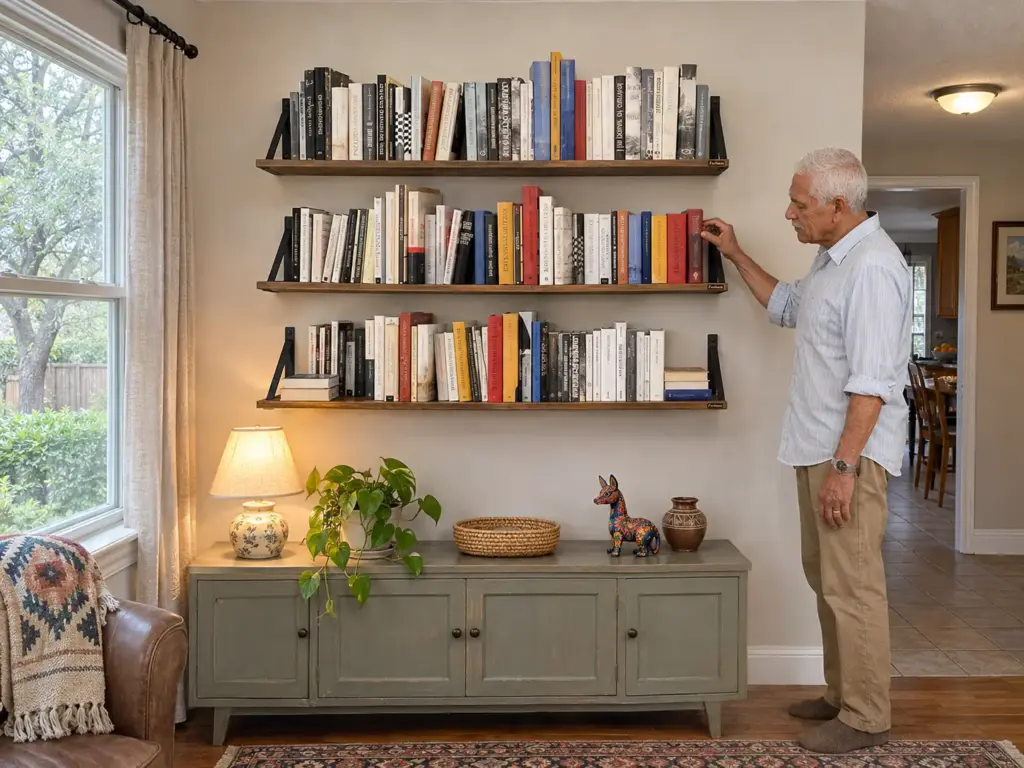
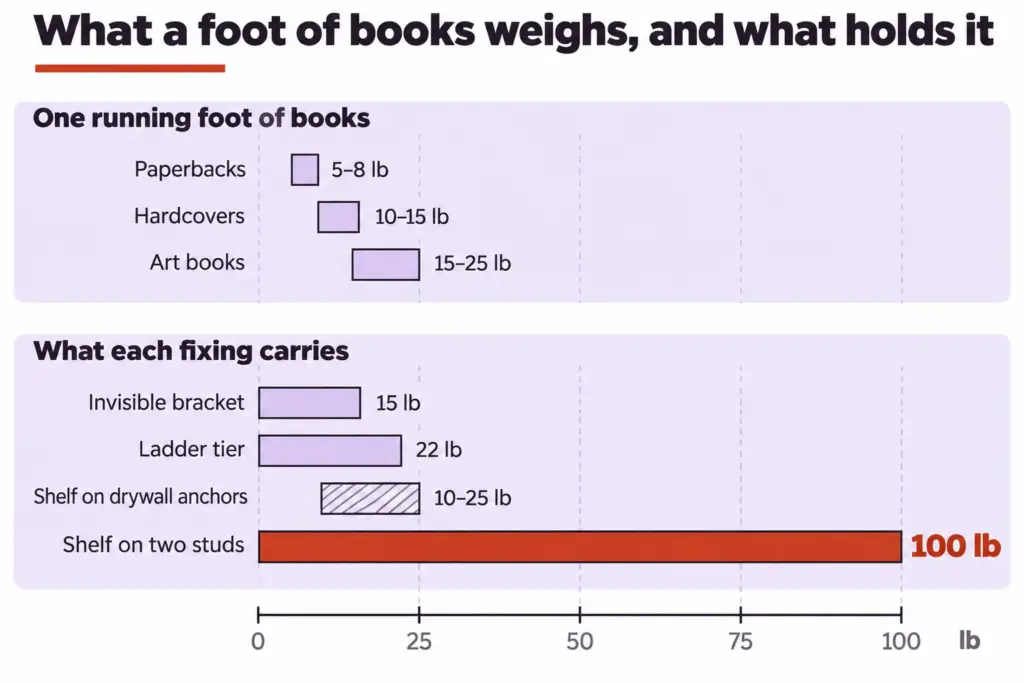
Start with the weight load, because it decides everything else. A running foot of paperbacks weighs about 5 to 8 lb, hardcovers 10 to 15 lb, and art books 15 to 25 lb. A 3-foot shelf of hardcovers is therefore 30 to 45 lb before a single candle or plant goes on it, and the shelf board and the fixing are two separate ceilings, so the weaker one wins.
Makers rate a floating shelf at roughly 45 to 50 lb for each wall stud its bracket reaches, so a 3-foot shelf screwed into two studs carries about 100 lb. The same shelf held by drywall anchors alone is good for 10 to 25 lb, which is less than the hardcovers you meant to put on it. The rule that follows: heavy books go low, light paperbacks go high, and the maker’s instructions rule the fixing every time. A renter has a harder call (two small stud holes and a patch at move-out, or no wall run at all), and the furniture ideas further down exist for exactly that reader.
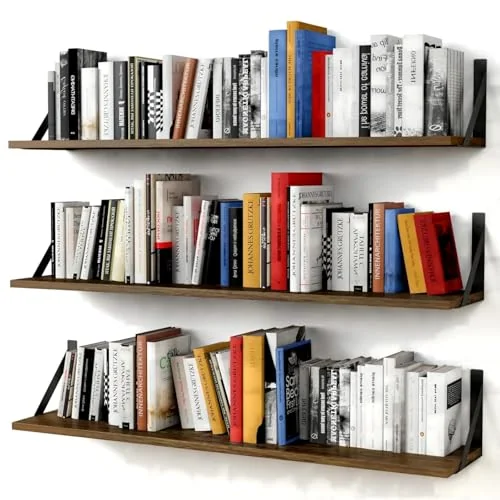
Shelf depth matters as much as weight. Most books are under 9 inches deep, so a shelf of 10 inches or less holds them with a little air at the front. Go to 12 inches and you waste wall while the books creep forward, and at 6 inches tall art books tip.
The Forbena floating book shelves are built around that sweet spot: a set of three, each 36 inches long and 8 inches deep, rated at 40 lb per shelf, so hardcovers stand upright instead of overhanging the edge. Durability is uneven, since some sets arrive cracked or break during installation, so check each board before you commit the wall.
Before choosing any shelf, it helps to see what each option holds when it is loaded, which is the comparison the wall-mounted shelves that actually hold weight roundup makes between stud-mounted and anchor-only capacity. And for the shelf span itself, the load and span limits for any run of shelves apply to a creative run exactly as they do to a plain bookcase. Put the run on studs and it earns the wall; leave it to drywall anchors alone and it is a skip.
Picture Ledges, Ladder Shelves and the Narrow Wall Strip
A narrow strip beside a door or a window is the other free wall most houses have, and a leaning ladder bookshelf uses it by going vertical on a narrow footprint. The HOOBRO 5-tier ladder shelf stands 66 inches tall with tiers 9.4 inches deep, each rated at 22 lb, and it holds roughly 55 books, which makes it the budget route for this kind of wall. Its honest ceiling shows up fast: a tier of hardcovers can pass 22 lb, and tall art books overhang the 9.4-inch depth, so keep paperbacks and mid-size novels on it and send the heavy volumes lower.
A picture ledge is the lighter cousin of the idea. Picture ledge depth is the whole story: only a book’s lower edge fits, so it suits a few covers turned face-out and nothing more.
Invisible Brackets: Cute, Light and Limited
Invisible brackets slide into the pages of one book so that it becomes the shelf for the next. They are the most photographed wall idea in every gallery, and they are also among the lightest-duty.
Each bracket is about 4 to 4.5 inches deep with a 15 lb limit, so a thick hardcover overhangs it and an art book is out of the question. Treat the look as a feature for a few light paperbacks, and read the floating shelves chosen by depth comparison if you want a wall run that carries real weight. One more placement belongs here as a fact about the spot: runs above a door or above kitchen cabinets sit in the warmest, dustiest air in the room, and the reasons that matters to paper come in the section on heat, light and dust.
Unexpected Spots Like Stairs, Dead Fireplaces, Niches and the Island End
These are the spots every gallery loves, and they are the ones where a good photo hides the most. The test here is plain: can you reach every book, and does the spot treat paper kindly? Some pass easily. Others only look good from the hallway.
The Staircase Run Fails on Reach Before It Fails on Looks
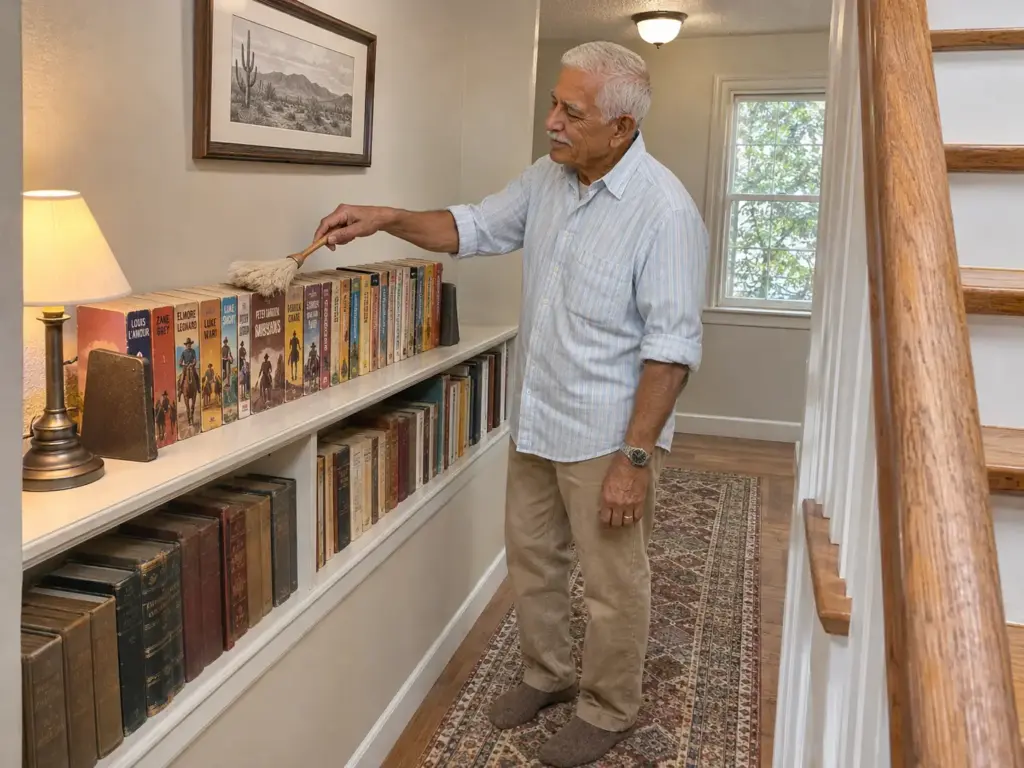
A ledge of books climbing the wall beside a staircase is genuinely striking, and a staircase bookshelf works only where every shelf is within reach from the landing. Above shoulder height it needs a step stool, and a run that only the tallest person in the house can use quietly becomes decor. The best version costs nothing: a stair-side or basement ledge the house already has, loaded with the books you actually pull.
An under-stair bookshelf is the quieter cousin, worth it when the space beneath the flight is deep enough to reach into without crawling. Stairs also earn their keep in small homes, where risers with drawers are real storage, as laid out in the tiny home storage built into stairs, lofts and walls guide.
The base matters too. A stair railing shelf, or any run built on rails, spindles or slatted boards, is the wrong support, because how the Library of Congress stores books calls for flat, solid shelves so a book rests on a full base and not on two thin edges. Do it on a ledge you already own and can reach, and skip it the day it needs a ladder.
Before any stair run or high ledge goes up, stand where you read and reach for the top shelf with your arm straight. If you need a stool for more than the odd book, put the titles you pull most on a lower shelf and keep only decor above it.
A Dead Fireplace Is a Dust and Air Problem, Not a Space Problem
A cold fireplace looks like free shelving, and dead fireplace storage works, with conditions. It has to be truly out of use, with the flue sealed, no fire lit and no heat rising from below.
Books packed tight into the box get no air, and a closed, dusty cavity invites damp, so the opening works as a display for a few rotating titles with space around them and fails as the whole library. Leave it open to the room, keep it off any heat source, and dust it as you would any shelf. A packed fireplace is a skip. A loosely filled one is fine.
Wall Niches and the Cookbook End of the Island
A recessed wall niche between studs is a real idea and a real project, adding only a few inches of depth, the thickness of the wall itself, which suits paperbacks and slim hardcovers but not art books. It is worth a carpenter and a check of what runs inside that wall. Painted a deep color, a book niche also turns the spines into a feature, and the measuring-first approach to books in small spaces shows how to confirm an opening fits before anyone cuts drywall.
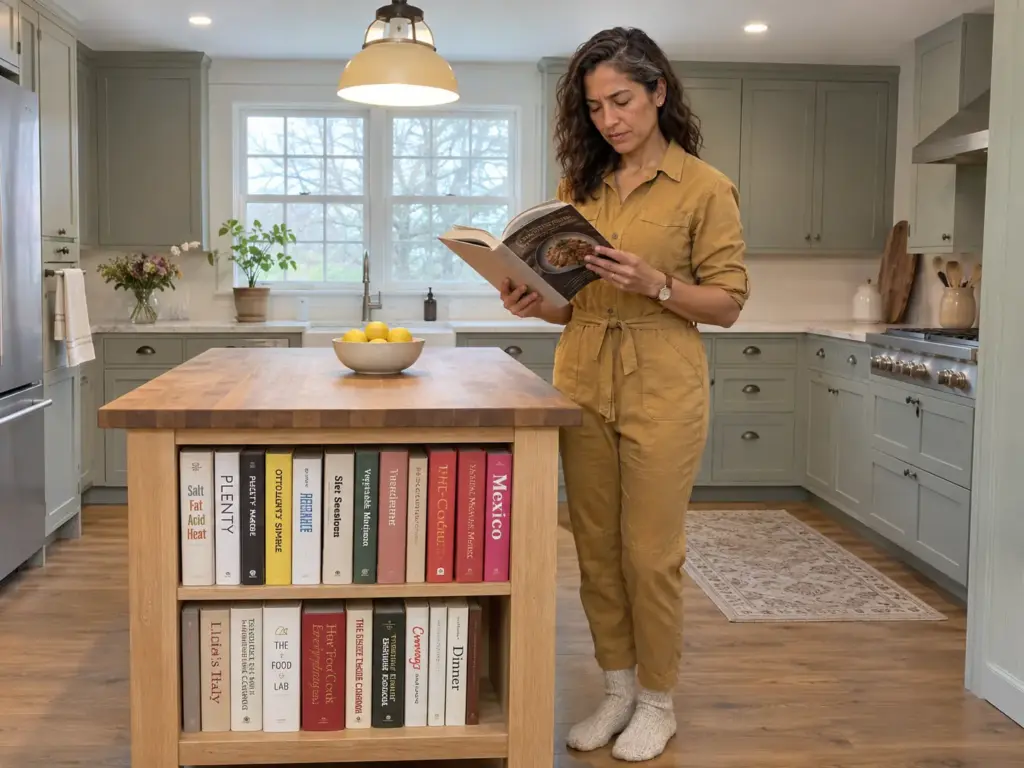
The island end is the easiest win in this section. A kitchen island cookbook shelf is just an open end at counter height that holds the cookbooks you actually use, spine out, right where the cooking happens. Heat, steam and grease are the enemy, so only cookbooks that are open on the counter at least weekly belong there, and never at the end nearest the cooktop.
Runs above kitchen cabinets and above doors look clever and age paper fastest, so keep boxes of spare copies or old magazines up there, not books you care about. So the island end is a do, the niche is a do with a carpenter, and anything above the cooker is a skip. In a large house, the landing wall and staircase are free wall. In a small flat, the niche and the island end are often the only free spots.
Furniture That Doubles as a Bookcase, From Room Dividers to Round Towers
Furniture is the answer for anyone who cannot or will not drill, and for anyone with a big open room that needs a visual break. It stores books with no wall fixing at all, but it charges in floor space, weight and tip-over risk instead.
A Bookcase as a Room Divider
The bookshelf as room divider idea splits an open plan or a studio into two zones and shows spines on both sides, which is why it keeps appearing in galleries. For the layout side, the room divider ideas for studio apartments compare bookcases with other ways to split a room, and creating zones in a studio apartment covers where each zone should land. A floor-to-ceiling bookcase makes the strongest divider, and it is also the tallest, heaviest, most climbable object in the house once it is loaded. The store-standard bookcase runs about 6.5 feet tall (IKEA’s Billy is the usual example), and shelf extenders add about 11 inches to that, so at that height it should be anchored or not loaded high.
The numbers are not abstract. CPSC data on furniture tip-over injuries counts about 17,800 tip-over injuries a year in 2020 to 2022, with 44% of the injured under 18. From 2013 to mid-2023 the agency recorded 217 tip-over deaths, and 71% of the victims were children aged one to three, the age at which a shelf of picture books sits at floor level.
According to CPSC’s Anchor It! campaign on securing bookcases, “Anchoring all furniture with drawers, doors, and shelves to the wall prevents tip-over injuries and deaths.”
Follow the maker’s instructions for the kit. In a rental, a tall divider gets anchored only with the landlord’s yes. Without it, choose something lower.
Benches, Bed Frames and Nightstands With a Shelf
Low pieces are stable and good for the books you reach for daily: a storage bench with a shelf below, a storage ottoman, a bed frame with bookcase base or a headboard bookshelf, a nightstand with cubby space, even a rolling book cart that parks beside the sofa and goes back to the wall. All of them are no-drill answers, and their capacity is small, which is the point of them.
The bench seat is also the first place a pile grows, because a flat surface at sitting height collects whatever is in your hands. Give each piece a ceiling of a few books, and move the overflow to a real shelf.
A Round Tower in the Dead Corner
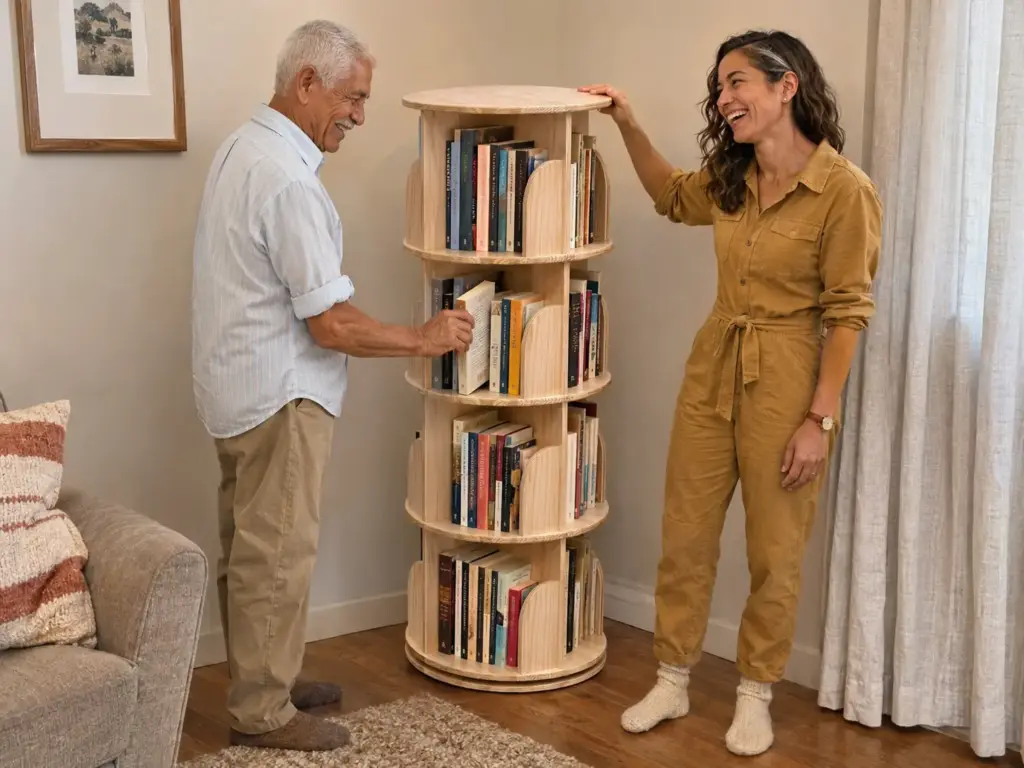
A rotating tower stores books by turning the problem inside out: with a 360-degree turn there is no back row, so one spin shows a whole layer. The Bear Qiaqia 4-tier rotating bookshelf is about 51 inches tall on a 17.3-inch square of floor, with 11.8 inches per layer and room for around 120 books, and it needs no wall. That narrow footprint is why a book tower suits a small apartment so well.
The pine boards can splinter and the assembly instructions are unclear, so allow extra time and sand any rough edge. Even a freestanding tower is tall, so anchor it where the base allows. The corner shelf ideas for small rooms page measures what a dead corner can really take.
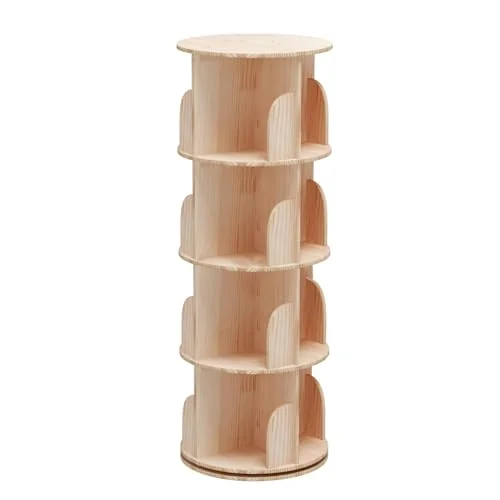
The lighter-budget way into the same format is the SpaceAid 4-tier rotating tower, which measures 18.1 by 18.1 inches and stands 50 inches tall. It is particle board, and units can arrive damaged or turn stiffly, so test the rotation before you load it. For anyone who finds a tower is overkill, the answer may be a plain case after all, and the best bookshelves for small spaces that do not sag are the place to look.
The tower and the low bench are worth doing, the divider is worth doing with an anchor, and any tall unit that cannot be anchored in a home with toddlers is a skip. In a large open room, a divider that doubles as a wall of books costs no wall at all and may be the best creative idea in this whole guide. In a small room, the tower wins.
What Heat, Light and Dust Do to a Book in an Unusual Spot
Placement is not only about whether you can find the book. It is also about what a season sitting there does to it, and a gallery photo captures the first day only. Sun, a radiator, a stove and a bathroom each age paper in a different way, and none of them shows up in the picture. Book care is mostly a matter of where the shelf stands, and a well-built shelf in the wrong spot does more damage than a plain one in the right spot.
The Temperature and Humidity a Book Tolerates
The numbers come from the national library. According to the Library of Congress, “A cool (70 degrees Fahrenheit or below) and relatively dry (30-55% relative humidity) environment is safe for most books.”
How the Library of Congress recommends storing books also asks for minimal light, none of it direct or intense, and it advises against basements, attics and garages for books of value, because temperature and humidity swing there and leaks happen. That removes a lot of free-looking space from the list. A basement wall is not free if the collection pays for it.
Humidity is the number people forget, because it does not show. A room can sit at a comfortable temperature and still run damp enough to curl covers and invite mold, and books on an outside wall or in a closed niche feel it first. A book packed tight with no air moving around it dries slowest, which is the same reason a stuffed fireplace fails.
Sunny Sills, Radiators and Kitchen Runs
Apply those numbers to the spots from earlier and the verdicts get quick. Direct sunlight fades covers to yellow while the same wall out of the beam keeps its color, and the damage lands on the spine, the edge that faces the room. That is spine damage you notice only when you pull one book from a row and its neighbors have gone paler. A shelf on the wall beside a window, out of the beam, can be fine, and a sheer curtain turns a bad spot into an acceptable one.
Heat is the other half. Mantel books above a radiator bake, a run over the stove sits in warm, greasy air, and a bathroom shelf lives in damp. Each of these spots scores badly regardless of how it looks, and a spot that scores badly here is a skip.
Dust is the quieter cost. It settles on the tops of books and in every niche, so dusting a shelf is part of the idea. If you will not do it, it is not really the idea for you.
Leave a hygrometer on the shelf for a week before you commit to a spot, and read it in the morning and again late in the afternoon. A spot that stays inside the 30 to 55% range through a normal week passes. One that jumps after showers or heating cycles does not, whatever it looks like.
Upright, Flat or Spine-Up: How a Book Is Supported
Books stand upright, supported by bookends, and oversized volumes lie flat. Horizontal stacking is the right answer for oversized art books, with the heaviest at the bottom. Never store a book spine-up, since that slowly pulls the text block away from its binding under its own weight.
A book leaning in a half-empty tier warps its own spine, so a run with no bookends turns every partly filled tier into a row of leaning spines. The bookends and shelf dividers that keep a tier upright guide covers the options for each shelf type. And remember the earlier rule, because it applies here too: shelves flat and solid, never a rail or a wire grid.
Books as Decor, From Coffee-Table Stacks to Color-Graded Walls
Some ideas use the books themselves as the decoration: stacks, pedestals, spines turned around, shelves graded by color. They look good because a book is a nice object. The risk is that the display begins to cost you the library.
Stacks That Have a Home Instead of the Floor
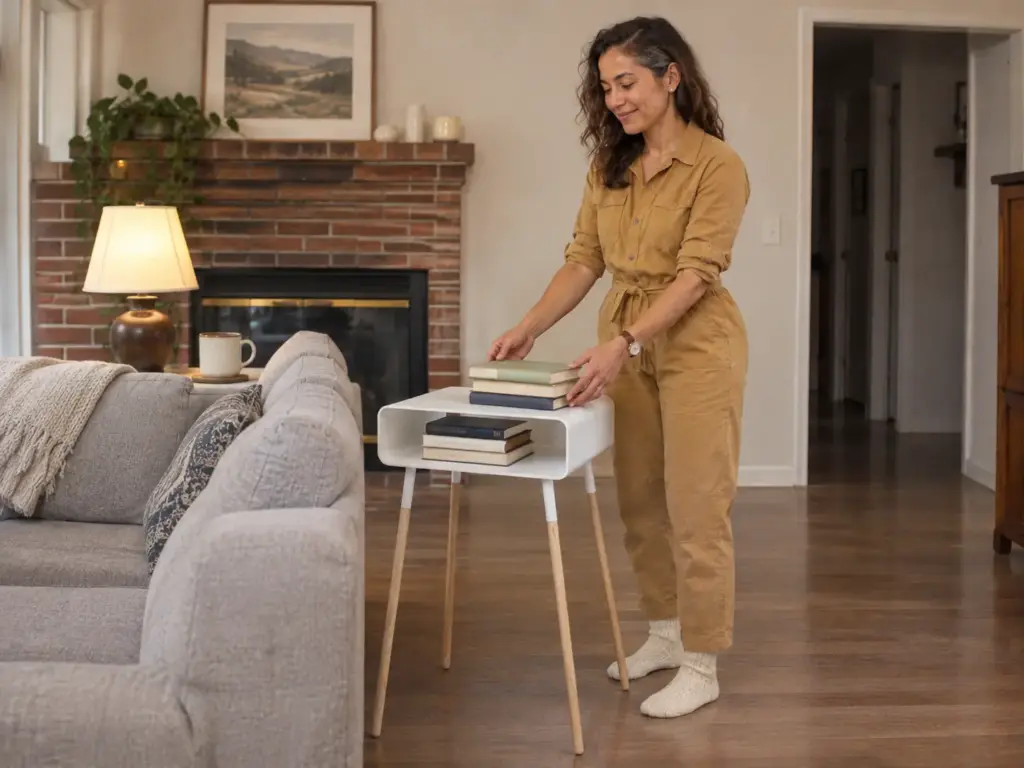
Book stacks work when they have a surface of their own: a side table or ledge with a lip, a ceiling on the number of books (a few, heaviest at the bottom) and one category. Without those three things, a stack is the overflow pile in waiting.
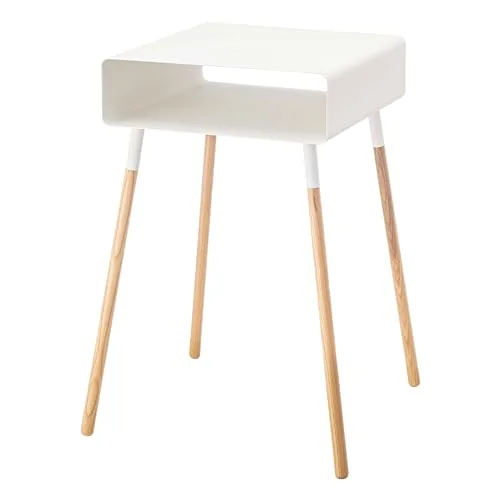
The YAMAZAKI Tall 23-inch side table gives a stack that home. It measures 16.14 by 16.14 by 22.64 inches, and its open shelf below the top holds about eight novels lengthwise, so the stack has a place and the table does not look like a bookcase. It is small and low, shorter than its photos suggest, which makes it right for a short stack and wrong for a library.
The test for any stack is whether it still has an edge to stop at. Once it runs past the ceiling, it is the overflow pile, and the coffee table organization ideas that survive daily use page makes the one-category-per-surface rule easy to keep. Coffee table books and other oversized volumes lie flat, as the Library of Congress guidance says, and they make the best base for a pedestal stack, with the heaviest at the bottom.
The Color-Graded Wall and the Turned Spine
A color-graded wall, the rainbow bookshelf of every gallery, looks like a feature and searches like a lock. You find a title by remembering what color its spine was, which works only if you remember it. Do it for a short run of books you rarely look up, and skip it as the whole library. It does have one practical benefit: regrading a shelf is an excuse for a small purge.
A shelf of color-coded books becomes much more usable the moment it carries a second category, such as genre inside each color, and the bookshelf styling ideas that survive real life show how to style a shelf without losing the books.
Turned spines, with the pages facing out, give a calm look and hide every title, so each book becomes a mystery. That is fine for one decorative row. As a working collection, it is a skip.
Making a Single Book the Shelf
The idea behind the xympo floating invisible bookshelf set of four is that one book becomes the shelf for the next. Each bracket is 5 by 4 by 1.5 inches, holds 15 lb and keeps its hardware out of sight. It is only about 4 to 4.5 inches deep, so thick hardcovers overhang and art books are out.
A four-pack from STORAGE MANIAC rated at 20 lb per bracket is a lighter-cost alternative with the same limits. Both use self-drilling anchors and leave small holes, so neither is a renter’s no-hole answer. The stack with a home and a short color run are worth doing; the color wall as your only system and the turned-spine library are not.
Which Creative Placements Let You Still Find a Book
Every idea so far has a retrieval cost. The difference is that some placements keep you browsing and others trade it away for the look. If you have already built something beautiful and now cannot find the book you want, you are not wrong to want it back on a plain shelf. A shelf exists to hand you one title quickly, and a placement that makes that slower has to earn the difference some other way.
A Shelf You Read Versus a Shelf You Search
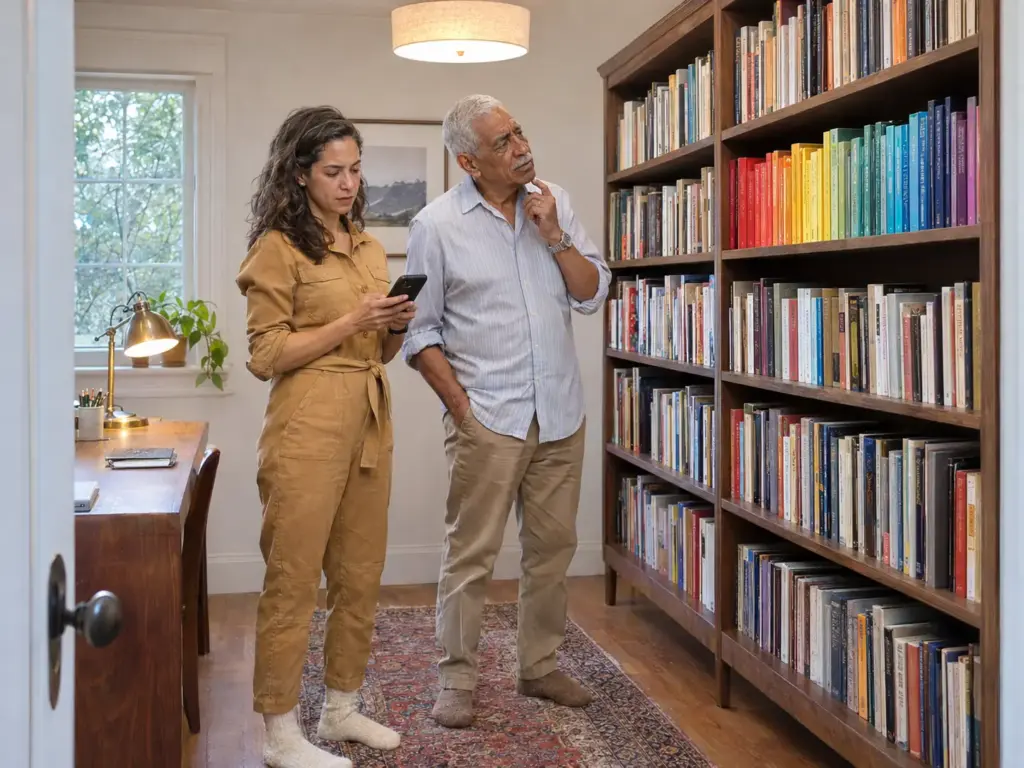
The useful distinction is between a shelf you read and a shelf you search. A shelf you read has spines in view, at eye level, in one row. A shelf you search is color-only, boxed, high or stacked deep.
The placements that keep browsing are a spine-out run at eye level, a rotating tower where one spin shows a whole layer, and a ladder shelf at reachable height. The ones that trade it away are color-only walls, books in a box on a top shelf, deep single stacks used as pedestals, and a fireplace packed solid.
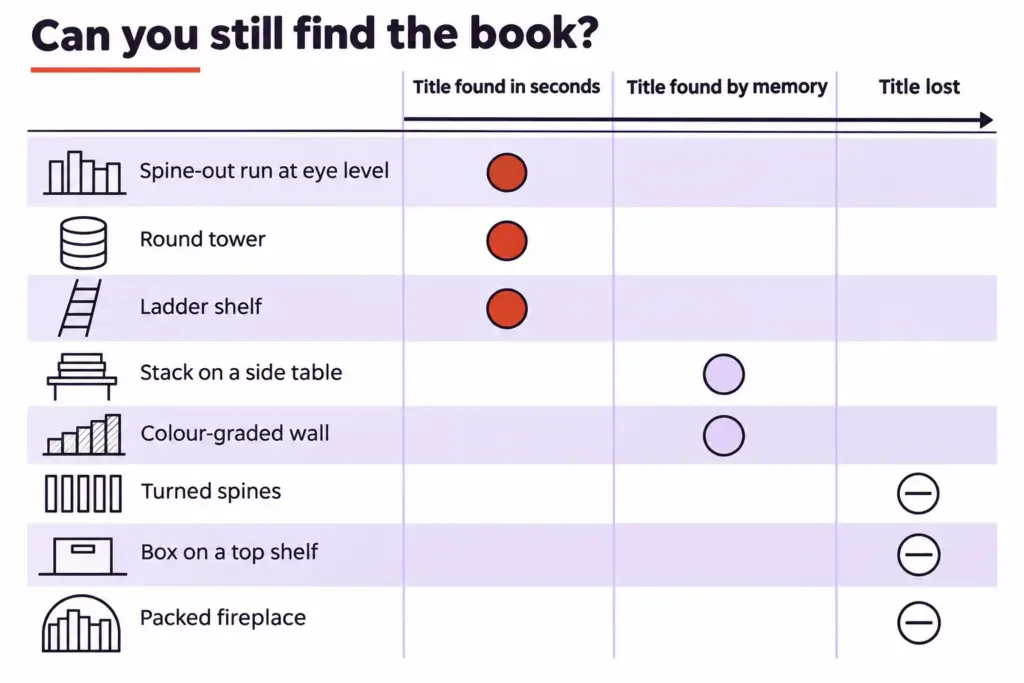
The band between waist and shoulder is where a shelf gets read. Below it you crouch, above it you reach, and every extra movement is a reason to skip the book you wanted and pick up the one in front of you. That is why a stair run and an above-cabinet run score so badly here even when they pass on paper.
The shelving rule from the national library is the technical version of the same point: similar sizes together, upright, supported by bookends. That is a system built for pulling one title out, not for a field of color.
A color wall has a second, quieter weakness: it only works for the person who built it. A builder who remembers covers can find a title in seconds, while a partner, a parent or a guest looks at the same wall and sees a gradient. In a house with two readers, as in most houses, a shelf that only one of them can search is half a shelf.
A large room can afford one decorative row, because the cost hides in all that wall. A small apartment charges it every day.
The One-Minute Test for Any Placement
Pick three titles you own at random and time how long each takes to find, standing where you normally stand. Over a minute for any of them means the placement is decor storage, however good it looks. Run the test before you build, and run it again after the first month, when the novelty has worn off.
Then hand a second person the same three titles. If they cannot find them without you pointing, the system lives in your head and not on the shelf, and it will not survive a day when you are not home to explain it.
Fixing a Placement That Is Already Costing You Titles
You can usually keep the idea and change the rule. Add a category inside the color so a title can be found by genre first. Keep the look to the short run and give the rest an alphabetical home.
Put a step stool in the stair run, or move the reference books lower. Turn the box upright and label the spine. Regrading a wall or reshuffling a boxed shelf is also a natural point to cull, and the guide to deciding which books deserve the space before you regrade a shelf takes that step from a vague plan to a finished one.
If a fix does not bring the one-minute time down, the placement is the wrong one and the books belong on a plain shelf. That is not a defeat. The idea was worth trying, and the test is what tells you when to stop.
Which Ideas Survive Real Life, Whether You Rent, Own or Spend Nothing
Most creative setups look right for the first few weeks and then slide. The slide is predictable, and it is almost never the shelf’s fault.
The Pattern Behind Ideas That Collapse
A display spot with no limit becomes decor storage. The stack becomes the overflow pile. The stair run stays decor for the tallest person in the house. The shelf over the cabinet gathers heat and dust and is never opened.
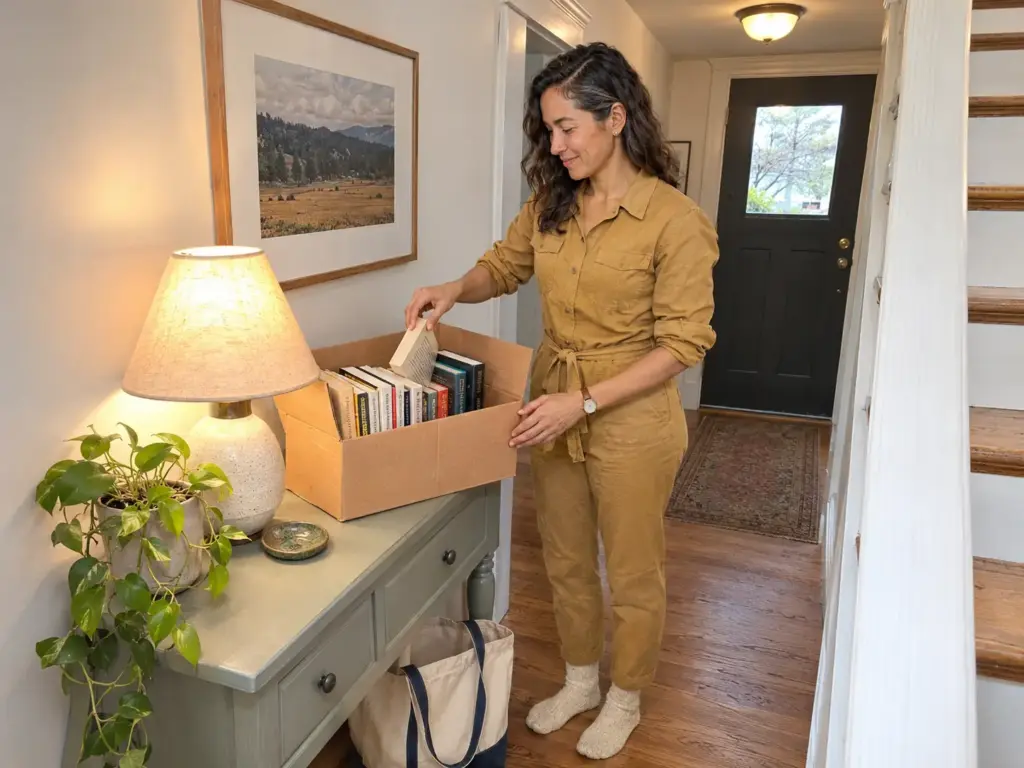
What holds an idea is a ceiling per spot, a number of books it is allowed to hold, and a reset date. Keep the weight load honest too: heavy hardcovers low, light paperbacks high, and nothing heavy on top of a loaded tall bookcase.
Owner, Renter and Large-Room Versions of the Same Idea
The same idea comes in different versions depending on who lives there. An owner can put up a stud-mounted deep run, a carpenter-built niche or an anchored divider. A renter works with freestanding, no-drill furniture, meaning a tower, a bench or a divider with the landlord’s yes, plus a stack with a home, and at most a stud-hole run patched at move-out.
A large room gets a wall of books and a divider that cost no floor. A small apartment gets the tower and the island end, and every row there has to work. For small living rooms that need pieces to earn their floor, the furniture that earns its floor in a small living room guide is the reference.
The Version That Costs Nothing
The cheapest creative book storage ideas start with fewer books. Cull first, because what stays decides what the spot has to hold. Borrow from the library instead of buying what you will read once, since a library loan leaves the house on its own when it is due.
Pass finished books on through a Little Free Library box or a donation, and use the ledge or niche the house already has. The question of where the culled books actually go has its own page, what to do after decluttering so the pile leaves.
Here is the whole inventory in one place, with a verdict for each.
| Placement | Who it suits | Verdict | What to watch |
|---|---|---|---|
| Stud-mounted deep run | Owners, large rooms | Do it | Heavy books low, studs only |
| Round rotating tower | Renters, small rooms | Do it | Anchor where the base allows |
| Stack on a side table or ledge | Everyone | Do it | A ceiling of a few books |
| Island end of cookbooks | Kitchens with an open end | Do it | Only books you use, far from the cooktop |
| Anchored divider | Owners, large open rooms | Do it with conditions | Anchor it, and ask the landlord if renting |
| Stair ledge or niche | Owners with a carpenter | Do it with conditions | Every shelf within reach |
| Color wall as the whole library | Nobody who searches | Skip | Titles found by memory |
| Packed fireplace | Nobody | Skip | No air, dust and damp |
| Run over the cooker or cabinet | Nobody with books they care about | Skip | Heat, steam and dust |
| Turned-spine library | Decor rows only | Skip | Every title hidden |
Give every display spot a written ceiling and a reset day. Taping a number to the underside of the shelf (eight books, say, or one stack of five) turns “it looks messy” into a count anyone in the house can check, and the count settles the argument.
Keep the upkeep short. Look at each spot once a season, check the stack against its ceiling, dust once, and return the strays to their home shelf.
Start With the Spot That Costs Nothing, Then Check It When the Season Turns
You do not need to build every idea in this guide, and most of them are not worth building. Pick the one that fits your home: the free wall if you own it and can reach studs, the corner tower if you rent, the island end if cookbooks are the pile. Give every stack a home with an edge, and move the delicate spot out of the sun and away from heat. A creative idea that fails the one-minute test or the temperature numbers is a skip, however good it looked in the photo.
At the end of the first season, look at the spot you chose and ask two plain questions: has it held its limit, and can you still find a title in a minute? If the answer to either is no, change the rule before you change the furniture.
For today, take whatever sits on the floor beside the bed and give it one edge of its own, whether that is the corner of a side table or a ledge in the hallway. Then notice, over the next few days, which of those books you actually reach for.
Frequently Asked Questions
01What are the best creative book storage ideas for a small space?
The best small-space picks are a round rotating tower, a deep shelf run on a free wall, and a stack on a side table with its own edge. A tower needs only about a 17-inch square of floor. Skip a color-only wall as your whole library.
02How do you store books without a bookshelf?
Use a bench, a side table with a shelf, a ledge the house already has, or a short stack with its own surface. Keep books off the floor, and give each spot a limit of a few books so it does not become an overflow pile.
03Can you store books in a fireplace?
Only a fireplace that is truly out of use, with the flue sealed and no heat from below, and only with air around the books. Keep the opening to the room, dust it like a shelf, and never pack it solid.
04How much weight can a floating shelf hold?
A floating shelf holds roughly 45 to 50 lb per wall stud it reaches, and only 10 to 25 lb on drywall anchors alone. A running foot of hardcovers weighs 10 to 15 lb, so a 3-foot shelf needs studs.
05Are creative book storage ideas bad for books?
Only the ones that sit in sun, over heat, in damp or leaning. The Library of Congress calls 70°F or below and 30 to 55% relative humidity safe for most books, with no direct light and shelves that are flat and solid.
Disclaimer: ClutterlessNest is a participant in the Amazon Services LLC Associates Program. As an Amazon Associate we earn from qualifying purchases. This article may contain affiliate links — if you buy through them, we may earn a small commission at no extra cost to you. We only recommend products we have tested or genuinely believe in.