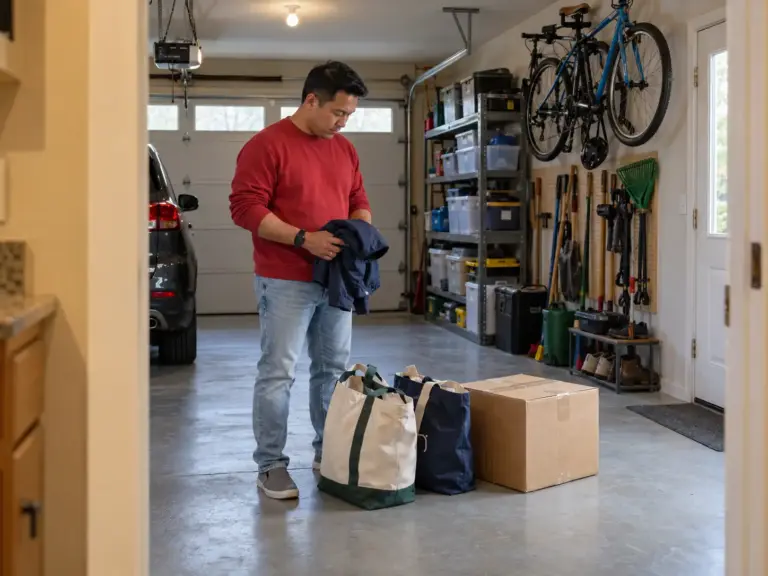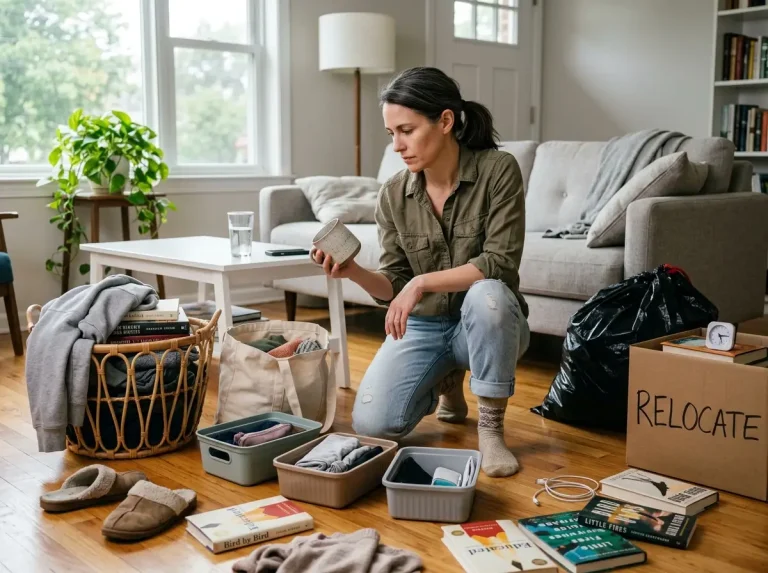

The bags are tied, the boxes are taped, and the pile has moved from the bedroom floor to the corner of the hallway, where you now step around it on the way to the kitchen. Knowing what to do after decluttering is its own job, separate from the cull, and it stalls for a plain reason: a pile with no destination and no date has no reason to leave. People who finish a big purge describe the same stall in the forums, a donation bag riding around in the garage for three or four weeks before it reaches a drop-off door. Below, every pile gets an exit, a place to wait that fits your home, a date, and a gate that keeps the room from refilling.
Quick Answer
The after-step runs in this order, and every pile in it gets a date.
- Sort every pile into an exit: trash, donate, sell, give away, or keep elsewhere.
- Give each exit a destination and a date before the bag is full.
- Box the doubtful items and write a review date on the lid.
- Take the trip and ask for a receipt that names the items.
- Hold off on organizers until the edit is done.
- Lock the intake with a one-in-one-out gate at the door.
Why the Pile Stalls After Decluttering

A Bag With No Date Waits
The bag was tied on Saturday and it is still by the door three Saturdays later. A bag with no destination and no date has no reason to leave, so it sits, and each time it gets nudged aside to vacuum, the decision behind it goes a little staler. One commenter in an r/workingmoms thread keeps a donation bag in the garage for three to four weeks before it goes to Goodwill, and that stretch is the typical shape of the stall.
The pile by the door is a second pile. It is made of things you have already decided about that are still in the way, which makes it more annoying than the first pile, because the first one at least was waiting on a decision.
The cause is short: nothing was ever assigned an exit. (Bags also get reopened for one more look at a sweater, and every reopening restarts a decision that was already finished.) The mechanism is what needs fixing, so everything below works on it.
Shared Items Need a Sign-Off
Some of what sits in the pile is not yours to send. In shared homes the stall often starts with one person who will not let go of items while the other is overwhelmed by the size of the heap, and the pile drifts to the garage and gets forgotten. Anything that belongs to a partner, a child or a parent cannot leave on one person’s decision, however tidy the logic looks from where you stand.
A workable rule from those same threads gives the other person a review window of one week to one month, after which the donate pile goes. That window is a partner sign-off date, and it gets written on the pile like any other date. If the disagreement runs deeper than a deadline can fix, decluttering with a partner who holds on to everything covers the zone agreements and the limbo box that make a deadline hold.
When the Outflow Becomes the New Clutter
Where the pile waits changes how it fails. In a large house it goes to the garage or the basement, lands in front of whatever was already there, and disappears behind the next thing someone sets down. In a small home the problem is the opposite: one poster in a small-house thread says there is no “put it in here and close the door” place, so the pile stays in view and the whole room feels unfinished.
Even a tidy storage box can turn into the new pile. In the four-box method, the box set aside for storage is the one that ends up with no destination and no review date, and a year later it is the thing you step around. The fix for all three versions of the stall is the same: an exit, a place to wait, and a date.
Sort Every Pile Into One of Five Exits

Trash and Recycling Leave First
If you have worked room by room through one of the decluttering methods that work past the first week, the floor is covered with piles and the next job is deciding where each one goes. Five decluttering exits cover everything: trash and recycling, donate, sell, give away, and keep elsewhere. Each has one test, and you run the tests in that order.
Broken, stained past use, or missing pieces goes out first. These items have no second owner, so each day they stay is pure cost, and they are the easiest win on the floor. Take that bag to the outside bin the same hour, not to the trunk with the donations, because a trash bag riding in the car with donation bags is how the wrong bag gets dropped at the wrong door. Recycling gets a day on the calendar as well, since the bin that is already full does not take a second load.
Donate, Give Away or Sell
Usable and easy to replace goes to a donation or a giveaway. Usable and still wanted by someone goes to a sale (a Facebook Marketplace listing, say), but only if the effort is worth it, and the effort is the part people misjudge (messages, photos, a pickup window). The temptation on a floor full of piles is to label everything donate because it feels kinder than deciding, and the result is a donation bag that holds a blender with a cracked jar. The sell vs donate call comes down to condition, item type and time: how good the item is, how easy it is to move, and how many weeks you are willing to spend on it.
Clothes are the easiest place to test the rule, and the resale check for clothes walks through it against a clock. Donations and sales each get a short paragraph in this guide, because each is a whole subject of its own. The point here is the decision: every usable item gets one of the three exits and a date, and you do not move to the next pile until the last one has both.
Keep, but Relocate
The exit people forget is the item that stays but leaves this room. The spare lamp goes to the garage shelf, the board games go to the other bedroom, the winter coats go to the hall closet. Keep means the item has a home. Relocate means it has a different home than the one it is in now.
The test is naming the shelf. If you can say which shelf in which room the item is going to, and that shelf has space today, it is a relocation. If you cannot, it is a pile with a nicer name, and it goes back to the sort.
Set Up a Holding Spot That Fits Your Home
The Small Apartment: A Door Bag and a Booked Trip
In a studio or a one-bedroom there is no room for a staging area, and a rental rules out shelving that needs a drill. What works instead is a bag by the door and a trip on the calendar. The bag stays closed, sits against the wall next to your shoes, and has a day written on it: the Saturday you will put it in the car. Once the bag goes into the trunk the same day, the car trunk becomes the holding spot until the drop-off, so the drop-off gets a time too.
If donations will keep coming, a standing donation bag stays at the door, keeps clutter creep from restarting, gets filled as items are decided on, and leaves when it is full or when its date arrives, whichever comes first. Nothing here needs hardware, which is the point.
The Large House: A Dated Bay, Not the Garage Corner
A house has the opposite problem. The garage and the basement storage have room, and room is how a pile gets forgotten. The better holding spot is a dated bay: one marked section of floor or one shelf, with a strip of painter’s tape on it that carries the review date. Anything in the bay on that date leaves, whatever it is, because the bay’s job is to hold things that are waiting for a trip, not things nobody wants to decide about.
Keep the bay near the door you use and out of the path of the lawn mower. A bay at the back of a deep garage lands behind the next project. And the objects in front of it make the trip harder than the stop, which defeats the purpose.
The Free Box First, the Bought Bin Second
The first container is the one you already own: a cardboard box from a delivery, a laundry basket, the bag the new shoes came in. It costs nothing, it goes straight out with the load, and it does the whole job for a pile that is leaving this week. Real Simple suggests a concealed donation bin, which works if there is a spare nook near the dining table. The poster in the small-house thread has no such nook, so the door bag is the answer there, and the bin is for the home that has the corner.
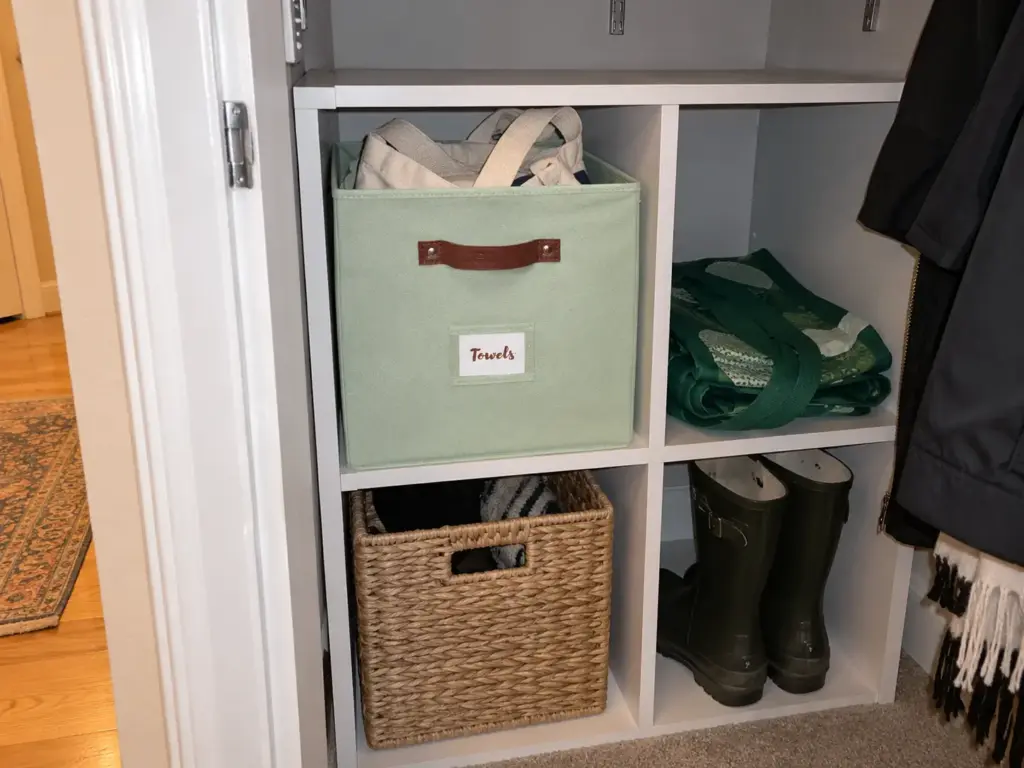
A bought box earns its place only for a dated box that has to live inside a closet.
For that job, Fabric Storage Bins with Labels (Set of 6, Collapsible) fits an 11-inch cube shelf at roughly 10.4 by 10.4 by 11 inches, has a label holder on the front for the date and the destination, and folds flat when empty, which keeps the extras out of the way. The set is on Amazon. The walls are thin, and the bin sags if kids climb or sit on it, so it holds soft things such as clothing and linens and stays off the floor in a house with climbers. The listing says the handles hold up to 11 lb, which is the seller’s claim, so keep a loaded bin light enough that you could lift it with one hand.
Write the trip date on the bag with a marker before you set it by the door. A date you can see every time you walk past gets kept far more often than a date that lives in your head.
Give Doubtful Items a Dated Box
Replaceable Things Leave Now
Two popular pieces of advice disagree here. The DIY Playbook’s 10-day checklist says to donate immediately. Nourishing Minimalism says to box the item, date it, and release it if nobody asks for it within six months. A commenter in the r/workingmoms thread sits between the two, holding the bag for three to four weeks.
You are standing in the middle with a pile of maybes, and the useful question is not how long to hold before donating but what it costs to be wrong.
The rule that settles it is reversibility. If an item is easy to replace, it leaves now, because the daily cost of a waiting bag is higher than the small regret of needing one again. If it is hard to replace or tied to a person, it goes into a dated box with a review date, and the box leaves if it has not been opened by then.
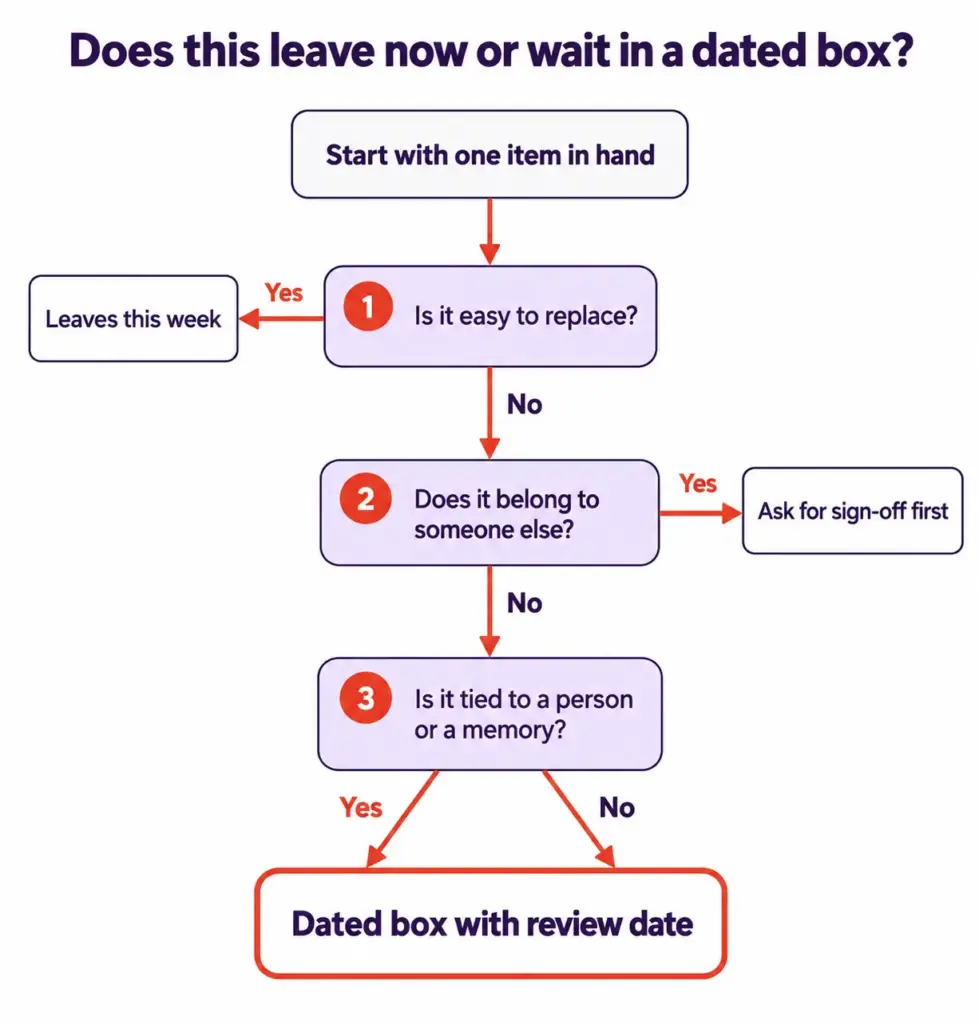
Easy to replace means you could get another with little effort and little money, and you would not mind doing it. A second spatula, a phone charger for a phone you no longer own, the third set of sheets. Those do not earn a box, and their regret, if it comes, is small and short. The waiting bag costs you every time you see it.
Hard-to-Replace Things Wait in a Dated Box
The dated box is for what you could not easily get back: out-of-print books, a gift from someone who will ask about it, tools that cost real effort to find again, anything tied to a person. Items that belong to someone else follow the same rule, with the sign-off date from the first section as the review date. The box is closed, labeled, and put somewhere you walk past rarely, and on the review date you open it only to answer one question: did I reach into it?
The length of the wait scales with how reversible the item is. A few weeks suits something you could re-buy at some cost. Up to six months, the outer limit one minimalism blog uses, suits things with real weight attached. (And a longer date than that is usually a sign the item belongs in the keep pile with a proper home, not in a box that will be forgotten.)
Writing the Review Date on the Box
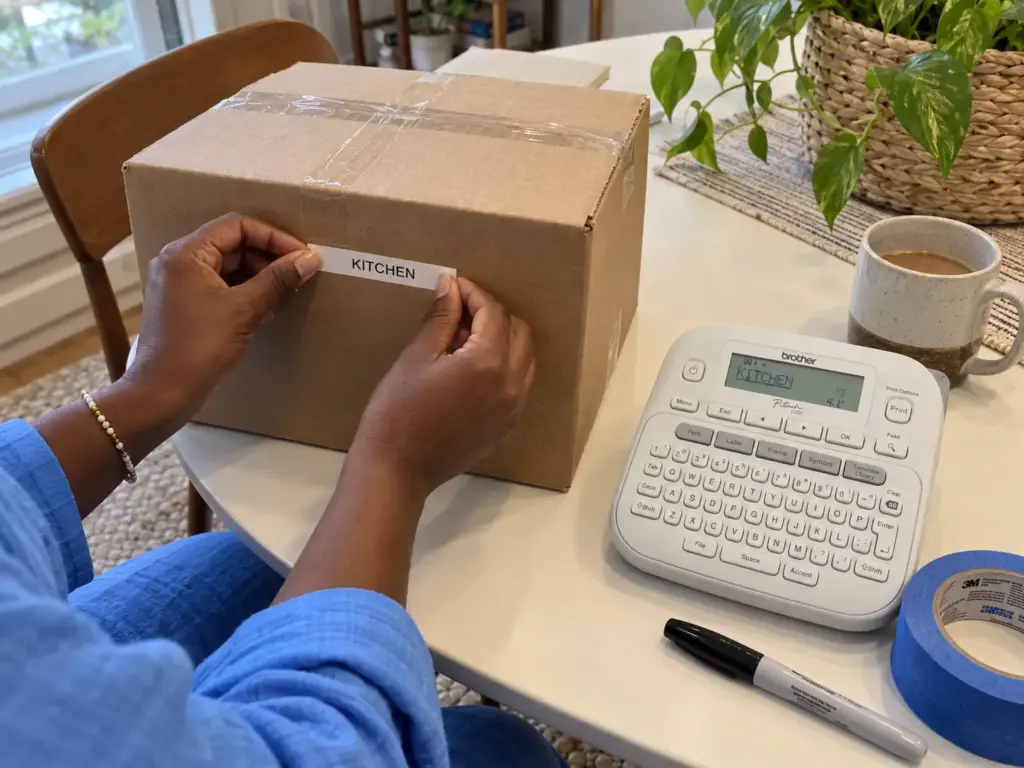
The label has three things on it: what is inside, the date the box was filled, and the date it leaves. The date is the point. A box without one is just a smaller pile.
The free option is a marker and a strip of painter’s tape across the lid. The tidy version is a label maker, and the Brother P-Touch PTD220 Label Maker prints the fill date and the review date in a clean line you can read from across the closet. The PTD220 is on Amazon. Tape jams are a common complaint on label makers in this class, though less frequent on newer models, and stock on this one runs thin at the moment, so if the listing shows no ship date, the marker and tape do the same job.
Book the Drop-Off Trip Before You Fill the Bag
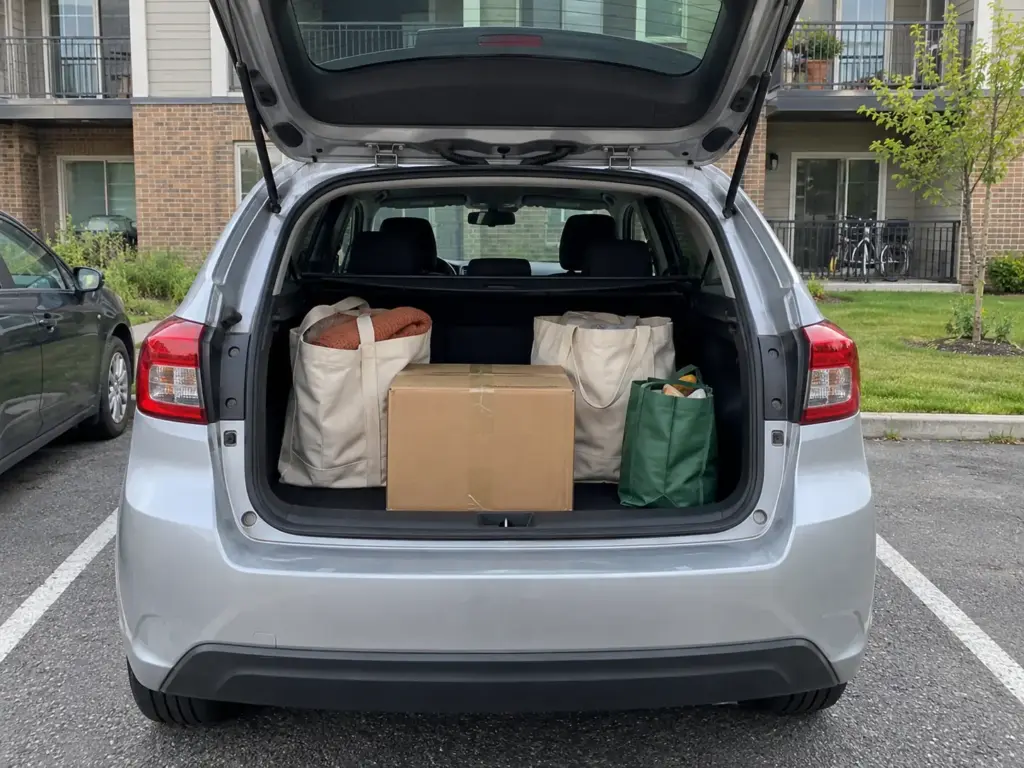
Put the Trip on the Calendar
Fix the date before the bag is full. A bag has a trip; a box has a review date. The trip gets a day, a time window and a place, and it goes in the same calendar as the dentist, because anything that lives only in your head loses to the first busy week. Give each discard a named exit before the bag is closed, so the trip is a single stop and not a tour.
If the load is bigger than the trunk, split it into two dated trips instead of one trip you keep postponing. The first trip carries what is already bagged, and the second carries what is still on the floor. A load that is too big for one afternoon does not get done in one afternoon; it gets done in two, and the second one needs its own date.
Put the drop-off stop on a route you already drive, like the way to work or the grocery store. A trip that needs its own errand is the trip that gets postponed.
Ask for a Receipt That Names the Items
For a big load, ask for a receipt before you leave. Under the IRS’s rules for charitable contributions, any contribution of $250 or more needs a written acknowledgment from the charity. The IRS’s written-acknowledgment rules say the acknowledgment describes non-cash items but does not state their value. The receipt reads something like three bags of clothing and a lamp, and the dollar figure is your own estimate, kept in your records.
A non-cash deduction above $500 also requires Form 8283 with your return, so keep a list of what you took.
The same page has a line that matters for the hand-me-down pile. According to the IRS’s rules for charitable contributions, “Gifts to individuals are not deductible.” Handing the sofa to a neighbor is a kindness, not a deduction, and only a drop-off at a qualified organization counts. For anything beyond these basics, a tax preparer is the right person to ask.
Check Kids’ Items for Recalls Before the Trip
Baby gear and kids’ items carry one extra step. According to the Consumer Product Safety Commission’s resale campaign, “Re-selling recalled products is a violation of federal law.” The agency asked resale stores to check for recalls before selling, which makes the donor’s check a courtesy that saves the store a step.
Find the model number on the tag or the underside of the item, and search it against the agency’s recall list before you load the trunk. A crib, a car seat, a high chair and a stroller are the usual suspects, and the number is usually printed where the hand never goes. Five minutes at the kitchen table beats an item that gets pulled off a shelf.
Sell, Give Away or Donate: A Quick Rule

When Selling Is Worth the Effort
Sell an item only if three things are true: it is in good condition, it is easy to ship or to hand over at a pickup, and you will answer messages within the week. Miss one, and a giveaway or a donation is the faster exit. Selling feels like the thrifty option. But a listing that sits for a month, with the lamp on the hall table waiting for a buyer who stopped replying, costs more in attention than the lamp was worth.
Put a deadline on the listing. If it has not sold by the date, the item goes into the donation bag, and nobody gets to renegotiate with the listing. The date again is what stops the pile from growing back as an online store.
When a Giveaway Beats a Donation Bin
A giveaway is the no-cost exit, and it is often the fastest. Buy Nothing groups and free-pickup listings put the item in front of someone who wants it, and the person who collects usually takes it the same week. It suits bulky things a donation center may not want to haul, and anything a neighbor can carry out in one trip.
The free exit comes first for budget reasons too: no listing fees, no shipping box, no time spent bargaining. Each of the three exits has its own page of detail, and this section is the short rule. If you are working through the aftermath of a decluttering challenge that has just ended, the same three exits apply to whatever the last week produced.
Handle the Piles That Don’t Fit an Exit

Paper Gets Its Own Stop Line
The paper pile after decluttering is neither trash nor donate nor keep, and that is why it ends up in a folder on the counter. Its exits are shred, scan and file, and each needs a stop line: a point past which nothing new is added until the pile is cleared. Without it the pile comes back, because mail arrives every day and your decision does not. Paper clutter and how to stop it coming back goes through the sorting in full.
Sentimental Items Need a Smaller Box
Sentimental items are the pile that no rule can sort for you, so the container sets the limit. One small box, with a size you can see, holds the things that matter. When it is full, something comes out before something goes in. The box is the limit, not your willpower, and willpower is the thing that gave out on the third photo album.
The dated box from earlier applies here with a longer review date. A dated maybe box for books works the same way for shelves of paperbacks nobody has opened in years.
Gifts and Hand-Me-Downs That Keep Arriving
Some of the pile never stops arriving. A relative drops off a bag of old toys, a friend passes along a coat, and there is a box of someone’s things in the closet again.
Ask the giver once, kindly, what happens if the item does not fit, and set the gate before the item enters your home. The intake gate is covered below. What comes in without a gate becomes the next pile.
Hold Off on Buying Organizers Until the Edit Is Done
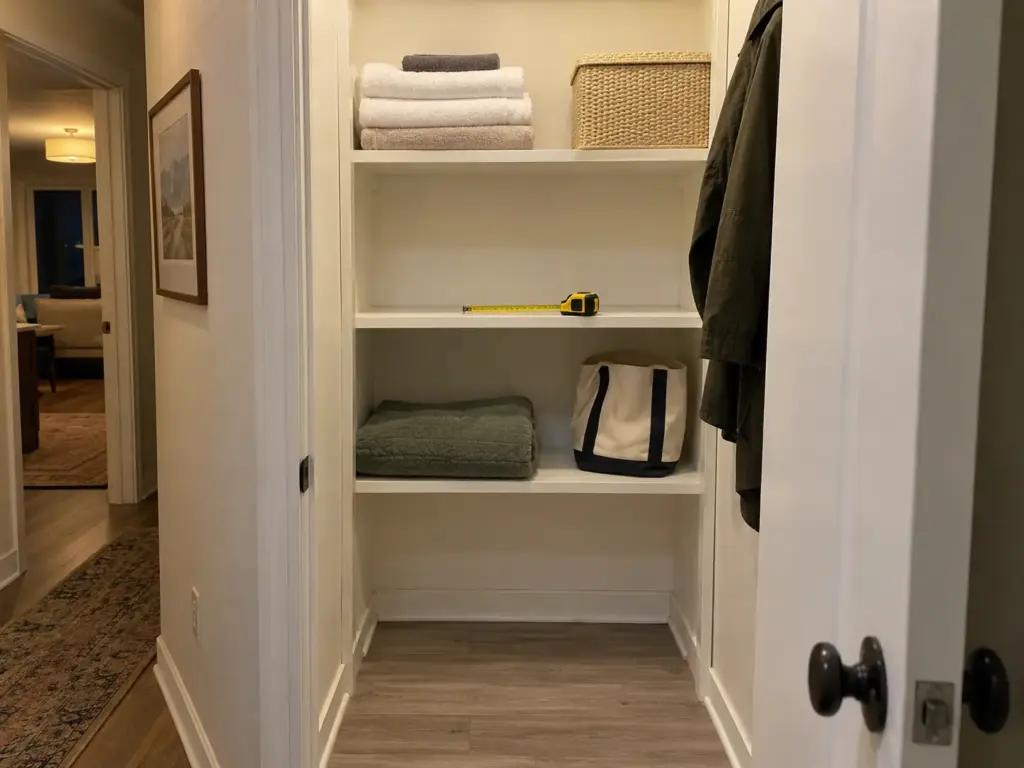
Empty Space Is the Result
After a good cull the shelf is half empty, and the next thought is to fill it with matching bins. One Reddit commenter put the trap plainly: “buying MORE products will never solve the too much stuff problem.” Nourishing Minimalism agrees and tells readers to wait before buying bins.
The empty shelf after the edit is the result you wanted, and the leftover space is not an invitation. Minimalist home organization without the bin trap goes deeper on why the bins come last.
Measure the Gap, Then Buy
Wait a few weeks, live with the new layout, and see what still has no home. Then measure the exact shelf: height, depth and width, and the exact item the system has to hold. A bin sized for the shelf you imagined sticks out past the frame on the shelf you have. Don’t buy organizers first; the budget order is the same as everywhere else in this article: the free box first, the bought one only for the job the free one cannot do.
Lock the Intake So the Room Stays Clear

One In, One Out
Once the room is clear, the new things arriving are what refill it. One-in-one-out is the rule for the place where the item lands: a new jacket comes in, an old jacket leaves. The number is not fixed, though. The rule everyone quotes is one in one out, but in a space that is still overfull, one in two out is the better call, because a one-for-one swap only holds the clutter where it is.
The rule has a known failure point. Why the one-in-one-out rule stops working by month three comes down to a missing staging place, because without one the old item has nowhere to wait, and the swap never happens. A renter’s staging zone with a seven-day deadline fixes that, and so does the holding spot from earlier in this article.
Where the New Thing Waits at the Door
A shopping bag puts a new jacket on the bench before the old one has left. The new thing waits at the door, next to the old thing it replaces, and the old one leaves on the next trip. If the old item cannot be named, the new item waits a few days before it comes in.
The test for the old thing is the 90/90 rule: has it been unused for 90 days, and do you expect to use it in the next 90? If both answers are no, it is the item that leaves. The rule works because it asks about use, not about whether you like the thing.
Keep the replaced item in the entry for the week, bagged and dated, with the new item’s receipt tucked inside. The two arrive together and they leave together, and the receipt doubles as the reminder.
Keep a Schedule and a Daily Surface Reset

The Seasonal Pass
A decluttering schedule that lasts is a full pass twice a year, with a drop-off at the end, and a smaller monthly drop in between, a cadence Real Simple suggests. It fits the calendar better than a once-a-year purge, because by the second pass the pile is half the size. Pick two dates you already notice, such as the clock change or the start of school, so the pass does not depend on remembering it. When you are ready for the next pass, start with decluttering by item type and work category first, one at a time.
The Two-Minute Surface Reset
The kitchen counter gathers mail, keys and one mug each evening, and by Friday it is a pile. A daily reset takes a few minutes: counter, table, entry bench, each cleared back to bare. Anything that does not belong goes where it belongs, and the outflow goes into the holding spot. How to keep surfaces clutter-free breaks the habit into steps you can finish before the kettle boils.
The counter is the surface that refills fastest, and kitchen counters that stay clear walk through the keep, relocate or toss decision for each thing on it. Decluttering maintenance only works if every object has an answer, so do the decision once and the nightly reset is just putting things back.
Every Pile Leaves With a Date Attached
Three rules carry the whole article:
- Each exit gets a destination and a date, so no bag waits for a mood.
- Doubtful items wait in a dated box, not in a pile, and the box leaves if it stays closed.
- A gate on what comes in keeps the room clear after the cull.
Look in the holding spot in three months. If it holds anything older than its date, the system is leaking, and the missing piece is almost always a trip or a sign-off. Tighten that one thing and look again.
Today, take a bag you already have, write a date on it, and put it by the door. Then watch what the date does: you will notice that the bag stops feeling like a decision you owe and starts feeling like an errand you have scheduled.
Frequently Asked Questions
01How long should I keep a donation bag before dropping it off?
Keep a donation bag only until its trip date, ideally within the week, because bags with no date tend to drift for weeks. Items that are hard to replace belong in a dated box instead, with a review date on the lid.
02What should I do with decluttered items I’m not sure about?
Put items you are unsure about in a labeled box with a fill date and a review date, and release the box if you have not opened it by then. Easy-to-replace items should leave now. Shared items need the other person’s sign-off first.
03Do I need a receipt for decluttered items I donate?
For any contribution of $250 or more you need a written acknowledgment from the charity, and a non-cash deduction above $500 also needs Form 8283. The receipt describes the items but not their value, which is your own estimate. See the IRS’s rules for charitable contributions.
04How do I get rid of years of clutter without it piling up again?
Give every pile an exit, a destination and a date, then add a gate on what comes in so the room cannot refill. A one-in-one-out rule and a short daily surface reset keep the cleared space clear.
05What is the best thing to do after decluttering a room?
The best next step is to sort every pile into an exit and put a date on each one before you do anything else. Box the doubtful items, book the drop-off trip, then hold off on buying organizers.
Disclaimer: ClutterlessNest is a participant in the Amazon Services LLC Associates Program. As an Amazon Associate we earn from qualifying purchases. This article may contain affiliate links — if you buy through them, we may earn a small commission at no extra cost to you. We only recommend products we have tested or genuinely believe in.