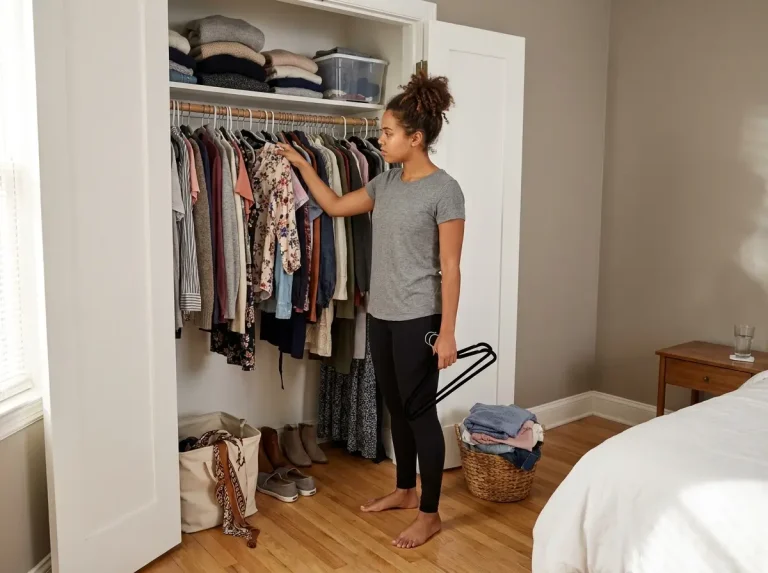

The bags have been packed for three weeks, and they have moved from the bedroom floor to the hallway to the trunk of your car without getting any closer to leaving. One person writing about this described the clothes as “out of the house and in the trunk of my car,” and called it progress, which it is, right up to the point where nothing moves.
Sorting is the easy half of how to declutter clothes, and the exits are where people in organizer posts and r/declutter threads get stuck. This guide is built around the decision and the door, and it picks up after the sorting steps in our guide to decluttering by item type, where clothes are one of seven categories.
Quick Answer
Declutter clothes by judging each piece against the same questions, then giving every pile a way out of the house.
- Sort one category at a time, easiest first, into piles that each have a spot.
- Run every piece through the same five questions, in the same order.
- Keep and rotate what fits the space; cut only when storage is over capacity.
- Check the resale price against your listing time, then donate the rest by a date.
- Put a date on the repair box and release whatever is not fixed.
- Write a short replacement list before you shop again.
How to Declutter Clothes One Category at a Time
Picture the whole closet emptied onto the bed at six on a Saturday. By nine you are sitting in a hill of sweaters with no idea which ones you already judged, and the bed still has to be slept on. A bed works as a sorting surface for exactly one evening, and it is also a deadline, which is why this section keeps the job small enough to finish before it gets there.

Start With the Category That Costs You Nothing to Cut
Work the easiest category first, starting with the pieces nobody argues over: socks with a hole, stretched-out tees, the shirt from a race you do not remember running. Move up to tops and pants, and leave outerwear, formal clothes and anything with a story for last. Every quick decision builds the speed you will need when you reach the coat that cost too much. Cutting a dozen pieces you never questioned also shows you how big the pile really is, which is more convincing than any rule.
You do not need to pull everything out all over again here. The edit with three piles that goes with it is in the walkthrough for a closet with too many clothes, and this guide picks up from the piles.
Piles That Already Have a Place to Go
Every pile needs a physical spot before the first piece lands in it. Keep, donate, trash and repair each get a spot: a hook for anything heading back to the closet, a paper bag by the door for the donate pile, a trash bag for the toss pile, a box on a shelf for repair, and one box for the maybe pile. A pile with no spot is where the decision stalls, because now you are deciding about the piece and about where it lives, and the second decision usually wins.
The labeled-pile system is the one in the four-box decluttering method, and its main warning applies to clothes too: the maybe box is a single box, never a second pile growing on the floor. (A pile on the floor is a decision postponed with a view.) The dated version of that box lives in our guide to decluttering by item type, so it is not repeated here.
Sort In-Season First and Leave the Rest for Its Own Pass
Start with what you wear now. The off-season clothes get their own sitting, judged against their own season (the seasonal section below covers that), because a summer dress looks different in October than it did in June, and a parka looks best in the one week you are cold. Mixing both in a single session is how a three-hour job turns into a six-hour one that you quit halfway through the winter pile.
Write the destination on the donate bag before you fill it, with the drop-off date next to it. A bag that already says where it is going is much harder to leave in the hallway than a bag that says nothing.
The Questions That Settle Each Piece
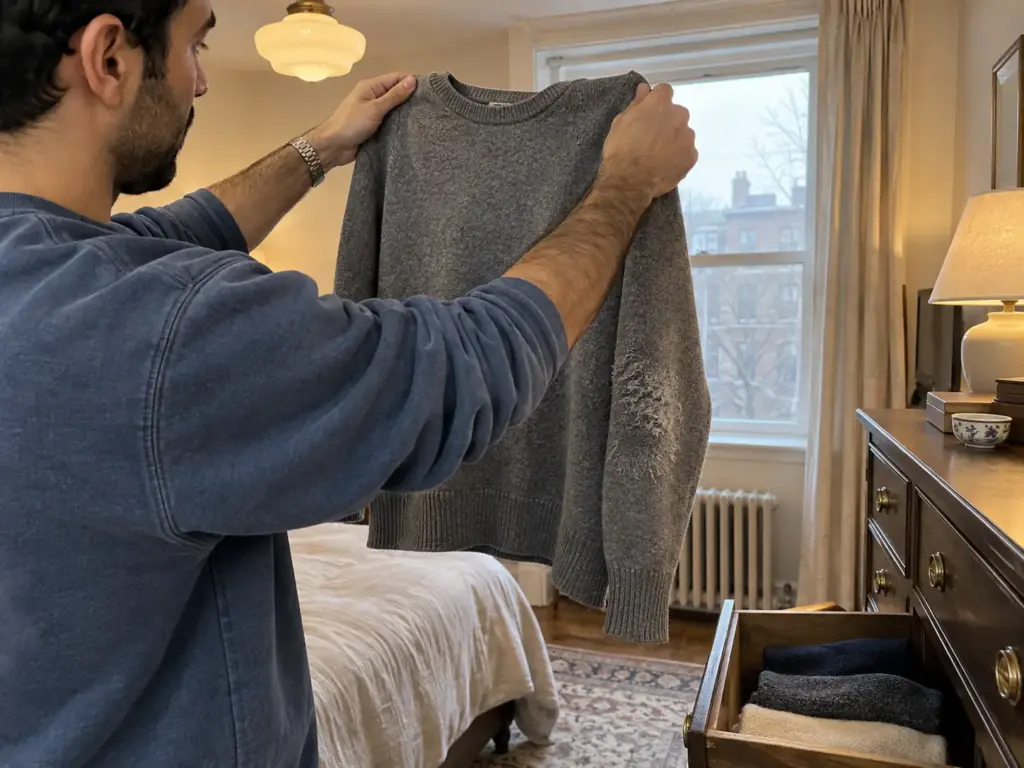
You can hold a sweater for ten minutes (the piece in your hand is the worst place to negotiate) and still not know. The questions are rarely the problem; the order and the stop rule are. A fixed list, asked in the same order every time, turns a mood into a procedure, and you stop negotiating with each piece separately.
Five Questions, the Same Five for Every Piece
Ask these in order, and stop at the first clear no. Have you worn it recently? Does it fit today, without a shove or a hope (try it on, because the dress that fits in memory does not count)? Is it in good enough condition to wear out of the house?
Would you buy it again, right now, off a rack? Does it still feel like you?
A Quora answer sorts clothes with a flowchart built on the first of these, asking whether you wore the piece in the past three months. Together the five make a test you can run in one sitting.
The 90/90 test and the three-month test are the same move with a different window: worn in the last three months, and likely to be worn in the next three. For the piece that fails every window, Martha Stewart’s guide gives a plain limit, which is that clothes unworn for about two years can go, even with the tags still on. The tag is a record of the purchase, and the purchase is already done.
The Doubtful Pile: Why You Stall and the Rule That Unsticks It
Sooner or later a piece fails one question and passes the others, and you freeze, which is decision fatigue showing up in the middle of a sort. The freeze is the thing to solve, so give it a rule.
A piece that fails two questions leaves. A piece that fails one goes into the single maybe box. A piece that passes all five stays, and you do not ask again. Nothing sits in your hand while you think.
If a piece still will not settle, the backward hangers test in the closet guide above settles it with evidence instead of mood. If the stalling is bigger than one pile, if you cannot start at all, our page on how to declutter when overwhelmed is for that reader. A pattern that keeps turning up in r/declutter threads is the person who judges each piece alone, finds every one of them fine, and ends up with a closet full of fine. The questions only work when you also look at the rest of the rod.
The “Fits Someday” Pile
The fit someday pile is a case of its own: clothes that do not fit today but might. The dated box in our guide to decluttering by item type handles it. Keep that one box, give it a date, and do not let it grow into a second wardrobe.
What to Do With Clothes You Paid a Lot For
You know the coat is wrong. The cut is off, the color pulls at your face, and it has hung there for four winters. You keep it because of what it cost, and the sentence in your head is “it was expensive.”
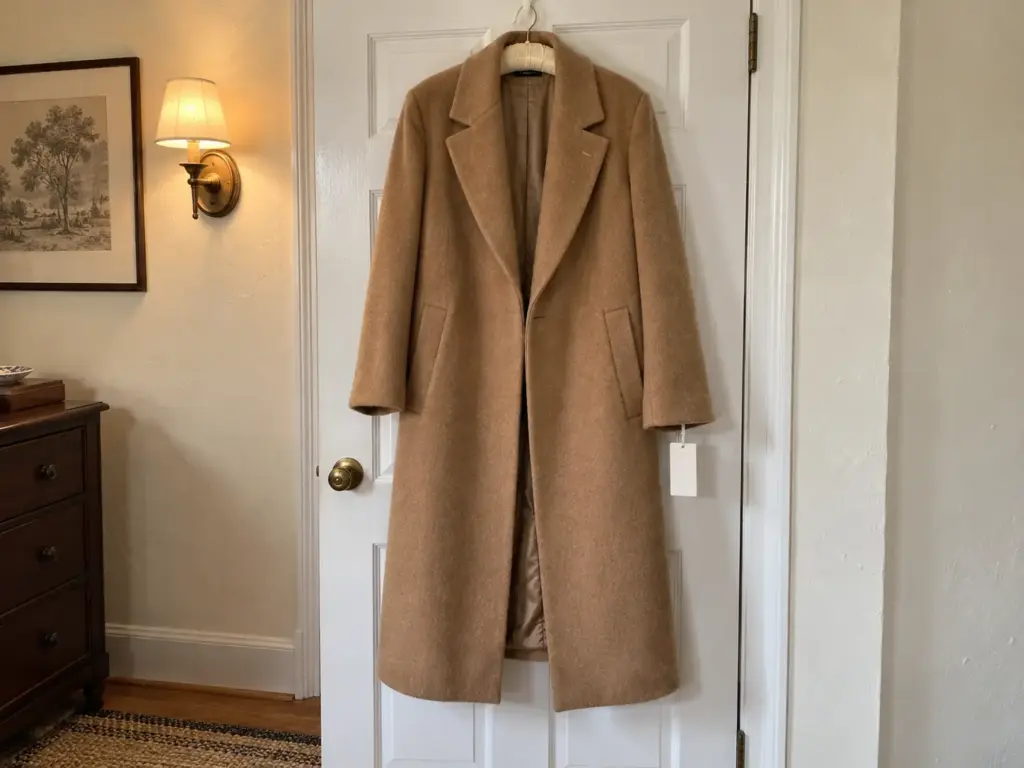
That is sunk cost talking, and it settles nothing about whether the coat belongs in your closet. Expensive clothes are the hardest to cut because every piece still carries its receipt.
Why the Price Tag Keeps Its Vote
Gillian, writing on the uncomplicatedspaces Substack, gives the reason in one line: the endowment effect is “when a person places more value on an item simply because they own it.” That is why the sweater a stranger would pay a modest price for feels like it is worth far more while you are the one holding it. The buyer does not share that feeling, and the gap between your number and theirs is why so many pieces never get listed.
A post in the wardrobe archive of NAPO’s Greater Philadelphia chapter names what sits under the pile: “even when someone commits to trimming their wardrobe, there is one item they want to get rid of but ‘can’t!’ … what’s really behind their ‘can’t’ is guilt.” So “can’t” is a feeling, not a fact, and the way to let the guilt go is to turn the question into one about rod space. The cost has been paid whether the coat stays or goes. What the coat still costs you is rod space and the time you spend choosing around it.
One r/declutter thread has a version of this from a reader who kept pricey clothes in case of a weight change and had no energy left to sell them. Another thread describes the same trap from the other side: the brain defends a decision after it has been made, which is why the cull needs a rule rather than a mood.
Letting Go of the Gift and the Piece With a Story
A gift from someone you love and a jacket from a year you miss are not sunk-cost problems. They belong in a sentimental pile of their own, and they need different handling, which our page on how to declutter sentimental items covers. For clothes, the short version is that a photo of the piece, taken before it leaves, keeps the memory without the rod space.
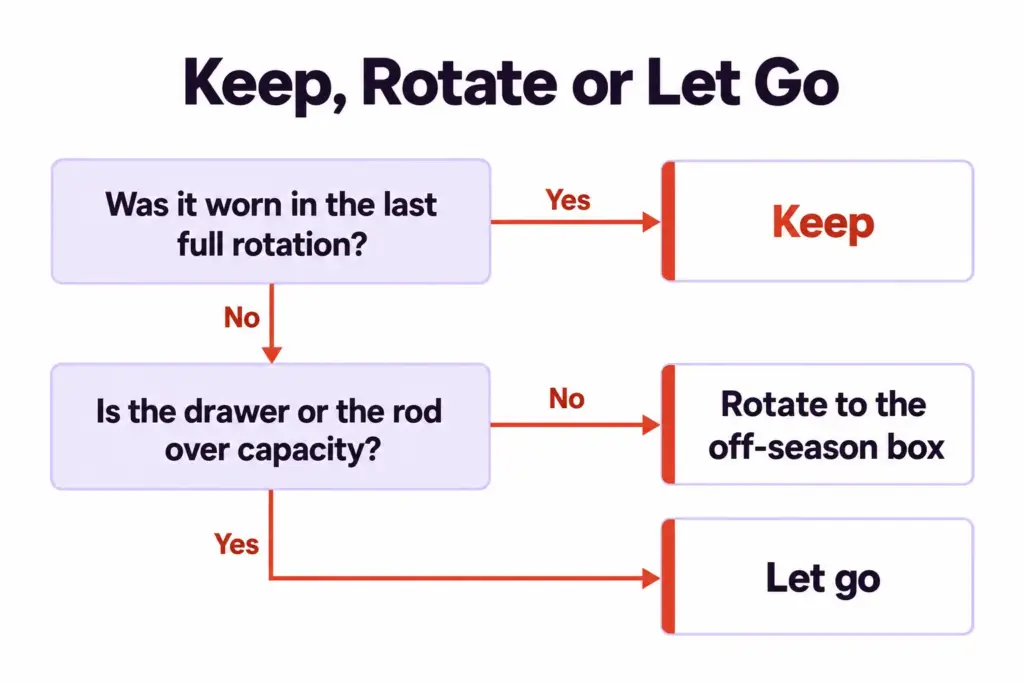
Do You Even Need to Cut? Keep, Rotate or Let Go
One r/declutter thread on exactly this topic comes from a reader whose clothes are all good and all fit, and who still has too many. The replies were about capacity and rotation, including a commenter who said you are “not obligated to get rid of your things.” If that is you, a cull is the wrong tool, and a decision rule is the right one.
When “I Like Everything” Is a Capacity Problem, Not a Taste Problem
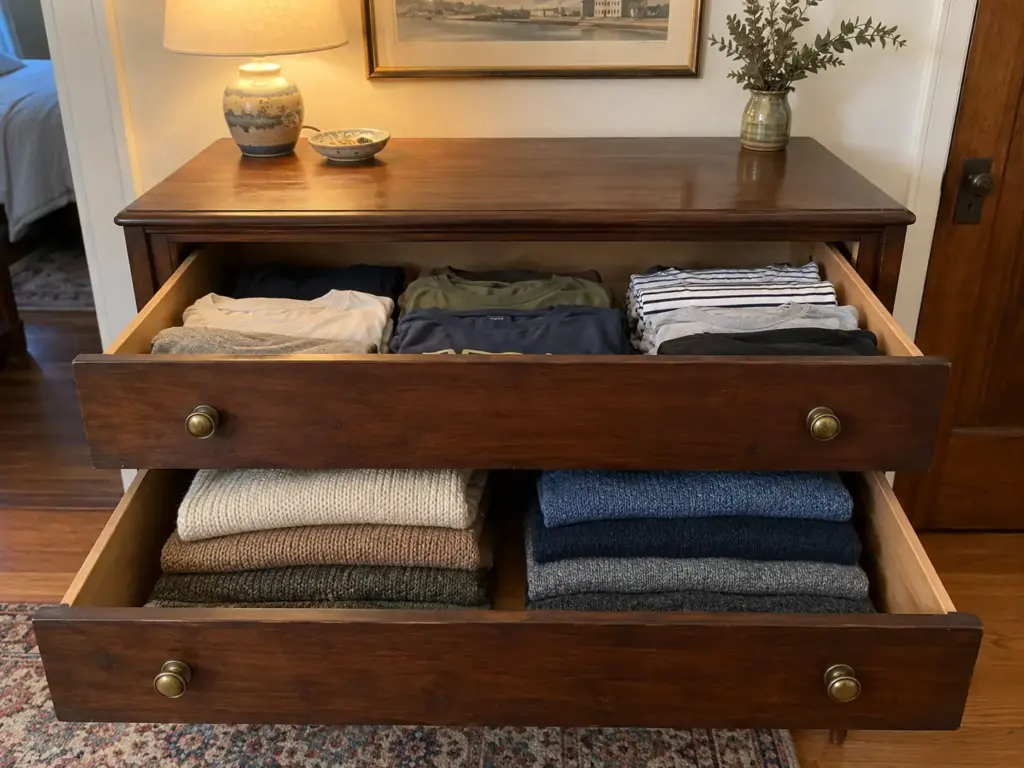
Taste has nothing to do with it. You like everything because you chose everything, and the closet rod and the closet space are a fixed size. One commenter described a closet with more than fifty nearly identical black slacks, which took five truckloads to Goodwill. Nobody in that story had bad taste; the closet simply held more than any person could rotate through.
So the practical question is whether the space is full. If the drawer closes without a shove and the rod slides, nothing has to go, and any guilt about owning “too much” is borrowed from somebody else’s idea of enough. Capacity belongs to your storage, not to a guilt number.
The Rule: If It Fits the Space and Gets Worn in Rotation, It Stays
Fill the space you have set aside for clothes with your favorites and let the rest rotate on a schedule, which is the shape the answers in that thread arrived at. Keep what you wear and rotate the rest: a piece that reaches the front of the rotation and gets worn is doing its job. A piece that never reaches the front is the cut candidate, and you find out which is which by moving things, not by thinking about them. The mechanics of that live in the seasonal closet rotation system, so use that page for the how and this one for the verdict.
When Rotation Stops Working and a Cut Is Due
A cut is due when two things are true at once: the storage is over capacity, and a particular piece has not been worn through a full rotation. One without the other is not enough. A full drawer of pieces you all wear is a storage problem, and a piece nobody has touched in a year, in a closet with room to spare, is not hurting anything yet.
In a shared closet the capacity is smaller and the rule stays the same, which is why the arguments in a two-person closet are about space and not about taste. If two of you are working from one rod, how to organize a shared closet is the better starting place, because the cut has to be agreed before it can be made.
Test capacity before you test guilt. Close the drawer and slide the rod. If both move easily, put the guilt question away for now and put a date on the next check instead.
Sell, Donate or Toss: A Resale Check With a Clock
Selling is the exit that sounds smartest and finishes least often. One writer on the Substack put the whole failure in a sentence: “They just sit in bags until I finally decide to list them, but that time never comes.” The bags are not stuck because the clothes are bad. They are stuck because every listing takes a photo, a description, a price, a message thread and a trip to the post office, and none of it feels urgent.

The Price Check Before You List Anything
Check the resale value of a piece before you give it an evening. According to the Bank of America Institute’s April 2026 report on secondhand fashion, BofA Global Research found that “on average, pre-loved clothes sell for between 30% and 40% of their original retail price.” That is an average across the market and says nothing about your particular sweater, but it moves the baseline: you are not selling at what you paid.
The same report found that almost 73% of customers selling on secondhand marketplaces list items once a quarter or once a month, and it describes resale as “more often a closet clean-out than a true income stream for now.” The figure covers resale platforms only, not donation. So for most people the choice is closer to a clean-out than a side income, and the pieces worth the time are few: the recent, the expensive, the barely worn.
Those are also the pieces on a clock. In the NAPO Greater Philadelphia archive, organizer Kelly Galfand says it directly: “Waiting too long to resell something is not smart; the resale market pays more for recent purchases.” The pricey piece you are saving for later is losing ground every week it sits in the closet.
A Date on Every Bag: Sell for a Set Number of Weeks, Then Donate the Lot
The rule that follows is short. List a piece only when its price is worth the time it takes to list, and give the sell bag a date.
Make it a calendar date rather than a count of weeks (four weeks, say, though a count of weeks quietly renews itself). When the date arrives, whatever has not sold goes into one donation box for a single trip, as a batch, with no further decisions. Posters in r/declutter say that selling item by item never gets finished, and the batch is what removes the need for willpower on the tenth piece.
No Buyers Nearby: Batch to Donation and Let the Rest Go
Some readers have nobody to sell to. A rural poster in an r/declutter thread said exactly that, with good-condition clothes and no local market, and the usual ways to sell or consign (eBay, Poshmark, ThredUp, a consignment shop) all cost time that person did not have. For that reader, donation is the exit that costs nothing: a bag kept at the back of the closet and taken to a donation drop-off when it fills, or a donation drawer emptied each January, which is how one commenter ran their own system.
What Leaves the House and Where It Ends Up
Every bag needs a named destination before it is packed. The EPA’s own textile figures show why: textiles generated in 2018 came to 17 million tons, 5.8% of municipal solid waste, and “Landfills received 11.3 million tons of MSW textiles in 2018.” The recycling rate was 14.7%, or 2.5 million tons, and reuse is not counted in those figures. So the real exits are donation and resale, and a bag with no destination is a landfill bag with a delay.
The Repair Box Gets a Deadline
A repair pile starts with good intentions: a button, a hem, a zipper that sticks. Three seasons later it is a second wardrobe under the bed, full of pieces you cannot wear and cannot let go of. The deadline below is our own rule, not a study’s finding, and it comes from watching how a box with no exit behaves.
Why a Repair Pile Quietly Becomes a Second Closet
A repair box has no natural exit. A donate bag leaves when it is full, a trash bag leaves on trash day, but a repair box leaves when you decide to fix something, and that moment keeps being tomorrow. The box also looks virtuous, which is the trouble: it feels like a plan, so you stop treating it like clutter, and a few pieces turn into a whole season of them.
Two questions decide whether a piece belongs in it at all. Is the fix one you can do yourself in one sitting, a button or a hem, or one you would pay for? And would you wear the piece tomorrow if it were fixed? A no to the second question answers the first.
Keep this box apart from the “might fit again” box in our guide to decluttering by item type, which handles sizing; this one holds pieces that are broken, not pieces that are the wrong size.
A Date on the Lid and the Rule When It Arrives
The rule is a date on the lid. On that day every piece in the box is either repaired or released, with no new date and no “next month.” One sitting with a needle and thread clears most of what a box like this holds, and anything that still needs a professional gets a deadline for the appointment or leaves with the donation bag. It is the same mechanism as the dated bin for sizes: a date forces the choice that “someday” avoids.
Set one piece next to the sewing kit the day you add it to the box. If you will not touch it within the week, the box is not a repair plan, and that piece belongs in the donate bag.
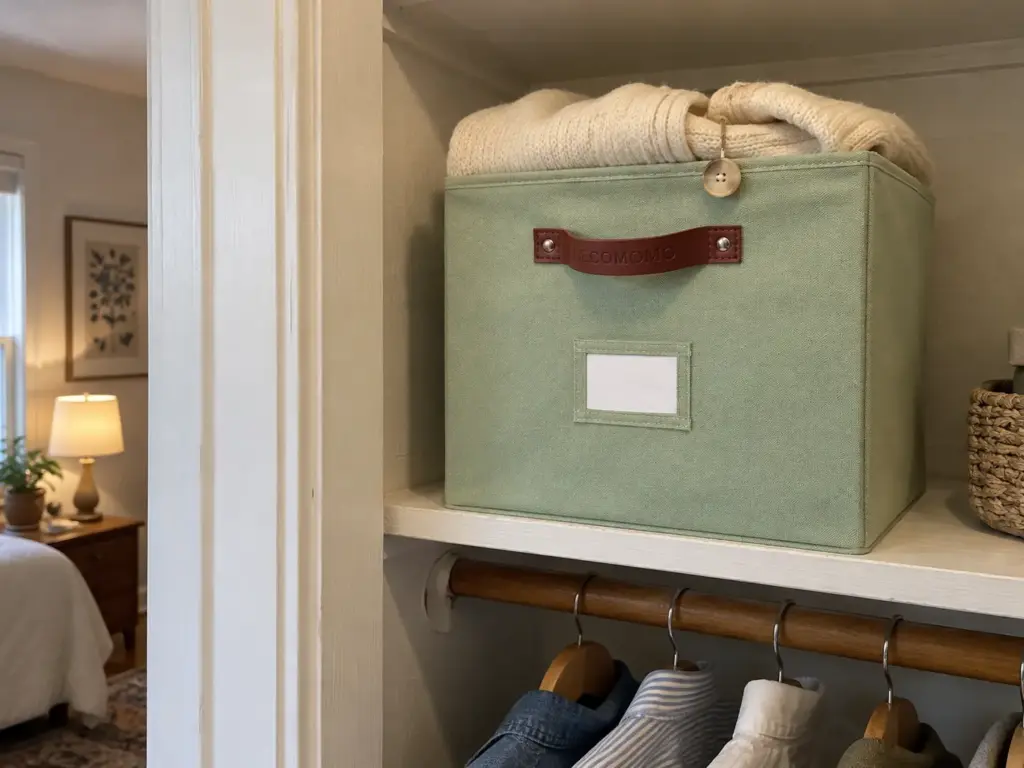
A Box That Fits the Pile: Free First, Then a Bin, Then a Label
The free option comes first: any cardboard box you already own, with the date written in marker on the lid. For most people that is enough, and a marker on a lid never wrinkles.
If you want a labeled bin that sits neatly on a shelf, Fabric Storage Bins with Labels (Set of 6, Collapsible) are 10.5 x 11 inch per cube, with a label holder on the front and a flat fold when empty. Several buyers describe a strong chemical smell from the fabric when the bins arrive, and a few say the walls are thin with no support underneath, so air them out for days before any clothes go in, and use them for light pieces like a repair box of shirts rather than as a dresser drawer for heavy knits.
For the date itself, a removable label comes off when the box is released, and Avery Removable Labels 6460 are 1 x 2-5/8 inch, 750 to a pack. One reviewer says they wrinkle when moved and re-stuck, so place each one once, and reach for the marker if you would rather skip them.
Seasonal Clothes: What Stays on the Rod and What Leaves
You sorted the summer clothes in April, and in October you find the winter coats were never touched. That happens when the off-season set is judged by the standards of the wrong season. The cleanest setup is two bars, one for winter and one for summer, so each set gets its own test.

Judge the Off-Season Clothes in Their Own Sitting
The off-season test is the same five questions with a longer window: worn at least once in the last season it belongs to. A coat that crossed two winters without leaving the closet gets the same verdict as a shirt that crossed two summers. You do not need a separate rule for it, only a longer look back. But that longer look back is the whole change.
What Earns a Spot in the Off-Season Bin
A piece earns its spot in off-season storage by passing the five questions and surviving one rotation. A piece that goes in one October and comes out unworn the next April has crossed two rotations unworn, and it goes. The dated box in our guide to decluttering by item type covers the date, and seasonal clothing storage for small spaces covers where the bin lives, which this page does not teach.
Kids clothes follow a different clock, because outgrown clothes are decided by size, not by wear. The page on organizing kids’ clothes by size handles that case.
Write the Replacement List Before the Closet Refills
A half-empty rod feels like a result. A month later it looks like an invitation, and a freshly cleared closet is the easiest one to refill, which is how clutter reverts. The gap you leave is the gap you shop for, so give the gap a plan.

Why a Clean Closet Refills
After a purge the closet no longer shows you what you own, and the missing pieces register as needs. The shopping trip that follows does not solve a problem; it fills an absence. A capsule wardrobe is one answer for someone who wants a fixed count, such as the Project 333 idea of 33 items for three months, though that page explains why systems like it tend to fail by month three.
A Short List of What You Actually Need to Replace, and a Pause Before You Buy
In Martha Stewart’s guide, professional organizer Lucy Milligan Wahl suggests making a list of items you need to replace, which she calls “a perfect excuse to hit a thrift store.” The list should be short, specific, and written during the purge, when you know exactly which piece you reached for and could not find. It names a missing piece, such as a dark pair of work pants, never a category such as “more tops.” Then add a pause between wanting a thing and buying it, a few days at least, because the list is the only thing that makes the pause mean anything.
One In, One Out, and the Date to Look Again
After the list comes the standing rule, the one-in-one-out rule, which one r/declutter thread calls the container method: anything new has to replace something, and what fits the space stays. That page carries the mechanics and the reasons the rule drifts. Put a date in your calendar three months out to look at the rod once more.
Keep the replacement list on a sticky note inside the closet door, not on your phone. You will see it at the exact moment you are tempted to buy something that is not on it.
The Bag, the Lid and the List: What Leaves This Week
Three things carry this whole job. The five questions settle each piece, and the single maybe box holds the doubtful ones, so no one pile stalls you. A resale check against the clock, plus one dated donation trip, sends the rest out of the house. And the repair box and the replacement list close the two doors a decluttered closet usually leaves open.
Look at the rod and the boxes again in three months: the repair box should be empty, the maybe box released, and the replacement list shorter than it was.
Today, pick the bag that has been waiting longest, write today’s date on it, and decide which door it leaves by: a drop-off, a listing with an end date, or the trash. Then notice how quickly the closet stops being the thing you think about.
Frequently Asked Questions
01What is the 90/90 rule for decluttering clothes?
The 90/90 rule keeps a piece only if you wore it in the last 90 days and are likely to wear it in the next 90. If not, it goes or enters the dated maybe box.
02How to declutter clothes without guilt?
Treat the price as already spent and ask only whether the piece earns its rod space today. Guilt usually sits behind the word can’t, so decide every piece by the same five questions.
03What is the 3-3-3 rule for clothing?
It is the name of a wardrobe challenge, and several versions circulate, so there is no single definition. The best-known relative is Project 333, which asks you to dress from 33 items for three months.
04What are the biggest decluttering mistakes?
The biggest mistakes are sorting everything at once and packing bags with no destination. Others are a repair box with no date and a purge with no replacement list, which lets the closet refill.
05How do you declutter when you have too many clothes?
Let capacity decide: if the drawer closes and the rod slides, nothing has to go. When storage is over its limit, cut what went unworn through a full rotation. See our guide to organizing a closet with too many clothes.
Disclaimer: ClutterlessNest is a participant in the Amazon Services LLC Associates Program. As an Amazon Associate we earn from qualifying purchases. This article may contain affiliate links — if you buy through them, we may earn a small commission at no extra cost to you. We only recommend products we have tested or genuinely believe in.