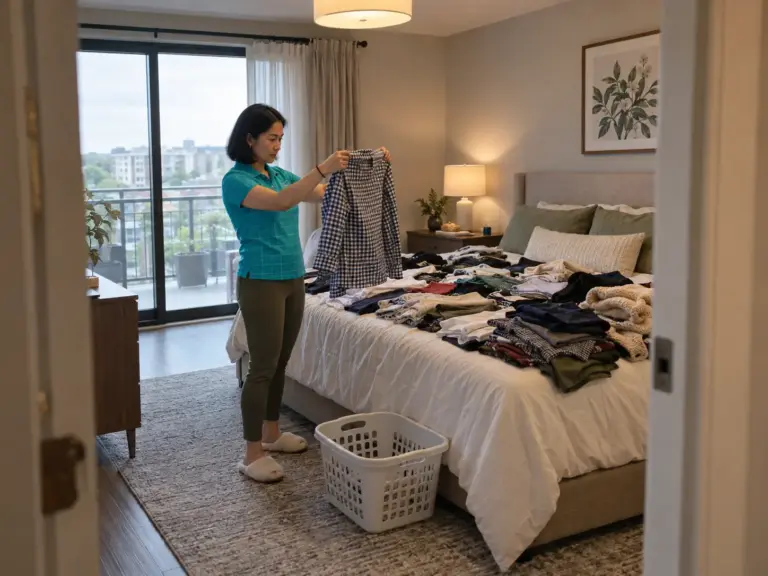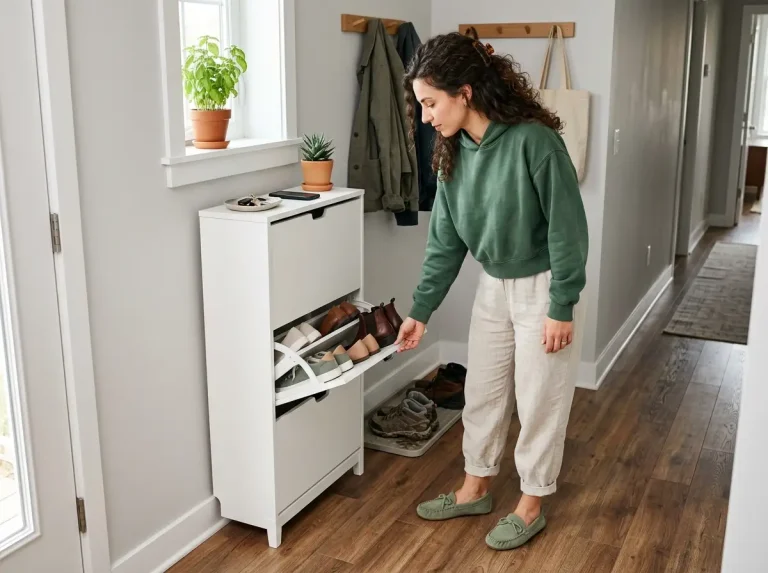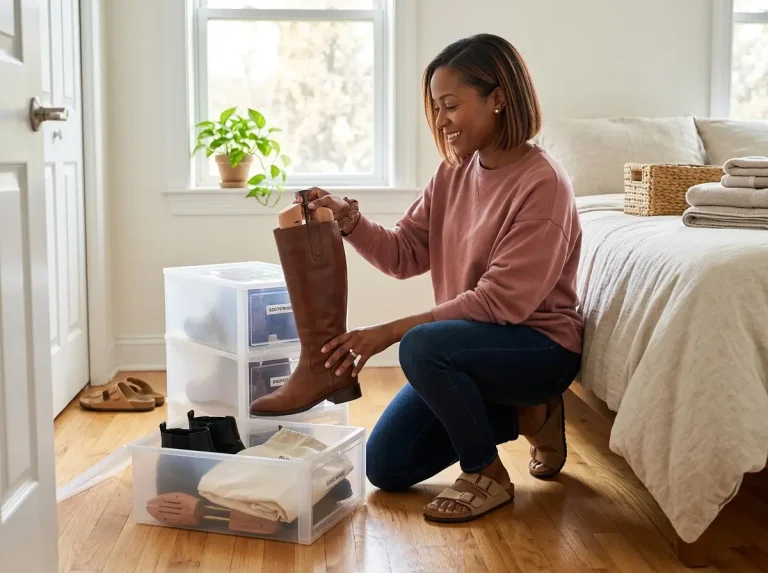
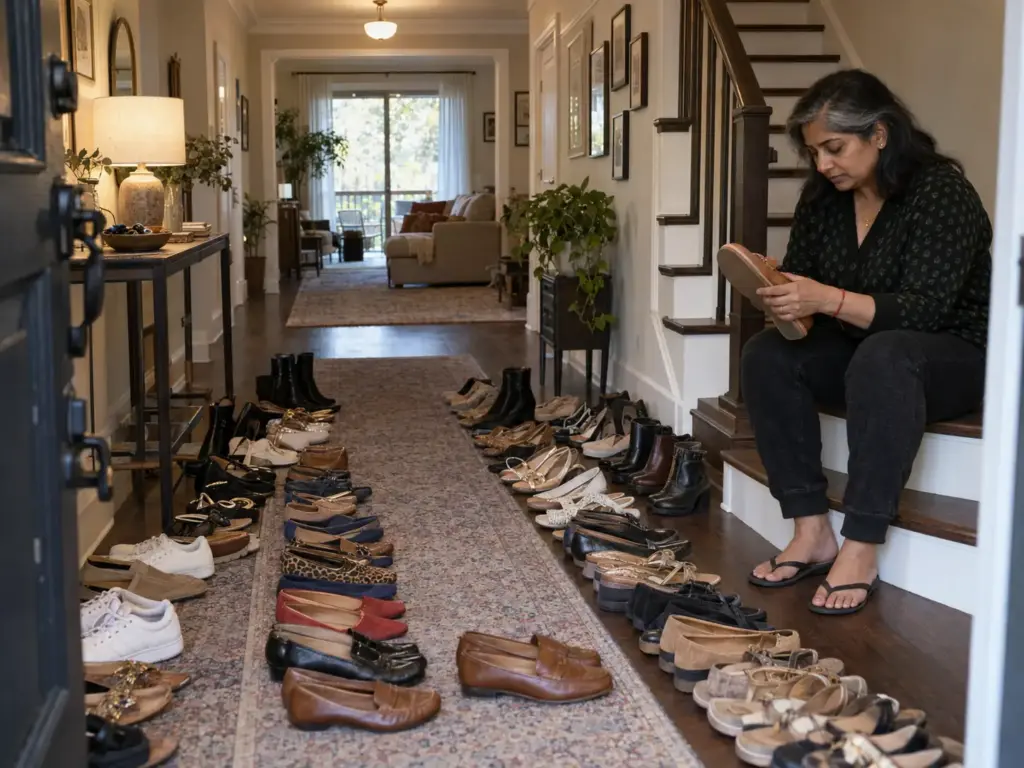
You pull a pair from the back of the closet to wear tonight, and the sole is not the material you remember: flaking at the edge, stiff as plastic, or already hanging off at the toe. A pair you stopped wearing feels safe where it sits, which is the belief that lets it stay. To declutter shoes you keep “just in case”, skip the feeling and run a short test, the one professional organizers publish and the r/declutter and Facebook decluttering threads keep reporting back on (the sole facts come from a footwear retailer’s guide and an environmental publication, named as we go). Shoes are one of the seven jobs in decluttering by item type, and this guide covers pulling every pair out, the wear test, the sole check, repair or release, where discards go, a count by job, a cut line by space, and what keeps the pile from coming back.
Quick Answer
Work through the pile in this order and every pair gets a clear yes or no:
- Pull every pair into one place and match the mates.
- Wear-test each maybe pair for a set time, with a date.
- Check soles and seams on pairs that have sat unworn.
- Repair only quality pairs with one fixable fault; release the rest.
- Set the keep count by job, not by a number.
- Pick each discard’s destination before the bag leaves the house.
How to Declutter Shoes by Pulling Every Pair Out First
Standing in the closet door, you are judging the pair you can see while four more live under the bed, by the back door and in a garage tote. Every decision gets made without the full picture, so everything “might still be needed”. The way out is to bring everything out first, then decide.
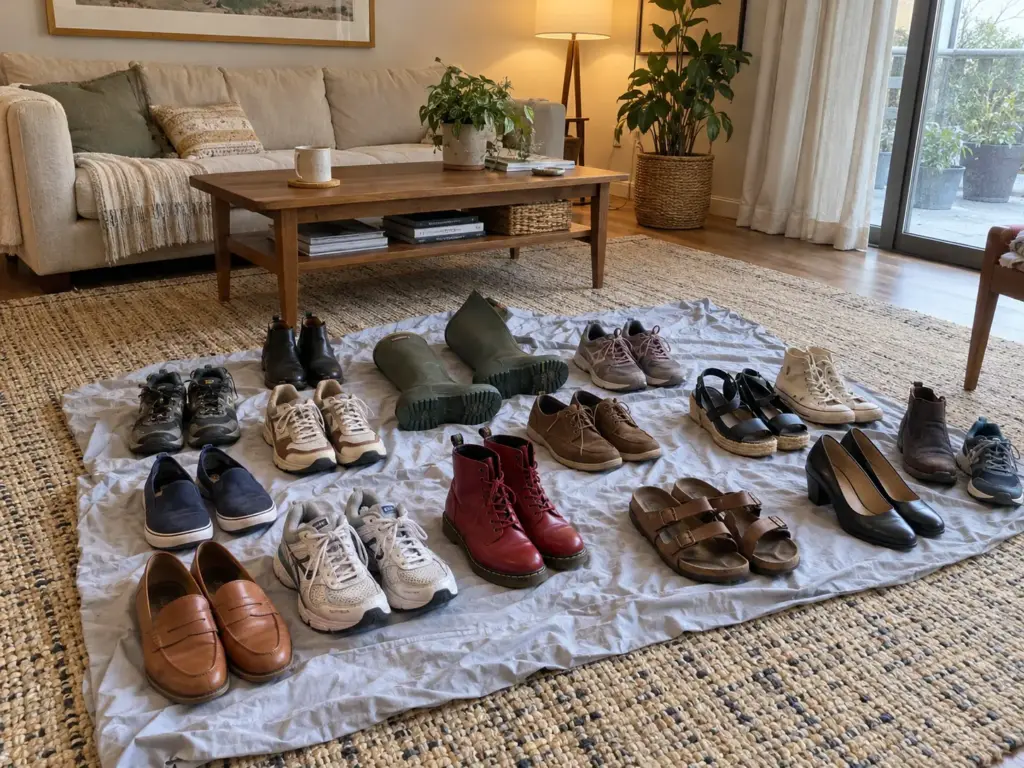
Gather every pair in one place
Carry every pair to one flat surface, a bed or a floor covered with an old sheet, and look at the total. Check the car, the hall closet, the mudroom and the bin on the garage shelf. A Facebook decluttering thread opens with the line that sums up the problem: “I have so many that I don’t wear but keep just in case and I don’t have the space for them.” The pile on the bed is the first honest number you will get.
Once the cull is done, the survivors need a home that fits them. The pair-count framework for storing what you keep covers that side, so this guide stays on the decision of which pairs leave.
Match the mates and park the singles
Pair every shoe with its mate. Singles go in a separate pile to wait for a partner, not into the keep pile by default, and an empty toss box beside the pile takes anything plainly finished. A single with no mate after the sort is a decision already made, and it saves you from carrying one boot through another year.
Sort the pairs you wear from the pairs you keep
A fair first filter comes from Martha Stewart’s home-care expert: a pair not worn in a year deserves the question of why.
Split the rest into two groups: the pairs your feet actually reach for, and the pairs that live on “just in case”. The second group is what the remaining sections are about. A commenter in an r/declutter thread described how it goes: every pair was cute, “I will wear this eventually” was the thought on each one, until a pair worn to work “were biting my ankles all day”. The next section replaces that thought with a timer.
Wear-Test the Maybe Pairs, and Tell Break-In From Plain Pain
You try a pair on in the bedroom, walk to the mirror and back, decide they are fine, and keep them. Fine for ten steps is not fine for a day. The blisters arrive on the first real wear, long after the decision was made, and by then the pair has earned another year on the shelf.
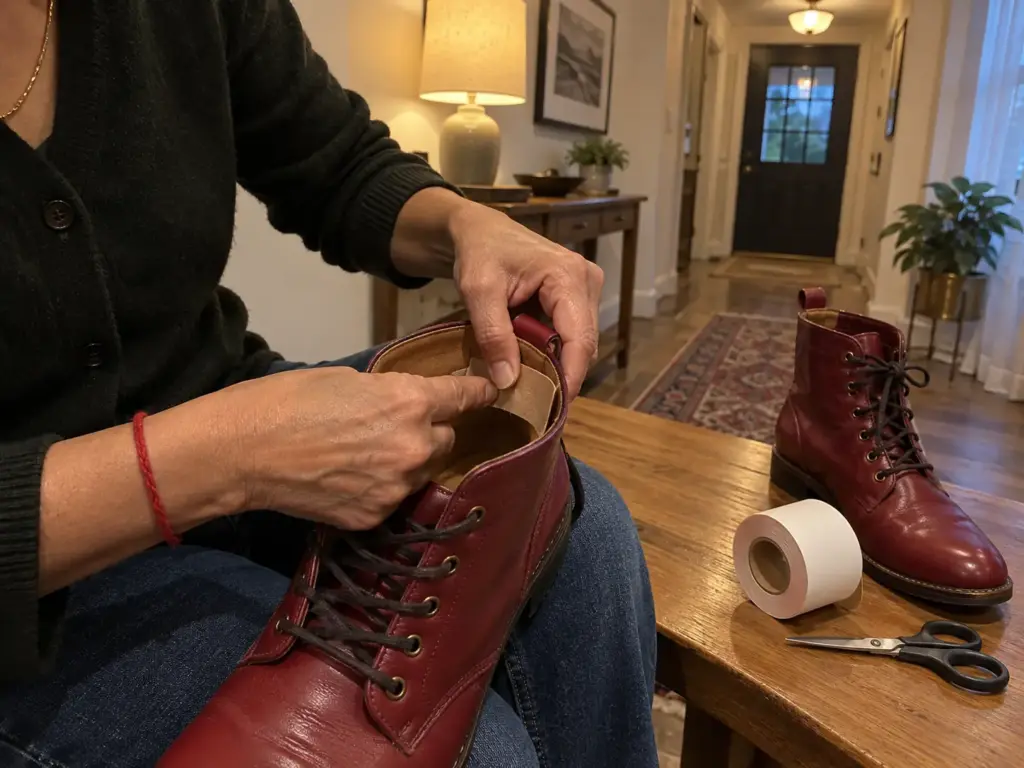
A dated commitment beats a quick try-on
Put the pair on and commit to a set time, thirty minutes or an hour. The original poster in the r/declutter thread set the bar plainly: “Even on a fancy occasion I do not want to be in foot pain after 30 mins.” Pairs that fail that bar are gone, in good shape or not, so uncomfortable shoes stop taking space for good.
A date makes the result stick. One commenter put a sticky note with the date inside each pair they wore. A pair of boots carrying a note from March 2021 went to donation, because the note made “I wear these” impossible to claim. Do the same: write the date you wore the pair, and write nothing on the pairs you skipped.
Break-in versus wrong fit: two tests
Here the sources do not agree, and the disagreement is useful. One professional organizer says there is no such thing as a break-in period. Another says some shoes do need breaking in, but pain from a wrong size is not that.
An r/declutter commenter says real leather needs purposeful breaking in, and a second commenter in the same thread gives the mechanism: breaking in is not stretching, it is the places that must flex becoming easier to flex, and sizing up to avoid blisters causes blisters. A third commenter keeps it short: “I don’t keep shoes that make blisters. If they don’t fit they go.”
Both camps are right about different pairs, so use a test that tells them apart. This one is a recommendation, not a finding from any of those sources. Pain that sits at a rub point (the heel, the ankle edge, a flex line across the toe) and eases over short wears is break-in. Pain in the toe box, under the arch, or all over, or a pair that feels the same on the tenth wear as on the first, is fit.
Stop the test at the first wrong-size sign. A pair that cramps your toes will not stop cramping on day six.
The stepped method and what to put on the rub spots
For a quality pair that passes the first test, the thread offers a stepped version, the 2-4-6-8 method for how to break in new shoes. A commenter said a boutique salesperson told them to wear new shoes for two hours, then on another day four, then six, then eight, spread over a week or two. The same commenter wraps rub spots with athletic tape, a technique carried over from dance, and wears a thin liner sock. Another commenter said moleskin or an adhesive heel guard on the inside of the shoe helped with stiff boots.
The free option comes first: athletic tape from the drawer does the job. If you want something that sits on the inside of the shoe where it does not show, the RadBizz Extra Durable Moleskin comes as a 2 inch by 5 yard roll you cut to fit the inner heel or ankle edge. The adhesive is the weak point. A recent reviewer called a reorder “very thin” and reported blisters, and an older reviewer said it would fall off, so check it holds on the first short wear before you trust it for the eight-hour step.
Run the stepped wear on the day you will be walking, not sitting. An eight-hour desk day tells you about the toe box; an errand day tells you about the heel and the flex line, which is where break-in pain lives.
A pair that still hurts after the stepped wear goes. A pair that passes keeps its place, and you know it survived eight hours without a problem.
Check the Soles Before You Keep a Just-in-Case Pair
Shoes are not sweaters. You assume a pair that is not worn is not wearing out, and the pair sits fine on the shelf for three years. Then it comes apart on the third step of the one day you need it.
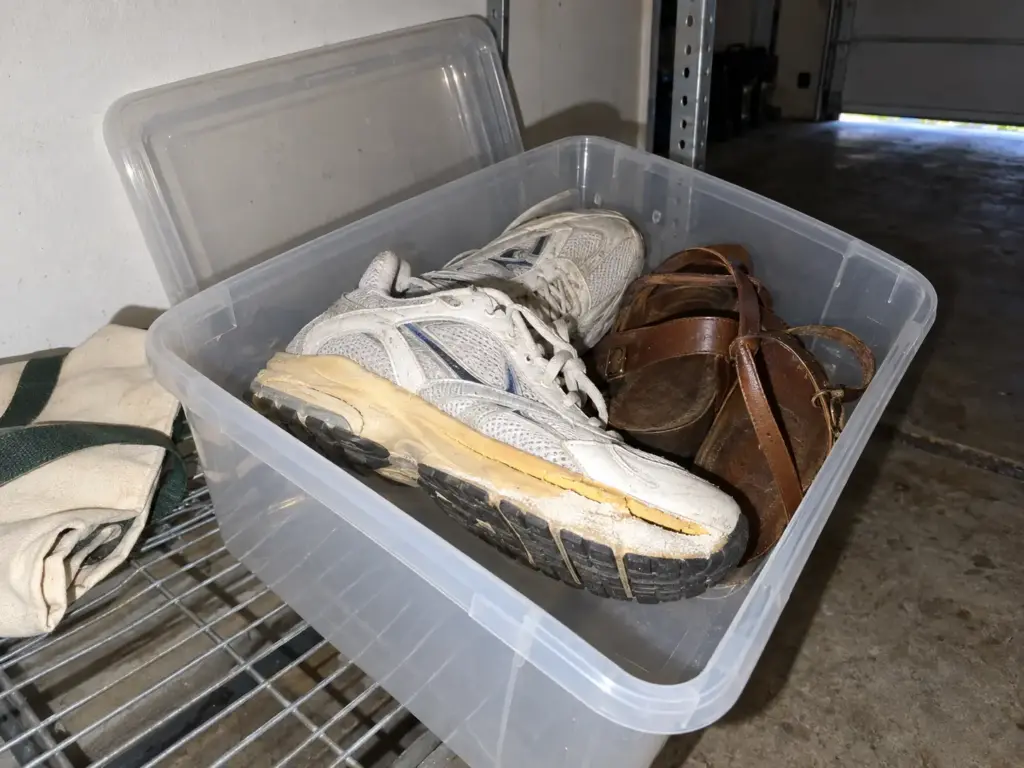
Why glue and foam age on a shelf
An r/declutter commenter put the failure in one line: “Shoes can fall apart in storage! The glues and rubber soles degrade and you can finally have that moment to wear them and they will disintegrate when you walk three feet.” Another bought a pair years earlier, never wore it, and found it disintegrating on the first real wear, which pushed them to try on every pair and keep only the favorites.
Another commenter, who said they were no expert, noted that stitched soles are the older and pricier construction, and that glued soles are the cheaper route that rots over time. A Facebook commenter had sandal straps break on the way to a wedding because the glue had dried out. A commenter described a pair of vintage Vans bought on eBay whose sole came detached after an hour of wear.
The retail and materials guides explain why. Fleet Feet says the glue usually degrades first, even on a shelf. Its advice is to start wearing running shoes within roughly six to twelve months of purchase. That window is for running shoes, so do not stretch it to every pair you own.
Impakter’s explainer on sole failure adds the chemistry: polyurethane soles break down with ambient humidity (hydrolysis) even when stored in a place that looks dry, rubber hardens, yellows and cracks with air and sunlight, foam midsoles flatten, and adhesives fail with heat and moisture. A pair doing nothing is still on a clock. It just does not feel like it.
A three-minute condition check
Take each pair that has sat unworn, judge its condition with the same five checks, and run them in order:
- Look at the sole edge and the seam for peeling or a gap.
- Press along the sole edge and look for powdery residue, a polyurethane warning sign.
- Flex the toe and look for cracks at the flex point.
- Look at rubber for yellowing, or a stiff, plastic feel.
- Press the midsole and note whether it springs back or feels flat.
A pair that fails any one of these goes to the repair-or-release decision in the next section. It is not a keep. A pair that passes is not automatically safe either, because the clock keeps running. Treat the check as a snapshot, not a certificate.
Foam-heavy shoes lose support with use, too, which is a separate kind of ageing. A commenter said a podiatrist told them most shoes last six months to a year when worn often, and that foam sandals lost arch support after two or three summers. That is a commenter’s report, not a medical rule, but it is a good reason to question the sandals you have been saving.
Do the sole check in the same sitting as the wear test. A pair that passes both gets its date note, and a pair that fails the sole check never needs the wear test at all, which saves you the blisters.
The counterpoint: some soles last longer when worn
None of this means every unworn pair is doomed. Impakter notes that polyurethane soles tend to last longer if worn occasionally, because flexing helps release trapped moisture. So for a pair that passes the check, the answer is to wear it, not shelve it. A just-in-case pair that never leaves the shelf is the worst of both worlds: it takes space and it ages faster.
Warm, humid places make everything above worse, and the storage side of the problem belongs to a separate guide: how to store the pairs you do keep so they do not mold.
Repair It, Release It, or Admit the Expensive Mistake
You hold a pair with a loose heel or a broken zipper and tell yourself you could fix it, and you have held it for two years. Repair is a real option. It is also the most common way a pair that will never be worn gets kept.
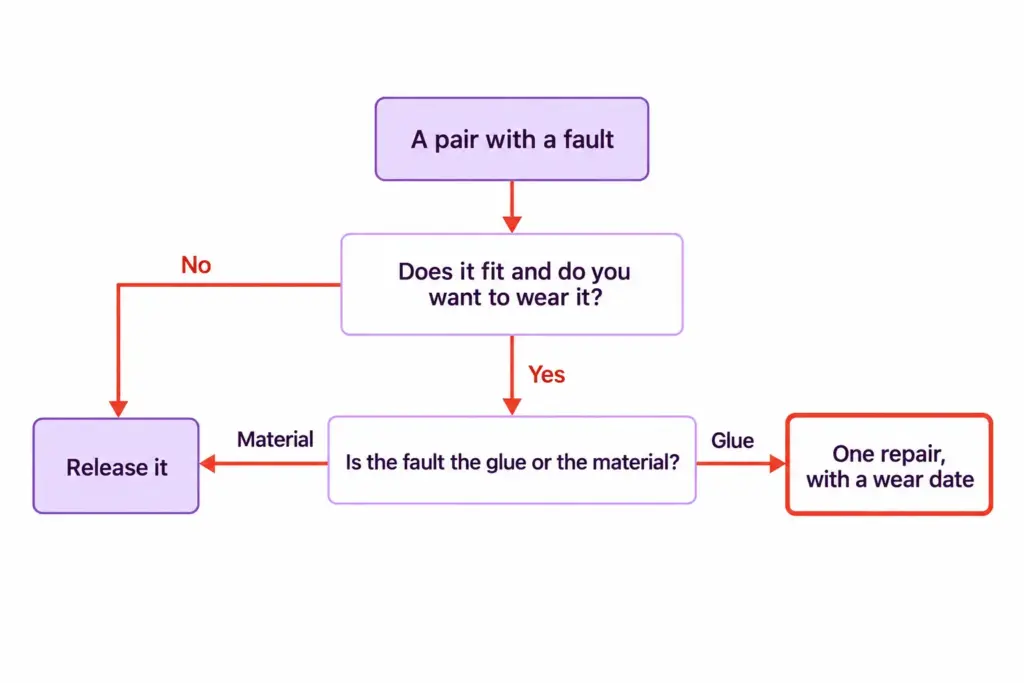
Is the repair worth it
A shoe repair shop earns its fee on a quality pair with one fixable fault: a worn heel or sole on a good leather pair, a broken zipper. Martha Stewart quotes a home-care expert saying that if a quality pair only needs a new sole or heel, repair is often the more sustainable option. A writer testing a decluttering rule for Apartment Therapy sends a boot with a broken zipper to the cobbler and says that if it comes back fixed and still goes unworn, it will be donated. That is a repair with a deadline, and the deadline is what makes it honest.
Release is the answer when the fault is the material. Per Impakter, a peeling sole is often just adhesive and can be re-glued, but a sole that has crumbled from hydrolysis or oxidation usually needs full replacement. An r/declutter commenter loved a pair, re-glued the sole repeatedly and consulted a cobbler, then stopped with “I’m not gluing these one more time”, unwilling to have it fail again halfway across town.
My rule, as a recommendation: one trip to a shoe repair shop, with a date to wear the pair after it. A second failure is the answer.
The expensive pair and the gift you never wore
Martha Stewart’s expert says to focus on the value a pair adds today, not on what it cost. If the pair is never worn it only creates visual clutter, and if it is in great condition but not your style, donate it so someone else can enjoy it. Gifted pairs follow the same logic, and the sunk cost of the price tag or the gift guilt fades once the pair is on someone who wears it. Sentimental shoes, the pair that stays because of who gave it or when you wore it, belong to a different question, covered in how to declutter sentimental items without the guilt.
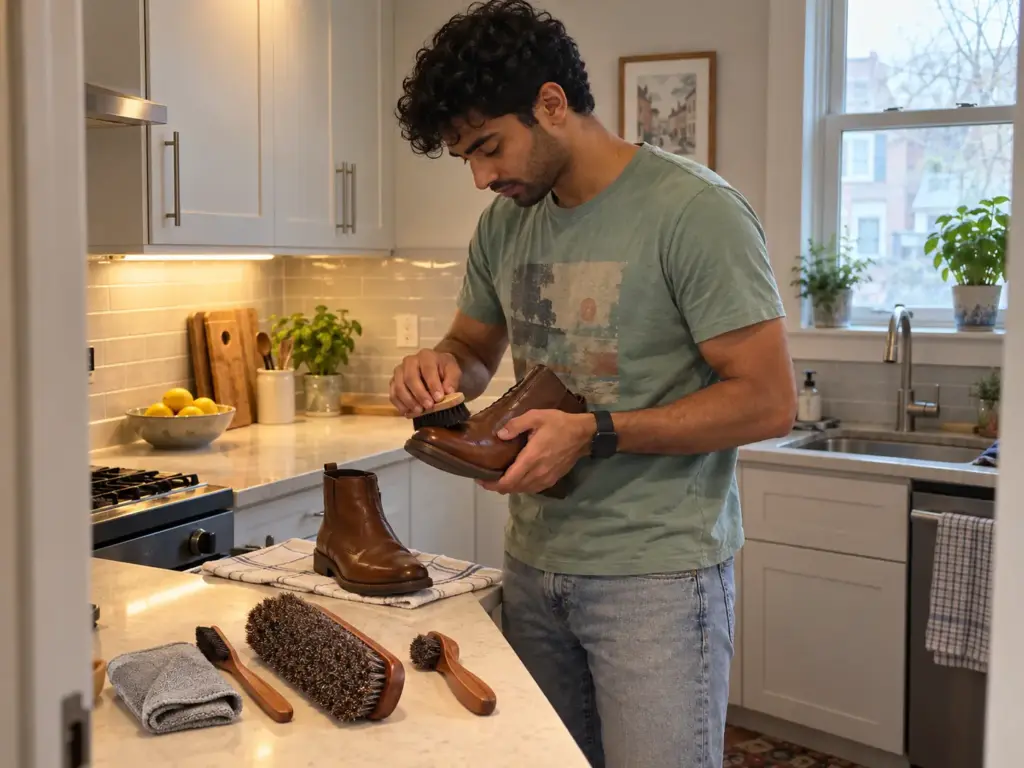
Brush them off before you decide
Dust and scuffs hide whether a pair is still good, and a clean pair is easier to sell or donate. An old toothbrush and a dry cloth are the free way to do it. For leather and suede pairs you are keeping, repairing or passing on, the ZJoey 4-piece horsehair shoe brush kit with microfiber cloth covers the cleaning job in one set (8.5 x 7 x 2 inches). Its flaws are in the reviews: one reviewer said a brush started falling apart after about a year, the set has no stiffer brush for boots, and another reviewer said the cloth shed fibers on the second use.
Know Where Each Pair Goes Before the Bag Leaves
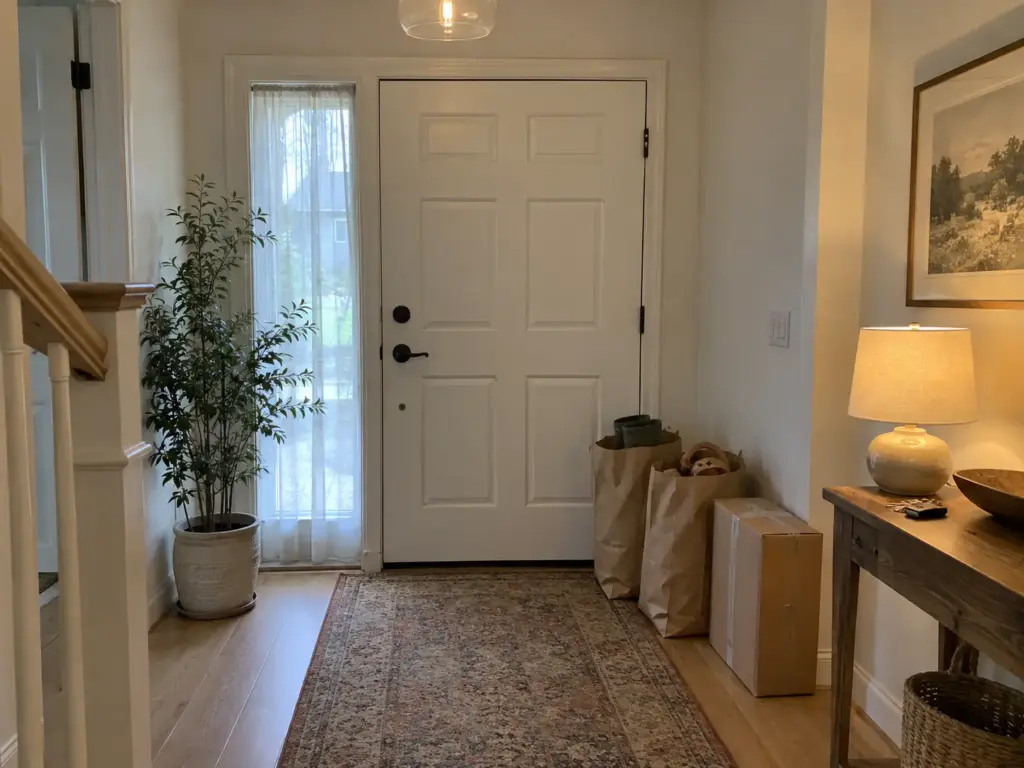
You make the keep and release piles, put the release pile in a bag, and leave the bag in the trunk for a month. The decluttering took an afternoon. The house is not clear until the bag is gone.
Donate, hand down or rehome
Name the exit before the sort ends, because the keep or donate shoes call is easier when the destination is already waiting. Professional organizer advice is consistent here: get the donations to their final destination as soon as possible, and pack separate donation bags for each exit.
The community reports show how many exits there are.
A food bank was “so grateful” for a big box of athletic shoes. One woman gave four pairs of the same shoe to a school-district prom closet and learned the girls loved them. A commenter’s niece, whose feet are half a size smaller, got a nearly new pair of ballet flats, and the original poster’s mother takes the too-tight pairs. As another commenter puts it, “someone else who needs them can get good use out of them.”
Shoes can ride out with the clothes bag, along the same donation path as your clothes.
Sell, consign or send it in
One r/declutter commenter filled a box for ThredUp, saying that even if it pays little, the shoes are out of the space. Another said DSW runs a take-back program and often gives points, and a Facebook commenter said the same. If a pair is in good shape and you would rather resell shoes than give them away, consignment is the middle path. Those are community reports, so check each program’s current terms before you pack the box.
Worn-out pairs have a different exit
A pair a stranger cannot wear safely is not a donation: crumbled soles, flat foam, shoes squished flat. One commenter bagged the pairs that felt less supportive than a new pair and took them to a shoe store that accepts worn shoes, so an exit exists, but a pair that is falling apart belongs in a textile take-back, not a donation bin.
The reason the exit matters is that a bag marked “donate” is not a guaranteed end. According to the EPA’s textile data, “EPA estimated that the recycling rate for textiles in clothing and footwear was 13 percent based on information from the American Textile Recycling Service.” That figure is 2018 data, and the same page reports that 11.3 million tons of textiles went to landfill that year. Name the destination before the bag leaves, and for worn-out pairs look for a take-back or textile-recycling drop-off, not a thrift store bin.
Set the Keep Count by Job, Then Add an Intake Rule
How many pairs is too many? Any single number ignores whether you walk to work, mow a lawn, run, or wear a suit twice a year.
One pair per job, then duplicates
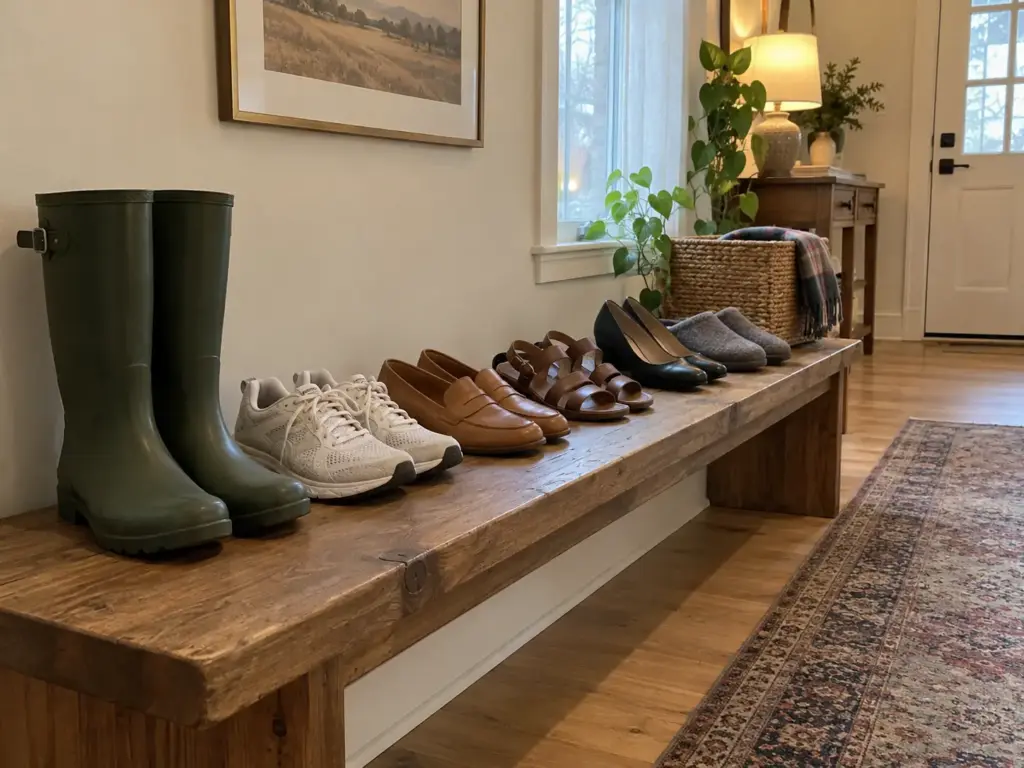
Start from the jobs. One commenter keeps a sneaker for walks and runs, a “junk shoe” for manual labor, a daily sandal (currently three pairs) and two dress-up pairs. They threw out the pairs that fit none of those jobs, including dress shoes scuffed ragged and one pair too many for lawn mowing.
The original poster said it plainly about lawn and paint pairs: “you need 1… maybe 2… certainly not 5.”
Write the jobs your week really has: walking, work, rain or snow, a dressy event, exercise, house slippers, chores. Give each one a pair. A pair with no job goes. A job with three pairs picks a favorite.
Duplicates follow the same rule: a Facebook commenter asked how many black pumps a person really needs, and another kept the most comfortable of similar styles and halved their collection.
Why there is no magic number
Martha Stewart’s expert says there is no magic number: a working mom who exercises and lives with four seasons needs more variety than someone with a simpler routine, and if every pair serves a purpose and gets worn, that is a better measure than counting; the pair count that works is the one your jobs produce.
A Facebook commenter noted that running shoes in rotation for different surfaces and wet days all get used, and warned against discarding things you will only rebuy. Another said five pairs can be enough.
The sources differ because the people differ. The job list is the way through the disagreement, because it changes with the week you actually live, not with a headline.
The intake rule
Martha Stewart’s expert also suggests asking whether a new pair truly fills a gap or is a slightly different version of something you own, and using a one in one out rule. State it for shoes this way: a new pair comes in only when the job list shows a gap, and an old pair of the same job leaves the same week. The rule is easy to say and hard to hold, and why the one-in-one-out rule stops working by month three explains where it slips.
Let Your Space Set the Cut Line
You read a count in a magazine that assumes a small apartment, or a collector’s advice that assumes a whole room. Neither fits the closet in front of you, and the same shoes get different answers depending on where they have to live.
One entryway closet: cut to the front row
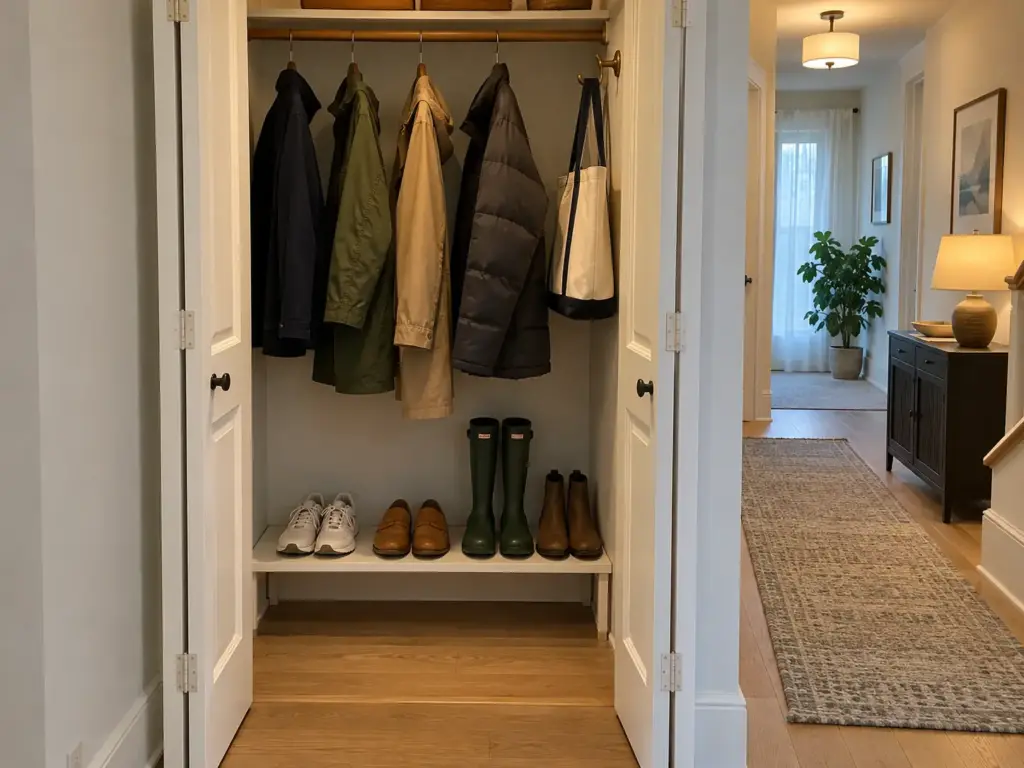
In a townhouse, condo or rental with one hallway or bedroom closet, the front row of the closet is the limit. The Apartment Therapy writer, who keeps daily pairs on an outdoor shoe rack and heels in another closet, had an entryway closet with more shoes than space. She tried the “front and center” rule, pulling the unworn pairs to the front for about a month, tossed about half of the pairs in that closet, and said being on the fence means it is time to let them go. A renter has the same limit with less room to argue: no extra storage can be added, so the cut line is stricter and the count is whatever fits.
The cut line I would draw: only what fits the front row stays in the entryway, and the rest has to earn a different home or leave. How to organize shoes at your entryway shows where the front-row pairs live.
Garage and basement: where shoes go to be forgotten
Impakter says warm, humid spaces like garages and basements make soles break down faster, so shoes stored there sit in the worst place for their soles. Any pair that lives in a garage or basement tote gets the sole check from earlier before it comes back upstairs, and only pairs that pass come up. Job shoes for yard work or painting are the exception: they live by the door they use, and they should be the “1… maybe 2” pairs, not the five.
The big walk-in: the floor that swallows pairs
In a large walk-in, the dead floor space under the hanging clothes swallows pairs because there is room to keep them. A big closet changes where the survivors fit, not how many jobs your week has. Apply the job list there as strictly as you would in a hallway closet. For the floor layout once you have cut, see how to organize shoes in a closet so they do not pile up again.
Keep the Pile From Coming Back
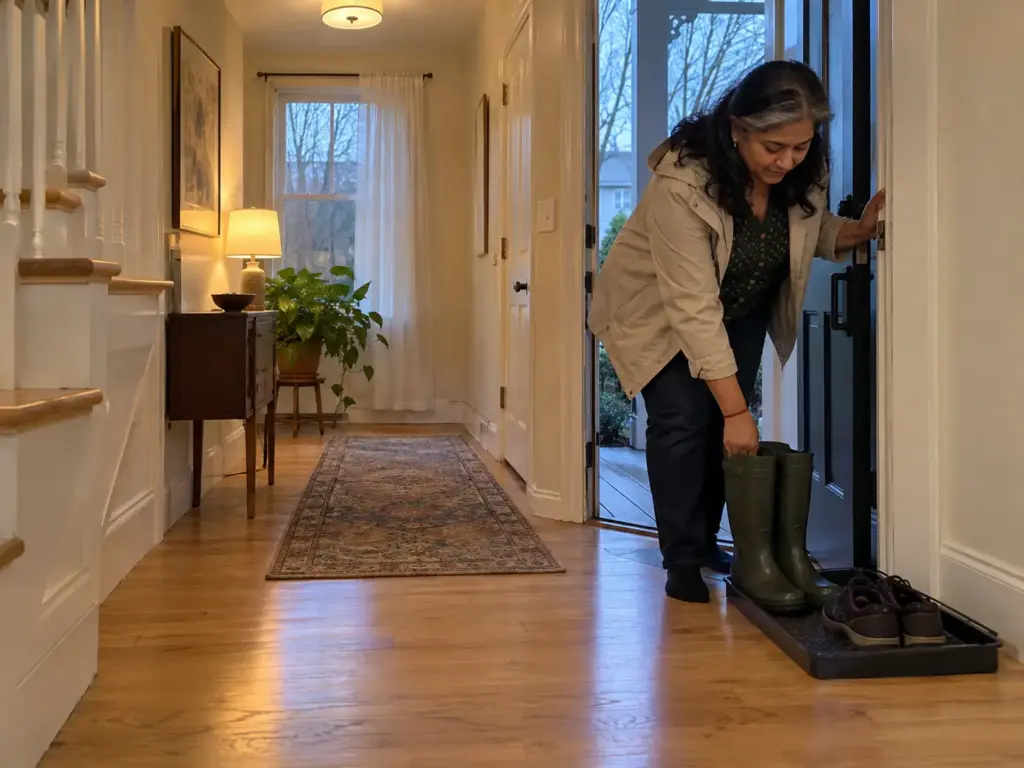
Three months after the cull, a pile of shoes has formed at the front door again, because the door is where shoes come off, not where they were ever decided about.
A drop spot and a visible limit
Martha Stewart’s expert names the biggest mistake as letting shoes accumulate where they come off, so entryways turn into drop zones. A designated place for everyday footwear, a rack, a bench or a basket, helps, and so does limiting how many pairs are visible at once. The same expert suggests a seasonal rotation: storing every shoe in the primary closet makes the space crowded, so keep everyday pairs accessible and rotate the rest. This guide covers only the intake side; why a shoe rack gets messy again handles the rack itself.
Set the visible limit by the drop spot, not by the shelf. If the entry basket holds four pairs, the fifth pair is your signal to put one away or to retire it, before the pile has a chance to start.
Date the pairs you keep
The sticky note with the wear date inside each pair is the maintenance version of the wear test. A pair with no new date after a season is the next cull. It costs a pen and a few seconds, and it replaces the memory you do not have about when you last wore something.
When to run the test again
After a season, any pair not worn gets the timed wear again or leaves. Another expert quoted by Martha Stewart suggests that if you have not worn a pair in the past one to two years, you challenge yourself to wear it within six months, and toss it if you cannot. Before a new pair comes in, the job list tells you whether a gap exists.
Date the Pair, Check the Sole, Name the Exit
Three habits carry the whole shoe declutter. Wear-test each maybe pair for a set time and write the date inside it. Check the soles of any pair that has sat unworn, and let the ones that fail go. Count by job, and decide where each discard goes before the bag leaves the house.
For later, run a three month test on the dated pairs: any pair still undated is the next cull, and the drop spot should be clear without you tidying it.
Today, take the one pair you have kept longest without wearing, put your hand on the sole, wear it for an hour, and write the date inside. What you notice about whether you wanted to keep wearing them after the hour tells you more than the closet ever did.
Frequently Asked Questions
01How do I declutter my shoes?
Pull every pair into one place, match the mates, then wear-test the maybe pairs for a set time and check the soles of any pair that has sat. Repair or release what fails, and name each discard’s destination before the bag leaves.
02How do I decide which shoes to keep?
Keep the pairs that pass the timed wear, pass the sole check, and do a job your week actually has. A pair with no job goes, and a job with three pairs picks a favorite.
03Should I keep shoes that give me blisters?
Only if the pain sits at a rub point and eases over short wears, which is break-in. Pain in the toe box, under the arch, or all over means wrong fit, and that pair should go.
04How many pairs of shoes should I keep?
There is no magic number, because the right count depends on the jobs your week has. Give each job one pair, let duplicates pick a favorite, and let any pair with no job leave.
05What is the best way to organize a lot of shoes?
Cull first, then store what is left. Once the count fits your jobs, the shoe organization guide shows where the survivors live.
Disclaimer: ClutterlessNest is a participant in the Amazon Services LLC Associates Program. As an Amazon Associate we earn from qualifying purchases. This article may contain affiliate links — if you buy through them, we may earn a small commission at no extra cost to you. We only recommend products we have tested or genuinely believe in.