
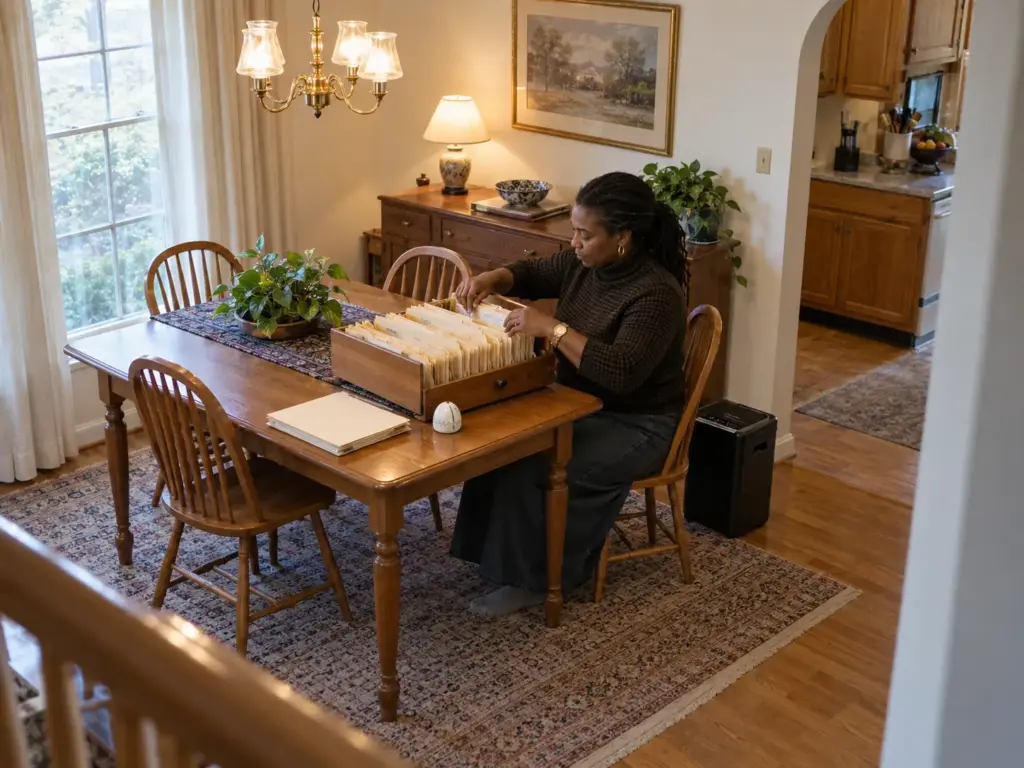
The desk drawer stopped closing weeks ago, and the stack on the table has been labeled “for later” for longer than you can place. You sit down to declutter paperwork, judge forty pages in a row, and the pile looks exactly the size it did before, because nothing in the job says where it ends. That is why it never feels finished, and it has little to do with discipline.
This guide starts with the line the job needs first, where the paper stops, then adds one cutoff per kind of paper from the IRS and the FTC, the shred-or-scan call, the two piles that stall a sort, and what keeps the paper clutter from coming back. Paperwork is one of the seven categories in our easiest-first order for decluttering by item type.
Quick Answer
A paperwork backlog is done when what you keep fits the container you chose, not when every page has been judged.
- Name the drawer or box that is your stop line before touching a page.
- Work in timed sessions and quit when the timer rings.
- Keep tax records three years; statements, pay stubs and bills one year.
- Shred anything that carries personal data.
- Scan what you might need once, then let the paper go.
- Stop the intake, and re-check only when the drawer is full.
How to Declutter Paperwork in Sessions That End on Purpose
A pile with no end is a pile where nobody decided how much paper the house is allowed to hold. Open the drawer, sort for an hour, and you quit at the second drawer, because the finish line was never drawn. Two decisions fix that, and both come before you touch a sheet: where the paper stops, and how long a session lasts.

Pick the stop line before you touch a page
The stop line is the capacity of a drawer or box you already own. It is not “zero paper”, a goal no household reaches and one that makes every session feel like a failure. One r/declutter commenter, Scott43206, finished a clean-out after about 2.5 months and set a new rule: “it has to all fit in 2 desk drawers.”
Another, librariandragon, estimates that one person should need to hold onto “one bankers box/file drawer full of actual paperwork, and usually less.” That is one commenter’s estimate, not an authority, but it gives you a sense of scale for a paper pile that fits in two desk drawers or one box.
Choose the container first and let it tell you when the sort is done. If the keepers do not fit, tighten the cutoffs in the next section before you reach for a bigger box, because a bigger box only postpones the same decision. And before you judge any single page, split the pile with the five-pile sort, which has its own guide so it does not need repeating here.
Other categories end the same way. The same cap that finishes a book cull finishes this pile: a container that is allowed to fill, and no further.
Set a timer, not a goal
A goal like “do the whole desk” is a verdict on you, and a timer is just a fact about the clock. malkin50’s advice in the thread is to “Work for about an hour or until you reach the bottom of the drawer,” and if an hour is too long to focus, to “set a timer for 30 minutes.” Another commenter, midnightchaotic, is working through a parent’s estate with a box a day, which is a session measured by a container rather than by minutes.
An hour is a long stretch for a big backlog, and one that ends mid-stack leaves half-judged pages on the table, which is the pile you were trying to leave behind. Pick the shorter timer you will actually obey and end each one at a natural edge: the bottom of a drawer, the end of a stack, the last envelope in the box. If you cannot start even a 30-minute session, the 15-minute system for when the whole house feels like too much is the place to begin.
When the timer rings, write where you stopped on a sticky note and put it on top of the pile. The next session starts at that note instead of with a fresh round of “where was I”, and the timer, not your mood, decides when the work is over.
Build a small station at the pile
Sort at the pile instead of carrying paper around the house. malkin50 sets up a chair, the shredder, a wastebasket and something to hold the keep items right next to the drawer or pile, so a decision never turns into a trip. Four things, all within reach.
Buy nothing else yet. Folders come after the stop line and the cutoffs, because folders bought first are labels for a system that does not exist. A cardboard box holds the keep items for now. And a pile left without a plan turns into what another commenter called a doom pile, paperwork parked “until I get the motivation to file it in the right place”, which is exactly the wait this station removes.
What Paperwork to Keep: One Cutoff for Each Kind
Nothing says how long to keep paperwork, so “I might need this later” has no answer on sorting day. Keep-for periods give it one: a date on a folder that settles what to keep and what to throw away for every sheet that lands inside.
Tax papers: three years, and the three cases that change it
Start where the stakes are highest. According to the IRS’s own guidance on how long to keep records, “Keep records for 3 years if situations (4), (5), and (6) below do not apply to you.” Those three situations are the only exceptions, and the default covers most drawers.
Keep records six years if the income you should have reported is more than 25% of the gross income on your return. Keep them seven years if you claimed a loss from worthless securities or a bad debt. Keep them indefinitely if you never filed a return or filed a fraudulent one. An unfiled year never expires, so it is not a shred pile at all.
Copies of your filed returns stay even after their support papers go, since the return is what you prepare next year from and what you amend this one with. Two other clocks run alongside the IRS’s. An insurer or a creditor may require you to hold a paper longer than the IRS does, and property records stay for as long as you own the property and through the tax window after you sell it. For any tax-era paper that fits none of this, ask a CPA before the shredder gets it.
Statements, pay stubs and bills: a year
Everything that is not tax support has a shorter document retention window. The FTC’s guide to which documents to keep and which to shred says to keep bank statements, pay stubs, undisputed medical bills, credit card and utility bills and deposited checks for a year. Tax returns and tax-related papers (canceled checks, receipts, W-2s and 1099s) it puts at no less than three years.
Pay stubs are where two US sources sit slightly apart. The FTC says a year. NAPO-GPC, the Greater Philadelphia chapter of the National Association of Productivity and Organizing Professionals, says to keep them until the annual W-2 arrives. Both are workable: the W-2 rule clears the stubs sooner, and the year rule is the easy default if you would rather not track when the form shows up.
Keep the one-year papers and the three-year papers apart. A single box that mixes the two is how a tax paper gets shredded early, when the one-year rule gets applied to the whole box. The community puts the whole lesson briefly: “You need to save a lot less than you think you do. If it’s a manual, you can look it up online,” wrote hilarymeggin, who also lets receipts go when you are not planning to return the item.
Write the cutoff on the folder, not in your head
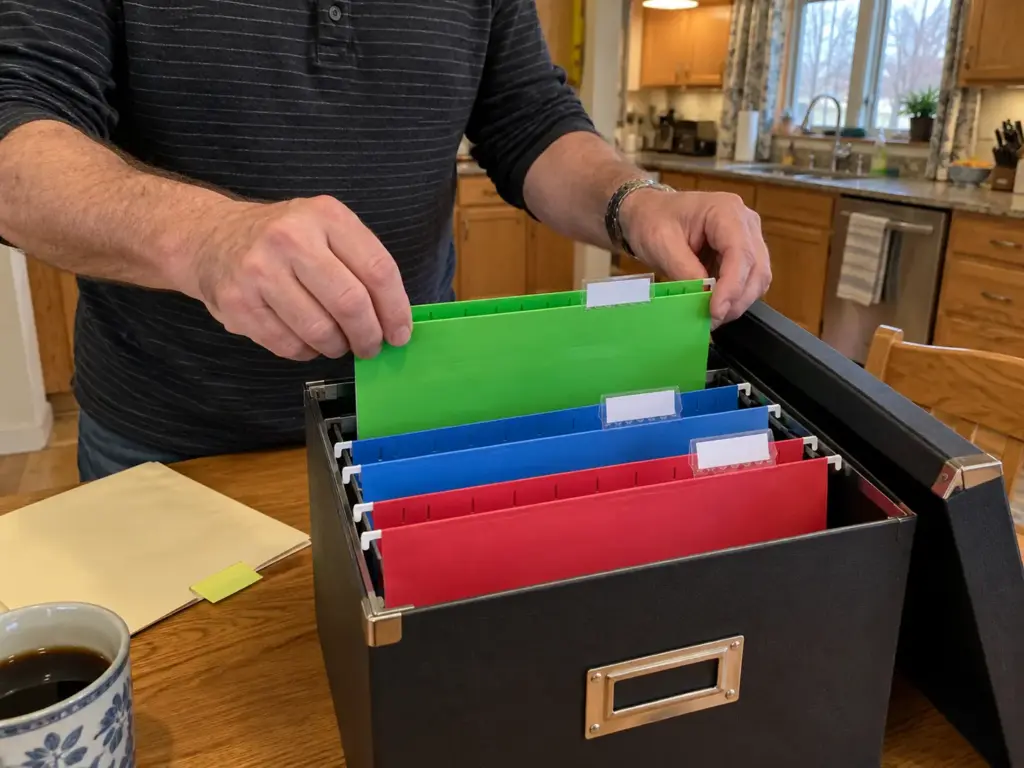
The free path comes first. DerHoggenCatten puts a post-it on the edge of a manila envelope “so it acts as a labeled tab”, which shows what is inside from within a file box. Write the cutoff on that note and you have a labeled folder out of an envelope you already own.
If you would rather have real hanging folders, Hanging File Folders 50 Pack Letter Size with 1/5-Cut Tabs hold letter-size paper and expand an inch. One folder per keep period (a year, three years, while you own it) puts each cutoff where you can see it inside the box. Fifty folders is far more than three periods need, so the pack makes sense only if the rest of the household’s paper is moving into folders too. Some reviewers say the slots for the tabs are too small, so write the label on the folder itself.
Label each folder with the year it can be shredded, not the year it covers. A shred-by year answers “can this go?” at a glance, while a folder marked with the year of its contents makes you redo the arithmetic every time you open the box.
Every other document type has a row in the full keep-for table, which is where to go once the tax papers and the one-year papers are settled.
Shred, Recycle or Drop Off: Pick the Path Before You Start
The shredding step is where a finished keep or toss sort stalls. You end up with a bag of papers that cannot go in the bin and no plan for the shredder, so the bag rides in the trunk or sits in the closet for a season.
What goes in the shredder and what goes in the recycling
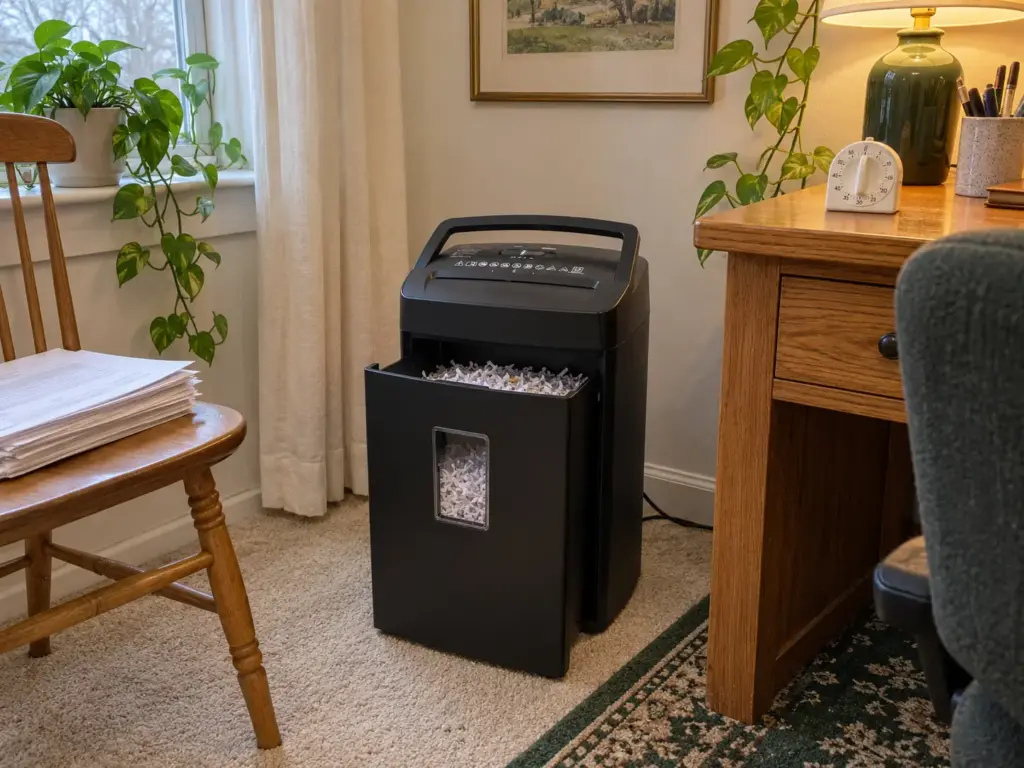
The FTC’s rule is short: papers that carry personal or financial information get shredded, not binned, since intact papers in the trash are an easy source for identity theft. Its shred list reads like the junk drawer. ATM receipts, pre-approved credit or insurance offers, cleared checks after 14 days, credit reports, expired warranties, expired credit cards and IDs. None of these needs a keep decision, and together they fill the shredder bin faster than anything else.
Paper with no personal data skips the machine. Expired coupons, store catalogs and old manuals you can look up online go to the recycling, which is hilarymeggin’s list and a sound one. Identity documents (birth or adoption papers, Social Security cards, passports, marriage and divorce papers, wills and vital health records) are neither shred nor drawer papers. They belong in a locked box for birth certificates, passports and wills, and that guide covers the box so this one does not repeat it.
Three shredding paths compared without a price
Price is the wrong first question about shredding, because each path stalls somewhere other than the bill. Ask what will stop you.
A community shred day is free, and the FTC says to look for one in your community if you do not have a shredder, but it runs on a calendar. Scott43206 lived the problem: “if you wait for an event or to take stuff in bulk it can be a derail issue, at least it was for me.”
A bulk drop-off service takes everything in one trip. As rttnmnna puts it, “there are usually cheaper bulk shredding services where you can just drop it all off too”, but the trip has to happen, and the bag has to survive in the trunk until it does. Your own shredder never waits for a date, but it runs at the speed of the machine, which is the next section.
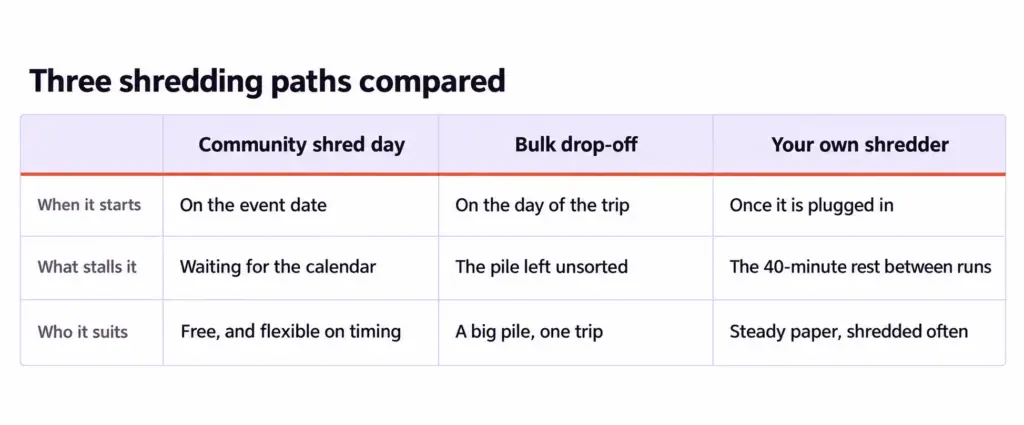
The free shred day is the obvious pick, and for a single drawer it is the right one. For a backlog that keeps getting new mail, it works as a clean-out tool and fails as a habit. Scott43206’s verdict is blunt: unless you can find a fundraising event, a paid service is “so pricey you might as well get a shredder.” Weigh that against how much paper keeps arriving, not just how much sits in the drawer today.
The shredder spec that sets your session length
Start with the free path. If a shred day falls within a few weeks, finish the sort now, keep the shred papers in one closed box and take it when the date comes. If the date is far off or the mail never stops, a home machine earns its place, and the spec that matters is not the bin size but how long it runs.
The Bonsaii 12-Sheet Cross Cut Paper Shredder 5.5 Gal (model C275-A) is a cross-cut shredder that takes 12 sheets per pass and cuts them into P-4 particles, with a 5.5-gallon bin; the listing gives its size as 12.6 by 7.91 by 18.3 inches. The same listing says it runs 6 minutes, then rests 40.
A drawer of paper is therefore a series of 6-minute runs with rests, not one afternoon of feeding, and that cool-down is the machine’s real limit. Build your session around the rests. One habit shrinks the pile before it starts: Scott43206 sorts and shreds incoming mail daily, so the stack never gets a chance to form.
Use each cool-down to sort the next stack into shred and keep, so the shredder never sits idle and you never stand there feeding it one sheet at a time.
Scan First, Then Let the Paper Go
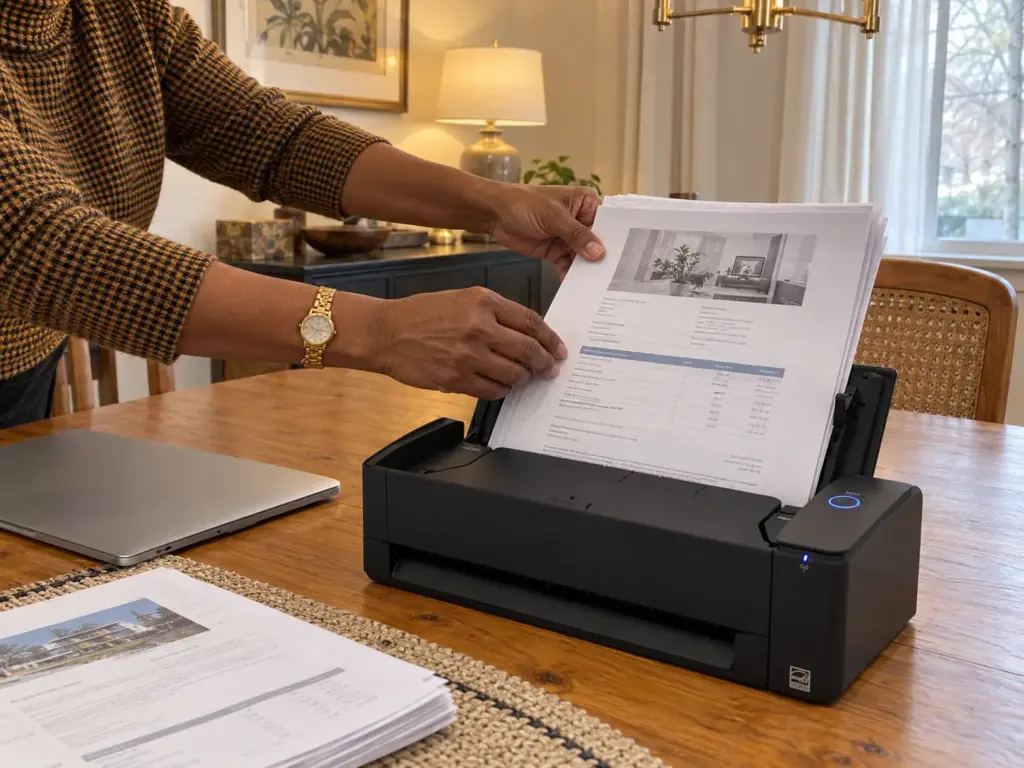
Decluttering paper stalls on “just in case”, which is usually a fear of needing a copy, not the original. A scan answers that case without the box. The cutoff for how old a paper is before it gets scanned keeps the scanning from becoming a second backlog.
Which papers deserve a scan before they go
A scan is permission to shred, not a second place to pile things. Manuals and anything you can find online skip the scanner entirely. The advice to scan everything sounds thorough and fails in practice: it swaps a drawer you cannot close for a folder you cannot search.
One commenter, Feeling_Wishbone_864, drew a line by age: “papers less than 3 months old were sorted in the file folder box; papers more than 3 months old were scanned and sorted on my computer.” That is one person’s method, and it works because the date decides, not the mood. Copy the shape, a date that separates the paper you hold from the paper you scan, and set your own number.
Phone app or feeder scanner
The free path is the phone in your pocket. A scanning app such as Scannable or Simple Scanner is fine for a handful of pages, a lease, a warranty, a letter you need once.
A backlog is different. The Fujitsu ScanSnap iX1300 Wireless or USB Double-Sided Color Document Scanner has a 20-sheet automatic feeder, scans both sides in one pass and works at 600 dpi, so a 200-page backlog is ten feeds, not 200 trips to the camera. Some reviewers report that the Wi-Fi connection will not work and that duplex scanning of multiple pages gives trouble, and since the name lists a USB connection as the other option, that is the first thing to try if the wireless one misbehaves. A phone app costs nothing, so try it on one stack before you decide the feeder is worth the shelf space.
If you want a digital filing cabinet where scans stay findable, why going paperless at home fails is the place to start.
Action Papers and Keepsakes Get Their Own Spots
The doom pile is not laziness. It is action items with no home, so you wait for motivation that a labeled spot would make unnecessary. Sentimental papers stall the sort for a different reason: judging them uses up the energy the bills needed.

One spot for papers that need an action
Papers that need something from you (a bill to pay, a form to return) are not clutter and not archive, so they belong nowhere, and they gather in the doom pile. Give them one spot, an action inbox such as a vertical inbox on the desk or a basket by the door. Pick the day it gets emptied, and let nothing else live there.
The spot has a cap as well. If it overflows, the signal is that the actions are not getting done, not that the spot needs to be bigger.
Pick the emptying day by what is due, not by what is convenient. If the bills pay on a set date, empty the spot a few days before it, so the inbox gets cleared by a deadline instead of by guilt.
Sentimental papers: apart, and few
Cards, kids’ drawings, school papers and old letters get a separate container from the working papers. Keep only the few that matter, and do not run them through the bill sort at all. The method for that sort lives in how to declutter sentimental items without the guilt.
When the pile belongs to someone else
Sorting a parent’s paper is a different job, because you cannot know what a stack holds. midnightchaotic is doing a “box a day” with a parent’s estate. When an original poster who grew up with a hoarding parent asked where to start, midnightchaotic’s answer was the simplest in the thread: “One stack/drawer at a time.” The poster replied that the bedside table in their own room was where they had begun.
One commenter in the same thread would throw it all in a garbage bag and keep only the tax returns. That skips the identity check that shredding exists for, and with someone else’s paper, where the contents are unknown, it is the wrong shortcut.
Stop the Paper Coming Back and Know When to Redo This
The pile returns because paper keeps arriving and the archive box ends up somewhere it is forgotten. The calendar is the wrong alarm. The drawer is the right one.
Cut the intake at the source
WishIWasThatClever puts it plainly: “Step 1 is the most important. And that is to have a plan/system for stopping the paper from piling up.” The plan has four parts.
Get off every mailing list possible, which means a mail opt-out for junk mail, and move bills to e-billing instead of paper statements. Shred incoming mail the day it lands (Scott43206’s habit, for anything that is not a keep or file item), and keep receipts on a metal spike, one bag per year. WishIWasThatClever’s version: “Buy a cheap metal spike for receipts. The kind they used to use in diners.”
The mail layer has its own guide, on how to build a mail system that holds.
Where the archive box lives in a rental and in a house
This part is my recommendation, built on how the two kinds of home are put together. It is not a finding from anything measured, so treat it as advice to test.
In a rental with no cabinet and no basement, the archive box fits on a closet shelf or under a bed, and the box is the cap. If the folders stop fitting, the cutoffs get stricter before the box gets bigger.
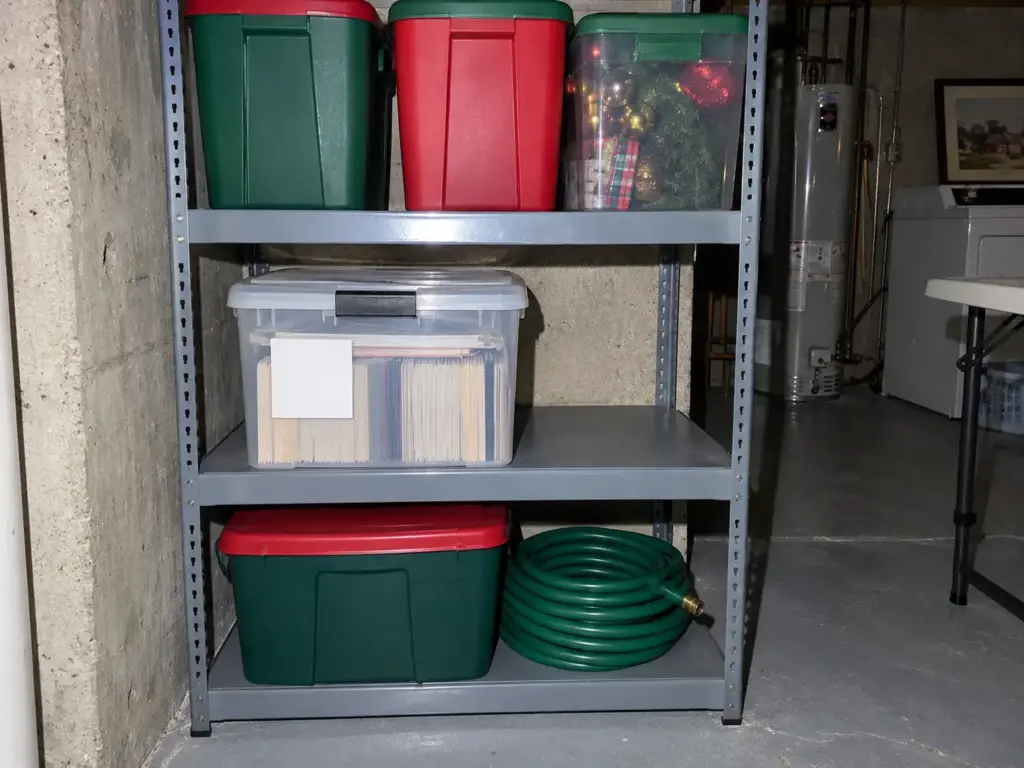
In a house with a garage or basement, the same cap is harder to hold, because the unlabeled box migrates to the room with the most space and then gets forgotten. A box nobody sees is a box nobody revisits, so the three-year papers outlive their cutoff. Write the cutoff date on the box and move it to the same shelf every time, up off the floor, because garages and basements run damper than a bedroom closet.
Re-check when the drawer fills, not on a date
The re-check trigger is the drawer filling. In Scott43206’s words, “when the drawer starts getting full it’s time to have another shredding party.” A date on a calendar gets skipped, but a drawer that will not close is hard to miss. At the three-month mark, take one look at whether the drawer is still under the line.
The Backlog Ends at the Drawer
Three things carry the whole job. The stop line comes first, because a container ends a sort and a goal never does. Then comes one cutoff per kind of paper: three years for tax records unless one of the three exceptions applies, and a year for statements, pay stubs and bills. And the drawer filling is the alarm that tells you to do this again, not a date on a calendar.
In three months, open the drawer and see two things: whether it still closes with room to spare, and whether the action spot is empty.
Today, name the drawer or box that is your stop line and put the first stack in it. Then notice how much easier the next stack is to judge once it has an edge to run up against.
Frequently Asked Questions
01How to get rid of paperwork clutter?
Choose a drawer or box as your stop line, then sort in timed sessions until what you keep fits inside it. Shred what carries personal data, keep the rest by its cutoff, and give action papers and keepsakes their own spots.
02How to organize a lot of paperwork?
Organize a large pile by how long each kind of paper must be kept, using one folder per cutoff instead of one folder per topic. Tax papers go in a three-year folder, statements, pay stubs and bills in a one-year folder. Property records stay while you own the property.
03What papers to keep and throw away?
Keep tax returns and their support papers at least three years, and bank statements, pay stubs and most bills for a year, following the IRS and the FTC. Shred whatever carries personal data, and recycle manuals, catalogs and expired coupons.
04How long does it take to declutter a backlog of paperwork?
A full backlog can take weeks to a couple of months because it is done in sessions, not in one weekend; one commenter’s complete clean-out took about 2.5 months. Sessions of an hour, or a 30-minute timer if an hour is too long to focus, kept it moving.
05Do I need to buy a shredder to declutter paperwork?
No, you can declutter paperwork without buying a shredder, because a free local shred day or a bulk drop-off service can take the whole pile. Both depend on a date or a trip, which is where backlogs stall. One commenter judged a paid service, outside a fundraiser, pricey enough that you might as well get a shredder.
Disclaimer: ClutterlessNest is a participant in the Amazon Services LLC Associates Program. As an Amazon Associate we earn from qualifying purchases. This article may contain affiliate links — if you buy through them, we may earn a small commission at no extra cost to you. We only recommend products we have tested or genuinely believe in.