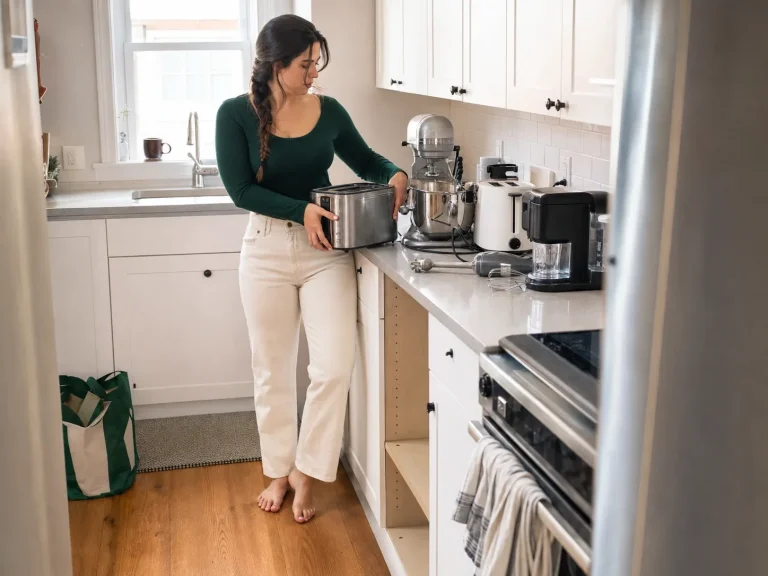

You reach for the one spatula you actually use, and the drawer refuses to slide shut over the pile it lives in, so everything gets pushed down and the drawer gets closed with a shoulder. It feels like a storage problem, which is why a cutlery tray, drawer dividers, shelf risers or a utensil crock keep looking like the answer. The real cause is that nobody ever put a number on each gadget, so every gadget stays. To declutter kitchen gadgets, run a short sequence of checks that organizers quoted by Forbes Vetted and Southern Living recommend and that people in r/declutter and Facebook decluttering threads report using, with the recycling rules taken from the EPA and a county government page.
The guide to decluttering by item type already covers the keep question and the three ways gadgets get in; this one covers the decisions after that, from emptying one drawer to fitting what is left to the drawer you really have.
Quick Answer
Work through the drawer in this order, and every gadget ends up with a place or an exit.
- Empty one drawer onto a table and wipe it clean.
- Give every gadget a use count and keep only what meets it.
- Test each single-job tool against the knife or pan that does the same job.
- Put the maybes in a dated box and release the box on its date.
- Choose each discard’s exit by its material before the bag leaves.
- Measure the inside of the drawer and keep only what fits it.
How to Declutter Kitchen Gadgets by Emptying One Drawer First
Picture yourself at an open drawer, pulling out one gadget at a time, holding it up and putting most of them back. Each decision gets made without seeing the others, so everything “might be needed,” and the pile that does come out sits on the counter for days.
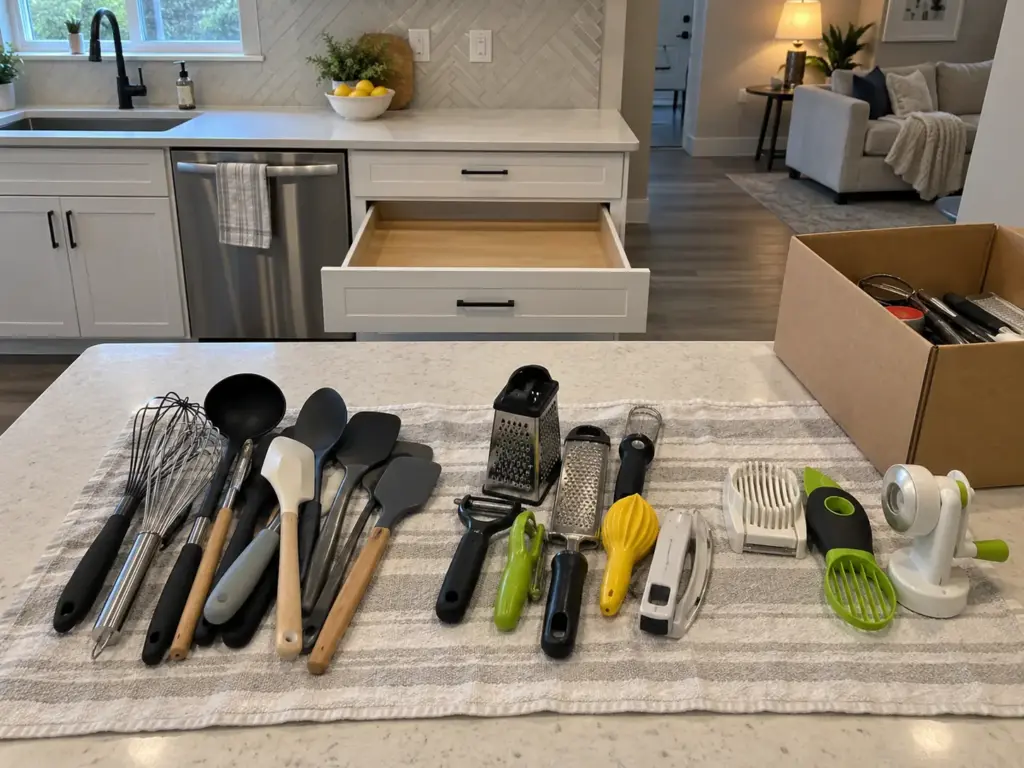
One r/declutter poster described exactly this: the sort started, but they “ended up overwhelmed. Instead of deciding, I sat down, procrastinated again, and left the pile sitting on the counter,” and the job now felt worse. The gadgets were never the failure. The size of the job was.
One drawer, not the whole kitchen
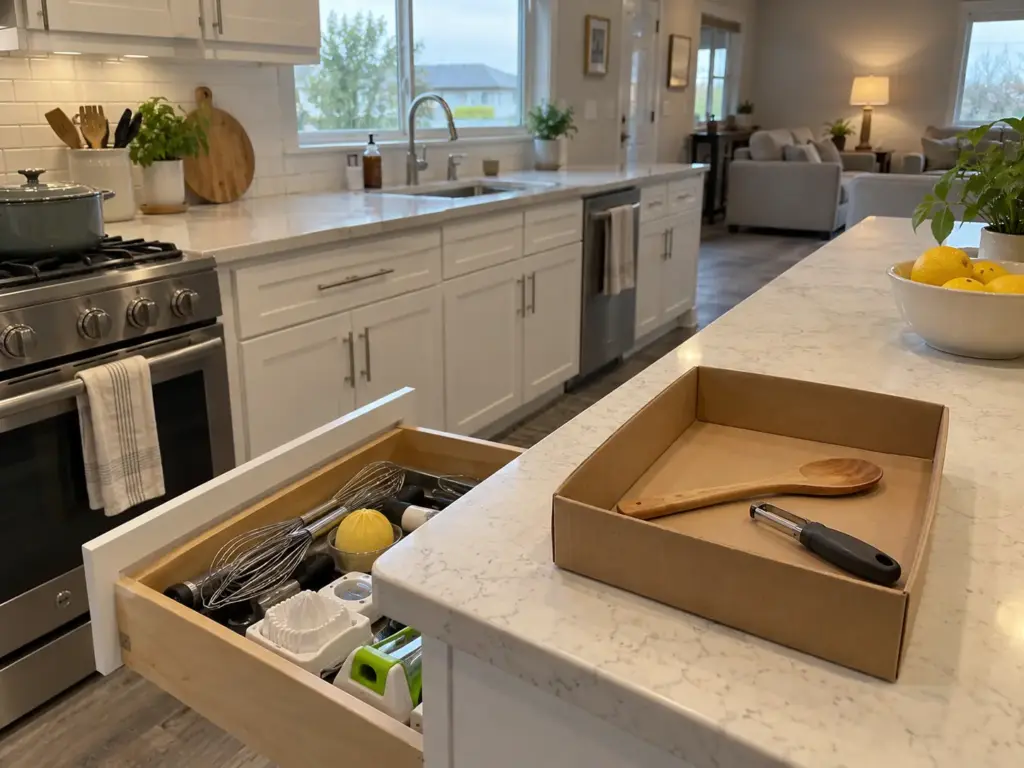
Shrink the job to a single drawer and the stall loses most of its power. One commenter laid out a routine that is hard to improve: pick one drawer, take out what you don’t use into a donation box, pile what you do use on the counter, wipe and dry the drawer, put the keepers back, close it, set the box in a corner, and only then decide whether to keep going. One addition is about destinations: the keepers pile goes back into the drawer, the donation box leaves the house, and nothing sits in a third category waiting for a mood.
Another commenter put the reasoning plainly: “Don’t make piles, that will discourage you.” Their version was a donation box in an easy spot, and a habit of dropping in five things whenever there is a spare minute.
If you stall before you even start, how to declutter when overwhelmed and actually finish deals with the pile that paralyses.
Wipe it, sort like with like, then decide
With the drawer empty, wipe it out, then sort what came out by job before judging any of it: spatulas with spatulas, peelers with peelers, whisks with whisks. The doubles introduce themselves once they sit side by side, and the later sections of this guide depend on that. The keepers pile that stays on your table or counter while the drawer dries is only a pause; if the surface itself is the problem, you can declutter the kitchen counters in a separate pass.
A five-zone timer instead of a free weekend
If one drawer still feels like a big ask, borrow a clock. The Secret Slob’s 5-5-5 rule, as SpaFinder reports it, is a 25-minute timer, five small zones, five minutes on each, then you move on. In a kitchen the five zones can be five drawers, five shelves or five cabinet fronts (an adaptation, not part of the rule).
One writer who tried the method said it “works best if you have absolutely no wildcards,” after a junk drawer of spilled pins ran past the five minutes. So a drawer full of loose bits gets its own session, with a container for the parts.
Give Every Gadget a Use Count, Then Count the Washing Up
“I’d use it if I had time” is the sentence that keeps a gadget in the drawer for two years. A feeling can always be argued with. A count of how many times the thing left the drawer this season cannot be. The first-pass question in the item-type guide asks whether a gadget left its cabinet in recent months; this is the number version of that question, with one extra cost added: the washing up.
A number per gadget, not a feeling
The community’s numbers disagree, and the disagreement is useful. One commenter keeps a gadget only if it gets used at least once a month and fits the cupboard “comfortably,” meaning that if other things have to be lifted out of the way to reach it, the cupboard holds too much. Another, with a small kitchen, says anything kept must “pull its weight,” which they define as used “multiple times a month.”
A third gets rid of anything untouched for more than four months, unless it is a yearly canning tool, and a fourth keeps it short: “Use it or lose it.” Forbes Vetted quotes organizer Shira Gill’s “love it or use it daily” rule, which asks for “at least three to four times per week” from whatever occupies the easiest-to-reach space.
Those numbers differ because the spaces differ: Gill is talking about prime reach, the others about a cupboard. So let the count set the place, not only keep or go. One commenter’s version works well as a frequency ladder: daily use goes on the counter, several times a week to once a week goes in a cupboard, and monthly or less lives somewhere else in the house. A gadget used less often than the lowest rung you can offer it goes to the dated box in the fifth section, or out.
The one number that misleads is a flat monthly line. A juicer used for pomegranates, cranberries and other autumn and winter fruit fails a monthly test for eight months of the year, and one commenter keeps theirs in a coat closet and brings it out when the fruit arrives (“only frequent fliers earn real estate,” they say). A canning tool used once a year is the other exception commenters name. If you keep a seasonal gadget, write down the season and the place it waits.
What a gadget costs to wash
Forbes Vetted points to a cost that is easy to miss: with gadgets such as avocado mashers and garlic choppers, “the time you may have saved during cooking can be lost during cleanup,” because several pieces or tedious grooves take longer to wash than a knife and a cutting board. Cleanup time belongs in the keep test, so here is a rule for it.
Count the washable parts. A gadget with more parts to wash than the knife it replaces has to be used far more often than the knife to earn its place in the drawer. Elinor Hutton, also quoted by Forbes Vetted, says the same thing from the storage side: “Unless you use it on a daily basis, most [unitaskers] collect dust,” and they are “bulky to fit in a drawer.”
Put the gadget next to the knife and cutting board it competes with and count the pieces that would go in the sink. A knife is one piece; a gadget that comes apart into several, or has grooves a brush has to reach, is extra washing that the use count has to pay for.
The one-more-use test
For the gadgets that survive the count but still feel doubtful, one commenter suggests making the thing once more. Their example was a bread maker. Did you enjoy the smell, did you enjoy eating it, are you going to keep making it? If not, let it go “without any regret,” and sometimes the cleanup alone reminds you why it fell out of use.
Another commenter put the same test bluntly: “if you can’t force yourself to use it a few times, you will probably never get around to using it.” Treat both as community tests, not law, and run it once per gadget.
Single-Job Gadgets Have to Beat the Knife You Already Own
The avocado slicer, the egg slicer and the garlic press each arrived with a promise to make one chore disappear. Each is a single-use gadget that does a job a knife already does, and each one has to be washed afterward. One poster on r/declutter listed a waffle maker, juicer, air fryer and bread machine, all bought hoping for a big payoff, and said they “mostly just collect dust.” That is the pattern: the hope is bought, the drawer fills, and the drawer pays for it.
The ones that lose to a knife
The organizers Southern Living quotes are blunt about it. Avocado, egg and strawberry slicers are all jobs “that can be completed with a knife.” Of the mini waffle maker, popcorn maker, ice cream maker and sandwich press, Julie Peak says “they’re not necessary,” and a spiralizer can be replaced by a knife, a potato peeler or a cheese grater.
She names two exceptions, apple and pineapple slicers, “but only if you eat these fruits often.” Forbes Vetted says most of the unitaskers Shira Gill points to, avocado slicers, garlic presses and egg separators, go months without use.
Not every appliance on that list is a loser for every household. If the waffle maker or the ice cream maker passes your use count, it still needs a place that isn’t the gadget drawer, and where small kitchen appliances that stay can live covers that.
The question that settles it: what would I use instead?
Several commenters land on the same question: “If I didn’t have this, what would I use instead?” If an option would work reasonably as well, the gadget goes. One commenter’s examples show how it plays out. The bread machine went when no-knead and folding techniques turned out to do the job without hurting the wrists.
The electric frying pan went because a frying pan as large already existed. The stand mixer that could not bring egg whites to a stiff peak as well as the hand mixer did went too, and of all the blender-type appliances only the stick blender stayed. Another commenter weighs a gadget against the good-enough alternative (frozen waffles against mixing batter, standing in the kitchen and cleaning up afterward), and a third asks whether a similar tool already owned or a borrow could cover the need.
There is a reason this question is safe to act on. Kitchen gadgets are so cheap now, one commenter notes, that you could get rid of one “fully intending to buy it back in a few months/years.” Another says to put it on Buy Nothing, and “in a few years when you miss it, you can get it free or cheap.” A wrong call costs very little, which is the argument for deciding today.
The single-job tools that earn their place
Accessibility is the clearest case. Forbes Vetted reports that Anne-Marie Bonneau’s mother, who is 93, has trouble opening cans, and says a soda can opener would be “a highly used, worthy investment” for her. Courtney Carver says to prioritize what makes life better, “especially with accessibility issues.” Gill makes the same point from the other direction about the Microplane zester, which earns its spot “when a tool is that good at its job and gets reached for multiple times a week.”
The same pass goes to a citrus juicer and a salad spinner when they get used. Forbes Vetted reports that Gill backs a citrus juicer “if it’s used often enough,” and that she and chef Jessica Rice both back a salad spinner for anyone who regularly washes batches of greens or berries.
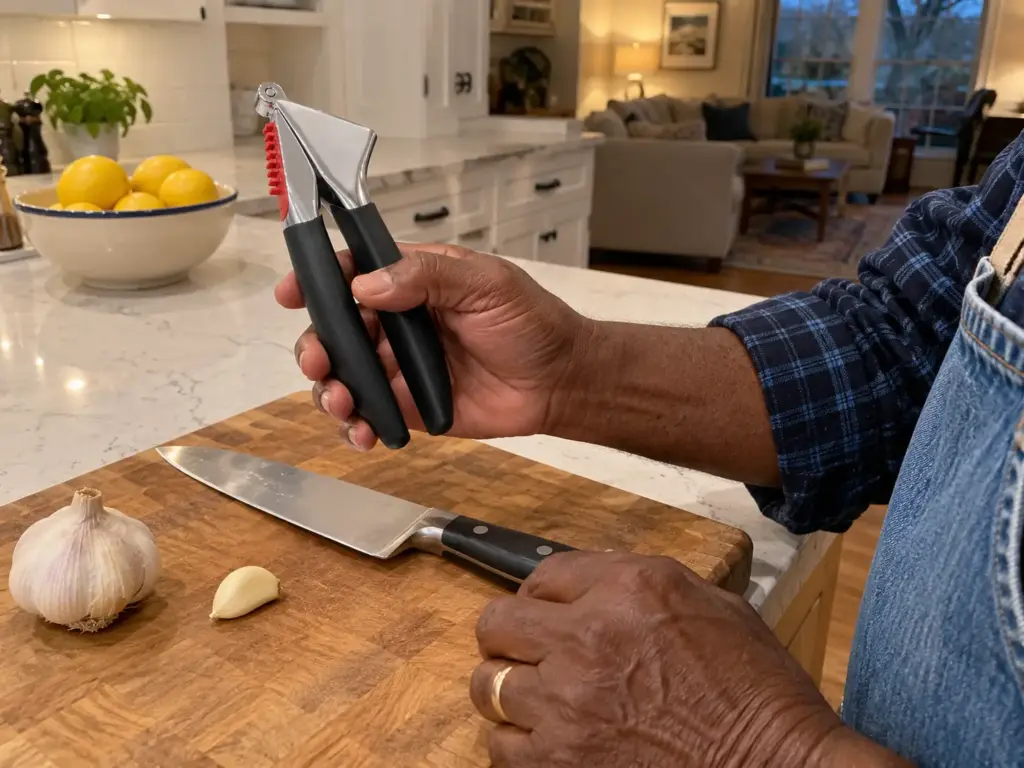
The garlic press is the test case. The free option comes first: lay the flat side of a chef’s knife over the clove and press down. But for most readers that is where the story ends.
Chef Jessica Rice takes a garlic press with her when she cooks on the road, because mincing garlic is the prep job she dislikes most, and Forbes Vetted says the press is worth the space if you cook with fresh garlic “on a near-daily basis.” Hold your own cooking against that line.
If it passes, the OXO Good Grips Garlic Press is the one worth giving the drawer to; Forbes Vetted lists an OXO garlic press among the single-use tools worth the space and calls it easy to clean. Below that number the knife does the job and the press goes.
So the rule for any single-job gadget has two doors: a number attached (several times a week) or a hand or joint that needs the tool. A mood or a “maybe” is not a door.
Keep the Better One: Duplicates and the Knives That Stay
You own two peelers, three spatulas from three different eras, and two sets of nonstick pans because the dishwasher made a second set feel necessary. None of the doubles looks like clutter on its own. Together they are the reason the drawer won’t close.
Two of the same job, keep the one you reach for
A Facebook decluttering post from Stitched By Susan puts the move in two lines: think about how you use kitchen items, keep fewer that serve multiple purposes, and keep the best-quality two spatulas while the others go. A commenter on r/declutter works the same way: “If I have something else that’ll do a similar job (croc pot vs instapot for example) I get rid of the one I use less.” Another owned a nice blender that shreds as well as a food processor, and let the processor go.
Forbes Vetted leans the same way, favoring the multipurpose, durable tool over the single-use one, and Gill calls a food processor the multitasker that replaces a dedicated chopper, mandoline, immersion blender, juicer and “even a stand mixer for many tasks.” The lesson is not which appliance to buy. It is that one good multi-use tool can cover several jobs, so the target is one tool per job.
The dishwasher doubles
One r/declutter commenter describes how doubles arrive: “I have some doubles. For example two sets of nonstick pans and some double utensils are taking space,” because of using the dishwasher. The doubles answer a real habit, so decide which set your household reaches for after a normal week of dishwasher use, then release the other. The pans have a longer story in why your pots and pans system falls apart in a month.
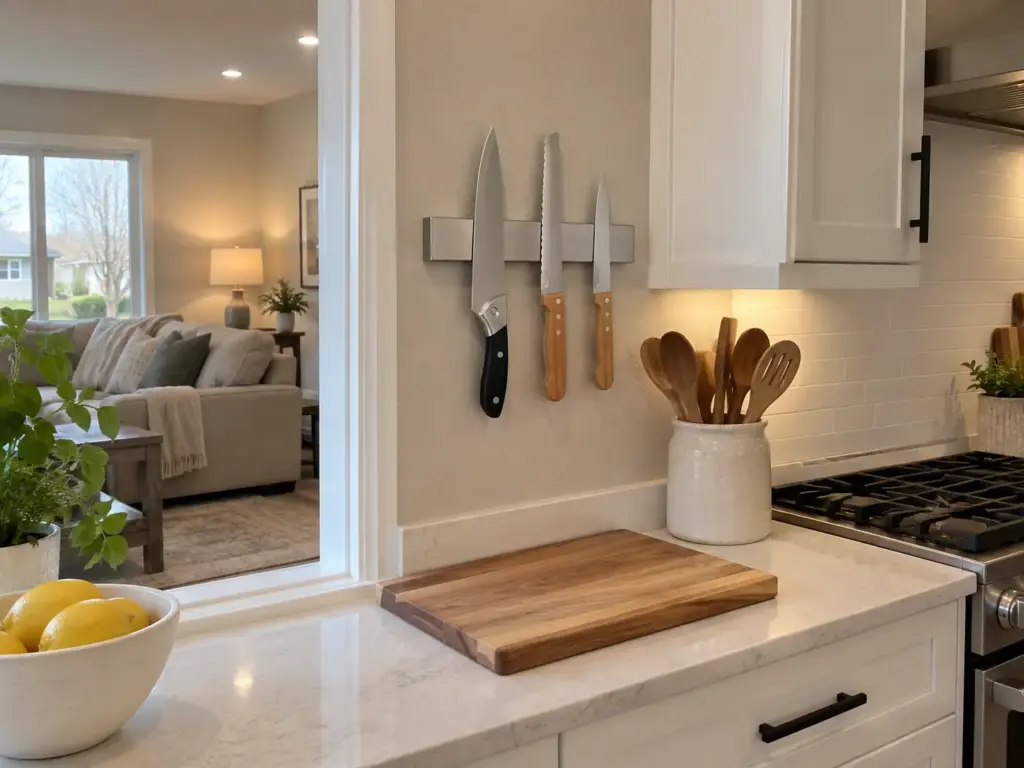
Three knives and where they live
Knives are the one place where fewer is easy to defend. Bonneau’s line in Forbes Vetted is “You don’t need seven knives”: her three are a chef’s knife, a bread knife and a paring knife, the ones she uses all the time. Hutton adds kitchen shears, which let you process ingredients without a knife and cutting board.
Where the three live is the next decision. Julie Peak, in Southern Living, points out that knife blocks are big, take counter space and are hard to clean and sanitize, and she suggests a drawer or a magnetic strip on the wall instead.
The free option is whatever you already have: the block already on the counter, or a drawer (the drawer-fit section near the end covers that). A wall strip frees both the drawer and the counter, and the Ninonly 12 Inch Magnetic Knife Strip is a 12-inch version of it. Check the listing for how it mounts, screws or adhesive, before you order. If your lease bans holes, a screw mount rules it out, and the drawer is the better home for the three.
Put the Maybes in a Dated Box and Let the Date Decide
By now you are down to the gadgets you “might need,” the ones kept “just in case.” Letting them go feels like a bet, and keeping them is how the drawer got full in the first place. A dated box turns the bet into a test that costs nothing.
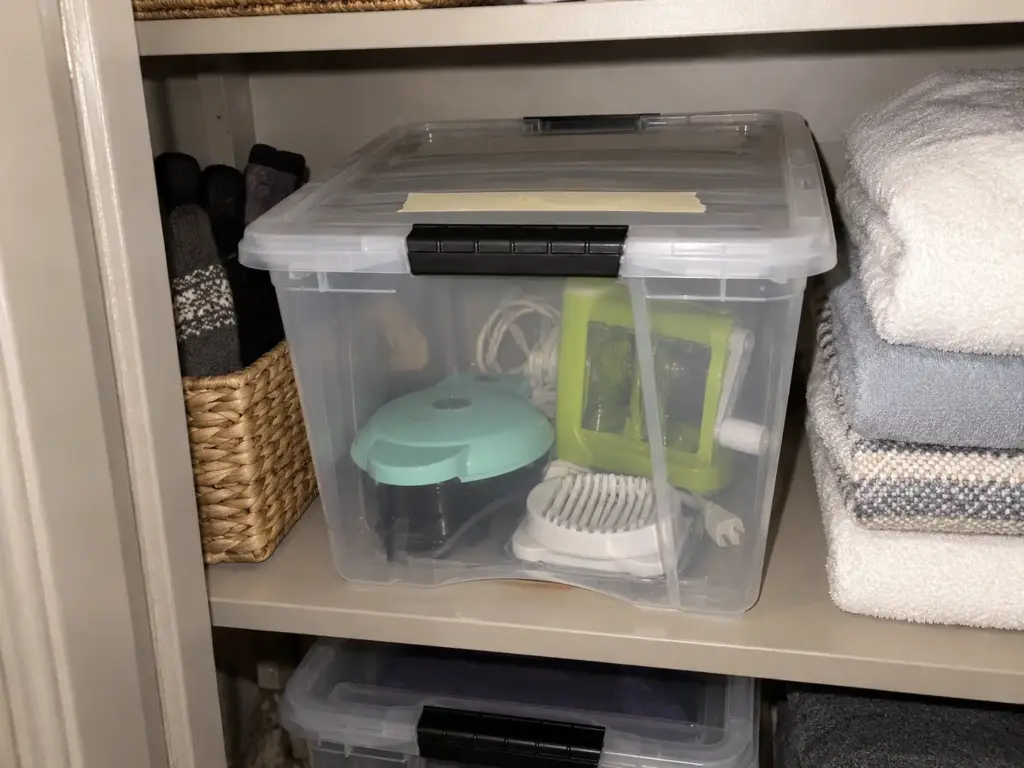
Write the release date on the box
Commenters describe the holding box a few ways. One writes a date three or six months ahead on a box, drops in whatever is unused, and donates the whole box if nothing was needed by that date. Another puts the unused gadgets in a box for three or six months and says “anything you don’t pull out in that time, let it go,” noting that with the big cooking holidays ahead the box gets a real test.
A Facebook commenter put every gadget in a big box, returned each to the drawer when it was used, and donated what was untouched after a month. Forbes Vetted quotes Carver on a quicker version: a box on the counter, every item used goes in it, and after a week or two you can see what is left in the drawer.
One r/declutter commenter has a version with no box at all, offered as an idea in a conversation with a sister: put tape on each item with the date it was last used, and after a few months to a year get rid of what did not get used in the time frame you set. The box with a date is still the cleaner method, because the drawer empties on day one.
A warning from a commenter whose husband is the cook: once he realizes a deadline is coming, he suddenly uses whatever is on the chopping block, so waffles, sausage links and mini Bundt cakes arrive “every six months like clockwork.” A use made only to save a gadget on deadline day counts as one use, not as proof it earns the drawer. Run the count from the second section on it.
Time spans also differ, and they should. Two of the community stories are one-year holds, not three-month ones: a bread maker and a deep fryer sent to a utility cupboard for about a year before the gadgets went to friends and a charity shop, and rarely used appliances moved to the furnace room, where the owner asks, “If I don’t use it in a year, do I even want it?” For a drawer you want back in weeks, three months fits. And for a pricey appliance, the longer hold is a choice, and it gets its own date.
Write the release date on two sides of the box, and stick a note with the same date inside the cupboard door where the gadgets used to live. The box can sit out of sight for months; the note is the thing that sends you to open it.
A clear box or a closed one
One commenter closes the flaps of a donation box so nobody can see what is inside. If you need something, you pull it out, use it, and put it back in the “to be sorted” pile, because needing it once this month does not mean it stays.
A clear box does the opposite: nothing gets forgotten, and the rescues come easier. Pick the risk you have. The free option is a cardboard box with the date written on it.
For the reader who wants to see what is held, the IRIS USA 32 Qt Latching Clear Storage Box (4-Pack) is a clear box with a latching lid, listed on Amazon as “IRIS USA 4-Pack 32 Quart Storage Bins with Lids, Clear.” Each holds 32 quarts and the set comes as a pack of 4. The limit is the one above: see-through shows the item and invites a rescue, and a closed cardboard box doesn’t. Whichever you pick, the box only counts if it has a date on it.
Where the box lives when you have no basement
Commenters park their boxes on a basement shelf, in a furnace room, a utility cupboard or a pantry. Plenty of readers have none of those. A closet shelf, the top of a wardrobe or a bin in another room works just as well (a suggestion, not something the commenters said). What matters is that everyone in the home knows where it is.
One commenter’s father put his box somewhere only he knew, “and gets cranky when we say we need something from the box,” so his wife “just buys a duplicate replacement,” a story told by his child in the thread.
The box needs a label, a date and a place, or it becomes a second junk drawer; why a drawer with no assigned spot turns into a junk drawer explains the mechanism.
Send Each Gadget Out by What It Is Made Of
You fill the donation box, set it by the door, and then find out the thrift store won’t take half of it. The decluttering took an afternoon, but the house is not clear until the box is gone. So name the exit before the sort ends, and make it one trip.
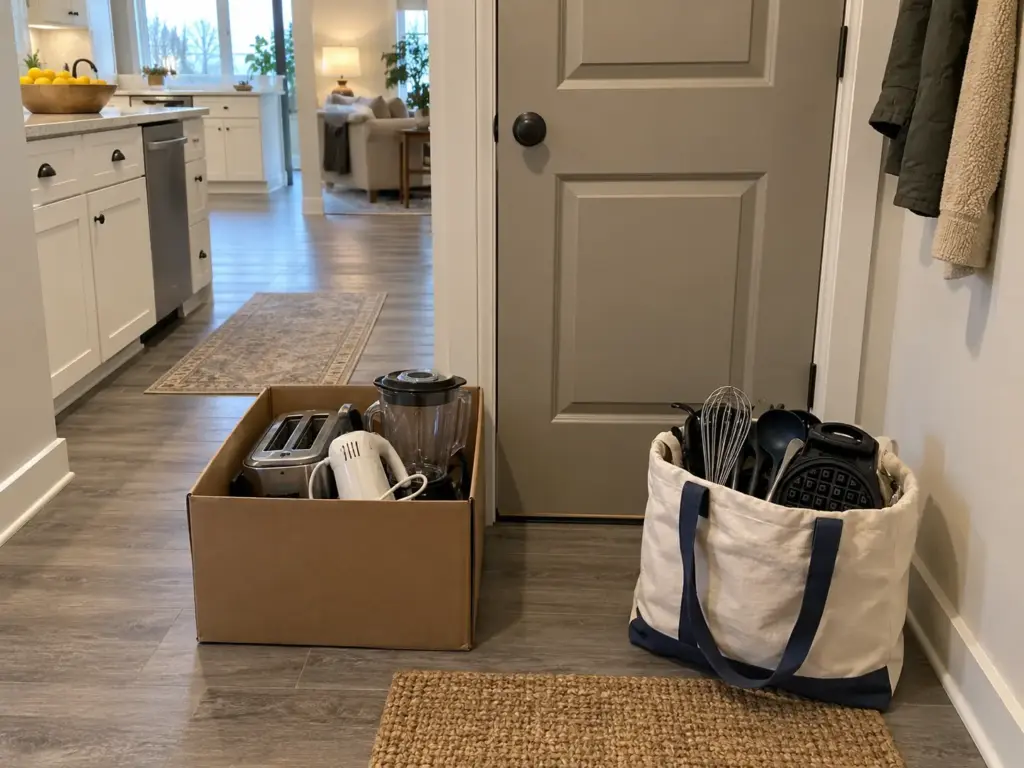
Working gadgets: thrift store, Buy Nothing or a friend
A working gadget has the most options. Thrift stores take them, and commenters add a few more routes: a Buy Nothing group (“Put them on Buy Nothing”), a list emailed to friends, neighbors and family on a first come, first served basis, a “Really Really Free Market” that works as a lending library for gizmos, people who cook a lot, or a stack taken to a resale shop. One commenter warns that volunteers sometimes put unfamiliar items straight in the skip, and suggests asking to take them to a different donation centre or listing them free or for pennies.
These are community reports, not guarantees. The box can go out on the same donation path as your clothes, which keeps it to one trip.
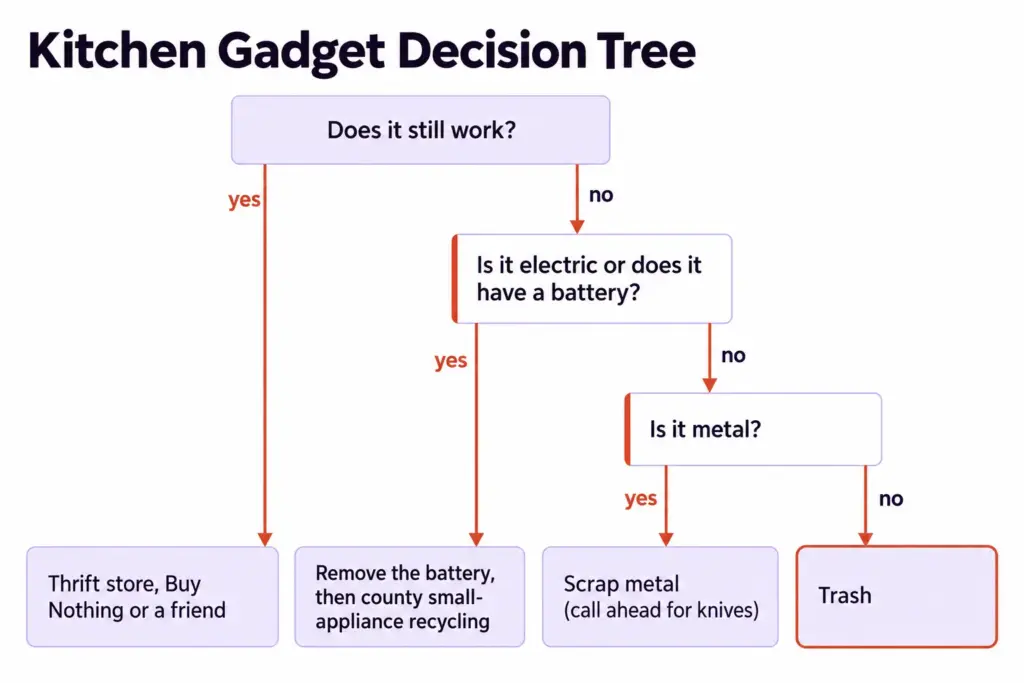
Call the thrift store or your county’s recycling line before you load the car, and ask two questions: do they take small appliances that work, and what do they do with knives. One phone call decides whether the box leaves in one trip or two.
Electrics and anything with a battery
A gadget with a battery leaves the drawer in two parts. According to the U.S. EPA’s guide to donating or recycling electronics, “Remove any batteries from your electronics; they may need to be recycled separately.” Do that before the box goes out the door.
Then split the pile by whether the thing still works and what it is made of. Ramsey County’s drop-off list for kitchen countertop appliances in Minnesota is one example of how a county does it: “If the item is still in working condition, donate it to a thrift store for reuse.”
The county accepts kitchen countertop appliances for free recycling, including blenders, food processors, mixers, toasters and rice cookers, and small electric items “must weigh less than 20 pounds.” Plastic or nonmetal parts go in the trash, and you recycle metal parts at the scrap metal bins. That is one county’s rule, not a national one, so look up your own county’s page before you drive anywhere.
Knives and broken metal
For a broken gadget, Gill’s advice in Forbes Vetted is to “check if parts are metal or plastic that can be recycled properly,” since many municipalities have specific guidelines for kitchen items. That split by material is what saves the trip: a heat-warped plastic part and a rusted metal one do not go the same way.
Knives are their own problem. A commenter on a home-storage blog reported that a charity refused old knives as hazardous, and replies suggested a church, a Buy Nothing group, a free-pickup listing, or metal recycling. One UK council, Worcestershire County Council, says “Household knives can be recycled in the scrap metal container at a Household Recycling Centre.” That is a UK rule, so check what your own county accepts: call your county’s recycling line or the scrap yard before the drive.
One Drawer, a Rental or a Shared Kitchen: Let the Space Set the Limit
You get a count from a list written for a big kitchen, or you cook in a rental kitchen where the single drawer next to the stove is the gadget drawer. A count from someone else’s kitchen cannot tell you what fits in yours. The same gadget gets a different answer depending on the drawer it has to live in, and two people sharing it add one more decision.
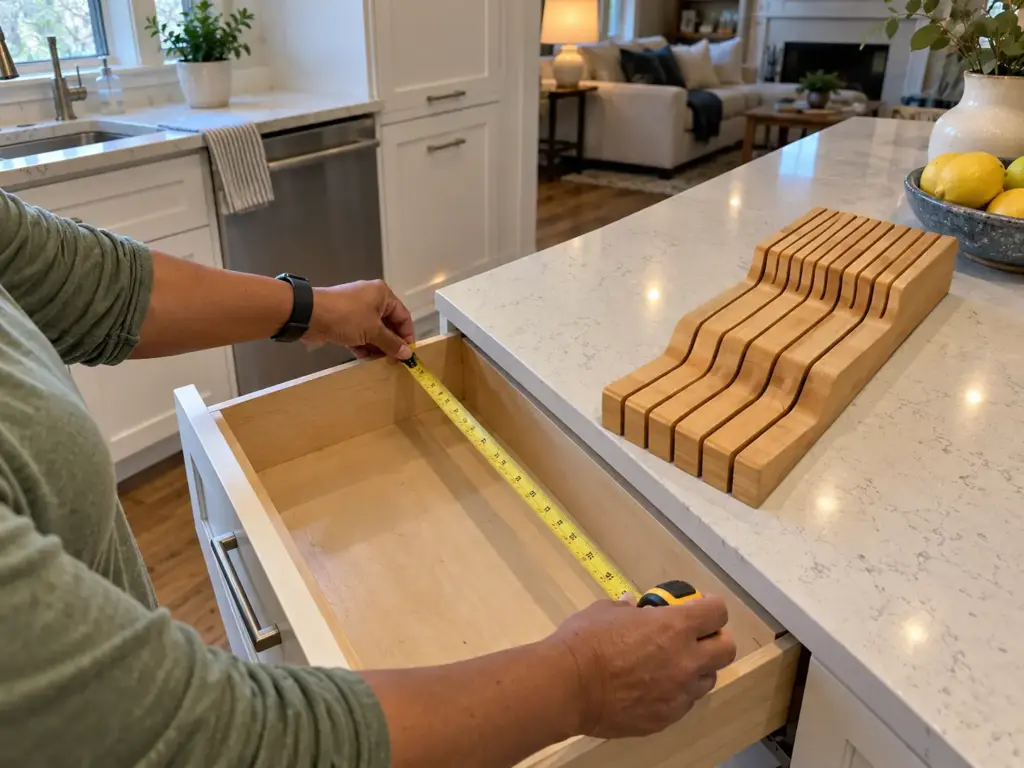
Measure the inside of the drawer, then decide
Measure the inside, not the front: the drawer face is wider than the box behind it. Take three numbers from the inside of the box: the length from one inner wall to the opposite one, the width the same way, and the drawer depth, from the floor of the drawer up to where the drawer still closes. Then compare each gadget’s footprint against those three numbers; that comparison is the fit test. “Keep going until it fits” is advice that only works once you know what fits.
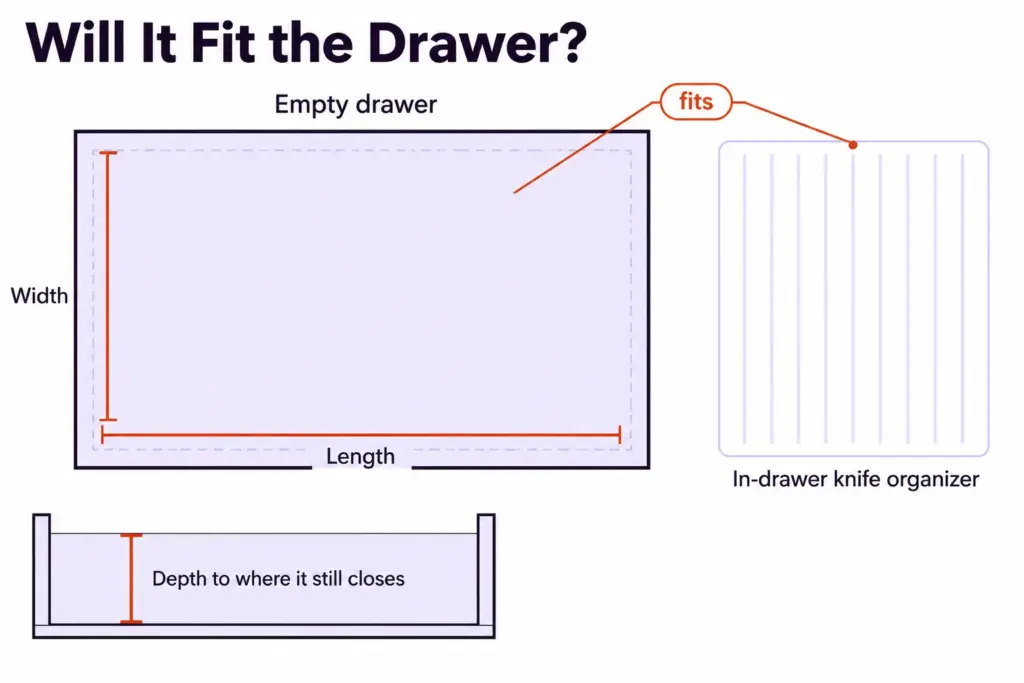
What goes inside once it fits is a separate job, and how to organize a utensil drawer so it fits whisks and tongs covers the interior depth for utensils. For the knives that stay, the free option comes first: the knife block already on the counter, or loose knives kept just as they are.
If you want them in the drawer, the Bambusi In-Drawer Knife Block Organizer measures 17 x 5.3 x 2 inches, so it takes 17 inches of the drawer’s length, 5.3 of its width and 2 of its depth. The drawer has to clear all three and still close. If the inside of your drawer is shorter than 17 inches, the block does not fit, and nothing replaces measuring first. The wall strip from the fourth section is the other route.
Measure with the drawer empty and the tape flat on the floor, then photograph the tape against the far wall. That photo goes shopping with you, so a 17-inch block is never a guess.
When the kitchen has one drawer
In a one drawer kitchen, one home-storage blog’s advice is to keep decluttering until everything you keep fits that drawer. That works once you add the part it leaves out: the drawer’s inside size is the budget, the use count decides who gets in, and anything that does not fit goes to a cabinet shelf, the dated box or out.
The cabinet shelf has a depth too, and it takes the monthly-or-less gadgets, so measure the cabinet depth the same way. A standard upper cabinet is about 12 inches deep and a lower one about 24, the same reference used in how to organize kitchen cabinets that stay neat. If your kitchen is short on drawers altogether, why a small kitchen with few drawers stays cluttered goes through the whole setup.
What a lease changes is where the box goes (no basement) and what can go on a wall. It does not change the count.
Two people, one drawer
An r/declutter commenter’s household downsized into a tiny new kitchen. One partner’s gadgets stayed, while the other gave up a toaster because the kitchen was tiny and a rice maker because the partner already owned the same one. For your own kitchen, whether the second person is a partner or a roommate, lay each person’s gadgets out separately, run the use count on each pile, and let the person who uses a gadget weekly keep it. Where you both own the same one, keep the better one.
Another commenter adds that friends who cook a lot may already own the pan you are about to buy, so ask around and borrow first. And when one person will not let go of anything, how to declutter with a partner who hoards is the place to go.
Keep it at the limit
Once the survivors fit, kitchen drawer organization ideas that last covers the layout. The quickest way back to a full drawer is the single-click purchase, an impulse buy; Forbes Vetted quotes Bonneau’s advice to sleep on it, since within a week you will probably have forgotten about it. The item-type guide names the other ways gadgets get in, and the rule for the drawer is one in, one out. It is a rule that slips, and why the one-in-one-out rule stops working by month three explains how.
A Drawer That Closes, a Box With a Date, and an Exit Plan
Three things carry the whole job. Empty one drawer, wipe it and sort like with like before you judge anything. Give every gadget a number, and let the knife you already own test the single-job ones. Decide each discard’s exit by what it is made of before the bag leaves, and fit what stays to the inside of the drawer, not the front.
In three months the dated box will have reached its release date, and the drawer, measured inside, should still close without a shoulder. If it doesn’t, the answer is in what came in since, and the item-type guide’s three-month check covers those doors.
Today, take everything out of the one drawer you fight with and set it on a table, wipe it dry, and put back only what you can name a recent use for. Write a date three months out on any cardboard box and drop the maybes in. Over the next week, watch which gadgets you reach for, and which ones you move aside to get to them.
Frequently Asked Questions
01How do I declutter kitchen gadgets?
To declutter kitchen gadgets, empty one drawer at a time, give every gadget a use count, and keep only the ones that meet it. Put the maybes in a dated box, then send each discard out by what it is made of.
02What is the 5-5-5 rule for decluttering?
The 5-5-5 rule, created by The Secret Slob, is a 25-minute timer split across five small zones, with five minutes spent in each before you move on. One writer found it works best without wildcards, such as a drawer of loose small parts spilled everywhere.
03What should I throw away when decluttering the kitchen?
Throw away broken, rusted or heat-warped pieces first, sorted by material, then duplicates and single-job gadgets that lost to the knife you already own. Everything else has an exit, such as a thrift store or Buy Nothing.
04What is the best way to organize kitchen gadgets?
Edit first, then organize: cut the drawer down to what you use, then measure its inside length, width and depth and fit what is left to those numbers. Layout comes last, after the edit.
05How many kitchen gadgets should I keep?
There is no fixed number for kitchen gadgets, because your own use count and the inside size of your drawer set the limit. Keep what gets used often enough to earn its place and fits the space without forcing the drawer closed.
Disclaimer: ClutterlessNest is a participant in the Amazon Services LLC Associates Program. As an Amazon Associate we earn from qualifying purchases. This article may contain affiliate links — if you buy through them, we may earn a small commission at no extra cost to you. We only recommend products we have tested or genuinely believe in.