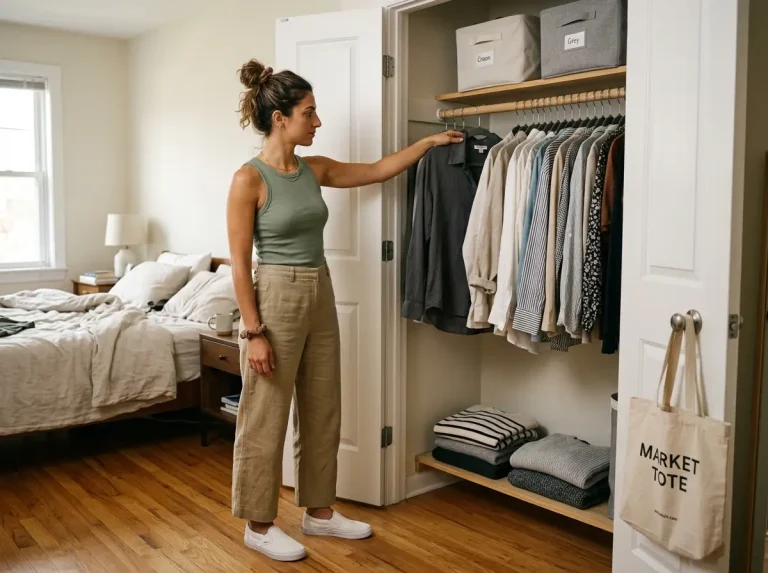

You spent a weekend building a capsule wardrobe, thirty-some pieces that all mix and match, everything you reach for actually getting worn. Then three months pass and the rod looks exactly like it did before you started: crammed, sagging in the middle, nothing to wear. The problem is almost never the clothes themselves. Ask anyone who has run a capsule through a full year and the same confession comes up, that the off-season half had nowhere to live, so it crept back onto the rod one “just for now” piece at a time. This guide is about organizing and storing a capsule you have already built: what hangs, what folds, where the other season goes, and how to keep the whole system from sliding back into a full closet with nothing to wear.
Quick Answer
Organize a capsule wardrobe in six moves, in this order:
- Edit down to the current season only.
- Group by category, not by color.
- Decide hang vs fold per garment (knits fold, structured pieces hang).
- Give the off-season half a fixed, labeled home before the first swap.
- Set the rod up for your closet’s real depth (measure first).
- Swap each season and run one-in-one-out so it never creeps back.
The Real Reason a Capsule Wardrobe Falls Apart (and How to Stop It)
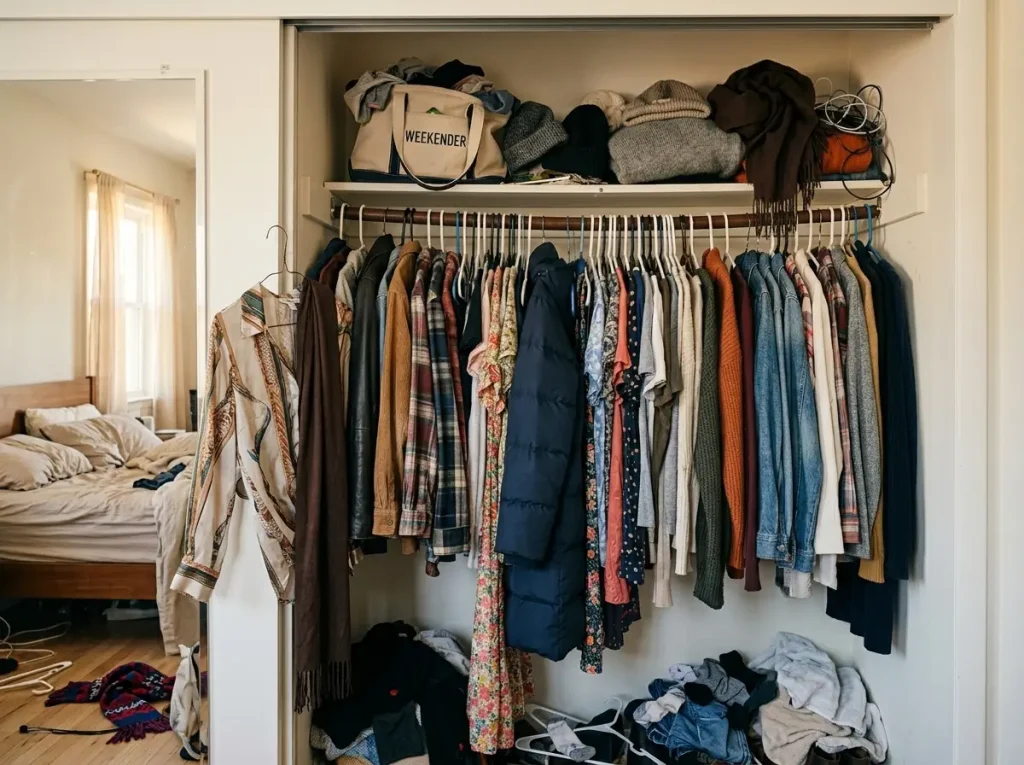
Most people blame themselves when the capsule unravels. They assume they bought too much again, or lack the discipline for it. The real cause is mechanical, and once you see it you can design around it.
The month-3 reversion, explained
A capsule is built around one season at a time. The classic structure, Project 333, is 33 items worn for three months, which means by design roughly half of what you own is out of rotation at any given moment. That out-of-season half does not evaporate, it has to physically sit somewhere. When it has no assigned home, it sits on the rod, because the rod is right there and putting it away “later” feels easier in the moment.
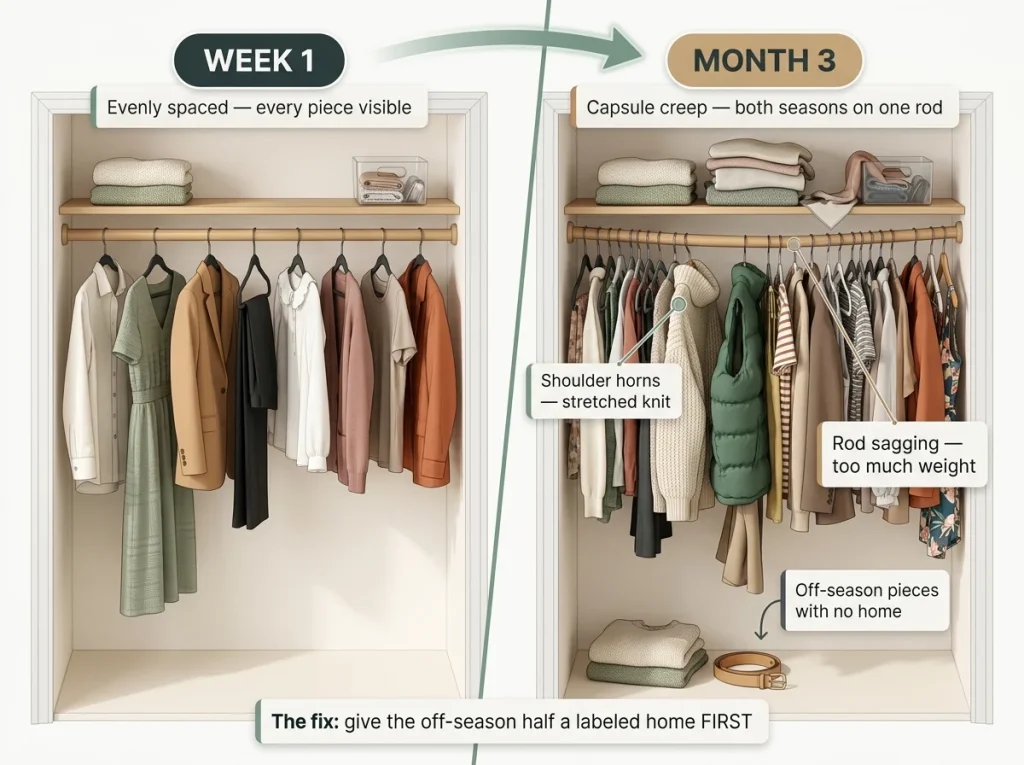
That slow migration has a name in organizing circles: capsule creep. A heavy sweater you wore once in a warm spell goes back on the rod instead of into storage. The swim coverup you keep “just in case” never leaves.
Three months in, you are back to a double-stuffed rod and the quiet shame of a closet you just organized. The pile even has a nickname, the closet of shame, and almost everyone who has tried a capsule has one.
Why “owning fewer clothes” isn’t the fix
The common advice is to cut deeper. Own less, the thinking goes, and the closet stays neat. But a 30-piece capsule already fits comfortably in less than one person’s standard rod allotment, so raw volume was never the real constraint.
You can own very little and still end up with a crowded rod if both seasons are competing for the same three feet of space. It is a storage problem wearing the costume of a clutter problem. This is the same reason a small closet gets messy again a few weeks after you organize it.
The fix that has to come first
The single move that prevents the month-3 collapse is deciding where the off-season half lives before you swap anything, not after. A labeled bin, a breathable bag, a rolling rack, whatever fits your space, chosen and set up first. Think of it as carving out a dedicated capsule space, with the off-season half housed somewhere it cannot drift back from.
When the off-season clothes have a real address, they go to it. When they do not, they default to the rod. Everything else in this guide assumes you have given that other season a home, so the rest of the system has room to work.
Edit Down and Group What You Actually Wear

You cannot organize a pile you have not edited. Declutter first, always: the capsule only works when the count is honest, and the grouping only works when you can see what you own at a glance.
Pull it all out and make the three piles
Take everything off the rod and out of the drawers. All of it, onto the bed, so you are working with the full picture instead of the convenient front layer. Then sort into three piles: keep for this season, store for the off-season, and donate.
The donate pile is where most people stall, so keep a grocery bag open beside you and the decision stays light. If you have not worn it in a year and it still has no clear role, it goes in the bag.
Group by category, not by color
Color-sorting photographs beautifully and hides your duplicates. Group by category instead: tops together, bottoms together, outerwear, dresses, then accessories. When all your tops live in one place you can finally see that you own four nearly identical white tees, which is the information that keeps you from buying a fifth. This connects back to the broader clothing organization system your capsule plugs into, where one universal setup branches out by space.
Run a quick pairing test as you keep pieces. Every top you keep should work with at least three bottoms. If a blouse only pairs with one skirt you no longer own, it is not earning its hanger, no matter how much you like it.
Count to the season (the Project 333 ceiling)
Pick a ceiling and hold to it. The original Project 333 challenge sets it at 33 items for three months, counting clothing, shoes, and accessories together. You do not have to land on exactly 33.
The point is having a number at all, because a capsule without a ceiling is just a smaller wardrobe waiting to grow back. Whatever falls outside the number is not in limbo, it is your off-season half, and it needs the home you set up in the last section.
Hang It or Fold It (the Decision Rule Nobody Gives You)
Every guide tells you to fold some things and hang others, then leaves you to guess which is which. The rule is not a matter of taste. It is physical, and once you know the mechanism you never have to wonder again.
Fold the knits (and why hanging ruins them)
Knit fabric is interlocking loops, not a woven grid, so it stretches under its own weight. Hang a sweater and gravity slowly pulls those loops long, especially anywhere warm or humid. Over a season you get a stretched, sagging shape and two permanent bumps at the shoulders where the hanger pushed up. People call those shoulder horns, and most do not notice them forming until the sweater is already ruined.
The mechanics are well documented by garment-care specialists, who note that knit loops stretch permanently under a hanger’s pull. So sweaters, knit tops, and anything stretchy get folded.
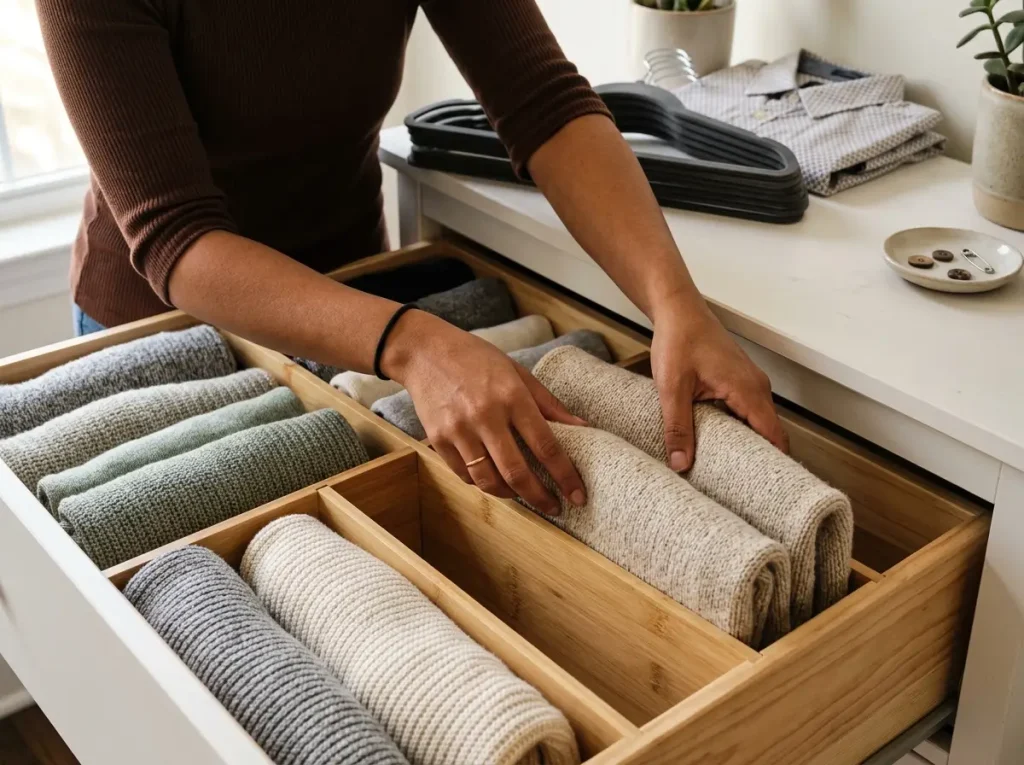
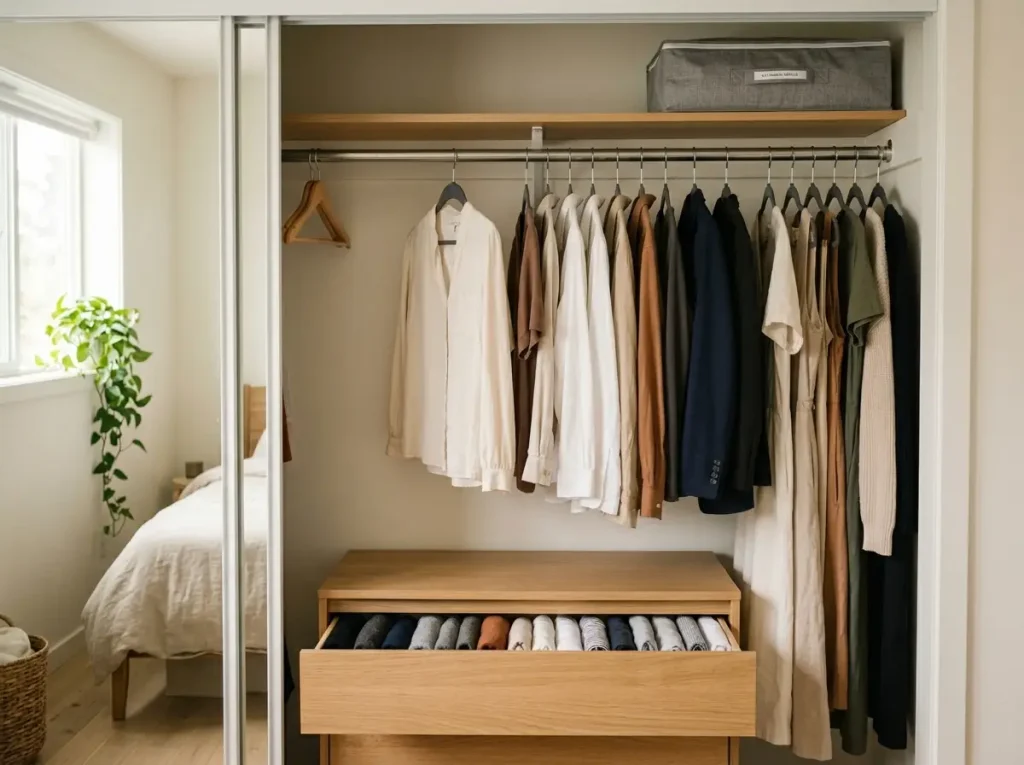
The best way to fold them is upright, file-folded the way the KonMari method files clothes, so each piece stands on its edge like a folder in a drawer, which lets you see every top at once instead of digging through a stack. The catch is that vertical folds collapse into a flat pile within a week without something holding them up.
Before reaching for a product, a row of cereal or shoe boxes cut down to your drawer’s height does the job for nothing. If you want it to look and feel better, a set of Bamboo Drawer Dividers adjusts to span most standard drawers and keeps each file standing. Measure your drawer’s interior height first, since the dividers sit around two and a half inches tall and very shallow drawers can need a shorter solution.
Hang the structured pieces (and why folding ruins them)
The instinct, once you start folding, is to fold everything so the rod looks empty. That is exactly how you end up opening a drawer to a wall of creased blazers that all need re-ironing. Structured and tailored pieces are the opposite case from knits: blazers, button-down shirts, trousers, and most dresses are sturdy enough to hold their shape under gravity, but folding crushes their built shoulders and presses in wrinkles that only an iron removes. So they hang.
The hangers and dividers that make it hold
Here is where one upgrade actually pays off. You do not need to replace every hanger you own, sturdy coats and jeans are fine on whatever you have. But knits and slippery tops slide off thin wire and bunch up, and mismatched hangers waste rod space because they all sit at different depths. Switching the hanging half of your capsule to matching slim velvet hangers reclaims a surprising amount of rod, since their thin non-slip profile lets garments sit closer without sliding.
A 50-pack of Zober Premium Velvet Hangers covers a full capsule with room to spare, and the uniform profile is what makes a small rod read as calm instead of chaotic. The one honest caveat is that the velvet flocking wears thin at the notches after years of heavy use, and these are not the hanger for a heavy winter coat, which wants a wide wooden or padded hanger instead. It is worth seeing how much rod space a switch to slim hangers actually frees up before you write off your current closet as too small.
Set Up the Off-Season Storage Before You Need It
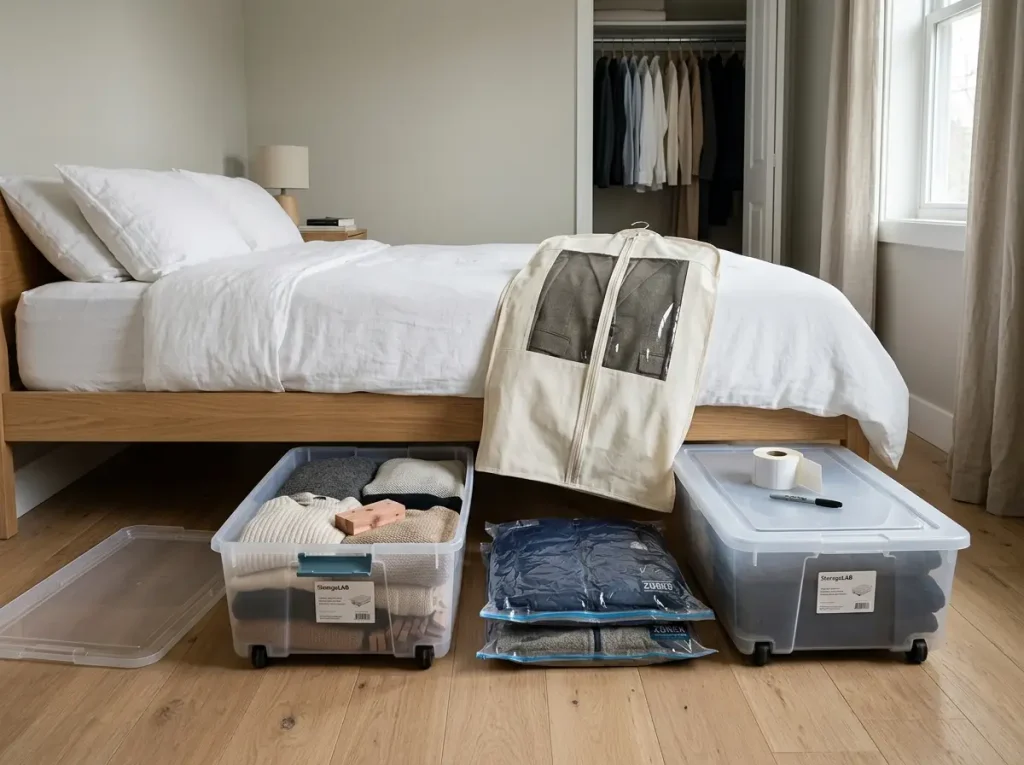
This is the section the fashion blogs skip, and the one that actually decides whether your capsule survives past month three. Done right, the seasonal swap is a ten-minute job: lift one container out, slide the next one in. Done wrong, it is a full re-organization every quarter, which is why so many people skip it until both seasons have blurred back together on the rod. Connect this to why a seasonal closet rotation fails when the off-season half has no fixed home and the whole pattern clicks.
One bin per season (rotate as a unit)
The trick that makes the swap fast is treating each season as a single unit. Pack the off-season half into one labeled container, sometimes called a seasonal kit, so you are never re-sorting individual pieces at the swap. You pull the winter kit out, the summer kit goes in, done. Repurposed boxes you already own work perfectly well for this, since the rotation does not care what the containers are, whether clear plastic totes, stackable storage bins, or old cardboard boxes, as long as you label each kit clearly with a marker or a label maker so the seasons never blur together.
Breathable or airtight — what to vacuum-bag and what never to
This is the decision that quietly ruins clothes, and it is about material, not money. Synthetic bulk, think puffer coats and fleece, compresses beautifully and takes the squeeze without harm. Vacuum bags get recommended for everything, and they do work, until you pull a wool coat out in October that has been pressed flat and lifeless for six months. Natural fibers like wool, cashmere, and silk should never be vacuum-compressed long term, because the crush damages the fiber and it does not bounce back.
For the synthetic side, a variety pack of ZOBER Vacuum Storage Bags shrinks a season of puffers and fleece to a fraction of the space. Budget versions from the dollar store seal fine for the first year, though the cheaper valves tend to lose their grip over time.
For everything natural, you want breathable. A cotton pillowcase with a small hole cut for the hanger hook is a genuine DIY garment bag for a single piece. For protecting several structured or natural-fiber pieces together, a MISSLO 60-inch Cotton Breathable Garment Bag is long enough to cover dresses and coats, and the cotton lets the fabric breathe instead of trapping the musty smell plastic does. It protects and holds shape, but it does not compress, so it is a hanging solution, not a space-saver.
Where the off-season half lives when there’s no spare room
For most renters there is no attic and no spare closet, so the off-season half goes under the bed. That only works if you measure the clearance first. A platform bed often leaves only four to seven inches underneath, while a metal frame gives you more like seven to nine, and a rigid tote that is an inch too tall simply will not slide under.
A set of StorageLAB Under-Bed Storage Containers rolls out on wheels for the swap and is the fixed, labeled home that keeps the off-season clothes off the rod, though it does want a few inches of clearance to roll. If your bed sits lower than that, a flat collapsible fabric bag squeezes into a tighter gap, and a set of bed risers can buy you a few extra inches without modifying the frame.
Keep the moths off stored wool
Anything wool going into long storage needs protection, and you do not need chemical mothballs for it. A handful of Homode Cedar Blocks tucked into the totes and garment bags deters moths naturally, and a light sanding each season refreshes the scent once it fades. Lavender sachets do a similar job for less if you already have them, just know the scent is shorter-lived than cedar.
Always wash or dry-clean clothes before they go into off-season storage. Moths are drawn to the sweat and food traces left on worn clothes, not the fabric itself, so a stored piece that looks clean but was worn once is exactly what gets eaten. Clean clothes, sealed container, cedar inside. That’s it.
Make It Work in a Rental Reach-In Without Drilling

Every other capsule guide seems to assume you have a walk-in. Most renters have a shallow reach-in with one rod and one shelf, and the system still works in it. You just have to measure first and build with no-drill zones instead of installed shelving.
Measure before you buy anything
Closet depth decides what fits, and rentals run shallow. A standard reach-in is about 24 inches deep, but a tight rental one often runs closer to 22, and that difference is exactly enough to make bulky hangers and bins crowd the opening. The rod itself needs to sit at least a foot off the back wall or your hangers knock against it.
For planning the rod, standard closet guides allow about two and a half inches of space per garment, which works out to roughly 16 hangers per linear foot, fewer for blazers and more for thin tops. That math lets you know before you buy whether your capsule actually fits the rod you have.
The no-drill toolkit (tension rod, removable hooks)
You can add real storage to a rental closet without a single hole. A spring tension rod from the dollar store adds a low second hang zone for shorter items, or partitions off the off-season side, and holds a light load fine. For something sturdier that carries more weight, the Home in Bold Tension Rod Shelving expands to fit and gives you a renter-friendly, no-drill shelf or second rod, just measure your closet’s interior width before ordering so the expansion range covers it. Removable over-door hooks and adhesive strips handle belts, bags, and scarves, the accessories that otherwise eat rod space.
When there’s no second closet (the freestanding rack)
If your reach-in genuinely cannot hold both the active capsule and the overflow, the answer is not to cram harder. The usual advice is to add a second rod inside, but in a 22-inch reach-in a second rod just doubles the crowding in the same shallow box. Before you spend anything, move the off-season half under the bed and see if that alone clears the rod.
If you are still short on space, a freestanding garment rack like the SONGMICS Rolling Garment Rack gives you an overflow rod that rolls wherever you have a wall, and in a room with no closet at all it becomes the main rod. It does claim some floor space, so it is the move for when the no-cost options are genuinely tapped out. When even that is not enough, the sibling guide on how to organize clothes when there’s no real closet at all goes deeper on no-closet setups.
Keep It From Creeping Back
Organizing the capsule once is the easy part. Keeping it a capsule is where almost everyone loses the thread. Two small rules carry most of the maintenance, and neither takes more than a few minutes.
The seasonal swap as a 10-minute routine
The swap stays quick only because you set the off-season home up first. When each season is already a packed, labeled kit, changing over is lifting one container out and sliding the next one in, then spending five minutes hanging and folding. If the swap feels like a project every time, that is the signal your off-season storage is not actually set up, and the system will keep reverting until it is.
One-in-one-out (the rule that stops capsule creep)
This is the rule that holds the count. Every time a new piece comes in, one piece leaves, so the capsule physically cannot grow past its ceiling. It sounds rigid and it takes about a month to become automatic, but it is the difference between a capsule that holds for years and one that quietly swells back into a full closet by spring.
At the start of each season, turn all your hangers so the hooks face backward. As you wear and rehang things, the hook flips to normal. At the next swap, anything still facing backward is something you never wore, which makes it an easy call for the donate bag.
The quarterly edit (re-evaluate while everything’s already out)
The swap is the natural moment to edit, because the clothes are already out of storage and in your hands. As you pack away the season that just ended, pull anything you did not actually wear into the donate pile right then.
The discipline is the same one professional organizers lean on for any system that has to last: a fixed home plus a fixed rule beats a pretty setup every time. Do that small edit four times a year and the capsule never gets the chance to drift. For the wider maintenance picture, the hub on building a closet system that still works three months in carries the same idea past the capsule.
The System in Three Lines
Three things keep a capsule from collapsing. The off-season half reverts because it is homeless, so give it a labeled home before you do anything else. Fold the knits and hang the structured pieces, because the rule is physical, not a matter of taste. And measure your closet’s real depth before you buy a single organizer, because a 22-inch reach-in plans differently than a walk-in.
In three months, open the closet and look at the rod. If it is as evenly spaced as it was in week one, the off-season home is doing its job. If it is crowding again, the overflow found its way back, and the fix is a bigger or closer home for it, not a deeper purge.
Start with the off-season half. Give it a home before anything else, and the rest of the capsule falls into place around it.
Frequently Asked Questions
01How many pieces should be in a capsule wardrobe?
Most capsules run about 25 to 40 pieces for a single three-month season, and the original Project 333 sets it at 33 including clothing, shoes, and accessories. The exact number matters less than picking a ceiling and storing everything outside it off-season.
02How do you store a capsule wardrobe between seasons?
Store the off-season half in a fixed, labeled container before you swap. Use breathable cotton bags for wool and silk, vacuum bags only for synthetic bulk, and keep them under the bed or on the top shelf. The key is deciding the home before the season changes, not after.
03Should you hang or fold capsule sweaters?
Fold them. Knits stretch permanently under their own weight on a hanger and develop bumps at the shoulders, so sweaters and stretchy pieces go in a drawer, file-folded upright with dividers to keep them from collapsing.
04Can you keep a capsule wardrobe in a small rental closet?
Yes. A 30 to 40 piece capsule fits a shallow reach-in if you measure first, fold the knits into a dresser, and move the off-season half under the bed. No-drill tension rods and a freestanding rack handle the overflow without touching the walls.
05How often should you refresh a capsule wardrobe?
Re-edit it once each season, at the quarterly swap, while everything is already out. Pull anything you did not wear into the donate pile and run one-in-one-out the rest of the season so the count holds steady.
Disclaimer: ClutterlessNest is a participant in the Amazon Services LLC Associates Program. As an Amazon Associate we earn from qualifying purchases. This article may contain affiliate links — if you buy through them, we may earn a small commission at no extra cost to you. We only recommend products we have tested or genuinely believe in.