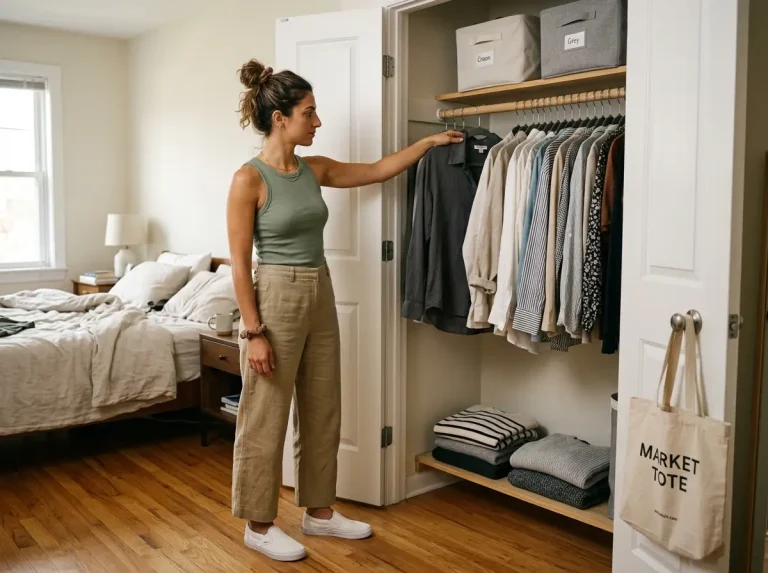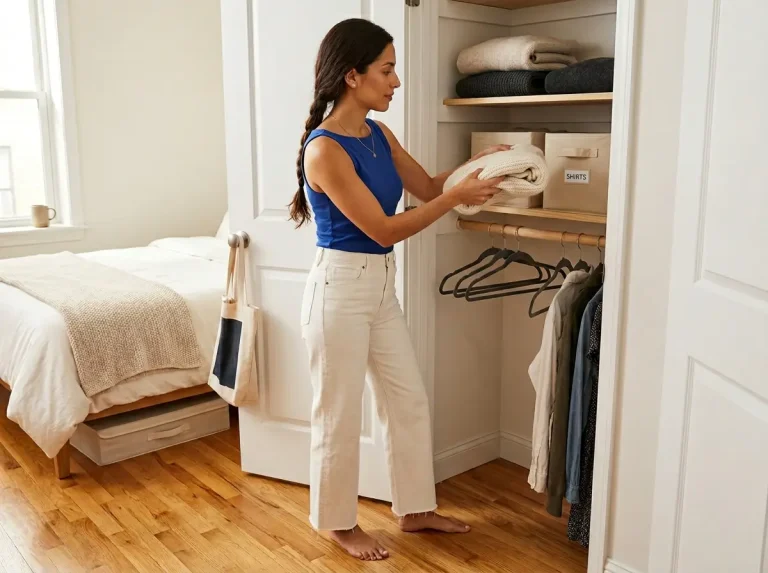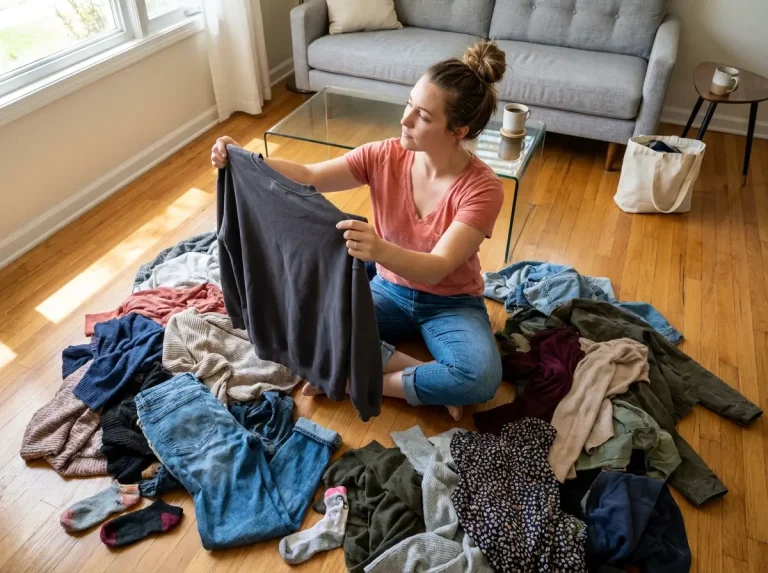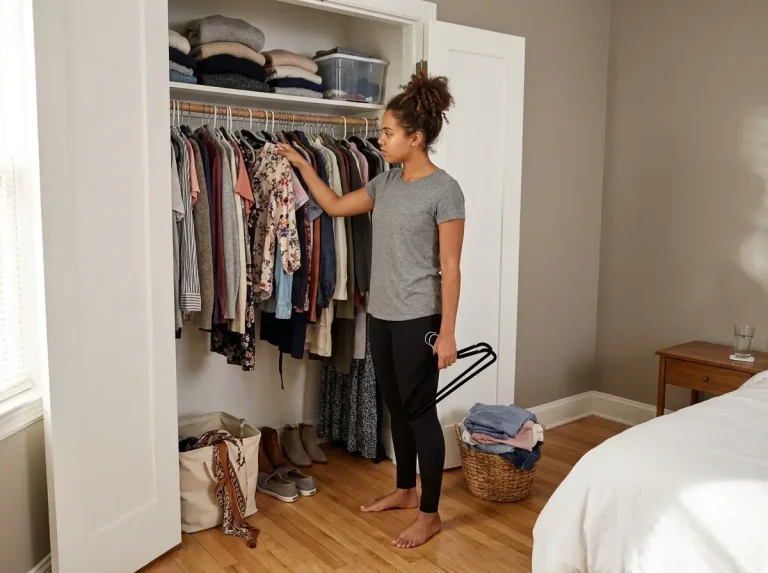

You moved into a place with no closet (an older apartment, a studio apartment, a dorm room, a kid’s room that was never built to hold a wardrobe), and now your clothes live on a chair, the floor, and a rack that’s already leaning. Here’s what nobody tells you: the problem was never that you own too much. It’s that nothing has a fixed home, so everything reads as mess. Figuring out how to organize clothes without a closet is less about buying furniture and more about deciding what goes where, then making the open setup look like you meant it. The same failures show up over and over in no-closet threads: the cheap rack that bows by month two, the open rail that looks like a laundry pile within weeks. Both are avoidable. This guide is the no-closet deep dive on organizing your clothes, from what to hang versus fold to what to actually buy, how to use the dead space, and how to keep it from sliding back into chaos.
Quick Answer
No closet means building one from open pieces, then keeping it disciplined. Here’s the order that works:
- Edit down to what you actually wear, so you store less.
- Split your clothes: hang structured pieces, fold the rest.
- Pick a hanging solution that won’t sag under a full load.
- Add folded storage: cubes, shelves, or furniture you own.
- Use under-bed, wall, and door space for everything else.
- Make it uniform so the open setup looks intentional.
Start by Sorting What to Hang and What to Fold
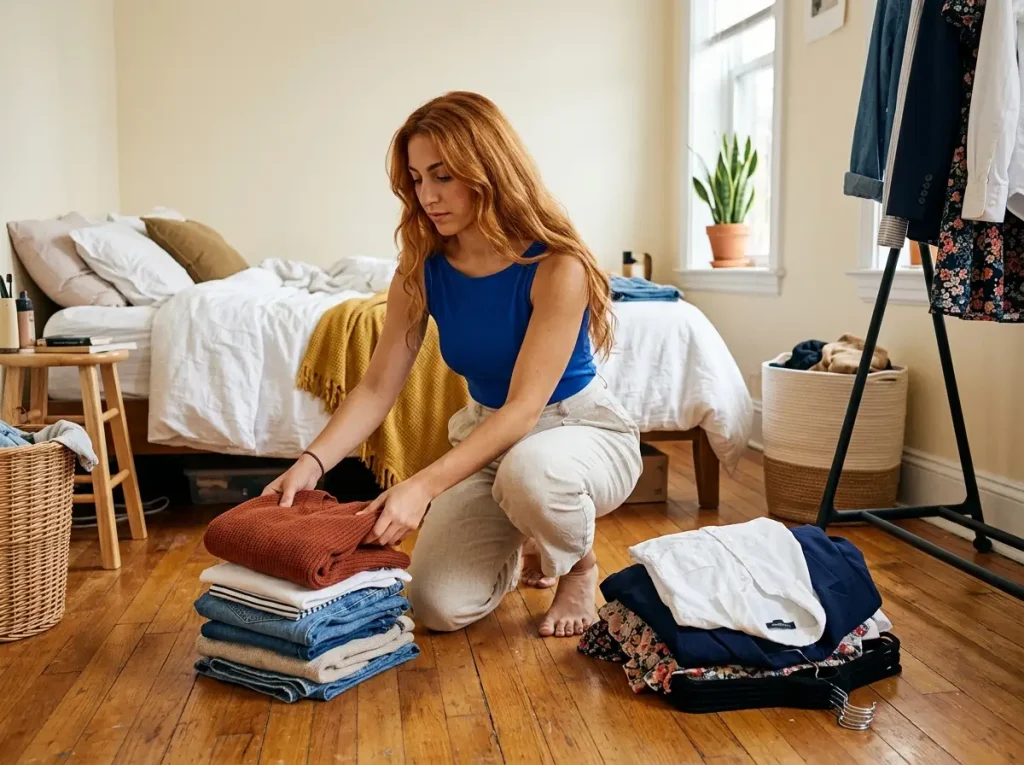
Before you buy a single rack, dump everything onto the bed. Every no-closet system that works starts here, with a pile and two decisions: what hangs and what folds. Skip this step and you’ll buy storage for clothes you don’t even wear, which is how a small room fills up fast.
What belongs on hangers (and why)
Hang the wrinkle-prone pieces, the ones that crease or hold a shape: button-downs, blouses, dresses, blazers, anything structured. These lose their crispness the second they sit folded in a stack, and on an open rack they’re also the pieces that make the whole setup look pulled together. Keep them grouped so the rack has a clear dressy zone instead of a random mix.
What to fold instead, and the sweater-stretch rule
Fold your knits, denim, and tees. Here’s the detail that trips people up: a sweater on a hanger stretches and bags at the shoulders within a season, because the weight of the knit pulls down on those two narrow contact points. Folding protects both the fibers and the shape. Organizing communities repeat this one constantly, usually right after someone posts a photo of a favorite sweater with permanent shoulder horns.
Fold knits and tees so they stand on edge like files instead of lying in a flat stack. You see every item at once, and pulling one out doesn’t topple the rest. It’s the KonMari file-fold, and a shelf suddenly holds noticeably more.
Edit first so you store less
The fastest way to make a no-closet small bedroom feel calm is to own fewer clothes in it. Pull everything out, then be honest about what you haven’t worn in a year, the same instinct behind a capsule wardrobe. You’re not organizing your whole wardrobe, you’re organizing the wardrobe that fits this room. If the edit feels overwhelming, start by paring down to what you actually wear before you give anything a home. Roughly half of most wardrobes doesn’t need to hang at all, which means a smaller rack and a lot less visual clutter.
Pick a Hanging Solution That Won’t Sag by Month Two
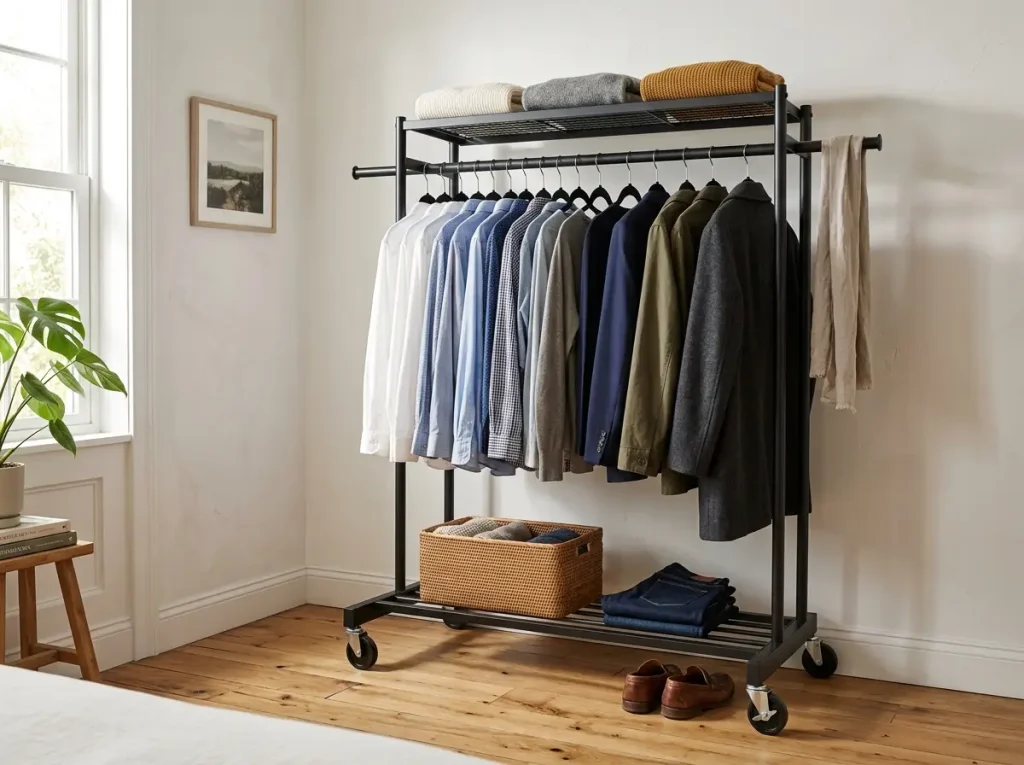
The standard advice is to grab any cheap rolling rack and call it done. And it works, honestly, for about a month. Then the thin tube bows in the middle, the casters splay outward, and you’ve got a rack doing its best impression of a hammock. “It sagged in the middle” is the single most repeated no-closet complaint, and it’s completely preventable.
Why the cheap rack sags (and the numbers behind it)
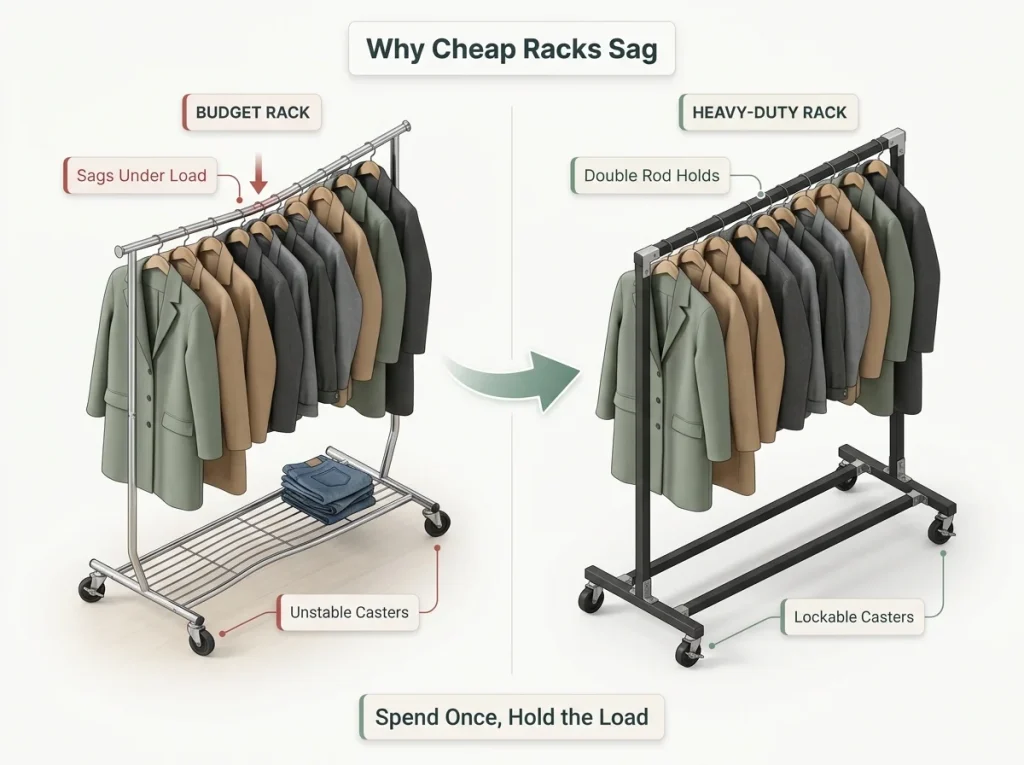
The problem is the rating on the box. A rack might claim it holds a few hundred pounds, but that’s the whole-frame load capacity. Each individual rod is often rated for a fraction of that, and the bottom shelf even less, so a full row of winter coats plus a stack of jeans below pushes past what the thin tube can take. Wider-gauge steel and a double rod are what hold the line.
What a buy-once rack actually looks like
If your load is light, a basic single-rod rail does the job for very little, and there’s no shame in that. You don’t need a bulky armoire or a full freestanding wardrobe eating half the room either. But if you’re hanging a real wardrobe, spend once on a heavy-duty rack with thick steel tube, a double rod, and lockable wheels. The SONGMICS Rolling Garment Rack is the sturdy middle ground, extendable, rated for a few hundred pounds, with casters that lock so it doesn’t drift across the floor when you yank a coat off. The one caveat: it’s wide, so measure before you assume it’ll tuck into a corner.
Measure the footprint and rod height first
Garment racks run roughly two feet deep and five to six feet wide, and full-length dresses need a closet rod set high enough to clear the floor. Tape the footprint onto the floor before you buy, the same way you’d measure the space before you commit to anything in a built-in closet. A rack that’s too wide for the alcove is the second most common return, right after the saggy one. Measure first.
Fold the Rest Into Shelves, Cubes, and Furniture You Already Own
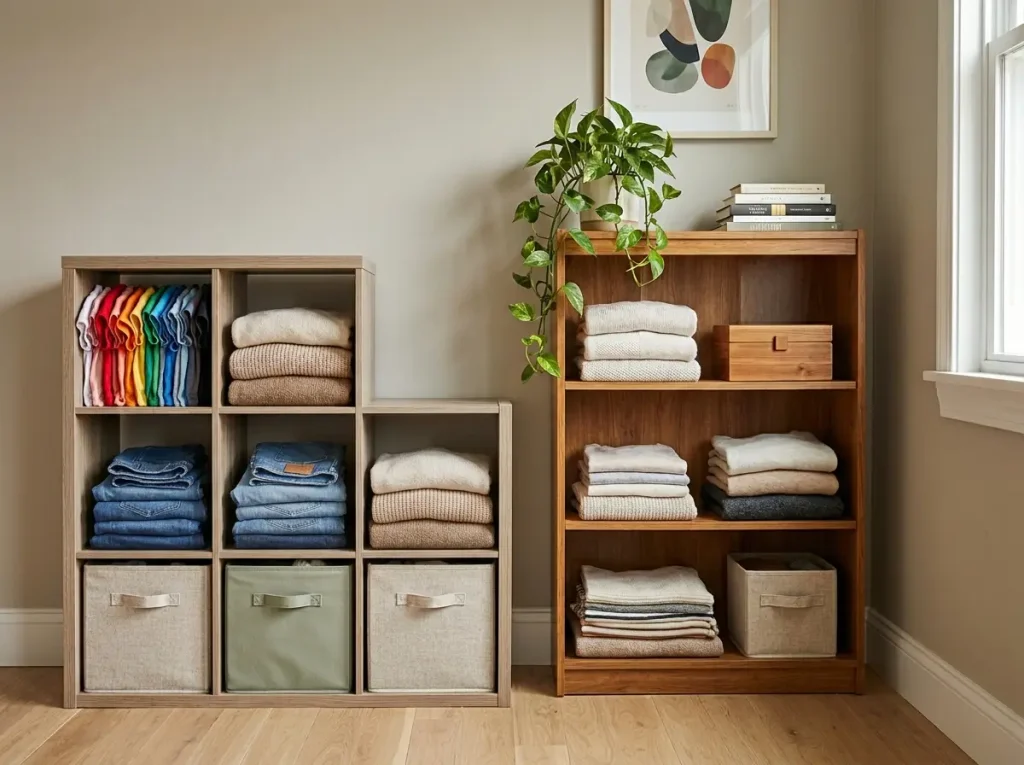
“No dresser, no closet” is its own special starting point, and the good news is you almost certainly already own the fix. A dresser is just a box with shelves. A bookshelf, a sideboard, an old TV stand, even a sturdy trunk can hold folded clothes today, for free, before you spend a cent.
Cube units and shelves as a dresser stand-in
If you’ve genuinely got nothing to repurpose, a freestanding cube organizer is the most flexible buy (floating shelves work too, if your lease lets you mount them). The AWTATOS Stackable Cube Organizer works as a dresser substitute with no drilling, and the modular cubes tuck into corners or slide under a window. Drop fabric bins or woven baskets into a few of the cubes for socks and underwear so the open shelves don’t look busy. It won’t hold as much as a deep dresser, so reserve it for your most-worn folded pieces and send the rest off-season. For more ways to store folded clothes without a dresser, the sibling guide covers the full range.
Repurpose furniture you already own first
Look around before you shop. A bookshelf becomes cubbies. Multi-functional furniture like a storage bench or a storage ottoman hides off-season knits under the seat. The cheap-rail-plus-a-cube-unit setup that gets passed around no-closet threads covers both hanging and folding for less than the price of one fancy bin set. The point of an open wardrobe isn’t to buy a matching system, it’s to make what you have do the job.
Fold so stacks stay upright
Flat stacks are where folded storage falls apart, because pulling the bottom shirt topples the pile and you quietly give up. File-fold instead, so each item stands on its edge and you can see everything at once. Match the bin or shelf depth to the fold so nothing tips into the gap behind it, the same trick that keeps folded stacks from sliding into each other on any open shelf.
Use the Dead Space Under the Bed for Off-Season Clothes
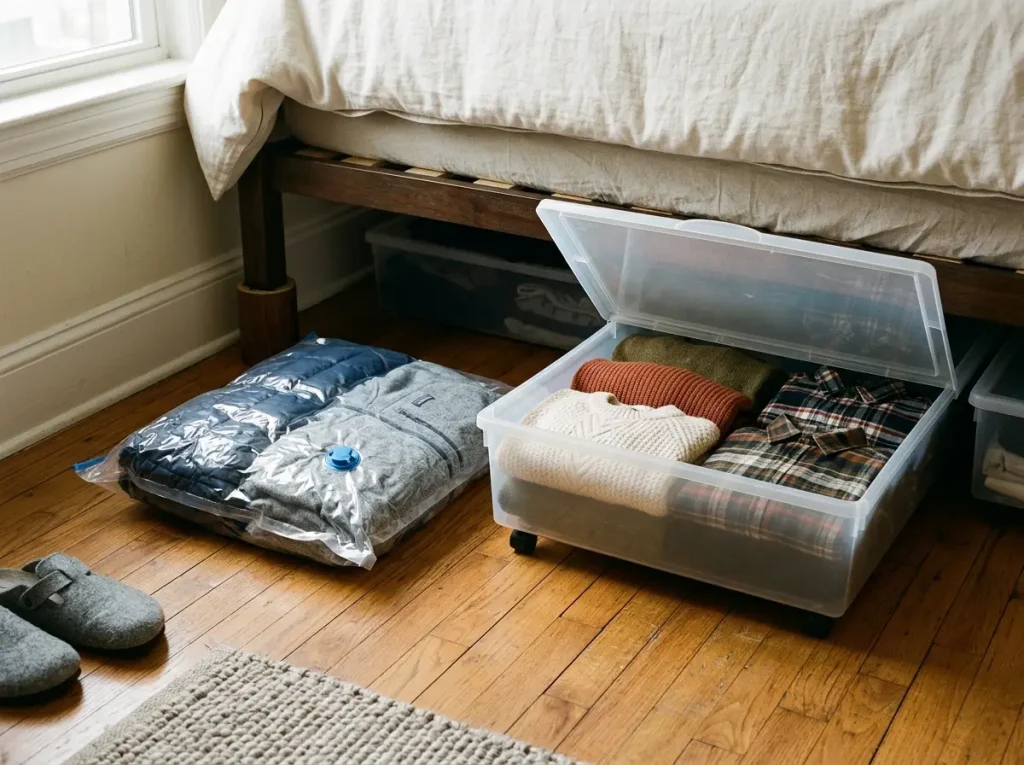
The biggest unused storage zone in a no-closet room is the dead space under your bed, and it’s exactly where off-season clothes belong. The catch is clearance. Buy bins before you measure and you’ll end up with boxes that won’t slide under the frame, which is a uniquely annoying way to waste an afternoon.
Measure your clearance first
Clearance varies wildly. A low platform frame might leave only a few inches, which needs flat, shallow containers; a metal frame on legs gives you enough room for rolling bins; bed risers add a few inches without modifying anything. Measure the gap, then match the bin height to your clearance instead of guessing in the store.
Measure floor-to-frame at the lowest point, not the highest. Bed frames sag a little in the middle, and the bin has to clear that spot or it’ll jam halfway in and stick out the side.
Bins and rolling drawers that fit low frames
Rolling drawers on casters are easiest for clothes you reach for often, since you’re not dragging a loaded bin across the floor by its lip. For a platform bed, look for the flat under-bed boxes built for tight clearance. Either way, keep these for folded items you’re not pulling daily, and label the ends so you’re not opening three to find the scarves.
Compression bags: what to compress and what to never
Vacuum bags get recommended for everything, and they’re genuinely great, until you seal the wrong thing. The SpaceSaver Vacuum Storage Bags crush bulky synthetics, puffer jackets, fleece, and spare bedding down to a fraction of their size, which is perfect for under a bed. But never vacuum-seal wool, down, or cashmere for months at a time, because compression crushes the loft and the fibers don’t fully bounce back. Those belong folded with a cedar block, not flattened. And for non-delicate off-season clothes, honestly, a suitcase you already own does the same job for free.
Claim Wall and Door Space Without Drilling
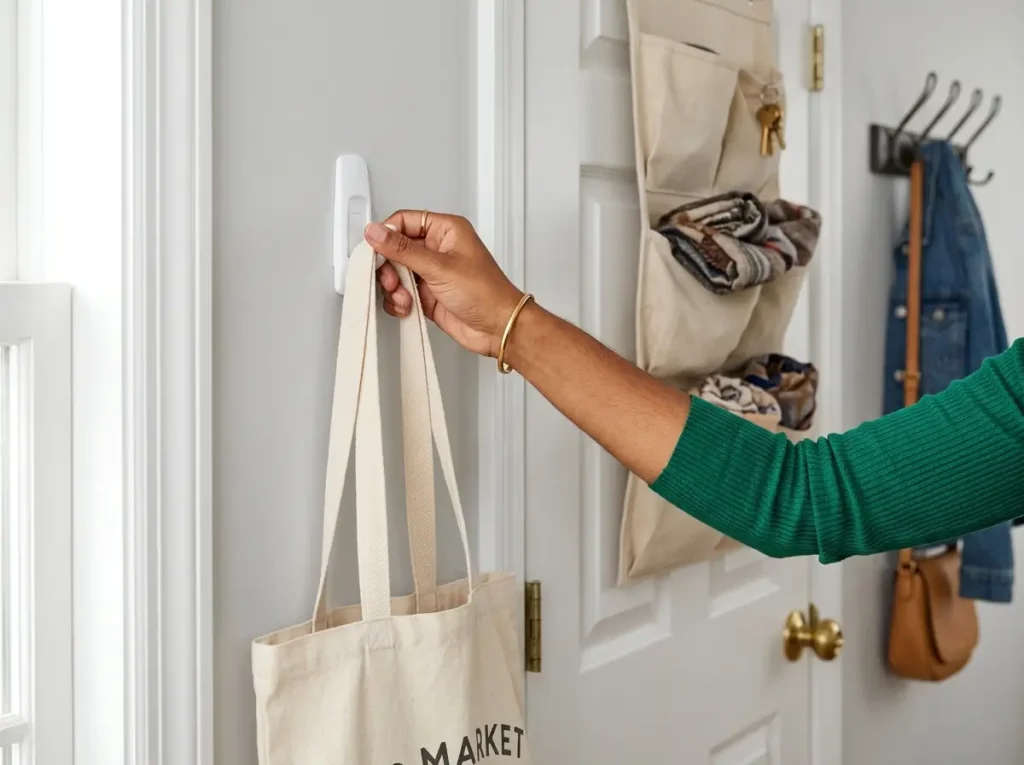
Walls and the backs of doors are free real estate, and renters tend to freeze here because they assume it means drilling. It usually doesn’t. Lead with the removable stuff that moves with you, and treat mounting as a bonus only if your lease allows it.
No-drill first: adhesive hooks and over-the-door organizers
Adhesive wall hooks and an over-the-door organizer carry daily coats, bags, and accessories with zero holes. Just respect the weight limits, because an overloaded hook peels off the wall at 2 a.m. and takes a chip of paint with it. Standard adhesive hooks hold only a few pounds, and the heavyweight versions hold more, so it’s worth a look at 3M’s official weight limits before you trust one with a loaded tote.
When you can mount a wall rack
If you can’t drill, Command Heavyweight hooks give you a no-hole version of the same idea. If you can, a wall coat rack or a small pegboard near the door is the move for daily-rotation layers, the jacket and bag you grab on the way out, so they never land on the chair instead. The Amazon Basics Wall-Mounted Coat Rack is a simple eight-hook option that keeps those pieces off your main rack. It does need screws and wall anchors, so it’s an owner-or-flexible-lease pick rather than a true renter one.
Turn the back of the door into a wardrobe wall
The back of the door is the surface everyone forgets. An over-the-door organizer turns it into a second wardrobe wall for shoes, scarves, and accessories, and it lifts right off when you move out. It’s one of the over-the-door and hook systems renters lean on, precisely because it adds a whole surface without touching the walls.
The No-Drill Renter Playbook, With Numbers to Pre-Measure
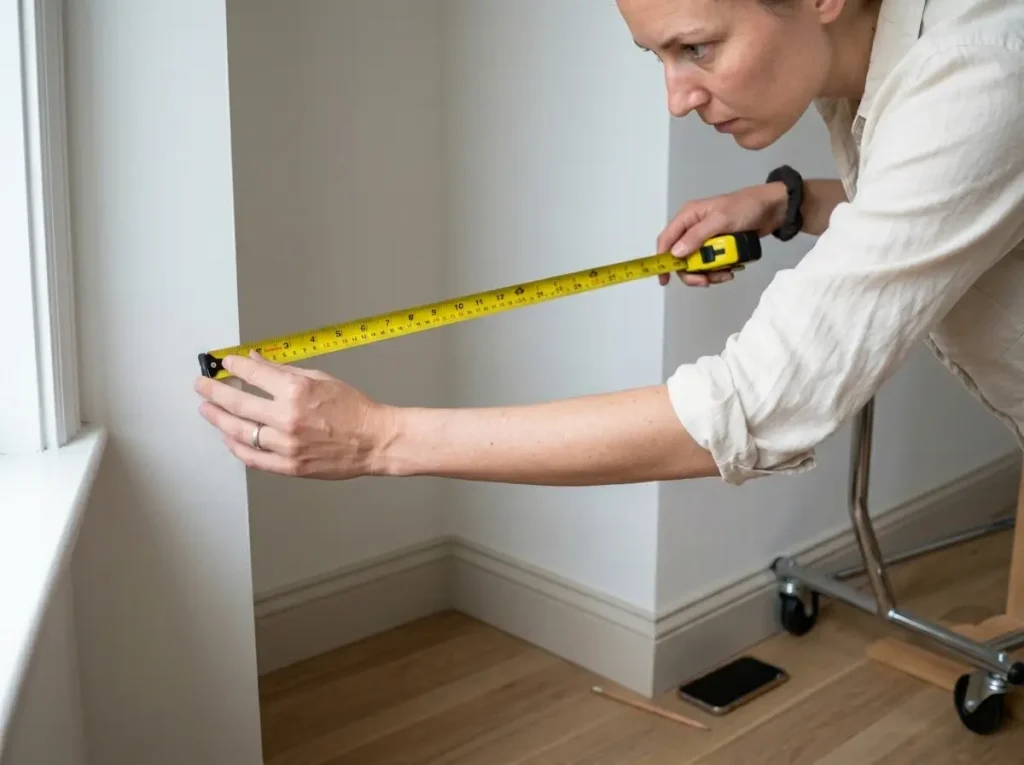
This is the section most guides skip: the renter constraints with actual numbers. You don’t need “be creative,” you need to know what a tension rod will and won’t hold, and exactly how wide a rack your alcove takes before you click buy. Here’s the full no-drill renter playbook in plain numbers.
Tension rods: real load limits and where they work
A tension rod is not a wardrobe rod. It holds maybe ten to thirty pounds, and only across a fairly narrow span on solid (not hollow) walls. Fine for a curtain or a few light dresses; load a full row of clothes and it slides down the wall by morning. For light vertical storage in an alcove or corner, Home in Bold Tension Rod Shelving gives you no-drill shelves that work within those limits. Keep the heavy items off it and it earns its place.
Freestanding everything: the move-with-you setup
The renter answer is to make everything freestanding. A rolling rack, a cube unit, and an over-the-door organizer add up to a full, renter-friendly wardrobe with zero drilling, and the whole thing moves with you to the next place. One trick worth stealing: turn a useless alcove into a covered open closet with a freestanding rod and a single curtain, hiding the visual clutter behind one clean line of fabric.
The pre-measure checklist
Write three numbers down before you shop: the width and depth you have for a rack, the height you need for full-length hanging, and your under-bed clearance. That’s the whole checklist, and it’s the difference between a setup that fits and a pile of returns.
Tape the rack’s footprint onto the floor with painter’s tape before you order. Living with the outline for a day tells you fast whether you can still open the door, make the bed, and walk past it without turning sideways.
Make an Open Wardrobe Look Intentional, Not Like a Pile
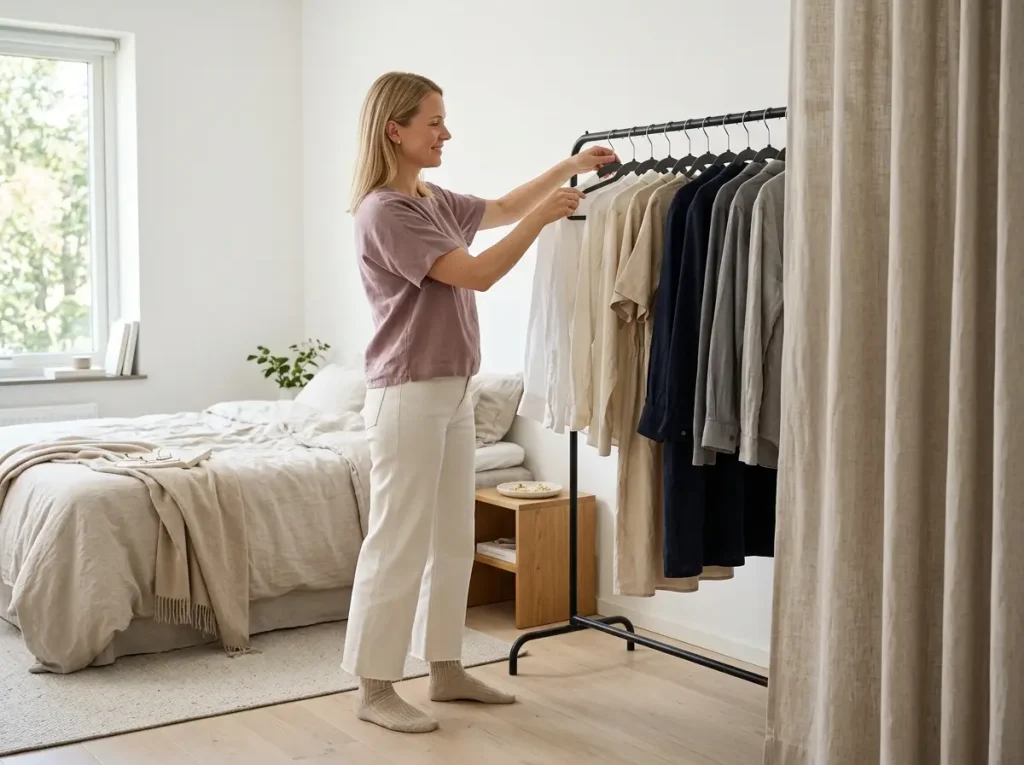
Here’s the payoff. Everyone says the way to fix a messy open rack is to add more storage. In practice, the fix is almost always less on the rack, not more. An open closet doesn’t read as messy because it’s open; it reads as messy because it’s overstuffed and the hangers don’t match. People set up a proud new rail and within weeks it “looks like a laundry pile,” and the cause is almost never the rack itself.
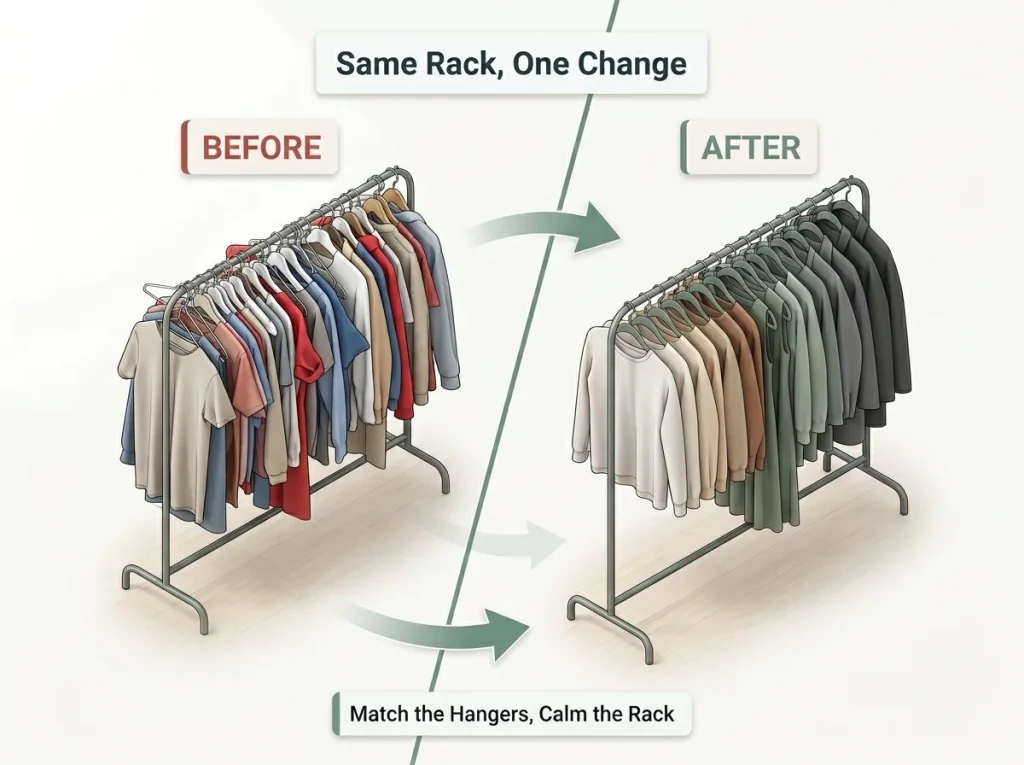
Matching hangers: the cheapest before/after
Start free: face every hanger you already own the same direction. It does half the work in five minutes. Then, if you want the real upgrade, switch to one uniform hanger type. Matching slim hangers level every garment to the same height and quiet the mismatched-hanger noise that screams “pile,” and the velvet ones reclaim rod space too. The Zober Velvet Hangers are the usual pick, thin, non-slip, and cheap by the pack, and switching to slim matching hangers is the single highest-impact change you can make to an open rack. The only downside is the swap itself, a tedious twenty minutes you do exactly once.
Cap the rack and give it breathing room
The other half is restraint. Cap the rack at what fits with a couple of fingers of space between hangers. If you have to fight the next hanger to slide one over, your eye reads “pile,” not “wardrobe.” Overflow goes to folded storage or off-season bins, never crammed back onto the rod because you didn’t feel like dealing with it.
Group it, then hide the rest behind a curtain
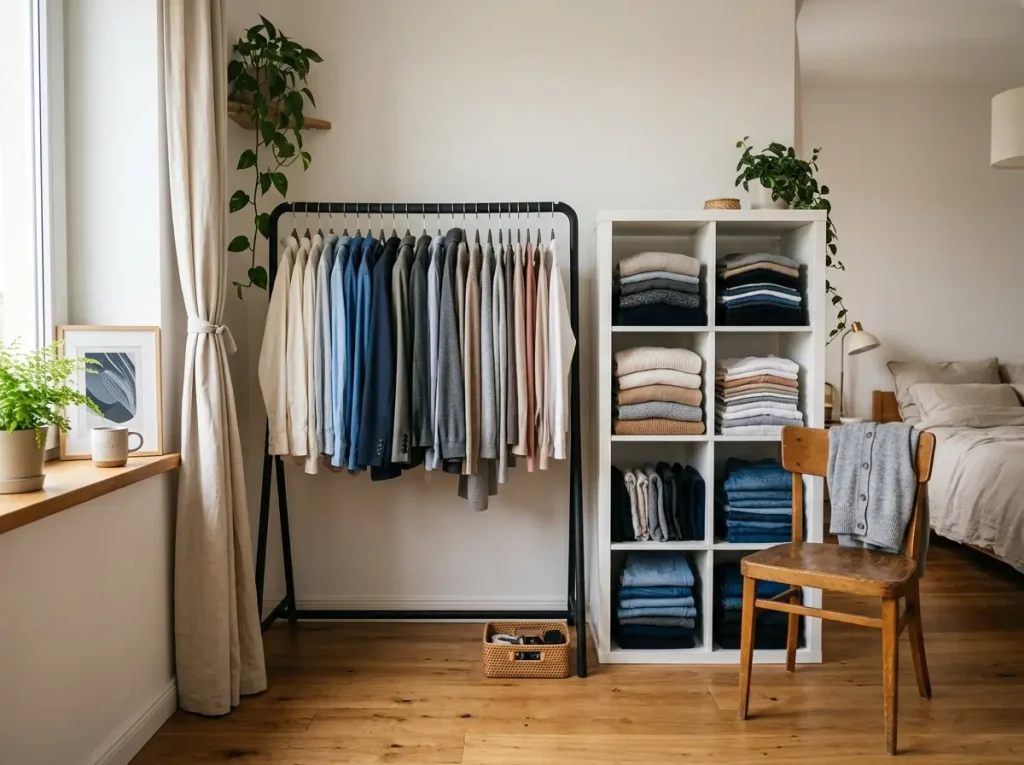
Group by type, then by color, then by length, so the hems form a clean line instead of a jagged one. And if it still feels busy on a bad day, a single curtain or cover on a ceiling track hides the whole rack behind one calm surface. That one move is what turns “exposed clothes” into “open closet.”
Keep It Working Past Month Three
Every setup looks good on day one. The open, no-closet version is the one most likely to slide back, because there’s no door to hide a bad week behind. The three-month test is the whole point: would this still be working in spring if you set it up over the holidays? Here’s what keeps it intact.
The twice-a-year seasonal swap
Twice a year, rotate. Move off-season clothes into under-bed bins or compression bags and bring the active season onto the rack. This keeps the rack capped, which keeps it looking deliberate instead of stuffed. A simple seasonal rotation is the difference between a rack that stays calm and one that quietly doubles in volume by fall.
The put-back rule for shared and studio spaces
An open system with no doors collapses fastest when two people share it and nobody resets it. Give each person one hook for the day’s clothes and make hang-it-back-tonight the rule, with a quiet one-in-one-out habit so the volume never creeps back up. When you share the space with someone, the system that survives is the one with the least friction, not the most rules.
A five-minute weekly reset
Once a week, take five minutes: rehang the chair pile, square the folded stacks, return strays to their zone. Small and frequent beats the big dreaded reorganization every time, because open storage shows a skipped week immediately. Which is actually an advantage, if you build the tiny habit.
Pin the weekly reset to something you already do, like the night before trash day. Habits stick when they ride on an existing routine instead of needing their own reminder you’ll learn to ignore.
The No-Closet Setup That Actually Lasts
You don’t need a closet to have an organized wardrobe. You need a split (hang the structured pieces, fold the knits), storage that holds up where it counts, and the discipline to keep the open part uniform. Spend where things actually fail, on a sturdy rack and matching hangers, and lean on furniture you already own for everything else. The open setup stays neat only when it’s capped, matched, and grouped, with a five-minute weekly reset to catch the drift.
Three-Month Check: in three months, look at the rack. If it’s overstuffed again or back to a jumble of mismatched hangers, you’ve outgrown the cap, not the system, so do a quick edit and a seasonal swap.
Start with the sort. Empty the chair, split the pile into hang and fold, and give just the hanging half a home this week. The rest follows.
Frequently Asked Questions
01Where do you put clothes when you don’t have a closet?
Use a freestanding garment rack for what you hang, a cube unit or repurposed shelf for what you fold, and under-bed bins for off-season pieces. Split your clothes by hang-versus-fold first, then give each group a fixed spot.
02How do you store clothes without a closet or a dresser?
You don’t need either one. A garment rack covers hanging, while open shelving, a cube organizer, or a repurposed bookshelf covers folding. Most people already own a piece of furniture that works as a dresser before they buy anything.
03How do you keep an open clothing rack from looking messy?
Cap it at what fits with breathing room between hangers, switch to matching hangers, and group by color and length. Overstuffing and mismatched hangers are the real cause. Add a curtain on a track if you want to hide it entirely.
04Can you organize clothes without a closet as a renter without drilling?
Yes. Go fully freestanding with a rolling rack, a cube unit, and an over-the-door organizer, and use adhesive hooks rated for the weight. Skip tension rods for heavy loads, since they only hold a little before sliding down the wall.
05How do you store off-season clothes with no closet?
Compress them into under-bed bins or vacuum bags and rotate twice a year. Keep wool, down, and cashmere folded with cedar instead of vacuum-sealed, since long compression crushes the loft and the fibers don’t fully recover.
Disclaimer: ClutterlessNest is a participant in the Amazon Services LLC Associates Program. As an Amazon Associate we earn from qualifying purchases. This article may contain affiliate links — if you buy through them, we may earn a small commission at no extra cost to you. We only recommend products we have tested or genuinely believe in.