
The box comes down in December and what is inside is not what went in: a wreath with a bin-shaped dent across it, a cell of broken glass, a damp smell, a silverfish riding a cardboard corner. Nothing in that box was chosen for the shelf, the room or the thing it holds; it was whatever was at hand the January everything went away. Holiday and seasonal item storage works when each box is sized by the number that actually decides it (the depth of the shelf, the length of the longest roll, the height of the tree), and the libraries and archives that keep objects for decades publish the same rules you need for a box of ornaments. This guide to holiday storage counts first, explains why boxes fail by the second year, sizes the bin to the shelf, then handles ornaments, lights and garland, artificial Christmas tree storage and wreaths, where the boxes should sleep, wrapping paper, apartment storage with no attic, and the other half of seasonal storage.
Quick Answer
Count everything you own and add a quarter for growth, then buy each bin for the shelf it sits on: the shelf’s depth minus 1 inch, so a 12-inch wire shelf takes nothing deeper than about 11.5 inches. Pack by shape (ornaments in cells with the heavy pieces at the bottom, lights wound on a notched board, a tree bag as long as the tree, wrapping paper in a container longer than the longest roll), keep every box off the floor and out of the damp, and label by the order you unpack.
Holiday and Seasonal Item Storage Starts With a Count, Not a Bin
Picture the storage you have right now: two bins under the guest bed, a few boxes in the garage, the tree somewhere up high, and no idea how many boxes that makes in total. A collection bought one December at a time and put away wherever there was room ends up in three places with no index, so a box goes missing in November and a second one gets bought. The container is the last decision in this job. Counting comes first, as a one-page inventory, and nothing in this section needs a purchase.
Pull everything out and sort it by shape
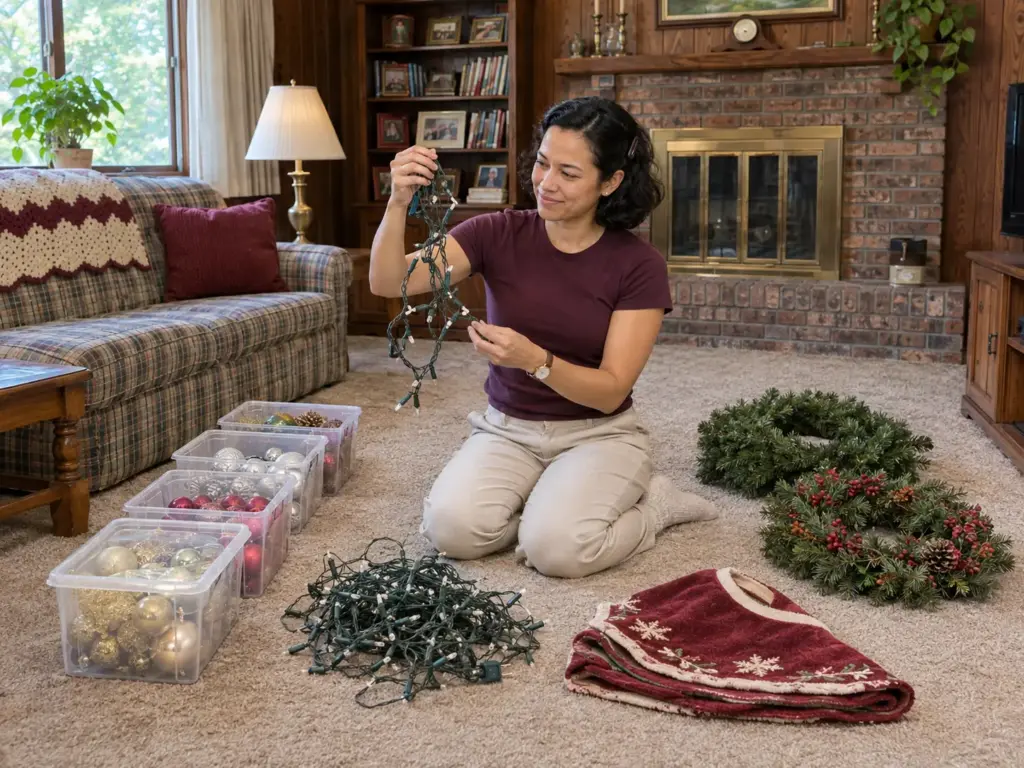
Do the count at takedown, while everything is already on the floor, and do the category sorting by shape instead of by holiday: ornaments, light strands, wreaths and garland, trees, tabletop pieces and wrapping supplies. Write down how many of each, then add about a quarter for growth, because the collection will keep growing and the boxes you buy now have to absorb it. Measure the largest piece in each pile too. The big finial or the oversized wreath decides the cell or the box, not the average piece, and a container sized to the average piece fails the first time the exception goes in.
A collection that has taken over a basement wall usually means boxes in no order and one list that lives in somebody’s head. Number every box and keep a single list of what each number holds.
What to repair, donate or let go before it is packed again
To declutter decorations, start with anything broken and not worth repairing. That goes first, and a box by the door collects whatever you will donate decorations from. Next goes whatever has not been put up in two seasons, and the pieces inherited out of duty that nobody in the house likes.
Decorations that stay in a box for two years are taking up the same shelf depth as the ones that come out every December, and a shelf is the one thing you cannot grow. In a home with no spare room, the cheapest storage is a smaller collection.
A cap for the collection, and the rule for what arrives in December
New pieces arrive every year, so give the collection a ceiling. One-in-one-out is the simplest version: a new ornament comes in, an old one goes out.
In a shared home the cap works better counted in totes. One person’s “only one tote” has a way of ending in a compromise of six, and the version that holds says anything new must fit inside the six or replace something. A cap, not a purge, and nobody has to throw out their favorites to follow it.
Why Stored Decorations Come Out Ruined by the Second Year
Four things ruin a stored box: the material it is made of, the damp that material traps, the floor it sits on and the weight stacked on top. Every choice later in this guide, for Christmas decoration storage or any other holiday decoration storage, works against one of them, so it is worth naming them before any bin gets measured.
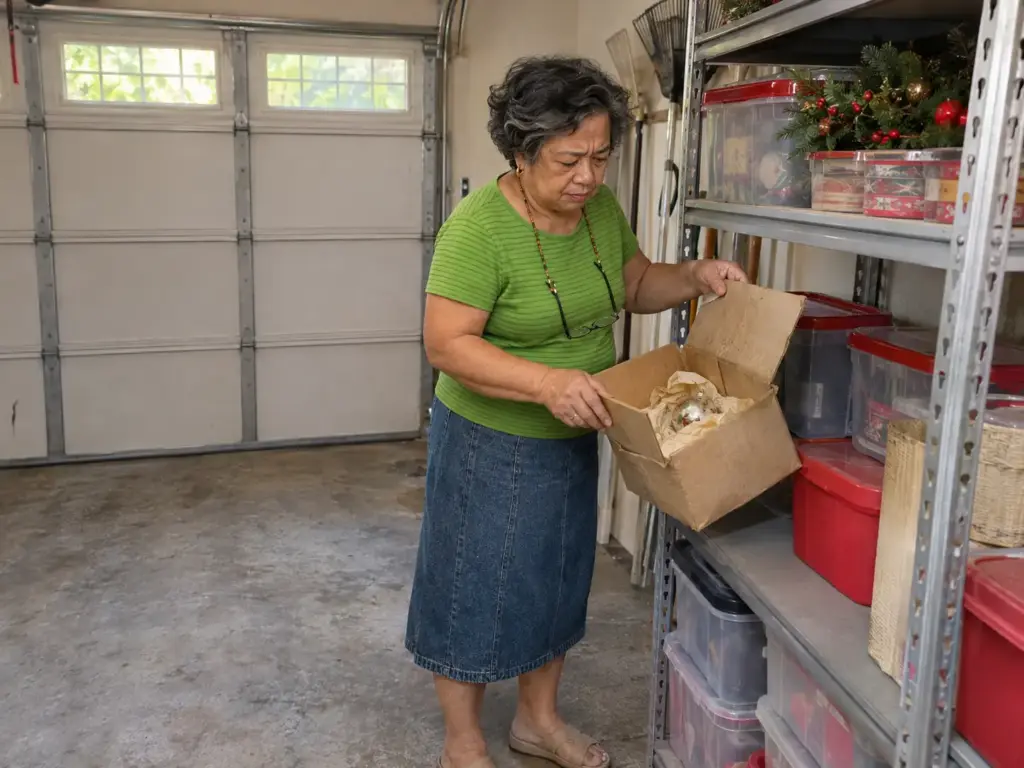
A cardboard box is a habitat before it is a container
The box inherited from a parent’s attic is the usual case: old tissue and newspaper from decades ago, still wrapped around a glass bauble, and the first December something living comes out with it. That is not bad luck.
According to Texas A&M AgriLife’s pest-management guidance, “Cardboard can harbor roaches, silverfish, mice, and mold.” The corrugations hold insects, the paper feeds them, and damp cardboard grows mold on whatever it touches. A box that has sat in an attic for a decade is the one that rains silverfish onto the living-room rug when it is opened.
A sealed plastic bin keeps the damp in as well as out
In the plastic vs cardboard question, plastic wins against pests and a spill. It does not win against a damp room. The Library of Congress’s preservation advice puts plastic bins in the category of secondary protection against water, with no protection against environmental extremes, and in a high-humidity room the combination raises mold risk.
The same page notes that basements, attics and garages have poor temperature and humidity control, so attic storage, basement storage and garage storage all face the same temperature swings. A sealed bin keeps a spill and a mouse out, and it also keeps the room’s damp in with the decorations. If the room is wet, the room is the problem, and the lid only makes it a closed one.
The material-by-room comparison of fabric and plastic bins works through where each one fails.
What sits on top of a wreath decides what comes back
A wreath under three bins does not recover, and neither does a tree squashed into last year’s carton. Weight is the fourth failure, and it needs no source to explain: soft things crush and glass cracks under whatever sits above it, and the bottom box of any stack takes the whole load. From here on, each section names which of these four failures it prevents.
Size the Bin to the Shelf It Sits On
A bin looks right in the store and overhangs the closet top shelf by two inches at home. The number that decides the purchase is the depth of the shelf, front to back, and the closet’s width has nothing to do with it.
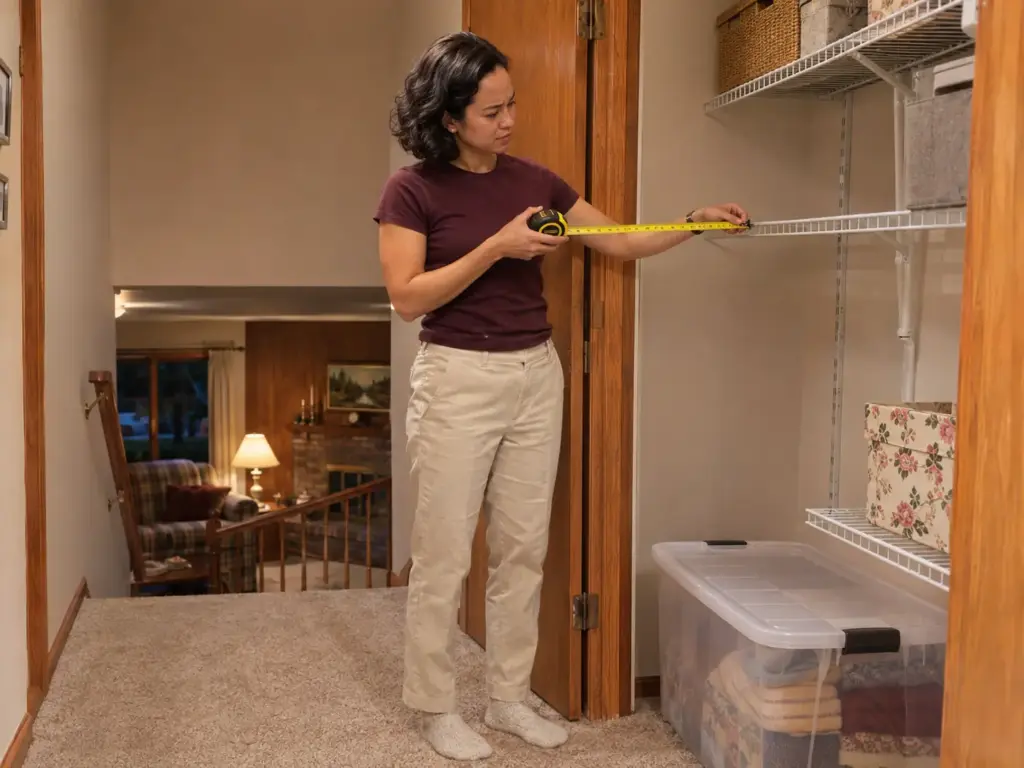
Measure the shelf front to back, not the closet
A reach-in closet is about 24 inches deep inside, its shelves run 12 to 16 inches deep, and a single rod hangs at about 66 inches. Most builder closets carry 12-inch wire shelving, and a bin deeper than about 11.5 inches overhangs the front rail and tips forward when you pull it. A 13-inch cube bin belongs in a cube unit, not on a closet shelf. Put the tape on the shelf itself before anything goes in a cart, and for bins sized to real shelf depths, this guide to storage bins that fit closets does the matching.
The fit formula that keeps a bin from wedging
Give the bin finger room on every side or it wedges, drags and scrapes. The maximum width is the clear width minus 1 inch, the maximum depth is the clear depth minus 1 inch, and the maximum height is the clear height minus 1.5 inches. A shelf opening that is 36 inches wide, 12 deep and 14 high takes three 11-inch bins across, or two layers of 6-inch bins.
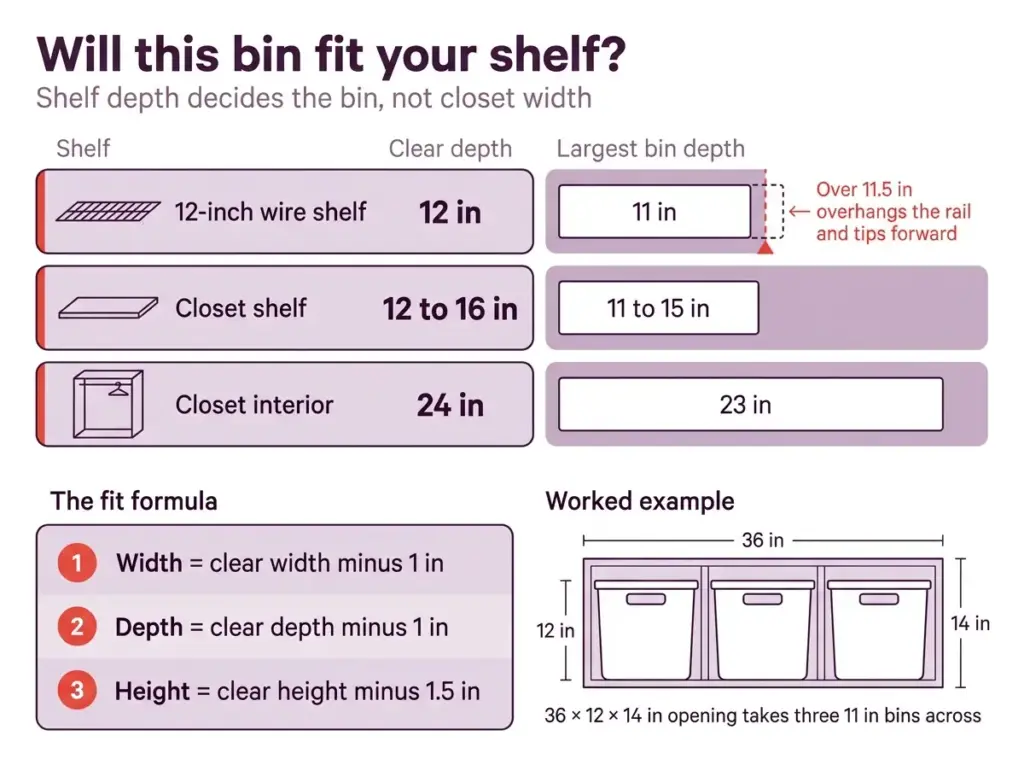
The chart is a quick way to check: find your shelf depth in the left column and read across to the largest bin it takes.
Put a strip of painter’s tape on the front edge of the shelf and mark the usable depth on it with a pen. The same number then serves at the store, at the cart and when the bin goes back up, and it is the first thing anyone sees before pushing a deeper box onto the rail.
Why 40 to 60 quarts is the practical top for a bin you lift down
Weight and size travel together. Between 40 and 60 quarts is the practical range for a tote you carry down a ladder or a step stool; above 60 a full bin is too heavy to lift safely and its own weight starts cracking the lid corners. A 54-quart gasket box lists at about 22.25 × 15 × 13 inches, which does not fit a 12-inch shelf at all. Bins of that size live on a deeper shelf or on the floor of a closet, and the number to remember is the depth, not the quart count on the label.
Label by the order you unpack, not by the holiday
Number the bins in the unpacking order, the order you will open them: tree first, lights second, then ornaments, then the table. Bin 1 is always the one you reach for, and nobody searches. Keep one list, taped inside a closet door or kept as a photo on your phone, that says what each number holds.
Choose clear bins over opaque ones where you can, since a clear lid lets you read the contents without opening anything (the roundup of clear storage bins covers the ones that actually fit rental shelves). An interlocking lid beats a stackable bin whose lid slides off, and a weathertight bin is only weathertight while the latches are shut, because a stack of holiday bins will get bumped at least once a year.
Ornaments: Cells, Tissue and the Heavy Pieces at the Bottom
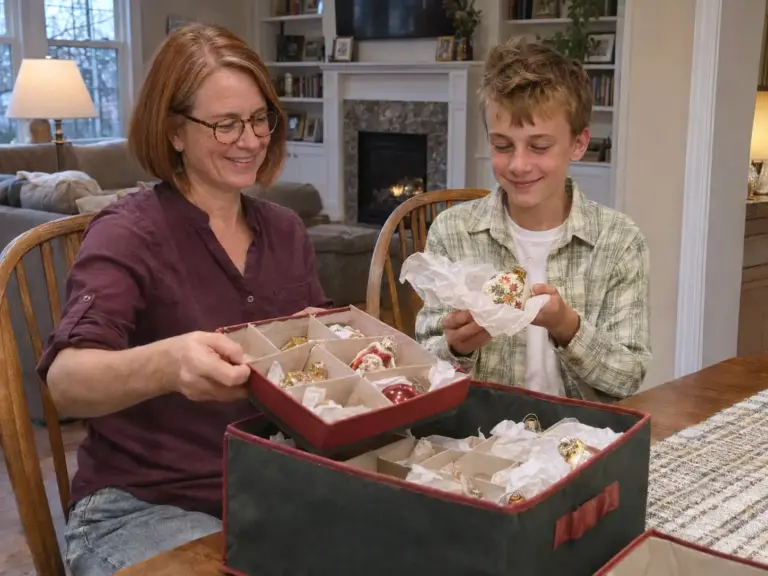
Glass is the most breakable thing in the house and the thing people pack last, at the end of a long day, with whatever is closest. A few minutes at takedown with acid-free tissue paper and the right layers is the whole difference.
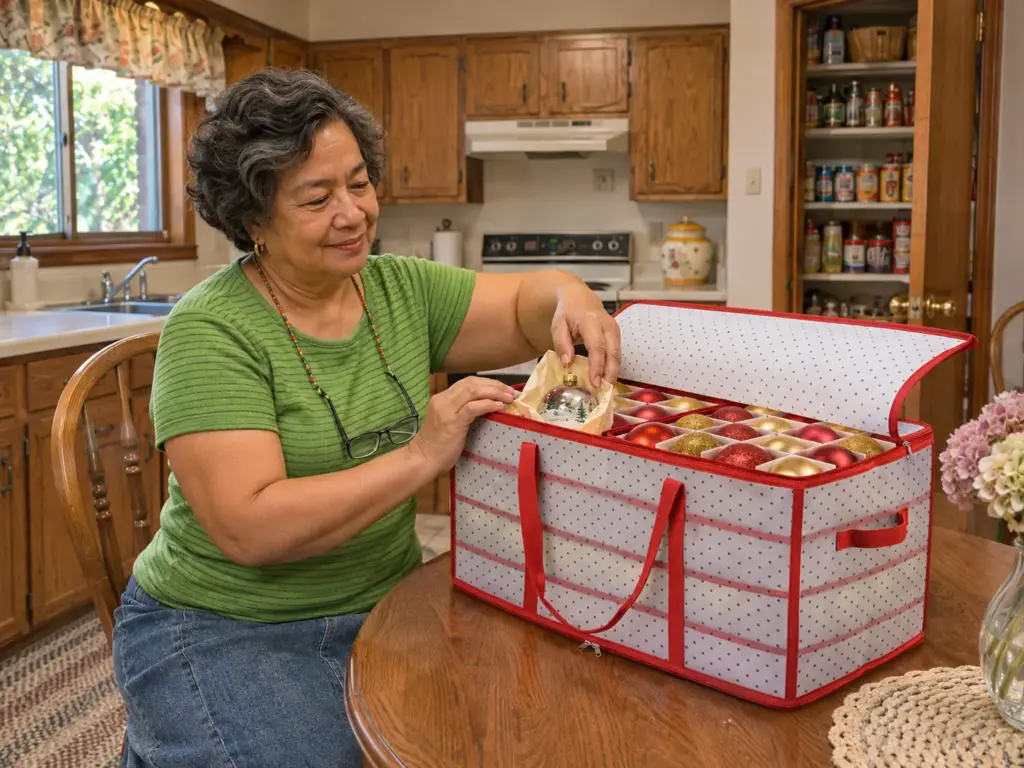
Start with the boxes the ornaments came in
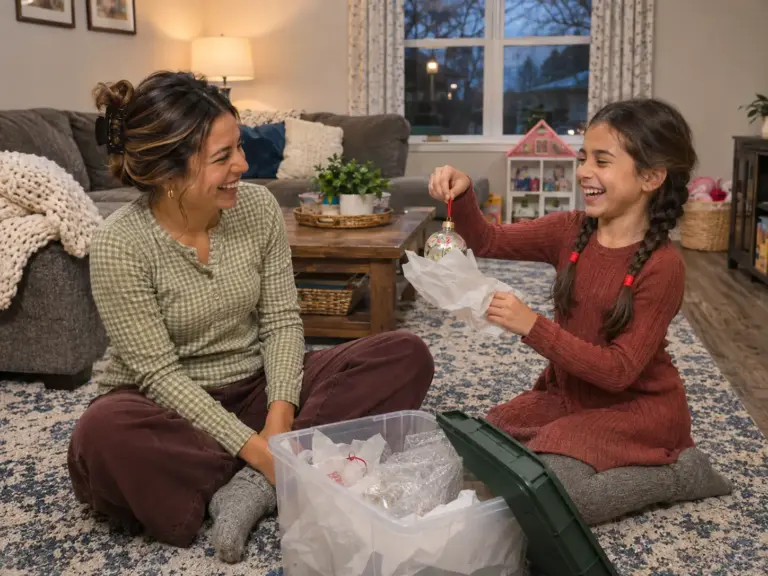
The free version works first. Keep the original ornament boxes, the cup carriers and egg cartons from the recycling, and wrap each piece in its own layer. Put them all inside one lidded tote, and use a pillowcase for soft pieces such as felt and fabric. Nothing about this needs a purchase, and it is the option to try before looking at any dedicated box.
Unbuffered acid-free tissue for glass and old pieces
The National Archives, which stores objects it means to keep indefinitely, says to use unbuffered acid-free tissue to protect the surface of each piece and preserve its shape (buffered tissue can harm protein materials such as silk and wool). Plain newspaper and old tissue do neither, and the yellowed paper in an inherited box is the visible sign of it. The same page gives the rule for what goes where: according to the National Archives’ guidance for storing artifacts, “Always place heavier artifacts in the bottom of the box.” For ornaments, that means heavy glass finials and large pieces at the bottom, light and fragile pieces on top, and never the reverse.
When a 128-cell box pays for itself, and where it cannot go
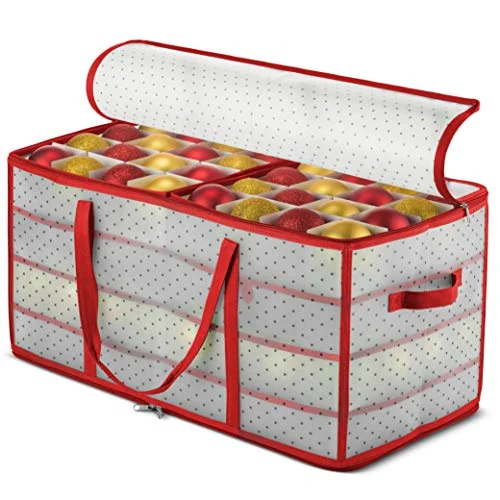
Cell size is the buying number. A 128-cell box has 128 usable cells only if every ornament is 3 inches or under, so check the largest piece in the collection against the cell before you add anything to a cart, and use the count you made at takedown, with a quarter on top for growth. A divided ornament box is worth the money for someone whose collection has outgrown last year’s cartons, and not before.
The ZOBER Christmas Ornament Storage Box 128 is the obvious pick at that stage, and it brings one thing to check. At 26.8 × 13.6 × 13.4 inches it is 1.6 inches deeper than a standard 12-inch closet shelf, so it never goes on the wire shelf above the rod. It belongs under a bed (check the bed’s clearance against the 13.4-inch height; the clearance math for containers under low beds covers it), on a deeper shelf, or on the floor of a closet.
Lights and Garland Without the Knot
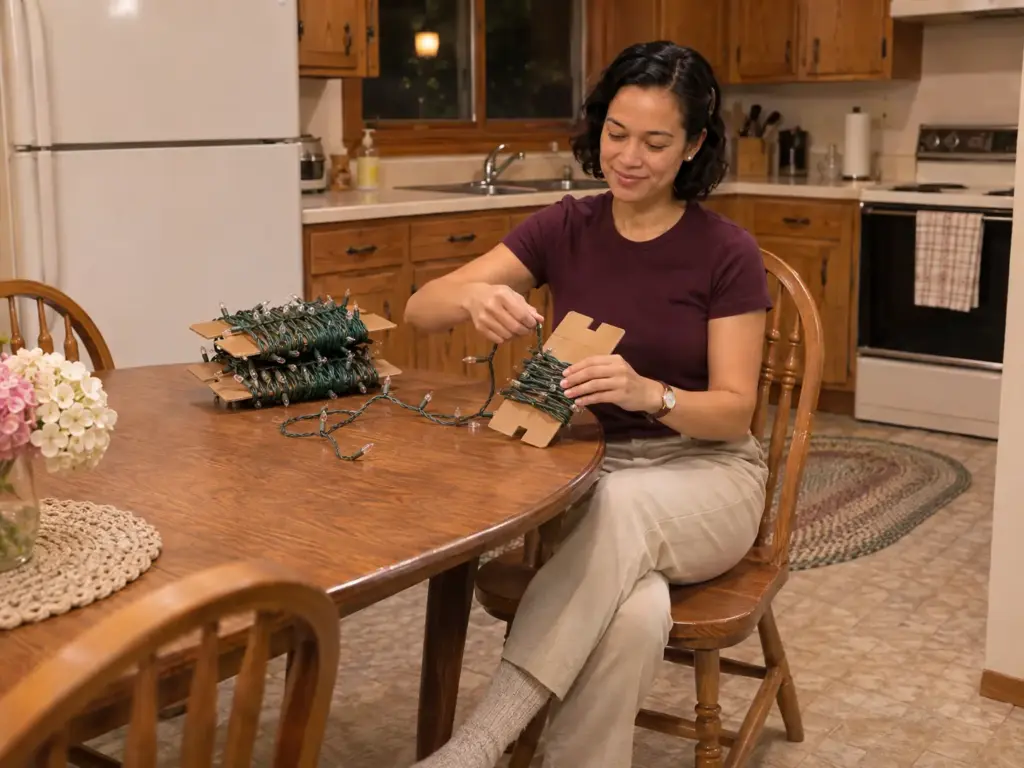
The strand you pull from the bin in December has one plug in your hand and a ball of wire, and the other end is somewhere in the middle of the ball. Winding string lights at takedown, one strand at a time, is the habit that ends tangled lights.
A notched board does the job
The light makers themselves give the cheapest method, a notched board in place of a light reel or light spool: Big Star Lights says a piece of cardboard or plastic with a notch cut in each end is enough, and Twinkly describes the same cardboard-with-notches approach. Cut a stiff rectangle about 12 × 8 inches with a notch in each short side, and wind one strand per board at takedown. A strand wound flat has no loops to catch, and with both ends seated in the notches it comes off the board end first.
Store the wound boards together in one tote instead of scattered across three. Garland storage follows the same weight rule as everything else: coil it loosely into its own section of a tote and never squeeze it under a heavy bin.
Plug in each strand and check it for dead sections before you wind it. A strand that has gone dark halfway down is easier to find at takedown, when the tree is still up, than in a heap in December.
When a pack of holders beats cardboard
The cardboard is enough for two or three strands. For a household with a dozen, the codree 4-Piece Light Storage Holders are the plastic version of the same method: four holders to a pack, each 11.8 × 5.9 inches, each good for about 100 mini LED lights, and they stack in a tote where cardboard slumps. Plan the buying number from your takedown count, one holder per strand or per roughly 100 mini LEDs.
Trees and Wreaths That Come Out Usable
The two pieces that come out ruined most often are the wreath that spent a year under the bins and the tree that went back into last year’s carton. Both are sizing problems before they are anything else.
A tree bag is bought by its length
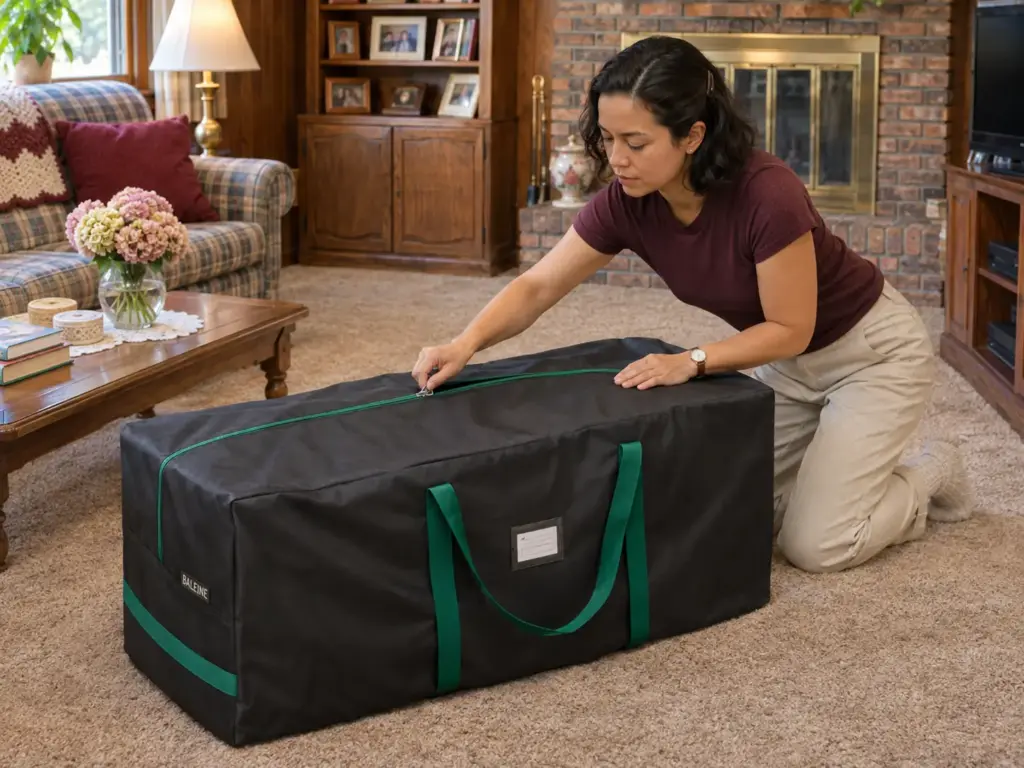
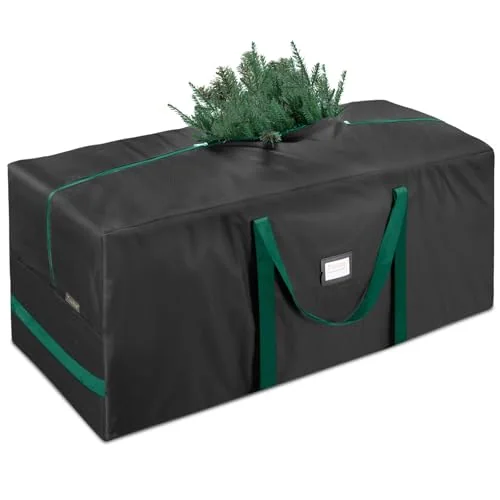
A bag holds the tree disassembled, so the number to match is length, not tree height. A 7.5-foot tree bag lists at 50 × 16 × 20 inches, and that 50-inch length is the figure to check against the shelf or the corner of the closet where it will stand. Measure the shelf or closet corner where it will live against that 50 inches before anything else, because a fluffed tree rarely goes back into the carton it came in.
Why the original carton fails by the third year
The original carton is the default tree storage box, and it works for about two seasons. By the third year the carton has softened at the corners and a fluffed tree rarely goes back into it at all; the carton splits under the weight of the sections and the tree ends up in a trash bag. If your carton still holds, tape it, label it and keep it, since that is the free answer. If it no longer does, the BALEINE 7.5 ft Christmas Tree Storage Bag is built to the length that matters.
A wreath box is sized by the bow, not the greenery
A 24-inch container is the common size, but it fits a 24-inch ring, not a 24-inch wreath with a full bow. Measure the widest point of the finished decoration, bow included, and then the depth, since many bags list about 8 inches. The free version is a pillowcase over the wreath, hung from a hook or a rod with the bow facing out. A trash bag keeps off dust and does nothing else, and anything stacked on a bag, a box or a pillowcase flattens the wreath inside it.
The Hearth & Harbor Wreath Storage Container, 24 inch has stiffened clear sides, a dual zipper and removable interior pockets for picks and extras. Thin flexible PVC keeps dust out and does nothing against weight stacked on top, and durability is mixed, so nothing goes on it.

Where the Boxes Live: Attic, Basement, Garage or Closet
The garage or basement where boxes were set down on concrete years ago and never moved is the most common version of this problem. The container matters, and the room matters just as much.
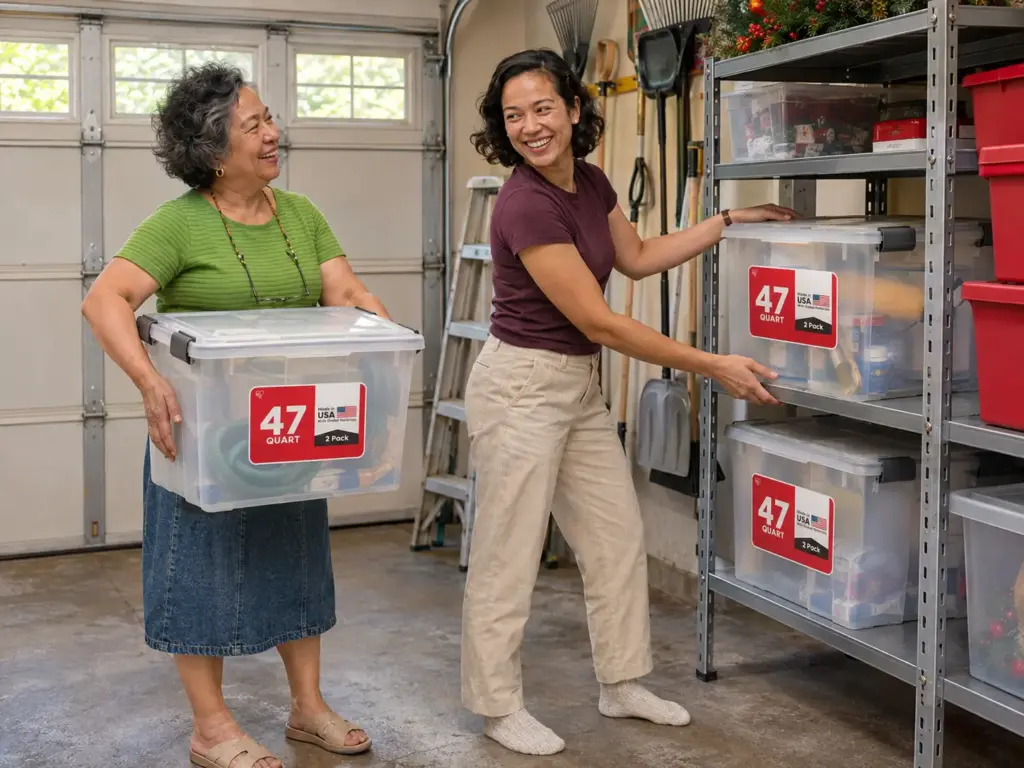
Lift every bin off the floor
Do the shelving before the bins; the garage organization order for a tight budget puts the shelf first for exactly that reason. BYU’s conservation department says housings should never be placed directly on the floor of storage.
A concrete floor wicks moisture upward, and the bottom box takes the weight while it softens. A shelf or a pallet is doing real work there, and the job is not neatness. The box that went down in a garage ten years ago and is now part of the floor shows where this ends.
Match the material to the room’s damp and swings
A dry interior closet lets a plain latching tote do the job. A garage or basement shelf is where a gasket seal earns its price, and a damp room should be dried before decorations are sealed into it, because sealed plastic keeps the damp in. The Library of Congress notes that basements, attics and garages have poor temperature and humidity control, so treat the room as the variable and choose the container for it.
A sealed bin is the usual advice for a garage, and in a dry garage it is right. In a damp one it only closes the problem in with the ornaments. The IRIS USA WeatherPro Storage Box, sold as a 2-pack of 47-quart bins, has a gasket seal and buckle latches, stacks, and is acid-free and BPA-free.
At 19.7 × 15.75 × 11.75 inches each it is a garage-shelf bin, not a closet-shelf one, because 15.75 inches of depth overhangs a 12-inch shelf by almost four. It costs more per bin than a plain latch box, and the inside runs smaller than the outside dimensions suggest. In a dry closet a latching tote does the same job; spend the gasket money only on the damp room.
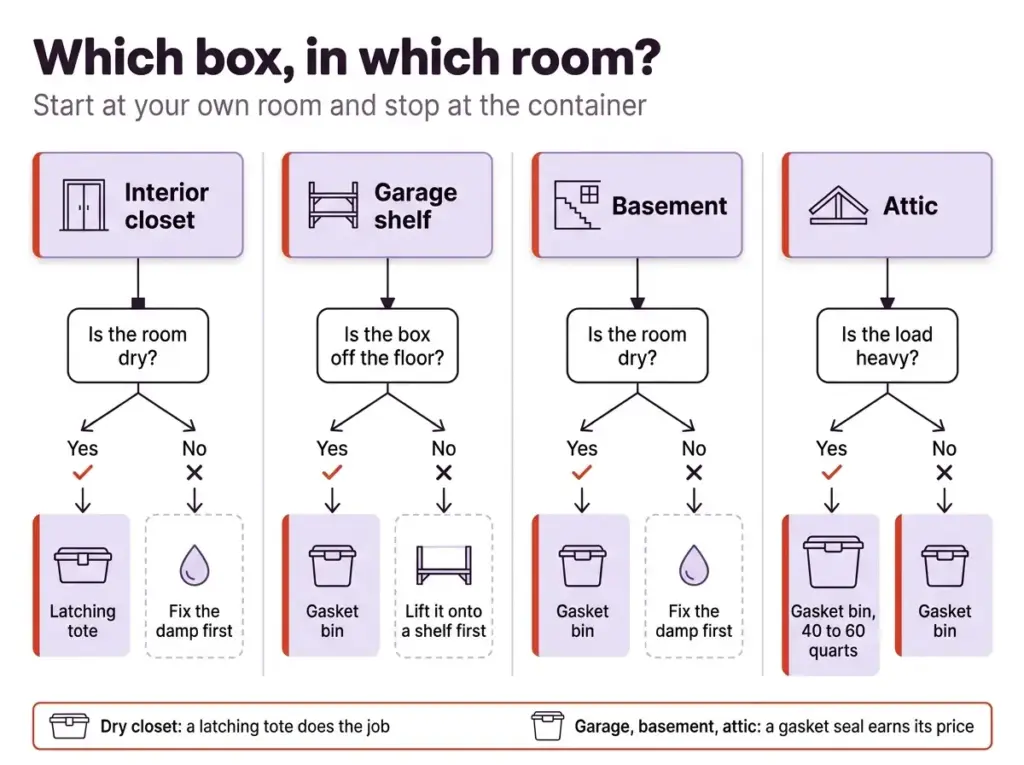
A shelf, not a stack: the next holiday nearest the door
Give each holiday its own zone on the steel shelving, with the next holiday’s bins nearest the door, and the year keeps moving: the finished season goes to the back, the coming one comes forward, and nothing heavy sits on top of the tree boxes. Ceiling hooks and wall shelves near the ceiling take the light pieces. For the shelves themselves, what a garage shelf can hold depends on what is stored on it, and heavy totes are where it matters most.
Put the tree boxes on the lowest shelf only if the shelf is steel and the boxes are light enough to slide out. A box that needs two hands to drag out is the one that will sit there until next year.
Wrapping Paper and Gift Supplies: Buy for the Longest Roll
The sheet you unroll in December has a bent edge from eleven months under a box or along a shelf. Wrapping paper rolls are long, and the container is sized by that length.
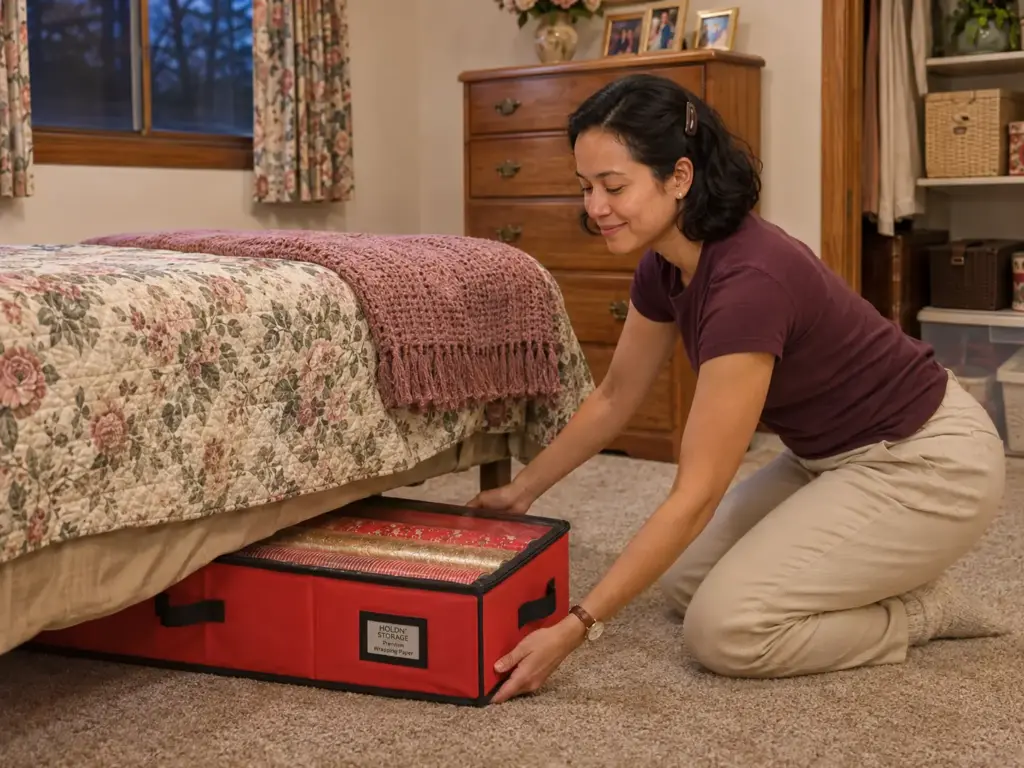
Measure the longest roll, not the number of rolls
A 40-inch roll needs a container about 41.25 inches long, and a container two inches short bends the edge of every roll. Buy by length, not by roll count. The HOLDN’ STORAGE Premium Wrapping Paper Container is built to that rule: 41.25 × 14.5 × 5.5 inches, space for 27 rolls up to 40 inches long, and at 5.5 inches tall it slides under a bed. Two straps hold the lid and the pockets in it take ribbon, bows and tags.
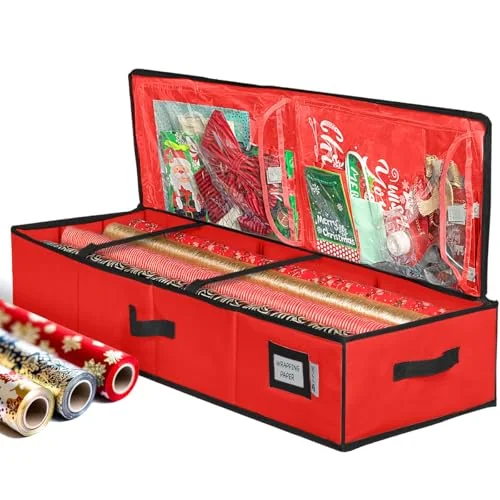
Ribbon, tape and tags in one place
Ribbon storage starts with keeping the tape, ribbon, scissors and tags with the paper, so the gift wrapping station is one container, not a hunt through four rooms. Gift bags flatten into a flat zippered bag, and tissue paper goes in with them. The point is the same as everywhere else in this guide: the system should hold up on the night before a deadline.
The free version: rolls upright in a tall bin
A flat zippered gift wrap storage bag does the same job for less than a dedicated container, and the free option beats both: stand the rolls upright in a tall bin or box from the back of a closet. The only measurement that matters is the one above, because a bin shorter than the longest roll bends the end however the rolls sit. If the bin is long enough, the paper keeps its shape.
The Home With No Attic, Basement or Garage
You have bought one more bin every year and run out of places to put it, and the tempting answer is a storage unit, which is a monthly bill dressed as organizing advice. Before that, count what the home holds.

Count the dead space you already own
Under-bed containers run 5.5 to 6.5 inches tall, which is the profile of the wrapping-paper container and the gasket bin above, and they hold flat things well. Under bed storage, set up properly is the first move, and a guide to finding space in an apartment that seems to have none covers the rest of the dead volume. A reach-in closet is about 24 inches deep with shelves 12 to 16 inches deep and a rod at about 66 inches, so the shelf above the rod and the vertical space over it are the largest unused volume in most homes. A suitcase is a free container with a lid, and in a rental, where nothing gets drilled into a wall, rental storage comes down to the bed, the closet and a suitcase.
The closet shelf, the rod and the back of the door
Sort by shape. Flat things (wrapping paper, a tree bag lying down) go under the bed. Light things and anything in a crush-proof container, such as a wreath box or tissue-wrapped ornaments, go on the closet shelf.
The tree bag stands in a closet corner at its 50-inch length. Everything in this section goes in without drilling.
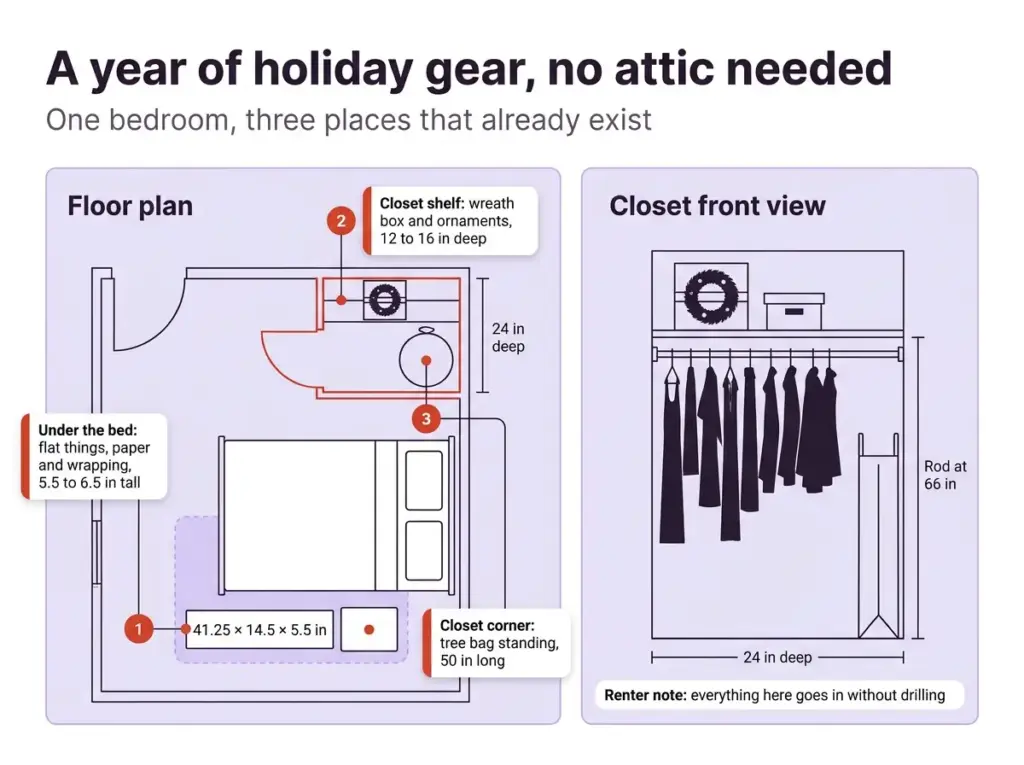
Weight limits matter once the shelf is high, and vertical storage that lasts in an apartment sets the numbers for what the inch above the rod can take.
Before you rent a unit
The cheapest storage is a smaller collection and a firm cap, set back in the first section. If there is no place to keep a decoration, the decoration does not get bought. Self storage is the last move, not the first, and it helps to know what the sizes mean: a 10×20 unit is about a one-car garage. A heavy holiday bin under a bed raises one more question, wheels or flat, and the comparison of rolling and flat under-bed storage answers it.
The Other Half of “Seasonal”: Clothing, Gear and the Yearly Swap
The reader who finds out in July that last Christmas is still up, or that the bins never went back where they came from, has run into the half of “seasonal” that nobody counts. Clothing and gear follow the same measurements as decorations.
Off-season clothes follow the same shelf math
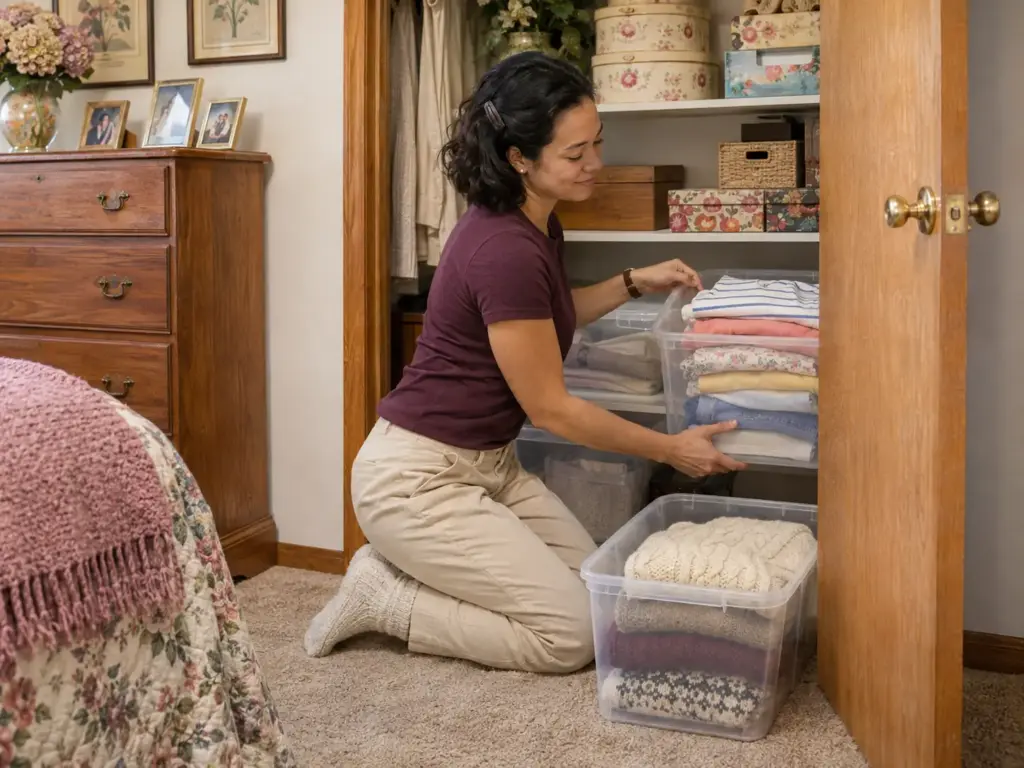
Off-season storage for coats, sweaters and shoes goes through the same count and the same shelf measurement as the decorations. The detailed methods live elsewhere: seasonal clothing storage in a small space, bulky winter coats and keeping seasonal shoes from molding each get their own page. Summer clothes go back on the shelf the winter coats left. Here the point is only that the frame is shared: measure the shelf, size the container, keep it off the floor.
Camping and sports gear: the bins nobody counts
Camping gear and sports equipment are the bulky seasonal items that end up in the garage and the car. They get the same off-the-floor rule and the same nearest-the-door rotation as the decorations. Count them in the same list, because a tent that is stored wet in a corner becomes the damp problem from earlier in this guide.
The swap calendar and the December returns
Pick one date in spring and one in fall to rotate what sits nearest the door, which is also how a seasonal wardrobe rotation works. The next season’s bins come forward, the finished season’s go back, and the box that did not go back is the tell. Why a seasonal closet rotation slips is worth reading before the first swap. When a new ornament arrives in December, one goes out.
Check that the bottom box is dry as a habit, not a project, and when the decorations come down, the annual audit is short: count again, repair or donate, and number the bins again in the order they will be unpacked.
The household that rotates the bins instead of the contents is the one that never finds December in July.
Write the Shelf Depth on the Lid of Bin One
Count first and add a margin. Buy the bin for the shelf, the roll or the tree, not for the store. Pack by shape with heavy things at the bottom and nothing on top of a wreath or a tree, keep every box off the floor and out of the damp, and number the bins in the order you will open them. Those five habits cover most of what goes wrong in a stored box.
To know whether the system held, look at the bottom box of each stack after the first humid stretch of the year, and again when the decorations come down in January.
Today, take a tape measure to the one shelf where the boxes will go and to your longest roll of paper. Write both numbers on the lid of the first bin, and see which of the things you own does not fit.
Frequently Asked Questions
01What are some good storage solutions for Christmas decorations?
Match each shape to a container sized by the number that decides it, then lift all of it off the floor. Use divided boxes or the original boxes with tissue for ornaments, a notched board for each strand of lights, a bag by its length for the tree, a box sized to the bow for a wreath, and a container longer than the longest roll for paper.
02What size storage bin fits a closet shelf?
Take the shelf’s depth and subtract 1 inch, so a 12-inch wire shelf takes nothing deeper than about 11.5 inches. Width follows the same one-inch rule, and height needs 1.5 inches of clearance, so the bin lifts out without scraping.
03Is plastic or cardboard better for storing holiday decorations?
Plastic is better against pests and a spill, because cardboard can harbor roaches, silverfish, mice and mold. Neither material fixes a damp room: plastic keeps the damp in with the decorations, so dry the room before sealing the bin.
04Where do I store holiday decorations with no attic, basement or garage?
Use flat boxes under the bed (a 5.5 to 6.5-inch profile), the closet shelf and the inch above the rod, and a suitcase. Set a firm cap on the collection before you consider a storage unit.
05How do I keep Christmas lights from tangling?
Wind each strand at takedown on a stiff board about 12 × 8 inches with a notch in each short side, one strand per board. Plastic holders do the same job and stack in a tote, which helps once the collection passes a few strands.
Disclaimer: ClutterlessNest is a participant in the Amazon Services LLC Associates Program. As an Amazon Associate we earn from qualifying purchases. This article may contain affiliate links — if you buy through them, we may earn a small commission at no extra cost to you. We only recommend products we have tested or genuinely believe in.