
In July you go to the closet for a birthday roll and it comes out with a bent corner and a crease down one side, after eleven months leaning in the corner under two bigger rolls. How to store wrapping paper well comes down to one idea: a year of sitting rarely ruins paper, but one thing pressing on one spot does, and most storage is sized to the number of rolls instead of the length of the longest one. Archives keep paper intact with a container longer than the sheet, in a cool, dry room away from light, and the same rules work for gift wrap. Here is how to apply them whether you own four rolls or forty, rent or own, and have a spare closet or one bedroom corner.
Quick Answer
Five moves keep every roll straight from one holiday to the next birthday.
- Measure your longest roll and add two inches; that is the minimum container length.
- Choose a bedroom or coat closet, never a garage, attic or damp basement.
- Match the shape to your space: a tall bin in a corner, a flat bag under the bed, or a hanging organizer on a door.
- Close each roll with a loose cardboard cuff or a ribbon, never a rubber band or tape on the paper.
- Keep tape, scissors and ribbon beside the paper, and keep only the rolls you will use.
How to Store Wrapping Paper Starts With What Ruins It
The closet corner in July shows every failure at once: one roll unrolls bent, another has a torn edge, and the two oversized holiday rolls that fit no container (free floaters) lean against the wall where they have leaned since January. Loose rolls fall, the paper rips and it picks up dust. Each of those problems has a cause you can name, and each cause points at a different choice further down.
Weight and Rim Pressure Leave the Crease That Never Lifts
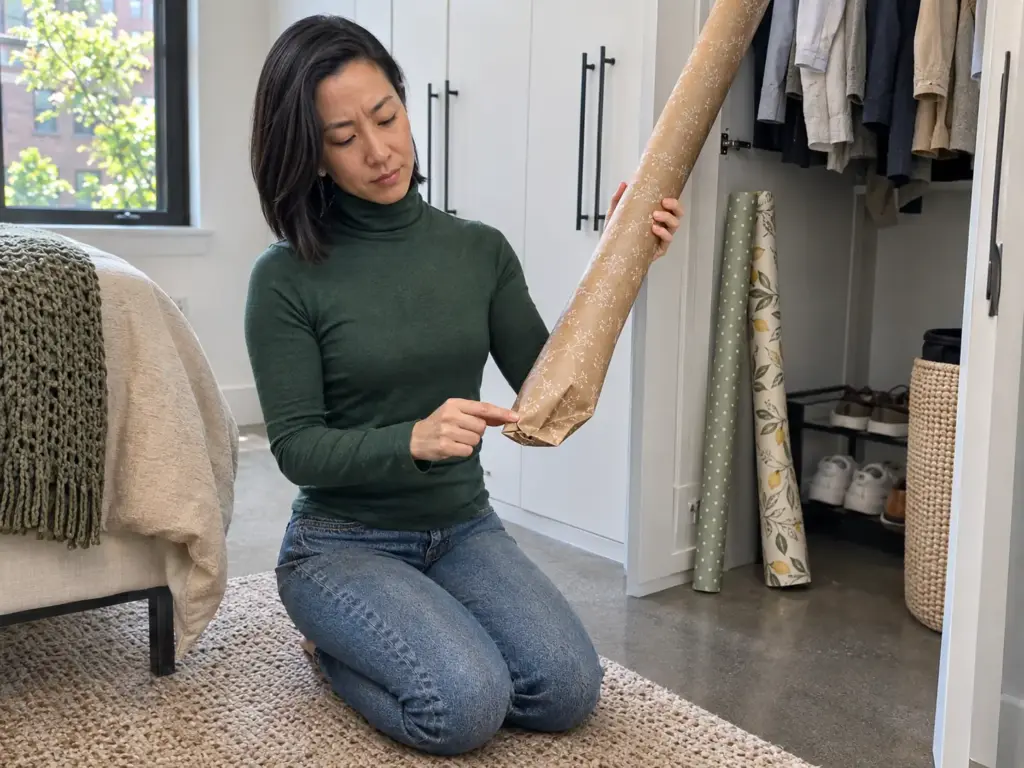
Weight is the main cause, and it shows up as a bent edge or a crumpled corner. A roll stored flat under a box, a bag or another roll flattens on one side, and the crease sets into the paper over a season. Stand the roll on its end and the problem moves instead of disappearing: the whole roll now rests on one rim, and by the following December the bottom inch is crushed.
Crowding adds to it from both directions. A bin packed tight presses every roll against its neighbors, and a bin with too much room lets them lean into one another, so the target is snug with nothing wedged.
Heat, Damp and Light: Why the Garage Is the Wrong Room
Paper keeps best in the rooms people find comfortable. The National Archives on storing family papers sets the ceiling at 75 °F and 65 percent relative humidity to hold off mold and insects, and it warns that air below about 15 percent humidity makes paper brittle. The Library of Congress’s guidance on storing works on paper aims lower, near 35 percent humidity, with no direct or intense light, nowhere near radiators or vents, and never in an attic or basement.
A bedroom or coat closet sits inside those numbers. If that closet already runs a seasonal rotation, the platform-bed and shelf clearances a seasonal swap has to respect apply to a roll bin as much as to a sweater box. A garage, an attic or a damp basement swings through those limits inside a single year, and the moisture there warps a sheet that a climate-controlled bedroom closet leaves flat. Light is the quieter loss, because direct sunlight is what fades the print, which makes the shelf under a window the worst spot in the house and the top of a closet the best.
Silverfish Go for the Thin Glossy Paper, Not the Kraft
Silverfish eat starch, glue and refined paper, so the thin, glossy sheet with a starchy finish is the roll at risk. University of Maryland Extension’s silverfish fact sheet says newsprint, cardboard and brown wrapping paper are seldom attacked. The brown kraft roll is safe, and so is a cardboard cuff or a cereal-box divider, which means the pest worry is usually aimed at the wrong roll.
The Bend Test for a Roll That Is Already Dead
Fold a corner back gently. Good paper flexes and springs back; a dead roll cracks along the bend instead of folding, and a frayed edge is the other early sign. Once it cracks, a better box only delays the tear on the fold, so that roll belongs in the purge pile described near the end, not in storage. What good storage buys is plain: nothing rests on a roll, and you can see every print without digging, so a third roll of the same snowflake pattern never gets bought.
Measure the Longest Roll, Then Add Two Inches
Picture a bin in the closet with its lid off, because the rolls are an inch too long to let it close. That inch is what bends the paper. The rule below settles the container before you shop and the spot before you move a single roll.
The Two-Inch Rule Applied to Rolls You Really Own
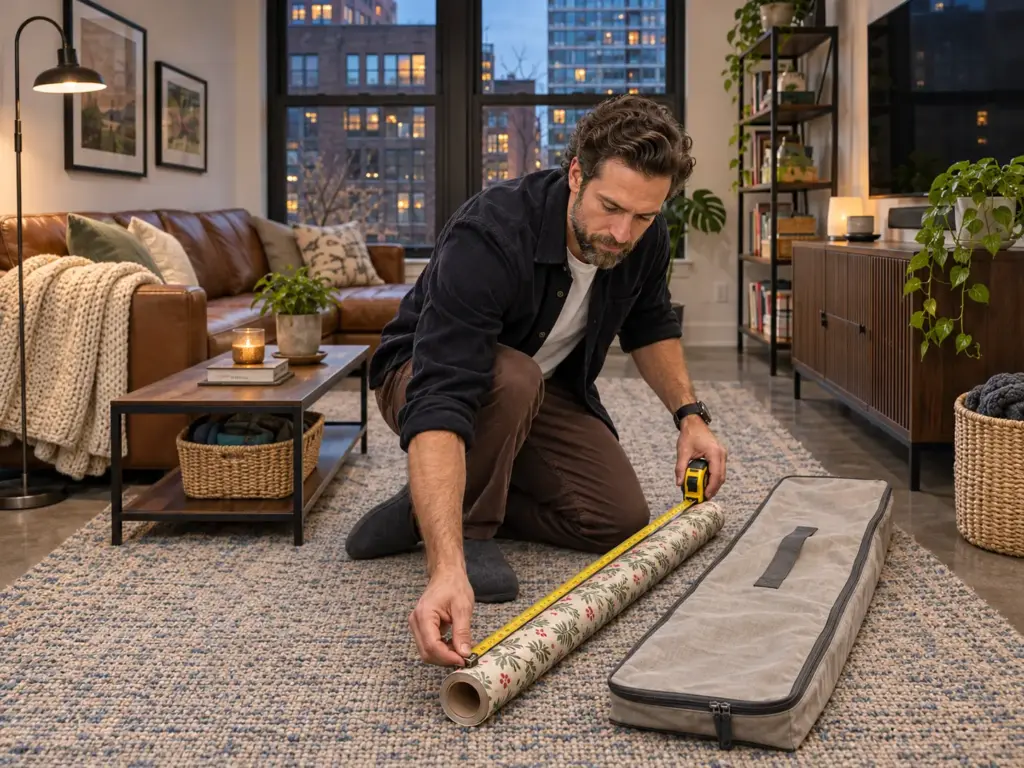
The rule comes from archivists. According to the National Archives, “Select a tube that is at least two inches longer than the width of the widest sheet.” Applied to wrapping paper rolls, a 30-inch roll wants a 32-inch container, a 36-inch roll wants 38, and a 40-inch roll wants 42. A wrapping paper container one inch short does not fit; it bends every roll in it, and the bend sets over eleven months.
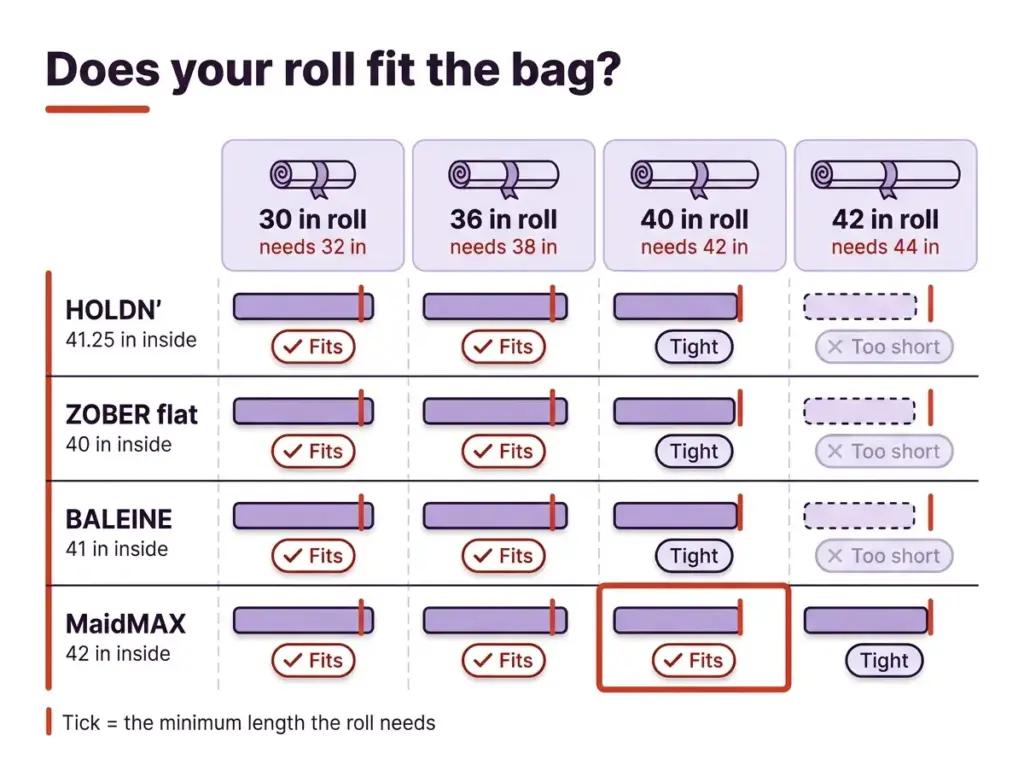
Dividers take length too. A cardboard insert or an adjustable divider eats one to two inches, so a bag that clears a 40-inch roll empty may not clear it once the divider is in. And the roll you measure is the longest one you own, including the jumbo from a holiday sale, not the average one.
Cut a length of string to match your longest roll, add two inches, and tie a knot at that mark. Carrying it to the closet or the store settles every container argument in ten seconds.
What the Boxes on Sale Actually Measure
Held against a 40-inch roll, the four soft containers in this guide land in different places. The HOLDN’ bag measures 41.25 inches inside (1.25 spare), the ZOBER flat bag is built for exactly 40 (none spare), the BALEINE tube is 41 (one spare) and the MaidMAX is 42 (two spare), the only one of the four that meets the archival rule. Call 41.25 workable, not generous.
For a 42-inch roll the answer is the MaidMAX Wrapping Paper Storage, 42 x 14 x 5.5 in, which takes rolls up to 42 inches. It has no reinforced walls, so it needs support to stand and the zip is fiddly at the corners, so it belongs lying flat, not leaning in a corner. Lying flat means a 5.5-inch height, and which under-bed boxes clear a low frame is worth reading before you commit to any flat bag. One rigid upright bin also quotes two heights for the same product, and that case gets its own paragraph in the upright section.
Roll Thickness Decides the Capacity, Not the Number on the Front
Capacity is a diameter question, and the capacity per roll count printed on a bag assumes thin paper. The HOLDN’ promise of 27 rolls assumes a core of 1 3/8 inches and a roll up to 40 inches long; once the rolls are the fat 2.5-inch kind, the same bag holds about 18.
The ZOBER flat bag quotes both ends of the range, 24 of the 1.5-inch rolls or 18 of the 2.5-inch rolls. A cross-section of 14 by 5.5 inches fits about four thick rolls per layer, so do the arithmetic with your own rolls, not the headline. Most of what is sold is sized for a bigger stash than a household owns.
Standing Rolls Upright in a Tall Bin
Shop for wrap storage and nearly everything is built for a stash of twenty-seven rolls, while the average closet holds four. Vertical storage can be as cheap as a container from the laundry room, and the ones worth buying are the ones that get the height right.
Free and Nearly Free: a Trash Can, a Hamper, a Soda Box
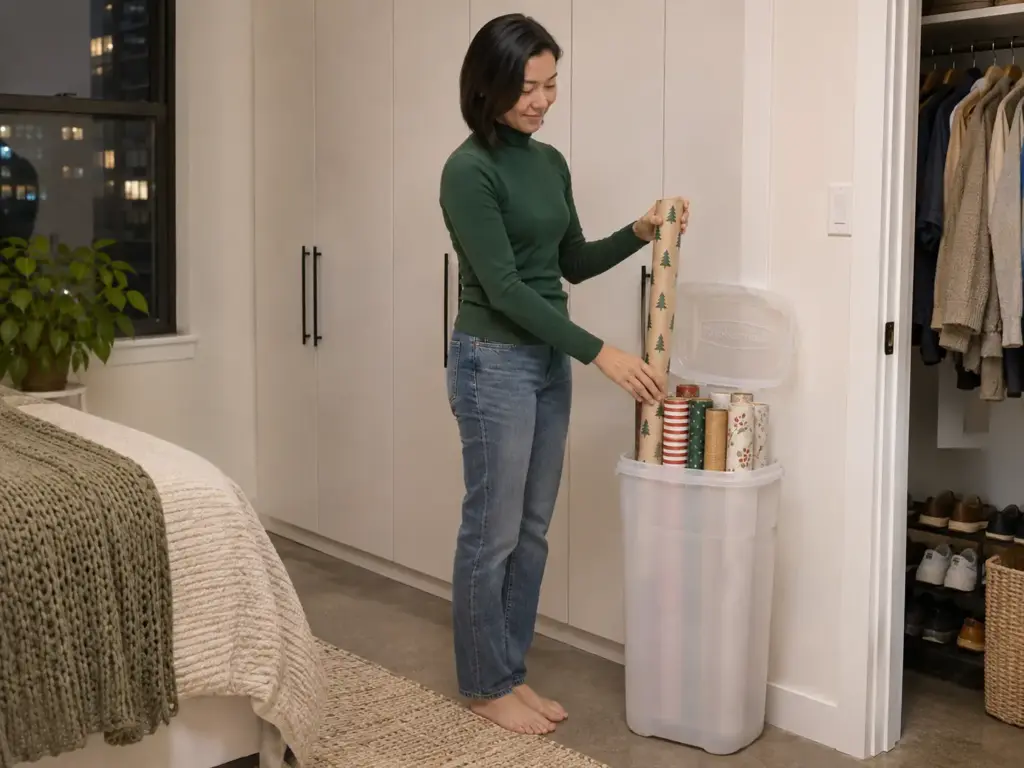
A tall kitchen trash can, a laundry hamper, a tall laundry basket or an umbrella stand holds rolls upright with no purchase, and a twelve-pack soda box opened at one end and covered in kraft paper does the same job for four rolls, so repurpose whatever tall thing is already in the house. For four to eight rolls this is the entire answer. Stand it in a closet corner, where the shelf and rod geometry a closet corner works with decides how much floor it gets, and the oversized free floaters finally have somewhere to stand.
How Tall Is Tall Enough
Upright is the usual first answer, and it comes with a condition: the rim takes the whole weight of the roll. A roll standing on bare plastic for eleven months crushes its bottom inch, so the bin needs a folded towel or a layer of tissue on the floor, and a height that clears the longest roll by the two inches from the rule above. A 30-inch roll needs a bin that clears 32.
Pack the bin so the rolls hold each other straight. For an upright box that is not full, the National Archives advises a spacer board and no overstuffing, which in a hamper means a folded towel or a rolled blanket tucked against the rolls.
Cut a square of corrugated cardboard to the floor of the bin and set the rolls on it. The rim presses on a flat, even surface, and the cardboard can be swapped when it dents.
The Rigid Bin and the Fabric Tube
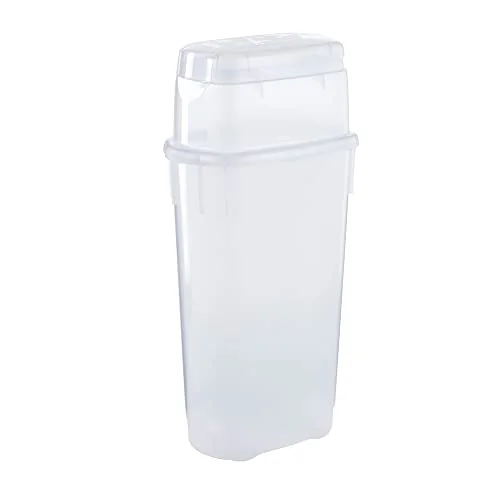
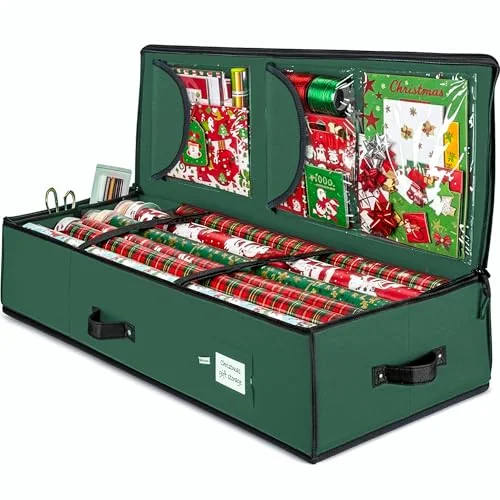
Two upright containers earn their place in this guide. The rigid one, a hard plastic wrapping paper storage box with a lid, keeps anything from being stacked on a roll and carries a compartment for tape, scissors and bows. Read its height first: the maker’s specs give 26.75 inches in one place and 33.25 in another, and only the taller figure clears a 30-inch roll.
The budget answer is the fabric tube, 41 inches long and 11 across, with a clear PVC window that shows each pattern without emptying the bag.
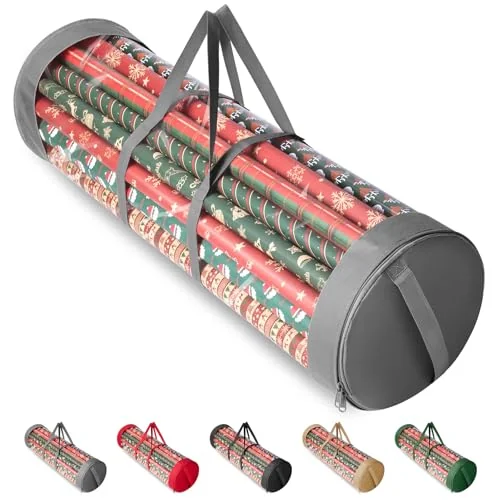
Set the rigid bin against the tube and the real question is how fabric and plastic bins fail differently: plastic cracks at the lid, fabric slumps when it is half empty. Both stand on the floor with no holes in anything, so the difference for a renter and an owner is the footprint. Measure the corner first (17 by 10 inches for the rigid bin).
A Corner, a Hamper and No Drilling at All
Rack after rack in the store says wall-mounted, which is no help when the lease bans holes, the coat closet is full and there is no clear floor. Here is the version for six rolls in a nook of a small space, the corner of a bedroom or the gap beside a guest room dresser, with nothing mounted.
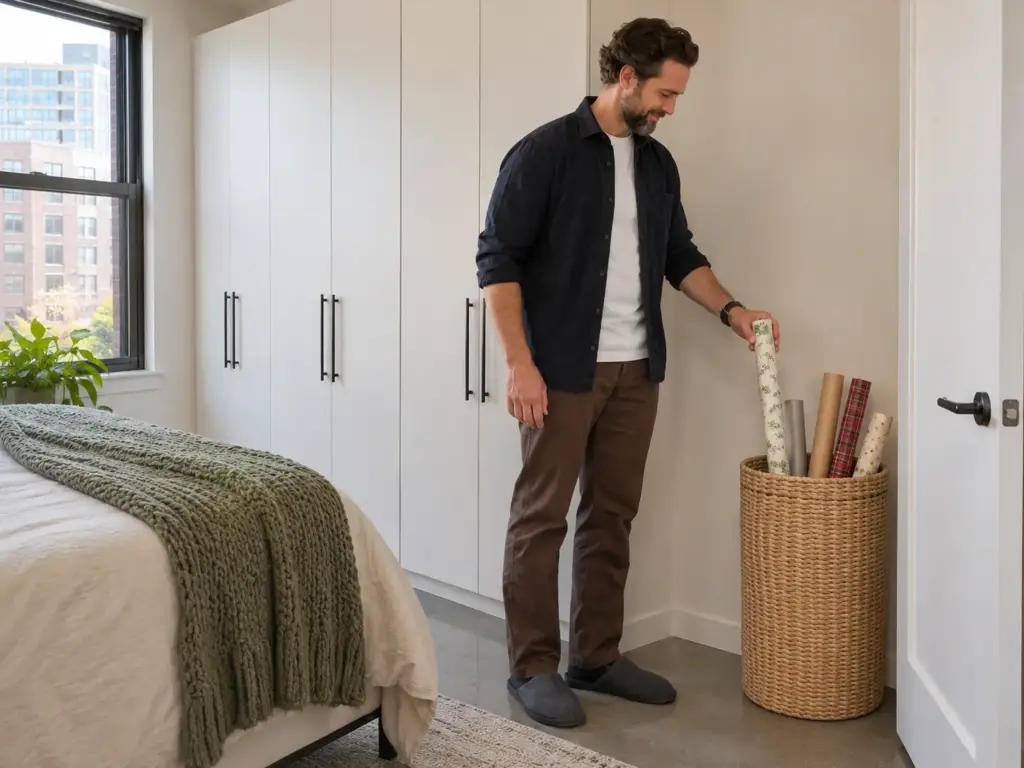
Six Rolls in a Bedroom Corner
A hamper or a tall kitchen bin with a folded towel in the bottom holds six rolls, and with a lid on it disappears. Where a rectangle will not go, the ZOBER Round Gift Wrapping Paper Organizer, 40 in fits 25 standard rolls and its round profile drops into a corner, a deep shelf gap or under a bed. Durability is mixed: the fabric can tear. Use up the oversized free floaters first, and the upright bin never has to be bought for them.
The same logic holds in a big house, only the problem flips. A spare bedroom closet or a garage shelf swallows rolls by the dozen, so the rule of a spot per category and one station for supplies matters more there than the container, and a rolling cart can park the whole kit.
A Rod Through the Cores Only Works If It Is Longer Than the Roll
A tension rod, a curtain rod or a dowel rod through the cores holds a stack of rolls like a spool rack, resting on a pair of S-hooks or on the rod’s own brackets, and it needs a closet or alcove wider than the roll. Each rod has a span printed on its pack, and a gap narrower than your longest roll rules the method out; narrow spaces should skip to the shoe-organizer version below. For the exact limits, see where a tension rod holds and where it drops.
Free Hooks and Racks for a Renter
An open-backed over-the-door shoe organizer takes a full roll pushed through each slot, and a rope-and-dowel ladder on adhesive hooks holds art paper and gift wrap together. A zippered bag from a bedsheet set becomes the pouch for ribbon spools and tissue paper. Adhesive hooks have weight ratings, so read the rating on the pack and keep the load to what a few rolls weigh. More setups that keep a deposit safe are collected in no-drill closet setups that keep a deposit safe.
Flat Under the Bed or on a Closet Shelf
The flat bag that seemed to fit until it met the side rail sticks out two inches into the room, because the mattress height was measured by guess. The number that decides this is the gap under the lowest rail.
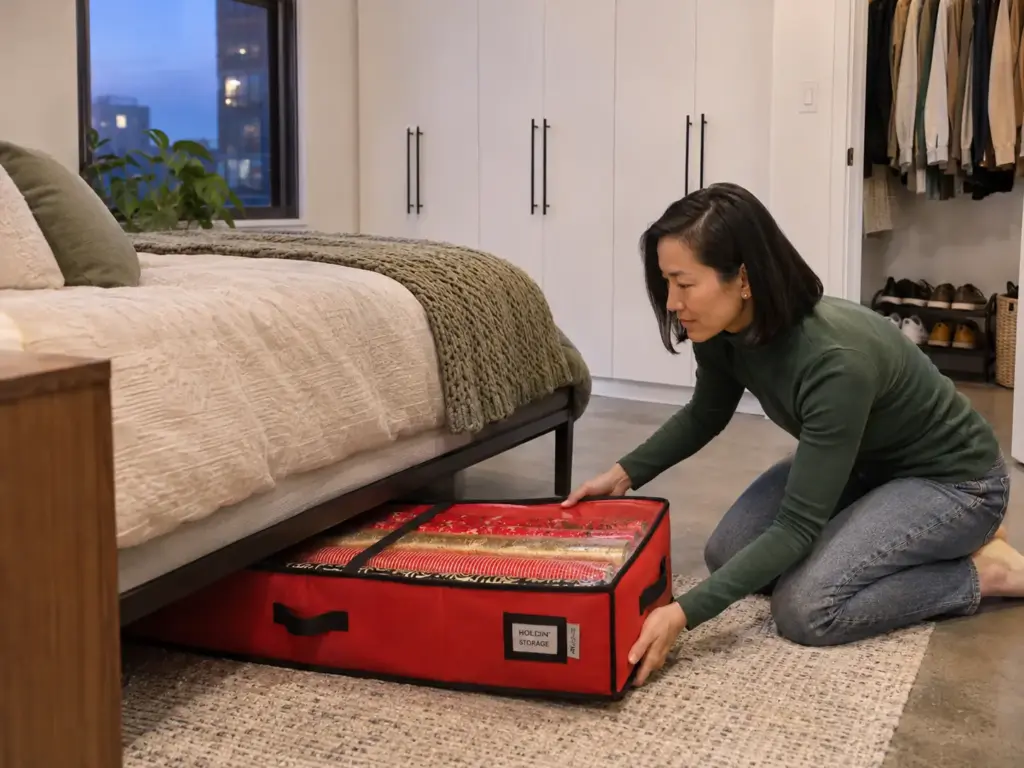
Measure the Rail, Not the Mattress
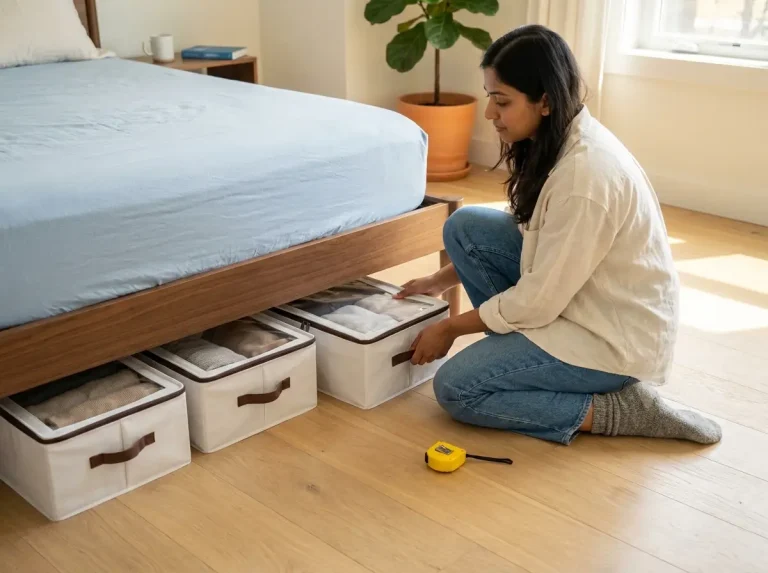
A bed frame lifts the mattress well off the floor, but under-bed storage is decided by the rail. A 5.5-inch bag needs 5.5 inches plus room for the hand that slides it out. Platform beds leave about four to seven inches; metal frames leave seven to thirteen.
A rail that leaves four inches rules the flat bag out and sends the paper to a closet shelf or an upright bin. What platform and metal frames leave underneath is worth a look, and why a flat bag clears a frame that a rolling drawer cannot explains why paper beats a rolling drawer here.
The Bag That Slides Under the Bed
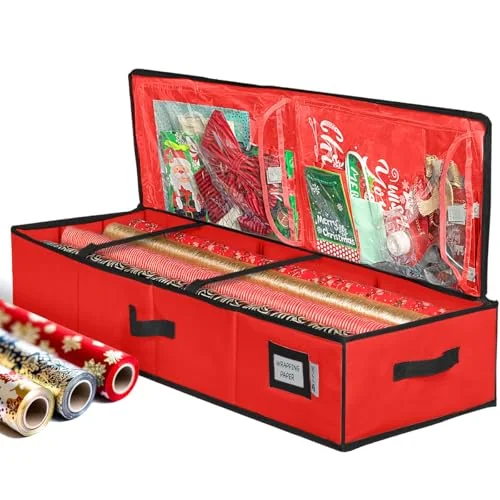
The flat bag to measure first is the HOLDN’, 41.25 by 14.5 by 5.5 inches in 600D fabric, with straps and two vinyl pockets in the lid. The 27-roll number is a thin-roll figure, and the bag fills sooner with fat rolls, so count the capacity from the core size, not the headline.
A Flat Box on a Shelf When the Bed Is Too Low
Flat, or horizontal storage, means nothing stacked on top: a bag under a bed takes nothing, and a bag on a shelf takes nothing on it. The tell that it is wrong for you is a divider that eats the inch you counted. An owner with a spare closet shelf can use the same flat box there; a renter keeps the method with no mounting at all by sliding it under the bed.
The structured shelf option is the cheapest one: a cardboard insert holds the shape, and pockets take bows and tags. It is built for a 40-inch roll with no length to spare and the insert uses more, so reserve it for 30- to 36-inch rolls.
Keep Each Roll Closed and the Kit in One Place
A roll that unrolls the moment it leaves the bin gets a rubber band by July, and the band leaves a crease around it. Then comes the Sunday before a birthday, hunting for the tape in three rooms. Both problems have the same answer: close the roll without touching the paper, and keep everything for wrapping in one spot.

A Band on the Paper Does More Harm Than a Loose Roll
A rubber band, a strip of tape or a sheet of plastic wrap is the first answer most people reach for, and all three touch the paper. The Library of Congress lists among the things not to do to paper: “Not using rubber bands, self-adhesive tape, and/or glue on paper.” Read in full on the Library of Congress’s list of what not to do to paper, the point is that a rubber band creases and degrades onto the sheet, and tape tears the print off. A band that touches the paper is out.
A Cardboard Cuff, a Ribbon Tie, a Clip on the Edge
What holds a roll without touching it is a loose cardboard cuff cut from a tube or a cereal box and slipped over the end, a ribbon or a Velcro strip tied loosely around that cuff, or a binder clip that grips only the very edge. Watch the clip: the same guidance rules out paper clips and fasteners, and a clip that dents the edge you will wrap with is the same mistake as tape. A cuff costs a minute of scissor work; a ribbon costs a few seconds per roll.
Slice a paper-towel tube into rings about two inches wide, then cut each ring open along one side. The cut ring springs snug over the end of a roll and slides off in a second, with no adhesive anywhere near the paper.
A half-used roll gets rolled back tight with nothing taped, and the cuff goes on at the cut edge. The roll that gets used in July is never the full one. Kids and pets go for loose rolls, and a closed cuff plus a bin with a lid solves both without a household rule.
One Station for Paper, Tape, Scissors and Bags
Ribbon, tape, scissors, gift tags, bows, gift bags and tissue belong in the same place as the paper. That gift wrapping station is what keeps a gift from taking forty minutes, and it puts the roll you actually use at the front. Gift bags nest inside the largest one, tissue folds flat, and the zippered bedsheet bag from the renter section holds the ribbon. For the rolls and spools themselves, storing rolls and spools of paper in a craft room shows the same problem from the craft side, and which craft organizers earn their space sorts the paper cases and carts worth keeping from the ones that only take up room.
Hanging Rolls on a Door or a Closet Rod
The hanging organizer that was fine with six rolls turns heavy by the third Christmas, hard to get anything in and out of. The back of the door, a bedroom door or a closet door, is the one place nobody sees, so it is worth knowing its limit.
The Free Version: an Over-the-Door Shoe Organizer
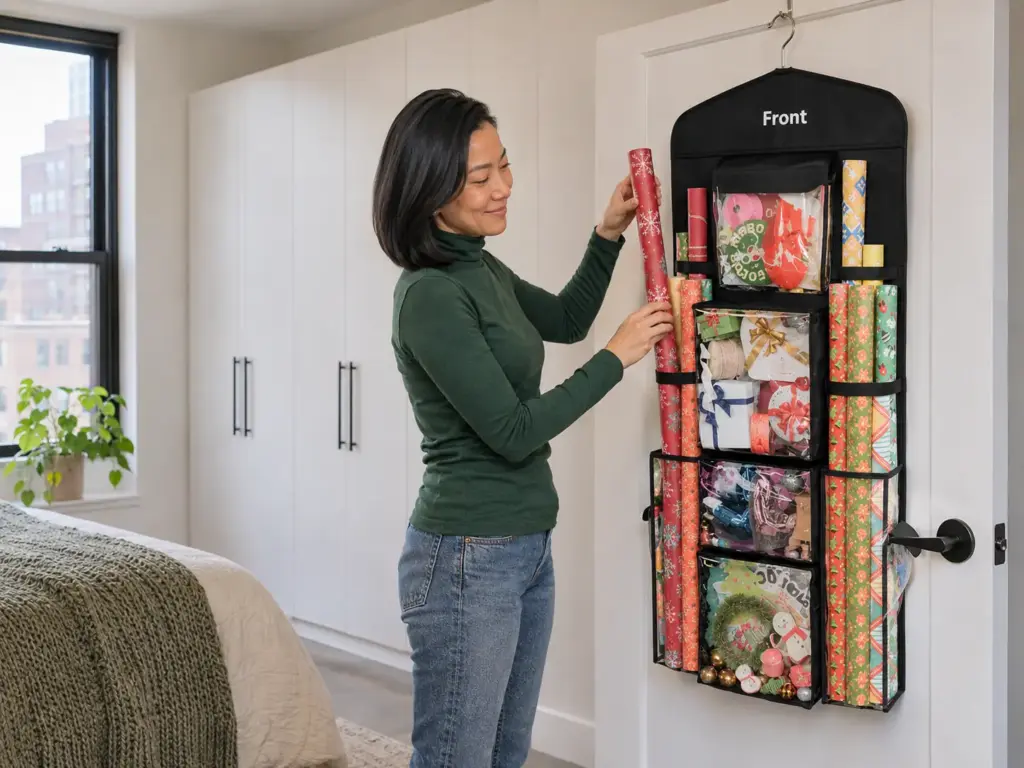
Skip the purchase first. An over-the-door organizer you already own, shoe pockets included, holds six to eight rolls, with a roll pushed through each pocket slot and the bags and tape in the other pockets, and a renter changes nothing on the door. An over-door shoe organizer already measured for slots shows the slot sizes before you start.
A Hanging Organizer for Rolls, Bags and Bows
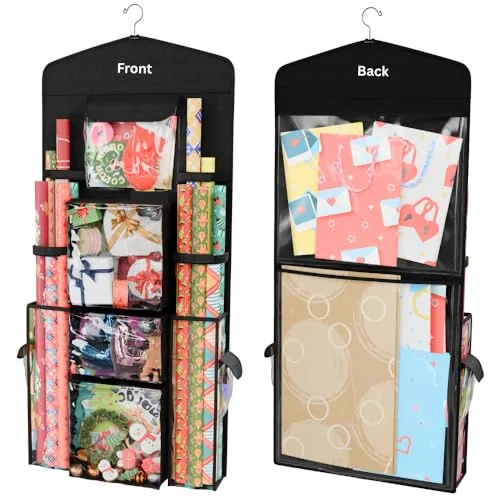
When the shoe organizer is full, one organizer made for rolls earns its place. It uses vertical space nobody else wants, hangs a 40-inch roll with no floor footprint, and a garment bag on a closet rod can do a smaller version of the same job, and the front pockets keep bags, bows, tape and scissors next to the paper.
What the Door Can Carry
Weight is the limit of any hanging method. Past about eight rolls one hanger is carrying a lot, and the first thing to give is the hanger, then the door, so door thickness and hollow-core limits before hanging anything are worth checking. Spread the load: once the organizer is full, hang it on the door and not on a closet rod, and keep the stash to what it was made for. Keep it out of direct light and away from a vent, the same rule as the room.
Both hanging versions go on a door or a rod without a hole. An owner can mount a rack, but the rack carries the same load, so the limit is the same. For renters, weight limits for over-door and hook storage in an apartment cover the hooks.
How Many Rolls to Keep and When to Let One Go
The July birthday empties half the stash and December fills it again, so the paper is not a December object. A household that wraps six gifts a year needs four rolls and an umbrella stand; the bag built for twenty-seven rolls is for the reader who owns twenty-seven.

Count What You Really Wrap in a Year
Count the gifts you wrapped in the last twelve months, birthdays included, and keep about that many rolls’ worth. A closet that holds more is storing paper for a household that does not exist. The roll you use most sits at the front or the top, the rest behind it; hiding all of it is how a roll gets bought twice.
The Purge Test: Cracked, Duplicate, Oversized
The purge test, the one declutter step this stash needs, comes from the paper. A roll that cracks when a corner is bent is dead, the brittle-paper failure of the dry-air section. Duplicate rolls, two of the same print, mean one goes. An oversized roll that fits no container goes to the front and gets used up first.
Scraps and gift bags belong with the kit, tissue folded flat, bags nested inside the largest one. What is put away after the holiday follows a rhythm of its own; the post-holiday take-down and packing order covers it for decorations, and the rolls join that same trip.
Match the Method to the Stash and the Home
Four to eight rolls in a rental call for the corner bin or the shoe organizer. Eight to twenty rolls fit an upright bin or a flat bag. Past that, one flat bag plus an upright, and a spare closet or garage shelf if there is one.
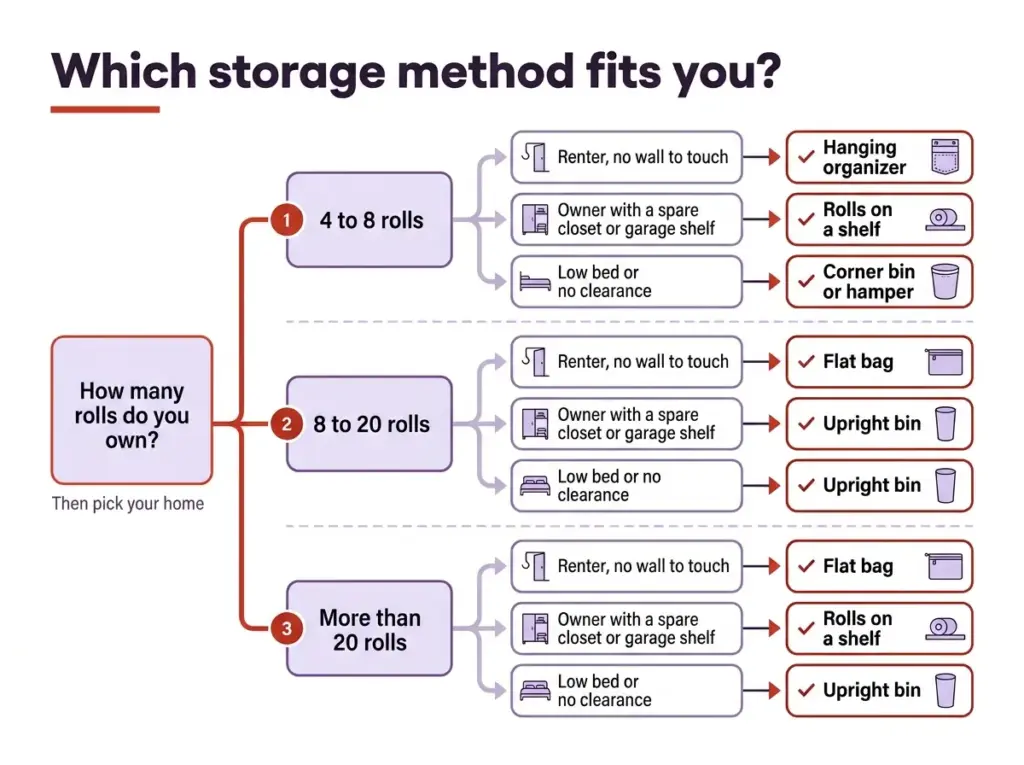
A large home with a spare closet can hold a full station, and the same rules apply: the room, the length, the cuff. Then the rest of the season’s gear needs its own place, and storage boxes for ornaments, trees and wreaths is where that lives.
Where the Rolls Live From Here
Measure the longest roll and add two inches, then hold every container to that number. The rolls are one box among many, and how every holiday and seasonal item is sized by shelf depth, tree length and room dampness covers the rest of the closet. Keep the paper in a bedroom or coat closet, off the floor and out of the light. Close each roll with a loose cuff, never a band on the paper, and keep only the rolls that will be used.
Before the first birthday or holiday after the setup, take the longest roll out and look at its edge and its corner. A crease or a crack at that spot says the container is a hair short, so change the container, not the roll.
Today, stand the rolls in the hamper from the laundry room or a tall bin in a closet corner, slide a cardboard cuff onto each one, and notice which roll comes out flat and which one belongs in the purge pile.
Frequently Asked Questions
01What are some good storage containers for wrapping paper?
For a stash of four to eight rolls, a tall hamper, a kitchen trash can or an umbrella stand is all the container you need. For more, pick by space: a rigid bin in a closet corner, a flat bag under the bed, or a hanging organizer on a door. Make it two inches longer than your longest roll.
02What are some cheap or DIY ways to store wrapping paper?
A twelve-pack soda box opened at one end and covered in kraft paper, a tall bin, an over-the-door shoe organizer with a roll through each pocket, or a cardboard tube cut into cuffs. All cost nothing or close to it, and none needs a drill.
03How do you put wrapping paper in a box so it doesn’t bend?
Lay the rolls in lengthwise with nothing on top, or stand them upright in a bin taller than the longest roll, packed so they do not lean. If the box is not full, fill the gap with a folded towel or a spacer so the rolls hold each other straight.
04How do you keep a roll from unrolling without a rubber band?
Slide a loose cardboard cuff over the end, or tie a ribbon around the cuff, never around the paper. A rubber band creases the paper and tape pulls the print off it.
05How do you store wrapping paper in a small apartment?
Use a hamper or a round cylinder in a bedroom corner, or an over-the-door shoe organizer, and keep only the rolls you will use in a year. Nothing here needs a hole in the wall.
Disclaimer: ClutterlessNest is a participant in the Amazon Services LLC Associates Program. As an Amazon Associate we earn from qualifying purchases. This article may contain affiliate links — if you buy through them, we may earn a small commission at no extra cost to you. We only recommend products we have tested or genuinely believe in.