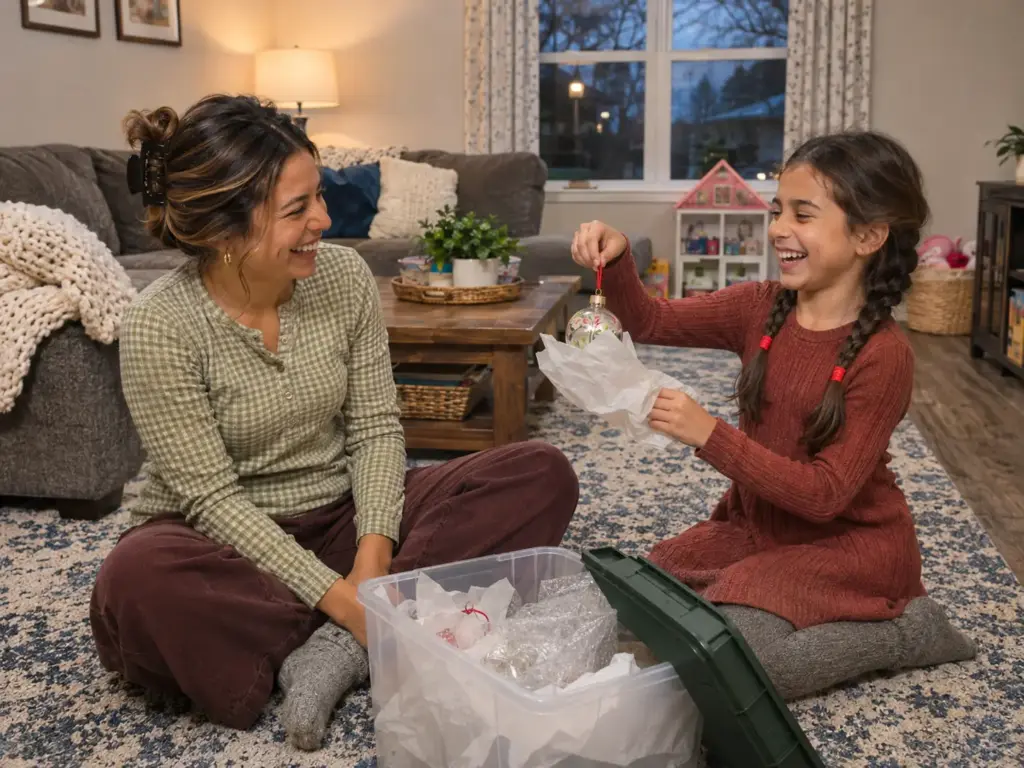
A strand that will not light, a wreath crushed flat on one side, an ornament whose paint has gone dull and tacky: most of what you find in the tote next December traces back to Christmas decoration storage done on the evening of the twenty-sixth, tired, box by box, in whichever corner nobody checked. The preservation rules that museums, libraries and archives write for objects they must keep for decades apply to a box of ornaments almost line for line, and they are why the advice below differs from what most households do. This guide walks through the order to take things down in, one packing rule for each kind of thing, and the spot where the totes should sleep, matched to the home you actually have, whether that is a garage that bakes, a hall closet or the space under a bed.
Quick Answer
Pack in the order the room comes apart, give each kind of decoration its own container, and put the totes in the most stable spot the home has.
- Take decorations down room by room, wrapping breakables as they leave the shelf.
- Pull failed strands and worn pieces, then pack one tote per kind.
- Wind lights on notched cardboard, bag the tree in sections, give wreaths a stiff shell.
- Label the contents and the room they return to, on the top and the side.
- Store totes in the most interior, driest, coolest spot you have, off the floor.
How to Store Christmas Decorations in the Order the Room Comes Apart
The evening of the twenty-sixth is the worst possible time to make storage decisions, and it is exactly when most of them get made. The living room is half stripped, one box is open on the sofa, three more ideas about where everything should go are competing, and “just throw it in” sounds like relief. The bill arrives eleven months later, in the form of a tangled strand and a tote nobody wants to open. A system that survives being done tired starts with the take-down order, because the order you pull things off the walls decides how they come out of the box.

Take It Down Room by Room, Not Box by Box
Boxes are laid out by kind of object, but a house comes apart by room, and fighting that costs you. If you try to fill the ornament box first, you end up crossing the living room four times with a bare hand, picking up glass on the way to something else. Work room by room, then surface by surface, then item by item, and let each room’s worth of decorations land in one temporary tote. The regrouping into one tote per kind happens later, once the room is clear and you can sit down with it.
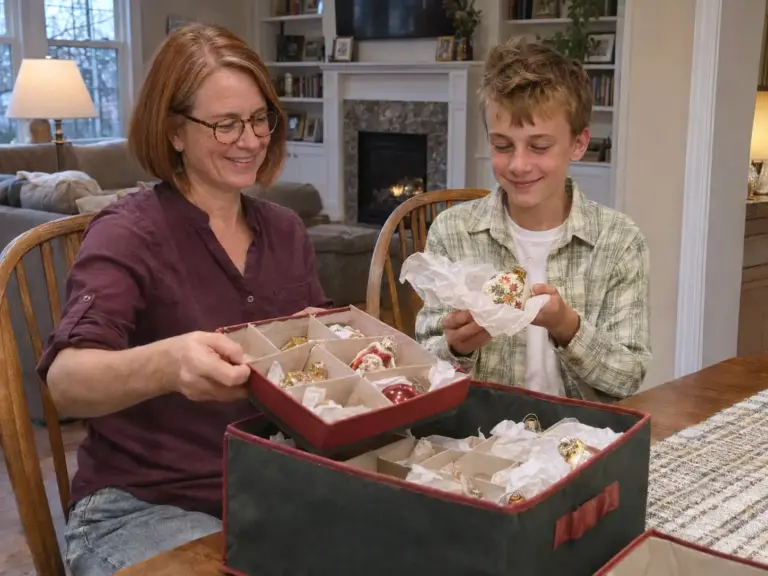
The one rule that cannot wait for the second pass is wrapping. A breakable wrapped as it comes off the shelf stays whole; a breakable dropped into a tote “to wrap later” gets wrapped the night before the tote closes, or never. Keep the tissue, the cell box and a roll of tape within reach of whatever you are stripping, so wrapping is the next movement of the same hand and not a separate chore.
Clean before storing: dust each piece and let anything damp dry first, because moisture inside a closed tote does the damage. Inflatables get fully deflated, folded and kept with their pump in their own bag.
The Three-Pile Sort Before Anything Is Wrapped
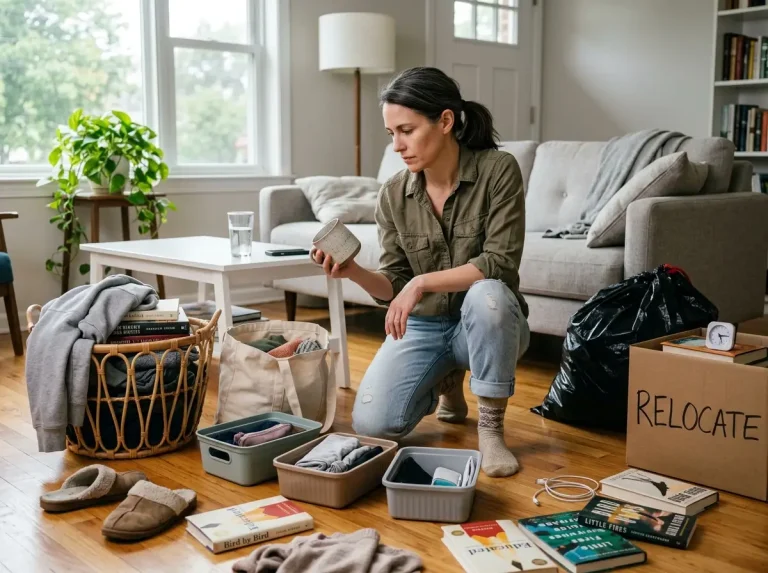
Before a single piece is wrapped, it goes into one of three piles: keep, donate, trash. A three-bin sort with a labeled box for each is enough, and anything that still works but will not earn its slot is a donate decoration, not a trash one. Broken lights, frayed cord, a wreath that has lost its shape and the third duplicate of a plastic star all leave before they take a slot.
A tote full of things nobody wants is the fastest way to run out of room, and the sort is cheap at this stage: a few minutes a room. The version that skips it costs an hour of untangling and a shelf’s worth of space in the garage.
The same keep, donate and trash logic scales up to any decluttering project, and a four-box sort shows what happens when the “maybe” box quietly becomes permanent storage, which is the exact trap a holiday tote falls into when nobody decides.
Set an empty shoebox on the arm of the sofa and call it the discard box. Anything that fails a look goes straight in, while it is still in your hand. The decision costs seconds now and an argument in November.
What Goes in the Trash Instead of the Tote
Some things should not be stored at all, and the sorting pile is where you learn which. Strands with cracked sockets or bare wire go in the trash. Ornaments that have already lost their hook, their cap or half their paint rarely get repaired next year, so they go too.
A wreath that has gone flat on one side will not recover in a shelf’s darkness. And batteries come out of anything that takes them, because a leaking cell inside a tucked-away light-up figure is the kind of damage that stays invisible until you open the tote.
Here is the part that sounds harsh but saves the most space: whatever you would not buy again today does not get a place in next year’s tote. That is not a call to purge the sentimental pieces. It is a call to stop paying shelf space for the third string of lights that never worked.
Ornaments and Breakables: Padding, Cells and What Never Touches Paint
Pull out last year’s newspaper-wrapped ornament and the paint has gone dull, a little tacky under the thumb, with a faint ghost of newsprint on the glass. It was wrapped that way because that is how the household always did it, and because newspaper is free. Padding and container are really one decision, and the free material most people reach for is the one that damages the paint.
Why Newspaper Is the Wrong Wrap for Painted Glass
Newsprint is cheap paper made to be read this week, not kept for years. As the Library of Congress’s own guidance on storing newsprint puts it, “Newspapers from the mid-19th century onwards are printed on inexpensive, machine-made, wood pulp paper that is not manufactured for longevity.”
The National Archives ties the discoloration to impurities in that paper, which turn acidic when light, humidity and air pollution work on them over time. Against hand-painted glass, that acid has months of contact to work with. Glass itself does not react, but the paint does.
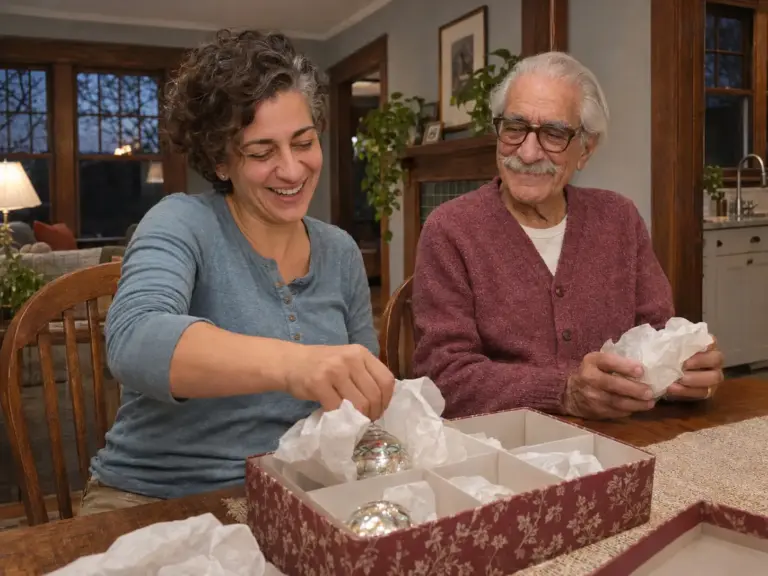
The swap is acid-free tissue paper, white and unprinted. Bubble wrap is fine as an outer layer for sturdy pieces, but the tissue goes against the paint first. Wrapping paper with a pattern on it is not a swap, since the ink sits in the same position as the newsprint, touching paint.
Plain unprinted paper works for the sturdy pieces. For the painted ones, and for anything with glitter, tissue is the better answer.
Cells, Dividers and the Free Version of Both
A grid of cells is the best idea in ornament storage, because nothing touches its neighbor and a single drop does not become a chain reaction. You do not need to buy one to get it, and the free solution is sturdier than it sounds. A liquor-store box with its cardboard bottle dividers still in place is already a grid, sturdy, free and the right depth for most standard ornaments.
For small pieces, plastic cups hot-glued into a bin or an egg carton cut to fit do the same job. Loose hooks, caps and tree-topper parts go in a cookie tin or a coffee can with a lid, taped inside the tote.
For glitter and thin glass, there is a better version. Art conservators at the University of Delaware recommend padding with lightly crumpled tissue, placing the piece in a plain cardboard box, then nesting that box inside a larger box or a plastic bin. The layers work as a buffer: the outer plastic keeps out pests and splashes, and the cardboard shell between them slows the swings in humidity that reach the piece. It is the free version of an ornament box, and it is better than most of the bought ones.
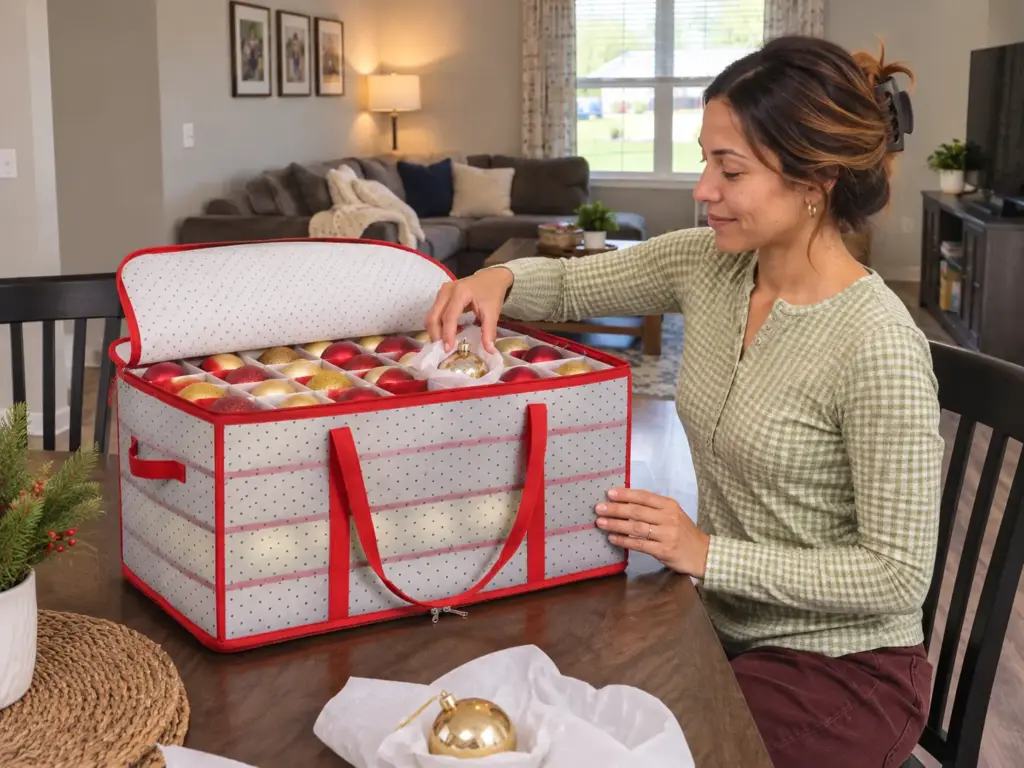
A divided ornament box earns its place when the collection is large and you want 128 separate cells in a single box that stores flat. The ZOBER Christmas Ornament Storage Box 128 gives you 128 individual three-inch cells behind a zipper on both sides, weighs about a pound empty and measures 26.8 inches long by 13.6 wide, which suits a standard shelf. The weak points are the dividers and the handles.
The cardboard dividers can collapse and the handles can rip, and the dividers are exactly what the box is bought for, so carry it from underneath and treat the handles as decoration. For a small collection, the free grid does the same work.
The Heavy and the Sentimental Pieces Get Their Own Layer
Weight is the second problem hiding inside the padding question. A 27-gallon tote packed with ornaments gets heavy fast, which is a lift from a shelf that quickly turns into a strain, and the bottom layer takes all of it. Many light boxes beat one heavy tote, and the same rule applies from every end of the system, as the totes section below shows.
Within each box, the heavy ornaments (glass ornaments, ceramics, anything with a metal cap) go in the bottom layer, where they cannot crush what sits above. The sentimental ornaments, the pieces nobody can replace, get their own layer, wrapped last and packed at the top, in the position where a stack of other boxes cannot reach them. Take the metal ornament hooks off before packing, since they scratch paint and snag tissue, and keep them in a small bag.
Hand-painted glass is dusted, never washed, since water lifts the paint. And glitter sheds into everything it touches, so pieces that carry it go in their own tissue-lined cardboard shell instead of sharing a cell with something smooth.
Lights and Garland: Wind Them So the Knot Never Forms
An hour spent on tangled lights in December is almost always the bill for stuffing them in “just for now” the January before. Nobody admits to packing a strand badly; a goblin must have got into the box overnight. The knot forms when strands share a space with no structure, and the structure costs almost nothing.

The Free Winder: A Notched Piece of Cardboard
Cut a rectangle of cardboard from any shipping box, roughly the size of a paperback, and notch each short side: one notch for the plug end, one for the last bulb. Anchor the plug in its notch, wind the light strand around the cardboard (the notched piece works as a cord winder), tuck the last bulb into the other notch, and slide the whole thing into a plastic grocery bag, one strand per bag, so two strands never share a lap. It costs nothing and does the job, so take it first.
Write on the bag with a marker where the strand goes (tree, window, mantel). Next December, the strand that belongs on the window is in the bag marked window, and not at the bottom of a pile you have to empty onto the floor.
When a Holder Is Worth Buying (and When You Need a Reel)
A bought holder earns its price for the household with many short strands, because holders hang or sit in any tote and need no cutting. The codree 4-Piece Light Storage Holders come as a set of four, each 11.8 inches long, with built-in hooks for the plug and room for about 100 mini lights apiece according to the listing. That makes them right for tree and window strands. A long outdoor run needs a light reel instead, because it will not fit around a holder that size without crowding.
The free winder does the same job at no cost, so the holders are a convenience for the household that dislikes cutting cardboard, not a necessity.
Plug each strand in for ten seconds before it is wound. A strand that lights goes onto its winder; one that does not goes in the discard box, and the winder you saved goes to the next strand.
Garland, Cords and the Strand That Goes Back In
The safety checklist that the Consumer Product Safety Commission publishes is blunt about the problem. As the Consumer Product Safety Commission’s holiday decorating checklist says, “Check each set of lights, new or old, for broken or cracked sockets, frayed or bare wires, or loose connections.” Damaged sets go in the trash.
The Commission’s timing is before decorating, when lights go up. My judgment is that the same look belongs at pack-down too, because a failed strand then leaves in the trash and never rides eleven months in a box, where it comes out as a strand of busted plastic. Looking at the sockets and wire takes one minute a strand, and it ends December’s argument over which strand died.
Garland and cord get wound loosely around a holder or a broad roll, never tight. Temperature swings make plastic and wire move, and a strand under tension in a hot garage can crack at the bend, which is why it can fail even when it looks fine on the shelf. And skip the tight rubber band; a loose loop of the cord’s own end holds the winding without squeezing it.
The Tree and the Wreaths: Keep the Shape, Skip the Crush
A tree box taped shut for the third year, split now down one corner, and a wreath that came out flat on one side: both are shape failures, and both are cheap to prevent. The tree needs a container sized to its sections. The wreath needs a shell that stops it being crushed.
Taking the Tree Apart and Bagging It by Section
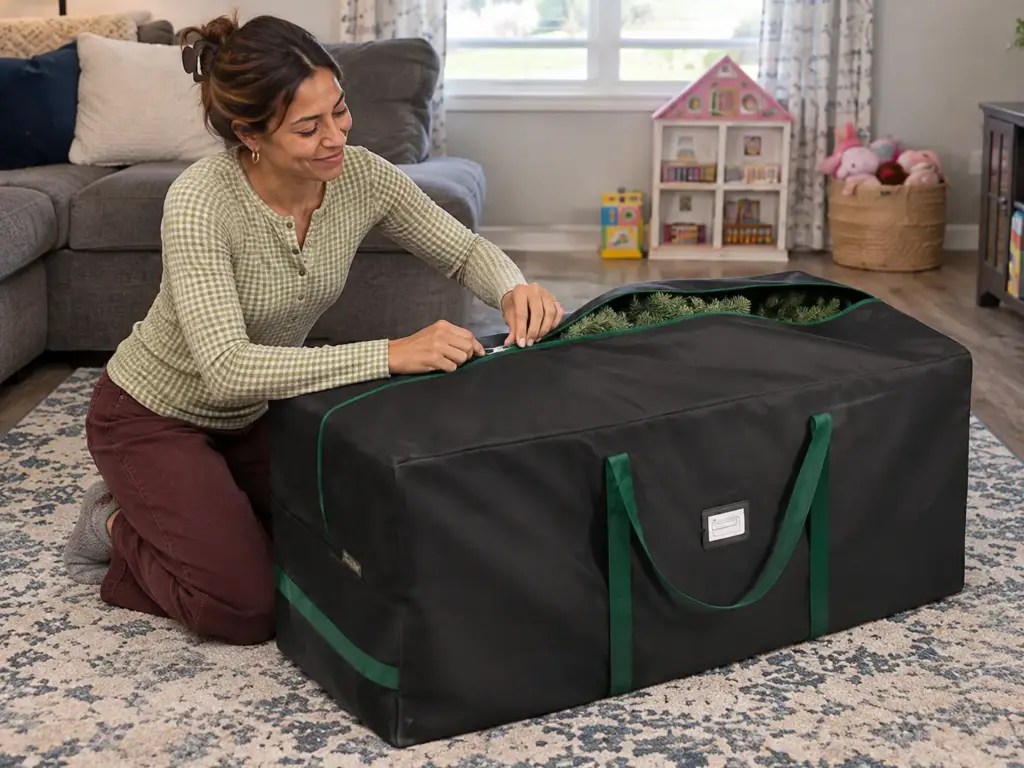
An artificial Christmas tree comes apart at its own joints. Disassemble the tree section by section, fold each layer’s branches upward so the tree layers pack compact, and bag them in that order, so the sections come out of the bag in the sequence you will rebuild them. The container decides where the tree sleeps. If the original box survived, it is the free and stiffer option, and a box that fits a tree is hard to beat.
If it did not, the BALEINE 7.5 ft Christmas Tree Storage Bag is 50 inches long, 16 wide and 20 high, made of 900D Oxford with reinforced handles and dual zippers, sized for a 7.5-foot tree in sections. The zipper is the weak point, since quality is mixed and some zippers fail or come open, so close the bag with the handles aligned and do not stand on it to compress it. Wheels help on a long haul, and a rolling tree bag is worth a look for a tree that has to cross a house, though this one has handles, not wheels.
The 50 inches is the number that matters. It decides whether the bag stands in a corner or lies across a shelf, and a short tree is a different problem altogether: only the tall tree is a 50-inch problem, and a shorter one can go in a tote.
One Rigid Shell for the Wreaths
A wreath is a ring of wire and plastic needles, and it fails by being crushed, usually under whatever got stacked on top. A stiff container around it fixes that. The Hearth & Harbor Wreath Storage Container is 24 inches across, with clear PVC sides, a dual zipper and removable interior pockets.
The shell is firm rather than rigid. It stops a wreath being crushed on its own, but it does not carry a loaded tote set on top of it, and the build quality is mixed, so it goes on top of the stack or on a shelf of its own.
A two-pack of soft polyethylene wreath bags costs less and does less: they keep out dust and nothing more. And for the reader with room, a wreath on a hook inside a closet door needs no container at all, just a bag over it to keep the dust off.
Where a Fifty-Inch Bag Actually Lives
A 50-inch bag does not fit a shelf, so settle where it goes before it arrives. It lies across the top of a closet, along the floor of a wardrobe, or upright in a corner of the garage or a spare room, away from the door. In a one-bedroom, the best answer is often the back of a hall closet. Measure the spot first, and measure the diagonal if the bag is going to stand.
Totes, Cardboard and Labels: One Container for Each Kind of Thing
Open the black tote with the yellow lid labeled “Christmas stuff” and the mix inside is the whole problem in one box: lights under the ornaments, garland under the lights, and a reader emptying everything onto the floor to find one stocking. The container question is really two questions: what protects, and what damages.
What a Tote Does and What It Does Not Do
A lidded tote keeps dust, pests and splashes out, and it gives you a stack. What it does not do is hold a temperature steady. A sealed lid slows the movement of air and humidity but does not insulate, and nothing about a latched tote turns a hot garage into a cool one, so the lid is not a fix for the spot. For more on when fabric bins hold up and when plastic does, the question is worth settling for any container that will sit through a summer.
Cardboard is not the enemy it is made out to be. The conservators’ nested-box method above is cardboard inside plastic, and the original tree box is stiffer than any bag. What cardboard fails at is damp and pests, so it belongs inside the house, in a dry closet or a spare room, not in a damp basement or a shed.
Clear plastic storage bins show what is inside; solid color keeps sunlight off the contents where sun reaches. Choose by where the tote sleeps.
One Tote Per Kind, Packed to What You Can Lift
Sort by kind: ornaments, lights, tree, wreaths, table linens (the tablecloth and runners), stockings. One tote per kind means the stocking that you want in December is in the stocking tote and not under the tree skirt. And pack each to a weight you can carry down a flight of stairs, since a tote you cannot lift gets dragged, and dragging cracks them.
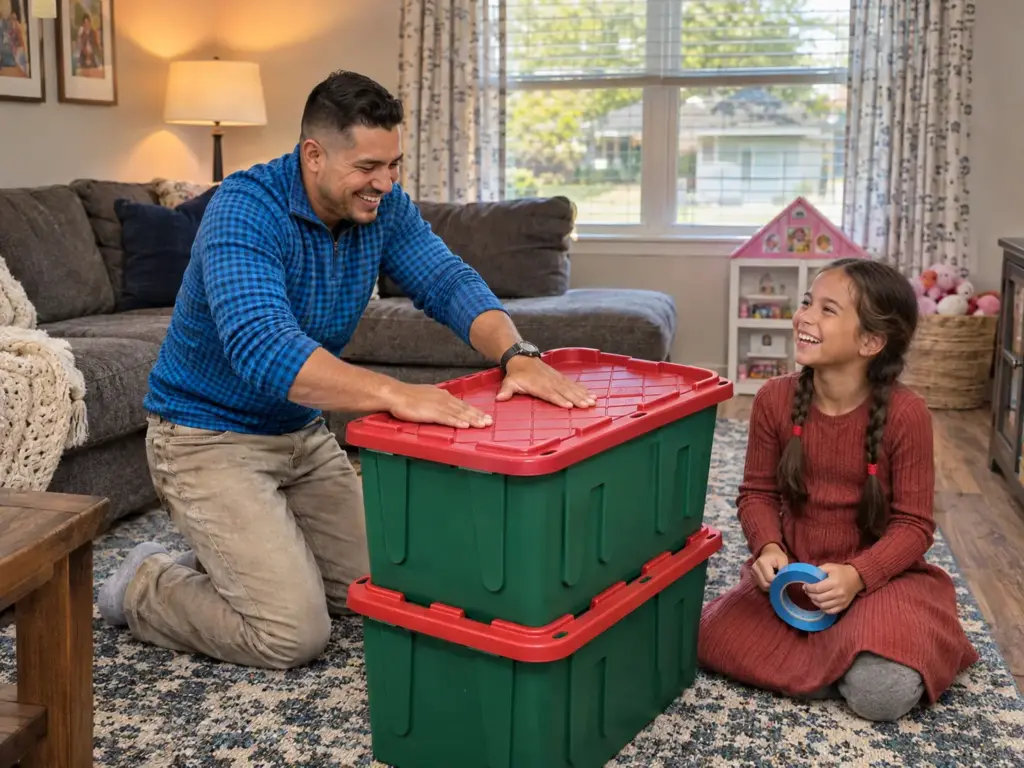
For the general-purpose tote, the HOMZ Durabilt Plastic Storage Bins with Lids are a two-pack of 27-gallon totes, each 30.75 by 20.5 by 14.38 inches, with a hinged lid, four-way handles and 90 percent recycled plastic. Some units arrive with cracks and some buyers find them expensive for plastic, so open the box and check. The budget alternative is HOMZ’s 41-quart holiday tote, shallower, which is easier to lift when full. Whichever you choose, the full weight is the limit, not the size of the lid.
When the totes are sized, the next step is sizing the rest of the seasonal boxes to the shelf they will sit on, which the guide to holiday decor storage by shelf size works through for everything beyond Christmas.
Labels That Survive a Tired Evening
A label that says “Christmas” is not a label. A contents label names the contents and the room they return to (“lights, tree, hall closet”), and write it twice, on the top and on the side, so one reads from either angle in a stack. Put the label on before the lid goes on, with painter’s tape or masking tape and a marker (a label maker works too), since a label put on “later” tends to stay unwritten. For which bins stack and stay reachable, the shape of the lid is the thing to read: stackable bins need flat lids that do not slide.
Where It All Goes: Garage, Attic, Closet or Under the Bed
Three readers on one street have three different answers to the same tote. One has a garage that reaches 100 degrees in July. One has a basement that smells of damp.
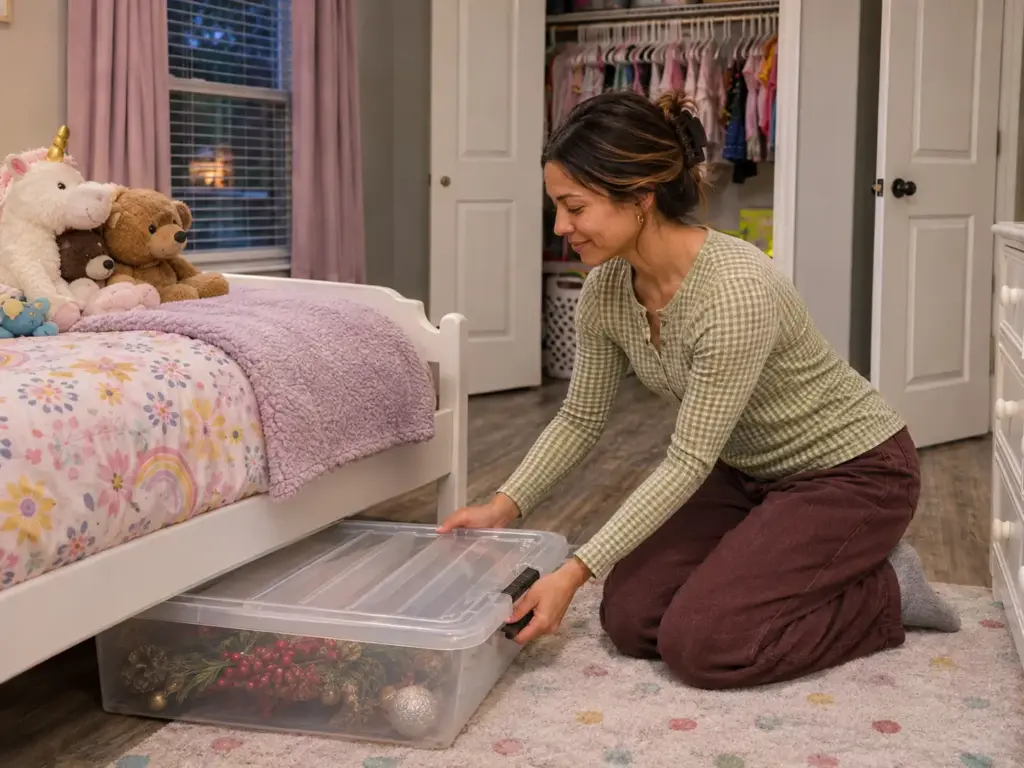
One has a one-bedroom and a hall closet. The question is not “cool and dry” as a wish; it is what the spot actually does across the year, and what each material in the tote can take.
The Garage That Bakes: What Altitude and a Pallet Can Fix
“Cool and dry” is a number. The National Archives’ target range for paper is 60 to 70 degrees Fahrenheit and 40 to 50 percent relative humidity, protected from light. The Library of Congress asks for under 70 degrees and 30 to 55 percent for newspapers, and says attics, basements and garages should not be used.
It is the swing more than the heat alone that does the damage. Winterthur Museum’s guidance for family heirlooms explains that cold causes shrinking and cracking while heat causes swelling and warping, and an uninsulated garage runs through both twice a day in summer.
For a garage you cannot change, the fix is not a better tote. It is altitude inside the room, because the top shelf is hotter and the floor is damper, so the middle of a shelf is the compromise. And it is getting the totes off the concrete: the Library of Congress calls for shelving preferably six inches above the floor in case of flooding, and a pallet or two 2-by-4s under a shelf is the same idea at no cost.
Do not count on a sealed tote to hold a temperature; it does not. The pieces that mind swings most (glitter, thin glass, wool, candles, anything wax or printed) go in the house instead.
For readers who need the shelving itself, garage shelving that matches the depth of the totes covers the mismatch between a 20-inch tote and an 18-inch shelf before it bites.
Attics, Basements and the Reason Conservators Say No
The University of Delaware conservators say to avoid attics and basements when you can, because humidity and temperature fluctuations cause damage, and they put interior closets at the top of the list. The attic rule is blunt: only non-melty stuff goes up there, and anything with wax, glue or a printed finish stays down. A basement has the opposite problem, damp, which is what cardboard and fabric cannot take.
Wool needs a special note. A knitted stocking or a wool tree skirt is a magnet for moths and goes in a tightly sealed, airtight container, away from windows. Polyester is pest-safe, but it fades in light. In a damp garage or shed, a moisture absorber in the tote’s corner or on the shelf answers the musty smell, replaced on a schedule, and a few silica packets do the same job in a small tote.
No Garage: The Closet and the Space Under the Bed
With no garage, the answer is smaller and closer, and it still works. Under the bed, a shallow box that clears the frame is the place for the flat things: linens, stockings, a boxed garland. The Hespama 3-Pack 50 Quart Plastic Underbed Storage Container Box measures 29.06 by 20.59 by 7.87 inches, with latching buckles and grooves in the lid for stacking, and it is the only container in this guide that clears an 8-inch bed frame.
That clearance is tight, a bit over a tenth of an inch, so measure from the floor to the lowest rail, carpet included. The cost per box is high, which is the honest caveat; a flat suitcase you already have does the same job. More options for under-bed storage ideas for a small bedroom cover the frames that sit lower than eight inches.
The closet is the other answer. Interior closets are where conservators want things, and a top shelf takes the flat boxes, though a shelf is only as useful as its depth. Wool and the top shelf are the two things how small-space seasonal storage handles wool and top shelves covers for clothing, and the same method (a container matched to its environment) applies to decorations.
Leave an inexpensive thermometer with a humidity reading in the storage spot for one hot week. The number on it after a July afternoon beats any guess about whether the spot is safe.
How Much Room a Collection Really Takes
Count the kinds (ornaments, lights, tree, wreaths, linens, stockings) and give each a footprint from the real sizes. The ornament box is 26.8 inches long and 13.6 wide, so on a 24-inch-deep shelf it turns sideways and uses 13.6 inches of depth. A 27-gallon tote slid in lengthwise needs 30.75 inches and hangs off the same shelf; turned sideways it uses 20.5 inches of depth, takes 30.75 inches of the shelf’s width, and needs 14.4 inches of height above it.
The tree bag is 50 inches long. The under-bed box is 7.87 inches high. Those four numbers are most of the space math.
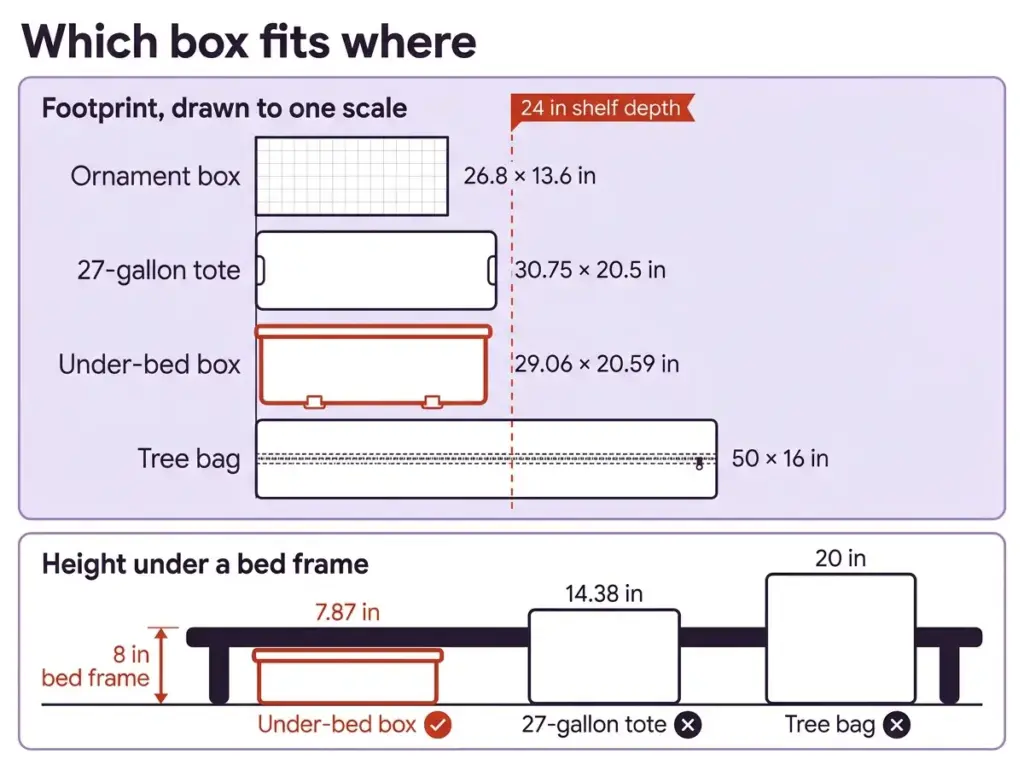
Tape that footprint on the floor, or on the shelf, before buying anything. If the outline does not fit inside the tape, you have your answer about how much room you really have, and the collection has to shrink to meet it, or the spot has to change. In a garage that is already full, ceiling storage (hooks and a suspended shelf over the car bay) is the space saving move that gives back floor space, and rotating the totes so the next season’s tote sits nearest the interior door keeps the heavy lift short.
When the Collection Outgrows the Spot: Next December’s Rules
Fifteen totes “busting at the seams” and a new box arriving every year is a collection that has outgrown the spot, not the house. The garage that used to hold a car now holds the holiday, and the last person who knew what was in the third tote moved out. Fixing that is a rule, not another bin.

Why It Goes Wrong by the Next December
The failures repeat, and each one has a cause you can name. Dividers collapse and handles rip, which is the first thing to give in a bought ornament box. A strand goes in untested and comes out dead.
And the take-down is done tired, at speed, with no room for judgment. The remedy for all three is the order from the first section plus a pack rule that survives being tired: wrap on the way off, one tote per kind, label before the lid goes on.
Add the fourth cause, which is the real one: the count only moves in one direction. When a collection grows by a piece or two each December, no rule makes anything leave. The shelf does not grow, so the spot fills.
One In, One Out, Kind by Kind
The rule that holds is the one that works inside a kind. When the spot is full, a new piece replaces something of the same kind, and the outgoing piece goes in the donate box on the same trip. A new string of lights means an old string leaves.
A new ornament means one that is broken, duplicated or unloved goes out. Without the “same kind” condition, the rule turns into an excuse, because a new tree topper can always claim it replaces some other thing entirely.
In practice a household agrees on one tote per kind, ends up with six, and keeps the swap condition attached: anything new has to fit, or something leaves. The cap is physical. The shelf and the ceiling hooks decide the count, not the sales. Why the one-in-one-out rule slips and what holds it goes into the point at which the rule usually gives up, which tends to be the month the donate box stops getting emptied.
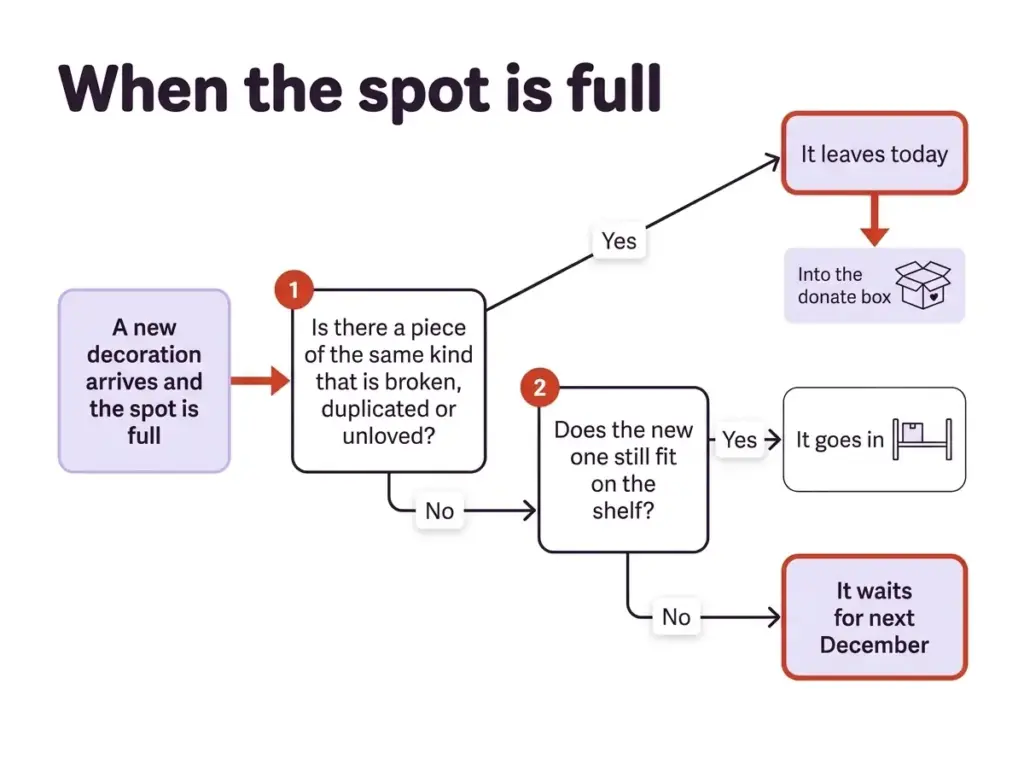
The decision tree is short, and the two exits worth remembering are the donate box and the wait.
What Happens to the Overflow
Overflow gets donated or given away on the same trip, not parked by the door for a month. Resist the reflex to buy more bins: a bin buys you one more year of the same problem. A self storage unit is the last resort, and only worth it as climate-controlled storage, because an uncontrolled unit has the garage’s swings with a monthly bill on top of them.
A yearly check keeps the system honest. Once in the middle of summer, open the tote that sleeps in the hottest spot and touch what is inside: if the glue has gone soft or the tissue has gone limp, the spot is wrong. And once in the first days of December, count the totes. A count that has crept up by one since last year is the rule slipping, caught before it costs a garage.
The July Tote Check and the Cardboard Winder to Make Today
What carries you to next December is a short list. Take it down in the order the room comes apart. Wrap breakables as they leave the shelf, give each kind of decoration one tote, and write on the label what is inside and which room it returns to. Put the totes in the most interior, driest spot the home has, off the floor, and let every new piece replace an old one of the same kind.
Then check it: one look in the middle of summer at the tote that sleeps in the hottest place, and one count in the first days of December. If the tote is soft, sticky or smells of damp in July, move it before it costs you a season.
For today, find a piece of cardboard and a pair of scissors, and wind the strand that is about to go back in the box. Notice how long it takes (a minute or two) and how it sits in the bag. Do that with every kind and you unpack next year in an afternoon, and that strand will come out of the bag straight.
Frequently Asked Questions
01What is a good way to store Christmas ornaments?
Wrap each ornament in acid-free tissue and give it its own cell or a tissue-lined box, so nothing touches its neighbor. Never use newspaper against painted glass. Several light boxes beat one heavy tote, because the bottom layer carries everything above it.
02Can you store Christmas decorations in the garage?
Yes, with conditions: keep totes off the concrete on a mid-height shelf, and bring the pieces that mind heat and swings (glitter, thin glass, wool, wax, anything printed) into the house. A sealed tote does not hold a temperature steady.
03How do you store Christmas decorations in an apartment with no garage?
Use the space under the bed (a box 8 inches high or less), the closet shelf, and the back of a wardrobe. The ornament box turns sideways to fit a 24-inch shelf, while a 27-gallon tote hangs over it. Sort by kind so the smaller footprint holds.
04Is it okay to wrap ornaments in newspaper?
Not for painted glass, because newsprint is acidic and can discolor paint over months of contact. Use acid-free tissue or plain unprinted paper instead. Printed wrapping paper is no swap, since the ink sits where the newsprint did.
05Should the artificial tree go back in its original box?
If the box survived, yes: it is free and stiffer than a bag. If not, use a bag sized to the tree, about 50 inches for a 7.5-foot tree, lying on a shelf or standing in a corner.
Disclaimer: ClutterlessNest is a participant in the Amazon Services LLC Associates Program. As an Amazon Associate we earn from qualifying purchases. This article may contain affiliate links — if you buy through them, we may earn a small commission at no extra cost to you. We only recommend products we have tested or genuinely believe in.