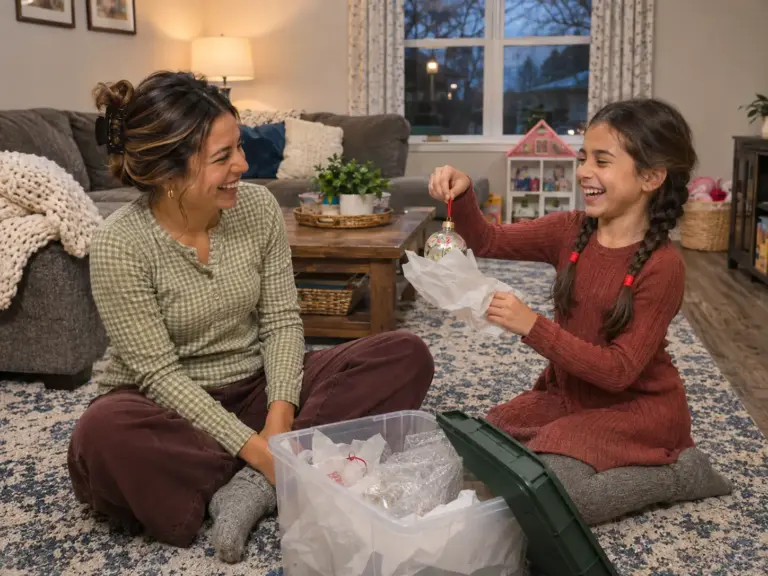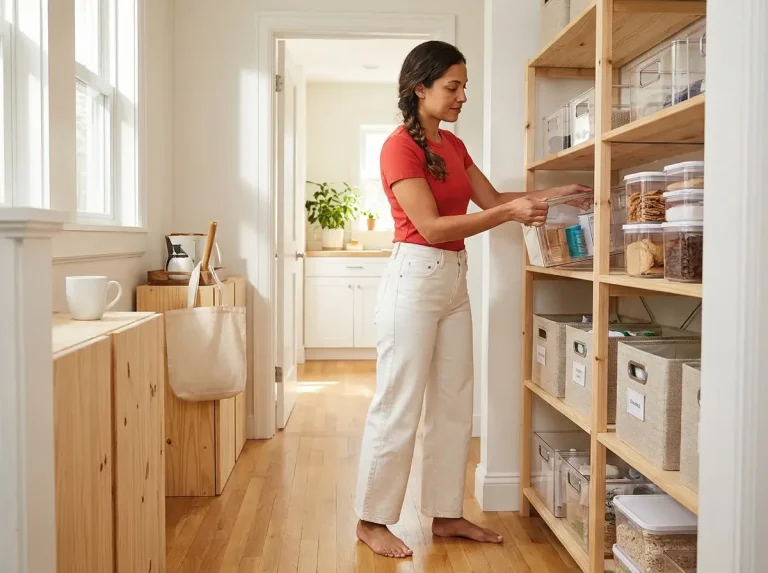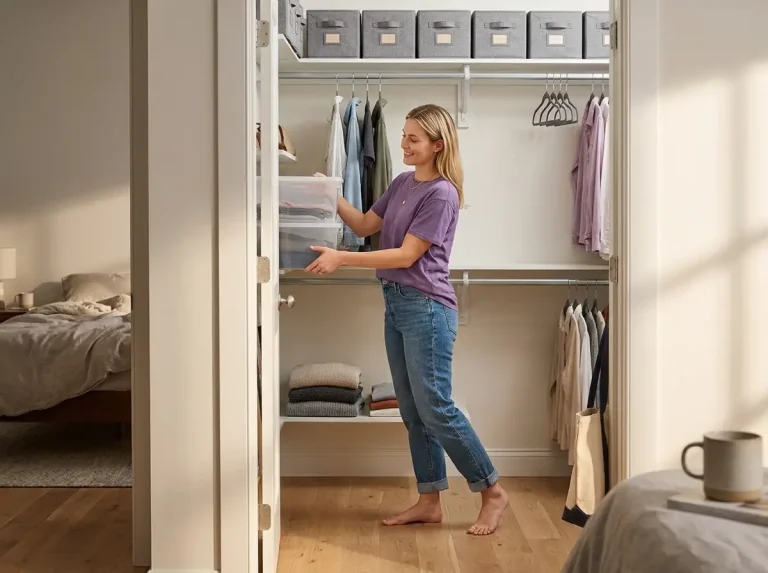
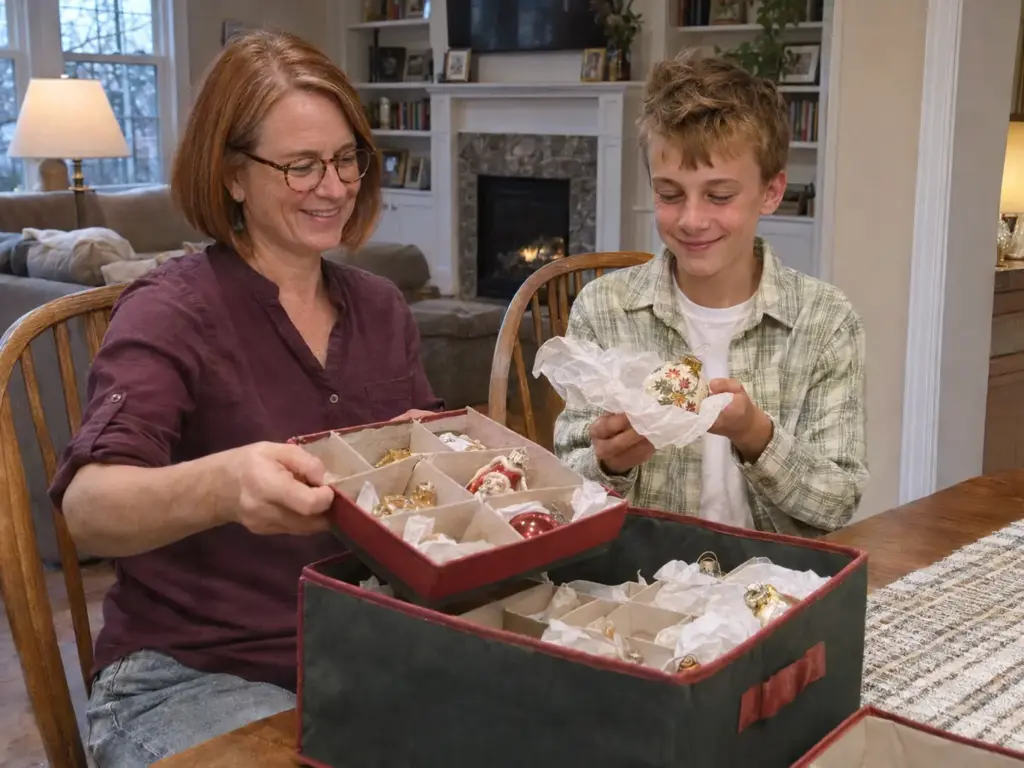
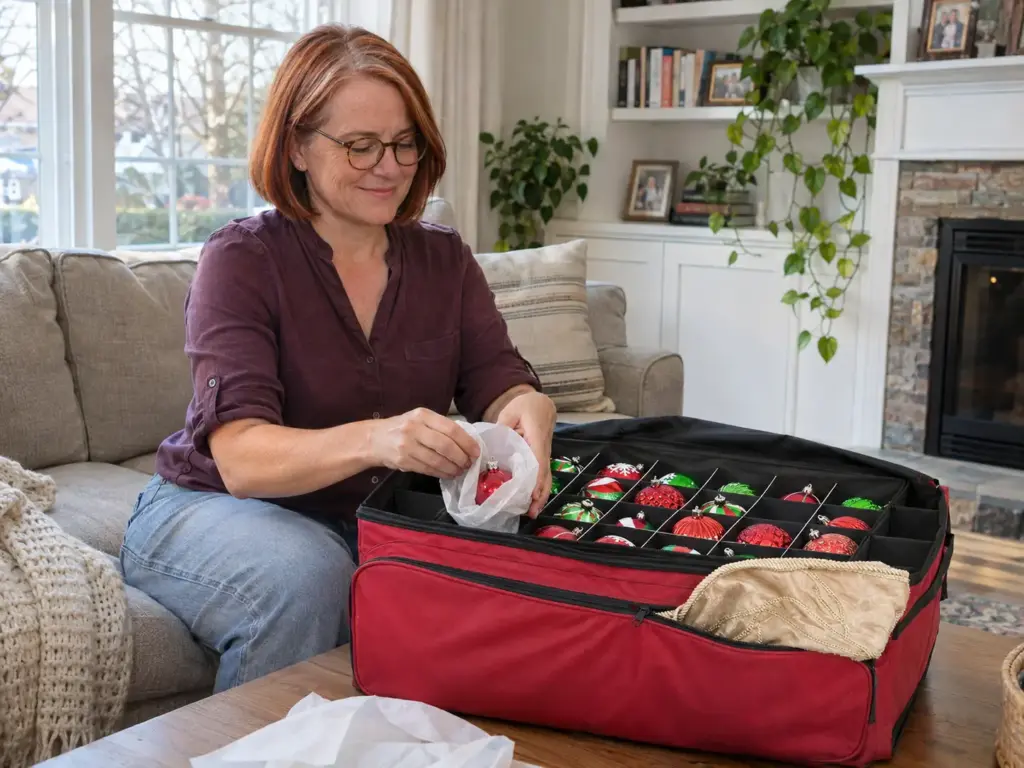
It is December, you lift the lid, and the sound that comes out is glass sliding into one corner of the box. It was the good box, too, the one with the dividers, and it folded under the tote that rode on top of it all year.
Most holiday decoration storage containers get chosen for the number printed on the front, not for what will sit on them or the room they spend eleven months in, and that is the whole problem. Museum collections managers have a plain first rule for anything kept for years, and it applies to a box of ornaments just as well as to a quilt. Below, each kind of decoration gets the container that fits it and the shelf, bed frame or garage wall you have, starting with why containers fail, then ornament boxes, measuring the place, trees and wreaths, what holds up in a stack, and last the lights, the gift wrap and the flat tote. The order of packing lives on the take-down and packing order page, so this one stays on the container the packed things go into.
| What you are storing | The container that fits | The number to check |
|---|---|---|
| Glass and heirloom ornaments | An ornament box with removable, fixed trays: 72 cells for large pieces, 128 for a mixed collection of three-inch balls | The ornament size each cell is built for |
| A pre-lit or full-size tree | A long zippered bag | The longest section of the tree, not its height |
| Wreaths | A hard shell with latches | The widest point, bow included |
| Light strings | A reel or holder, one run per spool | The count of strands |
| Wrapping paper | A flat box that slides under a bed | The length of your longest roll |
| Everything else | A flat, clear, lidded tote | Its height against the clearance |
Why Most Holiday Decoration Storage Containers Fail by Next December
A container fails in one of three places: the material it is made of, the grid inside it, or the room it lives in. Nobody shops for those three, which is how a box with a great photo ends up as the thing that broke the glass. Every pick later in this article gets judged against these failures, so they come first.

The Box the Decorations Came In Is the First to Go
The cardboard carton the tree or the ornaments arrived in is the container professionals rule out first. Here is the rule in the words of storage advice from museum collections managers at the Denver Art Museum: “Don’t store anything in cardboard boxes.” Cardboard is acidic, it wicks damp from whatever floor it sits on, and it collapses the moment something is stacked on it. A tree carton that looked fine in year one goes soft in a garage by year three.
Acid does not need a flame to do harm, and that matters for the plastic boxes in this guide too. Paint and pigment can fade or discolour next to acidic vapours from poor-quality cardboard and from some plastics, and a sealed plastic box traps those vapours instead of venting them. So airtight is not automatically safer. A single sheet of acid-free tissue between the painted surface and whatever holds it is the cheap answer, and it comes back in the next section.
Soft Trays, Torn Handles and Lids That Pop
The weak part of most divided boxes is the grid, not the shell. The bottom of each tray is one thin sheet, so ornaments slide under the dividers and the whole level lifts crooked when you pull it out. Soft-sided boxes give up even faster: the handle seams and straps tear once the trays are full, and a floppy tree bag turns zipping into a two-person job.
Then there is the household. A full flat box gets lifted by its handle by somebody who did not pack it, the lid pops, the dividers rise, and every ornament ends up in one corner. That is a lid problem and a handle problem, and neither shows in a product photo. If you want the longer version of how rigid and soft bins behave under a lid and a stack, that guide covers it, and this article applies it to decorations.
A Good Container Still Fails in the Wrong Room
A well-built box in a bad room fails slowly. Heat, damp and temperature swings do the damage a drop never would, and the garage and the attic are the two rooms where decorations spend most of the year. Section three goes through the room, not just the box, because it is the failure nobody prices in.
Not every fix costs money. A liquor-store wine box with built-in dividers is sturdier than most cardboard grids, and stores will usually hand them over for free. Section five develops that and the other free options.
Ornament Boxes for Glass and Heirloom Pieces
Picture the shopper who bought the biggest number on the shelf, then found half the cells empty because the good pieces are four inches across, and still had nowhere to put the figurines. The box is not wrong. The count printed on it just means something narrower than it sounds, and a divided ornament box is only as good as the ornament cells inside it.
Count the Ornaments by Size Before You Choose 72 or 128
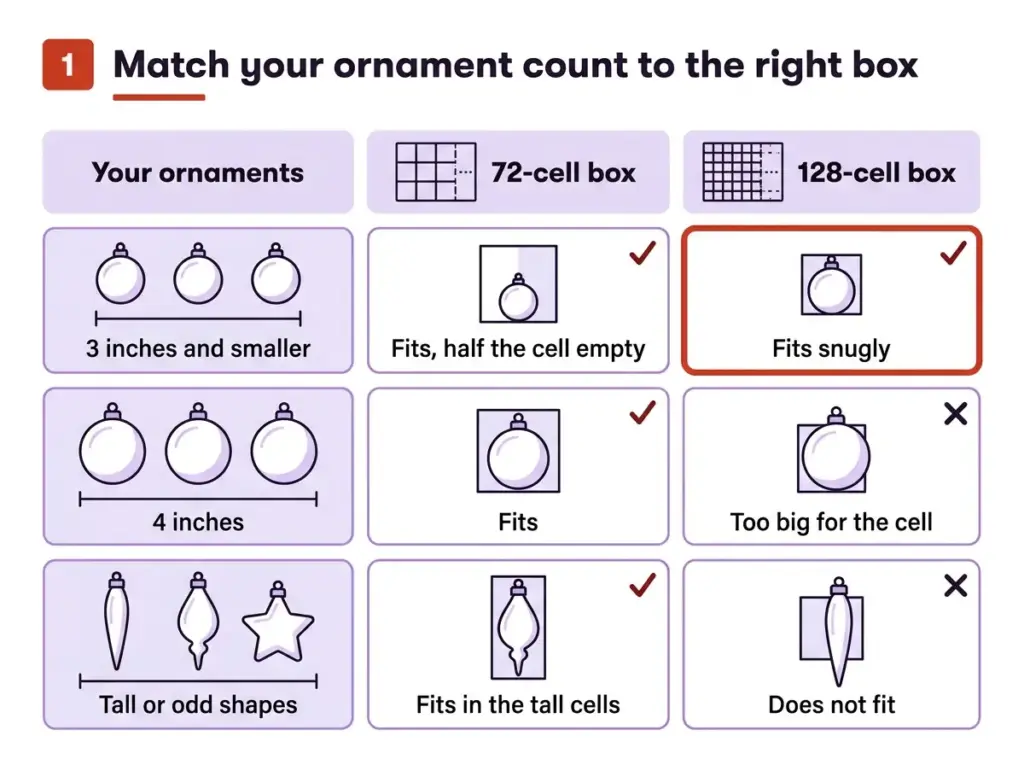
A 128-cell ornament box has 128 slots, and each one is sized for a three-inch ornament, so that is its real capacity. The 72-cell version is sold in a three-inch listing and a separate four-inch one. Put four-inch or oversized pieces into a 128-cell box and they fill about half the cells, so the box that looked generous ends up holding the same collection as a smaller one. Purge the cracked and the duplicate pieces, then sort what you have into three size classes: three-inch and smaller, four-inch, and tall or odd shapes like finials and figurines.
For a ballpark, a garden center’s rule of thumb is ten to fifteen ornaments per foot of tree height, which puts a 7.5 ft tree at roughly 75 to 110 pieces (Mahoney’s Garden Center). Size the box to what you own, with a little room for growth, and not to the tree. A 6 ft tree rarely needs 128 cells. Think about the shelf the box will live on, too, since storing seasonal items by shelf size is the same argument from the other direction.
What an Acid-Free Liner Does and What It Does Not
One of the four boxes below states an acid-free tray lining. For the rest, acid-free tissue paper between the paint and the cardboard does the same job, and it is cheap. Per conservation guidance on storage materials, pigments can fade or discolour next to acidic vapours, and poor-quality cardboard and some plastics are named among the sources.
The limit is worth knowing. A liner protects the finish from the cardboard, and it does not protect it from the window. Light causes color loss too, and no liner stops that, so the ornament box belongs in a dark spot. And a box described as semi-transparent lets you see what is inside without opening it, but the trays hide most of the contents anyway, so do not count on it as a window.
Rigid Trays or Floppy Trays: How Four Boxes Differ
Semi-rigid trays keep their shape, and a box built on them can carry another bin. A flexible plastic box is light and compact, and it goes on top of the pile, never under it. That one rule sorts the four picks. A box that cannot carry a stack is a top-of-the-stack box, which is fine as long as you put it there.
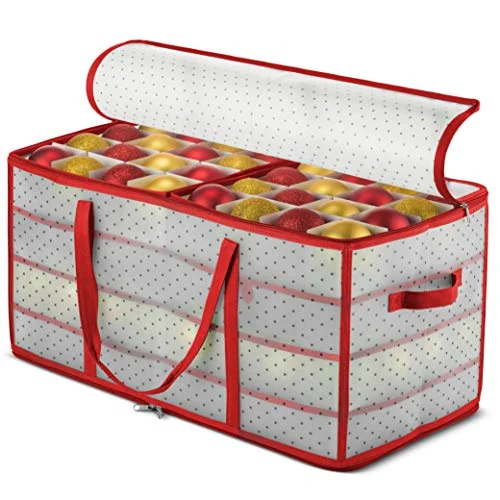
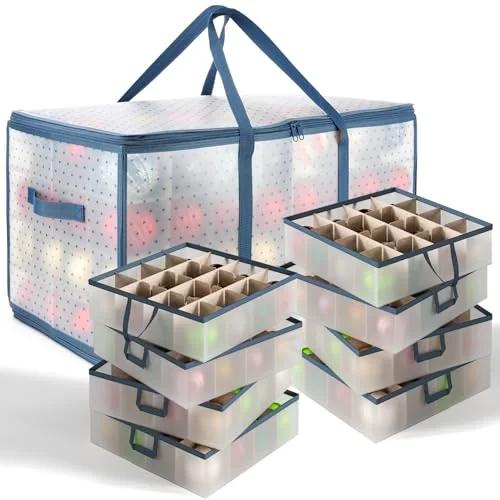
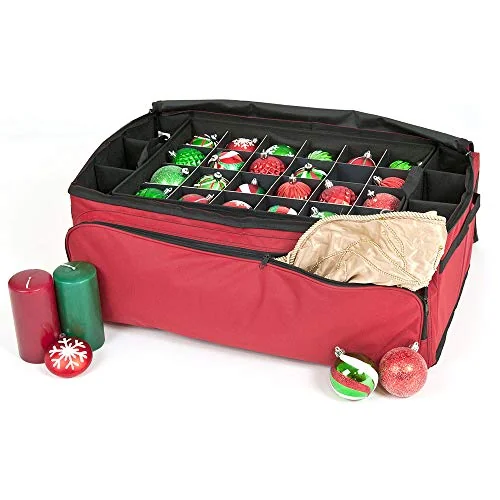
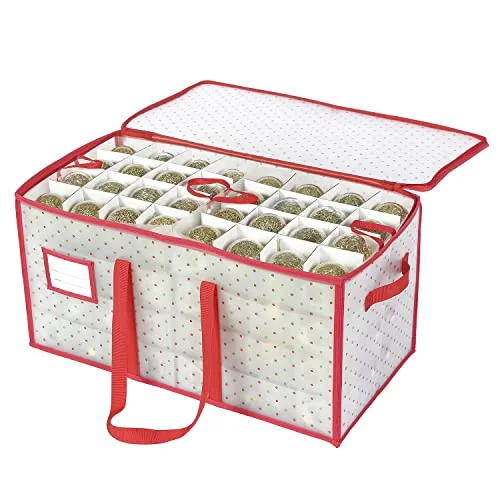
The tall-piece problem has a plain answer. A cell does not fit a finial, so give the tall pieces the side pockets of the Santa’s Bags box, or wrap them in acid-free tissue and lay them in a plain tote.
Wrap each good ornament in white acid-free tissue, not in the colored kind, since dyed tissue can leave a tint on a damp day. One sheet per piece, folded around the hook end, is enough.
Measure the Place Before the Box
The box arrives, it does not fit the shelf it was bought for, and it spends the season on the closet floor with the door pushed against it. The opposite house exists too: a big garage wall shelf that swallows a tote nobody sees again until next December. Same decorations, different place, different box. So measure the place first.
The Closet Shelf Is Usually Shallower Than the Box
The four ornament boxes above run about 24 to 27 inches long and 12 to 15 inches deep. A standard closet shelf is about 12 inches deep, so a 13.6-inch box hangs 1.6 inches over the edge and tips when the door closes. These boxes belong on a 14 to 16 inch shelf, on a top shelf turned sideways, or on the closet floor. For a true shelf in a standard closet, a flat box five or six inches tall is the answer, and closet bins matched to shelf depth is where to check the numbers.
If you rent a small apartment with no garage, the flat box under the bed and the top shelf of the closet are the whole system. Look up, too: using the space above the closet door is where a box that only comes down once a year can sit without costing floor space.
Under the Bed: A Few Inches Decide Everything
Platform beds leave about four to seven inches under the frame, and metal frames leave seven to nine. A tall ornament box does not go there: the boxes above are 10 to 13.4 inches high. Only a flat wrap box (5.5 inches) or a flat five-inch ornament box slides under a bed, which makes under bed storage the narrowest zone in the house.
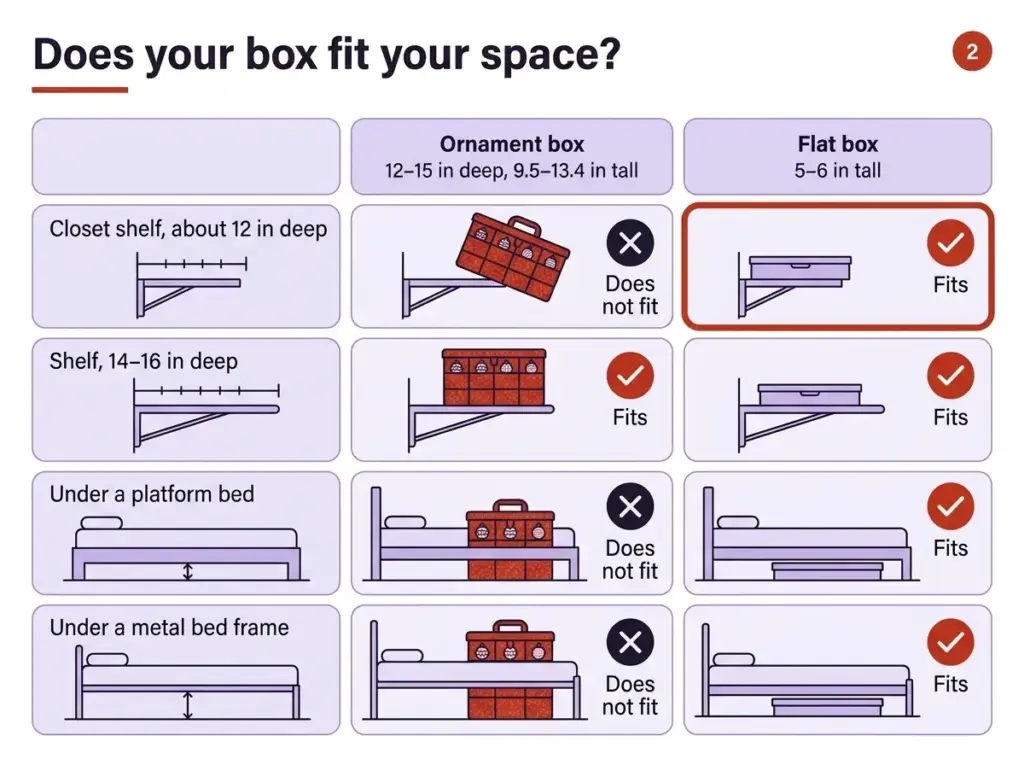
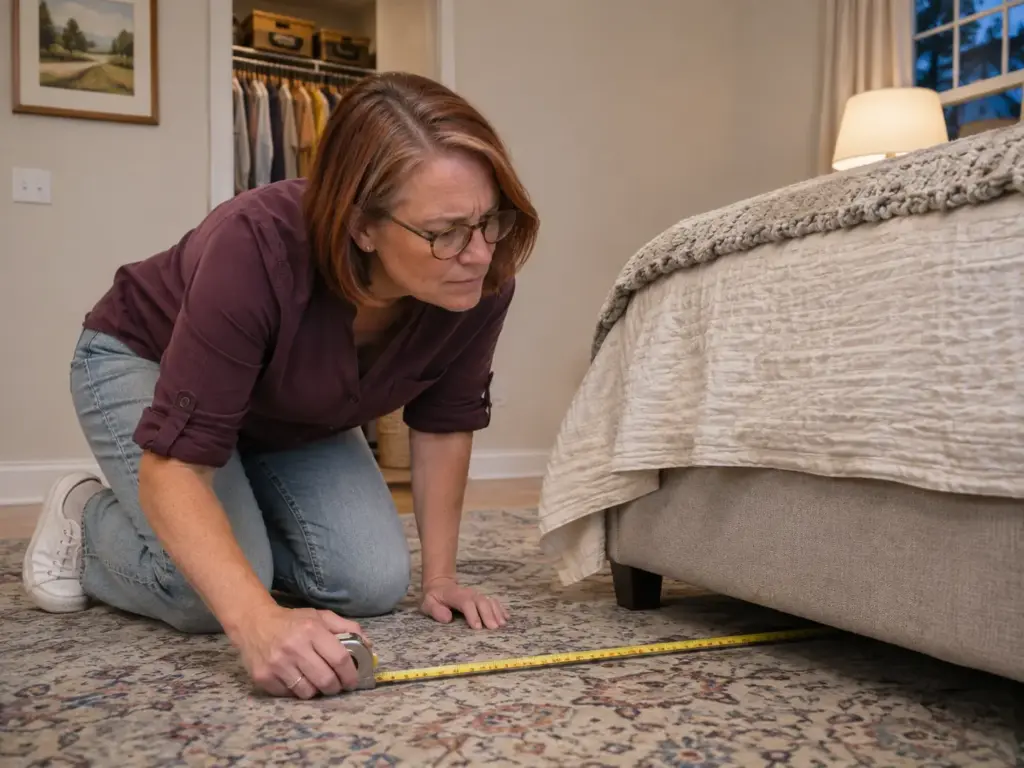
Measure the gap with a tape from the floor to the lowest part of the frame, then subtract half an inch for the lid. Boxes built for low bed frames cover the clearance rule in detail if your bed sits near the bottom of the range.
Garage and Attic: What Heat, Damp and the Floor Do
For anything kept eleven months, museum guidance asks for steady humidity. The National WWII Museum puts it this way: “Store historic memorabilia in an area that has a steady, constant humidity (45%–55%).” Sheds, attics and basements are the rooms that guidance rules out, and the museum’s preservation guidance is worth reading once if you plan to store anything for decades.
The garage swings between wet and dry, and an attic bakes in summer.
A plastic bin on a concrete slab is the worst of both: it wicks moisture from below and takes heat swings from above.
The same bin on a shelf 18 to 24 inches up is a different object. If you have to choose between an attic and a basement, a cool basement wins because its temperature moves less, as long as everything stays off the floor. A closet inside the house beats both, and a rented storage unit follows the garage rules, only with less warning when something goes wrong. No lid, however snug, makes a box weatherproof.
Heat is rough on specific families. Light strings that spend summers in a roof space die early, glass ornaments sit best in a room that does not swing, and a tree bag lives on a shelf, never on the slab. Raising the bin is cheap, and garage shelving that carries a stack of totes is the way to do it in a big house. Off-season shoes fail in the same rooms for the same reason, and the same damp rule applied to off-season shoes is a useful check on any other boxed family.
The Order to Decide In
Measure before buying, using the exterior dimensions and not the inside ones, and the box picks itself:
- Count the ornaments by size class.
- Choose 72 cells for large pieces or 128 for small, mixed ones.
- Measure the shelf depth.
- Measure the clearance if the box goes under a bed.
- Decide rigid (it stacks) or soft (it goes on top).
Tree Bags and Wreath Boxes Are Bought by the Longest Piece
The tree comes out of the loft in a bag that had to be sat on to zip, and the wreath has a flat side by the next December. Both come from buying by the headline number. A tree is not stored at its height, and a wreath is not stored at its diameter.
Size a Tree Bag by Its Longest Section, Not by the Tree’s Height
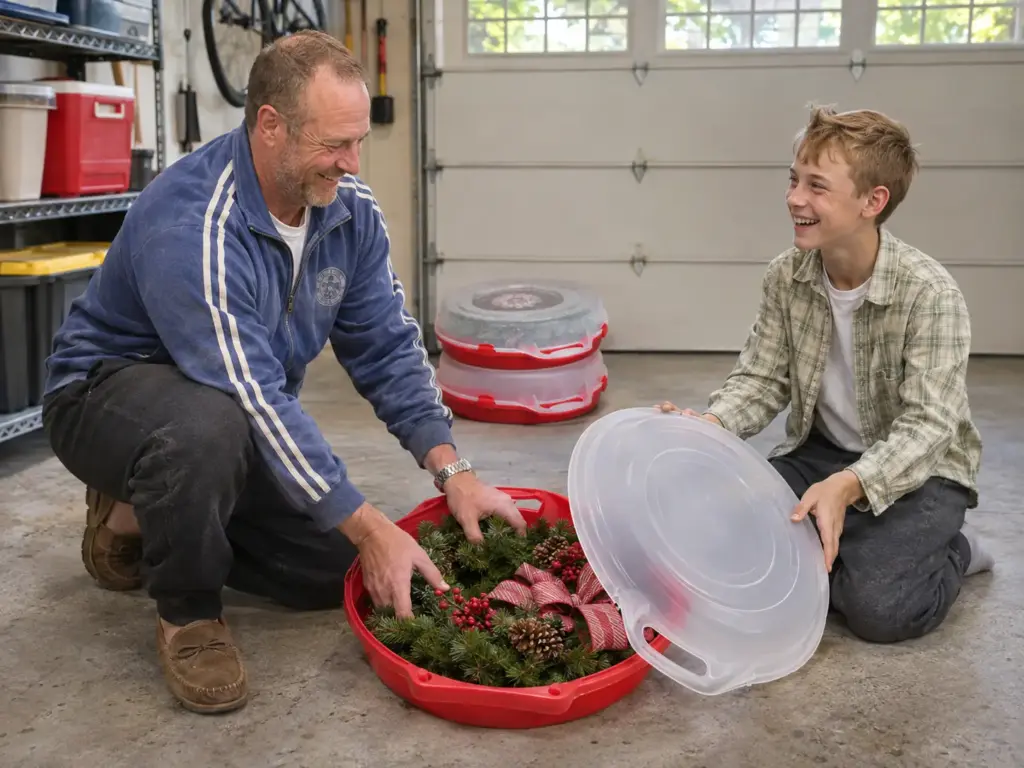
A tree bag is bought on the longest disassembled section plus room for the stand. On a 7.5 ft tree those sections run 34 to 40 inches, so the number to check is the bag’s length, and the 50-inch bag below clears them. The bag’s 900D Oxford fabric and double zipper help, but the zipper is still the weak point, so choose a bag whose zipper closure runs the full length, and zip it with the sections laid flat and not stuffed in. A floppy bag is a two-person job to close, so structure matters more than the fabric’s number.
The bag lives on a shelf, never the floor. A tall pre-lit tree with no box left usually ends up in a rigid stackable tote or a two-person zippered bag, not back in the carton, which is the one that goes soft in a garage within about three years. This is a yearly job that nobody schedules, and why seasonal rotations fail is the reason a bag ends up wherever it happened to land.
Why a Wreath Needs a Hard Shell and a Bag Does Not Do It
A wreath in a soft bag gets pressed by whatever is leaned against it, and a flat side in a wreath is permanent.
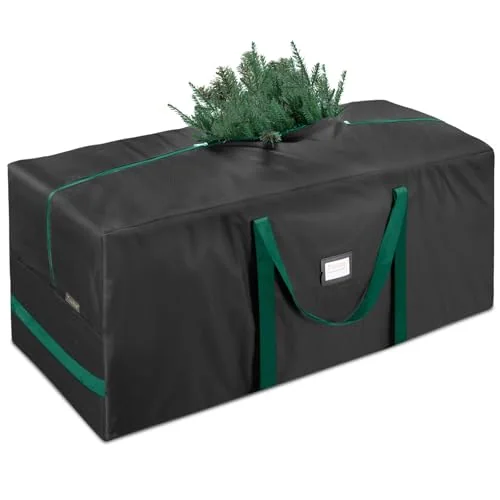
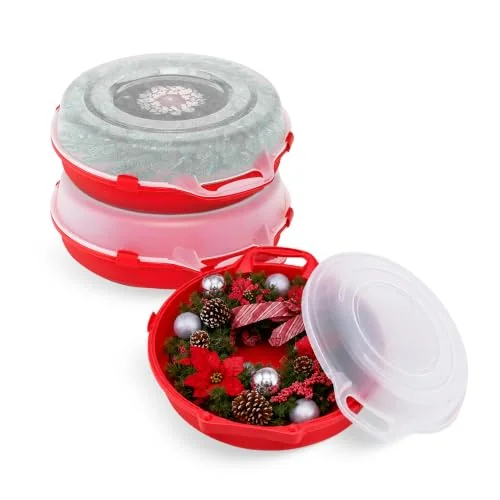
A hard shell with four-way latches does what a bag cannot: it nests inside another when empty and stacks when full. A 24-inch container holds an 18 to 20 inch wreath, and a wreath storage bag only suits one that can take a squeeze. A full 24-inch wreath with a bow needs the box measured at its widest point, bow included, so measure that before you order. A wreath wants a snug fit, not a squeeze.
The latches are tight, and the three-pack costs more than a bag would, so a single container is the cheaper way in. Spend it on your best wreath and wrap the rest in tissue inside a large bag.
Rigid, Soft or Cardboard: What Holds Up in a Stack
Almost everyone ends up with a mismatched collection from five different years. None of the boxes stacks with another, the fabric one sags under the plastic one, and the box the family trusts is the oldest and the softest. The fix for that pile is a rule more than a purchase.
One System of Boxes per Family, and the Soft One Goes on Top
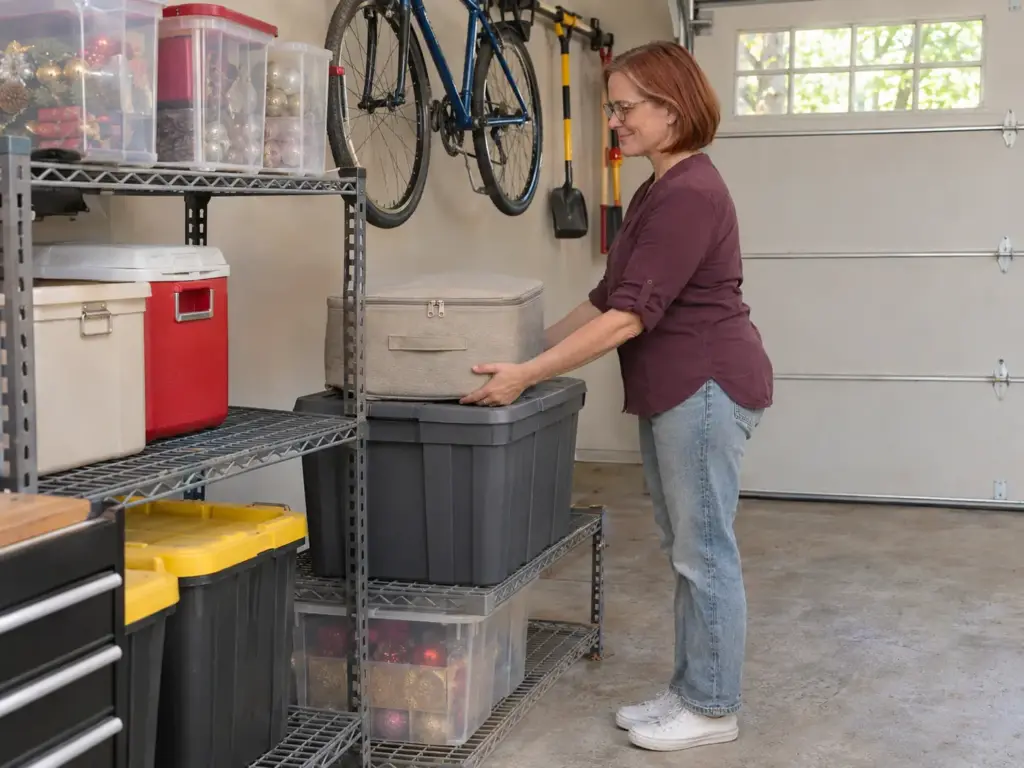
Rigidity decides what a stack can do, and so does weight distribution, not the price. A rigid shell with a recessed or interlocking lid takes a box on top. A soft box does not.
So buy one system of the same box per family, so the lids line up, and never let the fragile or soft box carry the load. The soft box goes on top. That is the entire rule, and it is also how you stack safely when the boxes come from five different years.
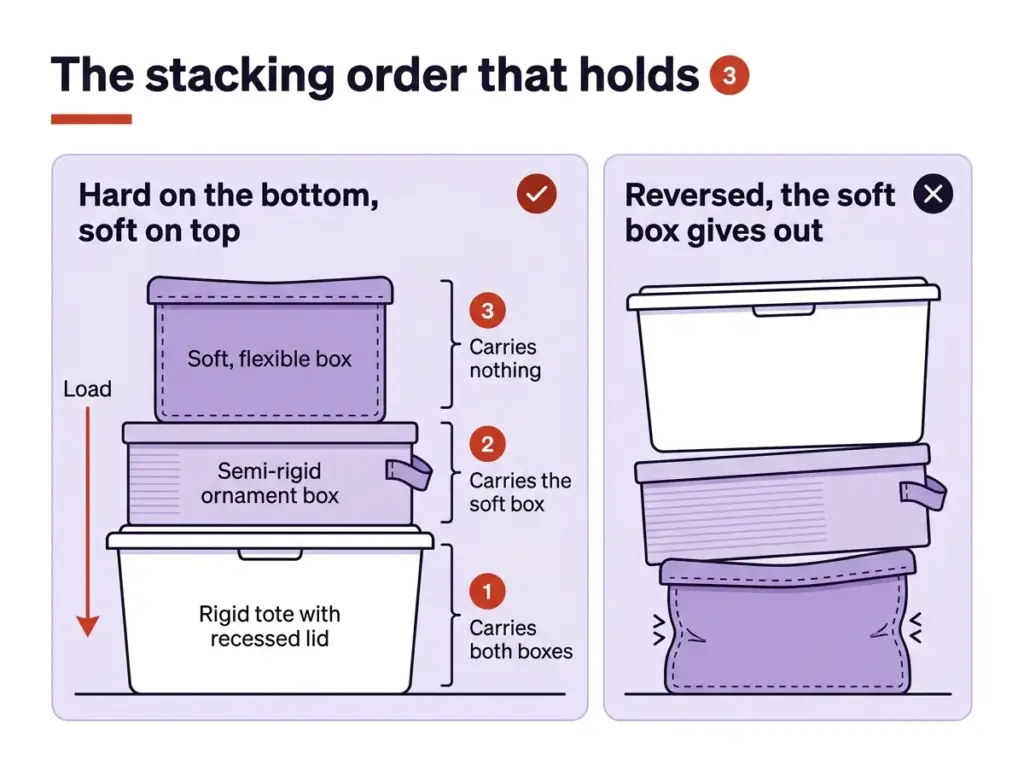
If the lids do not seat, the stack leans, and a leaning stack is how a box on the bottom gets crushed in a January shuffle. Bins whose lids actually interlock is the guide to read for that part. Handles matter here as well: the one that carries a full ornament box is the first to rip, so carry from below, and keep many light boxes instead of a few heavy totes.
Fabric, Plastic and Cardboard Compared by What Gives First
Cardboard collapses and wicks damp. Non-woven fabric, canvas or 600D fabric breathes, but it sags and its handles tear.
Hard plastic shields against dust, pests and rodents, and sealed it traps vapours, which is why acid-free tissue goes inside it. A box with a steel frame and a fabric skin splits the difference: it keeps its shape under a modest load and still lets air through. The longer comparison, fabric bins against plastic ones and when each fails, covers the damp-basement case.
One more material choice: clear sides help you find the box, but a lit spot fades what is behind them. A clear tote belongs in a dark room, a closet or under a bed.
Put a strip of masking tape on the lid of each box and write the count and the heaviest item on it. The person who lifts the stack in January will know which box can take weight and which cannot, without opening anything.
Free and Cheap Fixes Before You Buy
Start with the free options, because for a small collection they are enough. Liquor stores hand out wine boxes with built-in dividers, and the cardboard is much sturdier than most ornament grids.
A sock-drawer divider works as one of the adjustable dividers a cardboard grid never gives you, and it does not collapse. Strips of heavy cardboard dividers from a shipping box fill the gaps. And a tote lined with old towels, with the glass pieces in a heavy cardboard box inside it, protects well enough for a small number of pieces.
They stop working when the collection grows past what one tote can hold. At that point the bought boxes earn their place, and matching container to material is the same job as container and material choices for off-season clothes, only with glass in the mix.
Lights, Gift Wrap and the Flat Tote for Everything Else
The tote of lights balled together like a nest, the roll of paper that is an inch too long for its box, and the one big tote that does everything badly. These are the three families that tangle or do not fit, and each has one number that decides the purchase.
Light Strings: One Reel per Run
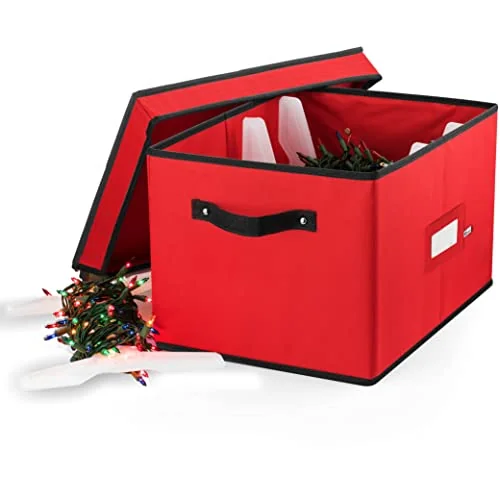
A light reel gives each run its own spool, and one reel per run is the whole method.
A cord reel does the same job for a long extension cord. If you do not wind a strand onto something, you will untangle it next year. A four-spool light storage box holds roughly 800 mini lights, has a lid, and stacks. Keep it out of the roof space, since summer heat shortens a string’s life.
The flaw is size. A large collection of several trees needs more than one set, and cheaper holders are the budget alternative if you only have a few strands.
Wrapping Paper: The Roll Length Nobody Prints
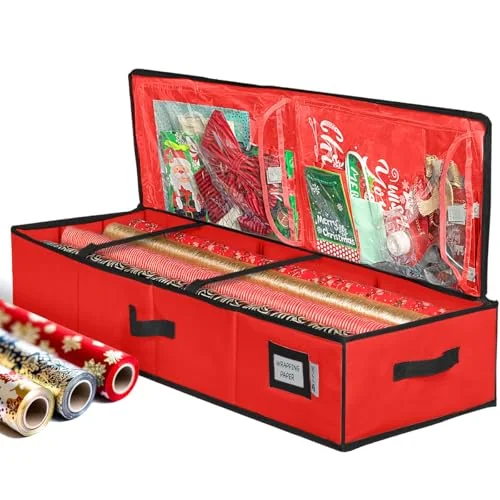
The number that decides this purchase is the length of your longest roll. A 40-inch roll does not go in a 36-inch box, and no listing leads with that. The pick below holds 27 rolls up to 40 inches long and is 5.5 inches tall, so it slides under a bed, with pockets for bow storage and tags. Twenty-seven rolls is about three seasons for a normal household.
The catch is it will not take every roll, so measure the longest one before ordering. A roll of paper stood upright in a bin you own does the job for a small stack. The box is for the household with a drawer’s worth of rolls, and the under-bed route is covered in setting up under-bed storage that stays organized, including the clearance rule.
The Flat Clear Tote for Everything That Is Not a Ball, a Tree or a Wreath
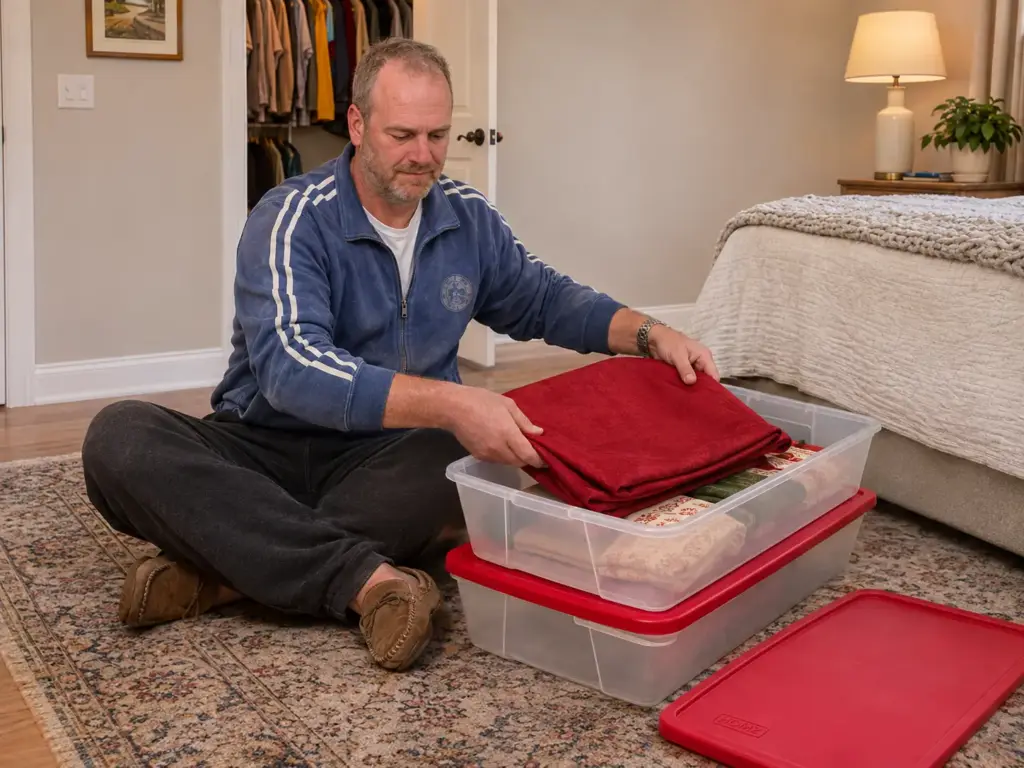
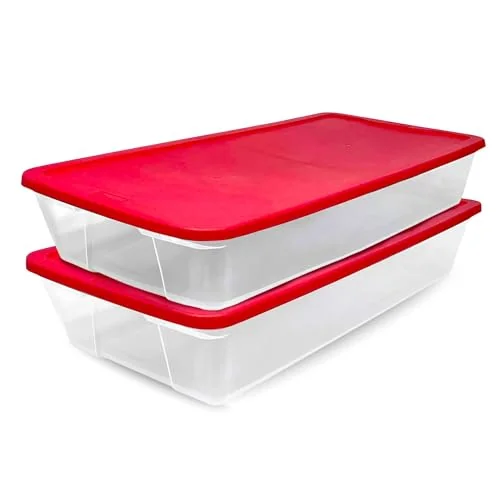
Table linens, a garland (a garland storage bag or a duffle bag with a zipper closure works too), stockings and a few figurines do not belong in any of the boxes above. They go in a flat, clear, lidded tote six inches tall, which slides under a bed and lets you see what is inside. The one limit comes with the clear sides: a lit room fades whatever is behind them, so put it in a dark room or under the bed. Clear bins and the yellowing question is the guide for how clear plastic ages.
It also answers the apartment case with no garage, where under-bed ideas for a small bedroom are the whole storage plan.
Tape one index card inside each lid with the family it holds and the year you last opened it. A box nobody has opened in three Decembers is the one to sort first, and seasonal storage works best when each box earns its shelf space.
Write Down the Shelf Depth, Then Pick the Box
What you take away is a short list of numbers: the ornament size a cell is built for, the shelf depth, the clearance under the bed, the tree’s longest section and the length of the longest roll of paper. Put the soft box on top of the stack, and put every box in the driest, steadiest room the house has, off the floor.
The first check comes the next time the boxes come down. Look at which lids popped and which handles tore, because those are the two boxes to swap before the next season, and a note on the lid saves you from guessing.
Today, before you open a single listing, measure the shelf or the gap under the bed and write the number on the edge of the shelf in marker. It takes a minute, and it is the number every other choice in this article depends on.
Frequently Asked Questions
01What are good storage solutions for Christmas decorations?
The best holiday decoration storage containers match one box to one family of decorations. Use a divided box for glass, a long bag for the tree, a hard shell for wreaths, reels for lights, a flat box for paper and a flat tote for the rest. Keep them in a steady, dry room, off the floor.
02Where can I buy a Christmas tree storage bag?
Amazon carries tree bags in several lengths. The number to check before ordering is the bag’s length against the tree’s longest section: the 50-inch bag clears the 34 to 40 inch sections of a 7.5 ft tree.
03Do ornament boxes need acid-free tissue even when the tray is acid-free?
Yes, tissue still helps. An acid-free liner covers the cardboard, while tissue covers the painted surface and the gaps between pieces. Neither stops light from fading colour, so keep the best containers for ornaments in a dark room.
04How many ornaments does a 72 or 128 ornament box hold?
The count is for three-inch ornaments. Four-inch pieces fill about half the cells, so a 128-cell box holds closer to 64 of them. Sort your collection by size first, then pick 72 or 128.
05Can I store holiday decorations in the garage or attic?
A garage or attic is the least stable place a house has. If it is the only place, put rigid boxes on a shelf off the floor, and keep the lights and the glass indoors.
Disclaimer: ClutterlessNest is a participant in the Amazon Services LLC Associates Program. As an Amazon Associate we earn from qualifying purchases. This article may contain affiliate links — if you buy through them, we may earn a small commission at no extra cost to you. We only recommend products we have tested or genuinely believe in.