
You lift the lid on a box that promises a big number of slots, press the first 4-inch ball toward its compartment, and it never drops in. It sits on top, leaning on its neighbors, and the lid is about to press down on all of them.
That number counts small rounds only: the maker of one drawer-style box states that its slots take ornaments up to 3 inches in diameter, and Old World Christmas, a maker of glass ornaments, publishes its own rules for wrapping and storage places. How to organize ornaments comes down to four decisions in order: count the collection by size, wrap each piece for what it is made of, pick the box by slot size, and give the odd shapes a home. The rest of the house is covered in a guide to holiday items stored by shelf size, so this one stays with the single ornament.
Quick Answer
Organize ornaments in five moves, in this order:
- Pull the cracked and the duplicates, then count pieces over 3 inches first.
- Dust each piece dry, then wrap it alone in acid-free tissue, never newspaper.
- Pick the box by slot size, not lid number; keep oversize pieces apart.
- Store boxes in an interior closet or under the bed before the attic.
- Write the label card before the lid closes, and give hooks their own compartment.
How to Organize Ornaments Before They Go Near a Box
Most breakage is decided before the first piece is wrapped. Take-down day pushes everyone toward having it all in boxes by tonight, and that rush is exactly when the count gets skipped, even though the count saves more glass than any wrap.
Sort Out the Cracked, the Duplicates and the Ones Nobody Hangs
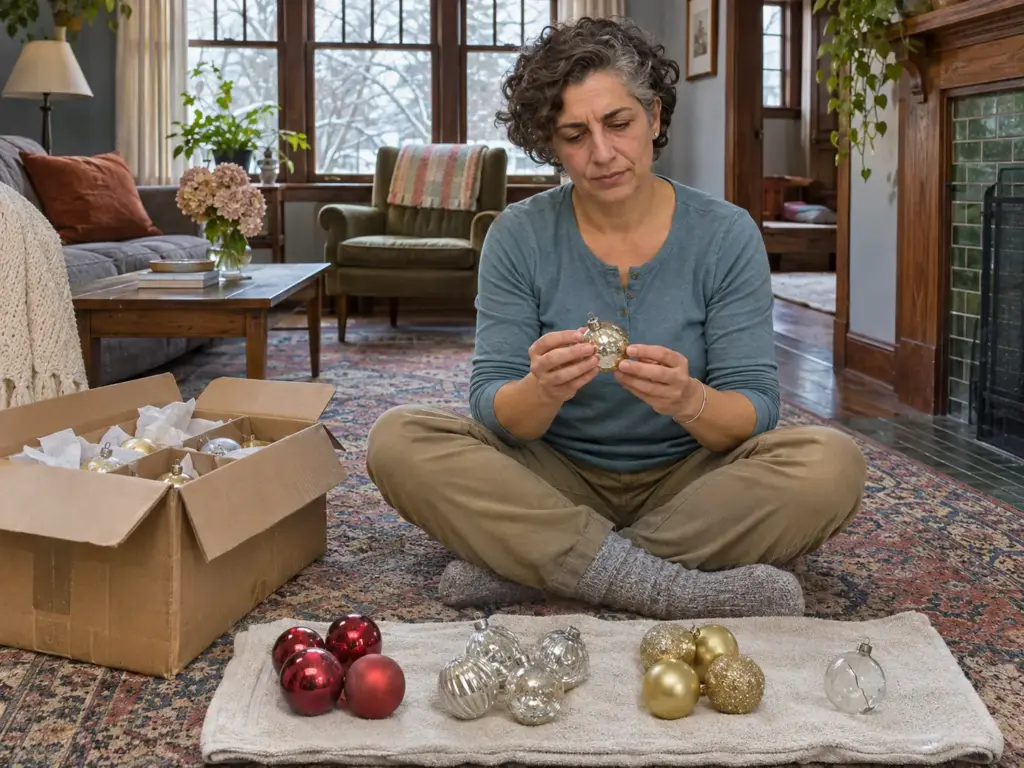
Declutter before storing: set out three piles on a table to sort and inspect every piece: keep and hang, keep and protect (the sentimental and the collectible), and let go. The cracked pieces go to the third pile now, not in March. A crack gives way when the lid is carried, and the shards cut whatever is packed beside it. Ornaments with chipped caps leave with them, and whole duplicates from a boxed set are worth a donate pile of their own, not another year in tissue.
The middle pile is the slow one, and a method for keeping the ones that carry a memory and letting the rest go makes the decisions quicker. If the sort has to cover more than ornaments, the four-pile sort that works for any room is the longer version of the same idea.
Inherited glass is a separate case. A piece that has hung on the same wire hanger for decades usually gets dropped while someone is working that hanger off, so decide now whether the hanger stays on, and do any unhooking over a folded towel or a couch cushion, never over bare floor.
Dust Dry — and Why Water Is the Wrong Cleaner
Dust before storing, every piece, with a dry, soft cloth, and stop there. Old World Christmas advises avoiding water on hand-painted or antique glass, and paint is what water takes: a cloth that looks harmless can lift a painted rim in one pass. A small dry paintbrush reaches the recesses of a molded piece. To clean ornaments any further is to gamble with the paint, so a piece that is truly grimy waits unpacked while you decide whether it belongs in the let-go pile.
Count the Pieces Over 3 Inches First
The number printed on a box lid counts one kind of ornament: a ball up to 3 inches across. Your collection is not all that kind, so count it by size instead of in total. Cut a 3-inch hole in a piece of cardboard (the compartments in most divided boxes are cubes about 3 inches on a side, so the hole is a fair stand-in) and hold each ornament to it.
What drops through is group one. What stays in the hole, plus anything whose hanger cap pushes it past 3 inches, is group two, the pieces from 3 to 4 inches. Everything larger, and everything that is not round, is group three.
A tally of “about 90 ornaments” usually hides this split. It might be 60 small rounds that suit any divided box and 30 pieces that need bigger cells or boxes of their own. Those 30 are the ones the number on the lid leaves out, so they get counted first, written on a sticky note, and carried into the box decision below.
Keep the cardboard template in the box with the hooks. Next fall it tells you in seconds whether a new ornament, or a new box, fits a slot before anything comes home.
Group by Tree or Room, Not by Color
Sorting by color looks tidy on the table and sends the wrong ornaments to the wrong tree in December. Pack by room or pack by theme instead, following how the house is decorated: by tree, by mantel, by sideboard, by the pink tree, the black-and-white tree and the kids tree. In a multi-tree household, the box that belongs to one tree comes out in one trip and goes back in one trip, and nobody opens four boxes to dress one. A single-tree household can skip the grouping and let the size groups from the count do the organizing.
Why Ornaments Break in Storage and What Actually Holds
A box that fails the same way every year gets blamed on the wrapping. The wrap is usually fine. What breaks the glass is the box.
The Shoebox and the Plain Tote Fail the Same Way
A plain plastic tote, and the clear storage bins that look so tidy on a shelf, have nothing between the pieces, so even a well-wrapped ball shifts when the lid is carried down a flight of stairs and meets its neighbor. Wrapping spreads the force; it does not stop the movement. A bare shoebox is the same failure in cardboard, with one more problem: cardboard takes on damp. The shoebox method gets handed down because it costs nothing, and it does its damage when loose glass rides in it, so the version worth keeping needs each piece wrapped and held in place (the last section covers it).
Dividers stacked three tiers high in a single bin fail differently. The dividers are flimsy, and the bottom tier cannot be packed without lifting everything above it, so it gets packed last and in a hurry. Single-layer bins stacked on top of one another fix that, because each layer is packed and reached on its own.
Stacking Rules: Rigid Shell Takes Weight, a Soft Box Does Not
Santa’s Bags sells its drawer box with a rigid shell that allows stacking, ZOBER describes its fabric box as supported by cardboard inserts, and Old World Christmas says to avoid overstacking. Put together, that gives a working rule: stack only rigid shells, keep soft boxes on a shelf at one layer, and never carry a column by one carrying handle. A torn handle is how the cheaper zip-up boxes fail, and it fails with the whole column attached. Lid shape matters too, and a page on bins whose lids actually lock into the one below explains what keeps a column from sliding.
The material question behind that rule, soft against rigid, is covered on a page about how fabric and plastic bins fail differently.
The Free Dividers That Hold Up (and the Two That Do Not)
Free comes first, so here is how the free options look in month three. An apple tray from a fruit-gift box is a real grid of cups, close to the size a 3-inch ball wants, and it stays rigid for several seasons. A cardboard wine box with a built-in grid works the same way until it meets humidity. Plastic cups stood upright in a bin, a method Old World Christmas itself suggests, suit odd small pieces because every cup is a wall.
Two free options do not reach month three. One is the bare shoebox. The other is the cardboard egg carton, which looks like a perfect grid, takes only tiny balls, and collapses the first time the box gets damp. It is a popular free idea, and the one to skip.
When a Drawer Box Earns Its Place
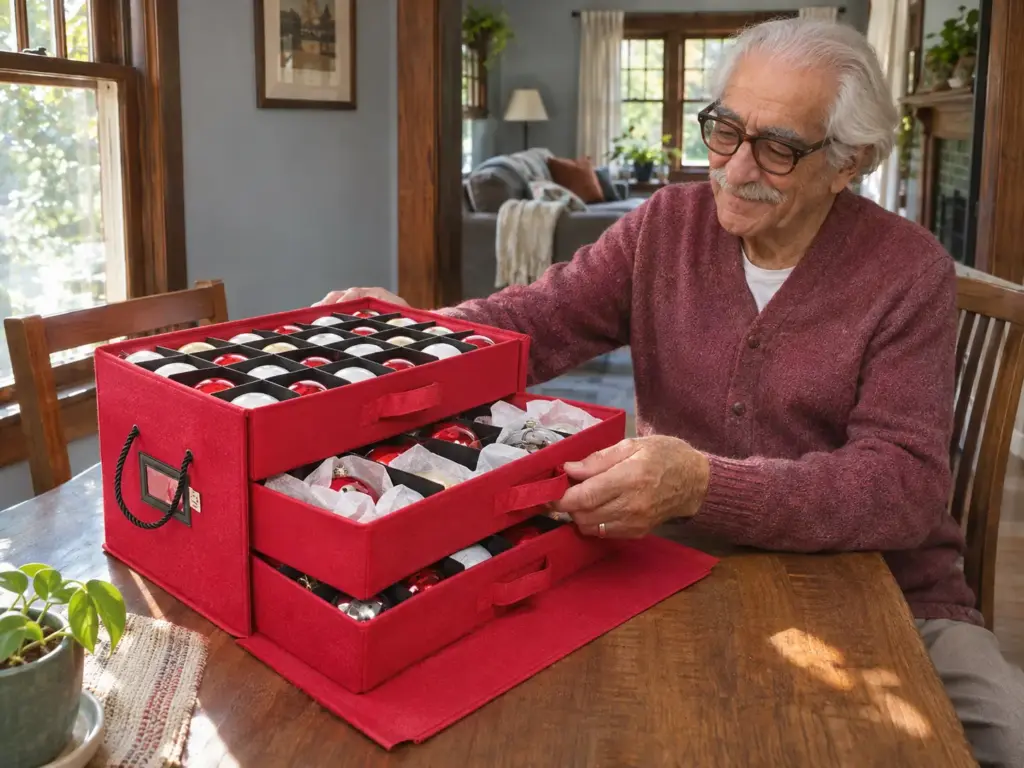
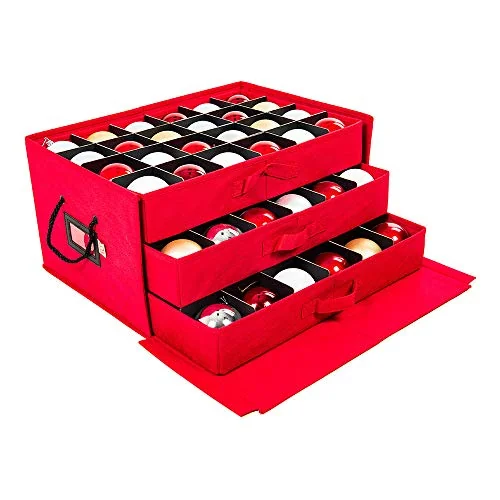
When the free versions are outgrown, a drawer box is the first purchase I would look at. Drawers pull straight out, so the bottom row is packed from above instead of under a lifted tray, which is the step people skip when they are hurrying. The Santa’s Bags Christmas Ornament Storage Box 72 states that its slots take ornaments up to 3 inches in diameter and that the trays are lined with acid-free material.
Its flaw is size: it runs long for some shelves, and the assembly is flimsy. A four-tray flat set, covered in the last section, is the budget alternative.
What to Wrap Each Ornament In, by What It Is Made Of
Standing there with a roll of tissue paper in one hand and a stack of newspaper in the other, the choice looks like a coin toss. It is not, and plastic ornaments do not need the same care as a 40-year-old glass one.
Glass and Hand-Painted Pieces
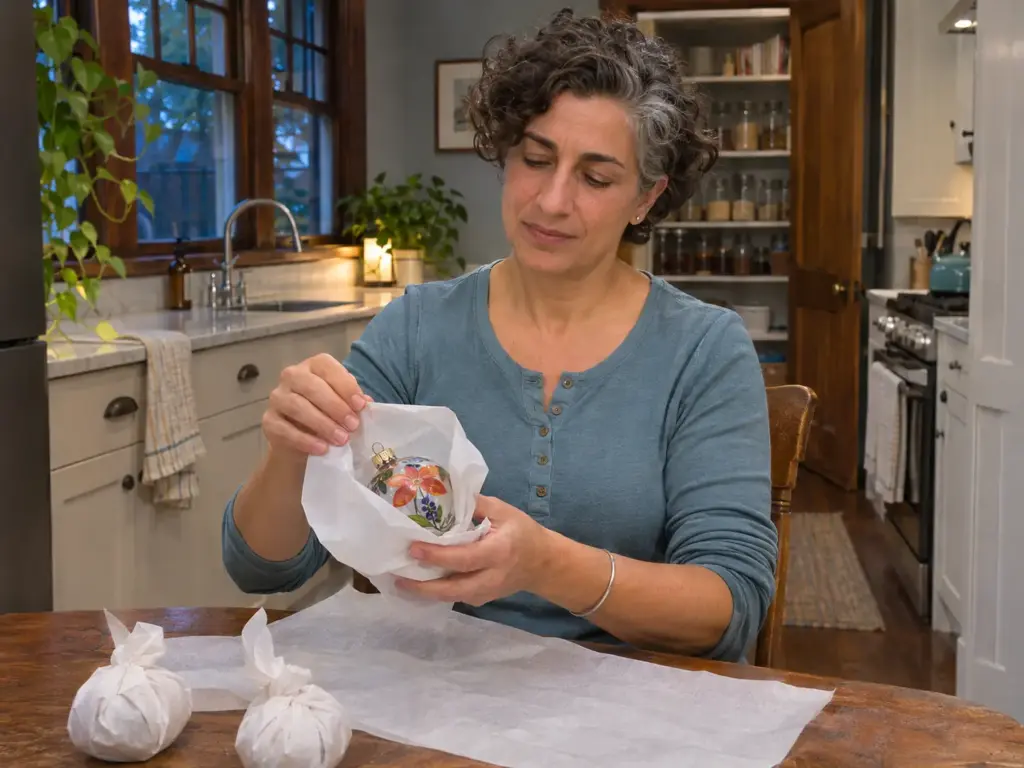
For glass, and blown glass above all, the maker’s guidance is acid-free tissue, one piece at a time. Old World Christmas lists acid-free tissue as the wrap that prevents discoloration, tells you to wrap ornaments one at a time, and names newspaper as the one to avoid because its ink transfers. Water stays out of it, as above. This is the maker’s guidance for its glass, so it is worth following for antique pieces and sensible for any painted one, collectible and heirloom ornaments included.
A bubble pouch is the quick alternative to loose bubble wrap: reusable and fast. The trap is that pouch sizes are measured flat, so the width of the ornament, not its height, picks the size.
Cotton batting works as a nested layer for many pieces at once. Lay a sheet in a tray, set sturdy pieces into it, cover them with another sheet, and the job goes faster than wrapping each ball. It suits only the sturdy ones, though; fragile and hand-painted pieces still get their own wrap. The take-down order and the lights are covered on a page that applies the same padding rule for the rest of the decorations.
Shatterproof and Plastic Pieces
Shatterproof ornaments survive without tissue. They still need separating from the glass. Plastic rubbing against a hand-painted ball scuffs the paint over a season, so give the plastic a separate tray, or at least a separate layer in the bin. The pattern is easy to miss because nothing breaks; the glass just comes out dull.
Homemade and Food-Based Pieces
Dough and cinnamon ornaments are a pest question more than a padding question. A food-based piece goes into a sealed container so insects stay out (a zip-top bag inside it adds a second barrier), and keepsake ornaments made by a child or a grandparent do well in small gift boxes set inside a larger bin. Nest them in cotton batting if they are sturdy, and tissue if they are not.
Hooks, Hangers and Toppers Go Last
Ornament hooks and ornament caps get a small compartment of their own, not a spot loose between the pieces. Loose wire hooks scratch glass, and a hanger left on a piece catches the tissue and the neighbors. A tree topper is the last thing packed because it rides on top, flat, where nothing presses it.
Thread each set of hooks onto a twist of ribbon before the lid closes. Next year they come out as one string instead of forty loose wires, and not one of them is lying on the glass.
Pick the Box by Slot Size, Not the Number on the Lid
Three boxes can all say 128 and hold very different collections. The difference sits in the one number the lid does not print: how wide a slot is.
What the Number on the Lid Is Counting
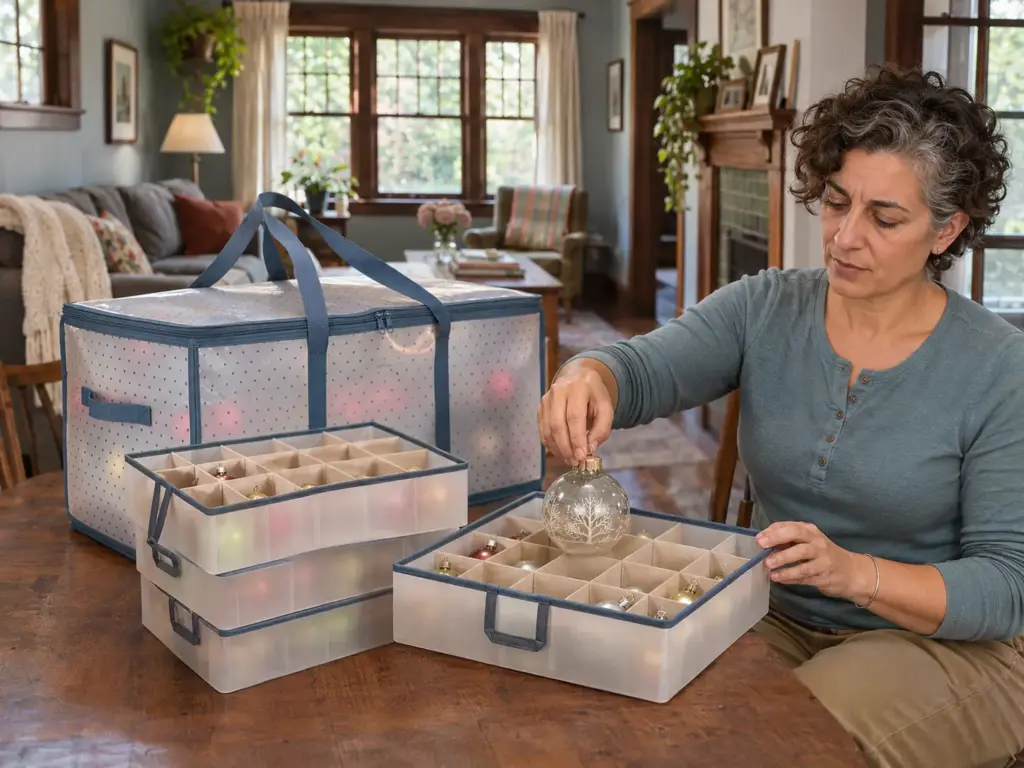
Sattiyrch sells the same 24-by-12-by-12-inch footprint in two versions: 128 slots for 3-inch ornaments and 54 slots for 4-inch ornaments. One extra inch of diameter costs 74 slots. The compartments are cubes about 3 inches on a side, and the number on the lid is a count of small rounds, nothing else, so the advertised capacity is a ceiling that only 3-inch rounds ever reach.
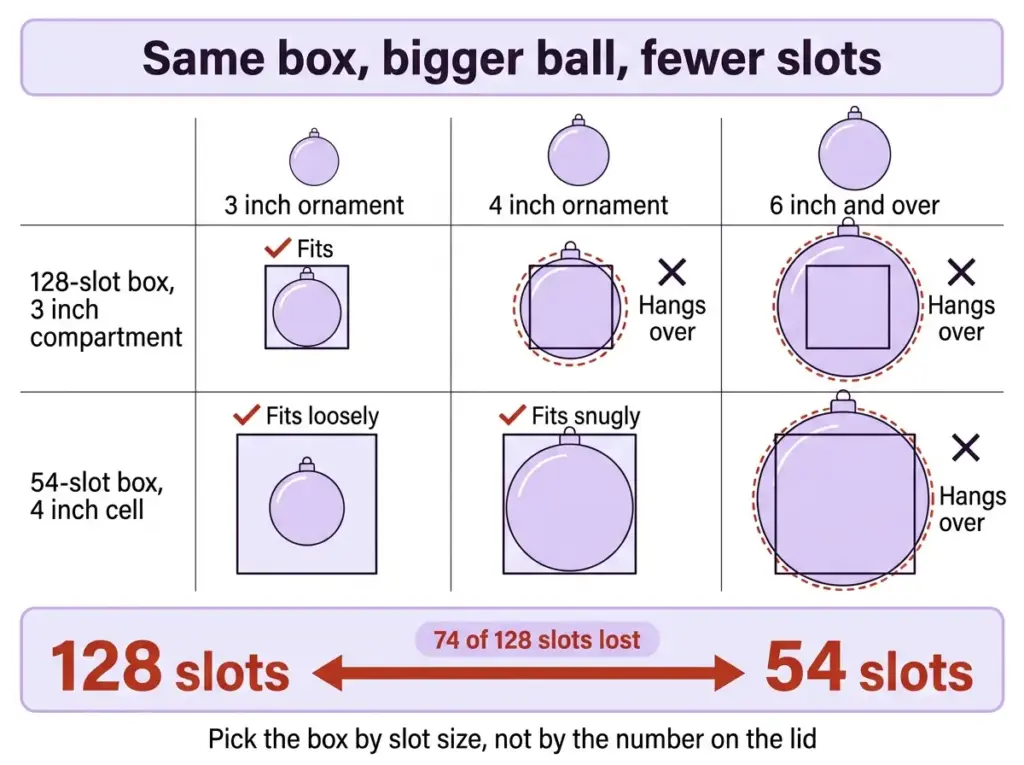
The drawer box says the same thing in words, and a 4-inch piece does not drop in. It sits on top and presses on its neighbors, and the lid presses on all of them. To turn the count into a box, take groups two and three from the first section: pieces over 3 inches each use more than one compartment, or one cell of the 54-slot box.
Pick the box whose slot size fits the most pieces, then add a second box for the rest. In the 90-piece example, one 128-slot box holds the 60 small rounds with room to spare, and the 30 larger pieces go into a 54-slot box, which takes them with 24 cells left over if none passes 4 inches.
Divided Box, Drawer Box or Rolling Chest: Which Collection Each One Fits
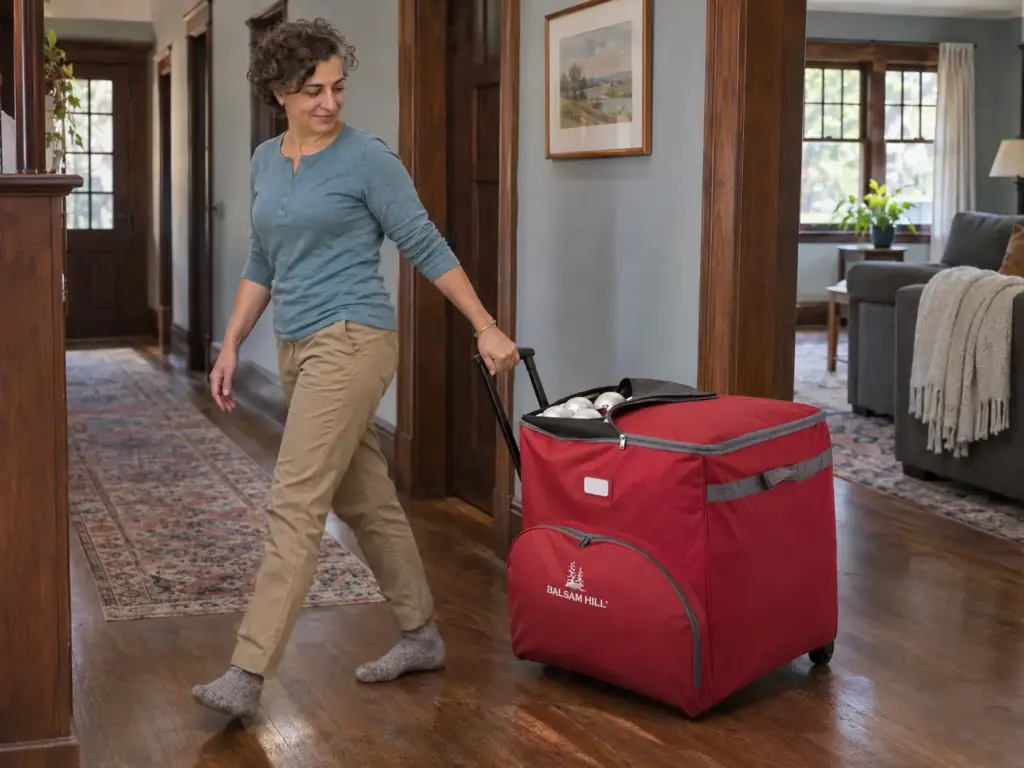
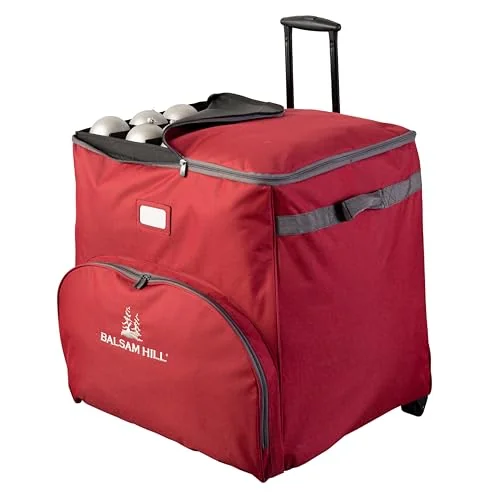
A divided zip-up box, the classic ornament organizer, suits a mid-sized collection that is carried from a closet shelf. A drawer ornament box suits a collection packed by tree, on a shelf deep enough to take it. A rolling chest suits a heavy collection with no shelf at all: the maker of the one covered later sells it on built-in wheels and a steel frame, so the idea is that a full chest gets rolled, never lifted, and any loaded box is worth weighing before a handle is trusted with it.
Adjustable dividers are what let odd sizes fit, and the ZOBER Christmas Ornament Storage Box 128 is the cheapest true 128 here, with cube compartments, a zipper down both sides and a card slot where the label goes. Its flaws are the handles, which tear, and the dividers, which collapse after a few seasons, so it belongs on a shelf and not carried in a stacked column. For boxes that serve wreaths and lights as well, there is a side-by-side look at holiday storage containers.
The Box That Does Not Stack and the One That Does
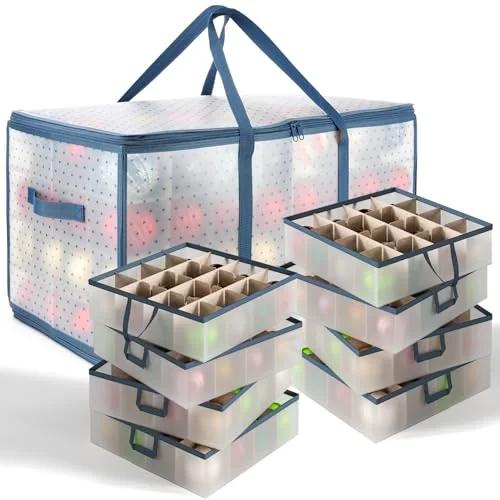
The fabric box with dividers is the obvious pick, and a damp garage or basement is the condition that changes it. The Sattiyrch Christmas Ornament Storage Box 128 x 3 inch has eight plastic trays that lift out one at a time to go around the tree, and the maker states a water-resistant shell. Its weak points are the straps, which break under a full load, and the fabric handles and seams, which tear. Carry it by the tray, not the strap, and keep a sealed container with silica gel in mind for a spot that is truly damp, because a water-resistant shell does not dry the air inside.
The Free Version That Still Works for Under a Hundred Pieces
A collection under about a hundred pieces can run on free parts. Use an apple tray or a wine-box grid for the 3-inch balls, wrap each piece in tissue, keep the original boxes for the four or five biggest, and pack by tree in one rigid tub or a stack of sturdy boxes. Past a hundred pieces, or when the collection mixes sizes, the divided box starts paying for itself.
Where Oversized and Odd-Shaped Ornaments Go
A divided box is built for balls, and the pieces that break first are the ones that are not round. The dozen pieces left on the table after 90 balls are packed are the ones this section is for.

Pieces Over 4 Inches and Why a Slot Will Not Hold Them
A 4-inch-plus ball does not fit a 3-inch cube, and forcing it makes the lid the thing that breaks it. The free answer is the original box: the biggest four or five pieces keep theirs, padded with tissue, which is what Old World Christmas recommends for collectibles. For a larger number of 4-inch rounds, the Sattiyrch Christmas Ornament Storage Box 54 x 4 inch has the same footprint as a 128-slot box but six trays of nine cells, wide enough for the bigger ball. Its limit is the nine fixed compartments per tray, too wide for anything narrow, so it is a box for large rounds and nothing else.
Icicles, Bells and Figures: The Original Box Beats the Divided One
Icicles, bells and long figures need length more than width, and no divided box has a cell for that. Their original keepsake box, padded with acid-free tissue, is the right home. If the box is gone, a small gift box of the right length works, and a hard tub with the boxed pieces nested inside is the second option. Slim pieces wrapped loosely in tissue and laid flat in a single layer travel better than the same pieces standing in a cell too wide for them.
Garlands and Beaded Pieces: Wind, Do Not Fold
Wind a beaded garland loosely around a cardboard tube or a flat card. Folding it creases the string and snaps the beads at the fold, and the damage shows up only when the garland comes out and hangs wrong. Tape nothing to the beads, and tuck the loose end under the last turn.
Where the Boxes Live and the Reset That Keeps Them Findable
On the second of January, a box is open in the living room, the closet is already full, and the attic starts to look good enough. The storage spot decides more about next December than the box does.
The Spot Order: Closet, Under the Bed, Then Attic, Basement and Garage
Old World Christmas names the places to avoid, hot attics, damp basements and direct sunlight, and the ones to use: interior closets and climate-controlled rooms. That order is the spine of this section. An interior closet comes first, and bins sized for a closet shelf take the guesswork out of fitting a box to the shelf depth.
Under bed storage comes second, and what the bed’s clearance leaves for a flat box decides whether slim trays fit. The attic, basement and garage come last, and only in a rigid sealed box.
When there is no spare closet, stack the single-layer bins in the dead corner of the one closet you have. Where a box goes when there is no spare closet is a question of vertical space, not floor space. The ProPik Christmas Ornament Storage Boxes 4 Pack is built for it: four flat trays, the slim stackable boxes of this list, each 12.9 by 12.9 by 3.1 inches, stack to about 12.4 inches, each is carried separately, and the clear top shows what is inside. The zippers are its weak point.
For a bed with a low frame, containers built for a low bed frame compare the 3.1-inch tray against deeper boxes. The free version is a shoebox per tree, each piece wrapped and held in place, labeled on the short end and kept on a shelf, never the floor.
A heavy collection with no shelf is the case for a rolling chest, because it goes with the floor, not the shelf.
What Damp Does to a Stored Box (and the Silica Gel Fix)
An attic bakes, a basement sweats and a garage lives with a daily temperature swing between the two. Each fails differently, and damp is the quiet one: mold and mildew show nothing until the lid comes off in December.
How damp air damages a stored collection is spelled out by the Canadian Conservation Institute: “Damp causes several types of deterioration – mould, rapid corrosion, and extreme forms of mechanical damage.” The same page puts the start of damp above 75% relative humidity. Visible mold on some surfaces takes about 100 days at 70% and two days at 90%, so a garage or basement that sits at 80 to 90% in summer is not a little humid; it can grow mold on a collection inside a week.
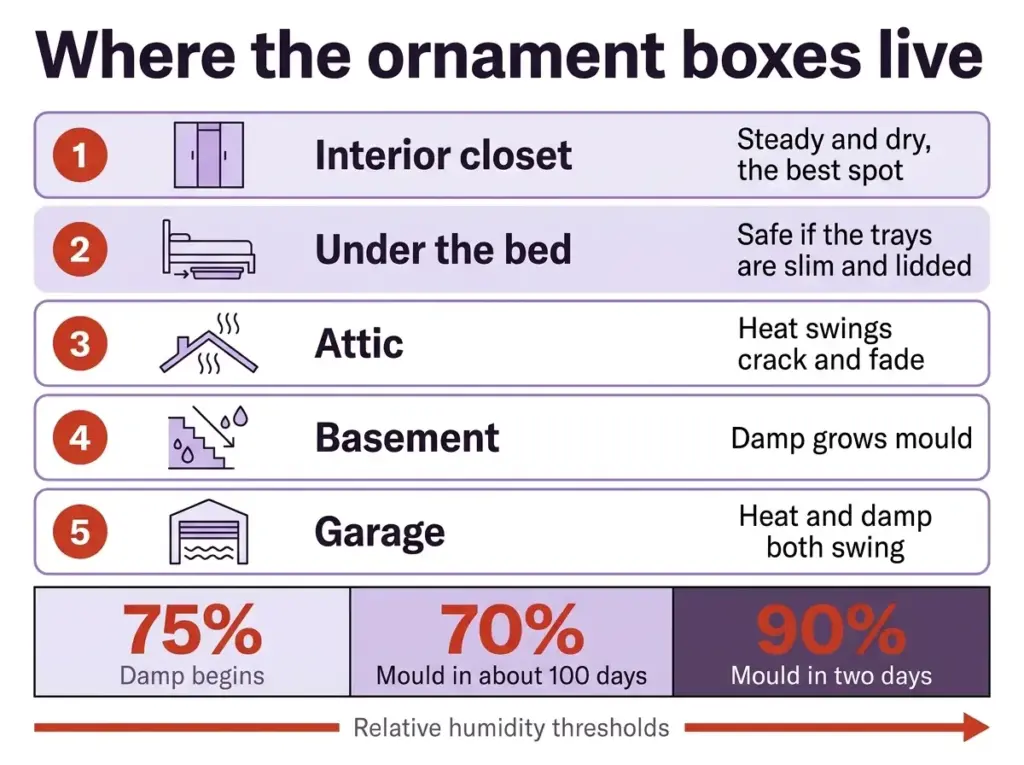
The same page carries a less obvious result. A stored collection that dips into the safe zone every few days is better off than one that sits at 75% all summer, because the dip resets the mold clock, so a swinging attic is not automatically worse than a basement that stays damp. That is no license to use the attic, since the maker rules out heat too. It does mean a basement is not safe just because it is steady.
For a spot that is truly damp, the working fix is a sealed box with a desiccant. Put silica gel inside a sealed box and the micro-climate changes: the Institute’s guidance for stored objects is “To reduce humidity around objects, they should be placed in sealed glass or vapour-proof plastic containers along with dry indicating silica gel”. The gel fills about one-third of the air space, and it gets replaced when it turns from blue to pink.
Labels That Work Without Opening the Lid
Label by what the box is: the tree, the mantel, the black-and-white tree. Do not label by color, and do not trust a memory of which box is which. Use the box’s card slot where it has one, or a label maker strip on the short end, and write the card before the lid closes, because the card written later is the one never written. A one-line, one-tree, one-trip rule keeps the system alive in a multi-tree house.
For a calendar-style approach to boxes of every season, there is a page on numbering the boxes in the order they come out.
Write the same line on the card and on a strip of masking tape across the lid. A card can slip out of its slot during a move, and the tape stays where it was put.
The Twenty-Minute January Reset
The pack-up that survives is the one done in a hurry, because the decorating season ends in a hurry, so the system is built to store for next season in twenty minutes. Work one tray at a time: ornaments out of the tree, into tissue, into the tray, hooks straight into their compartment, tray closed. Write the label card before the lid closes. A reset that leaves the oversize pieces for later is a reset that breaks them; they go in their own boxes first, while everyone still has energy.
Start With the Pieces That Do Not Fit
The oversize pieces get counted first and boxed apart, because they are the ones the number on the lid leaves out. Tissue goes around the glass, a dry cloth cleans it, and water and newspaper stay out. Slot size beats lid number, the interior closet beats the attic, and the label card is written before the lid closes.
The check for later is a single look: open the one box kept in the dampest spot in midsummer, read the silica gel color and the lid seal, and leave it alone until the tree comes down.
The small step for today is to take one tree’s worth of ornaments, cut the 3-inch hole in a piece of cardboard, and count the pieces that do not drop through. Wrap those first. Then notice how much of the rest fits in the box sitting in the closet right now.
Frequently Asked Questions
01How can I declutter my Christmas ornaments before storing them?
Pull the cracked pieces, the duplicates from boxed sets and any ornament nobody has hung in three seasons, then give the sentimental ones their own box. What is left is the collection you are actually packing, and its count by size decides the box.
02What are creative ways to store homemade ornaments?
Wrap each homemade ornament in acid-free tissue or cotton batting, and keep the keepsakes in small gift boxes inside a larger bin. Dough and cinnamon pieces are food, so they go in a sealed container to keep insects out.
03How many ornaments does a 128-slot box really hold?
A 128-slot box holds 128 only if every ornament is 3 inches or smaller; the same footprint holds 54 at 4 inches. Count the pieces over 3 inches first, since each one costs more than a slot and the largest need their own boxes.
04Can I store ornaments in the attic or garage?
Only in a rigid, sealed box with silica gel, and only after the closet and under-bed spots are used up. Old World Christmas, a maker of glass ornaments, names hot attics, damp basements and direct sunlight as the places to avoid.
05What is the best way to organize ornaments so they are quick to find next year?
Label each box by tree or room, write the card before the lid closes, and keep the hooks in their own compartment. One line, one tree, one trip is the rule that holds up in a house with several trees.
Disclaimer: ClutterlessNest is a participant in the Amazon Services LLC Associates Program. As an Amazon Associate we earn from qualifying purchases. This article may contain affiliate links — if you buy through them, we may earn a small commission at no extra cost to you. We only recommend products we have tested or genuinely believe in.