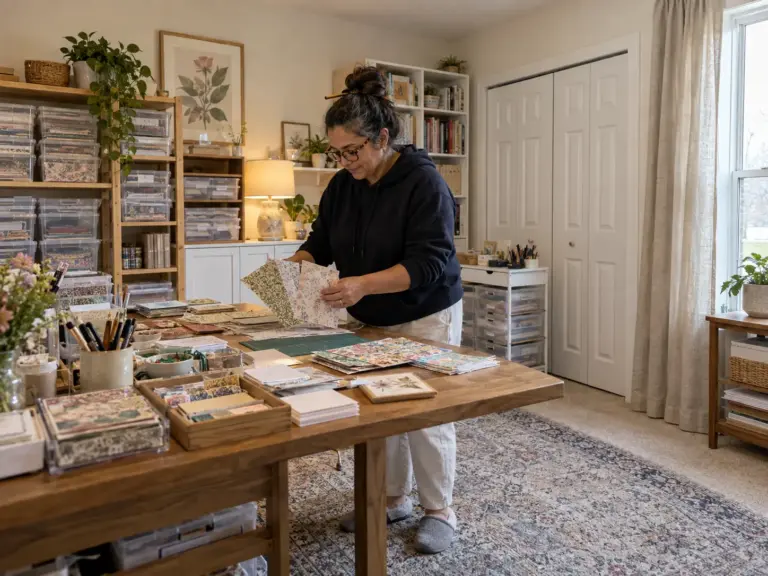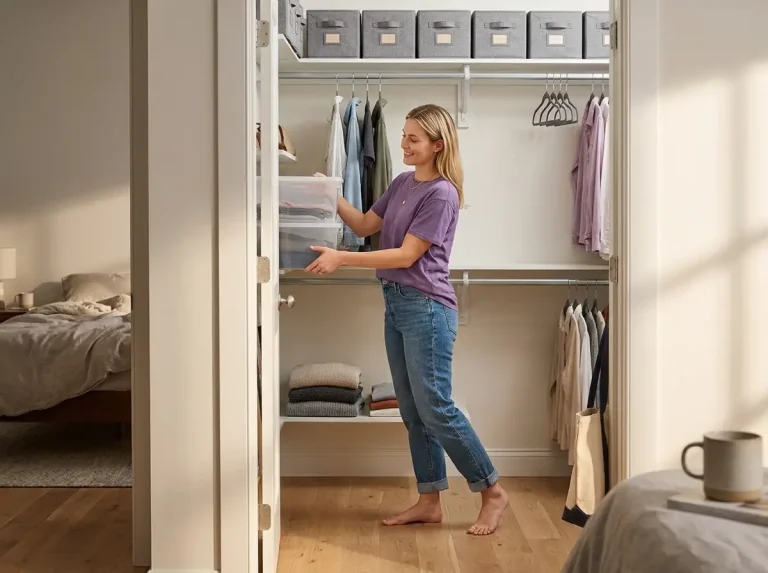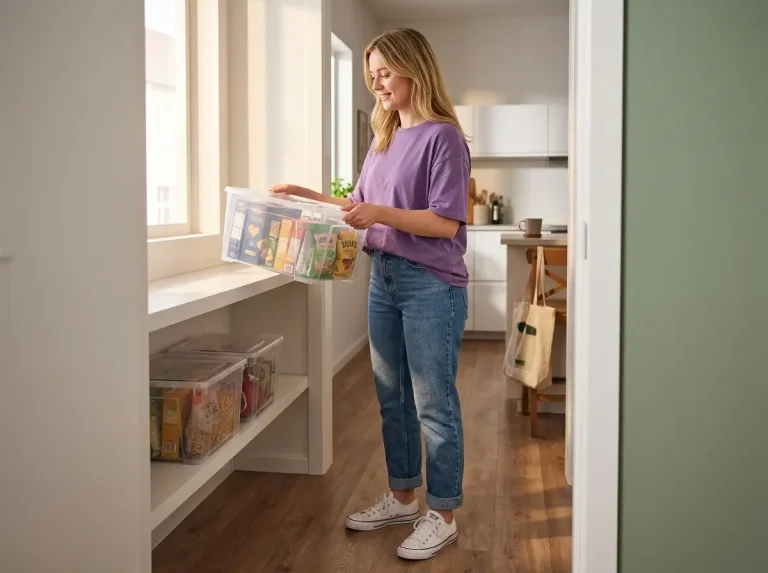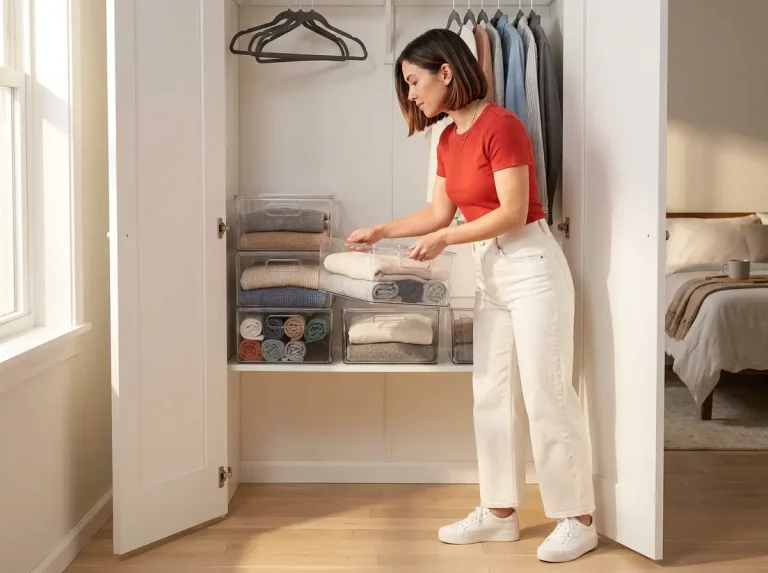
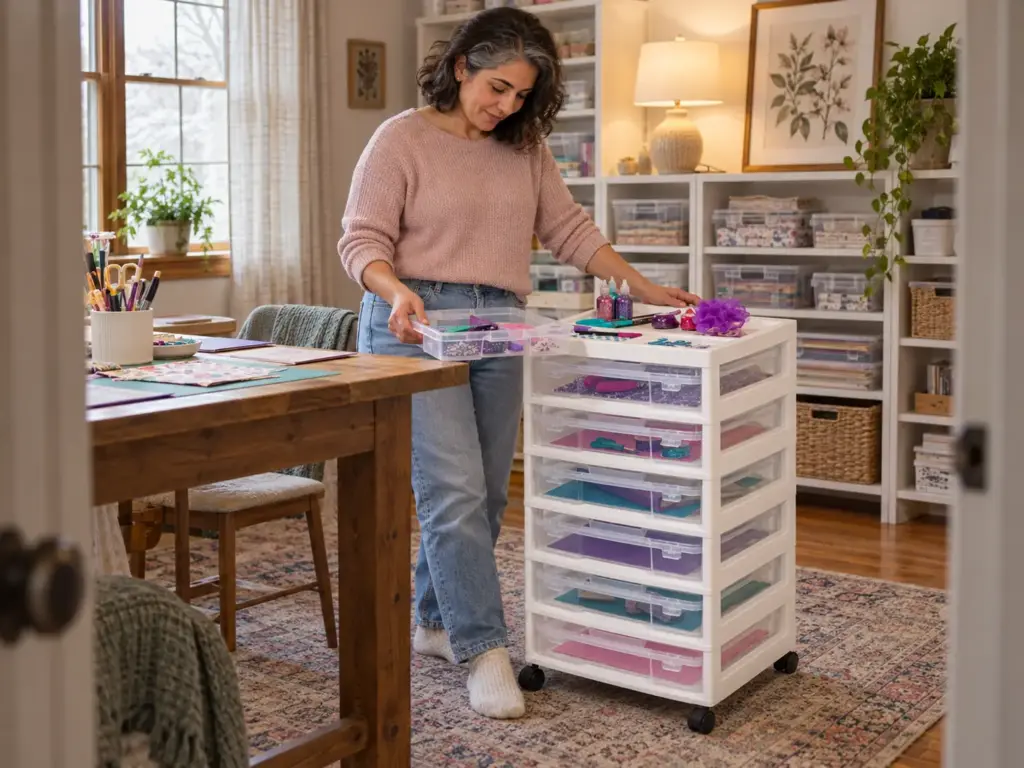
You slid the clear bins onto the closet shelf, and a few weeks later one of them still sticks out an inch past the frame while another has not been opened since the day it went up. The listing was accurate. The shelf just never got measured. A r/crafts commenter described the other half of the problem with cube storage: out of sight meant out of use.
Choosing the best craft storage organizers comes down to those two checks, whether a piece fits the spot and whether it keeps the stash where you will reach for it, and this guide runs both on eight named pieces, one storage type at a time, with a buy-or-skip rule at the end of each. If you are still planning your craft room storage from scratch, set up the whole craft room first and come back with your measurements.
The table sorts six storage types by what each is for, the one measurement to take first, and the way each tends to go wrong.
| Storage type | Best for | Check this first | Where it goes wrong |
|---|---|---|---|
| Clear lidded bins | Fabric, yarn and paper stock you reach for monthly | Shelf depth and the gap above for the lid | Sticks out past the frame, or the bottom of a stack gets forgotten |
| Door-fronted cabinets and cube units | A shared or visible room where the stash has to disappear | Whether weekly supplies end up behind a door | A r/crafts commenter found cube storage hid everything, so it went unused |
| Drawer units and small-parts cabinets | Beads, stamps, findings and hardware | The inside size of one drawer on the real unit | Anything longer than the drawer, and paper |
| Paper cases | Flat 12 x 12 sheets that must stay flat | The shelf against the case, not the sheet | A general bin is the wrong shape, so sheets curl or pile |
| Rolling carts | Work that moves between a table and a closet | Aisle width and where the cart parks | Ends up in the walkway when the table is in use |
| Secondhand dresser or bookcase | A heavy stash on a tight budget | Shelf strength and drawer depth | Cheap shelves bend under paper and paint, per a r/crafts commenter |
Measure the Spot First, Then Pick Your Craft Storage Organizers
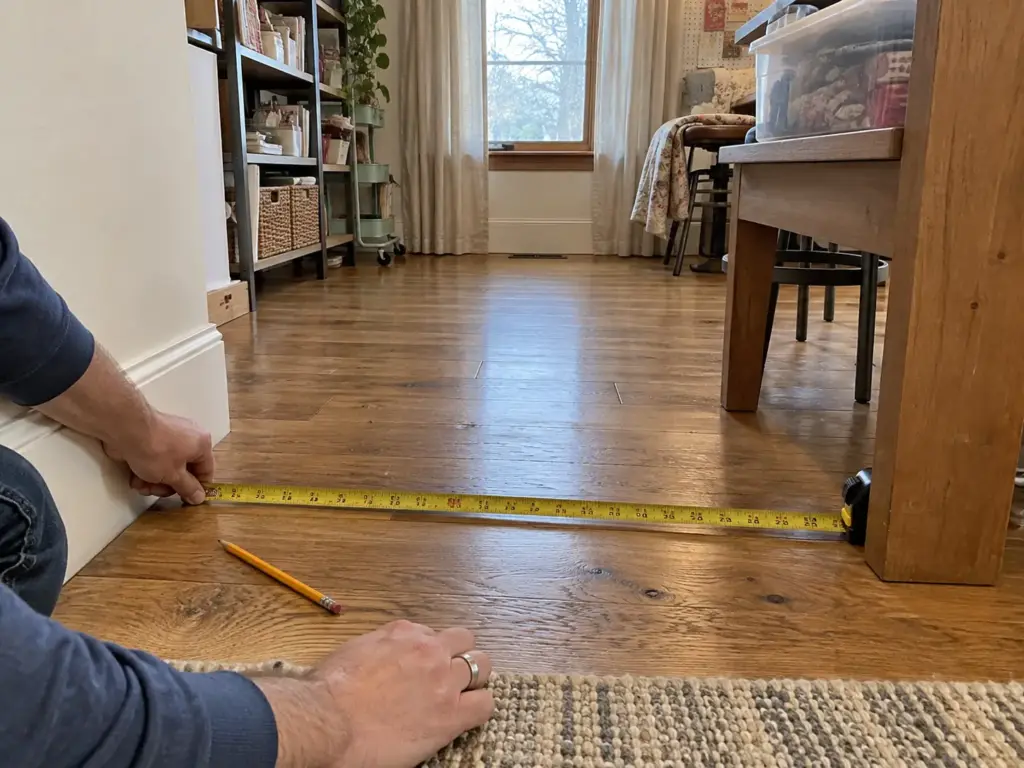
Four numbers to write down before you open a listing
The bin is the right width on the box and it still sticks out past the shelf frame, or the lid will not clear the shelf above it. Nothing was misprinted. A listing gives the size of the product, and nobody gave the listing the size of your shelf. Four measurements make a quick fit test, and they take less time than reading reviews.
- The depth of the shelf or the floor spot, front edge to wall
- The width of the opening, side to side
- The height between shelves, since a lid or a lifted bin needs room above it
- The clear floor in front, for a cart to roll or a drawer to pull out
Every product below gets compared to one of those four, so put them on one note and keep it on your phone while you shop. (A number you remember is usually the number you remember wrong.)
A listed size is also the outside of the product. What it holds is smaller by the wall thickness, the lid lip and any dividers, so for anything with compartments, measure one compartment on the real unit instead of trusting the box. The 44-drawer cabinet later in this guide is the example, because two sources give different sizes for the same small drawer. For closet shelves in particular, our guide to storage bins for closets that fit real shelves walks through the shelf-measuring step in full.
To see how far apart these pieces really are: the IRIS USA 44-drawer cabinet is 7 inches deep, 19.5 wide and 15.5 high. The Vtopmart bin measures 11 x 7.5 x 6 inches. The IRIS rolling cart is 15.88 inches long, 14.25 wide and 26.44 high, and the Ronlap slim cart is listed at 25.96 x 15.75 x 8.66 inches. A cabinet 7 inches deep and a cart with a footprint of roughly 16 by 14 inches need two different spots, and neither belongs where the other would go.
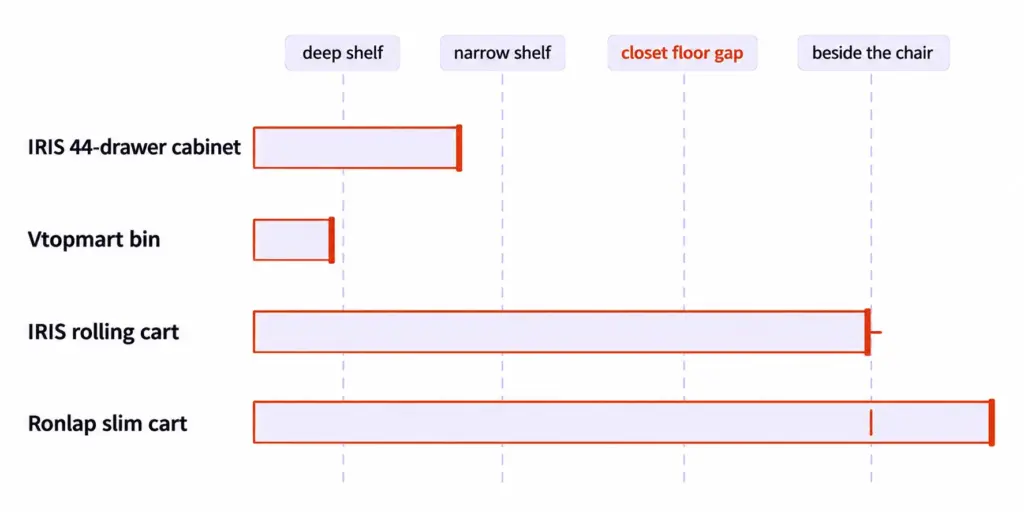
What a shelf, a closet floor and a work table each take
A shelf is ruled by depth and by the gap above it. A craft table is ruled by elbow room, since whatever sits on it competes with the project. The closet floor is the spot people forget, because the door cuts the usable width: stand in the doorway with the door open as far as you normally leave it, and measure from there, not from the wall.
The table matters for another reason. It is where the stash gets used, which makes the floor beside your chair the natural parking spot for anything on wheels. Measure that gap too, before a cart is in the picture.
Weight changes the answer
A heavy stash decides the shelf before it decides the bin. One r/crafts commenter (Ryoko_Kusanagi69) said it plainly about cheap bookshelves: “they deform and the shelves bend over time with heavy materials (papers, books, scrapbook papers, paints).” Paper stacks, fabric bolts and paint are the heavy categories. Beads and ribbon are not.
So sort what will sit on a shelf by weight before you buy containers for it, and put the heavy things low, on the sturdiest surface in the room. A bin that fits perfectly on a bowing shelf is still a bad purchase.
Cut a piece of cardboard to the footprint of anything you are about to order and set it on the shelf or the floor spot. Then open the door, pull the imaginary drawer and roll the imaginary cart past it. A cardboard template shows the clearance problems a tape measure misses.
Clear Bins and Tubs for the Stash You Want to See
A shelf of matching clear craft storage bins looks finished on day one. A few weeks on, you are using the one at arm height and ignoring the rest. Clear craft bins help only if the bin sits where you can see it, reach it and lift it out.
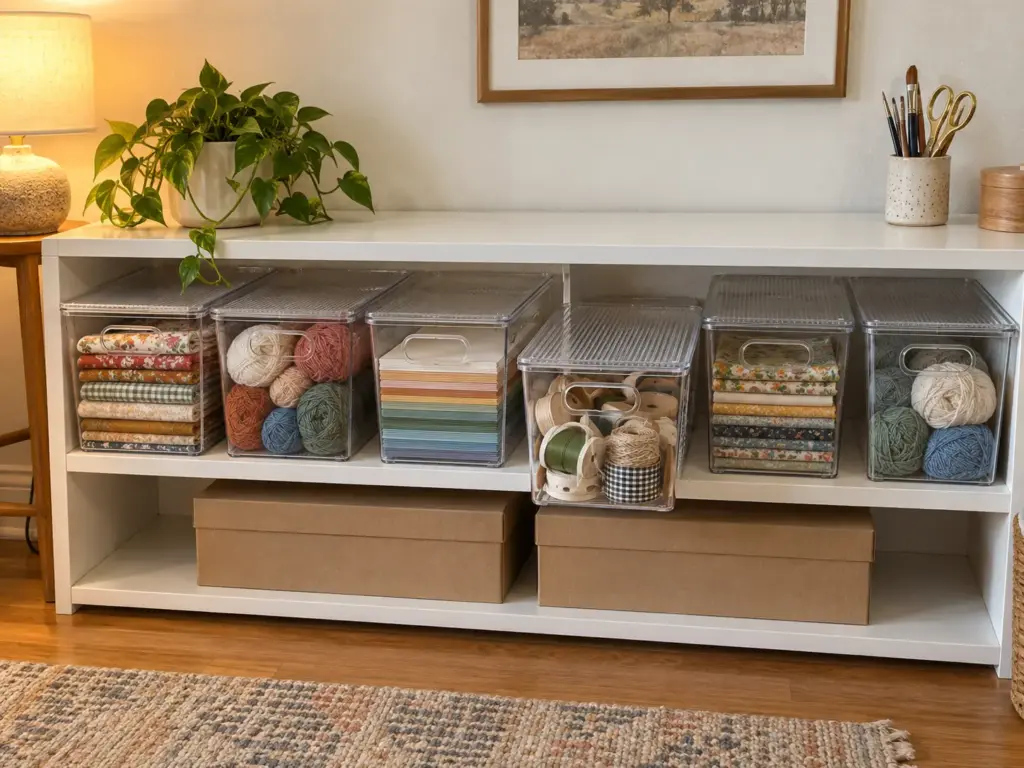
Lidded bins for shelves and closets
Free first: a shoebox-size container you already own does the job for yarn storage or fabric, if it fits the shelf you measured above. Clear matters because you have to see the stash to use it. “I use the clear bins for my fabric storage and I can see what I’ve got easily,” wrote one r/crafts commenter (Environmental-Ad9339).
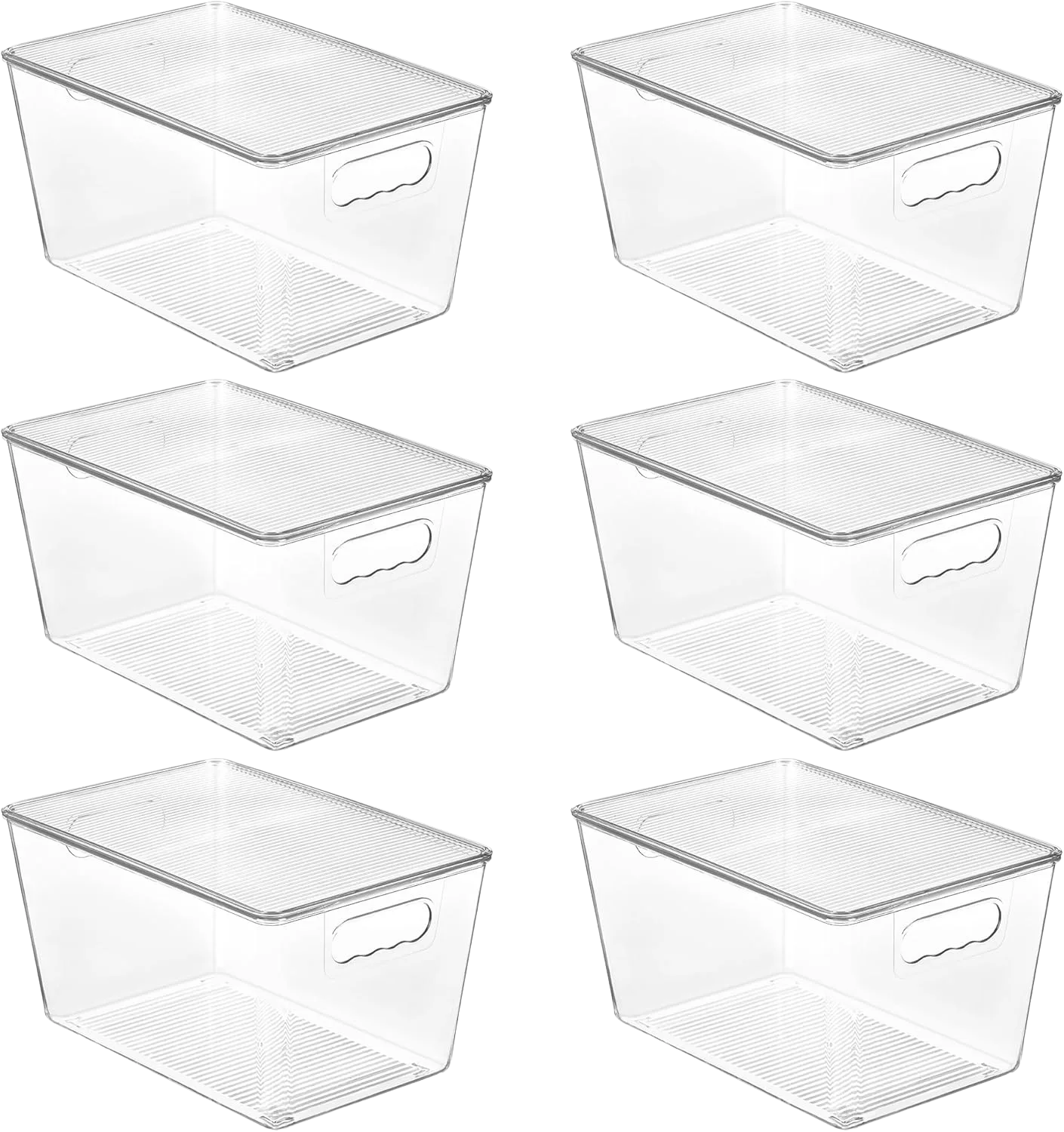
When a single container will not cover the stash, a six-pack fills a full shelf run from one order. The Vtopmart 6 Pack Clear Stackable Bins with Lids measure 11 x 7.5 x 6 inches each, and the lids stack. The dimension to check against your shelf is the 11-inch side, because you need room in front of and above the shelf to lift a bin out without scraping the frame. For more on lids and rental shelves, see our roundup of clear storage bins.
Latching boxes for stash you open once a season
“Clear everywhere” is the usual rule, and it stops being the right one for fabric you touch twice a year. For that stash, a latch that keeps the lid shut matters more than a view of the contents, and printable labels do the seeing for you. The IRIS USA 32 Qt Latching Clear Storage Box (4-Pack) fits that role. The 32 quarts on the listing is capacity, not footprint, so read the box dimensions on the page against your shelf before you order.
Stacking is where these boxes fight your shelf. A pile of four buries whatever is at the bottom (and the bottom box is always the one you want), which defeats the clear lid, so read up on bins that actually stack before you build a tower.
When a bin stops being used
Two causes cover nearly every dead bin. The first is a fit problem: it sticks out past the frame, or the lid fights the shelf above, so it lives on the floor.
The second is position. A bin out of arm’s reach stops being a bin you open, and the one at the bottom of a stack might as well be gone. Material matters less than position, though the ways plastic and cloth fail differ, and fabric bins against plastic ones lays out which fails how.
Buy clear lidded bins for the stash you reach for monthly. Skip the big opaque tub for anything you use weekly, because weekly supplies need to be seen and reached in one motion.
Cabinets With Doors and Cube Units Hide the Stash You Paid to Store
Picture the room with every door shut: tidy at a glance. Now picture starting a project, which means opening four doors and lifting out the box under the others. The person the cabinet has to serve is you, on a night when you have a short window to work.
Why closed storage goes unused
The poster who started the r/crafts thread was clear about the goal: “close up to keep the room looking tidy even if inside the cabinet isn’t.”
That is what doors do. They hide a mess, they do not fix it, and in a room the whole household sees, that trade is sometimes exactly right. The rule behind it, visible or closed storage, is covered in our craft room ideas guide. Here it is a buying consequence.
Buy a craft cabinet with doors for a shared craft space or a visible room, such as a dining area or a living room corner, where the stash has to vanish when the project is over. Skip doors for supplies you use every session. No specific craft storage cabinet is recommended here, because the choice depends on the room more than the model.
Cube units: the open cube and the box that hides it
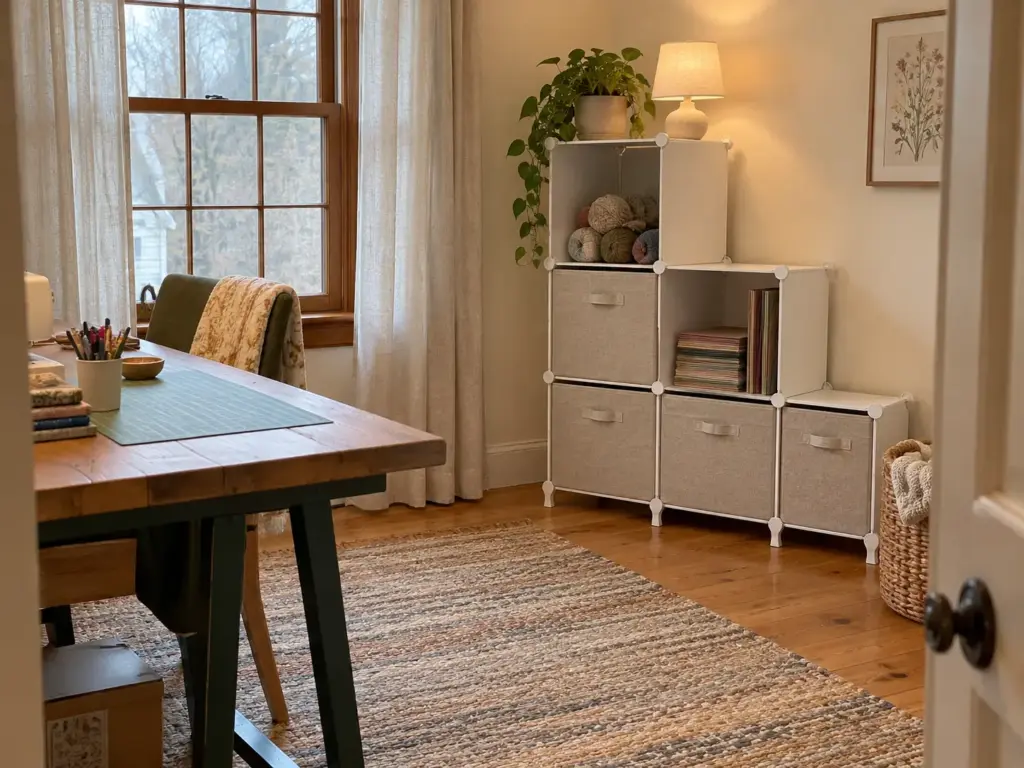
One commenter reported what happened with cube storage: “I feel like the cube storage hid everything and if I didn’t see it – I didn’t use it.” (Environmental-Ad9339). The original poster’s own closet of cubes and shelving was “always messy looking.” But open cubes, the plainest kind of visible storage, have the opposite problem: they show everything, including the mess.
The AWTATOS Stackable Cube Organizer (freestanding, 6 cubes) is the kind of unit that quote is about, though it describes cube storage in general, not this model. The detail to check on the listing is the front: open cubes show what is inside, and cubes filled with lidded fabric boxes do not. Which one you need depends on whether the stash behind each cube is something you touch weekly or a few times a season.
Sort the cubes by how often you open them. Leave the row at arm height open for the supplies you use weekly, and put fabric boxes on the cubes below for the stash you touch a few times a season. If a boxed cube never gets opened, move its contents up.
Tall units belong to the wall
Tall cubes and cabinets tip, and a top-heavy load of fabric makes it worse. According to the Consumer Product Safety Commission’s guidance on anchoring furniture, “CPSC recommends that consumers anchor furniture, including dressers, securely to the wall.”
The federal tip-over standard behind that guidance covers clothing storage units such as dressers, armoires and wardrobes. A craft cabinet is outside its scope, so do not assume one meets it. The anchoring principle applies to any tall unit all the same. If you rent, check the lease before you put a screw in the wall, and keep the heaviest supplies on the lowest shelf.
Drawer Units and Small-Parts Cabinets for Beads, Stamps and Hardware
Bead storage and stamps storage fail the same way: the jar and the tin share a box with the tape, and finding either one means tipping the box out. Small things dig themselves under larger ones whenever they have no spot of their own.
Why shallow drawers suit small things
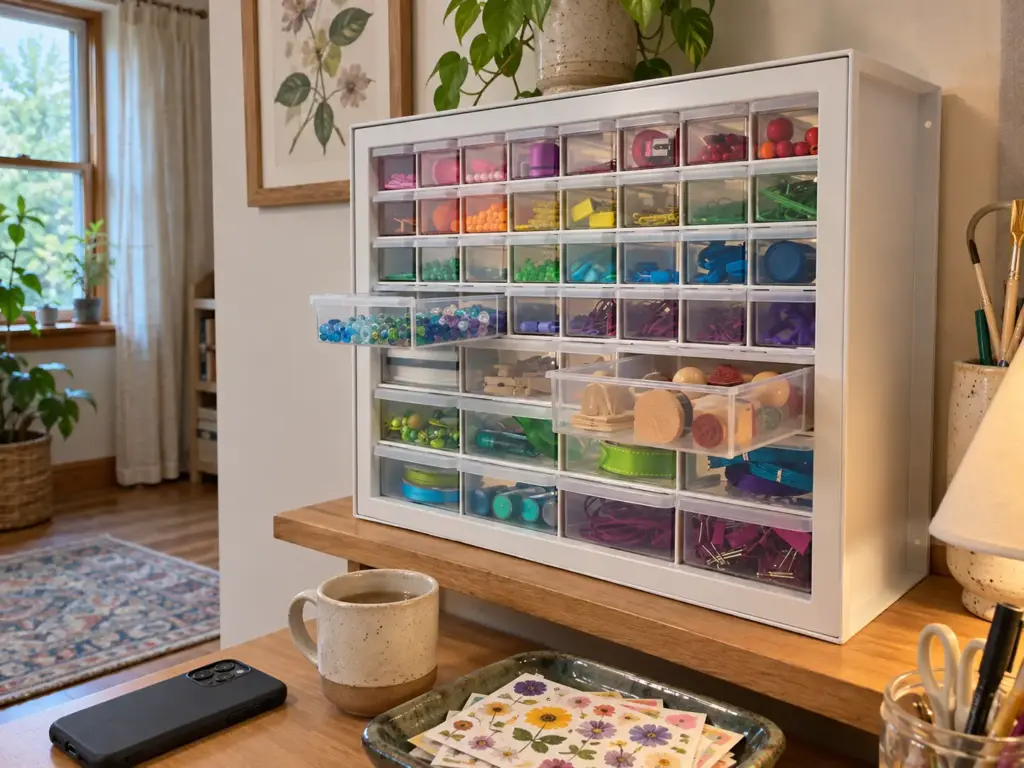
Free first: a stack of shallow shoebox lids turned upside down, or a tea caddy, gives small items their own spots. If you already own a dresser or desk drawer, drawer dividers or drawer organizer inserts are the cheaper way to divide it. A small parts organizer earns its place when the count of small items passes what a box and a few trays can handle. “Tackle boxes and hardware organizers are perfect for the tiny bits,” wrote one r/crafts commenter (Azilehteb).
More drawers is not automatically better. A 44-drawer unit sounds like the answer to everything, and for a large collection of small items it nearly is. For a handful it is an irritating one, because half the drawers sit empty and the other half still need labels. Count what you have first.
Measure one drawer, not the cabinet
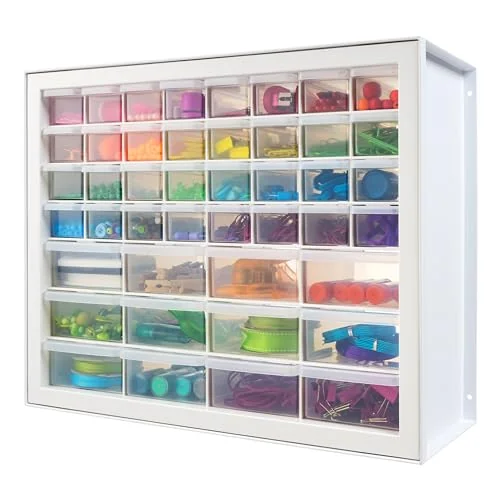
The IRIS USA 44 Drawer Small Parts Storage Cabinet is 7 inches deep, 19.5 wide and 15.5 high, which is shallow enough for a narrow shelf. Both the maker and the Amazon listing agree on that box. They disagree about the small drawer: one source gives 6 x 1.75 x 1.50 inches, the other 6 x 2.12 x 1.62. A tube of beads or a stamp that fits one will not fit the other, so measure a single drawer on the real unit before you count on anything fitting.
Stack it, set it on a desk or mount it
The cabinet has screw holes on the sides and grooves for stacking, so it can sit on a desk, stack with a second unit or go on a wall. And wall mounting is a lease question first. The listing gives the empty weight as 5.8 pounds, and a full cabinet weighs more, so check the wall and the mounting hardware against the filled weight and follow the maker’s instructions.
Buy a craft drawer organizer like this for beads, stamps, findings and hardware. Skip them for paper, and for anything longer than a drawer.
Paper Cases, Paint Storage and a No-Drill Pegboard
Scrapbook paper storage is a flat-goods problem: paper curls in the bottom of a tote, and paint tubes roll around in the same drawer as the scissors. Each of these three categories exists because a general bin gets one of them wrong.
Flat paper in cases sized to the sheet
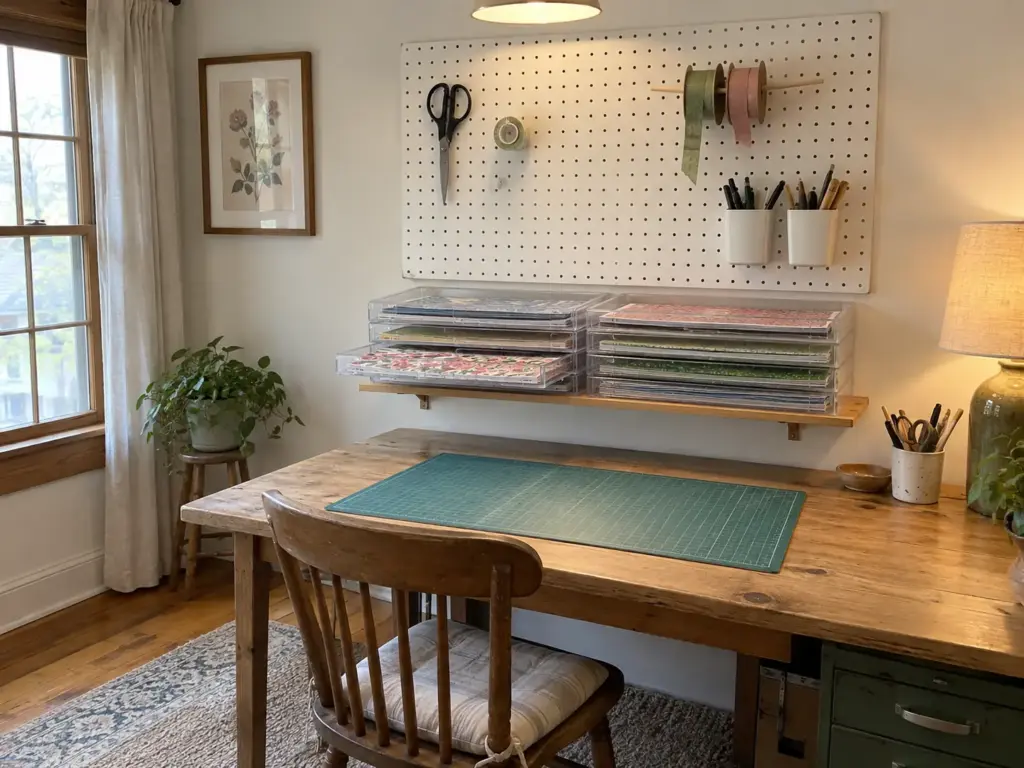
The IRIS USA Scrapbook Case, 12 x 12 inch (6-pack, clear) is a paper storage case cut for 12 x 12 sheets, and the clear shell shows the stock without opening anything. The outside size of the case is the number the listing does not give you here, so measure your shelf against the case, not the sheet (a case is always bigger than the paper in it). Paper stacks are heavy, so the shelf that holds them should be one of the sturdy ones from the weight check at the start.
Buy cases for flat 12 x 12 paper. Skip a general bin for it.
Paint: pick the container, not the brand
Paint storage comes in four shapes: a paint spinner, a palette box, airtight pots and pegboard clips for tubes. The decision rule is the number of colors and how often they come out.
A rack earns its footprint with a large collection and costs you a shelf for a handful of tubes. A paint palette box suits colors you mix and finish within a session. Airtight pots protect paint you decanted and will not touch for a while. No specific paint organizer is recommended here, because the container type decides the outcome more than the label on it.
Paint is also heavy once you own enough of it, which brings the shelf back into the decision.
Hang the tools you grab mid-project at elbow height beside your working hand, and leave empty holes between them. A crowded pegboard turns every grab into a search, and a board with gaps shows you at a glance what is missing.
A no-drill pegboard for the tools you use every session
For a rental or a wall you want to leave alone, the Just Hanging Pegboard Wall Mounting Hardware is Command-strip compatible, so the board hangs without a drill. The trade-off is weight. Pegboard hooks and a pen cup hold the light daily tools, such as scissors, tape and a spool of ribbon, and anything heavy goes on a shelf. Our guide to vertical storage ideas covers the no-drill wall approach in more depth.
Rolling Carts Move the Stash to the Table and Back
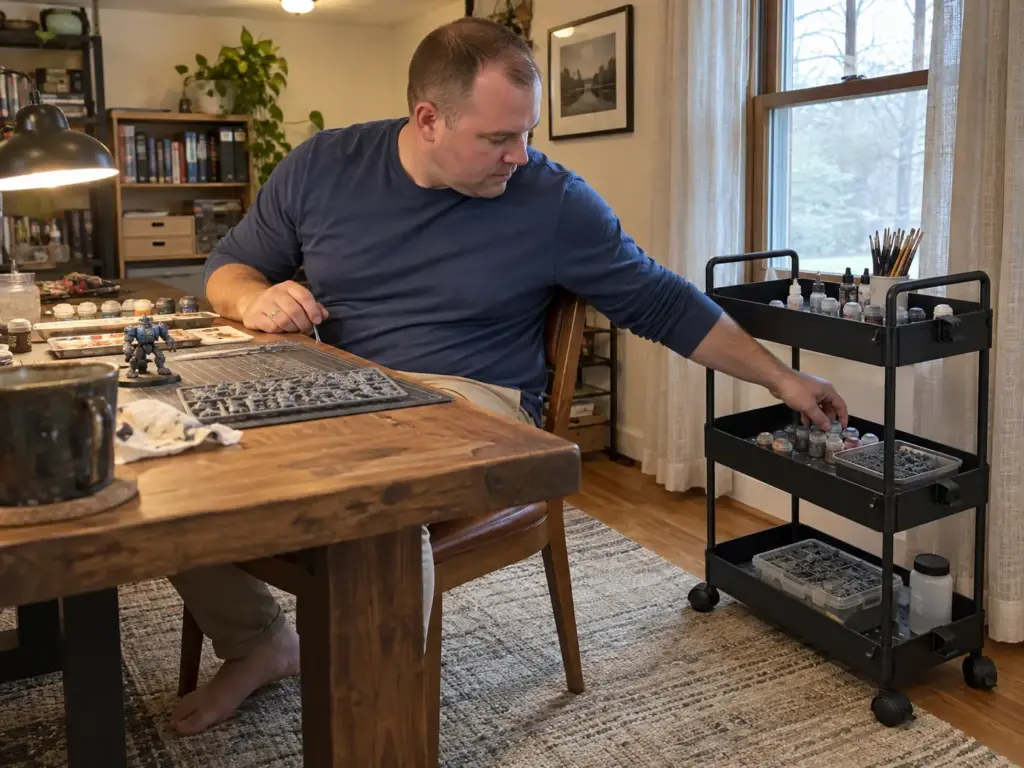
One r/crafts commenter (Burntjellytoast) used the dining table for art until the household “would just throw other stuff on the table and it would get ruined.” If your table has to turn back into a table every evening, the stash needs somewhere to go in a few minutes, and a rolling craft cart is the answer to a table that is not yours alone.
The full-size cart with cases and the slim cart beside the chair
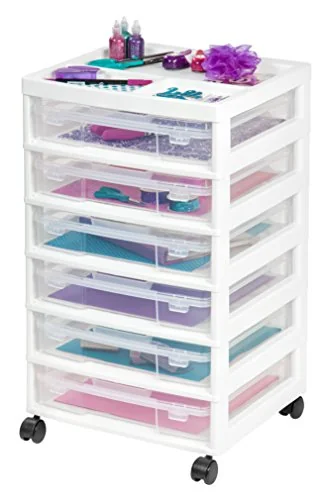
The IRIS USA Rolling Cart with 6 Cases, White is 15.88 inches long, 14.25 wide and 26.44 high. Each of the six cases is 14.12 inches deep, 14.25 wide and 3 high, which is roomy enough for 12 x 12 sheets. The listing gives a capacity of 35 pounds for the full unit.
The full-size cart is the obvious pick. But it is the wrong one when the only open spot is a gap beside a chair. In that gap, the Ronlap 3-Tier Slim Rolling Storage Cart is the one that works: a three-tier rolling cart listed at 25.96 x 15.75 x 8.66 inches, only 8.66 deep. You give up the case count, and you gain a cart that parks where the big one cannot.
The shared table and the cart that clears it
On a dining room table that other people use, speed is the feature. The stash goes onto the cart, the cart goes to its parking spot, and the table is a table again. The method for clearing the shared table is in our small-space guide. The cart’s job here is the buying side of it: pick the one whose size lets that happen without a fight.
What to check on the floor
Three things on the floor decide whether a cart gets used. The aisle has to be wide enough to roll it. A door threshold or a rug edge on the route will stop it. And it needs a spot to park when the table is in use, otherwise it sits in the walkway and becomes the thing everybody steps around.
Buy a cart if the work moves between a table and a closet. Skip it if the work stays in one spot.
Budget Versus Boutique Craft Storage Without a Price Tag
The r/crafts poster who started the thread wanted a closing craft cabinet and could not spend that much. The thread explained the trade, and it is one worth understanding if you are weighing the same choice.
What the modular cabinet class buys
The boutique class is the modular craft cabinet with doors and a work surface. They hold a lot, they close up to look tidy, and the table is built in. What you pay for is the gap: the price of a cabinet like that is the reason the original poster was asking in the first place. It is the right call only if the doors and the table are what the room needs.
What the cheaper bookcase with bins loses
One commenter (Burntjellytoast) described the cheaper cabinets that turn up in a search: “they don’t have the table though. But they look like they hold a lot.” The cheaper route, a bookcase with bins, loses the work surface, and it loses strength too. The weight check from the start of this guide applies, since cheap shelves bend under paper and paint over time.
Secondhand dressers and lingerie chests
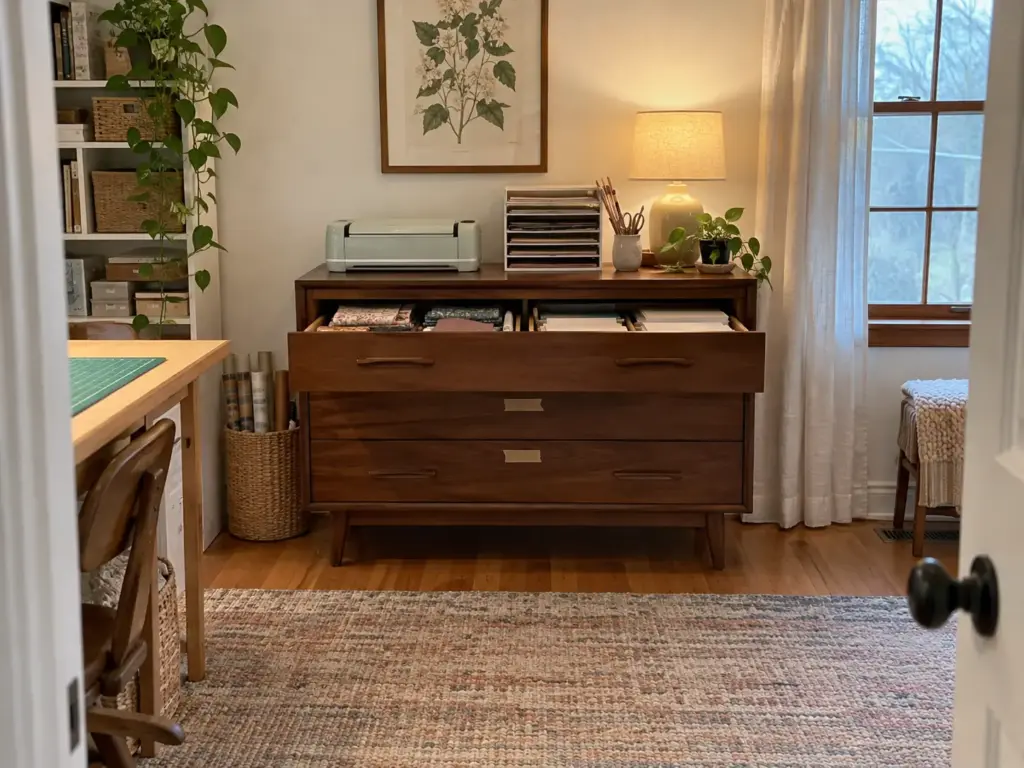
The route that beats both for some stashes is a dresser from a secondhand store. “Maybe buy a used dresser or two (or lingerie chests). Drawers are always convenient,” wrote one commenter (crafthappy4747), who added that “you can get some good quality ones pretty cheap at the Restore or thrift stores.” The top of a dresser doubles as a work spot: another commenter (JasperLily98) keeps drawers sorted by craft type so that a cutting machine “can sit on top and be accessible.”
Repurposed containers for the small stuff
Budget craft storage does not have to come from a store aisle. Repurposed storage covers the tea caddy storage that holds spools and buttons, mason jars for beads and brushes, and apothecary jars when you want the contents on show. Thrifted storage like this costs almost nothing, as long as the lid shuts and the container is the size of the thing in it.
Buy the boutique class only if the doors and the table are what the room needs. If cost is already the sticking point, the dresser route solves more than a cheaper cabinet does.
Measure First, Match Closed Storage to How Often You Reach In
Three ideas carry the whole guide. Measure the spot before you choose the product, because the listing only knows its own size. Match closed storage to how often you reach in, since doors trade visibility for tidiness and the stash you open weekly should not sit behind one. And let a cart or a drawer unit earn its place by the small things or the moving table it solves, not by how complete it looks in the listing.
When a season has passed, walk the room and note two things: which container nobody has lifted a lid on, and whether any shelf has begun to sag in the middle. Those two answers tell you whether the system held.
Today, take a tape measure to the one spot that annoys you most, write the four numbers on the back of an envelope, and hold them up against anything already in your shopping cart. Notice how many items fail the check.
Frequently Asked Questions
01What is the best craft organizer?
The best craft organizer is the one that fits your measured spot and keeps what you use weekly in sight. Clear lidded bins suit fabric, shallow drawers suit small parts, and a rolling cart suits work that moves.
02What is the best storage for crafting?
The best storage for crafting depends on what you store: clear bins for bulky stash, drawer units for beads and stamps, flat cases for paper. Pick by supply first, then check the size against your shelf.
03What is the best closet organizer for a craft room?
A freestanding cube unit or clear lidded bins on a measured shelf work best in a craft room closet, with the heaviest supplies low. Measure shelf depth, the gap above and the door opening first, since those three decide what fits.
04Is closed or open storage better for craft supplies?
Open storage is better for supplies you use every session, and closed storage suits a shared room and stash you touch a few times a season. One r/crafts commenter found that cube storage hid everything, so it went unused.
05What can I use instead of a craft cabinet if money is tight?
A used dresser or two is the budget route, since drawers suit small things and the top can hold a machine within reach. Thrift stores often carry good ones cheaply; check that the drawers slide and the top is level.
Disclaimer: ClutterlessNest is a participant in the Amazon Services LLC Associates Program. As an Amazon Associate we earn from qualifying purchases. This article may contain affiliate links — if you buy through them, we may earn a small commission at no extra cost to you. We only recommend products we have tested or genuinely believe in.