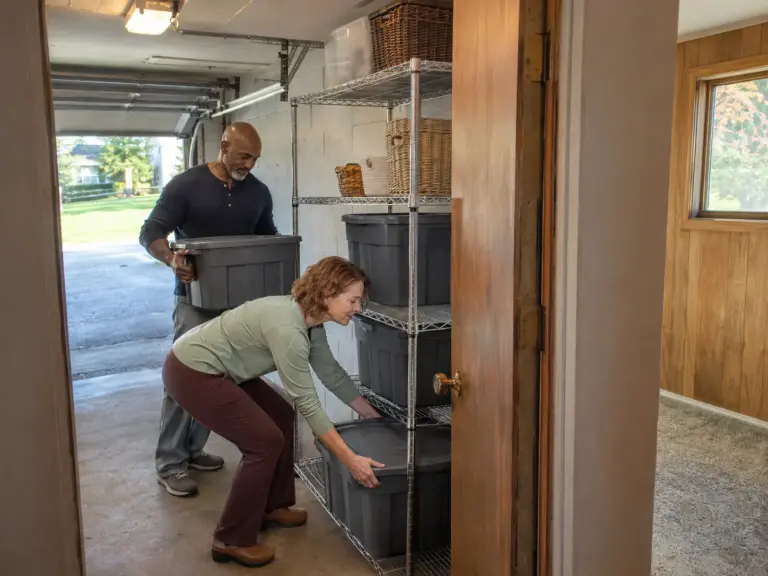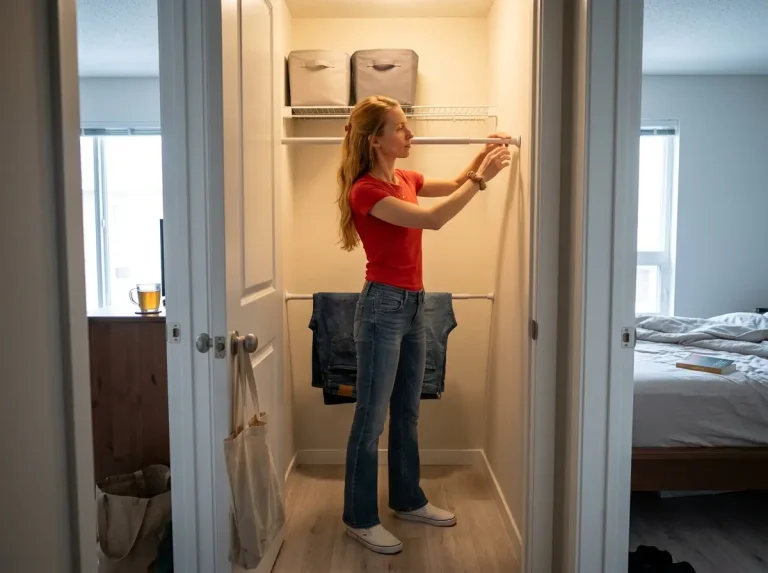
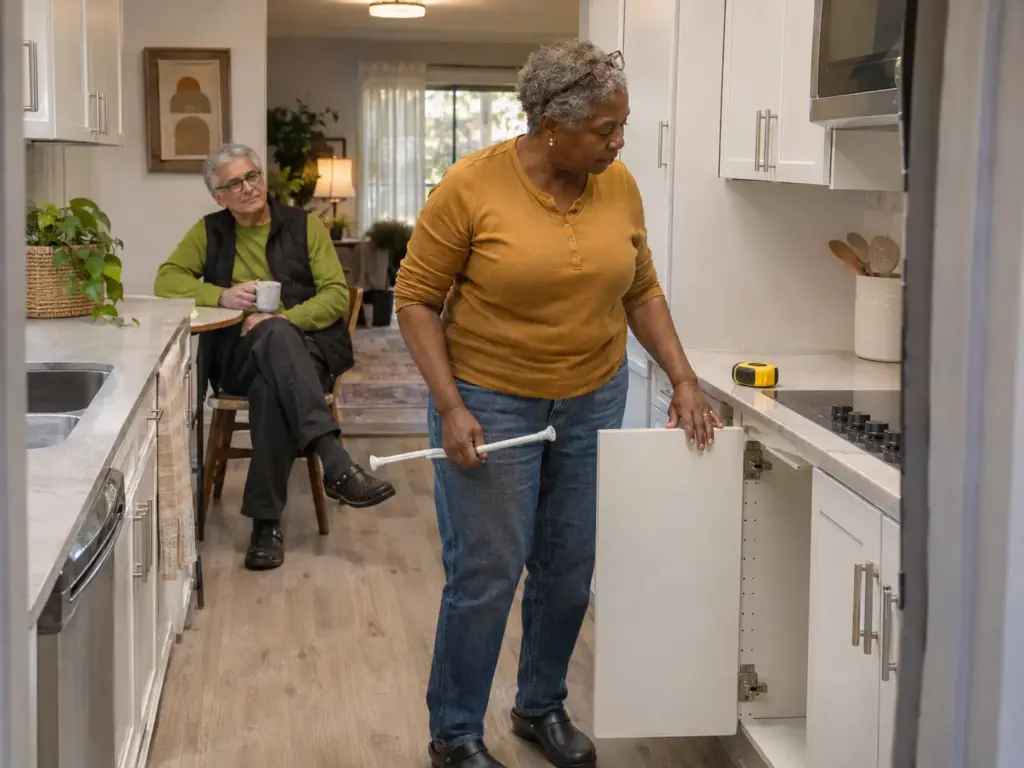
The rod that held your scarves for years lets go on one humid afternoon with nothing added to it, or the one you hung a tote from slides to the floor the first time it carries more than a bundle of silk. Good tension rod storage rarely fails because the idea was bad: the span, the load or the spot was wrong, and each placement has a check that tells you which before anything falls. A rod is a bar with two ends pressing on something, so it carries what hangs by a loop, holds back what stands behind it and hides what a curtain covers, and it does none of that past the edge of its span. Here the uses are sorted by the gap you measure and the thing that hangs there: the span first, then small rods, rolls, curtains, and what has to stay out of a child’s reach.
Quick Answer
A rod stays up when the gap, the load and the spot agree, so work through them in this order.
- Measure the gap at the height where the rod will sit, at both ends.
- Pick the rod by that span, never by the room it goes in.
- Hang only light things from a short rod and stand rolls behind it.
- Keep anything poisonous locked away and out of a child’s reach.
- Recheck the grip each time the season changes, humid spots first.
Tension Rod Storage Starts With the Span You Measure
Rods get bought by the room: one for the kitchen, one for the closet, a couple for the bathroom. The gap doesn’t know which room it’s in. It is a width at one particular height, and a rod that suits the room but not that width is the one that ends up on the floor.
The Three Spans a Rod Has to Cover
Nearly every placement in this guide falls into one of three gaps. A narrow gap inside a cabinet or closet niche takes a small spring tension rod, like the KXLife pair in the next section, which spans 7.5 to 11.5 in. A wide alcove between two walls takes a wide curtain rod, and the ALLZONE covers 83 to 123 in. An open corner with no second wall takes a floor-to-ceiling post, and the Umbra Anywhere adjusts 7 to 10 ft tall with a rod 35 to 66 in wide.
Each gap gets its own section below, because the span picks the rod, the load picks the placement and the reach picks what may hang there.
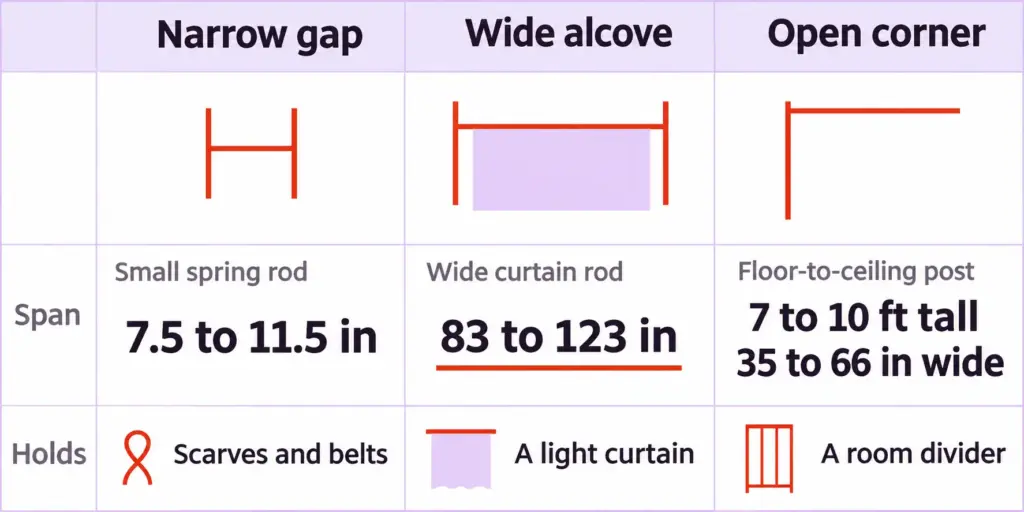
The back of a closet is the one spot this guide skips on purpose, since a second hanging rod at the back of the closet and the part of its range where it grips best already have a full write-up. Whatever gap you’re covering, a figure close to either end of a rod’s range is a warning sign, and the piece on why a rod slips near the end of its stretch names the surfaces where it happens first.
Measure at the Height Where the Rod Will Sit
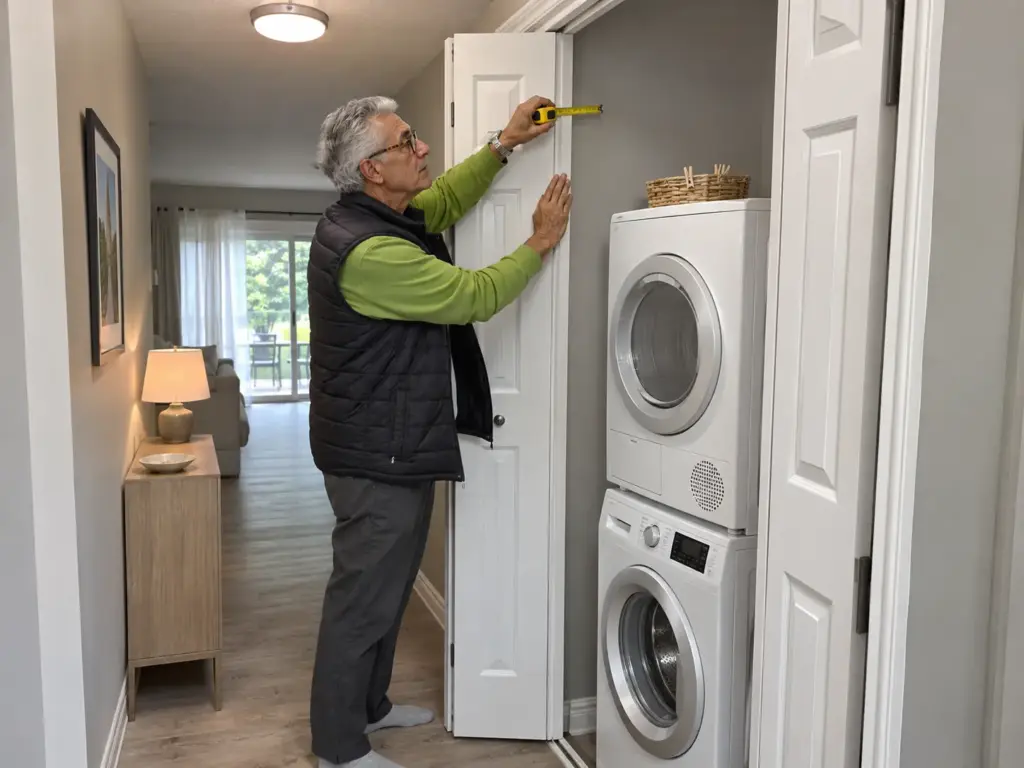
Take the measurement at the exact height the rod will sit, at both ends, and write down the smaller figure. Walls drift, cabinet sides bow and door frames bulge, so a gap that reads one number at the floor can read another at shoulder height. The faces matter as much as the width: pressure on two firm faces is the only thing holding a rod up, and a flexing panel or a loose cabinet side gives the spring nothing to push against.
The method for any placement skips the general rule. Hold the item you want to hang against the gap and mark where it ends. That mark decides how much clearance the item needs above and below the rod, and it is more reliable than any chart, this one included.
A fit that looks perfect still isn’t permanent. A rod that stayed put for years can drop on one humid summer day with no change in load, which is why the recheck routine at the end of this guide exists.
When You Can Drill, the Answer Changes
Pressure is the renter-friendly answer, and it suits anyone who would rather keep the wall whole. An owner, or anyone allowed to drill, has a better option for real weight: a heavy-duty closet rod set into studs with anchors and a center support. A rental may need the landlord’s approval first, with the deposit at stake, and that is the one place where drilling beats pressure. Screws set under each end of a spring rod will also stop it sliding, but only on walls you’re allowed to mark.
If what you want is a shelf rather than a bar, shelves built on two rods have a guide of their own, weight classes included. And before a rod takes a full load of clothes, the test that tells you whether it will hold is laid out in the piece on how to load-test a closet rod before you trust it.
Small Rods Hold Scarves, Belts and Ribbon Spools
The drawer where scarves, belts and rolls of tape tangle every morning is a narrow-gap job that puts dead space to work, and it is the most budget-friendly one in this guide.
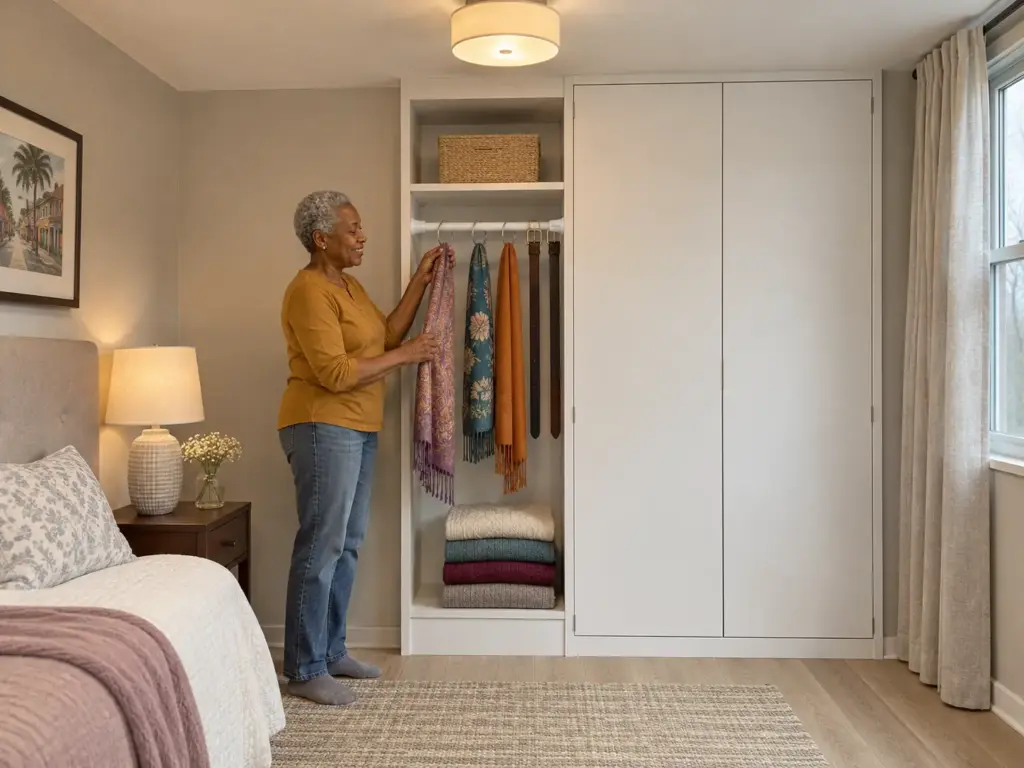
Scarves and Belts on Shower Curtain Rings
The free version comes first: a wooden dowel cut to fit the gap needs no spring, so it has nothing to slide. For anyone without a saw, the KXLife Small Spring Tension Curtain Rod comes as a 2-pack and spans 7.5 to 11.5 in, enough for a hanging row on one shelf and a second rod for spools. It has to be set until it resists, because a spring rod left even slightly loose is the one that slides down.
Put shower curtain rings or S-hooks on the rod and one shelf becomes a hanging row. The rings slide, so a single scarf comes off without dragging the others behind it, and a belt hangs by its buckle without curling into the drawer’s back corner. At closet scale the same move becomes a rod under the closet shelf for scarves and belts, worked out for a whole wardrobe.
Ribbon and Tape Spools on a Short Rod
Spools of ribbon, craft tape and packing tape thread onto the same short rod, and each one pulls off with a single hand. Position matters more than the rod itself: put it at the front of the gap where a hand reaches without moving anything, because a spool you have to dig for goes straight back into the drawer.
Load the spools and rings onto the rod first, then set it in the gap. Working around a rod that is already tight pushes on the spring and can walk it out of place.
Why Bags Are a Different Job
A loaded tote on a short spring rod is the too-weak-for-the-weight case, because the weight limit of a rod this small sits far below what a packed bag weighs. Hanging handbags from a small rod looks efficient and fails the first time one carries real contents, so the rod is for scarves and belts. A bag belongs on hooks rated for a loaded bag or on a closet rod.
The check for this section takes ten seconds. Press down gently on the middle of the rod with the load on it. If it creeps, either the span sits at the edge of its range or the load is too heavy for a rod this size.
Gift Wrap Rolls Stand Upright Behind a Rod
Gift wrap storage usually means flat under a bed, and the paper gets crushed before the holidays. A rod turns a spare cupboard corner into the place where rolls stand up, and almost nobody gives that its own spot.
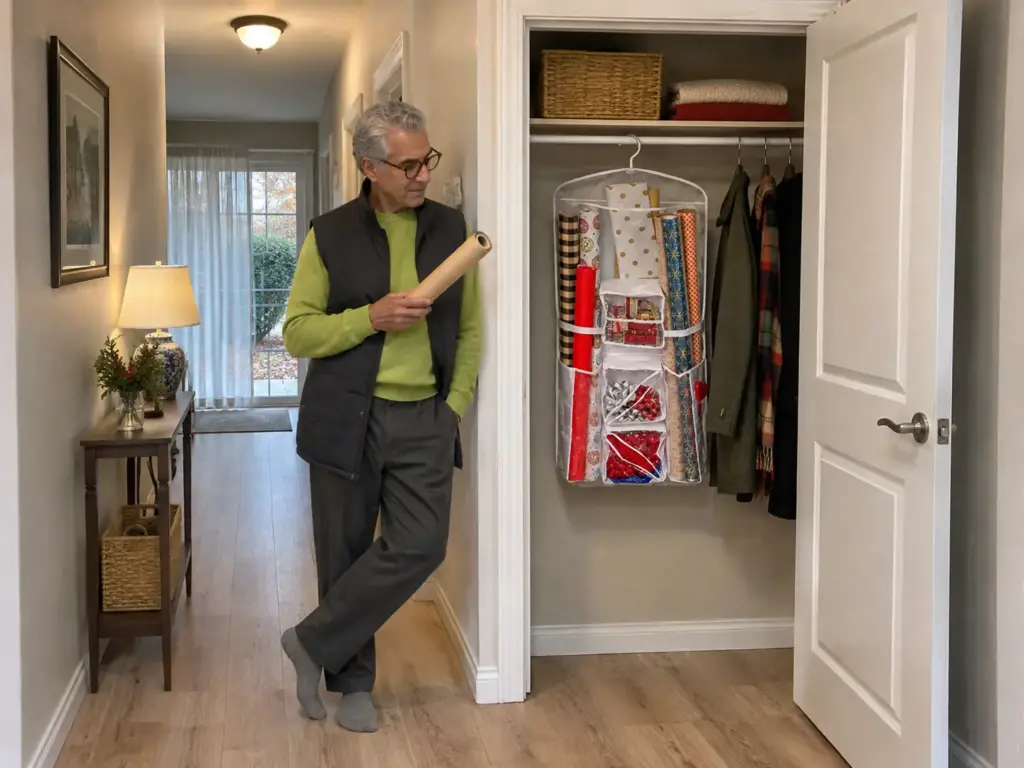
Gift Wrap in a Tall Cupboard or Closet Corner
Rolls of wrapping paper stand on end in a tall cupboard or a small closet, and a rod across the front keeps them from leaning. That is vertical storage for the price of one rod, and you see every roll and pull one out without unloading the rest. S-hooks on the same rod carry light gift bags. The free version is a tall, narrow bin on the floor of the same cupboard; the rod earns its place when floor space is gone.
Measure by standing the longest roll on its end and marking its top. The rod goes just below that mark, high enough to hold the rolls upright and low enough to reach. More roll and spool ideas for a bigger space are collected in a guide to storing rolls, beads and paper in a craft room.
Paper Towels and a Dish Cloth Above the Sink
Above a kitchen sink, a short rod holds a pair of paper towel rolls and a dish cloth within one reach of the tap. This is also the placement where steam and splashes test the grip, so it gets rechecked first. For the cabinet next door, a second tier at the back of a spice cabinet is built from the same short rod.
When a Holder Beats a Rod
The rod is the obvious pick for rolls, and it stops being the right one the moment there is no pair of firm faces at the right height. A cupboard with a wide open front, a closet with a slatted side or a wall too far from the next one gives the spring nothing to press on. There, a holder wins.
The Jokari Universal Rotating Gift Wrap Organizer hangs from a closet rod or the back of a door by its own hook and holds rolls in rotating slots. It hangs, it doesn’t press, so it needs no firm faces at all. Its limit is the hook: with no closet rod or door edge to hang from, it has nowhere to go.
A Curtain on a Rod Hides What Shelves Cannot
A utility corner or a litter box stays in view when nothing fits around it. Shelves need a tidy corner to look right. A curtain never does, so it turns a messy corner into a cupboard faster than any shelf.
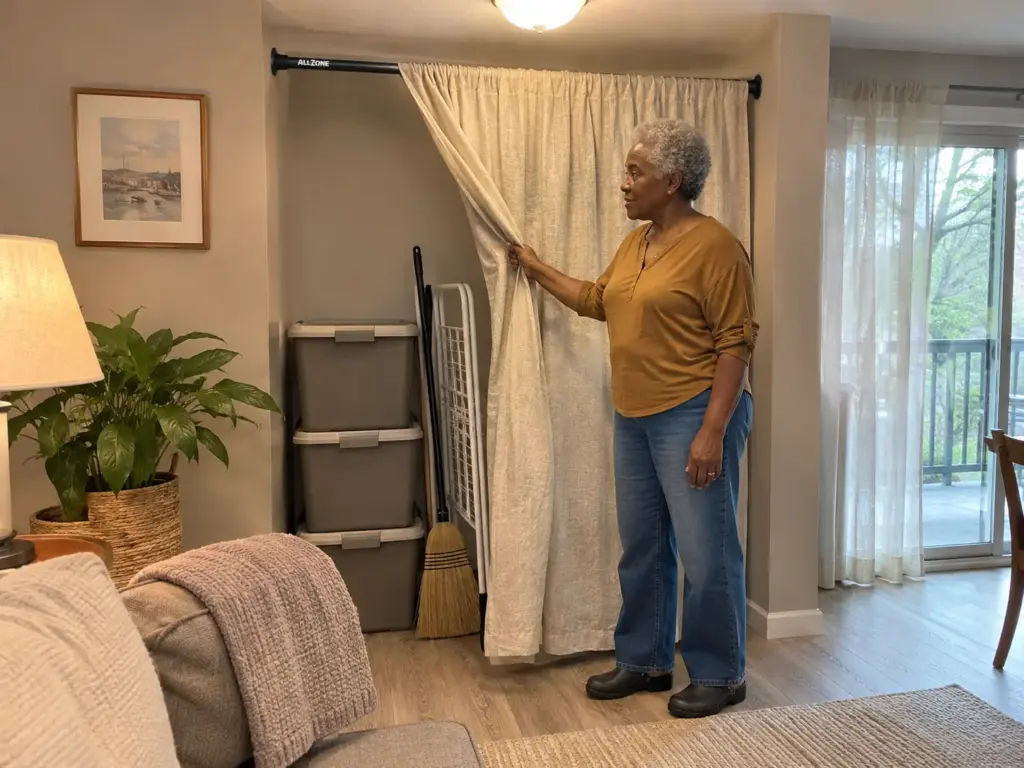
A Wide Alcove Takes a Wide Curtain Rod
A laundry room nook, a pet corner or a storage bay with no door has two firm walls, and that is the job for a wide rod. The ALLZONE Tension Curtain Rod spans 83 to 123 in and carries a light curtain. Measure at the height where the curtain should hang and pick the rod whose range puts your figure in the middle.
A rod used at either end of its stretch is a rod set up to slip, and the widest range on the shelf is not automatically the safest choice. A heavy fabric loads the center, and that is where a wide rod sags first.
A Corner With No Second Wall Needs a Floor-to-Ceiling Post
An open corner has one wall at most, and a rod needs two faces. The Umbra Anywhere Expandable Curtain Rod and Room Divider adjusts 7 to 10 ft tall with a rod 35 to 66 in wide, so a curtain on it closes off a corner and doubles as a divider.
It presses on the floor and the ceiling instead of two walls, and the same rule of two firm faces applies. That makes a flat, solid ceiling part of the purchase. A ceiling that flexes under a hand will not hold a post in place for long.
Keep the Curtain Light and the Hidden Thing Reachable
The curtain stays light. A litter box or a mop bucket behind it gets used daily, so the curtain has to part without untangling anything, and a heavy panel fights every pass.
Hang the curtain on rings that slide freely so a hand can part it from either side. A panel that has to be lifted aside gets left half open, and then the corner is in view again.
What Gives Way First, and What Must Stay Out of Reach
Picture a rod across the cabinet under the sink with spray bottles hanging from it by their triggers. It looks tidy, and the bottles hang right where a toddler’s hands arrive.
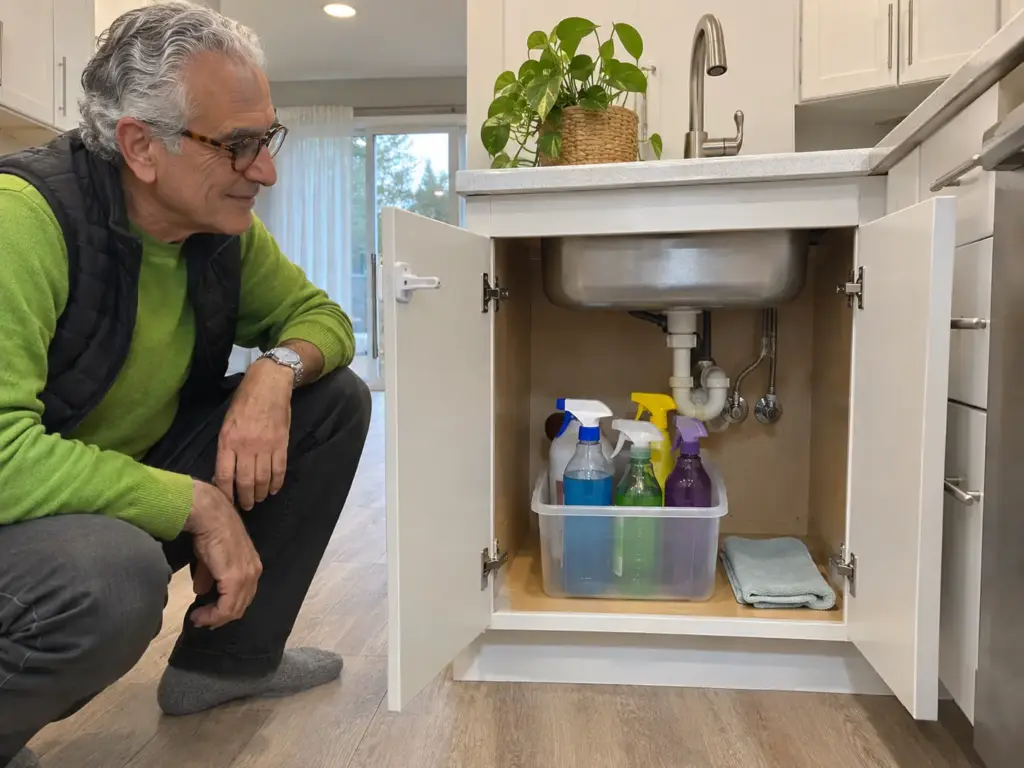
Under the Sink Is Eye Level for a Toddler
Spray bottles on a rod under the sink are a common idea, and with a child in the house they are the wrong one. Safe Kids Worldwide puts the problem plainly: “Young kids are often eye-level with items under the kitchen and bathroom sinks.” That line comes from Safe Kids Worldwide’s poisoning prevention tips, which also recommends child safety locks on any cabinet where poisonous items are stored, and says to keep cleaning products in their original containers.
That last point has a direct consequence here. Pouring a cleaner into an unlabeled bottle so it fits a rod is the move to skip, because a bottle without a label can be mistaken for something else. The free fix comes first: a lidded caddy on the floor of a locked cabinet, and the rod stays out of it. The lock itself is covered in the piece on locking the cabinet door when kids or pets are in the house.
Which Placements Give Way First
The order is predictable. Bathrooms and shower areas go first, because humidity works on the grip while the load stays the same, and a rod above the tub is a round of shower rod roulette. Loaded mugs and bags on short rods come next, since one heavy item can break a whole placement.
Wide curtain rods with heavy fabric come last. A load that was fine in the dry months can drop in humid ones.
For a cabinet under the kitchen sink, an under-sink layout that fits real pipes shows where a rod can actually span. For the humid room, bathroom storage a renter can leave behind covers what to do instead of leaning on a rod.
A Recheck That Fits the Season
When the season changes, give each rod a quick look. Twist it a little tighter, or take it down and set it back in the gap. For anything near water, look at it first.
Press a hand on the rod near each end after tightening. A rod that turns or creeps under that light push is not gripping, and it won’t grip better with a load on it.
Measure One Gap Today, Then Check It When the Season Turns
A rod holds when the gap was measured at its height, the range fits the figure and the load stays light: scarves, belts and spools on the short ones, rolls standing behind a rod or hanging from a holder, a light curtain on the wide ones. Bags go on hooks, real weight goes on a drilled rod, and anything poisonous stays locked away in its own container.
The check for later is short. When the weather turns, put a hand on each rod and press gently, humid spots over the tub and beside the sink first, and give any rod that creeps a twist tighter or a fresh start in the gap.
Today’s move is small. Take a tape measure to one gap in your home, at the height where a rod would sit, and write the smaller figure on a scrap of paper. Then notice how many of your scarves, spools or curtain panels are the right width for it. That count tells you whether the gap needs a rod at all.
Frequently Asked Questions
01How do you use a tension rod for storage?
Measure the gap where the rod will sit, pick a rod whose range fits that figure, and hang light things from it with rings or hooks. Small rods hold scarves, belts and spools, and wide ones carry a light curtain. Keep heavy loads for a drilled closet rod.
02Can a tension rod hold heavy things?
Not reliably, because a spring rod suits light items that hang by a loop, such as scarves and belts, and it drops under loaded bags or coats. For real weight, screw a closet rod into studs with anchors and a center support.
03How do you keep a tension rod from falling down?
Measure at the exact height, choose a rod whose range puts that figure in the middle, and twist it until it resists firmly. Recheck it when the season changes, humid spots first. Where drilling is allowed, screws under each end stop it sliding.
04Do tension rods damage walls or paint?
A tension rod needs no holes or screws, so it leaves no damage in the wall. Where it fails is grip, since smooth or damp surfaces let it slide, as the no-drill storage guide explains.
05Is it safe to hang cleaning sprays on a tension rod?
Not where a child can reach them, since Safe Kids Worldwide notes that young kids are often eye-level with items under the sinks. Keep cleaners in their original containers inside a locked cabinet, as the guide to cleaning supplies under the sink explains.
Disclaimer: ClutterlessNest is a participant in the Amazon Services LLC Associates Program. As an Amazon Associate we earn from qualifying purchases. This article may contain affiliate links — if you buy through them, we may earn a small commission at no extra cost to you. We only recommend products we have tested or genuinely believe in.