

It is the first evening in a room you did not choose: the bed already sits where the aisle should be, the desk drawer sticks halfway out, and a stranger’s closed boxes are stacked on the far side while nothing you own has a spot yet. Dorm room organization starts from that fact, because the room itself is the constraint, a contract-bound space with a second person in it, much like the order of work in a studio apartment where one room does everything. This plan comes from what the housing pages of Central Michigan, Western Kentucky, College of Saint Benedict and RIT actually say, not from a product list, and it leaves room trends alone, since those change every August while the three-month test does not. Rules and measuring come first, then the bed, closet, desk, cart, fridge, laundry and the roommate split, and the reset that outlasts the first month, the same logic that organizing any small apartment rests on.
Quick Answer
Work through the room in this order and it still holds after the first month:
- Read your hall’s adhesive rule and measure before you buy anything.
- Use the space under the bed, but only what clears the rail.
- Choose over-the-door storage and slim hangers over anything stuck to the wall.
- Give the desk drawer fixed compartments, and add a cart only if it has a parking spot.
- Check what the room already has, then split the fridge, laundry and list with your roommate.
- Label every drawer and reset on a fixed day.
Dorm Room Organization Starts With Your Housing Rules and a Tape Measure
Picture a pack of adhesive strips, bought in August and still sealed in the move-in box, and a handbook page you open in September that names them as the one thing you may not put on the wall. That sequence costs a return trip at best and a damage charge at worst. The housing page decides what you may stick, screw or hang, and three measurements decide what you may buy, so both come before the first piece of dorm room storage goes in a cart. Most dorm storage fails on size and rules, not on looks.
Read the adhesive rule before you buy a hook
Schools answer the adhesive question so differently that no general rule survives the trip between campuses. According to Central Michigan University’s residence life policy on adhesive strips, “Regular (non-removable) adhesive strips are not allowed on any surface.” Only removable strips pass at Central Michigan, screws, push pins, nails and glue are all out, and a strip that damages a surface leads to a charge. In a room like that, no drill and no nails is the whole menu, and even a no nails shelf counts as an adhesive item, which is the same logic behind no-drill closet organization that won’t cost your deposit.
Why the same school can give two answers
Western Kentucky shows how far a single campus can split. In its drywall halls, Western Kentucky University’s adhesives agreement for residence halls bans adhesive material of any kind, Command strips and painter’s tape included, while in its concrete halls the same page allows painter’s tape, regular tape and Command-type strips, with a possible damage charge if they are used wrong. Nails, screws and staples are out in both, and adhesive LED strips are banned in every hall, whatever wall sits behind them.
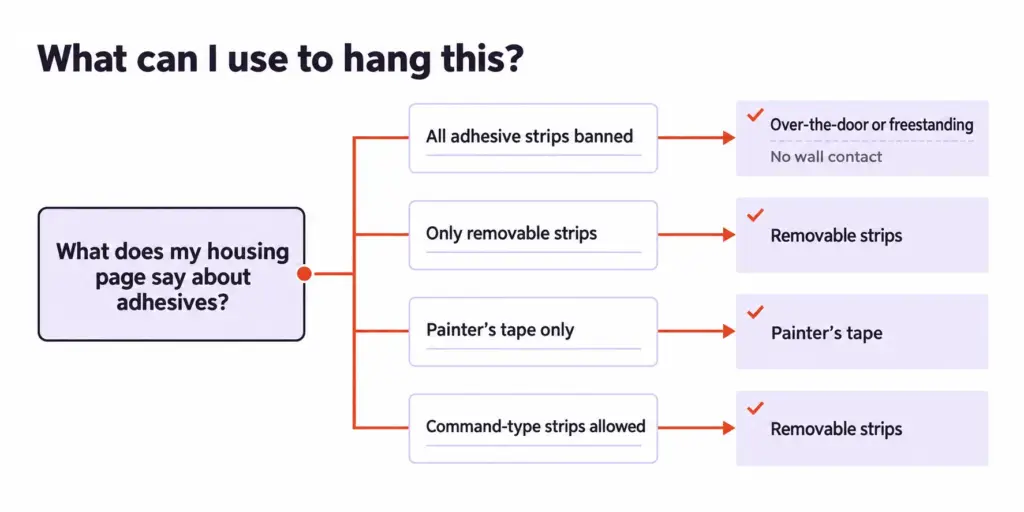
College of Saint Benedict adds another variation: its move-in tips call Command strips damaging to the walls and not allowed, and name blue painter’s tape as the way to hang things. That makes three schools and four answers to one question, so the takeaway is the contrast, not any single rule. Open your own housing page (or the portal page that covers your hall) before you buy anything that sticks, and do not borrow a rule from a friend’s campus.
Photograph every wall, the inside of the wardrobe and the desk drawer on move-in day, then log existing marks on the check-in room inspection. Both Western Kentucky and College of Saint Benedict point to that inspection, and a dated record is the cheapest protection a student account gets.
The three measurements that decide the shopping list
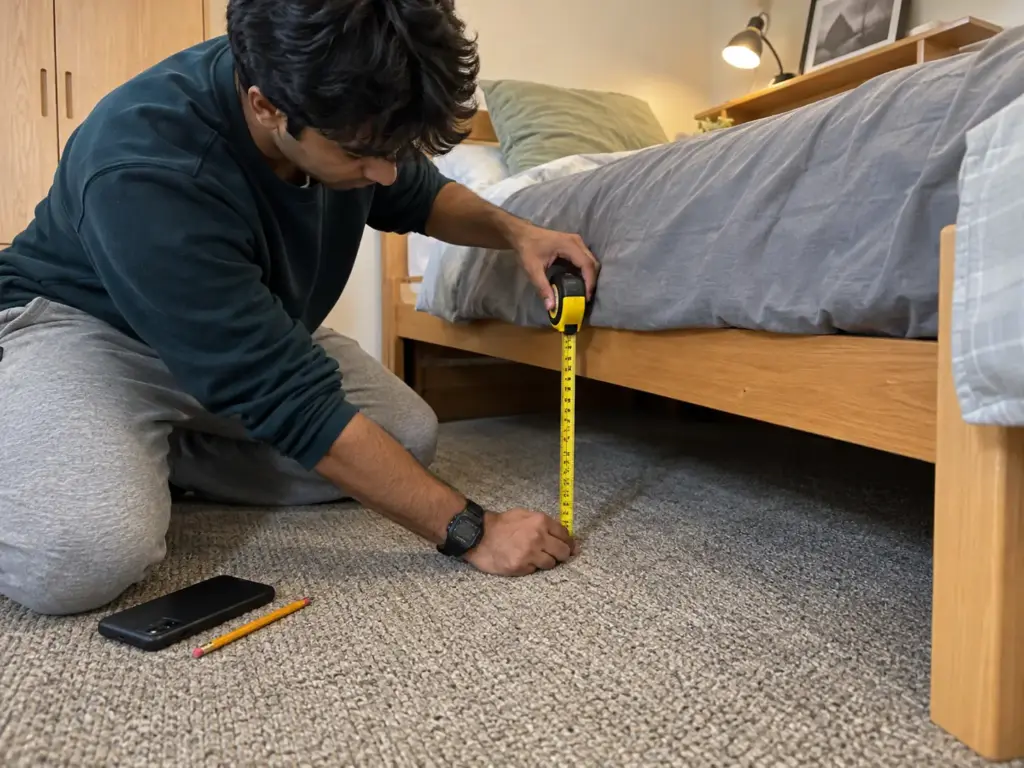
Rules settle what you may attach; measurements settle what fits. Take three, and measure the room before you measure any product: the clearance under the bed, measured from the floor to the lowest part of the side rail; the shelf depth and closet rod height against how far a hook or hanger sticks out; and the width of the desk drawer against the range an organizer claims to cover. Keep them in one note on your phone (the one place a student and a parent can both read them) before any listing gets a click.
Frame height is the trap.
A retailer’s listing for an 18 in Twin-XL metal frame gives an assembled height of 16 in, and that figure is not your clearance, because what limits a box is the lowest edge of the side rail, not the number on the listing. Measure to the rail, subtract the height of the box and its lid, and treat what is left as slack. If your room has a Twin XL bed, the rail height still varies from frame to frame, so the tape settles it. A bin that clears by a hair on paper will not slide out once the rail edge catches its lid.
Then check what the room already includes. RIT says its rooms come furnished with a bed, desk, chair and dresser, and that every RIT room has a micro-fridge, so at that school the shopping is organizers, not furniture. Your school’s room list may say something different, and it is worth reading before a single order ships.
Use the Space Under the Bed Without Losing Your Clearance
The bin that looked perfect on the listing and sits two fingers too tall for the rail is the most predictable dorm purchase there is, and it happens because the order of operations is backwards. Clearance comes first, the box second. A lid adds height the listing’s inside number never shows, so a box that fits only without its lid is a box that will not slide in. Everything else about under-bed storage is a question of what is flat enough to live down there.
Measure to the rail, not to the frame’s top
Run the tape from the floor to the lowest edge of the side rail, then take away the height of the box plus the lid. What remains is your slack, and you want some, because carpet and a rug edge steal height that no listing mentions. If the slack comes out negative, a different box will not help; a riser might. The wider system, including how to keep things findable down there, is covered in setting up under-bed storage that stays organized.
What a riser adds, and what the school may cap
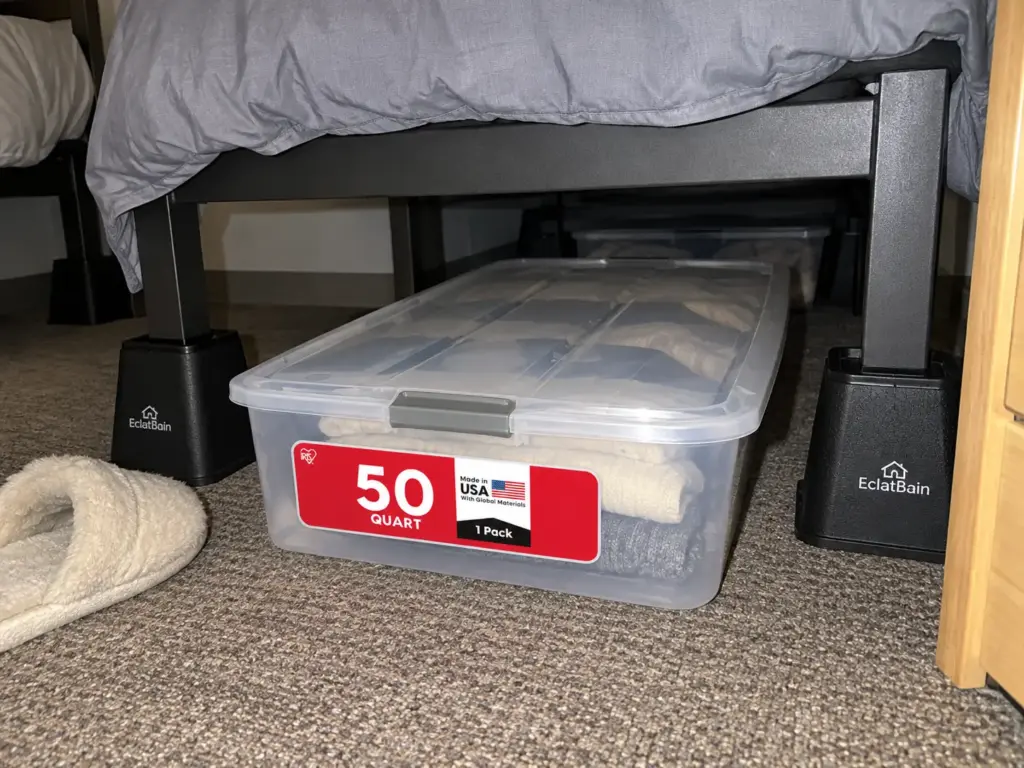
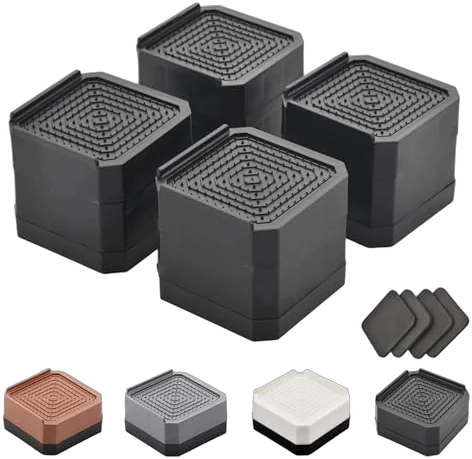
EclatBain bed risers lift a frame without tools or drilling, and the listing says the two-layer stack adds about 3 inches while the three-layer stack adds about 4.3 inches. Whether you may use them at all depends on the school. Central Michigan permits risers, and its own beds can sit in ten positions, with the top one leaving 30 inches underneath. Read that as one school’s adjustable bed, not a target to chase; a reader whose bed does not adjust should look for a bed risers line on the housing page before the package ships.
Two roommates, one decision: raise one bed and the room reads lopsided while the walkway shrinks, so raise both or leave both low.
Flat boxes, soft bags and what belongs under there at all
Free first: a couple of shoeboxes hold out-of-season socks and spare chargers, and a laundry bag, packing cubes or space bags do the soft version for a spare comforter. Spend only once that pile outgrows them. The space under a bed suits what is flat and used less than weekly (sweaters, a second set of sheets, shoes), and anything you reach for daily should live where you do not have to kneel. If you are still deciding between a flat lidded box and a rolling one, rolling versus flat boxes under a low frame works through that call.
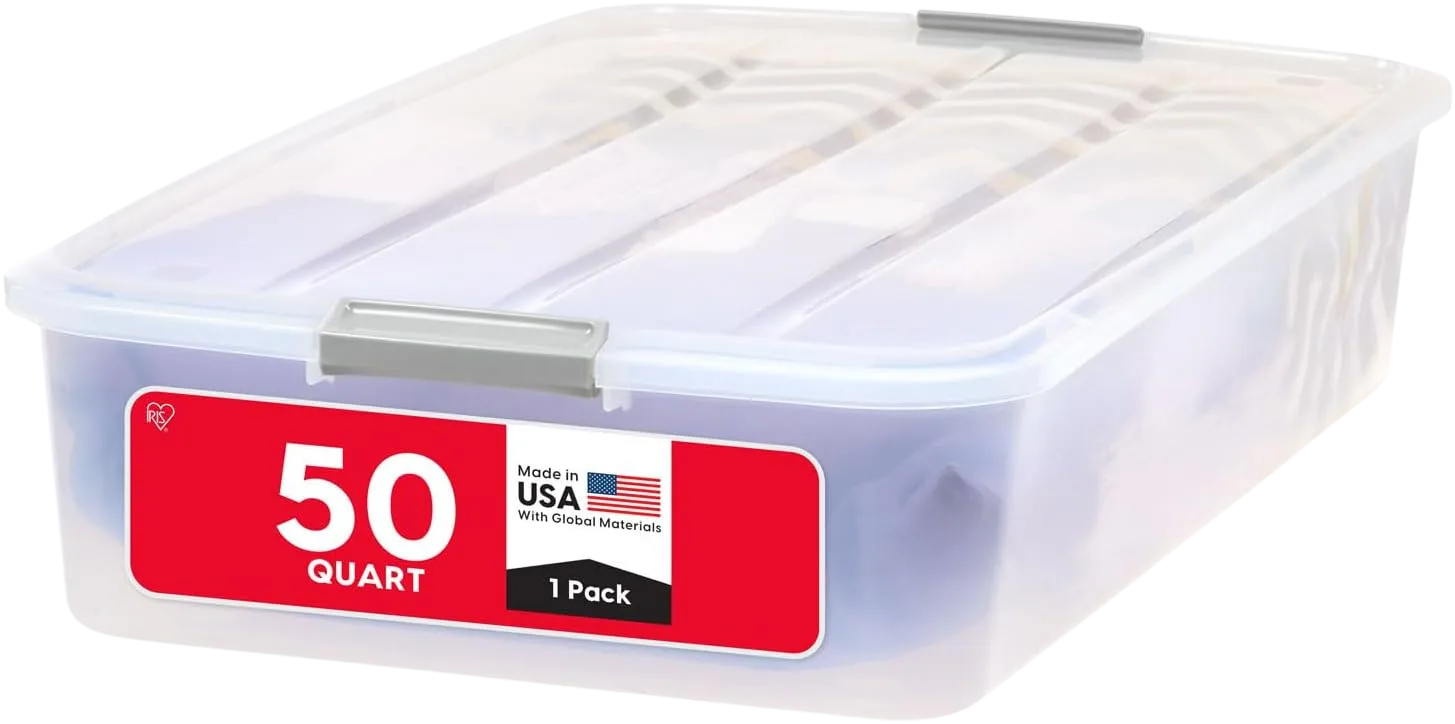
When a lidded box is worth it, the IRIS USA 50 qt long under-bed bin with lids is a clear option for flat items. Its flaw is the one that makes the measuring lesson: the real size can come in smaller than the listing claims, and some boxes will not fit under a low frame at all. So measure your clearance, then measure the bin again the day it arrives and slide it under before you fill it.
Get More Out of a Dorm Closet Without Sticking Anything to the Wall
A dorm wardrobe has to hold the same coats, jeans and towels as a house closet in a much narrower box, and the wall beside it is the one surface the handbook has probably ruled out. That pushes the extra capacity onto two places that need no permission: the back of the door and the rod itself.
Why over-the-door beats a wall hook in a rule-bound room
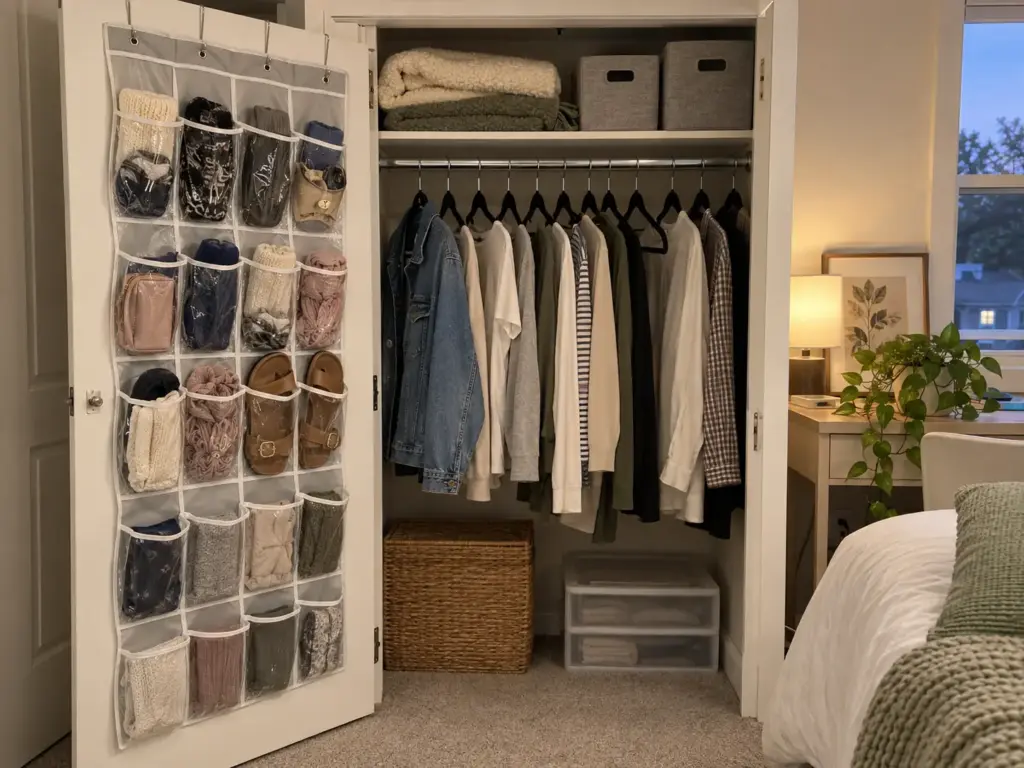
An over the door organizer touches no wall and uses no adhesive, so it passes at every school covered above, which a pack of strips cannot say. The adhesive hook is the usual answer for a bare wall, and in Western Kentucky’s drywall halls it is exactly what the agreement bans. The SimpleHouseware 24-pocket over-the-door shoe organizer measures 64 x 19 in and hangs on metal hooks, which suits shoes, rolled socks, chargers and bath supplies in pockets you can see through, and any hanging organizer on the door spares the dead space beside the bed.
Its flaw, per buyers, is that the holes along the top are too small for Command hooks, so use the metal hooks over the door’s edge and drop the adhesive idea entirely. And check a thick door before ordering, since a hook that cannot clear the edge will not hang flat.
For the next step up, closet organizers for apartment renters covers products that stay inside the same no-drill limits.
Slim hangers and the rod you already have
Rod width is the real limit in a shared wardrobe, and bulky hangers eat it. The hangers you already own come first, one type only, and the row tightens by itself. The closet rod is the one thing in the wardrobe you cannot extend, so the purchase is for clothes that slide off, which is where Zober velvet hangers, 50 pack come in, among the slim velvet hangers sold for exactly this. Black fiber dust can come off the hangers out of the box, and the velvet makes garments a little harder to hang, so wipe them before they go in the wardrobe and hang a few at a time.
One more thing the rod needs before any shelf does: agree out loud which half is whose. The roommate split gets its own section below.
Keep the Desk and the Drawer Usable All Semester
The drawer holds a stapler, a charger and a month of receipts in one pile by October, and the desk top follows within a week. Sorting the drawer first gives the desk top somewhere to send its overflow.
Fix what lives in the drawer before the desk top
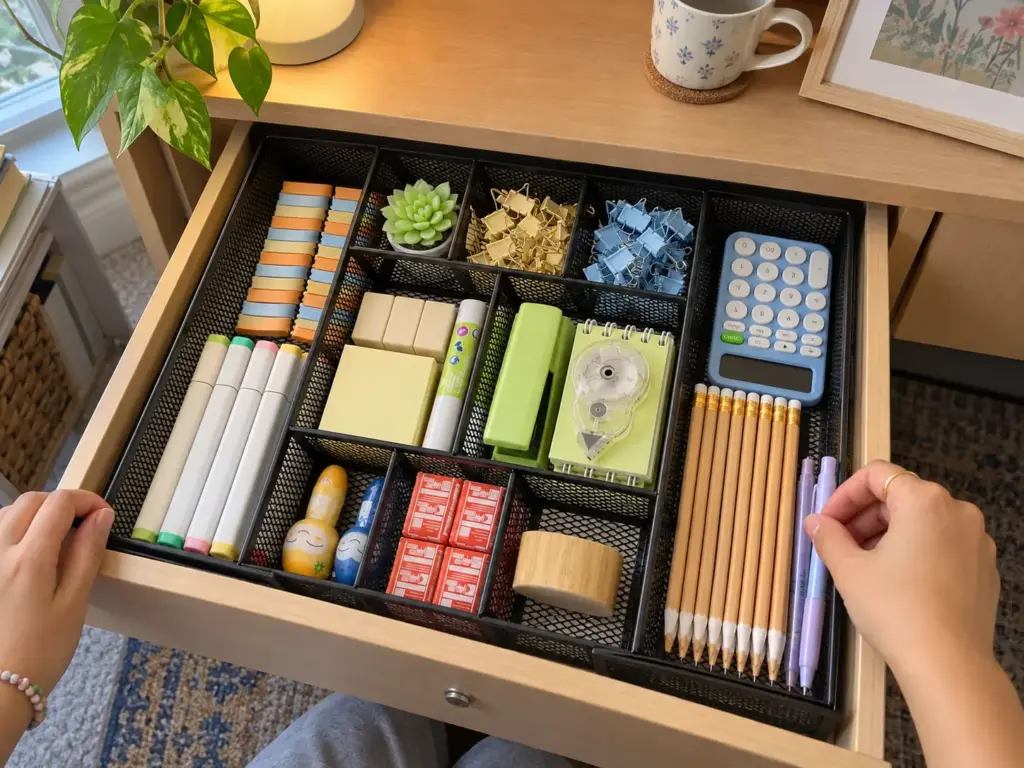
Size the organizer to the drawer you measured earlier, not to the number on a listing. A shoebox lid and two mugs do the same job for a month, and the pile tells you what compartments you need. Buy only if it survives that month.
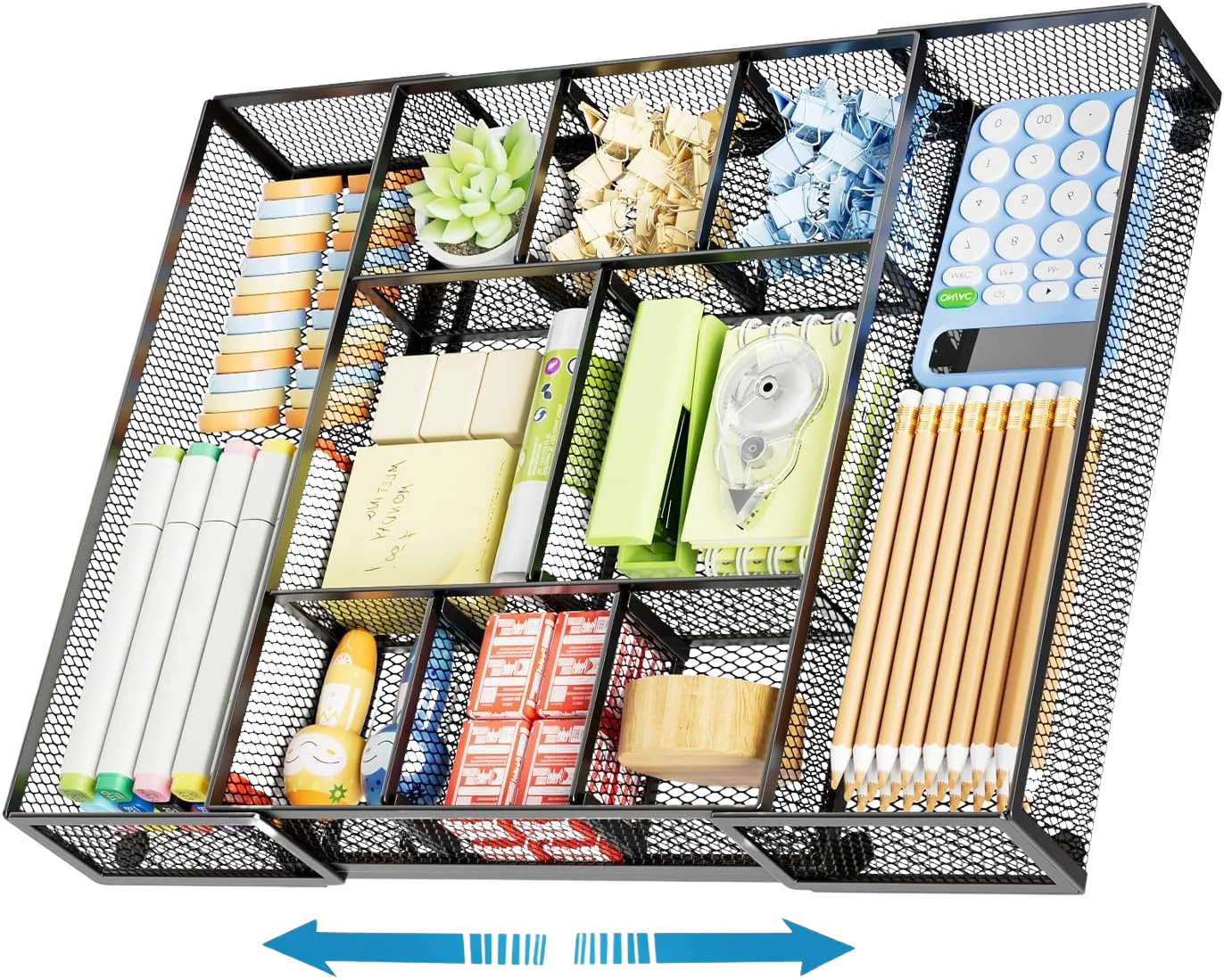
If you buy, the Marbrasse expandable mesh drawer organizer has ten adjustable compartments and expands to the drawer’s width with no screws.
It is the obvious pick, and it is not the right one for every drawer: Amazon’s own summary says buyers find the side extensions unstable, so it holds best in a drawer already close to its width. In a much wider drawer, a fixed insert, drawer dividers or the shoebox lid stays put better. A dorm desk organizer that fits the drawer does most of the work. For the full system, see desk organization that stays neat past the first week.
What belongs under the desk without screws
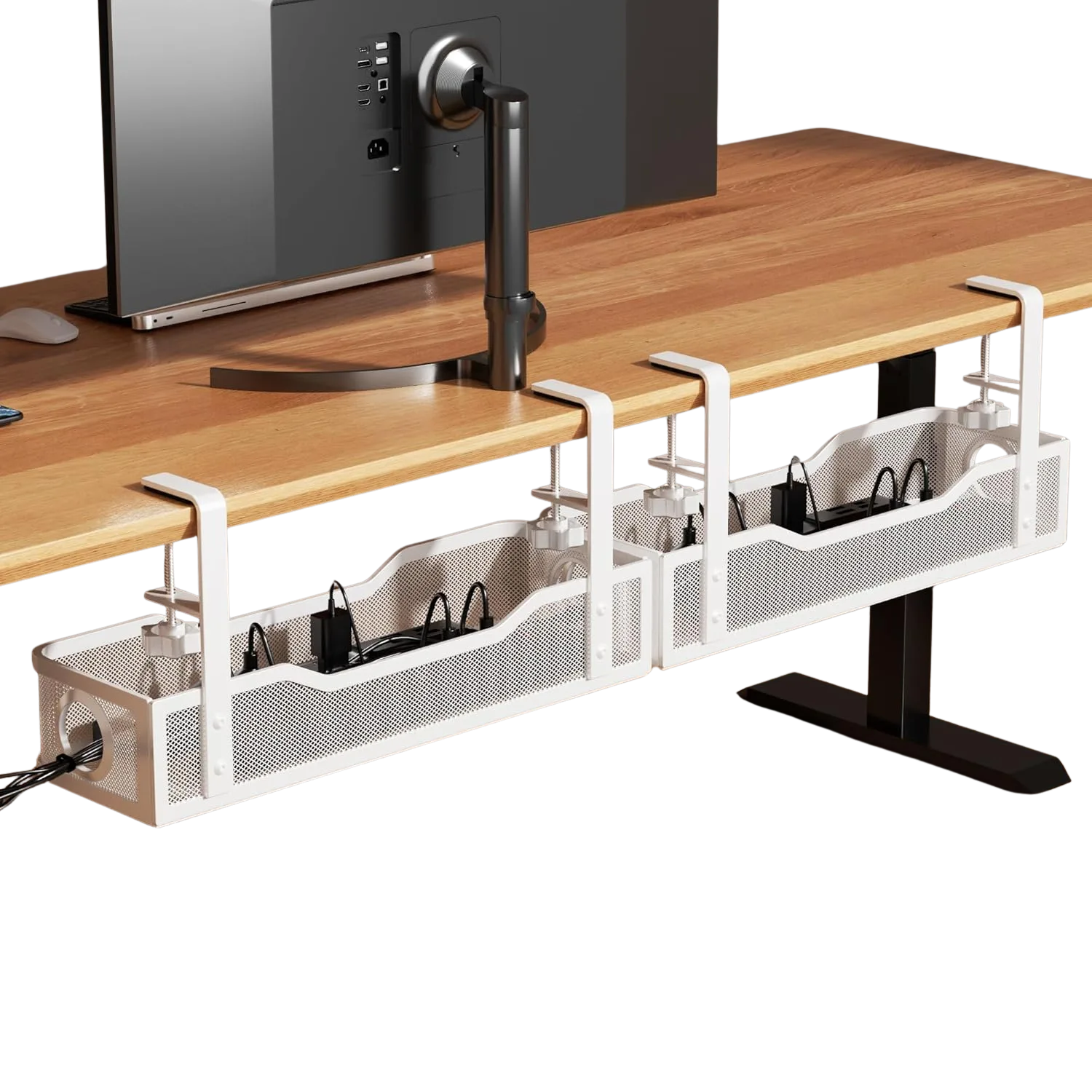
The space under the desk is its own problem in any study zone. Under desk storage that sits on the floor collects what has no home, such as the power strip, the chargers’ bundle, a box of cables. The Cinati 16 in under-desk tray (a two-pack) clamps onto the desk edge, no screws, and keeps the power strip and the chargers’ bundle off the floor.
Amazon’s summary says others find it flimsy and unstable, so keep it for light items. Cable management stays at that one line here; it is a shelf for things, not a wiring project. If your room has no built-in desk at all, compact desks for small rooms is the place to start.
Add a Rolling Cart Only If It Has a Parking Spot
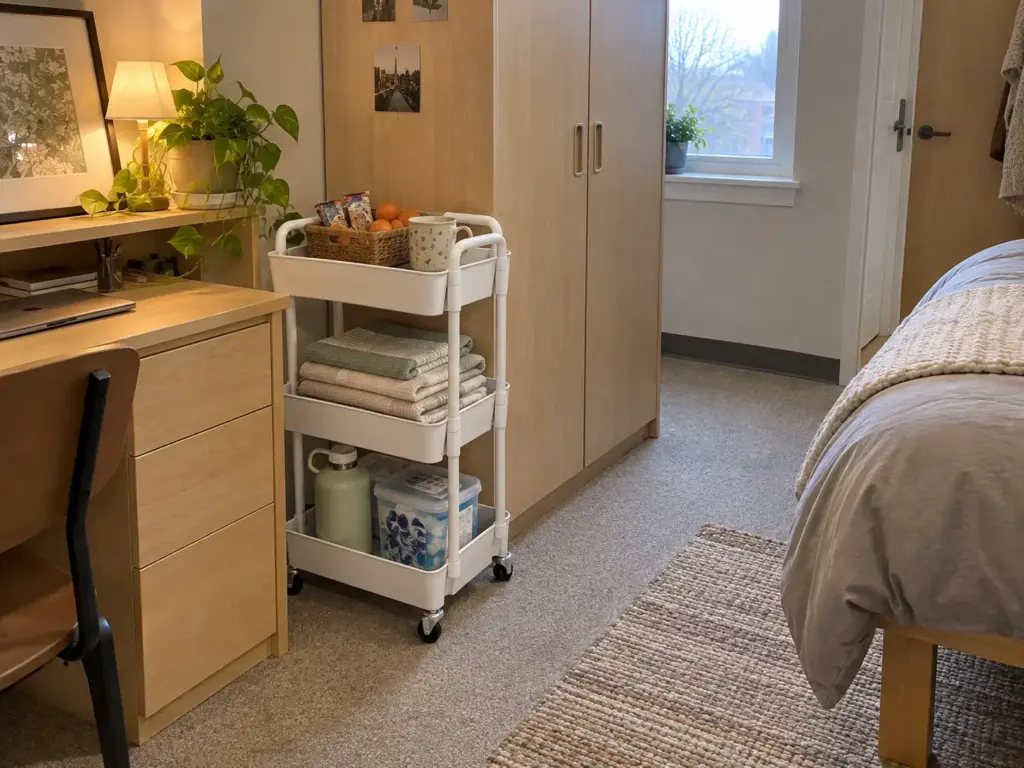
The cart that ends up in the middle of the walkway never had a home to begin with. A rolling cart is a storage cart that works as a flexible zone for snacks, towels or school supplies, but in a shared room it only works if someone decided where it lives before it was unpacked.
Pick the parking spot before the cart
Choose the spot first, and agree on it with your roommate, since the aisle belongs to both of you. The best spots are narrow gaps that have no other use: beside the desk, between the desk and the wardrobe. When the floor is already full, go up instead, and vertical storage for when the floor has no room left lays out how.
Test the parking spot by parking a laundry basket there for a day, then walking from the bed to the door with the room lights off. If you or your roommate bump it, the spot is wrong, and no cart will fix that.
What a three-tier plastic cart does badly
The Sywhitta 3-tier plastic rolling utility cart is a low-commitment version of the idea, and it comes with a flaw buyers repeat: it wobbles, and the casters do not seat as tightly as they should. Keep the heavy things (a water jug, a box of laundry pods) on the bottom tier and the light things on top, and do not treat it as a stable shelf. The free alternative is a closed bin on the floor beside the desk, which does the same job with no wheels. And wheels in a shared aisle carry a trip risk after dark, which is one more reason the parking spot matters more than the cart.
Check What the Room Already Has Before You Buy a Mini Fridge
Two fridges and one outlet strip in a single room on the day you move in is the purchase pattern this section exists to prevent. The mini fridge is often the first big buy a student makes, and it is the one a room list can cancel in two minutes.

Look at the room list and the size cap first
RIT’s list of things not to bring to college says every RIT dorm room already comes with a micro-fridge unit, a microwave, fridge and freezer combined, along with a furnished bed, desk, chair and dresser. That is one school’s facts, so check yours.
Size caps are school-specific too: Central Michigan limits refrigerators to 4.3 cubic feet, and that number is Central Michigan’s, not a figure to carry to another campus. The same goes for the microwave: College of Saint Benedict’s “this, not that” list rules out an in-room microwave and points to the lounge microwave. Use these as examples of what a housing page can say, not as rules.
Where the snack station goes when there is no fridge
A snack station is a shelf or a bin by the desk, not a second appliance. If the room has a fridge or a lounge microwave, you are organizing the dry goods, and a closed bin on the desk shelf handles that. If another fridge shows up on move-in day, it is probably your roommate’s, which leads straight into the next section.
Split the Laundry, the Caddy and the Shopping List With Your Roommate
Two of every appliance in one room is how a double turns into a storage unit. The cheapest organizing tool in a shared room is a message sent before move-in.
Message your roommate before you buy anything shared
According to RIT’s advice on duplicates with your roommate, “You don’t need two coffee makers, two rugs, or two sets of cleaning supplies.”
RIT’s answer is to reach out before move-in, and a shared list is the quickest way to do it. Split it by category, not by fairness: one person brings the shared rug, the other the shared mini storage, and whoever brings an item keeps it when you move out. A shared dorm checklist in one note makes that split visible. That rule is my own reasoning rather than a school policy, but it ends most arguments before they begin.
Laundry sorting that survives a long walk to the machines
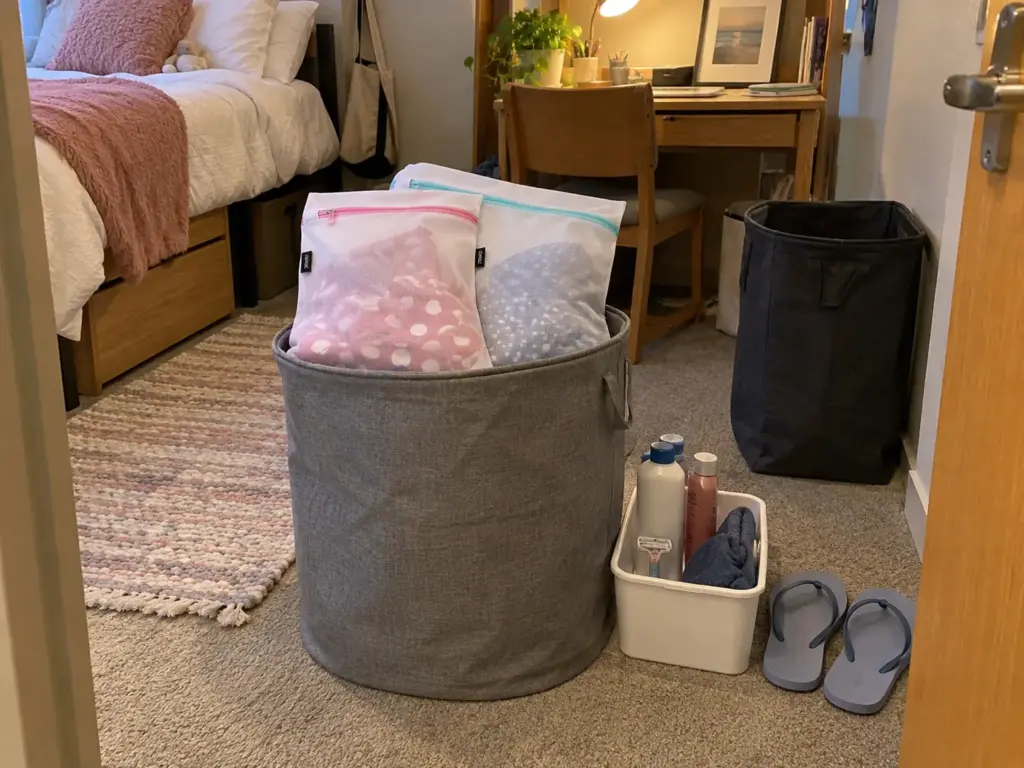
When the machines are down a corridor and the hamper stays in the room, sorting before you carry saves a second trip. Mesh bags let you separate delicates from everything else and carry them in one go.
The BAGAIL mesh laundry wash bags (set of 5) fit that role, with one flaw reviewers raise: they are not durable and tend to run and fall apart. Use them for delicates and not for everything. A shower caddy or bathroom caddy is personal and the cleaning supplies are shared, and a laundry hamper can stay a single shared item.
Whose is it at move-out
Settle ownership at the start so nobody argues in May. The closet halves from earlier carry over here: whose rod, whose shelf, whose cubes. Splitting a shared closet gives the full system if your wardrobe is the contested spot.
Why Dorm Systems Fail by Week Three and the Reset That Survives
The room that looked finished on day two and carries the same drawer pile by day twenty-one rarely failed from carelessness. It failed for structural reasons you can see coming, and each has a short answer.
The three ways a dorm system reverts
This is my reading of why dorm setups slide, and it is reasoning, not a study. First, things have no fixed home. A charger that lives wherever the last person dropped it will turn up somewhere new each week, and in a shared room there are two people dropping things. Give each item that moves a lot one named spot, and tell your roommate where it is.
Second, drawers get filled before they are labeled. By the time a label arrives, the contents have already decided what the drawer is for, and the label describes a hope. Label the empty drawer first, then fill it.
Third, the other person’s habits shift the room. A roommate with a different system drifts into your half through the aisle, the cart and the shared shelf. Boundaries said once, in words, hold better than boundaries guessed at.
A reset that fits in one evening
Pick one evening a week and keep it fixed, because a reset that waits for free time never reaches the calendar of someone with classes. Give each zone five minutes: bed and under-bed, wardrobe and door, desk and drawer, cart, the floor by the door. Bring one bag for whatever leaves the room, whether trash, recycling or laundry.
Set the evening with your roommate, not just for yourself, because their evening is part of your room too. The zone thinking behind this is the same as in creating zones that hold in a studio apartment, only scaled to a double. Summer storage and the move out itself are their own project, and one sentence is all they get here.
Put the reset evening in both phones’ calendars with the same alarm. A shared appointment feels like routine; a reminder from one roommate to the other feels like a complaint.
Labels, cubes and a fixed day
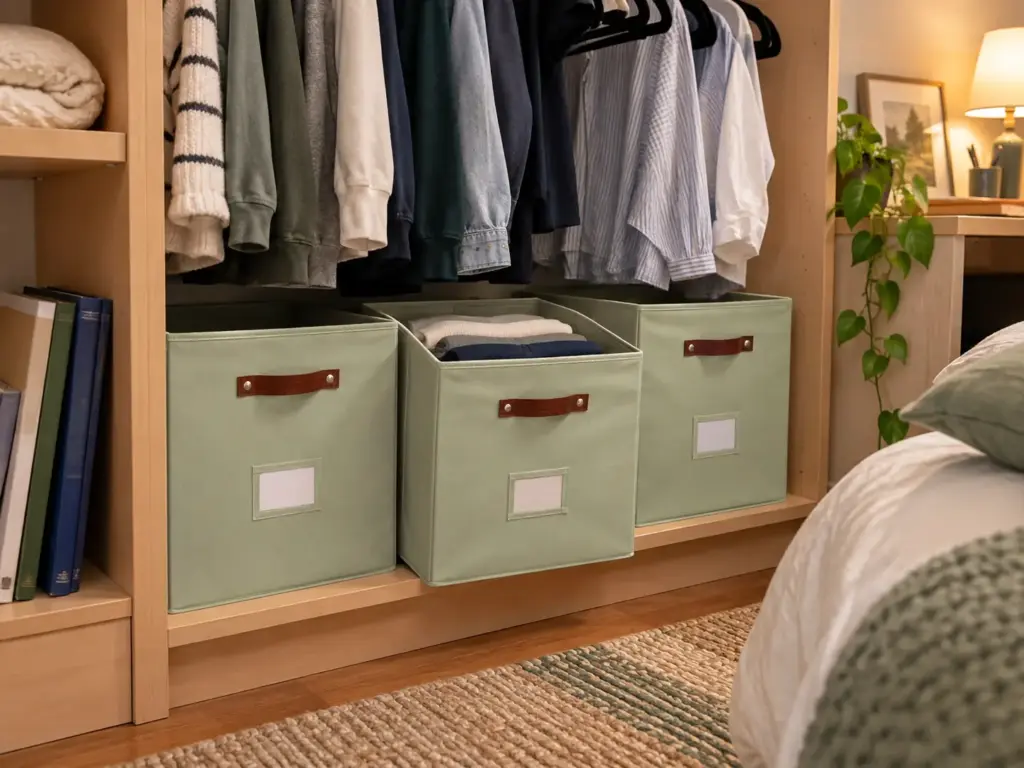
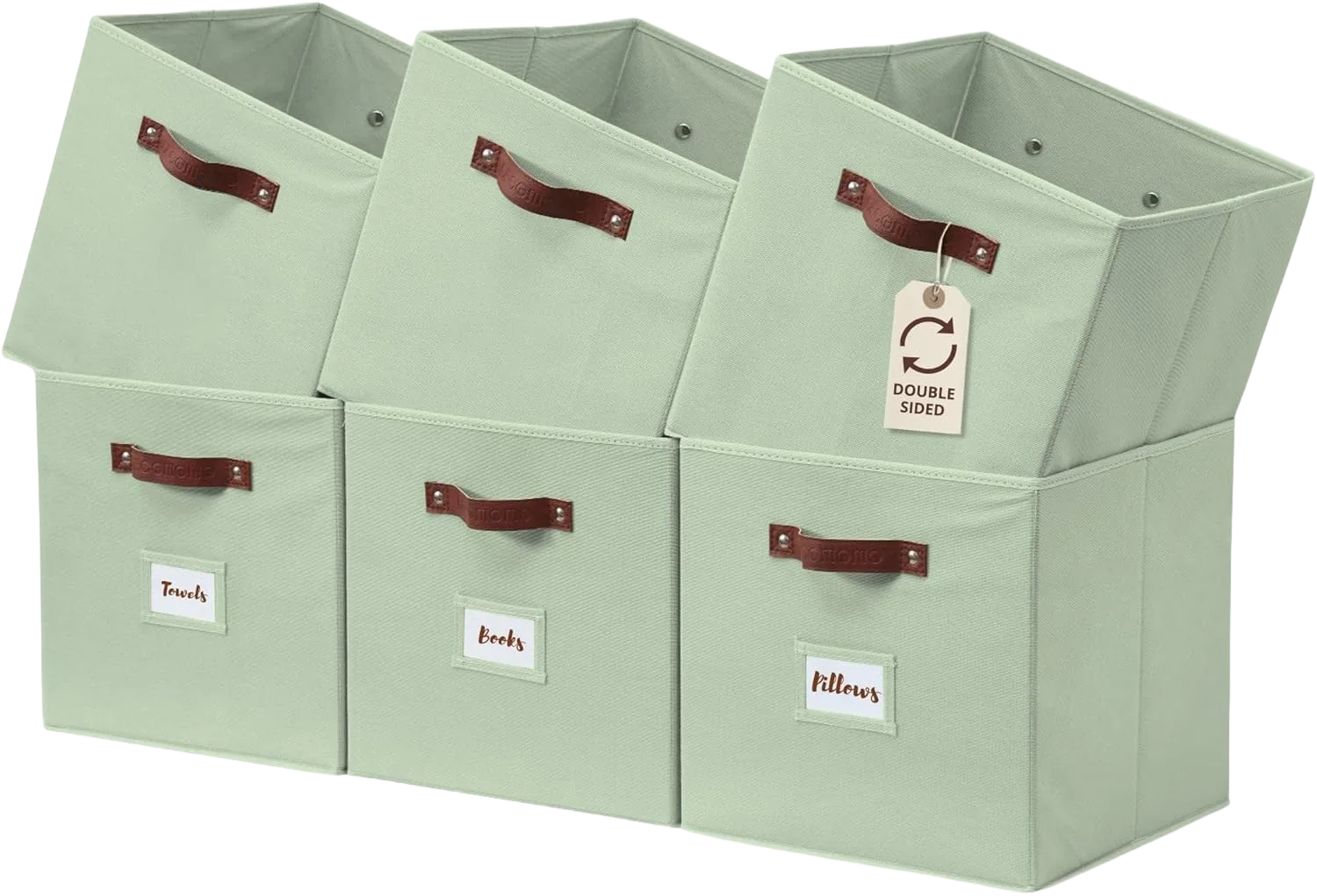
Labels make a reset checkable at a glance: if the tees cube holds a sweater, you see it from the doorway. Before buying cubes, use the free version, a plain bin and a strip of masking tape with one word on it (on the bin, never on the furniture, since some halls ban adhesive on furniture too). The cubes earn their place only if you will keep the labels current, and a plain storage tote works as budget storage for what the cubes do not hold. The DECOMOMO fabric storage cubes with labels (six cubes, 10.5 x 11 in) make the check visible, with one flaw from buyers: a smell for the first few days that fades.
Read the Handbook, Measure the Rail, Then Text Your Roommate
Three ideas carry the whole plan. Rules come before purchases, because the housing page can turn an adhesive pack into a return. Measurement comes before boxes, because the lowest edge of the rail decides what slides in. And the roommate comes before the cart, because most of what a shared room needs is agreed in words rather than bought.
When winter break arrives, pull the under-bed box and the desk drawer out and check them against their labels: if the contents still match, the system held, and if they do not, move the label to what the drawer has become. Today, open your housing page and put the tape measure to the rail, and notice how many items on your list stop fitting. The same month-three logic applies in any single-room home, and storage ideas that fail by month three shows where it breaks first.
Frequently Asked Questions
01What is the best way to organize my dorm room?
Start with your housing page and three measurements, under the bed, the closet and the desk drawer, then buy only what those numbers and rules allow. The order of work is rules, rail, closet door, drawer, then the roommate list.
02What are some good organizers for dorm rooms?
The best dorm organizers need no wall contact: an over-the-door organizer, a lidded under-bed box sized to your clearance, and a drawer organizer sized to your drawer. Add a rolling cart only if it has a parking spot.
03How are college dorms organized?
Most rooms come furnished with a bed, desk, chair and dresser per student, and some include a micro-fridge, so organizing mostly means the storage you add. RIT, for example, puts a micro-fridge in every room. Check your school’s room list first.
04Can you use Command strips in a dorm?
It depends on the school and sometimes the building: some ban every adhesive on drywall, some allow only removable strips, and one approves only painter’s tape. Check your own housing page before you stick anything.
05Do I need to bring a mini fridge to college?
Not until you check your school’s room list, because some rooms already include a fridge and some schools cap the size you may bring. Central Michigan, for example, limits refrigerators to 4.3 cubic feet.
Disclaimer: ClutterlessNest is a participant in the Amazon Services LLC Associates Program. As an Amazon Associate we earn from qualifying purchases. This article may contain affiliate links — if you buy through them, we may earn a small commission at no extra cost to you. We only recommend products we have tested or genuinely believe in.