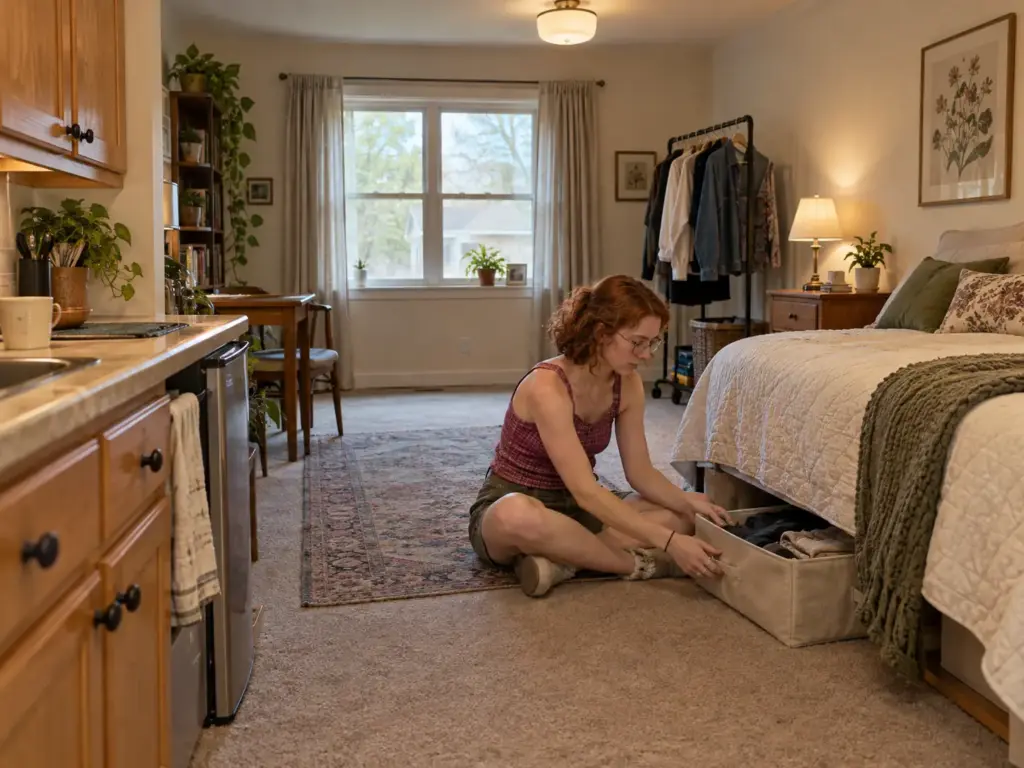
You bought a bin for the pile on the chair, and a week later the pile is back while the bin holds three charger cords and a takeout menu: it was bought for the furniture it would sit beside, not for the thing that needed a home. Studio living tends to run into the same breakdowns: clothes stored under the bed that come back out, a riser that does not fit the frame, and a free couch that arrives with bedbugs. This guide sorts studio apartment storage ideas by what a studio holds, gives each category a spot, and says how each one fails and what to measure first. The zones, the walkway and the weekly reset live in our studio apartment organization guide, so this one starts from what you own.
Quick Answer
Give every category you own one spot, and check how that spot fails before you load it.
- Clothes: a rolling rack by the bed wall, plus hooks on a door.
- Shoes: one slim open rack at the entry, with a hook line above it.
- Bedding: low fabric bins under the bed, with risers if the frame is low.
- Kitchen overflow: pans on edge and lids on a rack, stacked at the cooking zone.
- Paper and cables: one drawer or one shoebox for each.
- Furniture: pieces that hold things, with every dresser anchored to the wall.
Studio Apartment Storage Ideas for Clothes Without a Real Closet
A studio with one rod, or none, sends clothes on a tour: the chair, then the bed, then the floor. That is not a discipline problem. Nothing in the room has a rail, so the only place a worn shirt can wait is a flat surface. In a closetless studio the usual closet alternatives (a rolling rack, a line of hooks, a narrow dresser) all work, and the real question is which one costs the least floor.

Hang what you wear every week, fold the rest
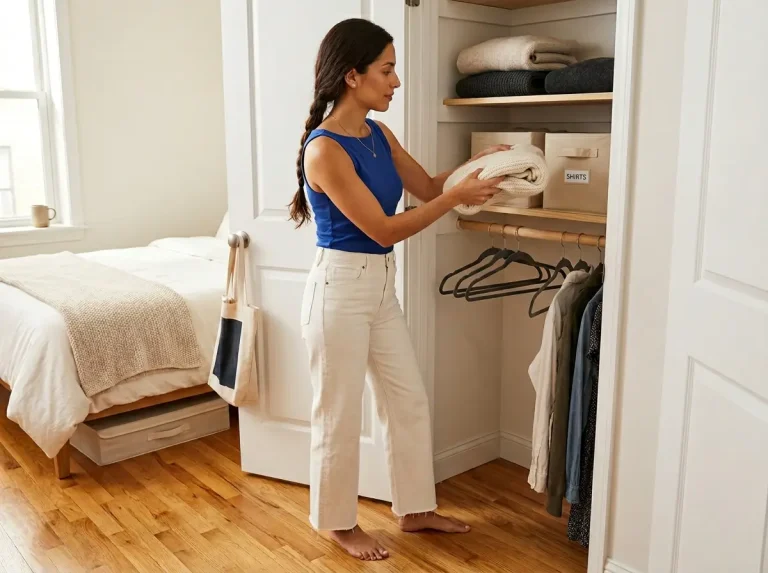
Sort before you buy hardware. Hang the weekly set at eye level, fold the shoulder-season set (our guide to how to store sweaters in a small closet without a dresser covers the folding half), and box whatever is out of season. A tension rod or a row of hooks you already own comes first.
The rolling rack, and where it fails
The SONGMICS Rolling Garment Rack is extendable, listed as heavy-duty, and needs no drill, which settles the rental question. Roll it against the wall nearest the bed, not at the foot where the walkway crosses. Reviews show where it gives: the legs can break to the side and the rack can tilt within a year, stability comments split between sturdy and wobbly, and long dresses are too long for it.
When a rack fills, the usual advice is to buy a second one. In a studio that is the wrong call: the second rack eats the floor the first one left, and the clothes spread to fill it. A rail with no limit fills to its full width, so the better rule is one-in-one-out, with the overflow going into a box.
Hang every hanger backward today, and turn it around each time you wear the piece. After one season, whatever still hangs backward is your first candidate for the box.
The no-drill version for the back of a door
People who live in studios keep landing on the same cheap setup: hooks on the back of a door for the jacket in use, and the ironing board hung there too, so it stops living in the room. One renter’s 320-square-foot studio tour does exactly this. A dresser only 15 inches wide can fit a small studio, where a standard dresser would block the walkway (anchor it, as the last section explains). Adhesive hooks such as Command hooks need no drill, but check the hook’s rated load before a winter coat goes on it.
Shoes, Bags and Keys Need an Address Before the Door Closes
Three pairs by the door turn into nine. A studio has no hall to take the overflow, so the entry pile is also the first thing you see from the bed.
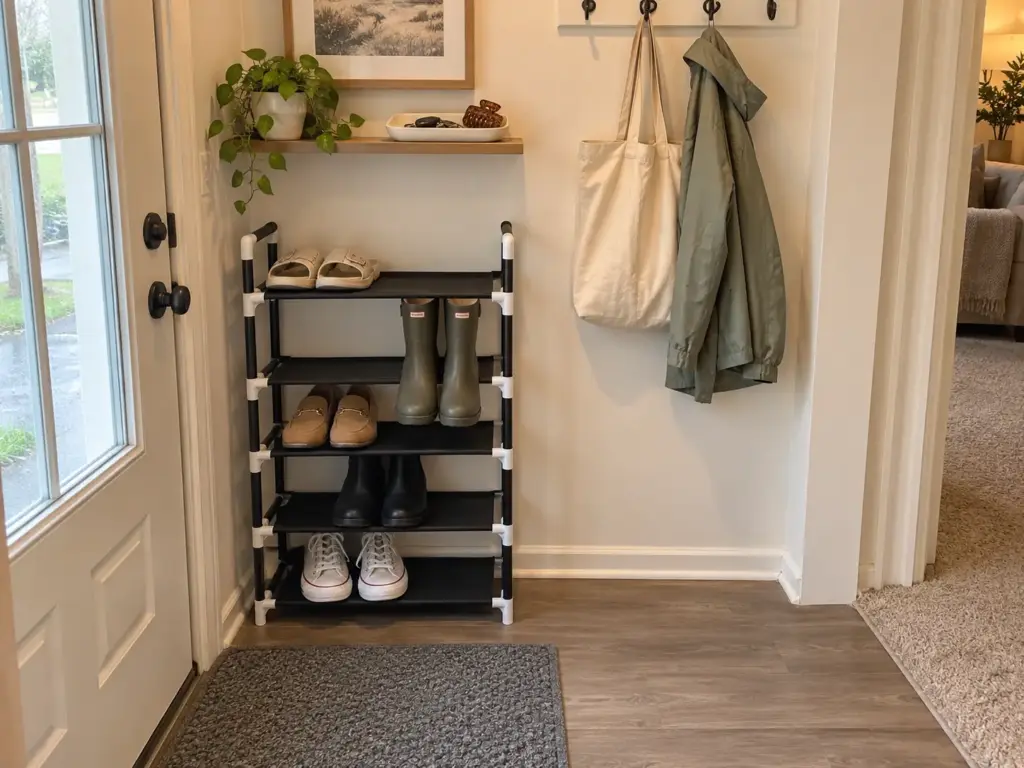
A rack narrow enough to leave the walkway alone
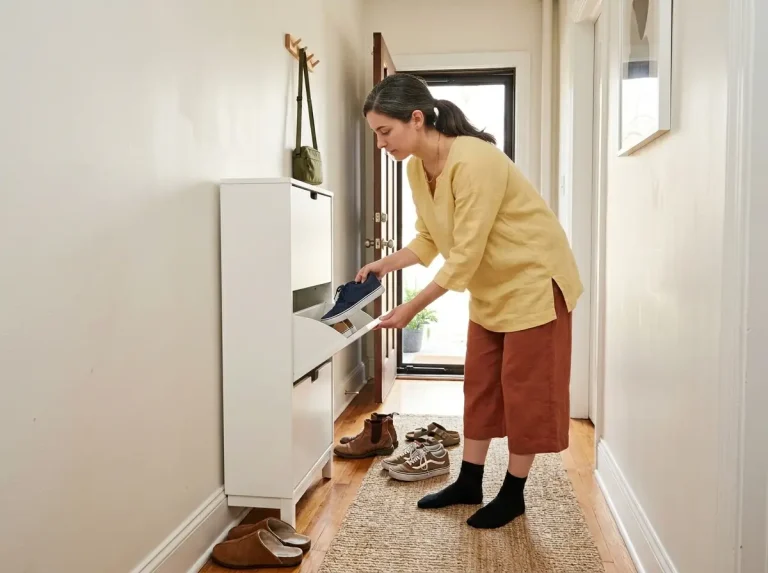
A closed shoe cabinet looks tidier, but in a studio the open rack wins: wet shoes dry on open shelves, and a narrow one takes the width of a single shoe. The SONGMICS 5-Tier Slim Shoe Rack measures 8.3 by 11.8 by 34.3 inches, and the 8.3 is the number that keeps the walkway clear. For more layouts, see our shoe storage ideas for small spaces, room by room.
The weak point is the plastic connectors. The connectors can crack during assembly, the shelf can feel unstable, and rust can show up over time. Put a boot tray under the front pair. A rack with nothing underneath becomes a doormat.
The over-door organizer, and the door it needs
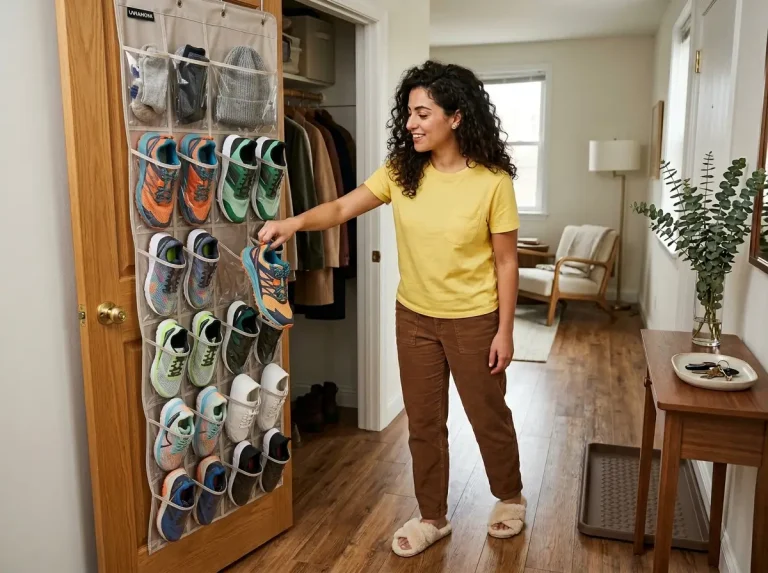
The budget option is the SimpleHouseware 24-pocket over the door organizer: no drill, and it uses a door that otherwise does nothing. A hollow-core door is a thin shell, though, and a loaded organizer can make it sag, so check the organizer’s rated load and your door before the boots go in. More setups are in these over door shoe organizer ideas that actually work.
Keys, bags and the tray that stops the spread
Put a tray for keys on the first flat surface within reach of the door, and a hook above the rack for the bag you carried today. A bin by the door for what you carry out daily keeps the sunglasses and the transit card from wandering to the nightstand.
Bedding and Off-Season Linens Go Under the Bed, in Bins Sized to the Gap
The bin that sat on the frame like a lid on a pot is a common under-bed return, and the arithmetic below prevents it. What belongs under a studio bed is bedding, throws and off-season linens: the gap makes a decent out-of-season storage spot for seasonal bedding such as a winter duvet.
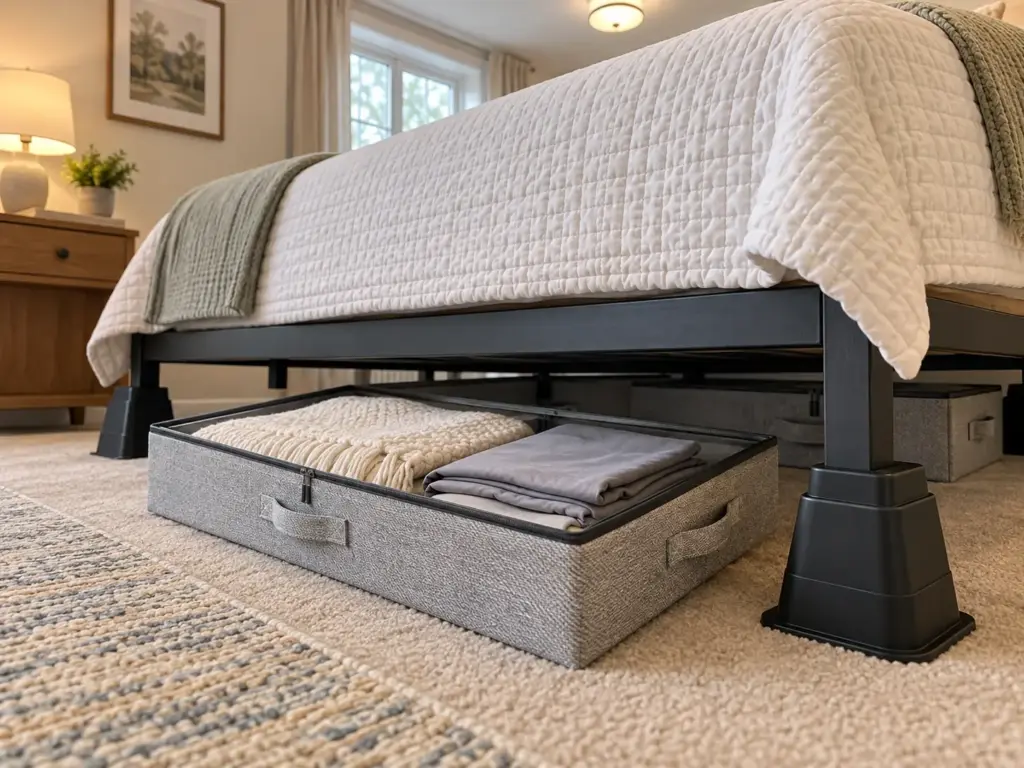
The clearance formula, with the numbers worked
Measure from the floor to the lowest solid point of the frame (the drop rail, the valance or the cross-brace, not the mattress). Subtract the bin’s full height, lid, casters and handles included, then about an inch more so it slides. What is left must be zero or more. Our guide to the best under bed storage containers for low beds sorts container types by that gap.
Worked case: the TidyCorner 2-Pack Under Bed Storage Containers are 4.5 inches tall, collapsible cotton-linen with firm sidewalls and bottom, so they need about 5.5 inches under the frame. Platform beds usually leave roughly 4 to 7 inches and metal frames roughly 7 to 9, so the bin fits only at the top of a platform bed’s range and sails under a metal frame. Its limit is the material: fabric protects less against damp than a rigid lidded tub, so keep it to bedding and linens.
Cut a piece of cardboard to the bin’s full height plus an inch, then slide it under the bed from the side and the foot. If it catches on a drop rail or a cross-brace, no bin of that height will clear either.
When risers earn their place
The usual advice is to buy risers, but the better question is whether your frame needs them at all. The EclatBain Adjustable Bed Risers come in 3, 4.3 and 5.3 inches, and the tallest lifts a bed 5.3 inches, no more. A 4-inch platform plus the tallest riser reaches about 9 inches, which swallows a bin with room to spare.
Budget-storage threads mention a 14-inch Zinus frame where the answer depends on which bin you pick. If your frame already clears the bin, skip the risers. Reviews add two cautions: some buyers say the set is too narrow for a full-size bed, and others say it slides on a smooth floor. Try one under a leg before you commit all four.
What stays out from under the bed
People in budget-storage threads warn against loose clothes under the bed. Dust and damp reach them, and they come back out onto the chair. Bedding and throws in a closed fabric bin are the exception; the sweaters you wear in March are not, and the guide on off-season clothes for a renter shows where they go instead.
A bed skirt hides the bins, and it pairs well with risers. None of it needs a drill, which makes this the easiest no-drill storage in the room.
Kitchen Overflow Belongs at the Cooking Zone, Not Beside the Bed
Picture the sheet pans leaning against the bed frame because the kitchenette’s two cabinets are full of what you use once a month. Pans that wander toward the sleeping zone mean the cooking corner has no system.
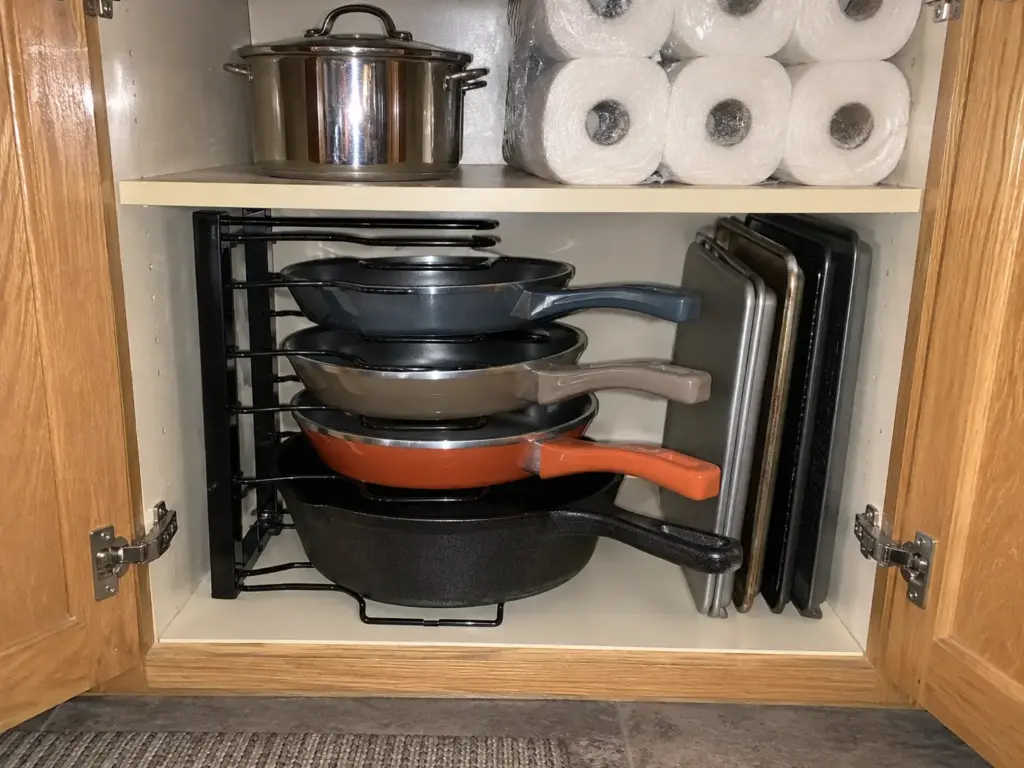
Stack pans on edge and lids on a rack
Pans on edge in one vertical rack free the cabinet floor for things that stack flat. The SimpleHouseware Adjustable Pan Organizer Rack, a five-tier unit at 12.5 by 9 by 11.5 inches, is freestanding, so no cabinet drilling. Its flaw is stability: reviewers call it flimsy, say it kept tipping over, and say skillets do not fit. Keep skillets on the cabinet floor and put only saucepans on the rack (or skip the rack until it has held one saucepan without leaning).
Lids are the other half of the same cabinet. The YouCopia StoraLid Pot Lid Organizer takes lids, not pans, so choose by the problem: the rack solves stacked pans, the lid organizer solves the avalanche when you reach for one.
The cabinet under the sink is bigger than it looks
A six-pack of paper towels can fit under a kitchen sink, and a pull-out bin there is a no-drill gain in a small renter’s space. It is dead space in most kitchenettes until something is put there on purpose. Pull the cleaning bottles out and measure around the pipes first.
Where the bulk buy lives
A bulk buy is a promise to store something for months. Decide its address on the day it arrives: paper goods under the sink, nothing beside the bed. If the kitchenette has no counter, a rolling cart parked beside the cooktop stands in for one without a drill, as long as the floor lane it rolls out into stays clear.
Paper, Cables and Daily Carry Get One Drawer, Not a Pile
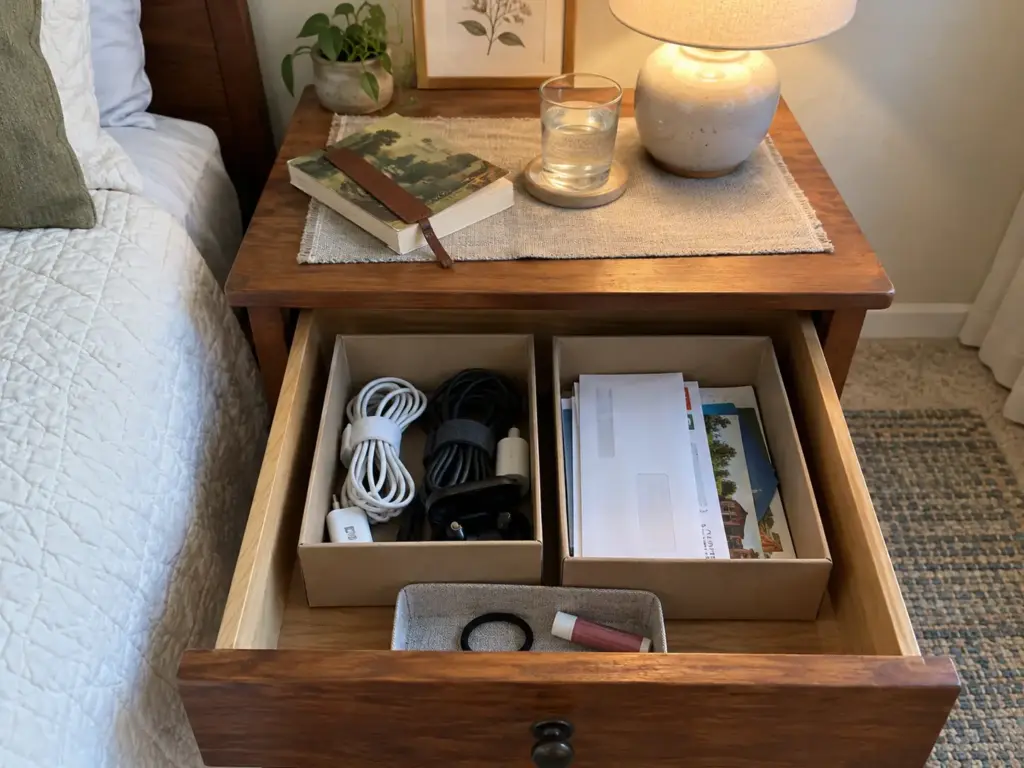
The charger, the mail and the headphones live on the nightstand because it is the only flat surface within reach of the pillow.
One drawer for paper, with a keep-or-recycle rule
The free fix comes first: an existing drawer or a shoebox, one category each for paper, cables and daily carry. Open the mail over the recycling bin, not on the bed, and keep only what you must act on or prove later.
One box for chargers and cables
Put chargers in one box with every cord’s end showing. Two habits help: one-color bins, so a glance shows what is missing, and measuring twice before buying any organizer. If your work zone shares a wall with the kitchen, keep the cable ends in the box and not along the bed.
Why the “miscellaneous” bin turns into the next pile
A bin of whatever does not fit anywhere becomes the next pile, because nothing in it has an address. Label every category, and empty the unlabeled bin first. Cheap drawer organizers, or a shoebox with cardboard dividers, give each cord and each envelope stack its own lane. For the work surface, our guide to small desk organization for apartments covers the cable and surface math.
Furniture That Stores More Than It Looks Like, and What to Check Before Buying It Used
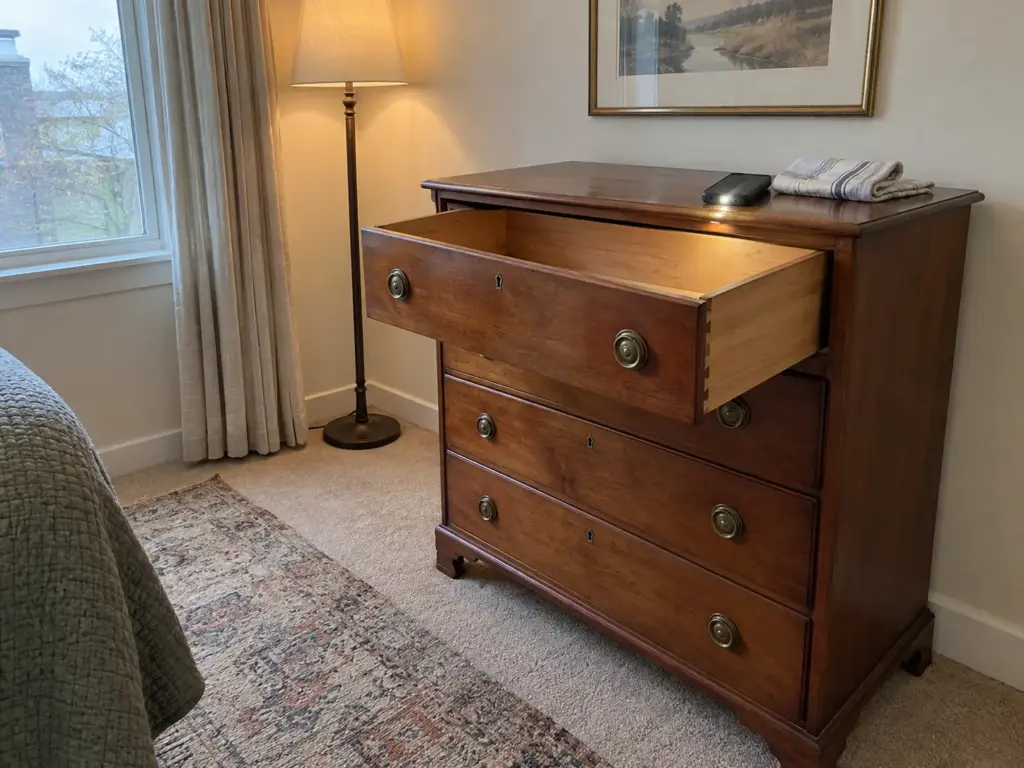
The free dresser at the curb fits the wall exactly, which is the trap: secondhand furniture carries a pest risk and a tip-over risk and nothing else you can see.
A bench, an ottoman or a bed that opens
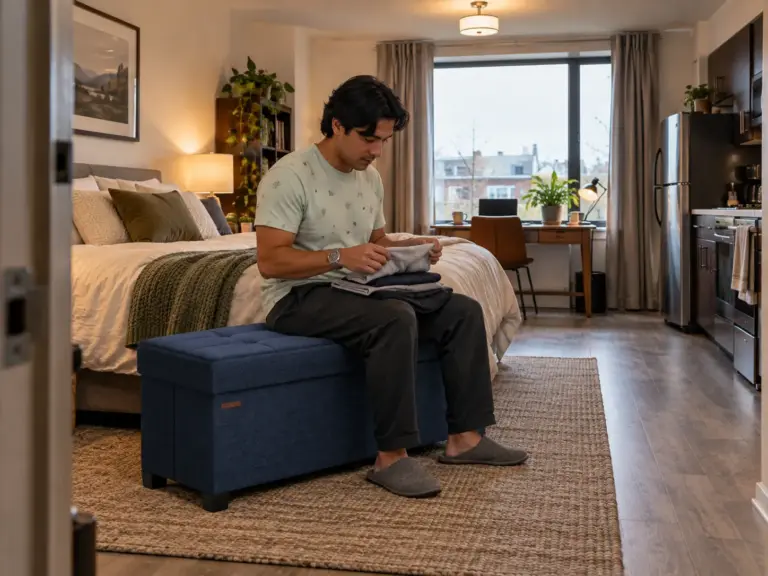
Hidden storage in an ottoman or a storage bench is the studio fix that renters keep landing on, and the 320-square-foot tour does too, and our guide to multi-functional furniture for small apartments covers ottomans and storage beds in depth. Check the failure first: reviews of one popular folding storage ottoman describe it breaking on the first sit, or within two weeks. Test the legs, the hinges and whether the lid takes your weight before you fill it.
The used-furniture check: bedbugs first
The community rule is blunt: do not take free furniture unless you know where it came from, because bedbugs happen. Inspect seams, folds and drawer joints with a phone light before the piece enters the room. Bedbugs are the first check; the second is whether the dresser can stay upright.
Pull every drawer all the way out before the piece comes in, and run a phone light along the runner channels, the drawer joints and the back-panel seams. It takes two minutes at the curb and settles the question before the piece is inside your one room.
Anchor it, even when you rent
The Consumer Product Safety Commission’s tip-over standard for dressers and armoires took effect on September 1, 2023, so a dresser made before that date was never tested to it. The standard tests stability with loaded drawers, with several drawers open and with a child of up to 60 pounds climbing on the unit.
A curbside piece has no proof it passed. The same release is plain about the remedy: “CPSC recommends that consumers anchor furniture, including dressers, securely to the wall.” CPSC puts the toll of these tip-overs at about 5,300 emergency room visits a year.
Renters can anchor too. CPSC’s Anchor It! campaign for furniture tip-overs says covering the holes from your anchors “won’t be a problem.” Whether your landlord agrees is another matter, so check your own lease before drilling anything.
One Spot per Category, Then Check What Grew
Three rules carry this guide: every category gets one spot and a failure check before it is loaded, the gap under the bed gets measured before the bin is bought, and the free fix (a drawer, a shoebox, the back of a door) comes before any product.
At the three-month mark, find the spot that has grown past its edges, the rack that overflows or the drawer that will not close. That is the category with no address, and the one to cut or move. Today, take the one of these studio storage ideas that answers the category bothering you most, give it a spot using what you already own, and notice after a week whether things go back there without a reminder. When that holds, the walkway and zone plan keeps the room clear.
Frequently Asked Questions
01What are some good storage options for a studio apartment?
The best studio apartment storage options match one spot to each category you own: a rolling rack for clothes, a slim open rack at the entry, low bins under the bed, and a drawer or shoebox for paper and cables. Anchor any dresser to the wall.
02How can I effectively organize my studio apartment to save space?
Give every category one spot, and nothing else gets to live there. Sort what you own first, then store each group where it is used: pans in the cooking corner, bedding under the bed, shoes at the door.
03What are some ways to maximize space in my small studio apartment?
Declutter first, because the cheapest square foot is the one a discarded item frees. Then use what you already own, a drawer, a shoebox, the back of a door and the gap under the bed, before you buy a rack or a riser.
04How to maximize storage in a small apartment?
Renters get most of the gain without a drill: a rolling rack, door hooks, under-bed bins and freestanding racks. Owners can add wall-mounted units, but anchor every dresser either way, and check your lease before fixing anything permanent to a wall.
Disclaimer: ClutterlessNest is a participant in the Amazon Services LLC Associates Program. As an Amazon Associate we earn from qualifying purchases. This article may contain affiliate links — if you buy through them, we may earn a small commission at no extra cost to you. We only recommend products we have tested or genuinely believe in.