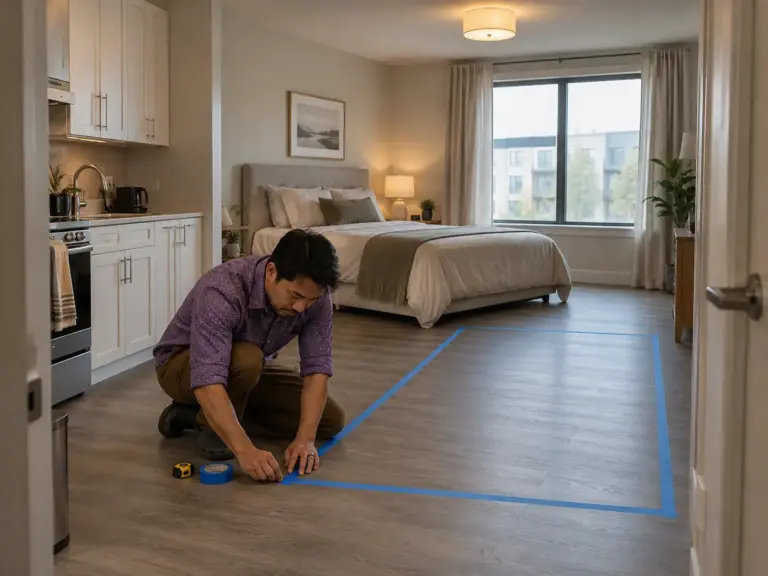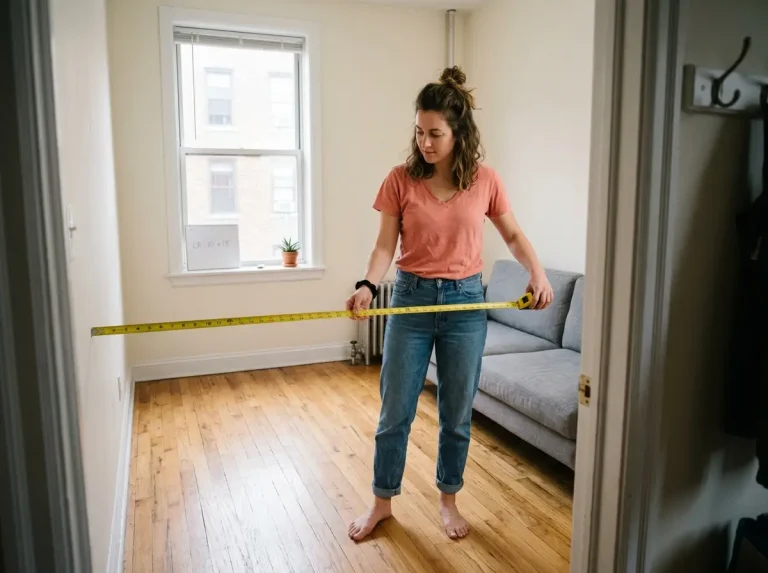

You open the front door of a studio and the bed is the first thing in the room, made or not. So a divider goes up, and the next thing you notice is the one window going dim, because the divider now stands between that window and half your floor. This guide sorts room divider ideas for studio apartments by what your lease allows, what each type does to the light, and how it looks after month one, with the free options first. Studio renters often land on the same two regrets: the divider that eats the window light, and the bookcase whose back side turns into a shelf of dust.
The short version of the studio apartment dividers on offer sits in the table below, and the sections after it explain each row.
| Divider type | Needs a drill? | What it does to window light | Where it breaks first |
|---|---|---|---|
| Curtain on a tension rod or ceiling track | No for a rod. No for an adhesive track, which suits a light curtain only | Sheer panels pass it, solid panels block it | A heavy panel sags the track, and the adhesive can let go |
| Folding screen | No | A fabric screen can block most of it | It goes over when knocked |
| Bookcase | Standing it, no. Anchoring it means a wall fixing or an adhesive anchor | Blocks the strip it stands in | The back side collects dust, and an unanchored unit can tip |
| Furniture (bed, sofa back, desk) | No | Light passes over it | No privacy above sofa height |
| Rug or paint line | No (check the lease before painting) | Leaves it alone | Zero privacy, and a thin rug curls at the edge |
| Glass or sliding partition | Yes, fixed to wall and floor | Frosted and fluted glass let it through | Permanent, so it is an owner’s call |
Room Divider Ideas for Studio Apartments Start With What Your Lease Allows
The lease decides which dividers are open to you before taste gets a vote, and a studio apartment room divider is no exception. Within studio apartment organization, this is the step where a wrong guess costs the most: a track that needs screws in a ceiling you cannot touch, or a glass partition you cannot install. The six types in the table fall into three groups. Freestanding ones (screen, bookcase, furniture) ask nothing of the building, hung ones (tension rod, adhesive track) lean on pressure or glue, and fixed ones (sliding or glass partition) need the owner’s say.

The no-hole route: what a renter can hang, lean or stand
A renter has two good paths. The first is anything that stands on the floor: a folding screen, a bookcase, the back of a sofa, a rug. The second is a tension rod curtain, which holds by pressure between two walls and is limited by the opening, not by the panel. If the alcove is 83 to 123 inches between two facing walls, a rod in that range closes it, and if it is wider or has only one wall, a rod is the wrong tool.
The adhesive ceiling track is the odd one out. The seller of one self-adhesive track states a maximum load of 11 pounds, and that is a seller claim nobody has tested here, so treat it as a light-curtain route and nothing heavier. Renters often reach for a ceiling track or a rod first, and wire suspension hangers paired with linen curtains from a big-box retailer are one option. That kind of no-drill divider is the baseline every other option has to beat.
When your question is where a divider can physically go, the walls that decide a studio layout first answer it, with the clearances and the tape method. This article only judges the divider itself.
The owner route: what only works once you can fix it to the wall
If you own the unit, two things open up. A bookcase can be anchored with screws, and a sliding door or glass partition can run on a track fixed to wall and floor. A sliding door is one owner’s answer, and it catches a bit of a window in the bedroom. That is the trade in one phrase: fixed dividers are the most solid and the least reversible.
So who is it for? Anyone staying for years who wants a bedroom that reads as a bedroom. Who is it not for? Anyone whose lease says nothing about fixtures, because “nothing” usually means “ask first”.
Why “temporary” still has to survive the move-out inspection
A divider is only a temporary wall if it comes off clean. A screw route is fine when the hole can be patched, and the federal Anchor It! campaign puts the patch at a few minutes, as the bookcase section shows. An adhesive route is fine when it holds, and the reviews for both adhesive products in this article say it often does not.
About half or more of the adhesive mentions are negative.
That leaves a renter with a plain order. Pick the type that needs nothing from the wall (screen, furniture, rug), then the pressure route (rod), and only then the glue.
The Window Test Before You Pick Any Divider
A divider in a studio can turn the sleeping zone into a dark back room, and the only way to know whether blocked light will follow is to look before you buy. A divider can cut off a big light source by blocking much of the window light. Others take the stronger position of no dividers at all, because a divider makes the room look smaller. Both are fair, and both are testable in ten minutes with things you already own.

Stand where the bed will be and look back at the window
The test is a method, not a measurement. Stand in the zone the divider will create, at the pillow end or wherever your head will be, and face the window. Look at where the light lands at the hour you actually use that zone: morning if that is when you wake, late afternoon if the room is where you retreat. If the light reaches the bed, the placement works, and if it stops short, move the line or change the type.
To stand in for the divider, hold up a bedsheet at head height, or lean a tall sheet of cardboard (a flattened wardrobe box is enough) on the spot where the divider would stand. The bedsheet shows what a sheer curtain does, since some light comes through. The cardboard shows what a solid screen or bookcase does, and mark the footprint first with the floor-tape test so the real thing lands in the same place.
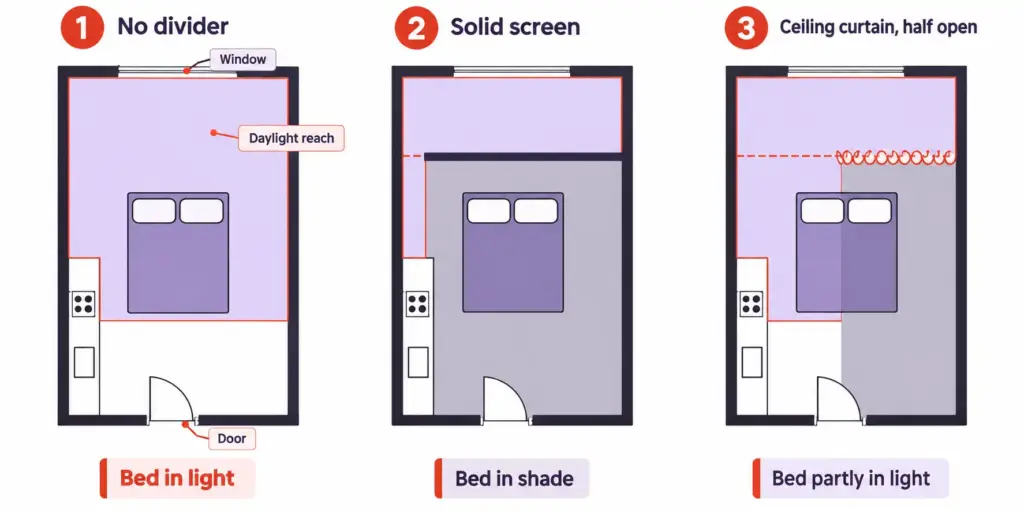
One placement trick comes out of the test more often than any other. If the window is at the foot of the bed, a divider running across the room between sofa and bed shades the bed, and if the window is at the side of the bed nook, the same divider can stand in front of the bed without touching the light. You are not choosing a divider so much as choosing where its shadow falls. And in a small room that decides how the living and sleeping areas share what daylight there is.
Sheer, solid or open: what each takes from the light
Sheer panels pass the light and give privacy only in daylight. A blackout curtain gives privacy and takes the light with it. That makes the usual answer a compromise: solid panels at the sides and sheer toward the middle, a layered setup that works with a full-width ceiling rod.
The sheer is the obvious pick for light, and it deserves one correction. After dark, with a lamp lit on the bed side, a sheer shows the shape of whoever is behind it. If the bed needs to disappear at night, the solid sides have to be wide enough to close across it. Open dividers, such as a shelf unit with gaps, fall in between: they break the sightline from the door but pass light through the open shelves.
The test also explains a limit of the folding screen covered below. The Kokorona listing describes its fabric as blocking most light, so it fails here unless the window sits on the other side of the bed. No light-permeable privacy screen turned up while this guide was put together, so if the test says you need light and a screen, the honest answer is a curtain with a sheer middle.
Take the window test at the two hours that matter, not the one that is convenient. A divider that looks fine at noon can leave the bed zone gloomy by the time you actually go to bed, and you want to know that while the cardboard is still leaning on a chair.
When the answer is “no divider at all”
Sometimes the test says the light stops dead at the line you were about to draw. The room is small, the window is the only source, and any tall divider turns half of it into a closet. That is a real result, not a failure, and it points to the next section: a rug and a paint line zone the room without touching the light.
Zone the Room Without a Divider: Rugs, Paint and Furniture You Already Own
The free fix goes first. You may be about to spend on a screen when a rug edge and a turned sofa would draw the same boundary, with no hole and nothing taken from the window.

A rug that marks the bed zone
If you already own a rug that is big enough, move it under the foot of the bed and stop there. The zone is drawn by the edge: sleeping starts where the rug starts. Rugs instead of dividers are a common answer, and floor rug zoning is a strong position for a small studio.
If you need to buy one, the AMADA HOMEFURNISHING 8×10 washable area rug has a low profile and a non-slip backing, and at 8 by 10 feet it holds a bed and a nightstand without the edge cutting through the sleeping zone. Confirm the colour on the listing before you order. The flaw buyers raise is thickness: reviews are mixed, and some say it is too thin to be vacuumed, which suits a rug you wash and shake out more than one you vacuum.
What a rug does not do matters as much as what it does. It gives zero privacy, so someone at the door still sees the bed. If your problem is sightline, a rug fixes the look of the room, not the view from the door.
A paint line or a wall colour that ends where the zone ends
A wall colour or a painted band can mark where the sleeping zone sits. This is paint zoning, a way of zoning with the eye, and like the rug it does nothing for privacy. Painting is also a lease question before it is a design one, so read the paint clause or ask first. A floor height change, such as a low platform, does the same job for the eye but belongs to owners, since it is built, not laid down.
Moving what you own so it faces away from the bed
Most studios already have a sofa and a desk, and the cheapest divider is the one that only needs turning around. A sofa with its back to the bed marks the line at no cost, and the furniture section below develops this in full. For the rug-and-sofa method in a different room, floating the sofa and zoning with a rug walks through it in a living room, and the logic carries over.
Curtain Dividers on a Ceiling Track or Tension Rod
A curtain room divider is the renter’s standard answer, and it is also the one that most often fails by week two. The reason is almost always the same: a light-load track carrying a heavy panel, which turns into a sagging curtain and then lets go. Knowing which hanging route fits which ceiling and which opening is most of the job.

Tension rod: when the alcove has two walls to push against
If your bed alcove has a wall on each side, you have the ideal tension-rod situation. The ALLZONE Tension Curtain Rod spans 83 to 123 inches and is spring-loaded, so it holds by pressure with no hardware in the wall. The opening is the whole constraint: measure between the two facing walls at the height you want the rod, and make sure that number falls inside the range.
Before you buy anything, use what you have. A rod from a closet or a shower that fits the gap can do the same job for nothing. That makes a budget divider out of two things already in the home, and a DIY room divider is rarely simpler than that. If the gap is wider than 123 inches or has no second wall, the ALLZONE rod is not the answer, and the next route is.
Adhesive ceiling track: a light load, a seller claim
For a ceiling with nothing to push against, a ceiling track curtain is the usual path. The DoubleFill 5.25 ft (63 in) self-adhesive ceiling curtain track is the only no-drill ceiling track that checked out, and it comes with a figure that deserves suspicion. The seller states a maximum load of 11 pounds. That is the seller’s claim, not a tested number, and it fits a single light sheer rather than a lined drape.
RAW|The DoubleFill track shows the weak point of this kind of product: the adhesive tape can pull loose under a curtain’s weight.
So the track suits a clean, flat ceiling and a light curtain, and a textured or painted ceiling is a reason to pick the rod instead. Fixing details belong to the maker’s instructions, not to this article.
The rod is the standard renter answer and the track is the fallback, but in a studio with no alcove walls the order reverses, since the rod has nothing to push against. Pick by the room’s walls, not by habit.
Put the curtain panel on a bathroom scale before you compare it to any load figure on a listing. A lined panel that feels light in your hands can weigh more than the 11 pounds a light track claims, and the scale settles the question in a few seconds.
Sheer, blackout or both: choosing the fabric by the hour you use the zone
Pick the fabric by the hour. If the bed zone is for sleeping at night and the window matters in the morning, solid panels at the sides with a sheer in the middle give you both. If someone works a night shift and sleeps in daylight, a blackout panel earns its place and the light is a cost you accept. And if one person never closes the curtain, which is a household fact and not a design problem, the sheer middle is the panel they will leave alone.
The weight rule applies here too. Blackout and lined fabrics weigh more, which pushes the choice toward a rod in an alcove and away from the adhesive track. If a curtain is going to be the answer in a bigger apartment, make a small apartment work harder for the wider zoning picture. As hanging room dividers go, this is the one with the most room to adjust after it is up.
Folding Screens and Freestanding Panels
A screen is the divider with no hardware at all. It arrives, you unfold it, and it works until someone brushes past it and it slides over. That makes the real question where to put it and how to keep it standing.
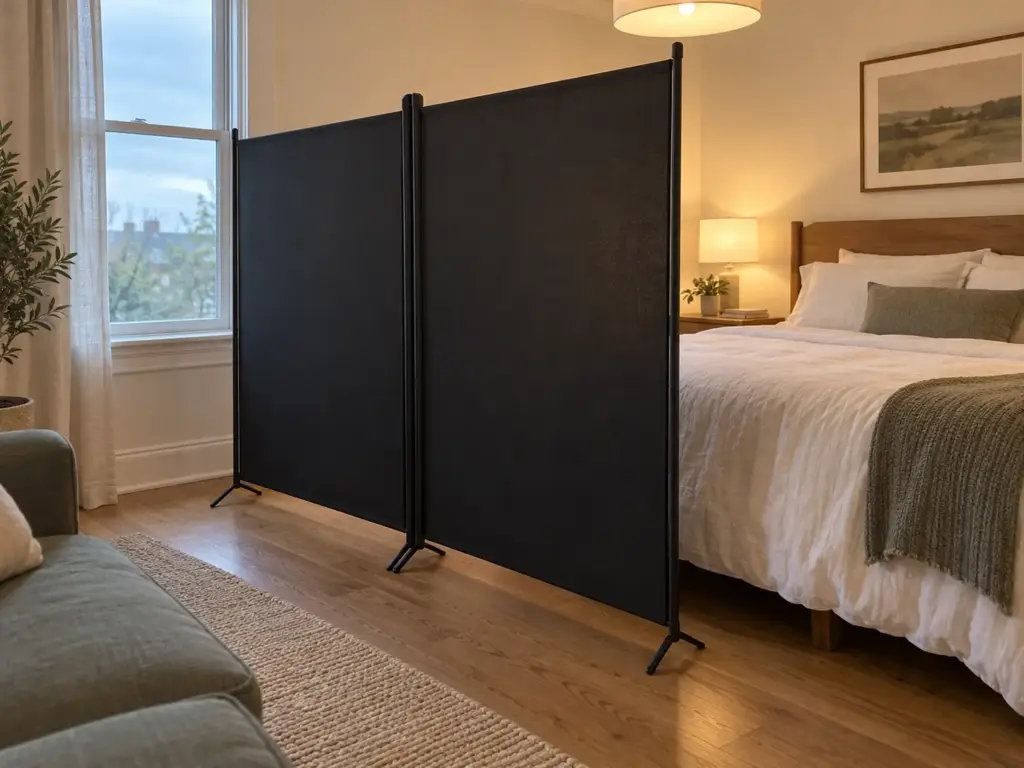
A screen’s job: block the sightline, not the room
A screen blocks the view, not the space. Put it between the door and the bed and the door no longer looks straight onto the pillow. It does not make a bedroom, but for a studio where the main complaint is that the bed is the first thing anyone sees, it can be enough to keep a separate sleeping area.
The Kokorona 3-panel folding screen measures 102 inches wide by 71 inches high according to its listing, which is roughly 8.5 feet across when fully extended. That width closes a bed alcove of that size. Pegboard dividers and movable panels exist as categories too, but no specific product was verified here, so there is nothing to link.
The window problem with a fabric screen
The Kokorona listing says its fabric blocks most light. That is the right thing to know before buying it and the wrong thing to find out on delivery, because the screen fails the window test whenever it stands between the bed and the window. Use it where the window sits on the other side of the bed, so the screen shades the part of the room that does not need light anyway.
Set it against back-to-back bookcases, where a screen is often the better call, because the bookcase back ends up cluttered and dusty. If you need privacy and light together, a screen like the Kokorona is the wrong tool, and a curtain with a sheer middle is the right one. An ALLZONE rod plus a curtain also covers a wider opening, which a three-panel screen cannot.
A screen that stays standing
Reviews of the screen are split on sturdiness: “The sturdiness receives mixed feedback, with some finding it sturdy while others report it falling over.” That is a review summary, not a test. The usual common-sense move is to open the panels in a zigzag rather than a straight line, so the feet spread wide and the screen leans on its own geometry. A straight line is a domino waiting for a shoulder.
Place it where nobody walks past it, not where the walkway squeezes between the screen and the sofa. Leave some walkway clearance on both sides, and treat the first knock as the real test. If it wobbles, move the line.
A Bookcase as a Room Divider (and the Back Side Nobody Plans For)
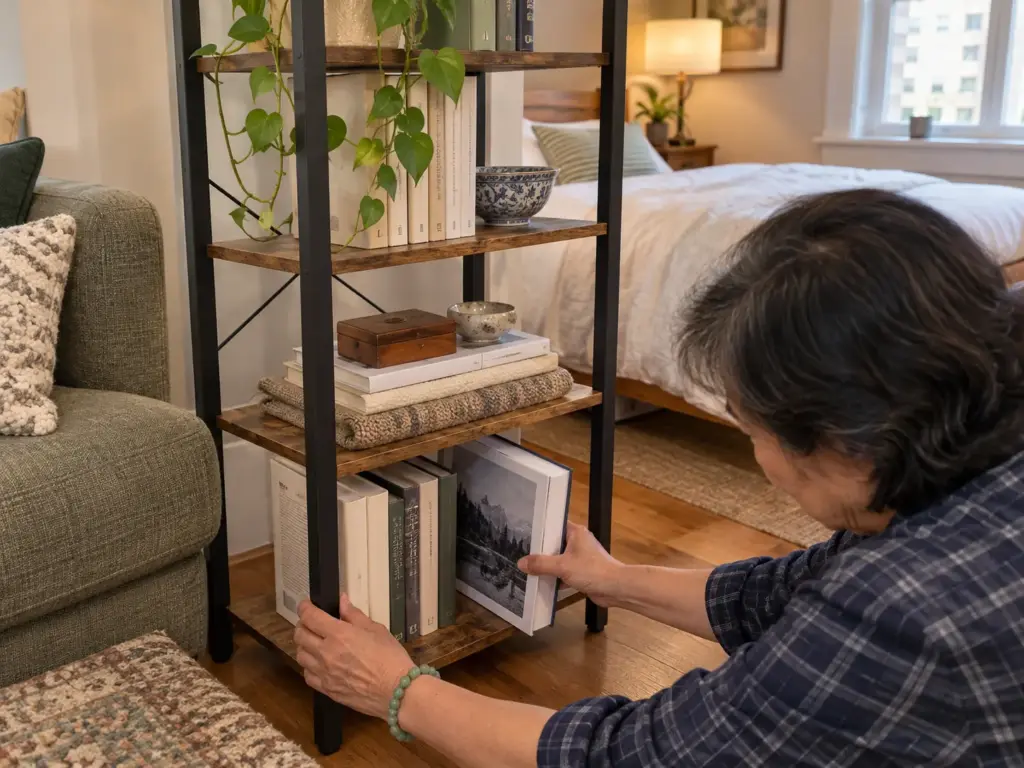
A bookcase divides a studio and stores things at the same time. It also has two problems that rarely appear in photos: the side facing the bed collects dust and stray objects, and a tall freestanding unit can tip.
Open back, closed back or double-sided
An open bookcase passes some light and shows the bed through its shelves, a closed bookcase hides the bed and blocks more light, and a double-sided bookcase gives both sides something to use. The VASAGLE 5-tier bookshelf measures 11.8 inches deep, 15.7 inches wide and 60.2 inches high according to its maker, with 18.3 pounds per shelf and 91.5 pounds in total, and an anti-tip kit comes with it. The listing does not make clear whether the back is open or closed, so treat that as unknown and check it before you decide how it will look from the bed.
At 15.7 inches wide, one unit is a partial divider and a row of them is a wall. At 11.8 inches deep it leaves about 24 inches clear on a 36-inch path. One flaw in the reviews is worth a line: holes can be missing or in the wrong places. That is a review summary, so check the pieces when the box arrives, not months later.
For the wider logic of tall shelving in a small home, see vertical storage that lasts. VASAGLE’s 5-tier unit is one worked example, not the only choice.
The back side that turns into a dust shelf
Whatever faces the bed gets the least attention. Two bookcases back to back can look tidy from the living side, but the back tends to end up cluttered and dusty. A screen is a better solution. The back of a shelf that faces a bed collects the stray objects that belong nowhere: the charger, the envelope, the spare hair ties.
Securing two units back to back makes them much safer against tipping. Both views are right about different things. Back to back is steadier, and it is also the arrangement that hides the dust. If a small child or a pet climbs, steadiness matters more than neatness, and if nobody climbs, a single unit with a cloth over the back is easier to keep clean.
Anchor it, and what a renter does instead
The tip-over numbers are the reason to take anchoring seriously. In a February 2026 CPSC release on anchoring TVs and furniture, the agency says to “Anchor TVs and furniture like bookcases and dressers securely to the wall,” and to keep heavier items on lower shelves. The same release reports 217 fatal tip-overs between 2013 and mid-2023, and 71 percent of those who died were children aged 1 to 3. That is the age that climbs a shelf to reach a toy.
One detail catches buyers out: the federal stability standard in effect since September 2023 covers dressers, armoires and similar clothing storage, and the release names no bookcase rule. So no rule protects you from a bookcase divider, and the anchor is your job.
For a renter, the question is screw or adhesive. According to the U.S. Consumer Product Safety Commission’s Anchor It! campaign, “for renters, repairing a wall once anchor is removed, only takes minutes.”
That makes a screw anchor the better route when the lease allows a small patch, and the one I would choose first.
When it does not, the No Drill Anti Tip Furniture Anchors (6 pairs) are the adhesive route, and it is the renter-friendly divider fix with a documented weakness.
Adhesion is the weak point in the reviews, with 24 of 41 mentions negative: after a month or so, shaking can peel them off the wall, and they do not stay adhered to painted walls. Treat them as a stopgap for a light unit, and check them monthly. For anything taller or heavier, freestanding shelving units that won’t tip over compares your options.
Load a bookcase divider from the bottom up: the thick hardcovers and the lamp base go on the lowest shelf, paper and plants go on top. It follows the CPSC advice to keep heavier items low, and it gives the unit a steadier base without costing anything.
Furniture That Divides: Bed, Sofa Back, Desk and Wardrobe
The sofa already sits in the middle of many studios, and it often only needs to face the other way. Furniture is the divider that costs nothing extra, takes nothing from the window, and does not touch the wall.

A sofa with its back to the bed
Turn the sofa so its back faces the bed. Using the sofa as divider works because the back becomes the line between living and sleeping, and a sofa is lower than a screen, so the light passes over it. You get a boundary without a wall, even a low half wall of upholstery.
The trade is honest: a sofa back hides nothing above its own height. Someone standing at the door sees over it to the pillow. If the bed must be hidden, a curtain hung behind or above the sofa adds the missing privacy.
A desk or console behind the sofa
A narrow console or a desk as divider behind the sofa makes a second layer. A bed and a desk in the same room can work with a work zone on the far side of the sofa, which gives the desk its own corner without a wall.
A wardrobe or storage bed that doubles as the wall
A tall wardrobe placed as a headboard wall, or a platform bed with storage that holds what a dresser would, can do the divider’s job and the storage’s job together. A wardrobe headboard costs floor depth, so measure it against the path to the window before committing. No product is recommended here, since nothing checked out for this section. If you are weighing storage against a divider in the same piece of furniture, storage that fails by month three lays out where the trade-offs sit.
Glass and Sliding Partitions: The Owner’s Option
Imagine owning the unit and wondering whether a real wall would be better than a curtain. A glass or sliding partition is the closest thing to a divider wall, and it is also the least reversible divider in this guide. For studio apartment partition ideas that stay, this is the end of the range.
Frosted, fluted and clear glass: what each lets through
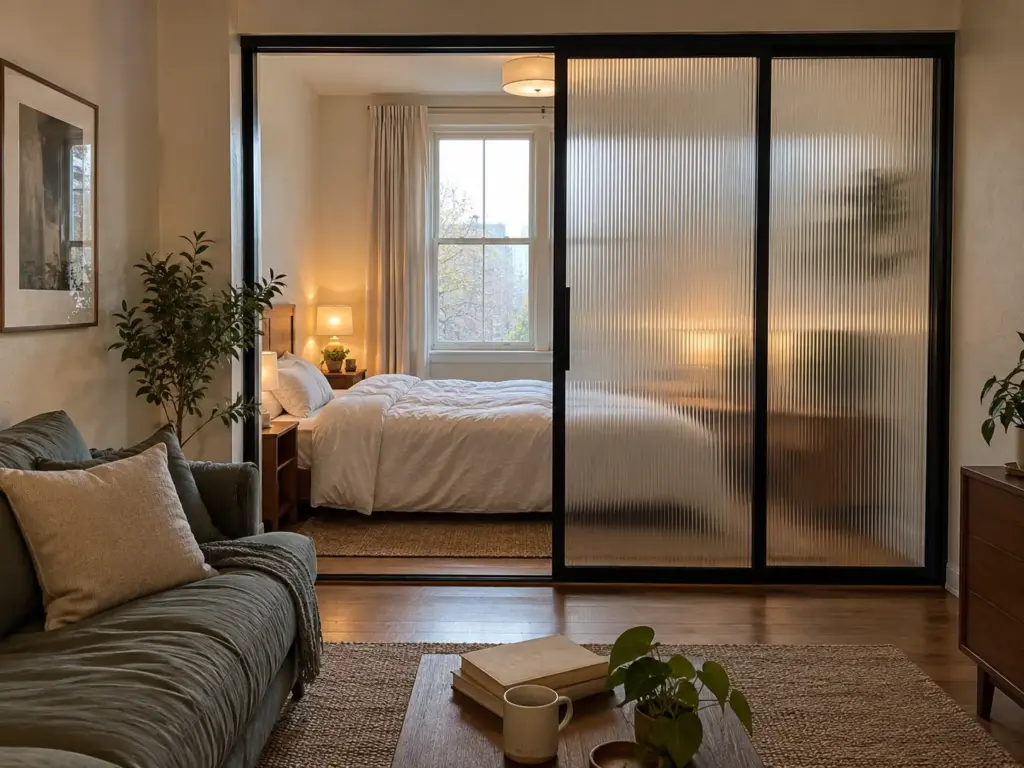
Glass keeps light moving through the divider and takes privacy in proportion to its finish. Clear glass gives none. Frosted glass and fluted glass give some, blurring the shape of a bed into a pale smudge while still letting daylight cross the room. Steel frames are the usual way to hold any of them.
For a studio with one window, this is the type that comes closest to passing the window test and still giving the sleeping nook its own space. That is its whole argument.
A sliding track versus a fixed pane
A sliding door runs on a track and can open fully when you want the room to feel whole. A fixed pane stays shut and costs you the flexibility. Both are fixed to the wall and floor, which means both need the owner’s say, and a sliding version is the one that owners often choose.
Why most renters should skip this one
It is the most permanent divider here, and fixings need a patch you may not be allowed to make. A renter gets most of the benefit from a sheer-middle curtain on a rod, at far lower commitment. If you own, the budget alternative still exists, and a reversible partition like a curtain on a rod can wait on glass until you are sure.
What Breaks by Month Three, and How to Check Before It Does
Every divider looks right on day one. The question is what it looks like after the first stretch of real living, and the answer differs by type. Rugs fail quietly: the thickness complaint turns into a corner that curls, so check the edge when you vacuum. The three types below fail louder.

Curtains and tracks: sagging and the adhesive that lets go
A curtain on a track or rod sags in the middle when the load is too heavy for the hanger. Lift the edge of the curtain and look along the rail: if the middle has dropped, the panel is heavier than the track wants. The adhesive failure is quicker and less polite, since the review that reads “Not even 2 weeks up and they fell” describes a track that gave up before the first month.
Press a hand lightly on the track once a month. If it feels loose, take the curtain down before it takes itself down. A rod is easier: if it slips, the spring or the opening width is the culprit, so re-measure.
Screens and panels: the knock that starts the fall
A screen’s first knock is its test. Give it a gentle shake at the top once a month. If it rocks, open the zigzag wider and move it away from the path, and if it keeps rocking, it belongs against a wall as a backdrop rather than a divider.
Bookcases: the back side, the load and the anchor
Three checks, one per problem. Dust the back side, or hang a cloth over it, because it is the shelf nobody looks at. Check the load: heavy items low, per the CPSC advice. And check the anchor after any time you move the unit or shake it hard, because an adhesive anchor that “peels off the wall” will not tell you when it lets go.
If you want these dividers placed in order inside the full studio, organize a studio apartment in the right order is the sequence that settles the bed zone first.
Sort by Lease, Test the Light, Check Again in Month Three
Three habits cover the whole job. Sort the options by what your lease allows before you shop, so you never fall for a divider you cannot install. Run the window test with a sheet or a flattened box before you buy, so the bed does not end up in a dark back room. And take the free fix first, a rug or a turned sofa or a curtain on a rod already up, because it often does the job.
Knowing the best dividers for studio apartment life comes down to those three checks, not to a photo.
For the check later, look at three things in three months: the sag in the curtain, the wobble at the top of the screen, and the back side of the bookcase. Those are the places a divider tells you it is losing.
Today, with nothing bought, lean a flattened box or hold a bedsheet where your divider would go, and stand at the pillow end looking at the window for a minute. Notice whether the light still reaches you. That one minute decides more of your shopping list than any photo will.
Frequently Asked Questions
01What are the best dividers for a studio apartment?
The best divider depends on your lease and your window: a curtain on a rod suits most renters, an anchored bookcase suits anyone who can fix it, and glass suits owners. Use the comparison table above, then run the window test before buying.
02What is a cheap way to make a room divider?
The cheap way to partition a room is with what you already own: a rug that marks the bed zone, then a curtain on a rod that is already hung. Neither needs a drill, and neither takes light from the window. A turned sofa works too.
03How do you make a separate bedroom in a studio apartment?
A separate bedroom in studio layouts starts with the sightline: block the view from the door with a curtain, a screen or the back of a sofa, then check that the window light still reaches the bed. Renters often pair solid panels at the sides with a sheer in the middle.
04Do room dividers make a studio look smaller?
They can, mostly when they stop window light from reaching the back half of the room. A rug or a sofa back leaves the light alone, so run the window test before you commit to a tall divider.
Disclaimer: ClutterlessNest is a participant in the Amazon Services LLC Associates Program. As an Amazon Associate we earn from qualifying purchases. This article may contain affiliate links — if you buy through them, we may earn a small commission at no extra cost to you. We only recommend products we have tested or genuinely believe in.