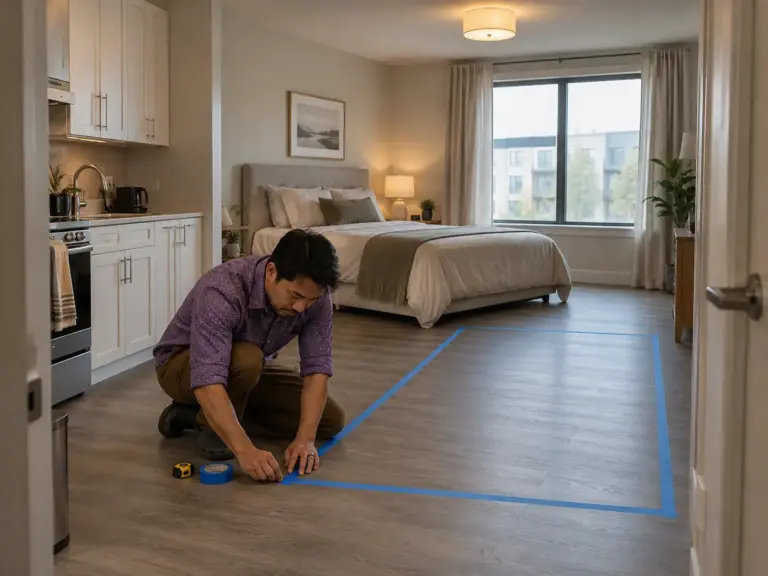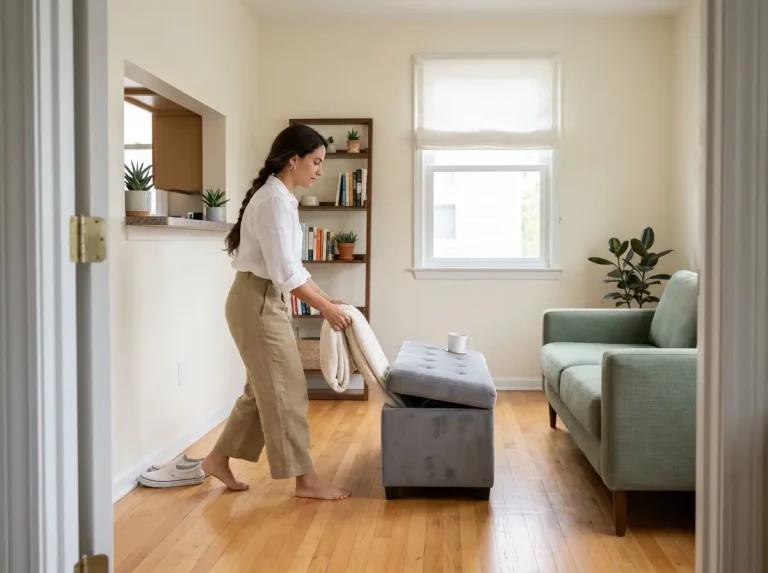
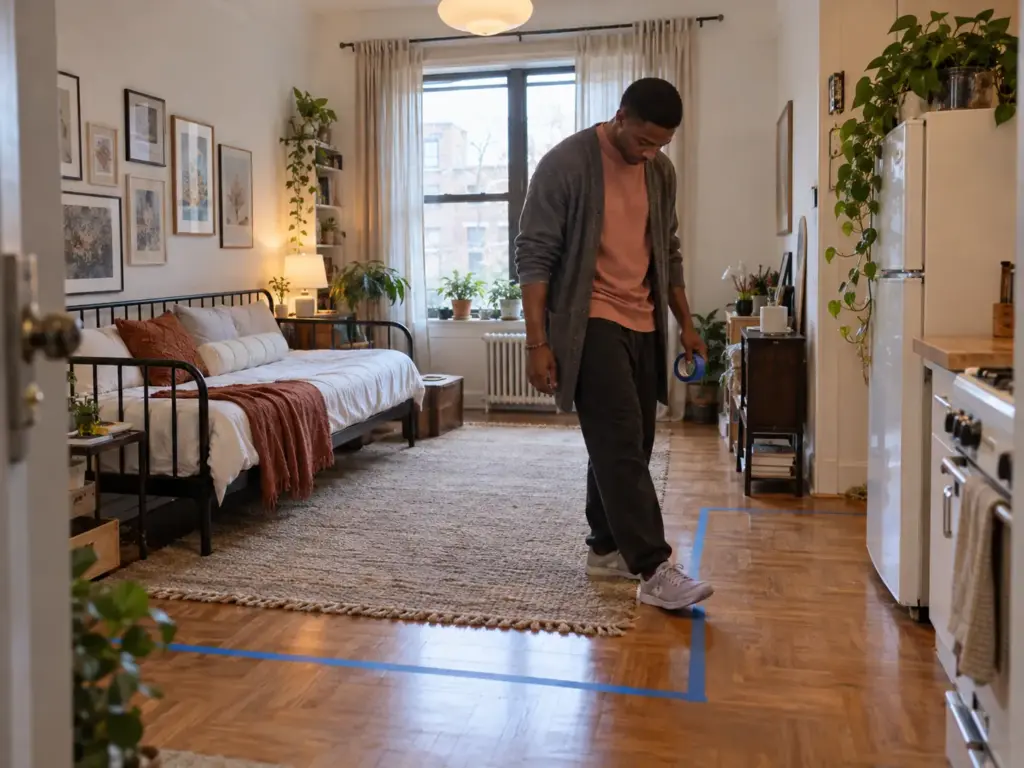
You have an empty room, a lease date and a cart holding a sofa, a table, a shelf and a bed that each looked right in their own product photo. None of it has a place yet, because the best furniture for studio apartments is chosen around the bed, and the bed is the one thing the cart has not settled. Threads from people furnishing a first studio keep landing on the same two regrets: the pull-out sofa that suits guests and fails as a nightly bed, and the table bought before anyone knew where the bed would go. So this guide runs as a buying order for studio apartment furniture: bed wall first, then the bed, the seat, the table and the divider, then a check at month three.
Here is the whole order in one table, before the reasoning.
| Piece | What it replaces | Floor space it costs | Owner or renter |
|---|---|---|---|
| Wall or Murphy bed | A freestanding bed | Gives the floor back in the daytime | Owner, installed |
| Daybed or sofa bed | The bed and the sofa in one piece | Its full footprint all day, plus the open depth of a pull-out | Renter |
| Storage ottoman | The bench by the bed | A strip along one wall | Either |
| Drop-leaf or gate-leg table | A fixed dining table | Narrow folded, wider only while in use | Either |
| Small desk that doubles as a table | A separate desk and a separate table | One surface, cleared each evening | Either |
| Bookcase divider | A wall between sleep and living | About 12 inches of depth per unit | Either, anchored |
Best Furniture for Studio Apartments Starts With the Bed Wall
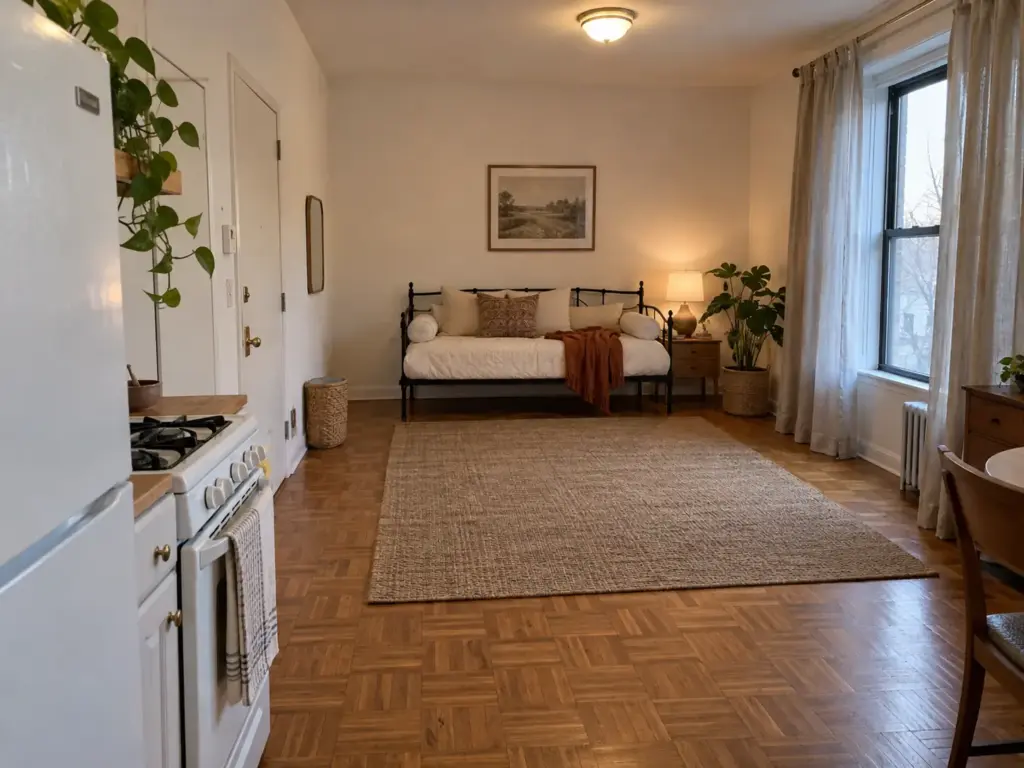
Pick the wall for the bed before you pick the bed
The first-studio moment is a familiar one. Someone moving the next month with no plan yet may ask whether a daybed against the left wall, pulling out toward the doors, could work. It is a sensible question asked in the wrong order. A daybed is a type of bed, and the type cannot be judged until the wall is chosen, because the wall decides how much floor the bed is allowed to take.
The advice that came back is worth building on: put the bed as far as possible from the door and from the kitchen. Those are the two spots in a studio that stay in use from morning to night, so a bed beside either one is a bed in the traffic. Once that wall is picked, the sleep zone becomes a fixed rectangle, and every other purchase is measured against what is left of the room. A table bought first gets its position from a room that does not yet have a bed in it.
The walkway the other pieces must leave open
Pieces bought one at a time each take only a little. The sofa gets a few inches more than it needed, a shelf stands out from the wall, a bench slides up beside the bed, and the room that looked open in the listing photos turns into a series of detours around furniture corners. The walkway is what you spend, so it has to be written down before anything is bought. A corner that looks like dead space on the plan is usually where the walkway needed to be.
Two numbers cover the walkway clearance. The main path through the room wants 30 to 36 inches, and the side of the bed you get out on wants 24 inches clear. Every later piece, the sofa, the table, the divider, may take floor only until it reaches one of those two lines.
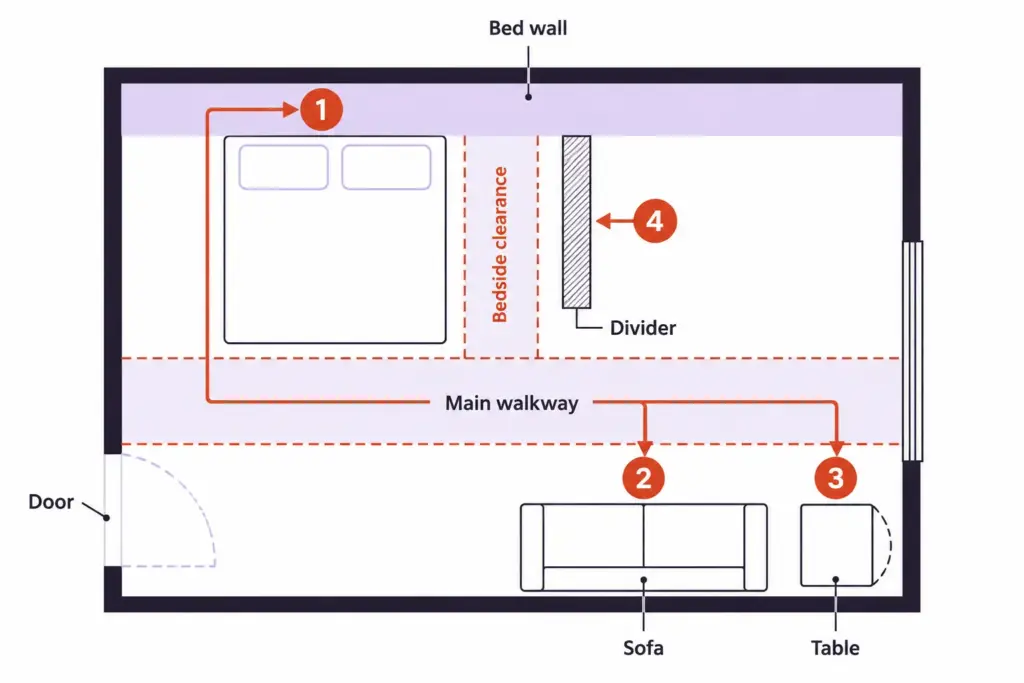
A pull-out changes the arithmetic of the sofa footprint, because it is measured open, not closed. A queen sleeper’s open sleeping surface runs 58 to 60 by 72 to 80 inches, and with 24 inches beside the mattress, seller figures put it at roughly 96 to 104 inches of floor. If the room cannot give that, the sofa bed was never a candidate, whatever the product page says about its folded size. The tape test and the wall-by-wall math belong to the guide on where the walls and the door leave room for a bed, so this article does not repeat them.
The order the rest of the buying follows
The sequence is five decisions, and each one narrows the next:
- The bed wall fixes the walkway and leaves a single zone for sleeping.
- The bed is chosen by the lease and by how much floor it needs when open.
- The seat is sized to the wall it faces, and only after the bed has taken its share.
- The table is whatever folds or doubles, placed against what remains.
- The divider comes last, because it only separates zones that already exist.
The headings below run in the same order on purpose. A shelf bought at step five has nowhere to stand if step one was skipped, and a shelf bought at step one tends to end up exactly where the bed needed to go.
Write the five steps at the top of your cart page. Any item that cannot say which step it belongs to waits until the earlier steps are settled, and the pieces left at the end of that sort are usually the ones the room did not need.
Wall Bed for Owners, Daybed or Sofa Bed for Renters

What an owner can do that a renter cannot
Gallery photos of studios keep showing the same bed: a wall bed folded into cabinetry (sold as a cabinet bed or a Murphy bed), the room reading as a living room by day. For the person who owns the place, it is a strong answer. For anyone whose lease forbids drilling, it is no answer at all on day one, and that second reader is who this section is written for.
Owners first. A wall or Murphy bed is the route that gives the floor back in the daytime, which is the reason the threads keep naming it alongside the bed with built-in storage. This section names categories, not models: none of these beds could be confirmed as buyable on Amazon when this was written, and a bed is not a piece to recommend blind. How a wall bed fixes to the wall is a matter for the maker’s instructions and whoever installs it, so nothing here describes it or claims a load figure.
Renters start from the opposite constraint, which is nothing that needs a bracket in the wall. The no-drill wall bed alternative is a freestanding bed, so it keeps its footprint all day, and the saving has to come from renter-friendly furniture that earns its floor: drawers or a lift underneath, a sofa that also sleeps, or simply a smaller rectangle than the one in the cart.
The freestanding route: daybed, storage bed, sofa bed
Each freestanding option trades something, which is the honest limit of space-saving furniture on a lease. A daybed is a sofa by day and a bed at night, and the direction it pulls out is part of the footprint, so that is the right question to ask. A storage bed puts drawers or a lift-up base under the mattress, and if the budget stretches, the gas lift type is the one to choose. The sofa bed needs its own part, because it fails differently.
If you are leaning on under-bed storage, check the gap first. A standard frame leaves about 8 inches underneath and a platform bed leaves only 4 to 6. A storage bed swaps that gap for drawers or a lift, so the swap gains a lot on a platform frame, while on a standard frame it is worth checking what the 8 inches already holds before paying for the upgrade. The guide to the order a studio gets set up in walks the bed zone through exactly that measurement.
Budget honesty belongs here, because the bed is the largest purchase in the room. For budget convertible furniture, the cheapest route is the bed you already own, set against the right wall. The order in this article means the first purchase is a decision, and a decision costs nothing.
Why the sofa bed that works for guests fails every night
A sofa bed, which is a convertible sofa with a mattress folded inside, reads as the efficient answer: one piece, two jobs. It holds up only while the second job is occasional. Sleeping on pull-out sofas is often really uncomfortable over the long term, because they are not designed for it. For the weekend guest that is fine, and for the person whose bed it is every night it is the wrong tool.
Pull-out sofa comfort comes down to nightly use, not to the product page.
What the pattern does give you is a test that matches the use. If the sofa bed will be your nightly bed, sleep on it for a full week before the return window closes, and judge it by the seventh night, not the first. The guide on sofa-bed clearance and the gas piston failure covers the open-depth side of the same decision.
Seating That Stores Something and Still Leaves a Path
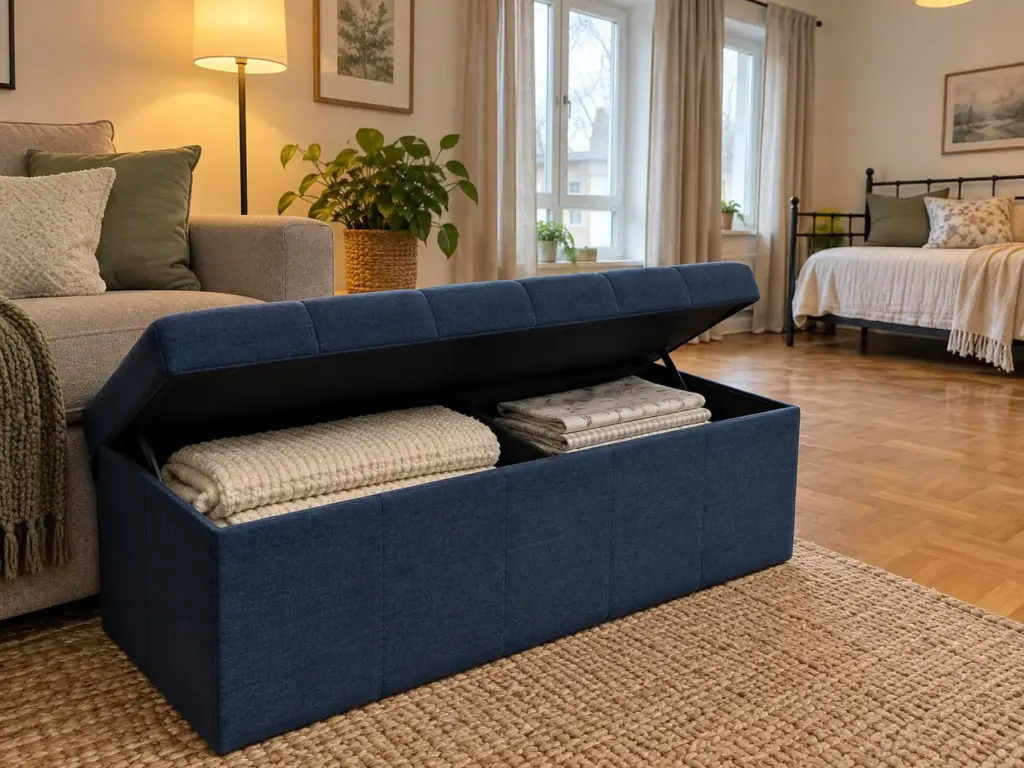
One seat that stores beats two that only sit
Picture the finished room: a bed, a sofa, and a bench at the foot of the bed. Three seats, none of them storing a thing, and the bench has taken a strip of floor the walkway needed. The usual advice is to add a bench by the bed, and in a studio that advice spends floor and gives nothing back.
A storage seat does the bench’s job and a second one. The SONGMICS Storage Ottoman Large measures about 43 by 16 by 17.5 inches and carries a listing load of 660 pounds, so it works as a second seat in the living zone and holds the throw blankets or the spare bedding inside it. The free alternative comes first: if the bed edge already serves as a seat for one extra person, a second seat is only worth floor space if you host often enough to use it.
Tape a 43 by 16 inch rectangle on the floor where the ottoman will go, then stand a chair against its long side. If you cannot lift an imaginary lid with the chair there, the spot is wrong, and it is cheaper to learn that with tape.
Scale the sofa to the wall, not to the showroom
The 2/3 rule is the sizing rule worth carrying: the sofa should take up about two thirds of the wall it faces. That leaves the remaining third for a side table, a floor lamp or simply the gap that lets a person pass. An apartment-scale sofa is sized to the wall, while one sized to the showroom fills the wall edge to edge, and in a studio the wall is also where the walkway lives.
The sofa is the largest soft piece after the bed, so it takes the biggest bite out of what the bed left. Full-size furniture on two adjoining walls, a sofa and a daybed, can eat the main path between them, and that is the moment to go back to the 30 to 36 inch figure from the first section. If the path falls short, the sofa gets smaller before the table does.
Where the ottoman goes in a room that has a bed
The ottoman’s failure mode is a placement one: a lid that cannot open because something sits against it. A chair, the end of the sofa or the bed frame can each do it. This is a check on where it stands, not a defect in the piece, and the placement that works is the one where the long side stays free.
In a room that has a bed, the living zone is the safer home for it, away from the 24 inches beside the mattress. A lift-top coffee table is the other piece of multi-functional furniture people reach for here, and it passes the same placement check. Pieces like this have their own specs elsewhere, and the guide to ottomans, lift-top tables and drop-leaf pieces with their dimensions carries them so this one does not have to.
A Table That Folds Away and a Desk That Shares It
A drop-leaf table gives you somewhere to eat that is not the bed
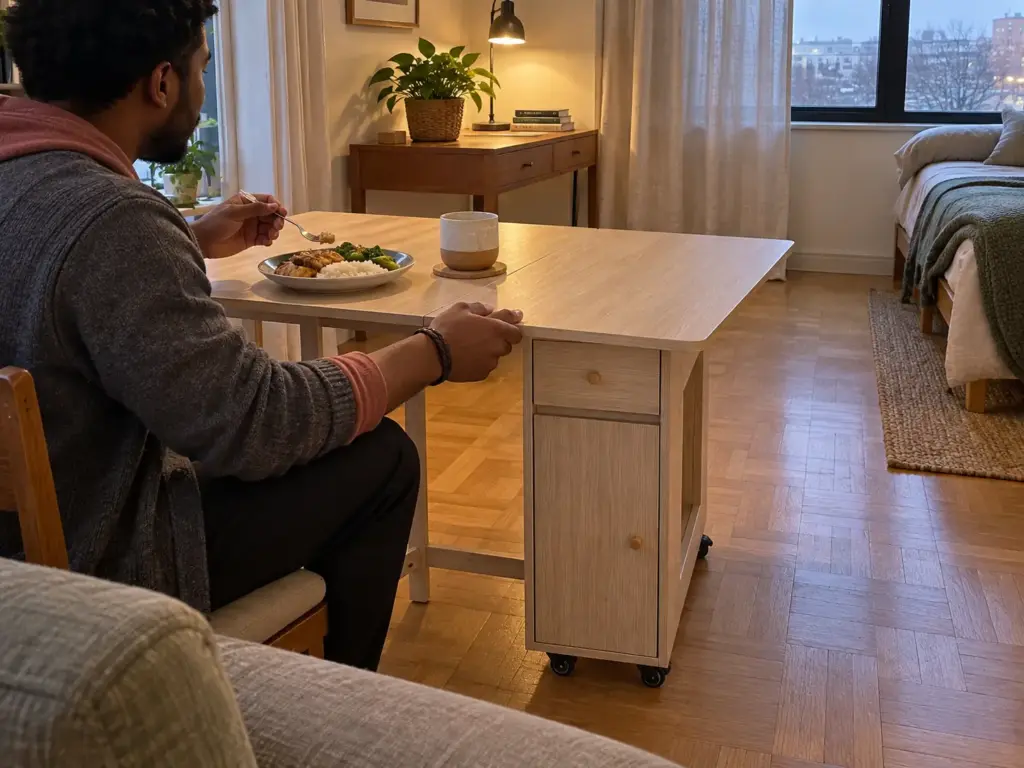
Look at the corner where the laptop, the plate and the bag all want the same flat surface. In a studio with no table, that surface ends up being the bed, and the bed is also where the crumbs end up. A dining zone in a studio does not need a dining room, only a surface that is not the bed. The cleanest answer is a gateleg table, a drop-leaf table or a wall-mounted folding table with stackable stools or chairs, which gives you a place to eat that is not your bed or sofa and folds away when you are done.
The VASAGLE Drop Leaf Folding Dining Table is that idea in a buyable form: it opens to a dining surface and folds back toward the wall, and because it stands on its own it suits a lease that bans drilling. The listing’s dimensions are the number to check against the 30 to 36 inch path, since a table that is fine open can be too wide only when it is open. If you want to start with no spend, eat at the desk you already have for a week and see whether a second surface is even needed.
The cheaper version in the same section
Money enters this section through the table, because a folding table is the budget route instead of a dining set. Within one listing category there is also a tier. The COMUHOME Extendable Drop Leaf Folding Table with Drawer and Wheels is the budget pick in the same section, and it adds a drawer and wheels to the folding idea. Only the live listings confirm the price gap.
The trade is in what you value.
A drawer gives you a place for the placemats and napkins that otherwise live on the surface, and wheels let the table travel to wherever it is used, which suits a room where the dining spot moves. Build quality matters more than extras here, because the leaf hinge is the part used every day, so read the buyer comments on it. If neither extra matters, the plainer folding table does the same job, and gate-leg and wall-mounted versions show that the category is wider than one shape. No prices are quoted here because they move; compare the live listings the day you buy.
A desk that doubles as the dining table
The thread offers a second route to the same result: a dining table doubling as a desk, and the reverse. A small desk that doubles as a dining table beats trying to squeeze in both. The Lufeiya Small Computer Desk is 31 inches wide with two drawers, which fits a narrow desk nook and gives you a surface for both jobs. A foldable desk takes even less floor, if drawers are not part of the plan.
The cost of the shared surface is a daily one. A desk used as a table must be cleared every evening, or dinner happens on top of the work. The drawers help by giving the cables and papers a home that is not the surface, and the guide to compact desks that still leave room for the chair covers the chair-clearance check that a desk this narrow has to pass.
Keep one shallow tray beside a desk that doubles as a table. Clearing the work surface then takes one armful instead of a sort, and a chore that takes ten seconds survives longer than one that takes ten minutes.
Furniture That Divides the Room, Anchored Before It Is Loaded
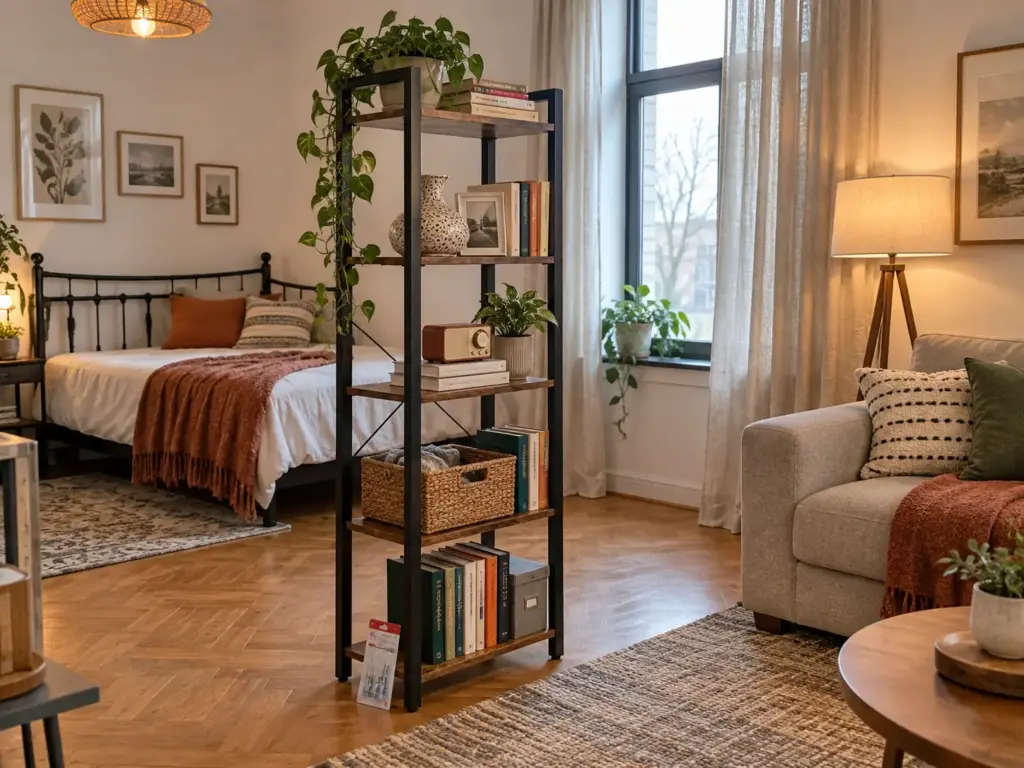
A narrow bookcase as a post, not a wall
The shelf that holds the books well is fine until the day someone leans on it, and in a studio the shelf is also the line between the bed and the sofa. The reason to divide at all is the bed in plain view from the couch, which makes the whole room read as one bedroom. Zoning furniture of this kind, a tall, shallow piece, draws that line without closing the room.
The VASAGLE 5-Tier Bookshelf is 11.8 inches deep, 15.7 wide and 60.2 tall, per the maker, so on a 36 inch path it leaves about 24 inches clear. It is vertical storage that doubles as room divider furniture. One unit is a post, not a wall; a row of two or three, each anchored, is the divider. The maker includes an anti-tip kit.
Holes can be missing or in the wrong places, so count the hardware when the box arrives. A big-box cube shelf is a common divider, and the same logic applies, since a unit with storage that is not too solid still gives some personal space. The room-divider guide lays out dividers compared by how much window light they take; this section picks the furniture divider only.
What the federal anchor rule says, and what it does not
According to Anchor It!, “Dressers, armoires and other clothing storage furniture, must meet stability standards” and include anchor kits as of September 1, 2023. Read that exactly. The standard names dressers and armoires, not bookcases, so anchoring a bookcase is the safe habit and not the legal requirement. The habit is still the right one for a tall unit standing in the middle of a room.
The page behind this, Anchor It!, the federal anti-tip campaign, also answers the renter’s usual objection: repairing the wall after an anchor comes out takes minutes. That removes the main reason for skipping the anchor in a rental.
The renter route: an anchor that comes off at move-out
For a lease that bans drilling, an adhesive anti-tip anchor is the practical route. The No Drill Anti Tip Furniture Anchors, Adhesive Wall Anchors (6 Pairs) pack has six pairs and comes off for move-out, which is what a rental needs. This pack is a substitute for an earlier pick, so its weight rating has not been compared against the shelf you will load: read the rating on the listing, set it against what the shelf will hold, and let the mismatch decide. The fitting itself belongs to the maker’s instructions, which this article does not paraphrase.
What Still Works at Month Three and What Doesn’t
The pieces that fail by habit, not by hardware
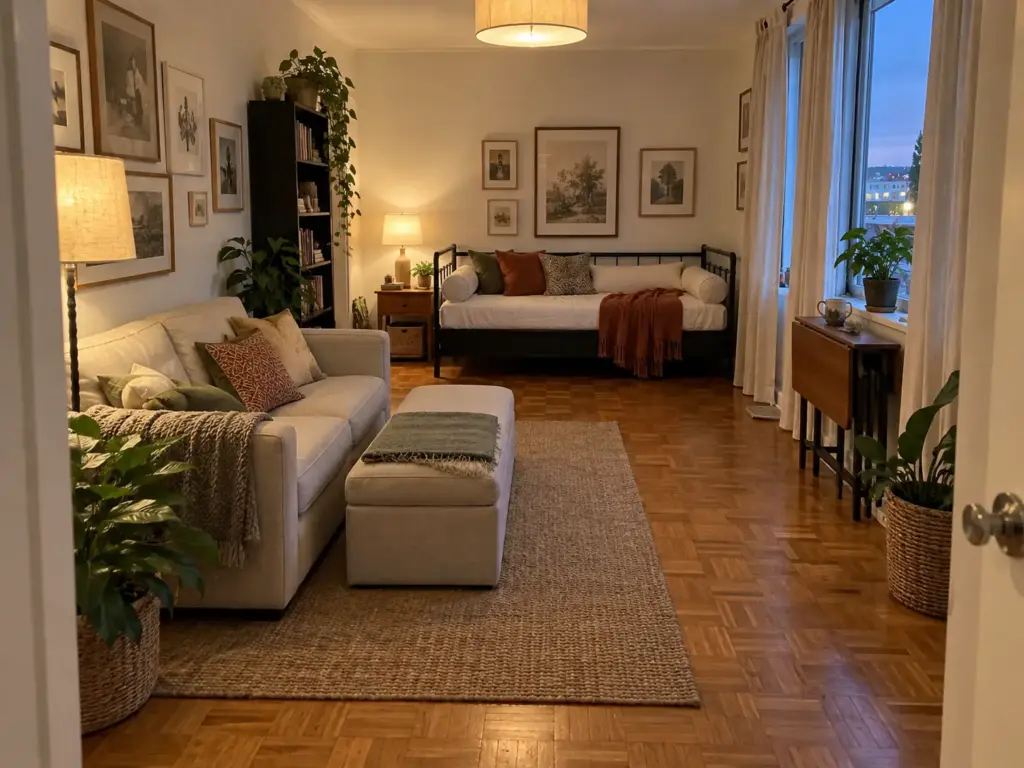
Picture the studio at the end of a long week with one piece that has quietly stopped doing its job. The leaf stays up because folding it is one more task, the ottoman lid has a chair against it, the sofa bed has become the sofa because nobody sleeps on it. None of these is a broken piece. They are habits the piece depends on, and when the habit fails, the table lives open, the walkway shrinks and the room goes back to the cart it started as.
A note on scope: none of this rests on measured hardware failure rates for hinges, cushions or leaves, so treat each check below as a thing to look at, not a prediction. The guide to the studio storage ideas that fail by month three carries the same month-three frame on the storage side, and the two read well together.
A short check for each piece, with what to do next
- The drop-leaf or folding table: is the leaf still folded most evenings? If not, move the table to a wall where it can stay open without costing the path, or fold it every evening for a week and see if the habit sticks.
- The storage ottoman: does the lid still open with something near it? If not, move the ottoman to the free side of the sofa before replacing anything.
- The sofa bed or daybed: is it being slept on as planned? If a sofa bed is not, accept that it is a sofa and put the real bed on the bed wall.
- The bookcase divider: does it stand without leaning? If it leans, add the second unit beside it so the row braces the post, and recheck the anchors.
- The anchors: is the adhesive still holding after the shelf is loaded? If it has shifted, take the load off first, then replace the anchor rather than trusting it twice.
The free fix comes before any replacement. Move the piece to a different wall, or fold it every evening for a week, and only buy something if that does not solve it.
The Buying Order, Start to Finish
Three things carry the rest. Fix the bed wall first, because the bed decides the walkway and the walkway decides everything else. Choose the bed by the lease: an installed wall bed for the owner, a freestanding daybed, storage bed or a sofa bed you have actually slept on for the renter. And let every later piece, the seat, the table and the divider, answer to the 30 to 36 inch path, not to its own product photo.
At month three, look at which piece you are working around. The one you step over, move aside or leave open is the piece that has stopped fitting, and the free fix is to move it before replacing it. Multifunctional furniture earns its place only when the second job is actually used.
Today, with only the studio furniture you already own, stand on the bed wall you chose and walk to the door. If the path is narrower than 30 inches anywhere, that is the spot your next purchase should leave alone. Notice what the room does afterwards, and carry the same method through the rest of the room with the full studio apartment organization plan.
Frequently Asked Questions
01What is the best furniture for a studio apartment?
The best furniture for a studio apartment is a bed chosen by your lease, a seat that stores, a table that folds and a divider that is anchored. The order you buy them in matters more than the brand. Start with the bed wall.
02What is the 2/3 rule for furniture?
The 2/3 rule sizes a sofa to about two thirds of the wall it faces, leaving the last third for a side table or a gap to pass through. The guide to arranging furniture in a small living room explains it.
03What is the best way to furnish a studio apartment?
Furnish in sequence: bed wall first, then the bed, the seat, the table and the divider. Each piece is allowed to take floor only until it reaches the walkway. The studio apartment layout guide handles the walls and clearances.
04What are the must-haves for a studio apartment?
The must-haves are a bed that fits your lease, a place to eat that is not the bed, and a seat that stores something. Everything else, including the divider, is optional until those three are settled.
Disclaimer: ClutterlessNest is a participant in the Amazon Services LLC Associates Program. As an Amazon Associate we earn from qualifying purchases. This article may contain affiliate links — if you buy through them, we may earn a small commission at no extra cost to you. We only recommend products we have tested or genuinely believe in.