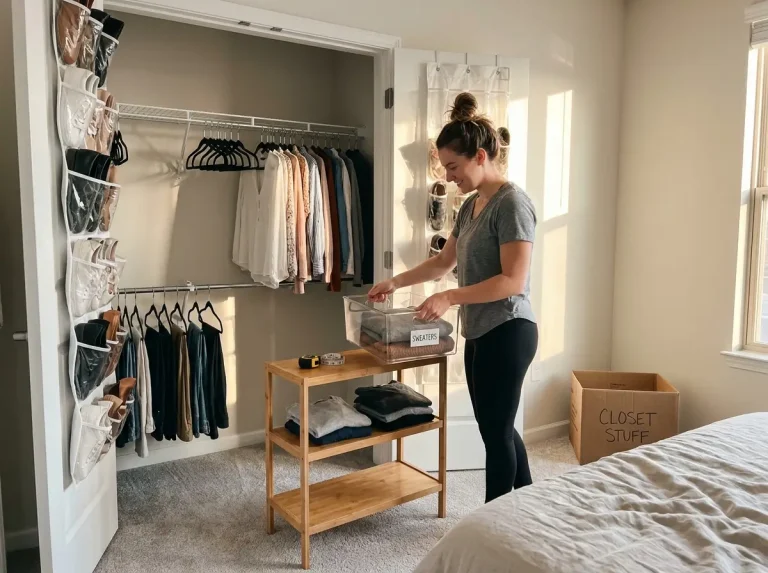

You are standing in a hallway with a cart of boxes, a phone full of saved dorm room organization ideas, and a painted cinderblock wall that is about to veto half of them. The hooks want a smooth surface, the rolling bins want a floor that rolls, and the tall drawer tower wants a wall you may not be allowed to drill. The idea is rarely what fails in a dorm; the wall, the floor and the housing rulebook decide that before the first box is open. Below, each idea is sorted by the one thing it depends on, with three to skip, and the hall rules quoted here come from published housing policies.
Two quick checks come first, then six families of ideas, then the skip list, and the rules, the measuring and the reset that keeps it all working live in the full dorm room system.
Quick Answer
Settle the room’s two limits first, then spend in this order:
- Ask housing which adhesives your hall’s walls allow before ordering anything.
- Push a rolled bin across your floor to see whether carpet drags it.
- Use the back of the door and the closet rod before any wall.
- Match under-bed bins to your bed’s height, and roll them only on hard floors.
- Fit a mesh organizer to the desk drawer, then add one multi-use seat last.
- Skip hanging cubbies, small plastic drawer carts and any tall drawer tower you cannot anchor.
Two Checks That Decide Most Dorm Room Organization Ideas
A saved idea almost always assumes a smooth drywall wall and a hard floor. A real dorm room often has painted block, a carpet, and a housing office with firm opinions about both. The wall check and the floor check sort the dorm room storage ideas below in about ten minutes and cost nothing, which is why they come before any product.
Which Wall Do You Have?
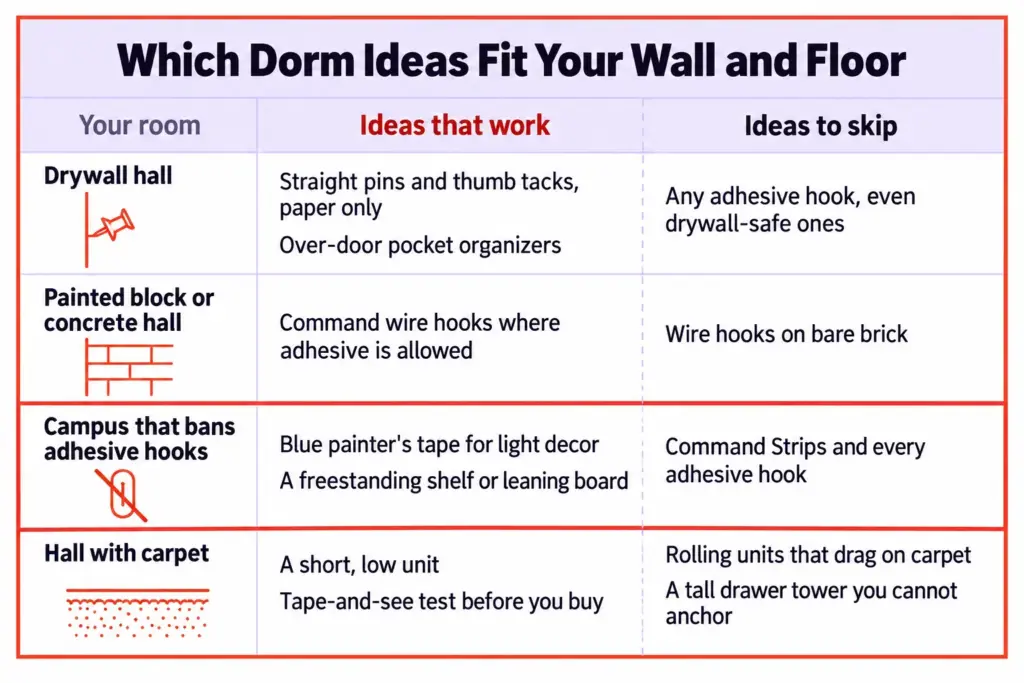
Housing policies split by wall material, and the split is sharp. Western Kentucky University’s housing adhesives policy bars every adhesive on drywall halls, including the “drywall-safe” kind, while concrete halls may use light adhesives, with damage charges still possible if something goes wrong. Other campuses skip the nuance. CSB’s room move-in guidance says “3M Command Strips are damaging to the walls and are not allowed,” and points students to blue painter’s tape instead.
So the plan cannot hang on a single adhesive hook. The usual no-drill advice is to stick a strip up and call it done, and that advice is the first to fail in a hall that bans the strip; the better call is a plan that works on the strictest wall you might be assigned, with the hook as a bonus where the rules allow it. The question for the housing office or the move-in packet is short: which adhesives are allowed on my hall’s walls, and what do you charge for damage? Ask it before the order goes in, not after the box arrives.
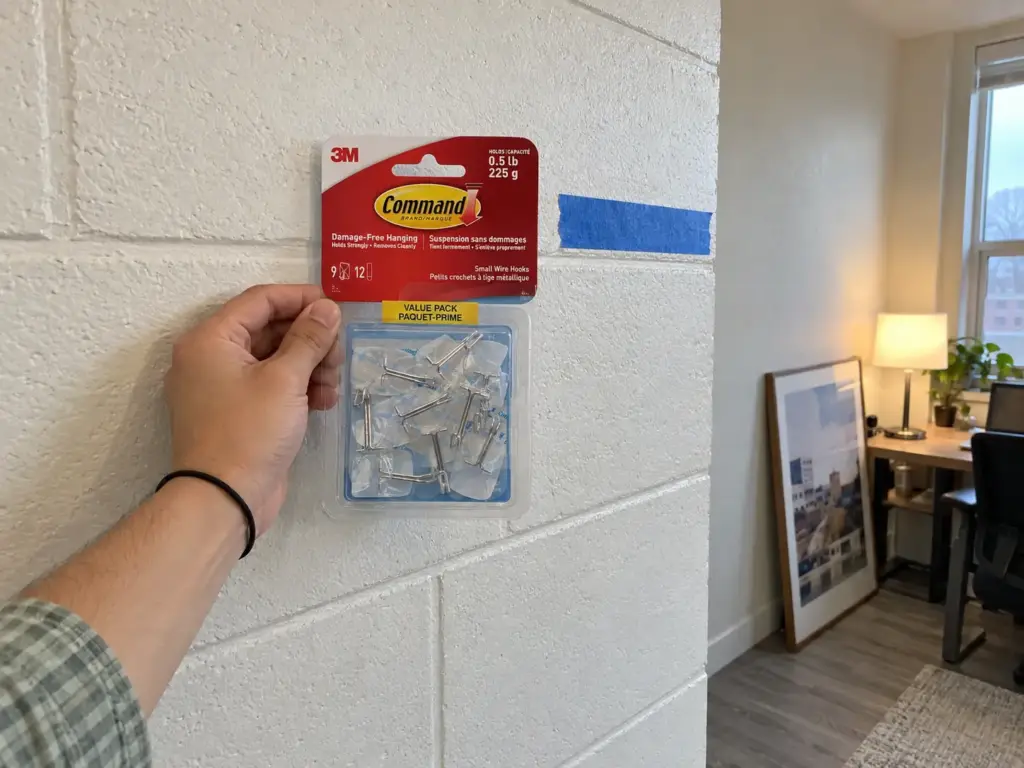
Painted cinderblock is where the hook question gets interesting.
A retailer listing for one of Command’s heavier-duty hooks names painted walls, painted concrete cinder blocks and concrete as surfaces it sticks to, and tells you to clean the surface with rubbing alcohol first and to remove the hook by pulling its tab straight down. That is a listing claim, it covers painted block only, it says nothing about a bare brick wall or unpainted block, and the same surface list is not confirmed for the wire-hook model.
If your hall allows adhesive and your wall is painted block or concrete, Command Large Wire Hooks are the hook to buy, and only for light things like a lanyard, a tote or a towel. They are a poor plan on a drywall hall and no plan at all on a campus like CSB. Stock on this multi-pack has run thin, so check that it is still listed before building around it.
The same logic carries into the closet. Anything that hangs from the rod or the door instead of the wall passes every policy above, and no-drill closet organization shows how far that approach goes.
What Your Floor Does to Anything With Wheels
Carpet is what decides whether a rolling unit glides or drags. Small wheels sink into pile, the bin tilts, and a container that rolled beautifully on the hallway tile now takes two hands to pull. On vinyl or bare floor the same bin slides out with one finger. The floor also matters for tall furniture, because the federal tip-over test for dressers is run on carpet, a point that comes back in the last section.
But keep it simple for now: if your room is carpeted, treat anything with wheels as unproven until you have tested it, and favor flat and soft formats under the bed.
The Ten-Minute Check Before You Order
Start with the free version. Put a strip of painter’s tape on the wall for a day and see whether it comes off clean and whether anyone from housing objects. Then take a rolled-up bin, or anything with wheels you already own, and push it across the floor where the under-bed storage would sit. If the tape holds without trouble and the wheels glide, you have two green lights and a short shopping list.
The rest of the room, from the full housing rules to measuring everything else, belongs to the housing rules and the tape measure routine, and this article only runs the two quick checks.
Four cases come out of the checks.
On a drywall hall, no adhesive of any kind is allowed, so the door, the bed frame, the desk and freestanding pieces carry the load. On a painted block or concrete hall that allows light adhesives, a few hooks for light items become reasonable. On a campus that bans adhesive hooks outright, painter’s tape and freestanding storage are the options. On a carpeted floor, flat boxes and soft bags beat anything with wheels.
Save the housing office’s reply to your adhesive question as a screenshot or a starred email. A move-out damage charge gets argued from what you were told at move-in, and a saved answer settles it faster than anyone’s memory of a hallway conversation.
Under-Bed Ideas That Depend on Your Floor
Storage under bed frames is the largest block of storage a dorm room offers, and it comes with two variables you do not control: how high the bed sits and what the floor is made of. A stack of bins bought for one bed height and delivered to another is the most common under-bed mistake, so the bed gets measured first and the bin second.
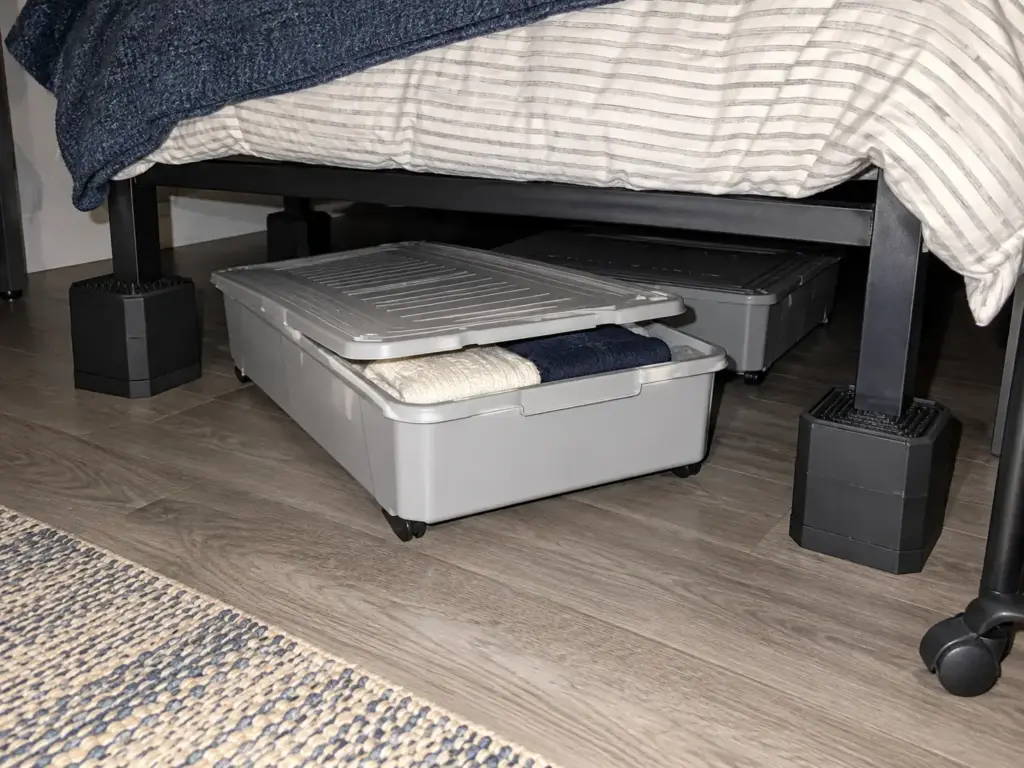
Dorm beds are usually Twin XL, which fixes the mattress and leaves the height as the variable. A raised dorm bed sits roughly 25 to 43 inches off the floor, and risers add roughly 3 to 8 inches on top of that, according to a college move-in guide that lists both ranges. Those are wide ranges, which is the point: your frame could be at either end, and the bin that clears one end will not clear the other.
Risers Buy Height, Not Storage
Use the height you already have before buying anything. Slide your tallest candidate bin under the bed (the one you already own, not the one in your cart), and if it clears with room to spare, you are done and the riser stays in the cart. A riser does the work of a new bed frame without changing the frame, which makes it useful when the bin you want is a few inches too tall, and pointless when it is not. Clearance math for the same problem in a small apartment lives in riser and clearance math, and the logic transfers directly.
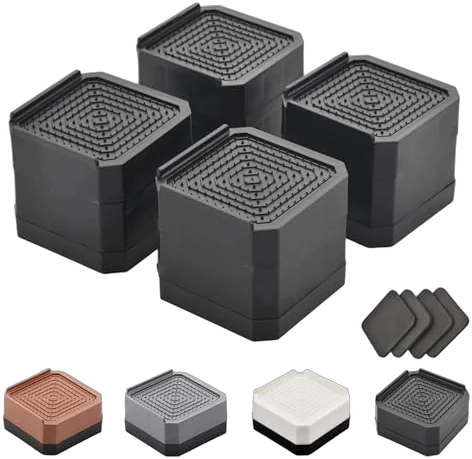
And if your housing packet says anything about bed modifications, a riser falls under it, so that is the same email as the adhesive question.
Rolling Bins Need a Floor That Lets Them Roll
Dorm move-in guides repeat the same warning about rolling bins: they may not work as well if the floor is carpeted. The mechanism is the one from the floor check, wheels that sink into pile. Rolling underbed storage is the right format for a bare or vinyl floor, because it turns the whole under-bed space into a drawer you can open with one hand.
For that room, the Aethel Under Bed Storage with Wheels, 2-Pack is the rolling pick. It comes as a pair of low-profile bins on wheels, so the whole under-bed gap becomes two drawers. On carpet it inherits the drag problem of every wheeled bin, which is the flaw to weigh before ordering. Stock on this one has been limited, so confirm it is still listed before you plan around it.
The failure to plan for is a rolling bin that sticks halfway out and gets left there, because carpet made it a chore to push back. The system becomes the floor. A flat box that never needs to roll, or a bin with a handle you can drag, avoids the whole cycle, and the longer comparison sits in rolling versus flat under-bed storage.
Flat Boxes and Soft Bags for the Carpeted Room
Soft bags suit seasonal and off-season clothes, because they ask nothing of the floor. Slide one in at move-in (before the room fills up), pull it out when the weather turns, and the carpet never gets a vote. Flat boxes work the same way for anything you reach for once a week or less.
One format needs a warning of its own. Vacuum-sealed bags look like the obvious answer for bulky winter clothes, and under a low bed they behave differently than they do in a closet, so read why vacuum bags fail under low beds before packing any.
Over-the-Door and Closet Rod Ideas for a Closet With No Drawers
A dorm wardrobe usually gives you one rod and nothing else, in a room shared with a roommate who has the same ideas you do. The good news is that the closet and the back of its door can hold a surprising amount without touching a wall or a floor.
The Back of the Door Is Free Wall
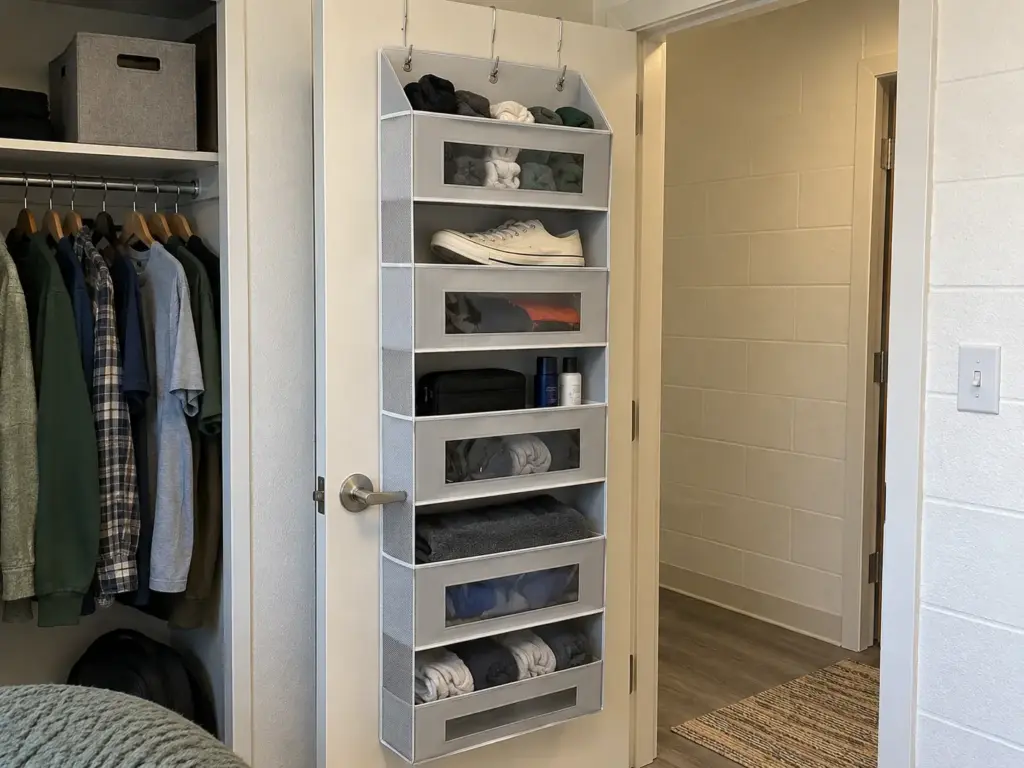
The over-door format uses neither the floor nor the wall, so it clears both checks from the first section. That makes it the safest idea in this article, and the first one to buy if the policies feel restrictive.
The SimpleHouseware Over-The-Door Organizer has five tiers of pockets and hangs over the door with no adhesive and no screws, which is why it survives a no-adhesive rule. It holds the small stuff that otherwise lands on the desk: chargers, toiletries, snacks, socks.
The weak point is the door itself. Storage guides describe thin or hollow dorm doors that complain under a full organizer, and the clearance at the door frame decides whether the door still closes. A closing door that slams on a stuffed organizer is the usual end of this idea, so test the fit with the pockets empty first.
The free option is already on the door: look for hooks that came with the wardrobe, because a hook that exists is a hook you do not need to buy. And if the organizer is for shoes, over-door shoe organizer ideas goes into the pocket sizes.
The pocket organizer is the obvious pick, and in a room where the door closes with almost no gap at the frame it is the wrong one. There, a slim run of hooks or hangers on the closet rod does the same job without adding an inch of thickness to the door.
Hanging Organizers and Rod Extenders
Slim velvet hangers do real work in a one-rod closet, because the thinner the hanger, the more clothes the same rod holds. A closet rod extender adds a second hanging level for shorter items, and a hanging shelf organizer turns the vertical gap into shelves. None of it touches the wall. For the sagging problem that sinks cheap versions, hanging closet organizers that won’t sag sorts the sturdy ones from the floppy ones.
Hang the closet by how often you reach for things, not by type. Daily clothes go at arm height on the rod, and anything seasonal goes high or into a bag under the bed. A closet that follows your week stays tidy, and one that follows the category chart does not.
Who Gets Which Hook
In a shared room, the door and the rod are shared too, and the split is simple to make before anyone argues. Divide the pockets or the hooks in half, one side per person, with a different color of tape or tag marking each. A shared-door split is a standard dorm guide recommendation because it takes ten seconds to set up and prevents the slow drift where one roommate’s coat colonizes both sides. The larger conversation about how two people share one room is part of the roommate split, so this section stops at the door.
Wall Ideas for Halls That Ban Adhesive
The saved photo of a gallery wall of hooks and shelves meets a policy that says no. Before giving up on the wall entirely, it helps to see what the policies still leave open and which ideas move elsewhere.

What the Policies Still Allow
Western Kentucky’s drywall halls allow straight pins and thumb tacks as the decor method, and CSB points to blue painter’s tape. Both are sourced and both are narrow. They hold paper and light things: a print, a class schedule, a postcard. A wall that only holds paper is not a storage wall.
Weight goes somewhere else. The door carries it, as in the last section, and so do the bed frame and the desk. A freestanding option beats a wall option in a hall that bans the wall, so a freestanding garment rack or a bench is a better answer than any workaround stuck to paint.
In a concrete hall that allows light adhesives, a few hooks for light items, such as a lanyard, a bag or a towel, are reasonable, with damage charges still possible. This is the one place the wire hooks from the first section earn their cost.
Putting the Wall to Work Without Marking It
A magnetic board, a dry-erase board or a whiteboard only helps where something holds it. If the wall will not hold it, the board leans against the desk, and a leaning board takes up desk space instead of saving it, so a board is a purchase to skip when the wall is off limits.
Drilled floating shelves are a different conversation. If you own a home or rent somewhere that allows mounting, vertical storage ideas for apartments covers wall storage systems for a reader who is allowed to use the wall. For a dorm reader the answer is usually no, and that is fine, since the door, the bed and the desk can carry most of the load.
Desk and Drawer Ideas That Fit a Dorm Desk
The dorm desk gives you one drawer and a surface that doubles as a dinner table. Everything small that has no home lands in that drawer loose, and the desktop slowly fills with whatever the drawer could not hold.
Start With the Drawer, Not the Desktop
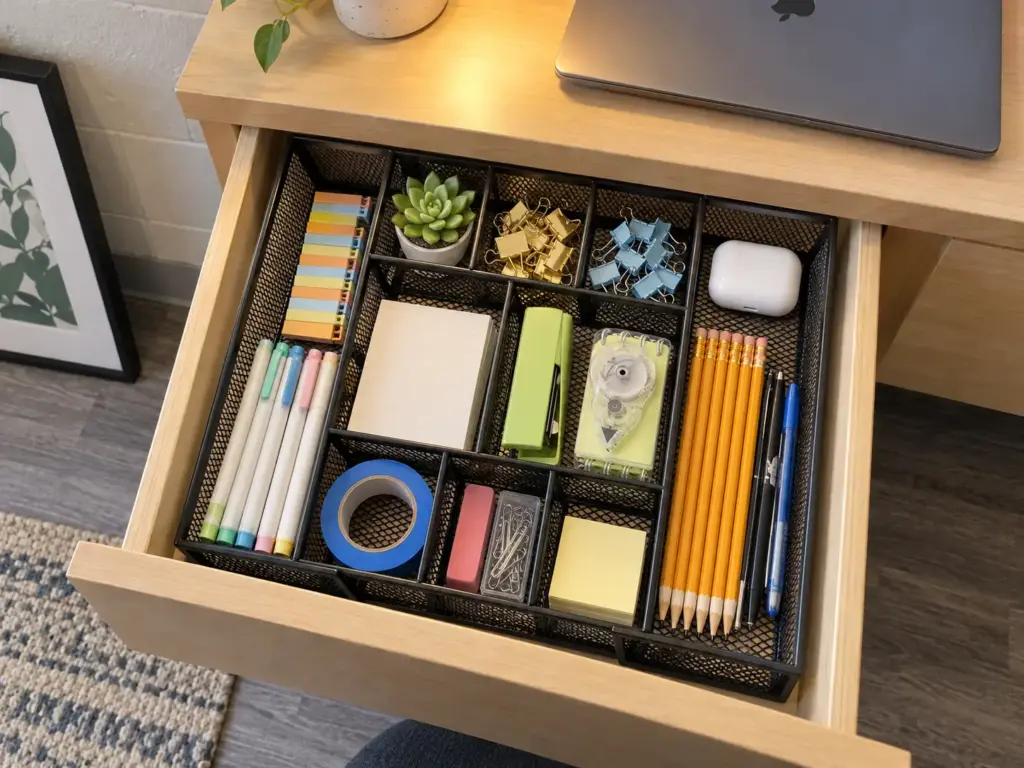
Measure the drawer width before choosing an organizer or a set of drawer dividers. An adjustable mesh organizer fits drawers that vary in width, which makes it a safer buy than a fixed tray that is an inch too wide to close. The Marbrasse Expandable Desk Drawer Organizer is a mesh tray with ten adjustable compartments that expands from 13.8 to 17.5 inches wide, so it covers a range of dorm drawers. The limit is the range itself: a drawer narrower than 13.8 inches or wider than 17.5 will not get a snug fit.
The free first step costs nothing. Sort the drawer’s contents into three piles on the bed, daily, sometimes and almost never, and see how little actually needs the drawer. The “almost never” pile (usually bigger than anyone expects) is usually what filled it. The system questions around desk and drawer are covered in desk organizers worth buying and the two to skip.
Vertical Desk Space Without a Hutch Purchase
A file rack, a small stand or a desk hutch uses vertical space without taking anything from the work surface. Keep the desk itself free for the laptop and the notebook, because a desk that cannot hold both is a desk that students end up working on the bed instead.
The failure here is a desktop organizer so large it takes the laptop’s place. Set the laptop down first, then fit the organizer into what remains. If it does not fit beside the laptop, it is too big, whatever the listing calls it. For more on the system side, desk organization ideas that last has what holds up past the first month.
Bins, Baskets and Cubes That Survive Move-Out
A dorm room gets emptied twice a year, and the container that looked perfect on move-in day may be the one that does not fold for the car. The test for any bin here is whether it survives the move out.
Fabric or Plastic?
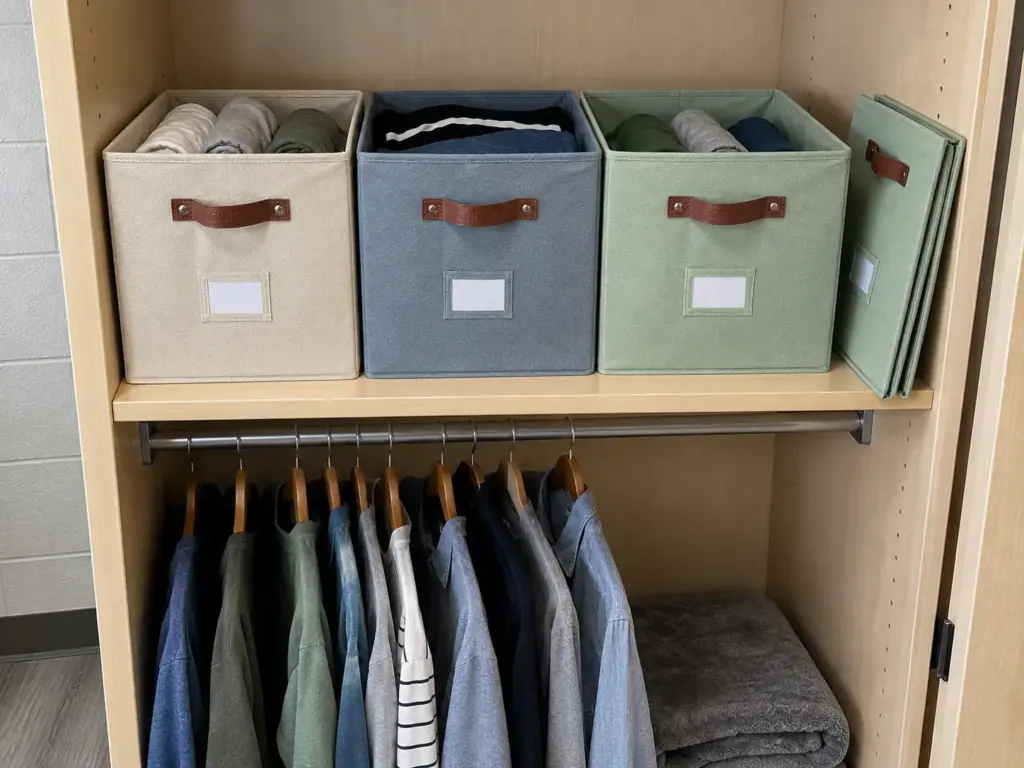
Soft fabric bins fold flat for move-out and stack inside a wardrobe, and plastic lasts longer and shows what is inside. Neither is better in general, because the trade is storage-in-use against storage-in-transit. A room that gets packed into a car twice a year favors fabric; a room with a long stay and a lot of small stuff favors clear plastic.
The DECOMOMO Fabric Cube Storage Bins with Labels are fabric cubes about 10.5 by 11 inches that fold for move-out and come with labels, which suits a shared room. What a fabric cube gives up for that folding is rigidity, so it is a poor choice for the bottom of a tall stack. The shelf’s measurements should pick the bin, not the other way around.
The budget version of this comparison is plain. A premium drawer system built for a dorm costs a lot, and a set of stackable baskets does most of the same work for far less. The cheap combination handles the job for a dorm closet, and the premium system earns its place only if you will carry it through several years of housing.
Labels in a Shared Room
Labels matter in a shared room because two people use one set of shelves. A label gives each person’s things a labeled home, turns “whose is this” into a lookup instead of a conversation, and keeps a roommate’s bin from drifting into your space.
How High to Stack Before It Becomes a Hazard
A stack of bins that reaches head height, or the shelf above, is where things come down. There is no stacking number that holds for every room, because the safe height depends on how heavy the bottom bin gets when full. A stack of light bins with sweaters is stable; the same stack with textbooks in the bottom one is not. Keep heavy things low, and keep the stack lower than you think it needs to be.
Containers that stack cleanly are a product question of their own, covered in stackable bins that actually stack.
Buy one bin and live with it for a week before buying the matching set. A bin that looked right in the listing can turn out too tall for the shelf or too wide for the wardrobe, and finding that out with a single bin is a small return instead of a pile of them.
Multi-Use Furniture That Earns Its Floor Space
A small dorm room has floor for a bed, a desk and about one more thing. That one more thing should work as hard as two pieces would.

The Storage Ottoman or Bench
An ottoman or storage bench is a seat, a footrest and a closed box in one footprint. In a room this small, that is the argument for owning one.
The SONGMICS Storage Ottoman Bench measures 43 by 15 by 15.7 inches. The length is the first constraint, because a bench that long needs a clear stretch of wall, so measure the space at the foot of the bed before you order. The second is the lid: a closed box only holds what you can reach over the top, so keep heavy things low in it and keep daily items out of it entirely.
What a Dorm Floor Can Actually Hold
Pick one piece and let it do the work. A nightstand is the other contender for that spot, and the bench stores more.
Two benches fight each other for the same wall, and a bench plus a cart plus a rack leaves no path to the door. Run the footprint of whatever you are considering against the open floor, and if it blocks the path from the door to the bed, it is the wrong piece however good the storage is. The footprint question belongs to organizing a small apartment too, and the same logic applies to a room half that size.
Three Dorm Storage Ideas to Skip and What to Buy Instead
The three ideas that look best in a saved photo are the ones that tend to cost the most to try. Each fails for a different reason, and each has a better replacement already covered above.

A photo shows the first day, with the shelves level and the drawers shut. A dorm shows the third week, with a laundry day, a stack of textbooks and a roommate’s bag already added to the load. The three skips below all pass the first day and fail the third week, which is the test every other idea in this article has to clear, shortened to a semester.
Hanging Fabric Cubbies
Dorm organizing guides describe hanging fabric cubbies as units that never stay neat. The mechanism is the soft sides: the shelves sag under the weight of folded clothes, the shape slumps, and a hanging cubby holds shapes rather than things. It also hangs from the rod, so it eats the hanging space it was supposed to free.
There is one narrow case where it works: a cubby that holds only light, flat things such as scarves or a few pairs of socks, on a rod that has room to spare. Past that, the shelves bow within a few weeks, and the folded piles lean into each other.
Replace it with the over-door pockets from the closet section or with a folded bin from the bins section. Either holds its shape, and neither takes a rod.
Small Plastic Drawer Carts
The same guides report that small plastic drawer carts do not hold very much and break under real loads. The drawers are shallow, the plastic is thin, and a cart full of the usual dorm clutter pulls the tracks out of true. What starts as a convenient rolling cart ends up as a crooked one, and the drawer that sticks is the one holding the thing you need.
Replace it with one drawer system that you size to the closet, or with the mesh organizer from the desk section. Both do the job with fewer parts that can crack. The same failure pattern in a studio is covered in studio storage ideas that fail by month three.
A Tall Drawer Tower You Cannot Anchor
A tall tower of drawers is the skip with the most weight behind it. The federal safety rule for dressers and other clothing storage units, ASTM F2057-23, has been in force since 1 September 2023. According to the Consumer Product Safety Commission’s tip-over rule for dressers, the test checks stability on carpet, with the drawers loaded and several of them open at once. That is the picture of a dorm room: carpet, drawers full of clothes, and a student pulling two drawers out at the same time.
The same release states: “CPSC recommends that consumers anchor furniture, including dressers, securely to the wall.” That advice assumes you are allowed to put a screw in the wall, which a hall that bars drilling rules out. This is not a dorm-specific rule, and it applies to any dresser, but the combination of carpet, a tall unit and a no-drilling policy is a clear mismatch. The agency’s own count is 234 clothing-storage tip-over fatalities known to staff between January 2000 and April 2022, 199 of them children.
So if you cannot anchor it, buy short and low. A shorter, wider unit is harder to pull over than a tall, narrow one, and a low unit costs you nothing in function when the closet and the under-bed space are already doing the heavy lifting.
The skip is not about the drawers themselves. It is about the combination: height, carpet, loaded drawers and no way to fix the unit to the wall. Take away one of the four, by choosing a low unit or by getting written permission to anchor, and the idea stops being a skip.
Wall and Floor First, Then the Door and the Bed
Three decisions carry this whole article. Check the wall and the floor before any product, because they veto more ideas than any budget does. Take the idea that uses the door and the bed before the one that needs the wall, because the door and the bed pass every policy. And skip the three, because a hanging cubby, a small plastic cart and an un-anchorable tower fail for reasons that no brand fixes.
Look at the room again when the semester turns or at winter break, once the first stack of laundry and the second round of textbooks have tested the system. The thing to check is whether every bin still slides, every hook still holds and the desk drawer still closes; the routine for that, a short weekly reset, lives in the week-three reset.
For today, you need nothing you do not already have: a strip of painter’s tape and the housing packet. Tape the wall, push a bin across the floor, read the adhesive rule, and write down which of your saved ideas survived. That list is your shopping list, and everything else can wait.
Frequently Asked Questions
01What should you put under a dorm bed?
Bins, soft bags or rolling units sized to the height your bed gives you, with risers if the frame allows them. Check the floor first, because carpet is what makes a rolling bin drag. The comparison in rolling versus flat under-bed storage covers the format choice.
02Can you use Command hooks on a cinderblock dorm wall?
Only if your hall allows adhesive at all, and then painted block is the case retailer listings name for Command’s heavier-duty hooks. Some campuses ban the strips outright, and bare brick is not named in the listing text. Ask housing first.
03Which dorm storage ideas are not worth buying?
Hanging fabric cubbies, small plastic drawer carts and a tall drawer tower you cannot anchor to the wall. Each fails for its own reason: sagging soft sides, thin plastic that breaks under load, and a high center of gravity on carpet.
04What are the best dorm room organization ideas for a closet with no drawers?
The back of the door, slim hangers, a rod extender and a few folded bins. Nothing on that list touches the wall, so every item passes a no-adhesive rule, and the over-door organizer alone adds five tiers of pockets.
05How do you share a dorm room’s storage with a roommate?
Divide the door pockets and the shelf space in half, then label each side so two people can use one set of shelves without a daily negotiation. The full dorm room system has the complete split.
Disclaimer: ClutterlessNest is a participant in the Amazon Services LLC Associates Program. As an Amazon Associate we earn from qualifying purchases. This article may contain affiliate links — if you buy through them, we may earn a small commission at no extra cost to you. We only recommend products we have tested or genuinely believe in.