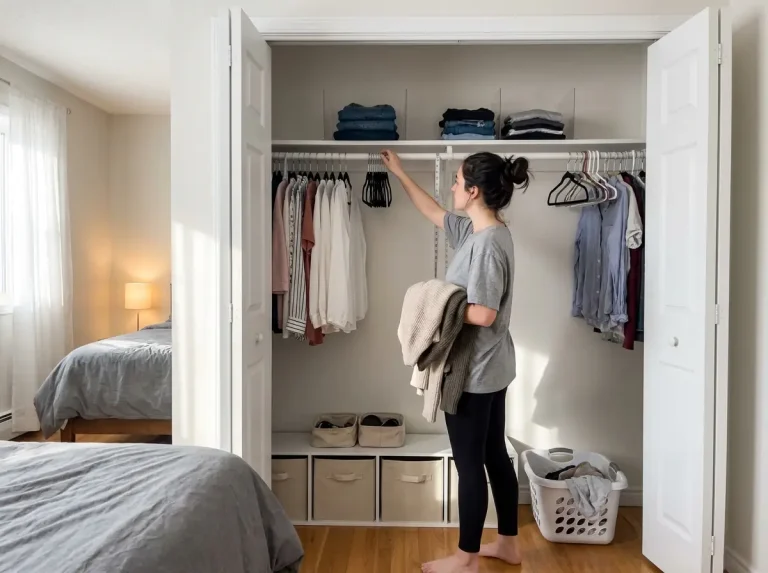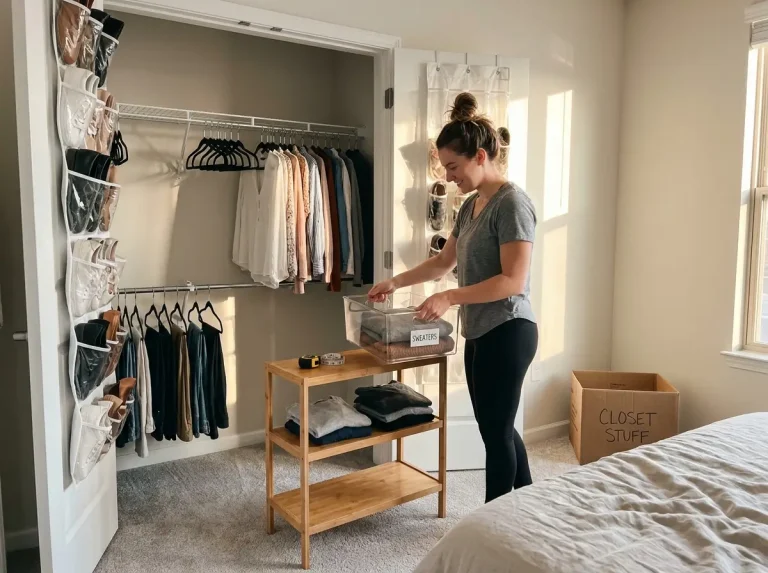

It is week fourteen, and you open the closet you set up so neatly on move-in day. The floor has vanished under shoes and a laundry pile, folded sweaters hang off the rod by their sleeves, and the shelf holds a leaning tower of tees. Dorm closet organization rarely collapses because the first setup was bad; it collapses because nothing in the closet has a fixed home and nothing sends things back to one.
The sizes, door rules and hanging-clearance rule below come from published residence-hall policies and dimension sheets, and they show that the closet you have may not be the closet most storage ideas assume. This guide walks through measuring it, working around the door, setting up hang, fold and floor, and running a ten-minute reset, with the room-level rules in the full dorm room system.
Quick Answer
A dorm closet holds up through finals when you measure first, buy only what your hall allows, and give every item a fixed spot.
- Write down four numbers: opening width, depth, rod height and shelf clearance.
- Read your hall’s policy on doors, rods and adhesives before buying anything that mounts.
- Swap bulky hangers for slim ones, then add a second rod only if the height allows.
- Move folded clothes off the rod and onto shelves with dividers and soft bins.
- Assign the hamper and the shoes a fixed corner each, so the floor stays clear.
- Run the same ten-minute reset every week.
Dorm Closet Organization Starts With Four Numbers
Picture the saved list of closet ideas on your phone, every one of them built for a closet of a size nobody has confirmed. A cart that glides into one hall’s closet jams in the next, and a hanging organizer cut for a tall opening drags on the floor of a short one. So the first purchase is a tape measure (or the one from the kitchen drawer at home) and a note on your phone.

The Four Numbers to Write Down
Take these four measurements before you open a single shopping tab. The width of the opening decides how many hangers fit and whether a double rod can hang evenly. The depth, from the front edge to the back wall, decides whether a cart or a bin can stand on the floor under the clothes without pushing them forward.
The rod’s height from the floor decides whether anything can hang below the clothes, which is exactly what hanging shelves and a second rod need. And the clearance under the shelf above the rod decides how tall a stack or a bin can be.
All four take a few minutes and cost nothing. Type them into your notes app with the closet side labeled, and snap a photo of the tape against each one so you are not guessing later. If you share the closet, measure together so you both work from the same numbers. Once you have them, how a reach-in closet splits into zones shows the hang, fold and floor frame this article reuses.
What Two Residence-Hall Sheets Show
Dorm closet dimensions vary more than product listings admit. The University of Central Missouri’s residence hall dimensions sheet lists closets from 6.5 ft to 7 ft 8 in tall, 2 ft deep wherever a depth is given, and between 2 ft and 3 ft wide. Some rooms have two closets, and one closet type is a step-in with shelves, 4 ft 6 in wide and 7 ft 6 in tall. The same sheet puts storage height under the bed at 33 in at the highest bed setting, and says the bed is adjustable.
Two feet of depth is tight for a closet that also has to hold a cart or two rows of shoes, because clothes on hangers claim a good share of it before anything else goes in. Whatever stands on the floor under the clothes has to be slim.
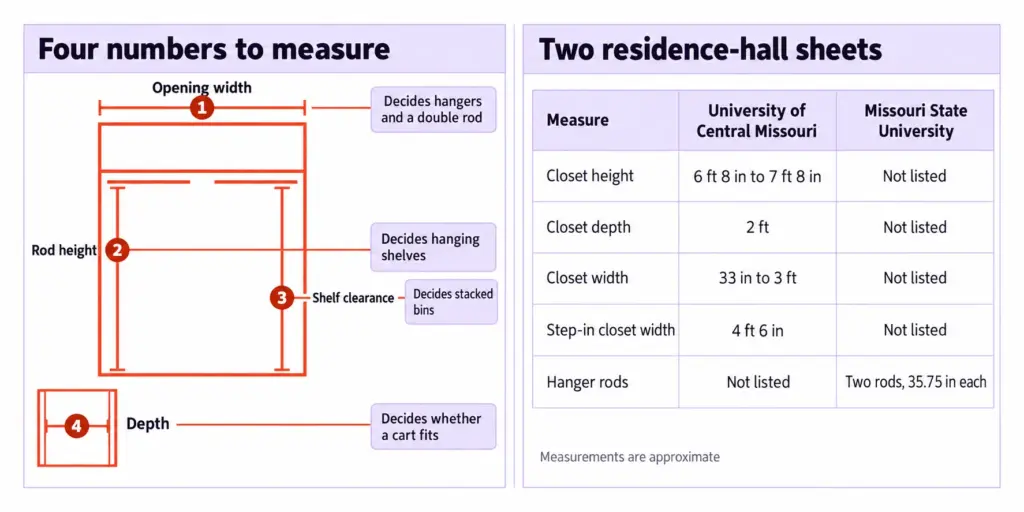
Missouri State University’s residence hall dimensions sheet describes a different shape for one of its houses: two hanger rods at 35.75 in each. It also carries a caution worth taking literally. According to that sheet, “Closet measurements are approximate as some spaces vary slightly in size.” Two schools, two shapes, and neither is a rule about dorms in general.
Even a number as basic as under-bed height moves a long way between campuses. Oklahoma State says its bed frames allow 10 to 15 in of space under the bed, against the 33 in on the Central Missouri sheet. That gap is the whole argument for measuring your own closet instead of trusting anyone’s list.
The Number No Sheet Gives You
Rod height. None of the sheets above gives the distance from the closet rod to the floor, so nobody can hand you that figure. It decides the purchases that look the most useful: a second rod needs room to hang beneath the first, or a five-shelf hanging organizer needs a long drop.
Measure from the floor to the center of the rod, then from the rod up to the underside of the shelf. If the rod sits low, write that down in capital letters, because that one fact will rule out half the products later in this article. The step costs nothing, and it comes before any cart goes in the basket.
Save the four numbers in one note on your phone and share it with whoever is ordering for you. A parent or a roommate can then check any listing against the note before anything is bought.
When the Door Can’t Hold the Organizer
Over-the-door organizers need a door. Some halls have none, and some rooms have closets with no doors at all. Where a door does exist, the hall’s rules may treat it as untouchable. Either way, the fix that hangs from a door is not the plan.
Why Over-the-Door Organizers Fail Here
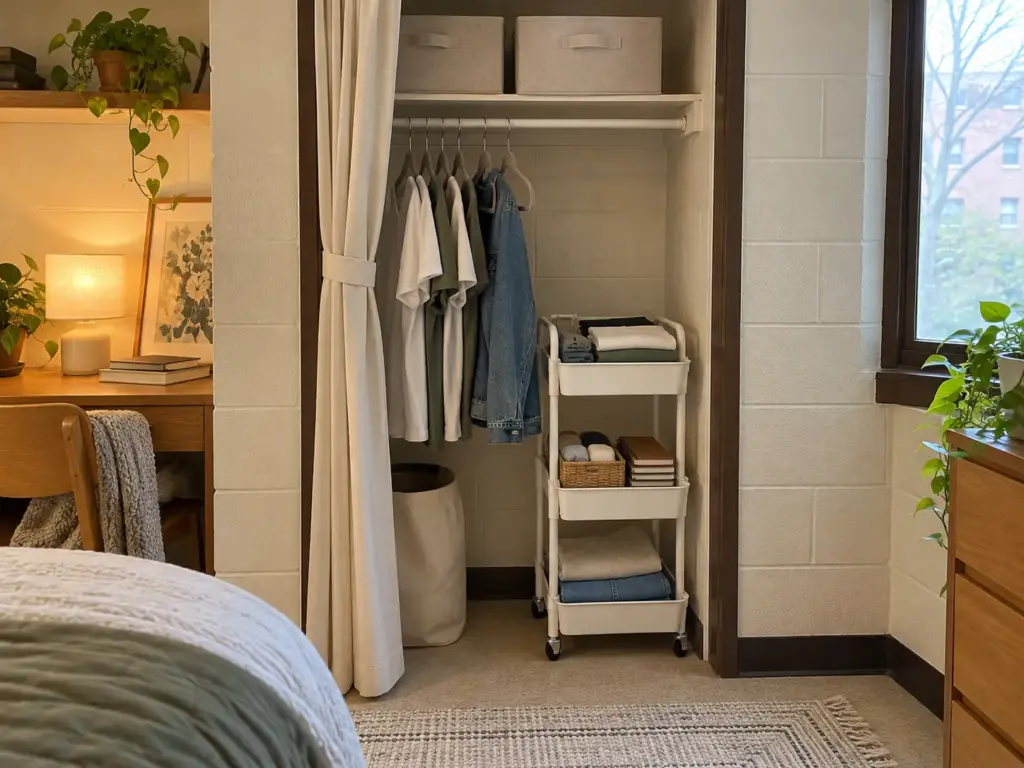
An over-the-door organizer is the first thing anyone names for a small closet, and it is a good call when a door exists, swings freely and the hall lets it stay as it is. In a doorless closet the over-the-door hooks have nothing to catch. Behind a door you must leave attached, the organizer still takes the clearance the door needs to close, which is clearance your clothes were using.
Our rundown of the over-the-door ideas worth buying covers where that fix pays off. This article stays inside the closet.
What the Housing Rules Actually Say
Two schools’ policies show how tight the rules run. According to Oklahoma State University’s room personalization policy, “If present, the closet door must always remain attached to the closet.” The same policy bars any curtain rod that needs drilling, nails or fixing to walls or windows, and it allows tension rods. Carnegie Mellon University’s housing policies land in the same place on the door: closet doors may not be removed.
They also limit hanging adhesives to 3M and Command products, and a strip removed the wrong way is billed to the student.
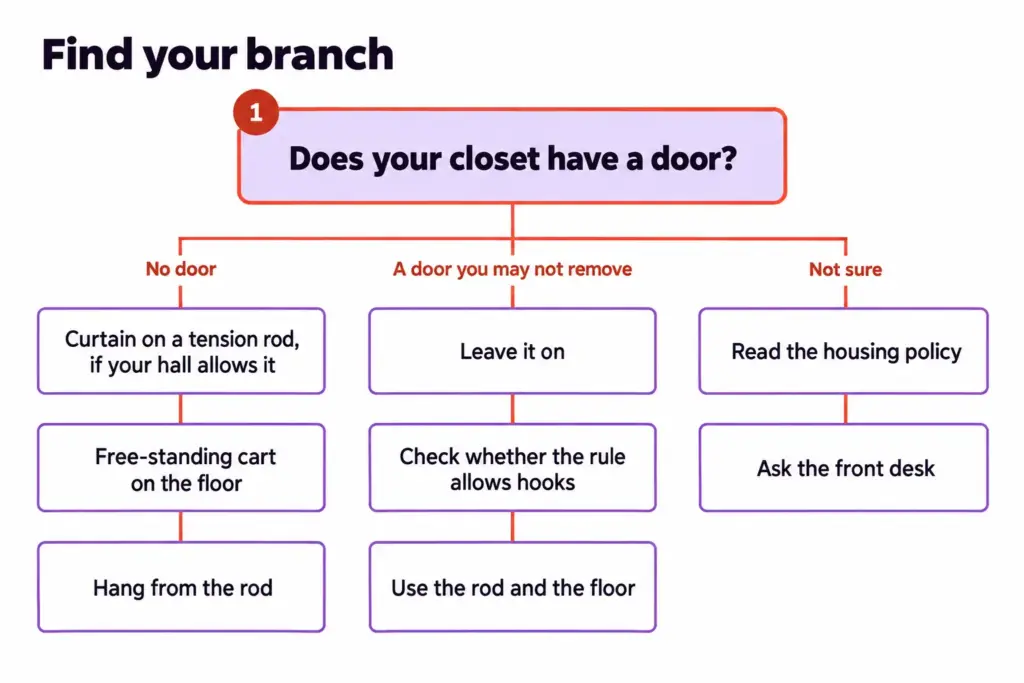
Those are two schools’ rules, not yours. Read your own hall’s policy page before you buy anything that clamps, sticks or drills (ten minutes with the page now is cheaper than a damage charge in May). The practical result: a curtain across a doorless opening belongs on a pressure-fit rod where your hall allows one, and an adhesive hook is a read-the-rule item, never a default.
Free-Standing and Tension Fixes That Need No Mounting
Free first: use the floor and the rod you already have before buying anything. Three kinds of piece need no mounting at all. Free-standing pieces sit on the closet floor, pressure-fit pieces hold themselves in an opening, and anything that hangs from the rod uses the rod that is already there. Each has a limit, and the limit is a number you measured.
A narrow rolling cart is the free-standing option, and floor depth decides it. The cart has to roll in and out without catching the hang side, so check how much floor lies between the back wall and the front edge once the clothes are hanging. The Slim 3-Tier Rolling Storage Cart (see it on Amazon) is a narrow three-tier cart on casters that needs neither a door nor a drill. Its width is the number to check on the live listing, then hold it against your own floor depth before ordering.
The pressure-fit option is a shelf that holds itself between two firm surfaces. Home in Bold Tension Rod Shelving (see it on Amazon) is expandable and needs no drill, the same kind of fix Oklahoma State’s policy permits for a curtain rod. But a policy that allows one item does not allow every item, so read yours and measure the opening, since a pressure fit only holds in a firm, square gap.
The budget logic is simple: the cart and the tension shelf are the low-cost pieces that need no mounting, and the free fix still comes before both. For the longer list of pieces, see no-drill closet ideas for renters.
The Hang Side: One Rod, Two Levels, Slimmer Hangers
Open the closet and the rod is already full, with a week of clothes and a coat that has claimed its own hanger. The rod is the first thing to fill, and the cheapest changes work on it first, before anything is bought to hang beneath it.
Slim Hangers First
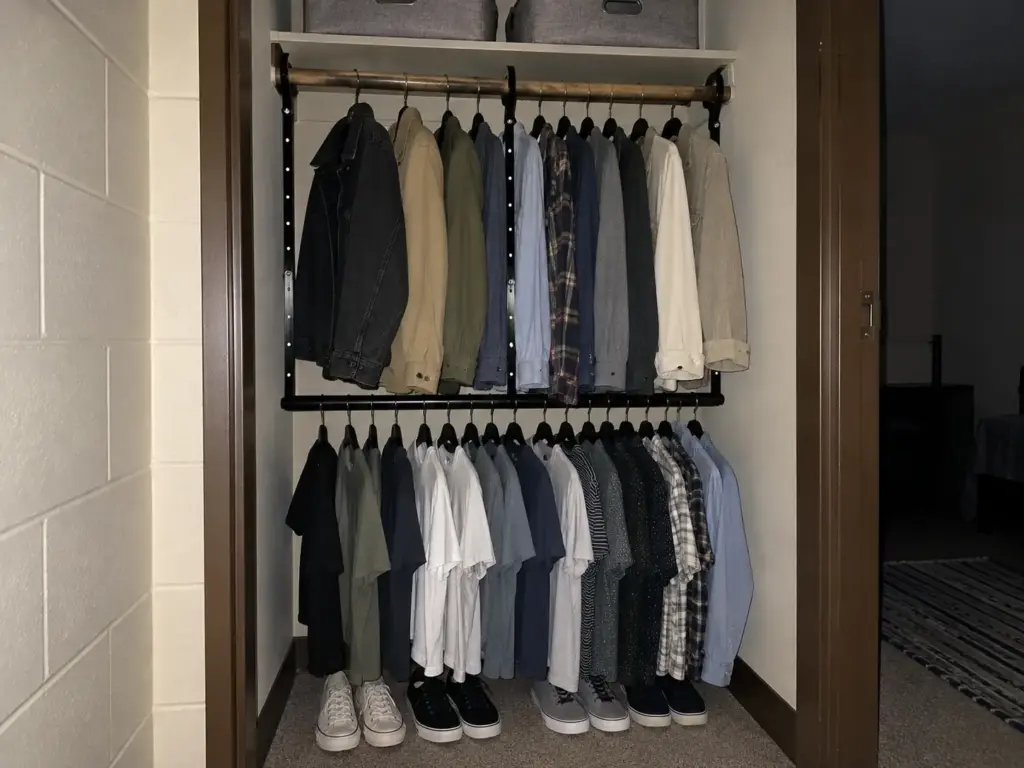
A bulky plastic hanger takes much more width than a slim velvet one (or a multi-use hanger that stacks several garments), so closet rod space runs out early and the same rod holds fewer clothes. Swapping hangers is the cheapest change in this article. Zober Premium Velvet Hangers (50-Pack) (see them on Amazon) are 0.2 in thick and 17.5 in wide per the listing, and a rod of them holds more than the same rod of standard plastic. How much width the swap frees depends on the closet, and slim hangers that give rod space back compares the options.
They only help if what hangs on them is what you wear. A rod full of clothes you have not touched since move-in stays full whatever the hanger is. So hang the pieces you wear weekly where your hand lands first, and let the rest go home or into storage.
A Second Level, If the Height Allows
An extra closet rod for a second hanging level looks like the obvious next step, and in a closet whose rod sits low it is the wrong one. A double closet rod hangs below the first, so the lower clothes need a clear drop above the floor or the shelf.
The closets on the Central Missouri sheet run 6.5 ft to 7 ft 8 in tall, but the closet’s height says nothing about where the rod is. The number you measured earlier, rod to floor, decides it. If the lower level would touch the floor or the shelf, skip this step and stay with slim hangers.
Hanging Shelves Need Clearance
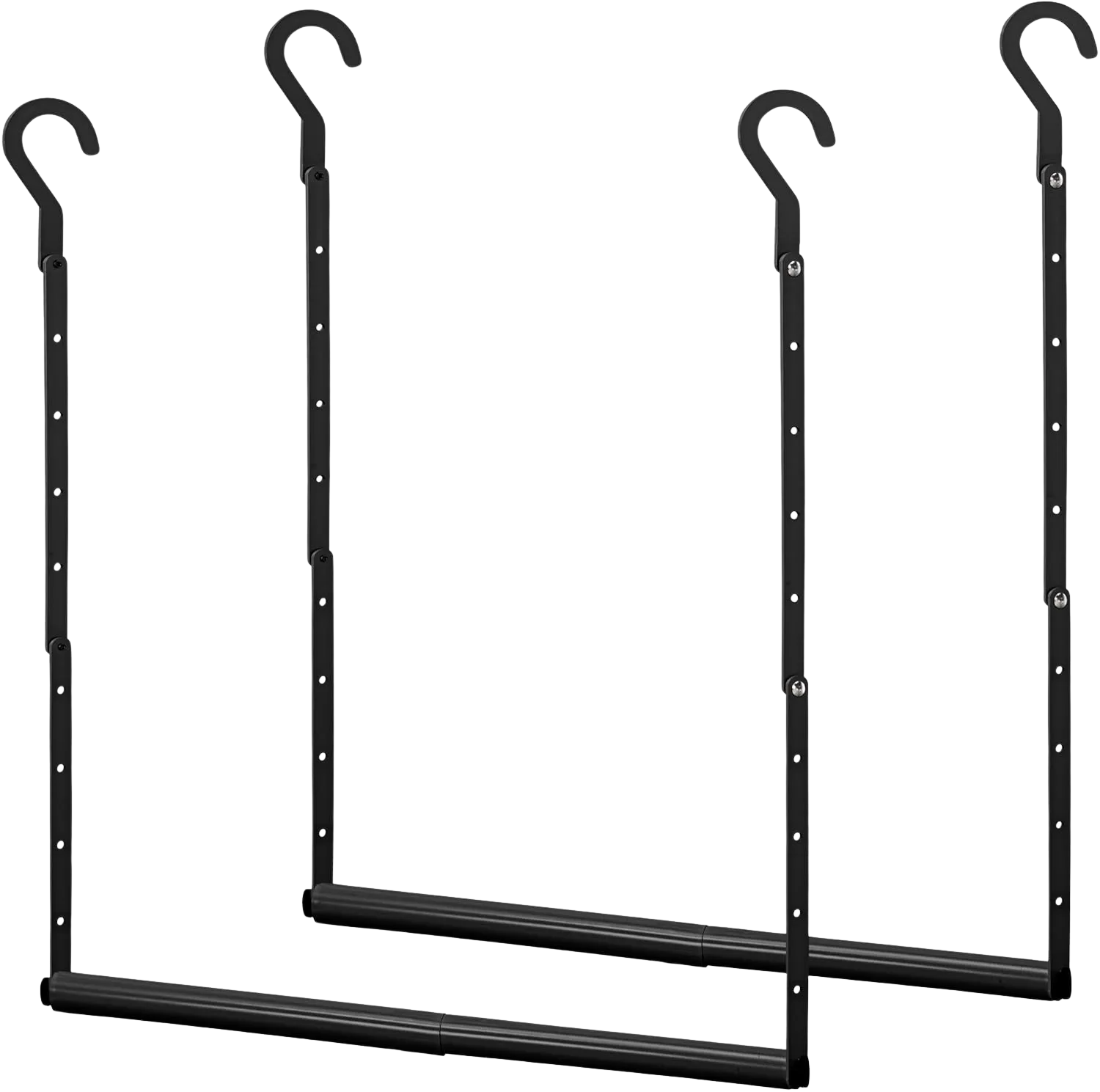
Hanging shelves, the kind sold as a sweater organizer, give sweaters, jeans and shoes a place without a door or a drill, but they hang from the rod and take a long drop. The YOUDENOVA Hanging Closet Organizer (5-Shelf, Grey) (see it on Amazon) asks for about 62 in from the rod to the floor, according to its listing. That is the listing’s requirement, not a fact about dorms, so check your own rod height first. In a closet with a lower rod, skip it; in a taller one, it is the quickest way to get shelf space on the hang side.
Even with the right numbers, this side drifts. A sweater gets slung over a hanger because the shelf looks full, and a pile grows on the lowest shelf because it is the easiest to reach. Folded clothes on the rod and a heap on the shelves are the first things to return, and they come back because nothing makes the hang side the wrong place for them.
Before you order a hanging organizer, hang a loop of string from the rod at the length the listing gives and see whether it clears the floor. The test takes a minute and needs nothing stuck to the wall.
The Fold Side: Shelves, Bins and the Shoe Question
Look at the shelf pile by midterms: a stack that leans, slides and ends up in the next stack or on the floor. It happens in slow motion, one pulled tee at a time.
Dividers Stop Shelf Piles Sliding
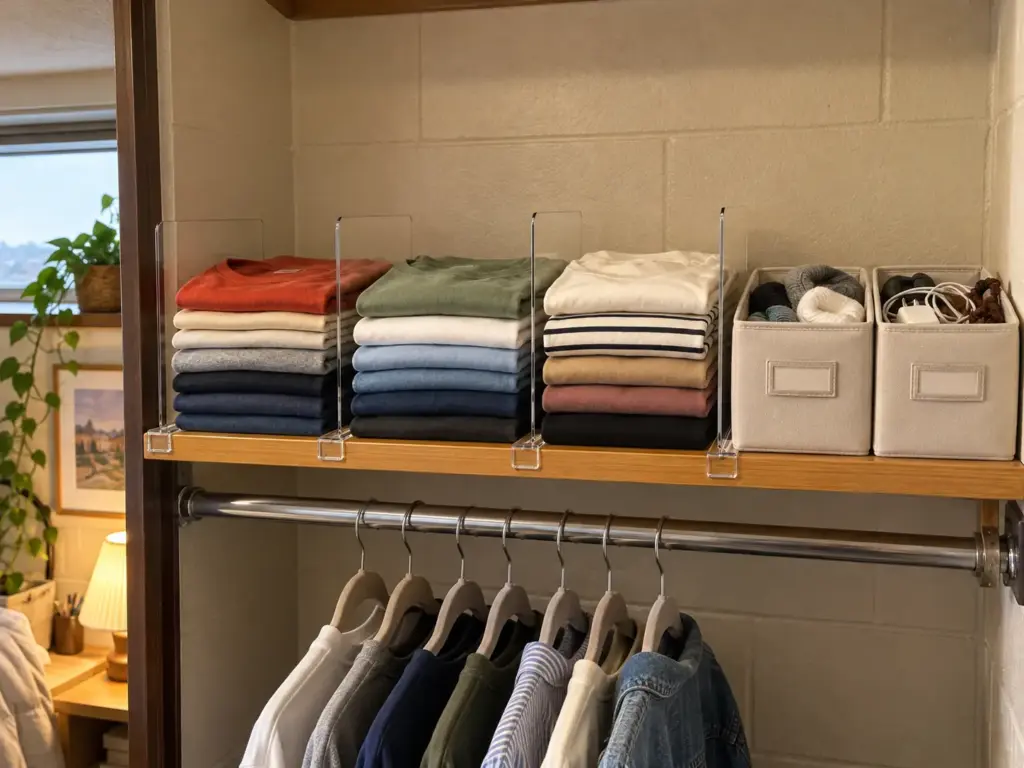
A stack fails when nothing holds its edge. Pull a shirt from the middle and the pile above it shifts sideways into its neighbor, and by Friday the whole shelf is a single slope. A divider gives each stack a wall.
The HBlife Acrylic Shelf Dividers (6-Pack) (see them on Amazon) are rated at 15 lb per divider and made for shelves from 9/16 to 1 in thick. Shelf thickness is the number that decides it, so measure the edge of your shelf before ordering.
The free fix works alongside them: fold flat, and stop stacking above a hand’s reach. The dividers are the cheap piece that makes that rule hold. For the full mechanism, why closet shelf piles keep falling over goes through it.
Bins for What Doesn’t Stack
Socks, tees you roll instead of fold, chargers and accessories refuse to stack, and that is where the shelf’s chaos begins. Soft collapsible fabric cube bins with labels (see them on Amazon), the kind sold as closet bins or drawer bins, take that load and fold flat when the term ends. A cube takes shelf depth, so check it against the depth you measured before counting on a full row. Use the labels: a bin with no stated job collects whatever is lying around.
Shoes: Floor, Rack or Under the Bed
Shoe storage has three places to go, and each has a constraint. On the floor shoes spread, because nothing sets an edge. A low stackable shoe rack uses floor depth, so the depth you measured matters again.
Underbed shoe storage depends on height, and under-bed storage runs 10 to 15 in at Oklahoma State against 33 in at the highest bed setting on the Central Missouri sheet. For the longer version, see how to organize shoes in a closet.
The Floor, the Hamper and the Hooks Your Hall Allows
If the laundry has no basket, it lands wherever the shoes are. The floor is where the reversion shows first, so it gets its own plan.
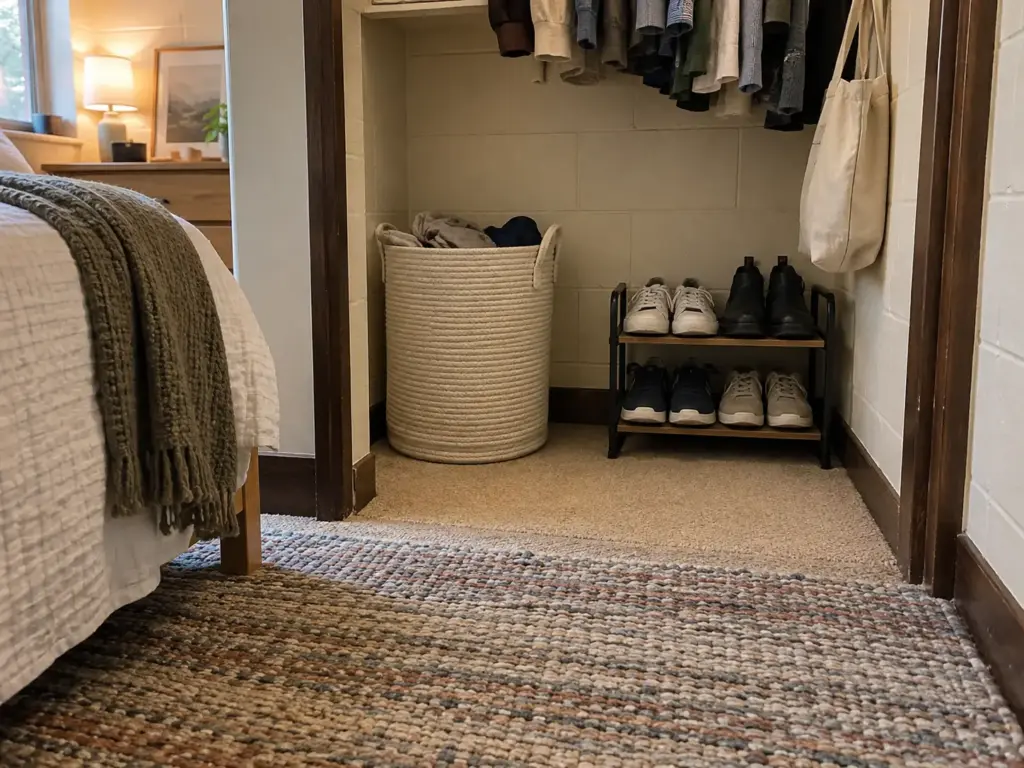
The Floor Fills First
The floor is the only surface in the closet with no assigned job, so everything without a home lands there. Backpack, shoes, a hoodie meant for later: none of them is a decision, just the nearest empty space. The answer is to give each part of the floor a job, a corner for the hamper and a spot for the shoes, so what lands there already belongs there.
Closet ideas that work without a dresser matter in a dorm, where the closet often stands in for one. And why a small closet gets messy again covers the same slide at home scale.
A laundry bag hung from the rod you already have takes no floor at all, and costs nothing. A garment rack outside the closet is the overflow option when the closet is full, and it needs no mounting. Neither needs a product link: a plain bag and a plain rack do the job.
A Hamper Corner That Keeps the Pile Off the Shoes
Put a plain hamper or a laundry bag in the closet corner nearest the door side, and keep the shoes on the opposite side. In a closet 2 ft deep the hamper takes one corner and the shoes take the other, so check your depth before picking either. The point is the line between them: a dirty-clothes pile has an edge only if the hamper gives it one.
Hooks and Hanging Bags, Rule First
The rule comes before any wall hooks. Carnegie Mellon allows only 3M and Command products for hanging items and bills improper removal, and other schools differ, so read your policy before sticking anything to a wall. No adhesive product is recommended here.
Hanging bags and stacked bins have a second rule: Oklahoma State’s rule on sprinkler heads bars placing or hanging anything within 18 in of a fire sprinkler head. Treat that as one school’s number, look for your own hall’s, and look up before you hang anything high.
A Weekly Reset and a Line Down the Middle for Your Roommate
It is Sunday evening. The closet either gets ten minutes of attention or loses another week, and a closet that loses enough weeks looks like the one from the opening.

The Ten-Minute Weekly Reset
A closet reverts because each thing has no fixed place and nothing brings it back. The reset is the thing that brings it back, and the weekly version is the semester reset in small pieces: ten minutes now instead of a full afternoon at finals.
Run the same order each week: floor first, hamper out, shelf piles squared, then the rod re-sorted by what you actually wore. Floor first, because it is the surface that absorbs everything else. The order matters less than the sameness, since a routine you can do without thinking is one you will do on a tired Sunday.
Tie the reset to something you already do every week, like doing laundry. A habit that rides on a routine holds up better in a busy week than one that needs its own reminder.
Nobody can say how many weeks a system lasts, because that depends on your schedule and your roommate. What holds either way is that every product above exists to keep the reset short. The free fix is the reset itself, and why budget closet makeovers revert explains why makeovers without one fade.
Drawing the Line Down the Middle
A roommate closet split works by the half, not by the shelf. A shelf split gives one person the high reach and the other the low, and it falls apart the first time one of you needs more space. Decide the line once, in words, on day one, and put a divider or a bin on the line if the closet has room for one. How to share a closet without a fight holds the long version.
What to Rotate Out at Midterm
By midterm the clothes you packed for August are not the clothes you wear. Carry the off-season pieces home or store them flat, before they start living on the floor. The closet swap is the seasonal rotation in one trip, and why a seasonal closet rotation fails shows how to keep it from becoming another pile.
Four Numbers, One Rule Check and Ten Minutes a Week
Three habits carry a dorm closet to the end of the term. Write the four numbers before you buy anything. Settle the door and the housing rule before the hardware. Reset the same ten minutes every week.
Everything else in this article is a way to make those three easier to keep.
At midterm, look at which part of the closet has drifted: if it is the floor, the hamper corner needs a firmer edge, and if it is the shelf, the dividers need to be closer together. If a product is not earning its place, organizers sorted by what fits shows what to swap in.
The first move costs nothing and takes minutes. Pull out a tape measure, write the four numbers in your phone, and open your hall’s housing policy page. Then notice what changes: the next time you open a shopping tab, you will already know which products your closet can hold.
Frequently Asked Questions
01What is the best closet organizer for a dorm?
The best one needs nothing your hall forbids: no door, no drilling, and a size that fits the closet you measured. Slim hangers and a narrow rolling cart come before anything that mounts. See organizers sorted by what fits.
02Is it cheaper to build or buy a closet system for a dorm?
Neither fits well, because a built system needs mounting that most halls restrict. The cheaper path is pieces that need none: slim hangers, a double rod, bins and a cart. Check your hall’s policy before buying anything that attaches.
03Can you take the closet door off in a dorm?
Not at the two schools covered here: Oklahoma State requires the closet door to stay attached, and Carnegie Mellon does not allow removing it. Ask your housing office before changing anything.
04How big is a dorm closet?
It varies by hall: one university’s sheet lists closets 2 ft deep and between 2 ft and 3 ft wide, while another lists two rods of 35.75 in each. Measure yours before buying anything.
05Where should you start with dorm closet organization?
Measure the opening, the depth, the rod height and the shelf clearance, then fix the rod, then the shelf, then the floor. For the room itself, see the dorm room system.
Disclaimer: ClutterlessNest is a participant in the Amazon Services LLC Associates Program. As an Amazon Associate we earn from qualifying purchases. This article may contain affiliate links — if you buy through them, we may earn a small commission at no extra cost to you. We only recommend products we have tested or genuinely believe in.