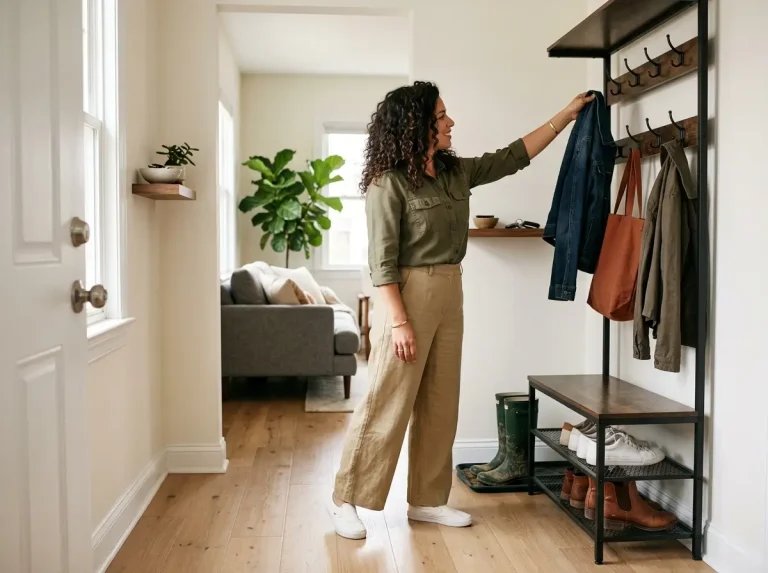

You are standing at the wall with a bag strap in one hand, or a damp bath towel, and the hook in front of you looks right on the listing. It will probably carry the weight. What decides whether it stays up is where the item sits on the hook and how far the peg stands off the wall, and the package prints neither.
Consumer Reports found adhesive strips and hooks fine for small, light things and poor for heavy ones, so the useful question for removable wall hooks and organizers is what you hang and what shape it needs. This guide goes in that order: hook shape, projection, spacing, and then organizers outside the entryway.
The quickest way in is to start from the item. This table gives the shape that holds each common load and the usual way it lets go.
| What you hang | The hook shape that holds it | What goes wrong |
|---|---|---|
| A coat or jacket | A hook with a lip that catches the collar or hood loop | A bare peg lets the collar slide, and full pockets add load |
| A bag with straps | A double hook, so the bag gets a prong | Straps work off a flat or round peg |
| A bath towel | A wide hook or a bar with room around it | Towels pile onto one spot and stay damp |
| A robe | One wide peg that takes the collar loop | A narrow hook crushes the loop and tilts the robe |
| Keys and light small items | A small clear wire hook that sits close to the wall | Anything heavier peels the strip |
| A school backpack or tote | A deep, rounded hook at kid height, one bag per hook | The swing loads the strip harder than the scale says |
Match Removable Wall Hooks to What They Carry
A purse hung on a hook weighs a couple of pounds before anything goes in it, and the strap is what decides whether it stays there. Check the hook that is already on the wall before any new hardware goes up: it may be fine, and the thing that keeps landing on the floor may simply be the item that should have a hook to itself. Move the bag, then judge the hook. If it still drops, the problem is shape, because a strap, a collar and a towel loop each meet a hook in a different way.
A Coat Needs a Lip, Not Just a Peg
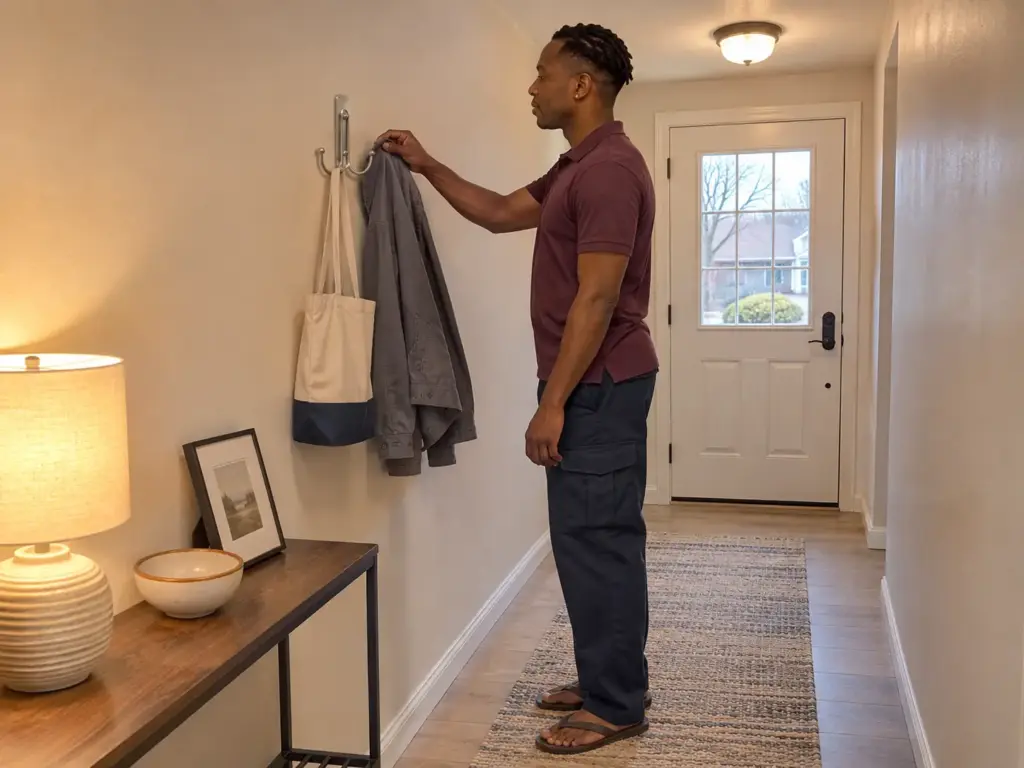
A coat hangs from its collar or its hanging loop, and the shoulders do the pulling. A bare peg hook gives the collar nothing to catch, so the coat creeps toward the tip and the first brush of a sleeve finishes the job. A hook with a lip at the tip keeps the collar seated. A hood adds a second pull, because it drags the coat backward whenever someone lifts the jacket by the neck.
Pockets load a hook before the coat does. Keys, a phone and a scarf stuffed in a pocket mean a winter coat is heavier than it looks, a point Decor&Decor, a UK retailer, makes about coats. Hook height and the one-hook-per-person habit are covered in where entry hooks sit for each person’s height. And when the wall is small and the puffers are bulky, what to do with bulky winter coats when the wall is small comes before another hook does.
Test the shape before the backing comes off the strip. Hold the hook against the wall at the planned height, let the real strap or collar settle into the bend, and give it one small bump. If the strap walks toward the tip, change the hook now. A strip that has been pressed on is a one-shot decision.
A Bag Strap Slides Off a Flat Peg, and a Double Hook Gives the Bag a Prong
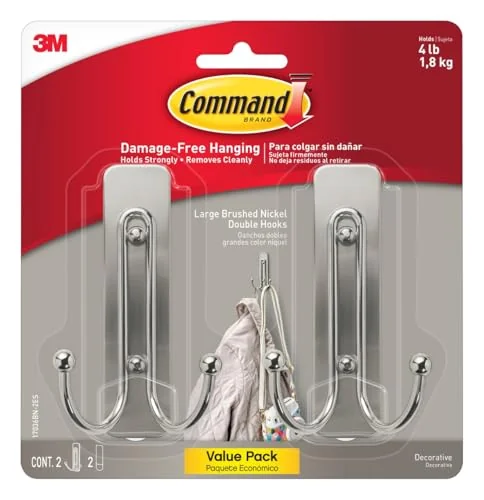
A strap is a loop of narrow webbing, and on a flat or round peg it works toward the tip a little with every bump of the door. Then the tote is on the floor the same afternoon it went up. A double hook has an upper and a lower prong, so the coat goes above and the bag below in one footprint, which is how Decor&Decor describes the shape. (It is a retailer’s observation, not a lab result.)
The obvious pick has a limit, though. A double hook still sends both loads through one strip, so where the coat and the bag are both heavy every day, two single hooks at different heights ask less of each strip than one double. The double suits a jacket and a light tote.
For a hook that lives in a real entry wall, the full small-entryway plan places the hook zone next to everything else that gathers there.
Towels and Robes Want a Wider Reach Than a Key Ring Ever Does
A bath towel is a wide, wet loop and a robe hangs by one narrow loop at the collar, so neither wants the hook a key ring wants. A thin peg crushes the robe’s collar loop and tilts the robe toward the wall. One broad, plain peg lets the loop sit flat and the robe drop straight. A bath towel does best draped over a wide hook or a bar with room around it, so air reaches both faces of the cloth.
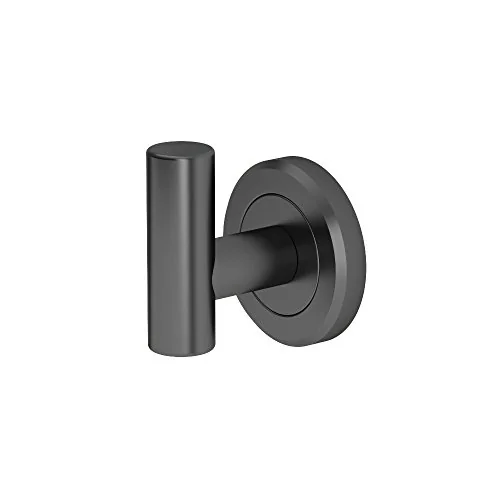
That broad single peg is the shape lesson of this card, and it is the exception in this article: a screw-in hook that fixes to the wall with screws. If holes are off the table, a wide adhesive hook with a rounded bend is the way to go, and a dry robe is a light enough load for one.
When the Item Is Light, the Lightest Wire Hook Is the Right One
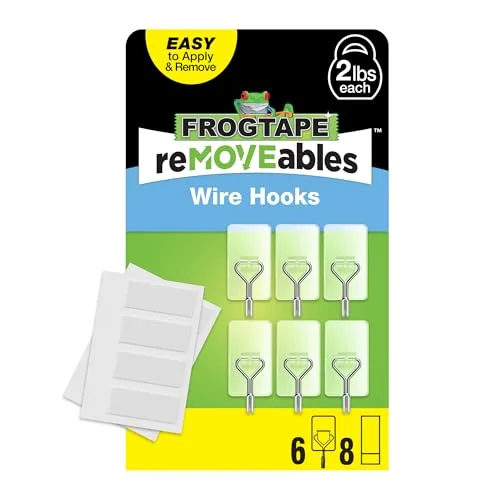
Keys, a cap and a thin scarf do not need a peg that sticks out into the hallway. A clear wire hook sits close to the wall, takes a ring or a loop, and asks very little of its strip.
Its listing figure is modest on purpose: FrogTape lists 2 lb per hook, the maker’s number, and it tells you what the hook is for. A scarf, yes. A loaded tote, no, because the strap will pass the limit long before the wire bends.
Why a Hook’s Projection Decides How Hard It Pulls on Its Strip
Hang the same bag from two hooks, one that sits flush and one with a peg that stands out from the wall. The scale reads the same both times. The strip does not, because a hook is a lever: the farther the bag hangs from the wall, the harder the top of the strip is pulled away while the bottom is pressed in. A wet towel makes the tilt easy to see, since the hook leans out at the top before anything has visibly slipped.

The Hook Is a Lever, and the Strip Is What Resists It
A rating describes a pull straight down the wall. A peg that projects turns part of that pull into a twist, so the top edge of the strip starts to peel while the bottom edge is squeezed against the wall. Command strips and other adhesive strips usually start to peel at the top edge first, so a hook that has begun to lean is already losing. A hook that sits flush asks less of the strip than a peg with the same rating that stands out, so two hooks with the same number on the box are not the same bargain.
Wirecutter gives the stand-off of two hooks it picked: the Vitra pulls out about an inch, and the peg of the Gatco robe hook from the first section is offset about an inch and a half and stands about an inch tall. Half an inch of extra reach sounds like nothing. But the twist grows with every inch the load hangs from the wall. The rated loads, the cure time and the way heat changes what a strip can take are laid out in how rated loads, cure time and heat change what a strip can carry.
A Moving, Wet or Yanked Load Counts as Heavier Than the Scale Says
A hand towel on a hook is not a still weight. It gets pulled off, wiped on and flung back. Stickwoll, a hook maker that weight-tests hooks, says anything that moves, swings, gets wet or is tugged on has to be treated as significantly heavier than its scale weight, and it counts a hand towel as a dynamic load of 1.5 to 3 lb. A towel yanked off a hook pulls harder than the same towel hanging still.
Consumer Reports drew the same line in its tests. According to Consumer Reports, “Most of the adhesive strips and hooks fared well with small, light items, but we wouldn’t recommend them for mounting heavy things to walls.” A backpack swung onto a peg every morning counts as a moving load, and a bag that crashes down once is usually the one that was swung. Heavy things belong lower, and the loads that belong on the floor instead of the wall are worth sorting before any strip goes on.
How to Read a Listing for Projection When It Never Prints One
Listings for damage-free hooks print a rating and a pack count and almost never the distance the hook stands off the wall or the surface the rating was earned on, usually a clean painted wall. Look for a side view in the photos: a flat disc with a short hook is a flush design, and a long peg in profile is not. If the listing has no side view and no dimensions, assume the hook stands out and treat the rating as the maker’s best case on a good wall.
The Command Large Utility Hooks 3 Pack is a projecting hook, the single-peg kind this section is about. The listing claims 5 lb per hook, the maker’s figure, and the peg reaches out from the wall, so read that number as the best case. Surface also changes what a strip grips, and paint types and the strips that sit on them is where that gets sorted.
Once a strip has set and the hook is loaded, watch the top edge of the hook. If it leans away from the wall, the load hangs too far out for that strip. Swap the peg for a flatter hook and the same item gets an easier ride.
Spacing Hooks So Coats and Towels Don’t End Up on the Same Spot
Two coats collapse onto one peg, and the towel on top keeps the one underneath damp all day. The hooks were fine. The spacing was the fault. Hook spacing is a different question from the summed load of a whole row: it is about keeping items from piling onto one spot.

About Six Inches Between Hooks, and Why That Is One Retailer’s Rule
Decor&Decor places hooks roughly 150 mm apart in a row, about six inches, with no test behind the figure. Treat it as a starting point.
For keys, caps and thin scarves it works. For a bulky puffer or a thick towel it is tight, because the garment is wider than the hook and fans out until it overlaps its neighbor. The number everybody quotes depends on what hangs from it, and a row of bath towels wants more room than a row of caps.
To find the right distance for a wall, mark the row in painter’s tape (it comes off the paint cleanly), hold the real items against each mark and step back. If two overlap, move one. In a steamy room the spacing also decides drying time, and towel hooks and strips in a steamy bathroom covers that room’s other limits.
Three Arms on One Base Share a Spot, and the Arms Move as a Set
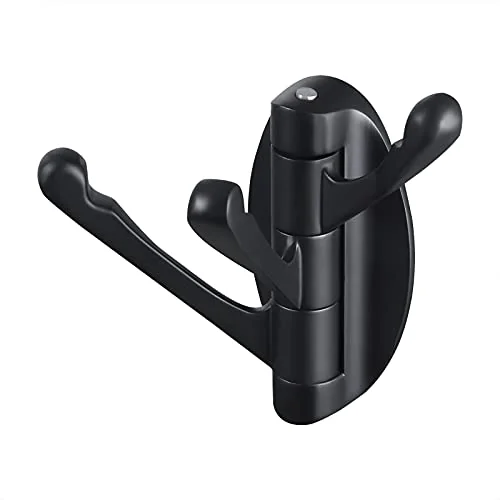
A swivel hook with three arms puts three items on one base, and it folds flat when it is not in use. Three closely set arms suit three or four towels or light items, not bulky coats.
The design has other trade-offs worth knowing. The arms are short and sit close together, the rounded tips let towels and coats slip off, and the top arm does not swing all the way out, which limits where the hook can be mounted. The arms also interlock and fold as a set, so the spacing cannot be adjusted one arm at a time. A spacing tool that cannot be spaced is an odd result, and it is the reason this hook sits in this section.
The mount matters too. It is the second screw-mounted product in this article: a rear bracket and a set screw, so it leaves small holes and belongs only where holes are allowed.
A Row of Single Hooks Asks One Item of Each
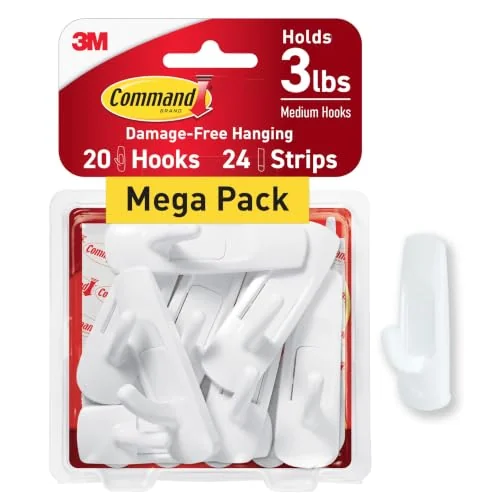
The adhesive route to good spacing is a row of single hooks, each set where its item needs it. For a hallway wall I would pick a row of single Command hooks over any multi-arm hook, because each hook can sit at the distance a coat or a bag needs, and one bag goes on one hook, which keeps the load per hook where its strip can take it. The multipack’s value is the row. Twenty hooks cover a whole wall, and the trade-off is a short reach that suits a jacket better than a bulky puffer.
How a row of adhesive hooks stacks up against the other mounts at move-out is laid out in how the whole set of rental-friendly mounts compares by damage at move-out.
Hang a towel on a trial hook for a week before committing the whole row. The spot where the towel is still damp after a day is the spot that needs more room or a wider hook.
Removable Organizers Outside the Entryway Carry Load at the Front Edge
The pocket organizer on the kitchen wall fills up with mail, markers and a charger, and the first sign of trouble is the bottom edge peeling away from the paint. A rail, a bar or a pocket wall organizer on two or three strips behaves differently from a single hook, because the load sits at the front edge and the pockets pull the lower strips off the wall first.

Pockets Add Weight Before Anything Is Hung
A pocket organizer is heavy before it is full. The board, the pockets and the first handful of paper all add up, and a winter coat with keys in the pocket is the same logic at a smaller scale.
The Command Message Center is the pocket-and-board format on adhesive strips. It measures 2 inches wide by 11.2 inches tall, and it runs smaller than expected with mixed durability. Keep it for flat things, such as paper, a pen or two and a charger cable, and it will hold up better than if it carried a stapler. The entry-wall version of this idea, with keys and mail by the door, is in the key rail and mail setup for the entry wall.
Kitchen, Bathroom, Laundry and Dorm Walls Ask Different Things of the Same Organizer
The same organizer meets a different wall in every room. Humid and cold walls defeat strips, and a bathroom wall that sweats after a shower or a laundry nook against a cold outside wall will both loosen a strip that would be fine in a hallway.
A kitchen wall near the stove gets a film of cooking steam that the strip grips instead of the paint. Many dorm walls are painted block with a rough finish, and a strip holds a smooth surface better than a rough one. So pick the driest, smoothest, warmest wall in the room, and expect to move the organizer if the wall proves otherwise.
What to Leave Off an Organizer and Move to a Shelf
The heaviest contents belong on a shelf, not on the organizer: scissors, a stapler (usually the heaviest thing on a desk), a jar of pens, a stack of books. A shoebox on a shelf does the job for nothing, and the organizer then carries only what a pocket was made for. A garage is the harsh version of this question, and what a garage wall asks of a hook rating shows how fast the demands climb. For the things that are too heavy for any strip, wall-mounted shelves that take the heavier things are the next step up.
Press gently on the bottom edge of the organizer once a week. If that edge lifts first, the load is sitting too far forward, and the heaviest pocket is the one to empty.
One Item, One Spot, and a Re-Check When the Season Turns
The shape follows the item: a lip for the coat, a prong for the bag, a wide peg for the robe, a small wire hook for keys. How far the peg stands off the wall decides how hard the strip is pulled, so a flush hook is the safer call for anything that swings. Give each item a spot, keep a bag to a hook, and use organizers for paper, not for tools.
Look at the top edge of every strip after the first week, and again when the heating comes on or the weather turns damp. A hook that has begun to lean away at the top is reporting a load that hangs too far out, and the bottom edge of an organizer will tell the same story first.
Today, take the one hook that keeps dropping something and change either what hangs on it or the shape of the hook. Notice whether the item is still up at the end of the week. The hook is one piece of the wider small-apartment plan this fits into.
Frequently Asked Questions
01Can removable wall hooks hold a heavy coat or bag?
Rarely: adhesive hooks are made for light things, and a heavy coat or a loaded bag is better carried by a screwed-in hook or by the floor. A lipped hook that sits close to the wall asks the least of the strip.
02How far apart should wall hooks be?
About six inches is one retailer’s starting point, and closer than that lets coats and towels pile onto the same spot. Bulky puffers and thick towels need more room, so mark the row in tape and hang the real items first.
03Which hook shape is best for a bag with straps?
A hook with a lip, or a double hook, holds a bag strap best, because a flat or round peg lets the strap slide toward the tip. Give each bag a hook to itself so the weight is not shared.
04Do removable hooks work in a bathroom or on a cold wall?
They struggle on damp and cold walls, where a strip bonds poorly and a steamy room keeps working at it. Pick the driest wall in the room, wipe it clean and dry before pressing the strip on, and keep the load light.
05Do removable hooks damage paint?
Sometimes: a weakly bonded paint layer can lift with the strip, and a hook that lets go by itself can take paint down with it. The wall, the paint and how the strip comes off decide the outcome.
Disclaimer: ClutterlessNest is a participant in the Amazon Services LLC Associates Program. As an Amazon Associate we earn from qualifying purchases. This article may contain affiliate links — if you buy through them, we may earn a small commission at no extra cost to you. We only recommend products we have tested or genuinely believe in.