
A stack leans against the end of the bookcase, a box marked maybe sits in the closet, and the book in your hand is the fifteenth you have weighed in an hour without sending a single title out of the house. That is what working out how to decide which books to keep feels like when the shelf has never been given a number: every book can be argued for, so none of them has to go. Libraries settle the same question every year with written criteria and a hard limit on space, and both ideas work for a personal library in a living room, because a shelf can be measured with a tape. This guide starts with the tape, then moves to the questions that settle one book, the copies that break the rule and the shelves that are not yours to cull, all in service of keeping a collection workable at any size.
Quick Answer
Choosing which books to keep gets easier once the choice is made against a number instead of a mood. Work through these five steps in order:
- Measure each shelf and turn its inches into a book count, which becomes your cap.
- Pull every book out and sort by category, one category at a time.
- Run each book through the keep questions: still accurate, read or soon read, replaceable, duplicate.
- Handle inscribed, shared and sentimental books apart from the rule.
- Send discards out the same week and put the maybes in a dated box.
The cap is the number to defend, not the mood on the day.
How to Decide Which Books to Keep by Measuring the Shelf First
Put the tape on the shelf before you touch a single book. A cull with no limit never finishes, because the question stays “is this one okay?” and the answer to that is nearly always yes. A book collection with no cap gets trimmed by mood, and mood loses to a full shelf.
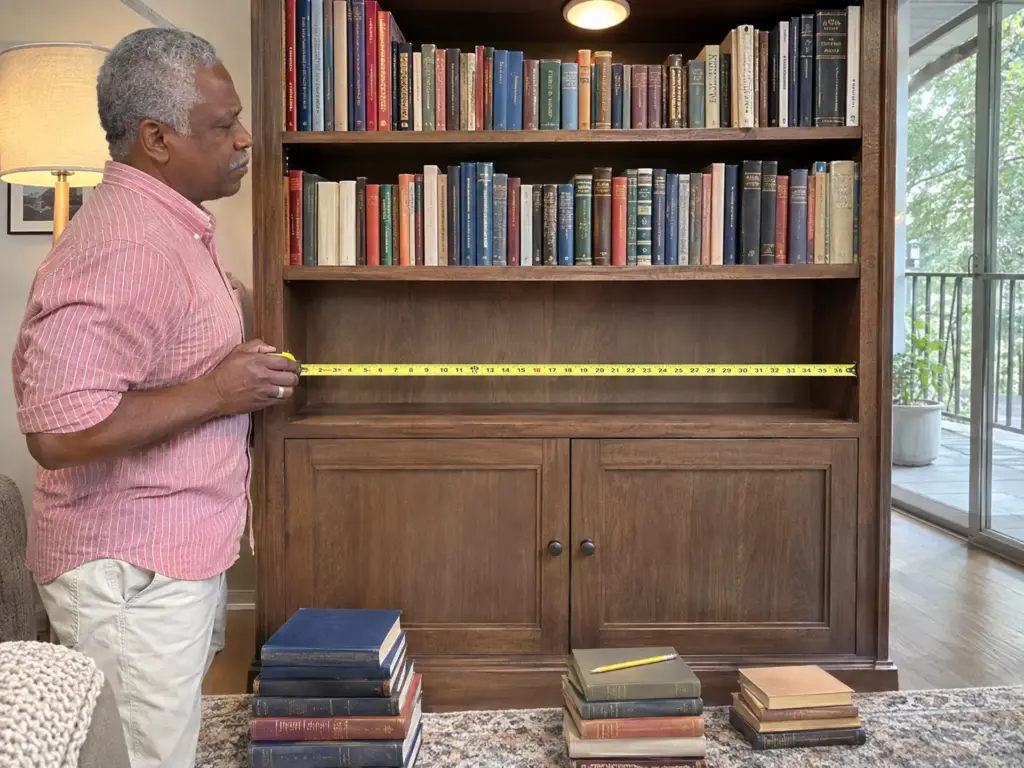
The question that ends the deadlock is how many books this shelf honestly holds, and the shelf can answer it in about two minutes.
Count Shelf Inches, Not the Books You Own
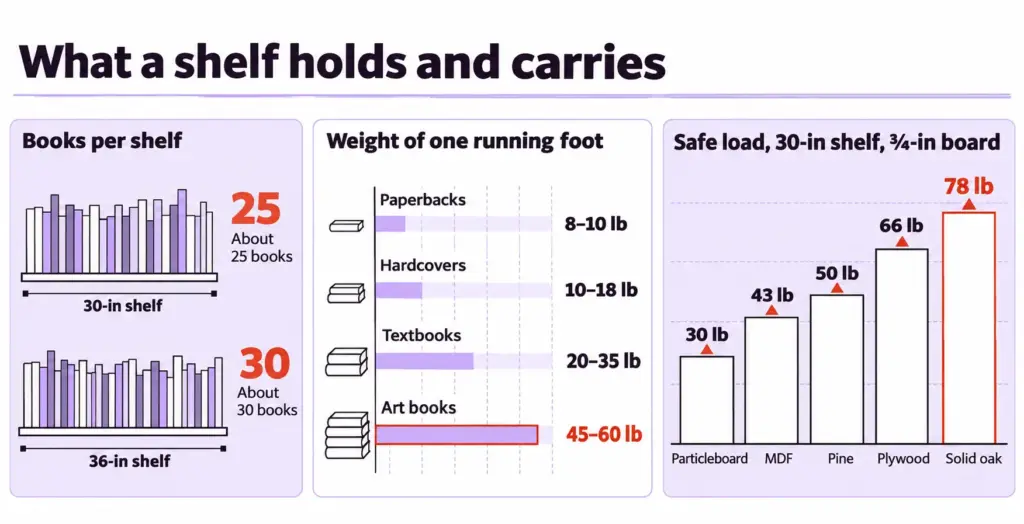
Measure the usable span of each shelf from side panel to side panel and multiply by what fits in a foot. Packed tight, a foot of shelf holds about 10 mixed books: 6 to 8 if they are hardcovers, 12 to 14 if they are paperbacks. That puts a 30-inch shelf at about 25 mixed books and a 36-inch shelf at about 30. The cap comes from the furniture, not from a feeling.
Scale it up and the number surprises people. A standard six-shelf bookcase, the familiar 31.5-inch-wide IKEA BILLY bookcase, packs about 156 books, or about 110 once picture frames and a plant share the shelves. One bookcase is a 150-book container, not a 400-book one, and a household that owns four hundred has already decided that two hundred and fifty of them live somewhere else, usually on the floor.
Shelf spacing counts too: 11 to 13 inches between shelves suits standard books and 14 to 16 inches suits oversize ones, so a case with fixed, shallow gaps simply refuses the tall ones. A cube unit such as the IKEA KALLAX counts cube by cube, and giving its top row over to books only turns a mixed unit into a designated space.
The ten-per-foot figure is the one everybody quotes, and it is the wrong one for a shelf of thick hardcovers. A run of novels and biographies lands nearer six to eight per foot, which cuts that 30-inch shelf to somewhere between 15 and 20 books. Count with the books you actually own in mind, and measure the paperbacks and hardcovers separately.
What a Full Shelf Weighs and Why Cheap Boards Bow
Book weight surprises people more than book count does. A packed shelf weighs 20 to 40 pounds per running foot, so a 3-foot shelf carries 60 to 120 pounds, roughly a ten-year-old child. What sits on it changes the load more than how many books there are. Paperbacks run about 8 to 10 pounds a foot, hardcovers 10 to 18, textbooks 20 to 35 and art books 45 to 60.
Counted one at a time, a paperback weighs 0.5 to 0.8 pounds, a hardcover 1 to 2 and a textbook 2.5 to 5, so ten hardcovers weigh about what twenty paperbacks do, and a shelf that looks half empty can already be at its limit.
The board and the fixing are two separate ceilings, and the weaker one wins. At a 30-inch span, a three-quarter-inch shelf safely carries about 30 pounds in particleboard, 43 in MDF, 50 in pine, 66 in plywood and 78 in solid oak. A packed 30-inch particleboard shelf is at its limit with roughly 25 hardcovers, while solid oak of the same size takes more than twice that. Stretch the span to 36 inches and thin boards give up quickly: Fine Woodworking puts three-quarter-inch pine at 6 pounds per foot and MDF at 2, but the same pine with a 2-inch front edge fixed to it works as a beam and holds 14 pounds per foot.
Shelf sag shows to the eye at about 1/32 inch per running foot, and wood creeps another 50 percent over time. The bow nobody sees on loading day is the one that shows in two years, and the design target for a shelf that stays flat is 0.02 inch per foot. “It fits” and “it holds” are different statements, and the second one needs a sturdier board. If a long run of hardcovers is going on a thin shelf, look at bookshelves that carry a full row of hardcovers without bowing before loading it.
A shelf screwed to the wall adds a third ceiling. Each stud it reaches carries about 45 to 50 pounds of shelf load, so a 3-foot shelf on two studs holds about 100 pounds, while the same shelf on drywall anchors alone drops under 25.
A wall shelf is also a cantilever: the same weight twice as far from the wall doubles the pull on the top fasteners, so a heavy art book at the front lip pulls harder than the same book pushed to the back. Heavy books go low and back. The fixing itself belongs to the shelf maker’s instructions.
Set the Cap and Leave the Last Tenth Empty
Add up the books per shelf for the whole case and you have the cap. Then take a tenth off it. A shelf about 90 percent full leaves room for the one book that arrives next month, and a shelf packed to the edge has no room for it, which is how the pile on the floor restarts. On a 30-inch shelf that means shelving about 22 books of the 25 it could hold.
If the cap comes out lower than the keepers you have, the container may be the problem, and choosing a bookcase by wall width is a separate, short job. Renting or owning, the arithmetic is the same; only the places the shelf can go change.
One more thing happens when the cull leaves a partial row: it leans. A one-piece steel bookend with a full non-skid base fixes that, and the Acrimet heavy duty bookends do it with a 6 7/8-inch face that covers a standard 8 to 9 inch hardcover about two-thirds of the way up. They are too narrow for oversized books, and those get the wider pair covered further down.
Write the cap on masking tape and stick it inside the case, one number per shelf. A number you can see settles an argument with a partner, a teenager or your own tired self far faster than a rule you have to remember.
Pull Every Book Out and Run Each One Through the Questions That Decide It
Anyone who tries to declutter bookshelves by walking along them and pulling out a few titles ends up putting them all back, because a full shelf makes every book look fine. Deciding which books to get rid of by how the shelf makes you feel, a vibes-based process, loses to a full shelf every time. The sort that works takes everything down, uses a short written list of questions, and gives each book the same ones.
Empty the Shelf and Sort One Category at a Time
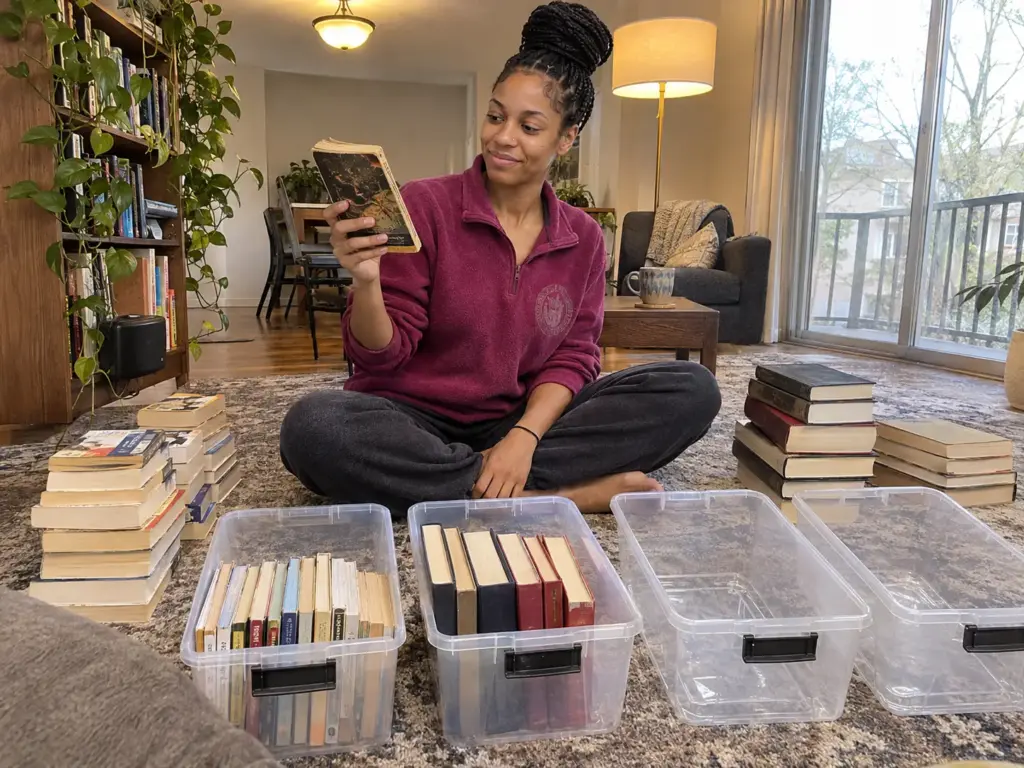
Everything comes off the shelf. Seeing the whole collection in one place is the only way to learn how many books there really are, and touching each one makes the choice real. Sort into categories first (fiction, cookbooks, reference, kids, work, art), by genre inside fiction, then decide one category at a time so you compare like with like.
Four containers hold the piles: keep, donate, sell and maybe. Sturdy cardboard boxes from the last delivery are enough for the donation run, and they cost nothing.
For the keep and maybe piles, clear lidded boxes help. The IRIS USA 32-quart latching clear storage boxes come as a 4-pack, the maybes stay visible through the sides, and one box takes about a dozen hardcovers. The handles are thin and the latches do not always close firmly, so keep each box to a load it lifts comfortably.
If the pass stalls halfway while you declutter books, the full process for decluttering books covers the stretch after the first sort. And when the choices start piling up faster than you can make them, a sorting session built for feeling overwhelmed keeps the pace manageable.
The Questions Librarians Use, Done at Home
Libraries do not weed on mood. The American Library Association puts the idea in one line in the criteria librarians use to weed a collection: “All materials are considered for weeding based on accuracy, currency, and relevancy.” Space limits, edition, format, physical condition and the number of copies sit on the same checklist. The CREW method librarians have used since 1976 condenses it into six letters, MUSTIE: Misleading, Ugly, Superseded, Trivial, Irrelevant, Elsewhere.
Five of the six work at home unchanged. An outdated travel guide is Superseded, a diet book that contradicts its own sequel is Misleading, a swollen paperback with a cracked spine is Ugly, and a fourth copy of the same title is a copies problem. Elsewhere is your library card and your e-reader.
Put the questions in a fixed order and run every book through them: is it still accurate, will you reread it or read it for the first time within a year, would a library copy or an e-reader do the same job, is it the only copy?
A book leaves the shelf at the first answer that fails, so the path stays under a minute, and sorting a category of forty books takes an evening instead of a weekend.
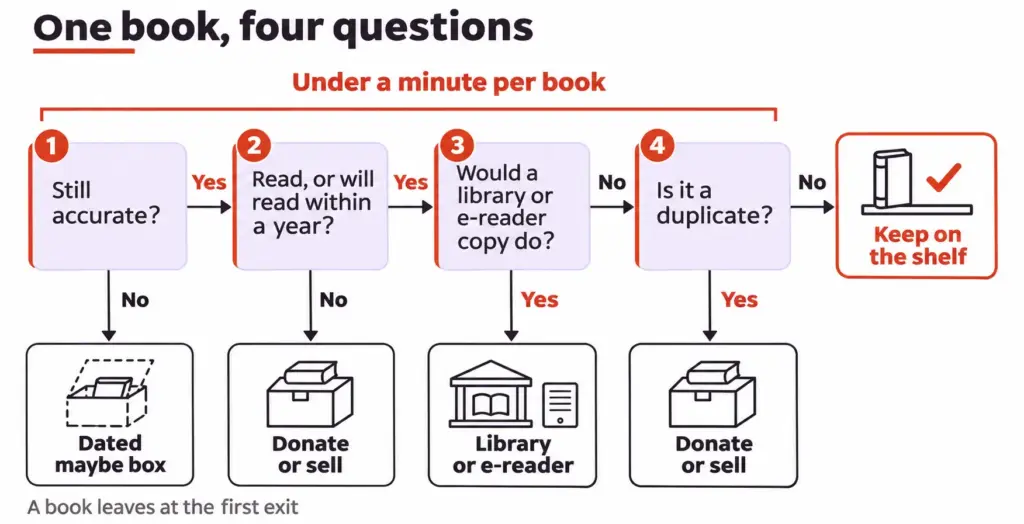
Order matters in one more way. The container method (sometimes called the Davis method) puts the favorites back on the shelf first and lets the shelf make the last cuts, so the container decides and the mood on the day does not.
The spark joy test from Marie Kondo’s approach, laid out in the KonMari method in full is another way in. It suits readers who decide by feel, but it is a test, not a count (the famous thirty-book figure is a myth, not a rule of the method), and for a reader whose shelves are full of books they love it keeps all of them and the cap overflows. There the shelf’s number comes first, and the test only picks between the books tied for the last slots.
The Unread Book and the 50-Page Rule
Aspirational books, the unread ones that seem to be mocking you whenever you pass the shelf, are the hardest to release, because letting one go feels like admitting you will never be the person who reads it. They are also the ones holding a slot.
Give each one fifty pages. A 300-page novel is about eight hours of reading, so fifty pages is little more than an hour, a fair trial. If it has not engaged you by then, it goes. If it has, you keep reading, and any unread book you are not ready to start waits in a separate next to read basket with a limit on its size, so the TBR pile cannot quietly turn into storage and unread books are not decided twice.
The book kept just in case deserves the same plain verdict. If it has not been opened since it was shelved, it is paying for a slot it never earned.
When the Library or an E-Reader Can Hold the Title Instead
A replaceable title does not need a copy on the shelf. The public library covers it, interlibrary loan covers the harder ones, Libby and an e-reader such as a Kindle or a Kobo hold the rest, and an audiobook handles the long commute. A written list of titles, a Goodreads shelf or a phone album of spines keeps the book findable without keeping the object. Think of it as three budget tiers: the library is free, an e-reader is a one-time purchase, and shelf space is the most expensive way to hold any single title.
Photograph each shelf with the spines readable before the books come down. The photo turns “I might want that one again” into a list you can check at the library catalog, and it makes letting go less of a gamble.
The Books That Break the Rule: Cookbooks, Reference and the Inscribed Copy
A rule built for novels misfires on a cookbook, a textbook or a book somebody wrote their name in. These categories get their own question, and the sentimental ones get their own place.
Cookbooks, Reference and Textbooks Get Their Own Question
A cookbook used in the kitchen lives on a kitchen shelf and is judged by use. A marked-up, stained copy has proved itself; one that has not left the shelf in years has not. A cookbook read like a novel is judged like a novel.
Reference books and textbooks fail on currency, since an edition that has been superseded is dead weight, and they are among the heaviest books you own at 20 to 35 pounds per running foot. Required reading from a course that ended years ago belongs in the same pile. A shelf of old editions costs board strength for no benefit.
Duplicates and the Outgrown Kids’ Book
Duplicates pile up quietly. A school copy, a gift and a replacement bought after one went missing, and soon four copies of one play sit in a single apartment with nobody able to say why. Keep the best copy, usually the one with the notes in the margins and the dust jacket still on, and let the rest go.
Children’s books follow use. Keep the ones the child is still reading and let the outgrown kids books leave, apart from a short stack the family still reads aloud. The stack should be short enough to fit on one shelf of the kids’ room, not a second collection.
The Inscribed Copy: Keep the Memory, Not Always the Object
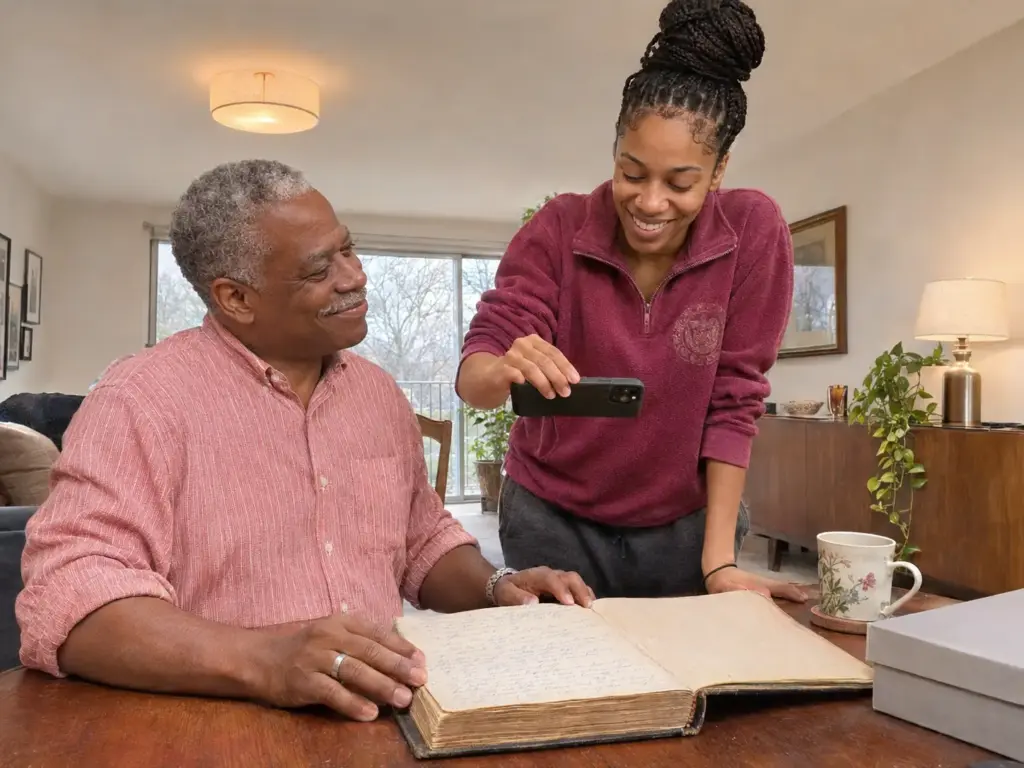
A signed copy is less special when you have many signed copies, and an inscription to a name you no longer go by carries less than it did. Yet sentimental books are the ones people defend longest, because the defense is about the memory, not the paper.
The test that separates the two is whether the book would be in the keep pile unsigned. If it would, it stays under the normal rules. If it would not, the memory is the handwriting and the date, and the paperback can leave.
Picture a complete Shakespeare inscribed by a grandmother on a twelfth birthday and carried through forty-five years, opened once or twice a year. It passes no usefulness test and still earns its place. The rule that allows it is a small, declared sentimental shelf: one keepsake box or one shelf, with a limit, not a loophole that swallows the cap. For the guilt that usually comes with the decision, letting go of sentimental things without the guilt covers the emotional side.
For everything else, photograph the inscription page, keep the photo, and send the book out. A shoebox and a few acid-free envelopes are enough to hold the photos for free. If you want the inscription shots to sit with printed family photos in something archival, the Pioneer acid-free photo storage box holds 1,100 4×6 photos and measures 11.25 by 7.75 by 4.5 inches. It runs smaller than the product photo makes it look, so check the spot on the shelf before you order.
When the Shelf Is Not Yours to Cull: Partners, Kids and an Inherited Library
Some of the books in the house are not yours to judge. A cull that ignores that turns into a standoff over a shelf.

Cull Your Own Half First
Start with your own duplicates, never the other person’s titles. When one side’s shelves go first, the temperature of the whole conversation changes, and a partner who tenses at the word cull has nothing to defend against. Sharing the cull with a partner who keeps everything goes further when your own half is done and theirs is not.
A Zone Agreement and a Sealed Limbo Box
Set up zones: his shelf, her shelf, ours. Each person’s zone has a cap, and each person culls only inside their own zone. The shared zone holds what both have read, and its titles are the only ones that need a joint decision.
For the disputed titles, use a sealed, dated limbo box. It holds the books neither person will release, it is taped shut with a date on the lid, and it leaves the house on that date unopened or gets exactly one review pass. The decision is made once.
A child’s collection works the same way with one change: the child chooses from the shelf the cap leaves, with a parent sitting beside them. Never sort a child’s books while they are out of the room.
Put the limbo box where both people pass it, not in a closet. A box that is out of sight gets forgotten, and a box in the hallway reminds everyone that the date is real.
An Inherited Library Is a Project of Its Own
A parent’s whole library is not a weekend job, and treating it like one produces either a panic donation or boxes that sit for years. Keep the set apart, in one room or a stack of boxes, then run the same questions with an extra rule: the titles the family would want go first, and the library or a dealer sees what is left. For a collection this size, clearing out a long-held household library gives the pacing that a single pass lacks.
When the House Has Too Much Shelf: Declare the Cap Before the Wall Fills
The shelf only decides when it fills. In a house with a study wall, built-in shelves or a basement shelf, the shelf never fills, nothing forces a choice, and the maybe books stack up in the next room.

Why the Cap Has to Be Declared, Not Discovered
A large home removes the pressure that makes the container method work, so the cap has to be declared out loud. Decide how many cases or how many shelves belong to books, treat the rest as off limits, and choose the number before the wall fills. Three tall bookcases is a cap. A wall with no end is not.
A run of built-in shelves needs a limit per category, such as two shelves of cookbooks and one of travel. Fill each shelf to about 90 percent, and keep the last tenth empty.
Fifty years of collecting rarely comes down in one pass, and a downsizer can still be packing dozens of boxes after the cull. That is the argument for declaring the cap early: the boxes you pack later are the ones you were never forced to decide on. For the span and load of a long wall, a bookshelf set up to stay organized is the reference.
Heavy Art and Reference Books Go Low and Back
Art books weigh 45 to 60 pounds per running foot and textbooks 20 to 35, and a wall shelf pulls harder on its fasteners the further the weight sits from the wall. So the biggest books go on the lowest shelf, pushed to the back, with their spines flush to the edge. Shelf load and span explains why that order protects the shelf.
At the end of that low shelf, an 8.5-inch face is what 10 to 12 inch art and reference books need. The MaxGear 8.5-inch extra large heavy duty bookends come as two pairs, which is one pair per end of a shelf. They are lighter than cast iron or marble would be for the very heaviest books, and the outer lip is a styling quirk, so a standard pair is enough for ordinary hardcovers.
A Yearly Pass for the Wall That Never Fills
Put a date on the calendar, the same time every year, and run only the books that have not been opened since the last pass through the questions again. The first pass is the big one. Every pass after it is short, because the books that survived once have already proved something. When the pass leaves gaps, creative places for the books that stay gives the kept books somewhere better than a stack.
Where the Discards and the Maybes Go So the Decision Stays Made
A cull is not finished when the piles are sorted. It finishes when the discard pile leaves the house and the maybes have a date.
Donate, Sell or Pass On: Sending the Pile Out the Same Week
Donating to a public library does not guarantee circulation. Libraries buy to a collection policy they set themselves, so a donated paperback often goes to a book sale instead of the shelf. That makes the library a poor first stop if you hope the book will be borrowed.
Better options exist when you donate books: a Little Free Library, a library book sale, a thrift store or charity shop, or friends who will actually read them. To sell used books, barcode trade-in apps take the sellable titles and some ship free at ten books, a secondhand bookstore is the other place to trade in books, and Freecycle or Olio-type groups take what is left.
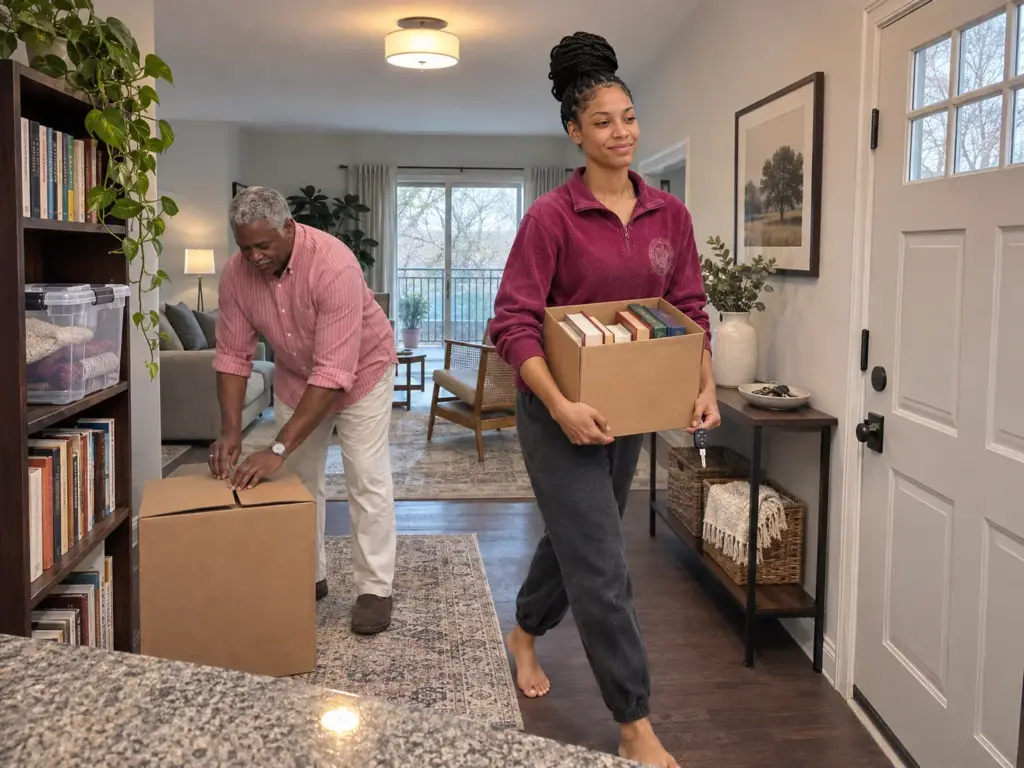
Apply a same-week rule: the discard boxes leave the house within seven days, in the car if possible. A pile that stays “temporarily” becomes the next maybe pile. For the pile that has to leave, getting the pile out of the house has the destinations.
The Dated Maybe Box
The maybe books move from the shelf to a box, and the box becomes a second pile unless the box has a date and a destination. Use one of the clear boxes from the sorting stage, write a date on a piece of tape, and put the box somewhere that is not the shelf.
When the date passes unopened, the box leaves the house. If a book is wanted before then, it comes out and takes a slot on the shelf, which means something else goes. The box answers the question the shelf cannot, which is what happens to the books that are neither yes nor no.
One In, One Out and the Yearly Re-Run
Once the shelf is at its cap, a book in means a book out. Some households run three in, three out, which is more forgiving when books arrive as gifts. A book buying ban is too blunt for most readers, so book acquisition rules do the job gently: the library first for anything replaceable, and nothing new onto a full shelf. Rules like this fail eventually, and where one-in-one-out stops working shows what to adjust when it does.
Re-run the cull on a date that fits the collection: yearly for a big one, after each move for a small one. Unread books stay in their own next to read basket so they are not judged twice. For the books that stay, where the kept books go when floor space is short is the next step.
What the Shelf Looks Like After the Cull and When to Check It Again
A finished shelf follows a pattern you can keep. The shelf sets the number, the questions pick the books, the special books get their own rule, the shared shelf gets a zone, the discards leave within the week and the maybes get a date. None of it depends on how you feel on the day you start, which is the reason it holds.
Look at the shelves again at the end of the first year with a few specific things in mind: whether the last tenth of every shelf is still empty, and whether the maybe box still carries its date. A big collection earns a yearly pass; a small one needs one after each move.
For today, take a tape measure to the shelf nearest the sofa and work out its cap. Notice how few books the number turns out to be compared with what you expected, because that gap between the guess and the arithmetic is what the rest of the cull runs on.
Frequently Asked Questions
01How do you determine which books to keep?
To determine which books to keep, measure the shelf, set the number of books it holds as your cap, then run each book through a short list of questions and keep the ones that pass. Inscribed and shared books get their own rule.
02How many books should I keep?
Keep the number your shelf actually holds: about 25 on a 30-inch shelf and about 156 in a standard six-shelf bookcase, with the last tenth left empty. Hardcovers pack looser than paperbacks, so count with the books you actually own.
03Should I keep books I have never read?
Give every unread book 50 pages: if it engages you, you keep reading, and if it does not, it leaves. Unread books you are not ready to start wait in a separate next to read basket with a limit. A 300-page novel is about eight hours, so 50 pages is a fair trial.
04What do I do with an inscribed or signed book I do not want on the shelf?
Photograph the inscription page, keep the photo in an acid-free box, and send the book out. The test is whether it would stay on the shelf unsigned. If it would, it follows the normal rules.
05Where should I take the books I cull?
Take culled books to a Little Free Library, a library book sale, a charity shop, a secondhand bookstore or a trade-in app for sellable titles. A public library may not circulate a donation, since it buys to a collection policy it sets itself.
Disclaimer: ClutterlessNest is a participant in the Amazon Services LLC Associates Program. As an Amazon Associate we earn from qualifying purchases. This article may contain affiliate links — if you buy through them, we may earn a small commission at no extra cost to you. We only recommend products we have tested or genuinely believe in.