Your last bookcase filled up, so the next paperbacks went onto the nightstand, then onto the floor beside the bed, and now that stack holds a lamp and a glass of water that nobody ever chose to put on a side table. Good small space book storage starts with a fact about homes this size: they run out of floor long before they run out of wall. Learning how to organize books in small spaces means treating every free strip, dead zone and stretch of air above a dresser as a spot with a depth, a weight limit and a damage rule that decide whether it is storage or the next pile. The order below works from measuring the books to keeping the paper safe where it lands, and for a collection that keeps growing, the full system for organizing a book collection that never stops growing covers what comes after.
Quick Answer
Work from the spots that cost no floor to the ones that cost the most, in this order.
- Measure your tallest and deepest book before choosing any spot.
- Fill free wall strips and the air above furniture before buying floor pieces.
- Pick a narrow or rotating format only for the floor you can spare.
- Let furniture the room needs anyway carry the overflow.
- Keep books off the floor and out of the sunny window sill.
- Set a stack ceiling and a rotation box so the pile cannot drift back.
How to Organize Books in Small Spaces by Measuring Them First
Picture a standard bookcase bought for the strip of wall beside the window. It gets loaded with paperbacks that needed half its depth, and the hardcovers are still stacked on the floor in front of it. The shelf was not too small, it was the wrong shape for the books, and nobody measured the books. A collection decides the furniture, not the other way round, and the same story repeats in homes with three good-sized bookcases, every one filled, no wall left and a row of books still waiting on the floor.
The Two Numbers That Decide Every Spot
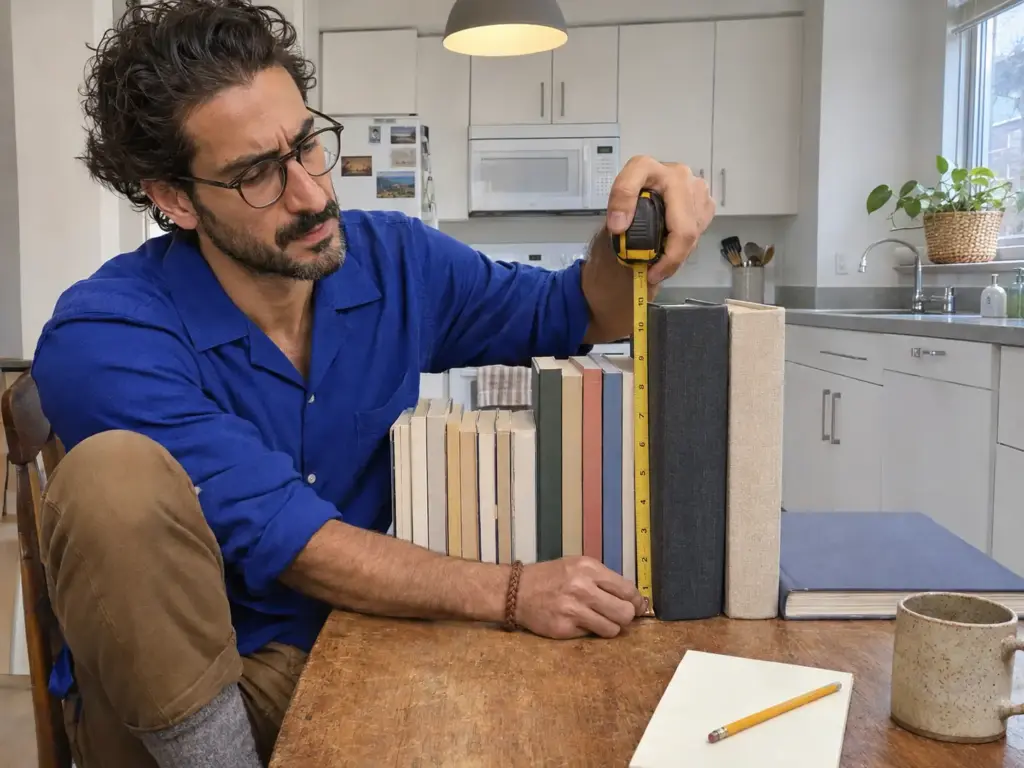
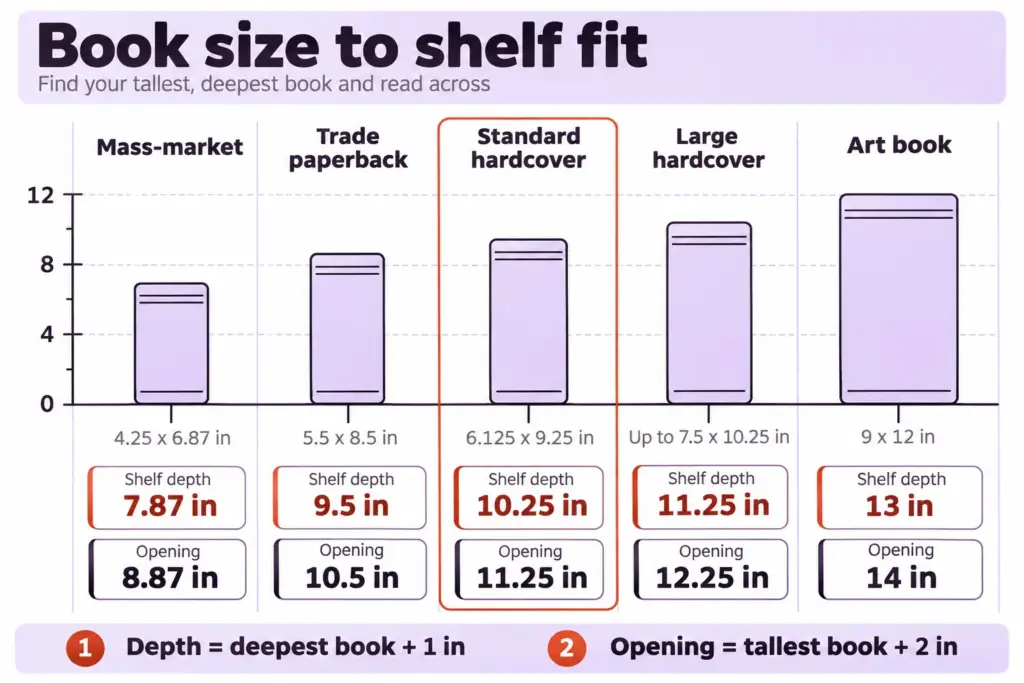
Book sizes are more standard than most people expect. A mass-market paperback measures 4.25 x 6.87 inches, a trade paperback 5.5 x 8.5, a standard hardcover 6.125 x 9.25 and a large hardcover up to 7.5 x 10.25, while art books and coffee table books run from 9 x 12 up to 12 x 14. Measure the tallest and the deepest book you own, not the average one, because the average book never has to squeeze into anything. Book height sets the opening and the deepest book sets the shelf, so a single coffee table book can overrule the rest of the collection.
Two formulas turn those measurements into a shelf. Shelf depth equals the deepest book plus 1 inch, and clear opening equals the tallest book plus 2 inches. A 9.25-inch hardcover wants a 10.25-inch shelf and an 11.25-inch opening, and a 12-inch art book needs about 14 inches of clearance, which is the number that decides whether the shelf over a doorway clears.
Why Art Books Break Plans Built for Paperbacks
An art book is the one volume that breaks a shelf plan written around paperbacks. It is taller than most openings, deeper than most shelves and heavy enough that a tall copy leaning on its spine sags within weeks, so it lies flat on the lowest shelf and gets its own measurement. Plan the rest of the collection around the paperbacks and the hardcovers, and give the two or three oversized books a spot of their own instead of letting them set the depth for everyone else.
That also means some books should not get a spot at all. Deciding which books are worth the space before anything is bought is a separate job, and this guide only measures what survives it.
What a Too-Deep Shelf Costs in Floor Space
The store-standard bookcase is 10 to 12 inches deep and 36 to 84 inches tall, with 10 to 12 inches between shelves (the IKEA Billy, about 6.5 feet tall, is the version most people picture). It is built around average hardcovers, so it wastes depth on paperbacks and height on small books. By format, paperbacks need 6 to 8 inches of depth, hardcover fiction 9 to 10, textbooks 10 to 12 and art books 12 to 14.
The 12-inch depth everyone quotes is the wrong number for a small room, and extra depth is never free. Four extra inches across an 8-foot wall uses more than 2.5 square feet of floor, and a 12-inch shelf holding 6-inch books leaves a ledge that collects keys and mail or pushes the back row into shadow. A shallow shelf that matches the books gives the floor back.
Cut one strip of paper to the length of your tallest book and another to the depth of your deepest, add the inch and the two inches from the formulas, and carry both strips to every spot you are considering. A spot that swallows the strips is real. One that does not was never going to work, whatever the listing says.
Narrow Towers, Rotating Shelves and Ladder Units for the Floor You Can Spare
One free corner and a dead strip about 10 inches wide beside the window: that is the brief. It calls for the most compartments per square foot and no back row where books vanish. Three formats answer it, and each one trades something: weight, wall or tip-over risk.
A Rotating Tower Has No Back Row to Lose
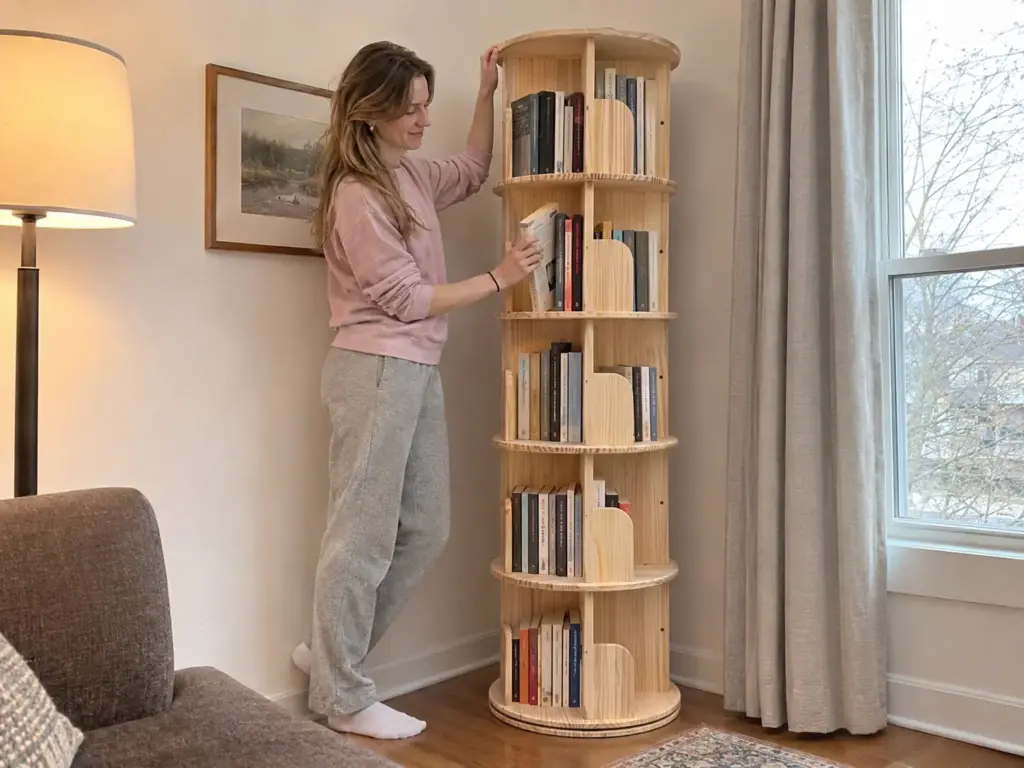
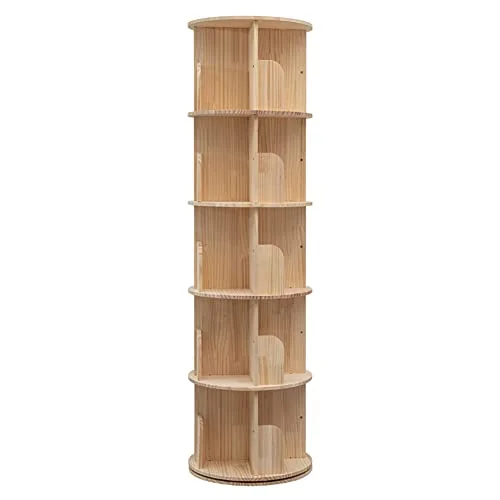
A rotating tower bookshelf solves the back-row problem by removing the back row. Because the whole thing spins, every book is at the front at some point, and it needs no wall and no holes, which makes it the renter’s answer for a corner. The Bear Qiaqia Rotating Bookshelf, 5 Tier carries 20 compartments on a 17.3-inch footprint, each opening about 11.8 inches wide, enough for medium and large books.
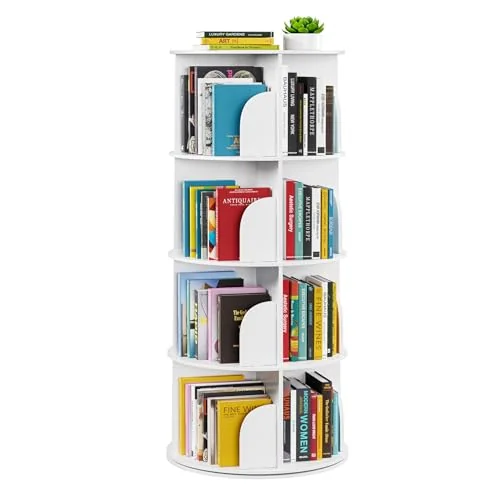
The budget way into the same format is a four-tier tower in plastic and particle board. The SpaceAid 4 Tier Rotating Bookshelf Tower trades the solid build for wipeable boards, 18.1 inches square and 50 inches tall. The cost shows up in the details: some units arrive loose and the spin runs stiff, so turn it a few times before filling every tier.
One rule keeps either tower working: a single row on every tier, plus one rotation box. Books not opened in a season go into the box, not onto the tier, because a second row is exactly how the back one disappears again.
Narrow Freestanding Towers and Ladder Shelves
The shallowest full-height option is a narrow ladder shelf. The HOOBRO DIY Ladder Shelf, 5 Tier Wall Mounted Bookshelf is 9.4 inches deep, so it fits a 10-inch strip where a 12-inch bookcase never will.
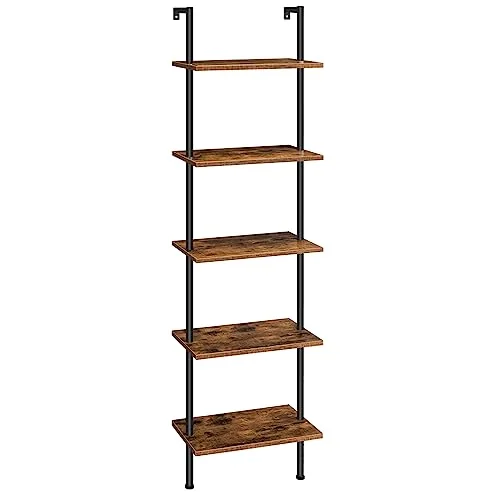
That one is the owner’s answer, since it goes on the wall. A renter with the same 10-inch strip wants something that holds itself up, and the VASAGLE 5 Tier Narrow Bookcase, Ladder Shelf is 13.3 inches wide, 11.8 deep and 66.9 tall, with a 110-pound total load and an anti-tip kit. The pre-drilled holes can arrive misaligned, and things tend to slide to the back of the shelves, so a lip or a row of bookends earns its place. Pairing any tall unit with the right anchor matters, and the freestanding units that stay upright are compared on exactly that.
Corner Units and the Bookcase That Doubles as a Divider
A corner bookshelf uses two walls and the dead angle between them, the one place a normal bookcase leaves empty. What a corner shelf can carry depends on its mount, meaning the weight rating of the fixing, not the look of the shelf.
In a studio apartment, a bookcase placed as a room divider stores books and cuts the room in two, and floor-to-ceiling shelves do the same job with the most storage. A tall back-to-back unit needs the anchor kit too, and using a bookcase to split a studio works best when the unit is shallow enough to leave the walkway open. If the room can take a full-size case after all, the comparison of shelves that do not sag under a full load covers that end of the range.
Wall Space Above Doors, Desks and Sofas, and What It Can Hold
The blank wall above the sofa and the strip over the doorway raise an obvious question: why does nobody use them? Vertical storage is the cheapest floor a small home has. The catch arrives with the first loaded shelf: hang one floating shelf, fill it with hardcovers and the front edge starts to tilt. Books get heavy fast.
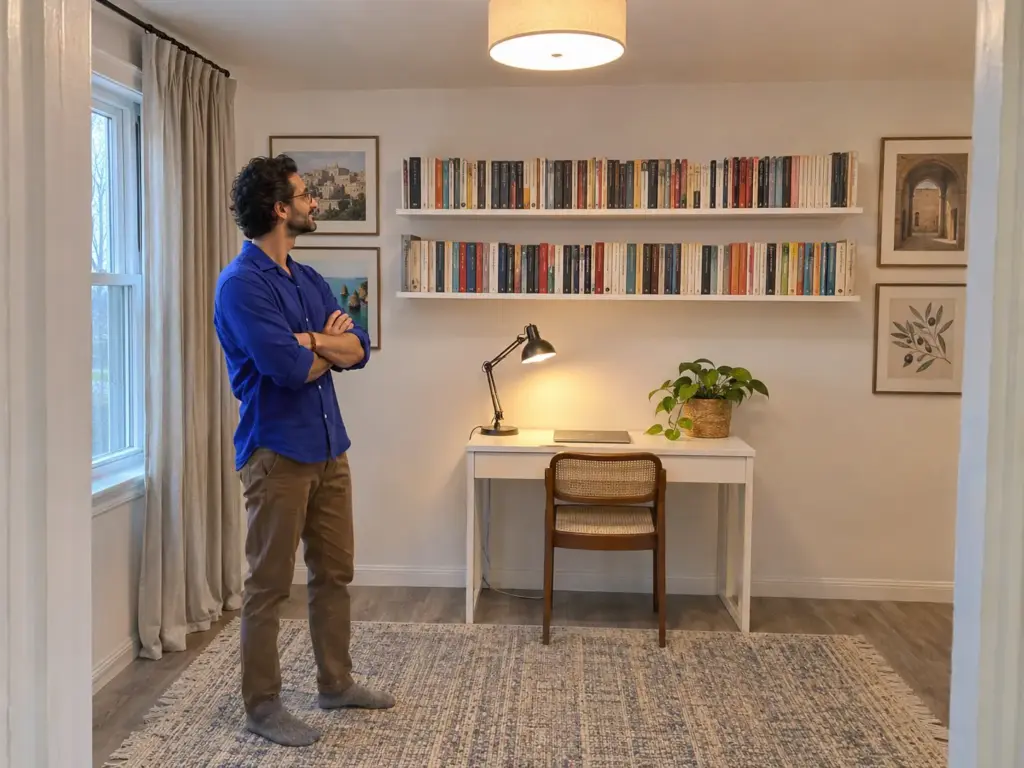
The Strips Most Small Homes Forget: Doorways, Windows and the Cabinet Tops
Free wall comes in five forms: the strip above a doorway, the wall above a desk or sofa, the space above kitchen cabinets, a single shelf running around the top of a room, and the space between studs, which adds 3½ to 4 inches of depth for an owner willing to build it. A track-and-bracket rail covers the awkward corners and the strip over a door. The Wallniture Turin 60 inch x 8 inch Floating Bookshelf, 2 Tier is that kind of system: an adjustable rail and brackets, boards 60 inches long and 8 inches deep, built to screw into the wall. Eight inches is plenty for paperbacks and slim hardcovers, and art books will overhang.
How high is too high? The wall has three reach zones: daily items live at 4 to 6 feet, weekly at 6 to 7, and anything seasonal at 7 feet and up. The books read most often go in the first zone, and the higher wall becomes the display and rotation layer. The same method is laid out for a whole apartment in using height in a small apartment, and the space above kitchen cabinets works only for books kept in lidded boxes, since grease and steam reach that high.
Studs, Toggles and Drywall Anchors: What Each One Holds
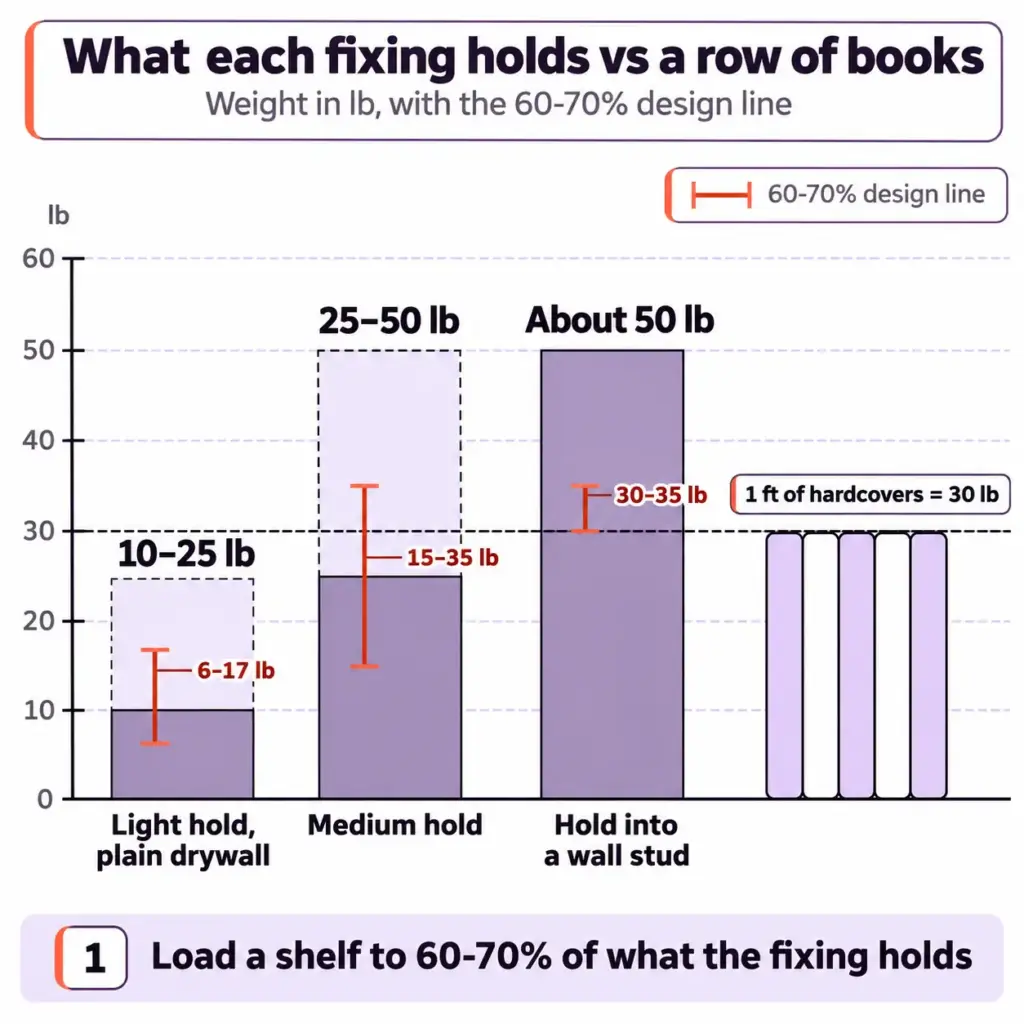
A floating shelf is the clean-looking wall answer, and for hardcovers it is a stud job. A plain drywall anchor holds roughly 10 to 25 pounds, a toggle bolt 25 to 50, and each wood stud reached about 50. A single row of hardcovers can outweigh an anchor-only floating shelf, and art and coffee table books run about 30 pounds per linear foot. Design for 60 to 70 percent of the rating, and keep the stack centered: a stack pushed to one end levers the nearest anchor out of the wall.
The board is a second ceiling, separate from the fixing. MDF and laminate carry about 8 to 25 pounds, solid pine 15 to 40, and solid hardwood 25 to 80 when stud-mounted, depending on length, and the weaker of the two limits wins. The manufacturer’s instructions rule the install, so use them as the last word on any shelf.
Stand one foot of the books you plan to hang on a bathroom scale and read the number. Multiply it by the shelf length in feet, then compare the result with 60 to 70 percent of the fixing’s rating. The scale settles the argument faster than any listing does.
Shelves sorted into stud, drywall and no-drill tiers make the numbers easier to match, and the wall-mounted shelves compared by what they actually hold are laid out that way.
What a Renter Can Hang and What a Renter Should Not
A lease that allows only adhesive strips and a couple hundred books do not belong on the same wall. Adhesive and no-drill products carry far less than a stud does, so the renter hangs light paperbacks on the wall and keeps the heavy books on freestanding furniture. The xympo Floating Invisible Bookshelf, Set of 4 is the easiest version of the floating-book look: each of the four pieces is 5 x 4.5 x 1.5 inches and carries 15 pounds, and its self-drilling anchors leave small holes. At only 4 to 5 inches deep, full-size hardcovers overhang, so it suits thin books and nothing else.
If a hole is out of the question, move to the floor and the furniture. For anyone who does want floating shelves, the picks that fit a small room are compared by floating shelf depth and what each one holds, and everything after this section needs no wall at all.
Furniture That Holds Books Without Adding a Bookcase
You need a nightstand anyway. And the entryway bench that only holds shoes is wasting its middle. A piece the room needs can carry a row of books without adding a bookcase.

A Side Table or Nightstand With an Open Lower Shelf
A slim side table with an open lower shelf puts a row of paperbacks and a lamp on a footprint that was already spent. The Yamazaki Home Plain Side Table with Open Storage Shelf, Tall 23 inch is 16.14 inches square and 22.64 tall, with a steel frame, wood legs and an open lower shelf. It is small and low for what it costs, so it holds a few dozen paperbacks, not a collection. For a small collection the furniture in the room is the answer, and money is worth spending only where one piece replaces two.
Benches, Ottomans and Bed Frames With Storage
A storage bench, a storage ottoman, a bed frame with storage or a nightstand with storage works the same way: the furniture was needed anyway. A closed lid is a bonus, because it keeps dust and light off the books, which an open shelf cannot do. Furniture that does two jobs in a small apartment is worth a look before any new bookcase goes on the list.
Baskets, Crates and a Rolling Cart
Crates stacked on their sides are sturdy and cheap, and a gas-station milk crate is sturdy for what it costs. A basket with no limit is how the fix reverts, so a labeled basket gets a maximum written on the label. A rolling cart parks beside the sofa for the books being read this month and rolls into the closet when guests come. The top of a dresser, a TV console or an entryway bench takes a single row held by bookends, and cardboard boxes carry the first 30 or 40 books when there is no shelf at all.
Under the Bed, Beside the Stairs and Inside the Closet
The bed and the closet are storage that is already paid for, but cold, dusty or hard to reach. Each dead zone can hold books, if the books are safe there.
The Floor Under the Bed and Its Clearance
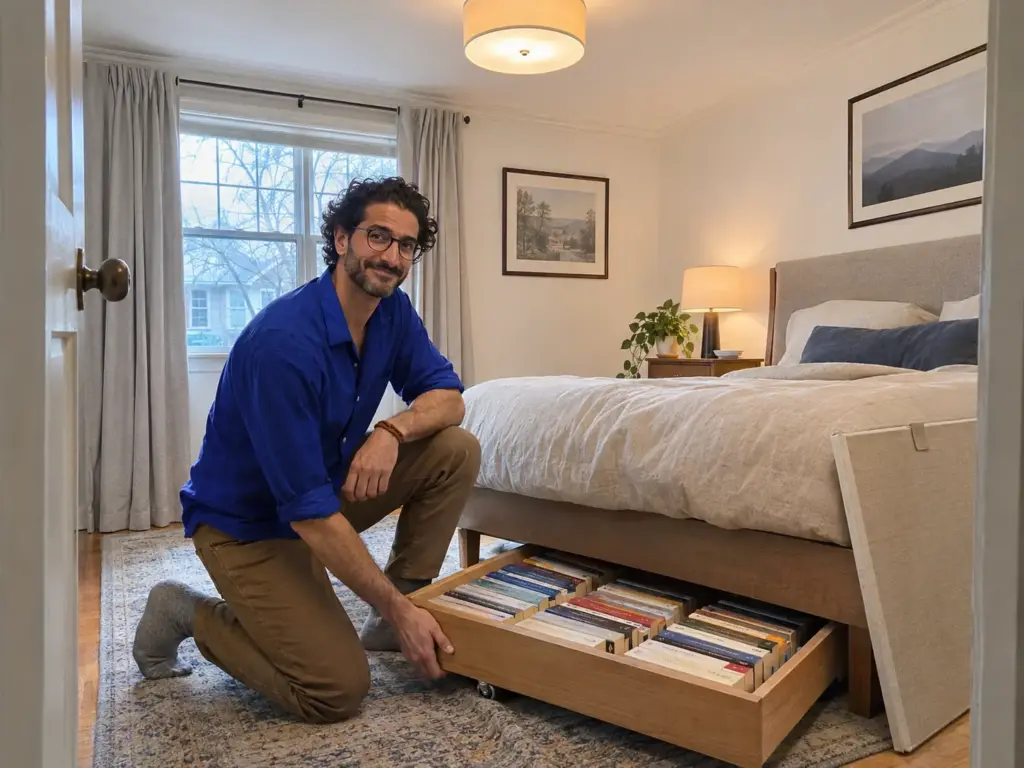
Measure the gap between the floor and the bed frame first. That clearance decides everything, and the deepest book decides the box, since books lie flat under a bed.
A shallow wheeled drawer or a flat lidded box fits best, and the lid is not optional: dust is the price of an open space. Skip the headboard wall if the room is humid. Under bed storage containers with real dimensions are worth checking against that clearance before anything is ordered.
Stair Sides, a Nonworking Fireplace and Other Alcoves
For a shelf behind the couch, beside the stairs, in the nook under stairs or in a hallway alcove, the shelf needs depth, not access depth. A nonworking fireplace is a recess that holds a full stack without costing any floor, and with a lamp beside it a stair alcove can become a reading nook. Owners can build into the space between studs, and renters keep to furniture that slides in. To find these zones in the first place, finding the dead zones in a small apartment maps them room by room.
The Closet Shelf Nobody Uses
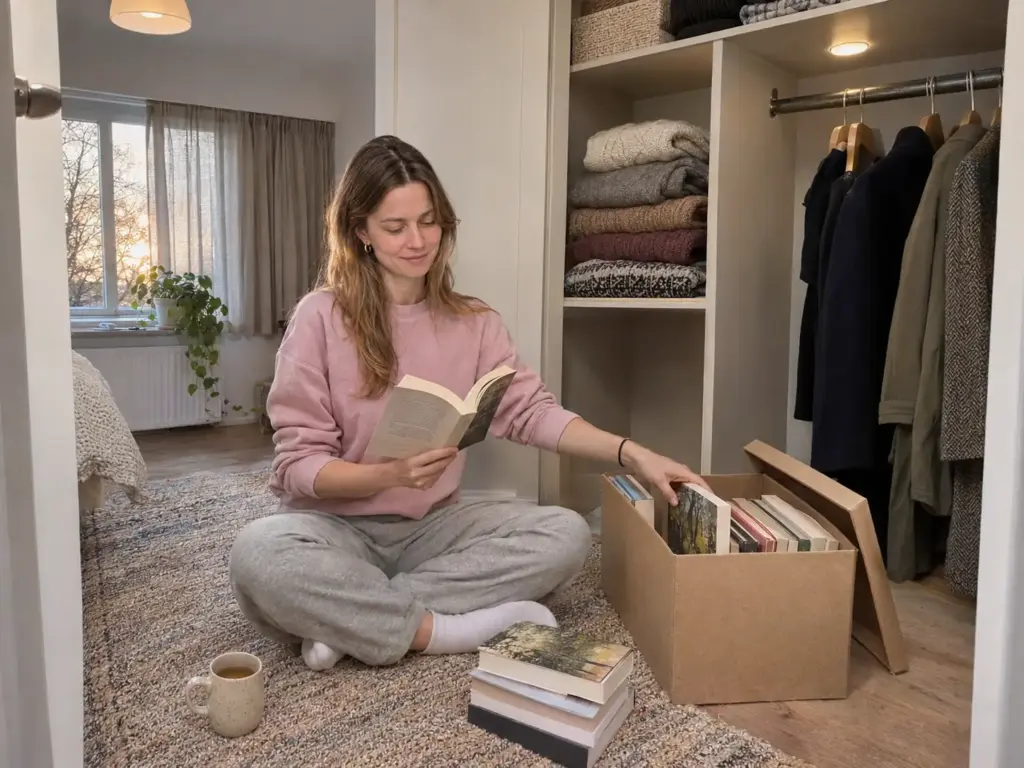
One deep shelf above the hanging rod, or a low shelf, holds a rotation box, and the closet keeps books out of the sun. Basements, attics and garages are the wrong closet: they swing too hot, too cold or too damp. The window sill and the kitchen are display spots, not storage, because heat, grease and light reach them first.
Loading Rules That Keep a Small Shelf From Becoming a Pile
A floor stack grows into a side table, and the book at the bottom is the one nobody can reach. Piles like that come from a missing loading rule, whatever the shelf looks like.
Vertical Rows, Horizontal Stacks and Spine Pressure
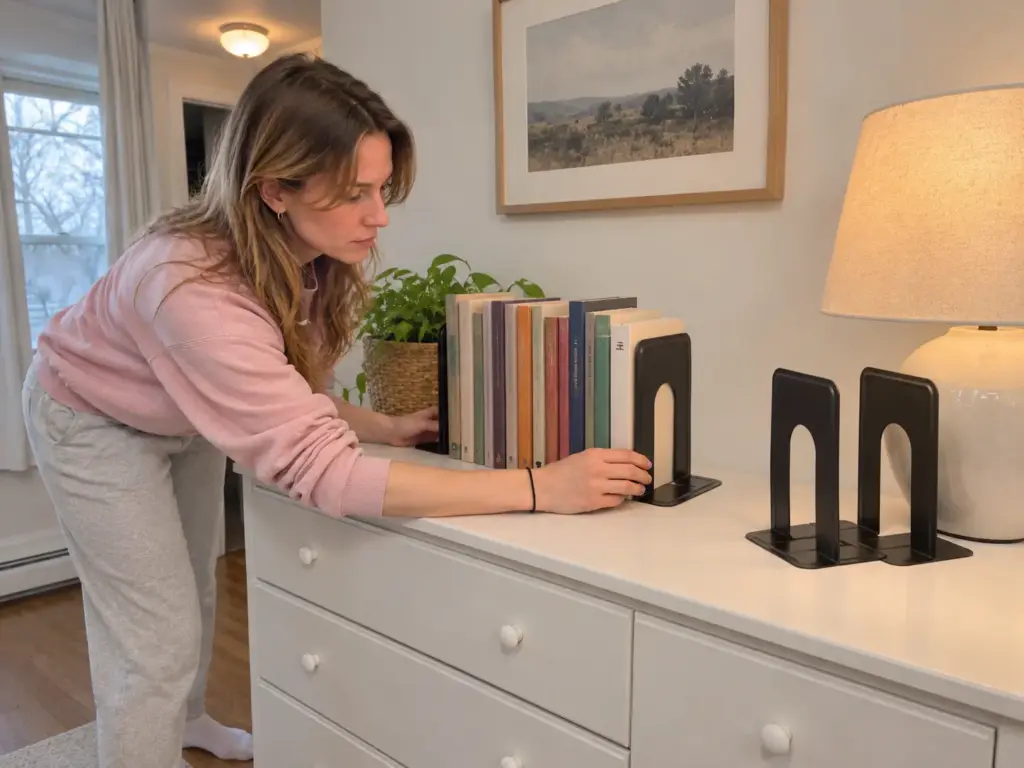
You stack books vertically in a single row for paperbacks and standard hardcovers. The row should be snug enough that nothing leans, because a spine that leans for weeks bows, and spine damage is the hardest kind to undo.
Heavy art books lie flat on the lowest shelf. When you stack books horizontally, the stack gets a ceiling, a number of books agreed in advance, so that it stays a stack and never turns into a table. Once the spot is chosen, arranging the shelf itself is a separate job.
A Stack Ceiling and Bookends
The top of a dresser, TV console or entryway bench needs only its surface and a pair of bookends. The MaxGear 8.5 inch Heavy Duty Metal Bookends, 2 Pairs are heavy-gauge steel with foam pads: the pads protect the surface, and the steel is what holds a row upright.
A double-row shelf is where the system breaks. The back row disappears, and a 12-inch shelf holding 6-inch books leaves a ledge that collects keys and mail. A single row plus a rotation box keeps every book in sight, and that book rotation is what stops a shelf from filling twice.
Put the Books You Reach For Closest
Place the books read most often nearest to where they get used, the bedside, the desk, the sofa arm. Professional organizers sort a home library on that principle, and how a professional organizer sorts a home library puts it simply: “Place the most important books closest to where you will use them”, with everything else further out. Each zone then gets exactly one rule: a single row and a rotation box on the shelf, a stack ceiling near the floor, and a labeled basket with a maximum. Arrangement by color or genre is a separate job.
Keeping Books Safe in the Spot You Chose
A favorite shelf by the window starts to show faded spines, or a box goes into the garage and comes out with damp paper. A placement can pass every measurement above and still fail because of what the room does to paper over a season.
Light, Heat and Humidity: What the Library of Congress Says
Paper has a comfortable range, and most homes sit outside it in places. Here is how the Library of Congress says to store books at home: “A cool (70 degrees Fahrenheit or below) and relatively dry (30-55% relative humidity) environment is safe for most books.” Basements, attics and garages fall outside it.
Light adds to the damage. Why sunlight fades a book spine comes down to one fact from the Library of Congress: light damage is cumulative, so dim light over a long time does as much as bright light over a short one. Sun fading cannot be undone, so a sunny sill or a shelf beside a window is a display spot, not storage.
Dust, Kitchen Grease and a Rotation Box
Dust discolors paper, attracts pests and absorbs moisture that can lead to mold, so dusting is preservation, not looks. The kitchen adds grease and steam on top. A rotation box is the quiet cure: the books not read this season go in a lidded box in the closet, and they swap places when the season changes. The shelf stays a single row, and the paper in the box stays out of the dust and the light.
Pencil the date of the last swap inside the box lid. At the next change of season the date tells you which books have earned a place on the shelf and which have waited long enough to go back in.
Keeping the Spot Usable When More Than One Person Lives There
A placement that works for the person who set it up can fail the moment a partner, a roommate or a child reaches for a book. The books come out and go back on the nearest flat surface, and a week later the stack ceiling means nothing. Each zone needs its rule stated once, in a form anyone can follow without asking: a row held by two bookends, a basket with a limit marked on it, a box that anyone can swap.
Reach decides more than most people expect. The books that are read often belong where an arm can lift them without a stool, and the ones above that line are the rotation layer, touched only when the season changes. A shelf that needs a stool to reach is a shelf that gets skipped, and the pile starts again on the sofa arm.
Heavy and tall pieces need their own habit. Put the heaviest books on the lowest tier, so a loaded unit stays bottom-heavy, and anchor anything tall as its maker instructs, because a freestanding tower is stable until someone leans on it with a stack in their arms. In a rental, the same logic runs in reverse at the end of the lease: freestanding pieces and adhesive-held shelves leave with the tenant, while anything fixed to the wall needs a plan for the holes it leaves. Settling that before the first book goes up costs nothing and removes an argument from the move-out walkthrough.
The Buy-Nothing Rung: Library, Digital and Donation
This is a library problem before it is a storage problem. The local library covers single reads, an ebook or audiobook covers re-reads and takes no floor at all, a Little Free Library box is a place to donate books that no longer earn their spot, and a half-price used-book shop turns them into something else. Spend nothing here, and the collection shrinks to the size the home can actually keep. A full small-apartment setup is laid out in organizing books in a small apartment.
Move One Pile Today, Then Check That Spot When the Season Turns
The tallest and deepest book set the size of every spot, the wall and the furniture get used before the floor, and every fixing has a weight it carries, so the shelf gets loaded to 60 to 70 percent of it. Each zone gets one rule, and the paper stays cool, dry and out of the sun.
When the season changes, look at the first spot that started to collect books. If it is still a single row and nothing leans, the plan held. If a second row or a stack has crept back, the rule for that zone needs tightening.
Today, take the one stray pile nearest the bed and run its tallest and deepest book through the two formulas, then move the pile into the first spot above that passes. Notice whether you reach for those books more or less than before: the spot that gets used is the right one.
Frequently Asked Questions
01How do you fit a lot of books in a small space?
Use the wall and the air above furniture before the floor, and add a narrow or rotating shelf only where you can spare the floor. Furniture the room needs anyway can take the overflow. Measure your tallest and deepest book first so every spot is the right size.
02Should books be stored vertically or horizontally?
Store paperbacks and standard hardcovers upright in a single row, and lay heavy art books flat on the lowest shelf. A horizontal stack needs a ceiling, a number of books agreed in advance, and bookends keep a row upright.
03What can a renter use when the lease allows only adhesive strips?
Freestanding towers and rotating shelves need no wall at all, so they are the renter’s main answer when only adhesive strips are allowed. Adhesive and invisible shelves carry light paperbacks only, far less than a row of hardcovers weighs.
04Is it bad to store books on the floor?
Yes, the floor is the worst spot, because moisture, dust and spills reach it first and a book cannot dry out the way a carpet can. Raise books at least onto a lidded box or a low shelf.
Disclaimer: ClutterlessNest is a participant in the Amazon Services LLC Associates Program. As an Amazon Associate we earn from qualifying purchases. This article may contain affiliate links — if you buy through them, we may earn a small commission at no extra cost to you. We only recommend products we have tested or genuinely believe in.