










In this article
You’ve bought pantry containers before. Probably more than once. The first set looked perfect on the shelf for about six weeks, and then the lids stopped sealing, the plastic went cloudy, and that one container you picked for flour turned out to be two cups too small for a full bag. So you shoved the bag behind the container and pretended the system still worked.
It didn’t. And the next set you bought had the same problems — because the issue was never which brand you chose. It was matching the right container type to the right food. Flour needs different things than cereal. Rice needs different things than snacks. And some items don’t need a container at all.
I’ve tested four different container sets across two kitchens over the past three years. What follows is the actual breakdown of what works for what — organized by food type, not by brand.
Quick Answer: The best pantry storage containers depend on what you’re storing.
| Best Pantry Containers by Food Type | |||
|---|---|---|---|
| Food Type | Best Container | Price | Why It Wins |
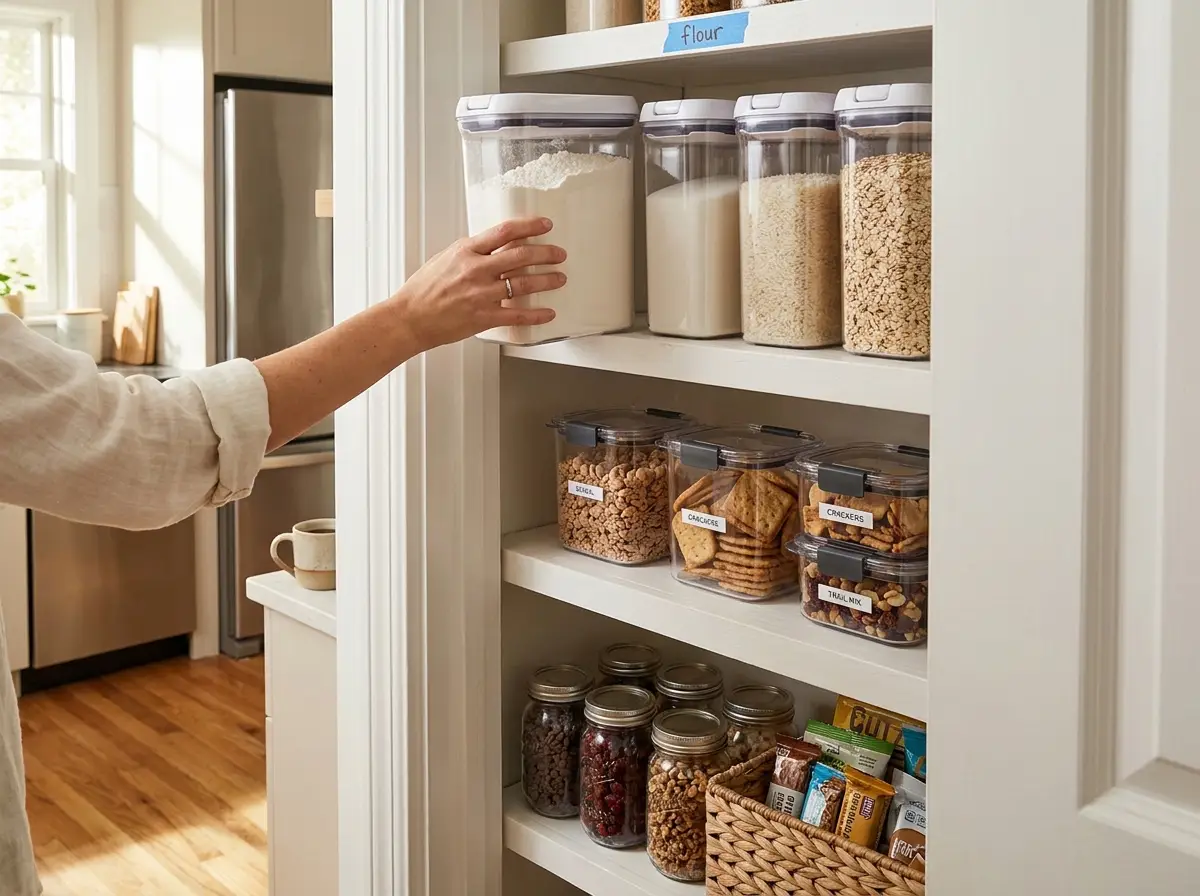
| Flour, Sugar, Baking | OXO POP 5-Piece Set | ~$50 | One-hand airtight seal, wide mouth for scoops |
| Cereal, Snacks, Dry Goods | Rubbermaid Brilliance 14-Piece | ~$55 | Dual-latch 100% airtight, stain resistant, multiple sizes |
| Pasta, Rice, Grains | Ball Mason Jars (Quart) | ~$15/12pk | Inert glass, no leaching, visible fill level |
| Budget (All Types) | Vtopmart 24-Piece Set | ~$30 | 24 containers + labels for the price of one premium set |

Why Most Pantry Containers Fail Within a Year
The container itself is rarely the problem — it’s the seal. Every airtight container depends on a silicone gasket pressed between the lid and body to keep air and moisture out. That gasket starts degrading the moment you begin using it. Flour dust gets into the seal channel. You run the lid through the dishwasher on the heated dry cycle and the silicone shrinks a fraction of a millimeter. After 12 to 18 months of regular use, the seal that was keeping your brown sugar soft is now letting in just enough air to turn it into a brick.
I’ve pulled apart containers from three different brands after a year of use. The pattern is the same: the gasket either yellows and stiffens (heat damage) or stretches and no longer seats flush (repeated removal). OXO lids with their push-button mechanism are better than most at maintaining compression, but even they lose seal integrity if the gasket isn’t cleaned monthly. Rubbermaid Brilliance uses a dual-latch system that distributes pressure more evenly — their gaskets have lasted longer in my testing, but they’re not immune to flour buildup in the channel.
The second failure point is material. Standard plastic containers — the kind you grab at a big box store for $10 a set — are made from polypropylene or low-grade polycarbonate. These absorb oils and pigments from foods like tomato sauce, turmeric, and chili powder. Once stained, the plastic surface becomes microscopically rougher, which traps moisture and odors. Within six months, those “clear” containers are a foggy, faintly spiced yellow that no amount of scrubbing fixes.
BPA-free Tritan plastic (what Rubbermaid Brilliance uses) and borosilicate glass resist staining entirely. The FDA’s food contact substance guidelines confirm that Tritan copolyester is cleared for food storage — it’s not just marketing. If you’re storing anything with pigment or strong odor, these two materials are the only ones worth buying.
Pro tip: Before tossing a container with a bad seal, check if the brand sells replacement gaskets. OXO sells replacement seals for their POP line. A $4 gasket gives an old container another two years instead of replacing the whole set.
Best Containers for Flour, Sugar, and Baking Staples
Baking staples are the hardest category to store well. Flour is fine-grained and gets everywhere — into seal channels, around gasket edges, into any gap wider than a hair. Sugar absorbs moisture from the air and clumps. Brown sugar hardens if exposed to any airflow at all. Powdered sugar compresses into a solid mass at the bottom of any container that isn’t perfectly dry.
What these ingredients need: a truly airtight seal (not “mostly airtight”), a wide opening big enough for a measuring cup, and a container tall enough to hold a full bag without overflow. Most 5-pound bags of flour need at least 16 cups of container volume. Most people buy containers that hold 12 cups and then have a half-bag of flour sitting open on the shelf behind the container that was supposed to solve this problem.

For individual baking containers, the Rubbermaid Brilliance Pantry 16-Cup (~$12) is the single best flour container on the market right now. The 16-cup capacity fits a full 5-pound bag of all-purpose flour with room for a measuring cup inside. The dual-latch lid creates a tighter seal than push-button mechanisms — it locks from two sides instead of one center point. The wide rectangular opening means you can get a full measuring cup in and out without spilling flour down the side. BPA-free Tritan plastic won’t absorb odors or stain, and the walls are clear enough to see the fill level without opening.
One note: Tritan is slightly heavier than standard plastic. A full 16-cup container of flour weighs about 7 pounds. If you’ve got wire shelves, make sure they can handle the weight across multiple containers. A full pantry organization system covers shelf weight capacity and zoning — worth reading if you’re building out a complete setup.
Pro tip: Store brown sugar with a terracotta sugar saver disc inside the container. The disc releases moisture slowly, keeping brown sugar soft for months. Without one, even the best airtight container won’t prevent hardening once you’ve opened the sugar and introduced dry pantry air inside.
Best Containers for Cereal, Snacks, and Dry Goods
Cereal and snacks are where most people’s container systems start — and where they usually fail first. The issue isn’t the container. It’s the turnover rate. Cereal moves fast in a household. You’re opening and closing that container twice a day in a family of four, and every opening lets ambient moisture in. Within two weeks of a humid summer, the cereal at the bottom of the container is stale even though the top layer tastes fine.
What cereal and snacks need: a 100% airtight seal (not the push-fit lids that come free with most container sets), a container wide enough to pour from without shaking cereal all over the counter, and enough volume to hold a full box. A standard cereal box holds 12 to 15 cups. If your container holds less than that, you’ve got a half-empty cereal box sitting next to the container, defeating the purpose.
For cereal specifically, the OXO Good Grips POP Cereal Dispenser 4.5 Qt (~$20) solves the pouring problem. Instead of tilting a wide container and scattering cereal, you flip the pour spout and it channels cereal directly into the bowl. The 4.5-quart size fits a standard large cereal box. One-handed operation — hold your bowl in one hand, pour with the other. If you have kids who serve themselves breakfast, this is the container that prevents the daily cereal-on-the-counter situation.
The pour spout narrows the opening, which is great for pouring but less great for cleaning. You’ll need a bottle brush to get into the spout channel. And the narrow opening means you can’t easily scoop from the bottom when it’s almost empty — you’re committed to pouring.
The Budget Alternative for Cereal and Snacks
If the Rubbermaid set is out of budget, the Vtopmart 24-piece set covers cereal, snacks, and most dry goods for a fraction of the cost.
The honest comparison: Vtopmart containers will last 1 to 2 years with regular use before the lids start losing their seal. OXO and Rubbermaid sets will last 3 to 5 years with gasket cleaning. If you think of it as cost-per-year, the premium sets are actually comparable. But if you need containers now and you need 20 of them, $30 beats $200 today. If you’re working with a small pantry with limited shelves, the Vtopmart set gives you enough containers to fill every shelf without worrying about running out of units.
Best Containers for Pasta, Rice, and Grains
Pasta, rice, and grains are the easiest pantry category to store — and the one where people overspend the most. These dry goods have low moisture content, don’t produce dust like flour, and don’t absorb odors the way snacks do. They just need to stay dry and be visible so you don’t buy duplicates.
Glass containers are the best option here. Unlike plastic, glass is completely inert — no chemical leaching, no odor absorption, no staining no matter what you store in it. You can see exactly how much is left without opening anything. And glass doesn’t degrade over time the way plastic seals do.
For long pasta like spaghetti and linguine, tall narrow containers work better than jars. The Vtopmart tall containers (included in the 24-piece set below) hold pasta upright so you can see what you have and grab a handful without dumping the whole box. Standard spaghetti is 10 inches long — make sure your container is at least 11 inches tall with the lid on.
If you’re working with deep pantry shelves, glass jars in the back get lost quickly. Use them on a shelf riser or in the front row where you can read the labels.
Pro tip: Write the expiration date on a small piece of masking tape and stick it to the container when you decant. Lentils and quinoa last 1 to 2 years in airtight storage, but you’ll forget when you bought them. A five-second label saves you from eating two-year-old quinoa that tastes like cardboard.
When to Skip the Container Entirely
Here’s the part most container roundups won’t tell you: some items are better left in their original packaging. Decanting everything into matching containers looks great for an Instagram photo. But decanting has a real cost — your time — and for certain foods, it adds nothing.
Skip decanting for:
- Canned goods. Cans are already sealed, stackable, and labeled. Moving them into containers makes zero sense. Use a tiered can rack to organize them instead.
- Tea bags and coffee pods. These come in individually sealed packets. Decanting them into a container removes the flavor protection each packet provides. Keep them in the original box.
- Items you’ll finish within two weeks. If you buy a bag of pretzels and it’s gone by Saturday, why spend 3 minutes pouring it into a container and washing the container? The bag with a binder clip works fine for fast-turnover snacks.
- Sealed packets and pouches. Oatmeal packets, seasoning mixes, microwave popcorn — all come in protective packaging. Putting them in a bin is fine for organization, but decanting them out of their wrappers makes them go stale faster.
Do decant when:
- The original bag isn’t resealable (flour, sugar, most rice)
- You buy bulk and the original packaging is just a thin plastic bag
- You need to see the fill level to avoid buying duplicates
- Bugs or pantry moths are a concern — airtight containers are the only real defense
The math: if you spend 3 minutes decanting an item and you rebuy it monthly, that’s 36 minutes a year per item. For flour and sugar, which genuinely need airtight storage, the 36 minutes is worth it. For a bag of chips your family eats in three days, it’s not.
Pro tip: If you’ve had pantry moths before, seal everything — no exceptions. One open bag of rice is all it takes. Moths can chew through paper and thin plastic but can’t get past a proper silicone-gasket container. That alone justifies the cost of airtight storage for every grain and flour product.
Conclusion
Three things to remember: match the container to the food (flour needs different storage than pasta), check the seal type before you buy (dual-latch beats push-fit for long-term use), and don’t decant everything just because it looks organized.
Three-month check: Open every container and press the seal. If air leaks through, clean the gasket channel with warm water and a toothbrush. If the gasket is warped or stiff, replace it or replace the container — a failed seal is worse than no container at all.
Start with your baking shelf. Get those five or six containers right — flour, sugar, brown sugar — and then decide if the rest of your pantry actually needs containers or just needs a better bin system.
Q1 What is the best airtight container for flour?
The Rubbermaid Brilliance 16-cup container is the best airtight flour container. Its dual-latch seal keeps moisture out completely, the wide opening fits a measuring cup, and the 16-cup capacity holds a full 5-pound bag with room for a scoop.
Q2 Are glass or plastic containers better for pantry storage?
Glass is better for foods you store long-term like grains and legumes because it doesn’t absorb odors or stain. Plastic works better for items you access daily like flour and cereal because it’s lighter and more impact resistant. Use both based on what you’re storing.
Q3 How often should you replace pantry storage containers?
Replace pantry containers when the seal fails, typically every 2 to 5 years depending on quality. Test by closing the lid and pressing on it — if air escapes, the gasket is worn. Budget containers like Vtopmart last 1 to 2 years while OXO and Rubbermaid last 3 to 5 years.
Q4 Is it worth decanting everything into pantry containers?
No. Decant flour, sugar, grains, and bulk items that need airtight protection. Skip decanting canned goods, individually sealed packets, and fast-turnover snacks. The time spent decanting and washing containers isn’t worth it for items you’ll finish in under two weeks.
Q5 How do you keep brown sugar soft in a container?
Place a terracotta sugar saver disc inside the container with the brown sugar. The disc slowly releases moisture, keeping the sugar soft for months. Even in an airtight container, brown sugar hardens once exposed to dry pantry air — the terracotta disc counteracts that.