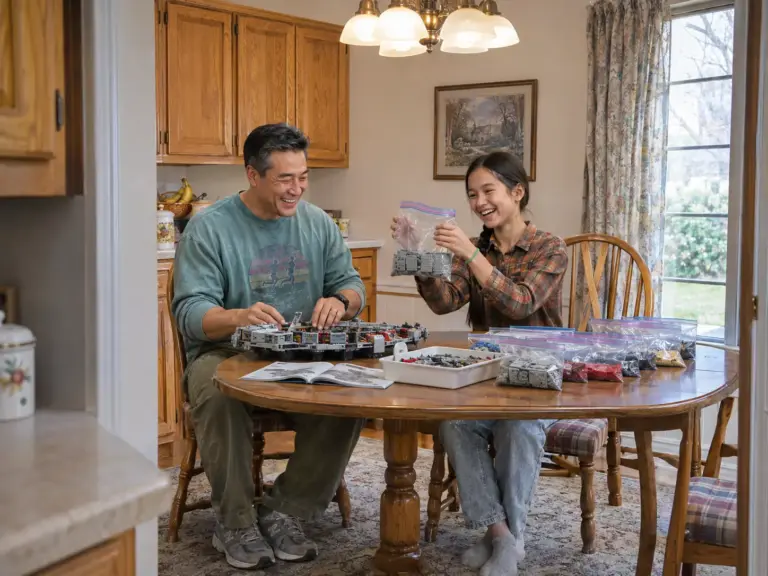

The third box slides off the stack, a lid pops open on the way down, and a handful of tokens skitters under the radiator while everyone waits at the table. If that scene sent you looking for how to organize board games, the usual answer to board game storage is a bigger shelf. A shelf holds for a season and then the closet drifts back, because boxes that crush and pieces that wander wear a game out long before the shelf does. This guide fixes the box first, then the lid, then the pieces, and only then picks the shelf that fits the tallest game you own.
Quick Answer
Work from the box outward, free fixes first and the shelf last.
- Cull the games nobody will play, starting with incomplete ones.
- Stand boxes on edge and hold lids shut with Velcro, tape or bands.
- Bag or tray each group of components inside its box.
- Match the tallest box you own to the shelf opening.
- Give the games played every week one shelf that is easy to reach.
How to Organize Board Games Starts With the Box, Not the Shelf
Picture pulling the bottom game out of a stack of five on the floor of a hallway closet that has become the game closet. The corners of that box are crushed, the lid no longer sits square, and three tokens are already working their way into the carpet. Nothing in that scene is a shelf problem. It is a box problem that the shelf inherits, and good board game organization starts there.
Why Stacks Collapse and Lids Pop
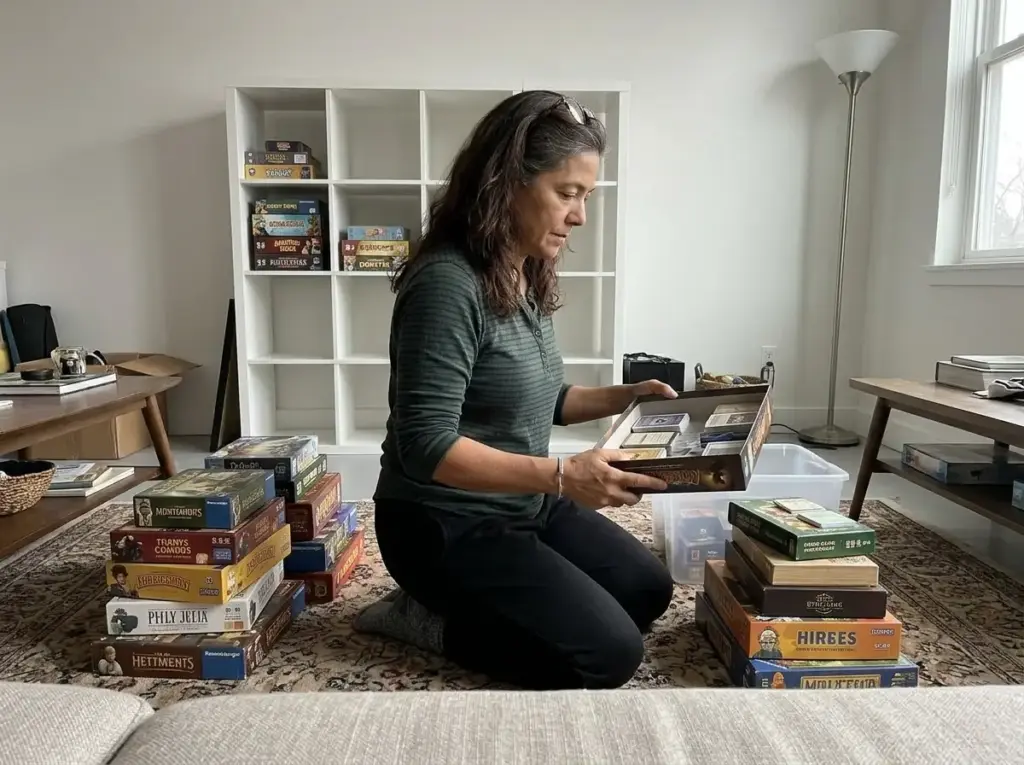
Cardboard game boxes have no frame. According to a preservation study from the University of North Texas published by the American Library Association, “The primary concerns for the longevity of the games centered on the boxes’ structural integrity and water damage to their contents.” Water is a basement problem. The structural half follows the game into every home: a box under a stack carries everything above it on its corners, the corners split, and a lid with split corners never sits square again.
Stacked boxes are not banned, only limited. Two or three boxes of the same size hold up far better than five mixed sizes, and the heaviest game goes at the bottom with the lightest on top. The same logic that separates stackable bins that actually stack from the ones that buckle applies to cardboard, minus the part where a crushed box can be swapped for a new one.
The shelf has to be built around the box, so the box numbers come first. Typical box height runs about 3 inches, and low-profile boxes come in under 2. The classic square hobby box is roughly 10 inches square and 2 inches tall, but most boxes on a real shelf run 11 to 12 inches square, and the single tall box in the pile sets the gap for every row.
Standing boxes on edge, library style, means you store games on their side like books. It ends the crushing and starts a second problem. On a shelf that is not packed tight, the lid comes loose, rides up and lets the contents fan out the first time a neighbor is pulled free. Box lids get a full section further down, because the cheap fixes are better than they sound.
The Pieces That Migrate to the Bottom of the Box
Pieces leave a game in quieter ways. Unboxing games into a cleaner setup is tempting, so the factory cardboard insert gets chucked, and the tokens that had a tray now roll loose in the base of the box. Expansions get folded into the base game and their own boxes thrown out, which saves a shelf slot and removes the only label the expansion’s pieces had. Then the box travels through the house and the small parts scatter: through a gap in an old floorboard, into a heat register, under the radiator, into a pet’s bed.
The library study puts a count on it. One unbagged copy lost three components over eight months of loans, and the cure it tested, bagging and labeling every group of pieces, added about fifteen minutes of processing per game. That is a price you pay once per game, not once per game night. Cheap insurance.
Cull First: Games That Will Never Get Played
Purging games comes before any measuring, because the number of games decides whether you need a cube shelf, a bookcase or nothing new at all. The purge test is one question: will this actually get played? Incomplete games leave first, then duplicates of titles you already own in a better edition, then the never played boxes still in shrink wrap after two years of good intentions. Collecting games and playing games are two different hobbies, and the shelf is for the second one.
Some calls are harder than that, and a system with rules beats a mood on a Saturday. Decluttering methods that work past the first week give you a way to decide a game’s fate in one pass, then stick with the decision.
Keep the Lid Shut on a Shelf That Isn’t Jammed Full
Pull one game from the middle of a shelf that is three-quarters full and watch the neighbors: they lean into the gap, one lid slides up, and a deck of cards fans across the floor. The correction costs less than any shelf.
Velcro Dots and Corner Tape Before Anything Else
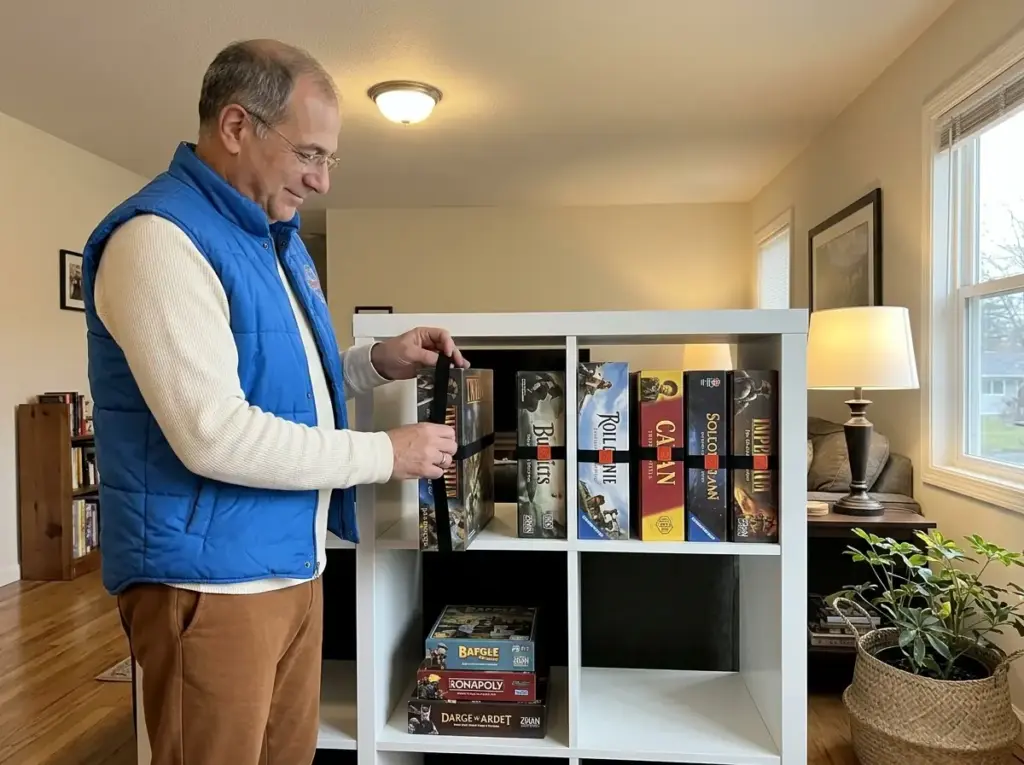
The method borrows from how books live on a shelf, and standing things on a shelf the way books stand depends on two things a game collection rarely has: a tight row and a bookend at the end of it. A game box is also not a book. Its lid is a separate piece held on by friction, so the first fix is to take away the friction problem.
A pair of adhesive Velcro dots, one on each side of the lid, locks the lid to the base without touching the art on the front. It outlasts rubber bands, it does not stretch out, and from across the room it looks like nothing at all. Split corners get a strip of clear packing tape or cloth tape, since reinforcing the corners reduced wear in the library study too.
Press the dots on with the lid seated square, then hold for a full minute. On a glossy cover, wipe the spot with a dry cloth first, or the dots peel the first time someone yanks a box from the row.
Elastic Bands: What They Fix and What They Mark
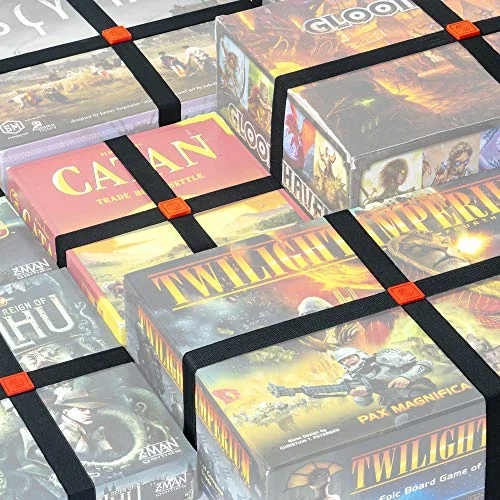
Elastic does the same job from the outside. A wide band that loops all four sides keeps a lid on a box standing on edge, and it suits a box with corners too soft to hold Velcro. It also leaves no adhesive behind, which matters if the games are borrowed or the collection gets passed on.
Bands come with two catches. Elastic can press a groove into a soft cardboard cover when it sits on one spot for months, so the band should be slid to a different position now and then. And a band that lives in a drawer is the band that is missing when the lid pops, so it stays on the box, always.
When the Shelf Is Packed Tight, Skip All of It
The common advice is to band or dot every box on the shelf. On a shelf packed edge to edge, the neighbors already hold each lid shut, and the extra step only slows down putting a game back. Dots and bands belong to the shelf that is not full yet, to the box that leaves the house for another table, and to any game whose lid has already shown it wants to open.
If you rent and own one cube shelf, nothing in this section touches the wall. Every fix sits on the box, and it moves with you.
Bag the Pieces: Cards, Tokens and Tiny Parts Inside the Box
A small bag of tokens splits open at the bottom of the box, and before the first turn four people are sorting wooden cubes by color. Good component storage gives every group of pieces one fixed home, at three budget levels.
One Bag per Component Group
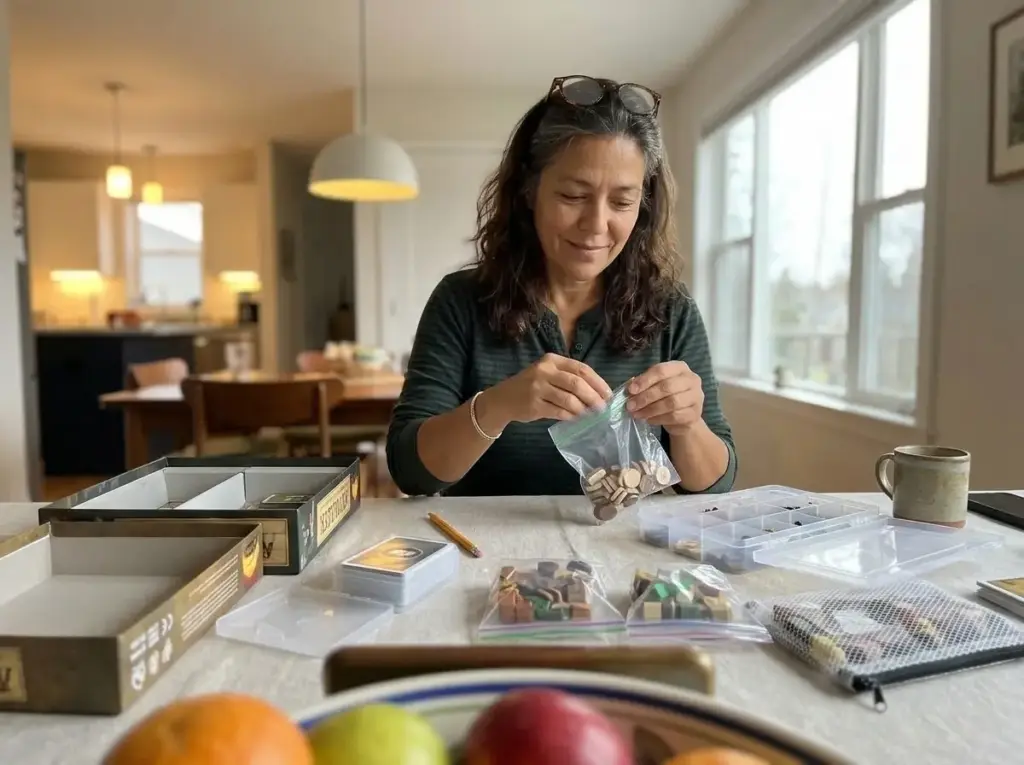
Start at the free end: a resealable bag for each group of pieces, with the piece count written on the bag in marker. The deck, each color of tokens, the dice and the folded boards each get their own. Counting at setup costs a minute, and counting at the end of the night tells you what is missing while the game is still on the table. It is the method the library study used, which is why the fifteen minutes per game is worth spending once.
The BornFeel 300 Small Plastic Zipper Bags cover most of a collection in three sizes, 2.4 by 3.5, 3.5 by 5 and 4 by 6 inches, enough to give a deck, a token color and a pile of cubes a bag each. The film is 2 mil, the thinnest common gauge, so they suit parts that stay put between games, not a bag torn open and re-sealed at every setup.
Plain bags are cheap storage, and they are enough for most of a shelf.
For the games that come out weekly, the upgrade is mesh pouches. The EOOUT 30 Mesh Zipper Pouch Bags are see-through, take a label from a label maker, and run from 15.6 by 11.2 inches down to 7 by 4.8, so the biggest holds a stack of player boards and the smallest a bag of tokens.
That smallest size is still generous for a handful of cubes, so the tiniest sets stay in the plain bags. Whichever you pick, keeping small pieces from drifting out of the set works on the same logic as a LEGO box: one group, one bag, one label.
Write the piece count and the group name on the bag, not on the box. Whoever puts the game away at the end of the evening can check the count in seconds, and a short bag shows up the same night instead of at the next game.
Token Trays That Go Straight to the Table
The factory insert is the part of the box worth copying and the part that gets binned, because a tray lifts out and goes straight to the table while a bag has to be opened and poured. Food containers make poor substitutes: they are often too large or too steep to get tokens out easily. A tackle box doubles as a token box, and it is the compromise.
The Newbested 4-Pack 5-Grid Clear Tackle Boxes measure 7.1 by 4.3 by 1.2 inches each, with five lift-out compartments that replace the cardboard. At 1.2 inches deep they hold tokens, cubes and meeples, not sleeved decks. Counter trays are the lower-cost alternative.
Bead organizers and small-parts trays from the craft aisle do the same job for a game with dozens of tiny parts. Laser-cut aftermarket trays, such as Gametrayz, sit at the far end of the budget, and the shelf section below explains when they earn it. A pre-scored foam insert is the quieter alternative to a laser-cut tray, and it suits a game that stays in its original box.
One check belongs to every tray and bag. According to the CPSC’s small-parts rule, “A small part is any object that fits, without compressing and in any orientation, entirely into the small parts cylinder.” The cylinder approximates a toddler’s throat, so the quick home version is a toilet-paper tube: a token that drops through it is a choking hazard for a child under three, and that game lives above reach.
Card Decks That Do Not Fan Out
A loose deck in a big box spreads across the base the first time the box is tilted. A rigid case or deck box keeps it together, and a snap case also gives the cards a fixed place on the table. The IOKUKI 4 Clear Playing Card Cases measure 4.1 by 3 by 1 inch, a decent size for a standard deck. Fit is tight on bigger decks, and a full Uno deck is a squeeze, so the fallback for fat decks is a resealable bag sized to the pile.
Sleeved cards fared better in the library study as well, so the case is one layer and the sleeve is another.
When the Original Box Is Beaten: Rigid Boxes, Thin Boxes and Puzzles
Somewhere in most closets lives a box with split corners and a lid that stopped closing, and it is still there only because nobody has made the call. Here is how to make it.
Keep the Box or Unbox the Game
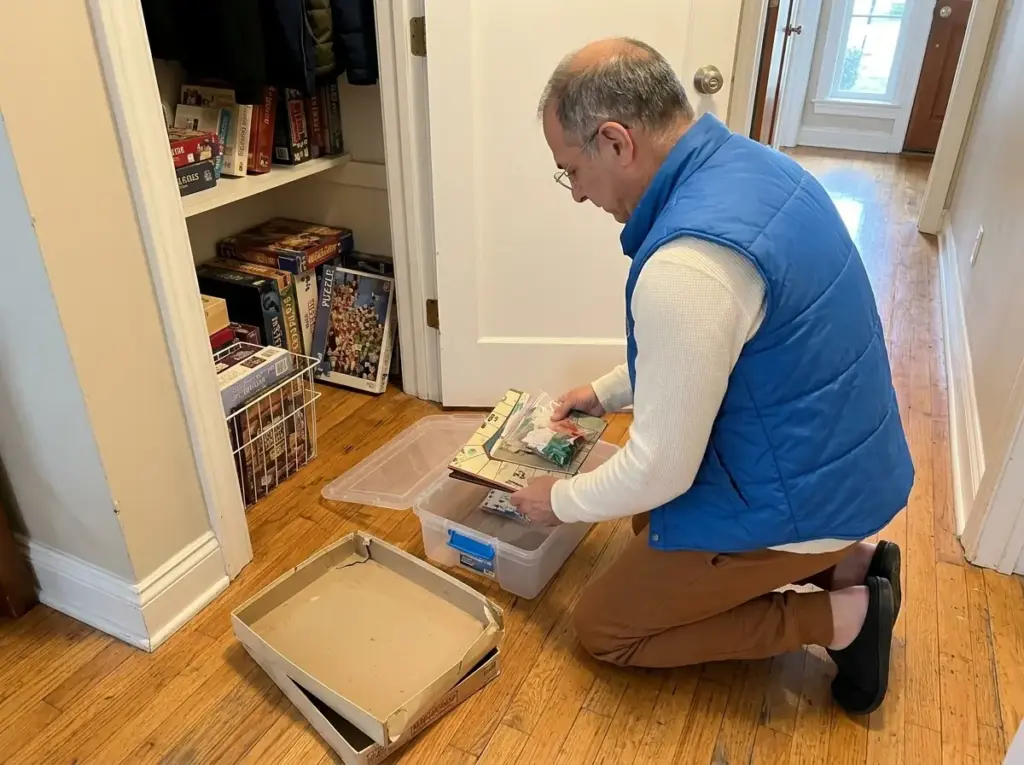
Keep the original while it is intact. The art, the shape of the insert and the resale value all live in the box, and a game in a plain container is harder to recognize on a shelf. The obvious move for a battered box is to replace it, but the better first step is tape on the corners and a lid fix from the section above. Swap the box only when taping no longer holds the lid.
The exception is the small box games. A card game in a hard case takes half the shelf space of its original box, and the box tells you nothing the case does not. Expansions follow the same logic: when the base box has room, keep the expansion inside it and recycle the extra box.
One Rigid Box for the Whole Game
A clear rigid box with a clip-lock lid holds the game, the bags and the board together, and it stacks with boxes of its own size, which means no mixed stacks.
The Really Useful Box 9.0 Liter, Clear measures 14.5 by 10.25 by 6.25 inches. Check the board against that 10.25-inch width first: a board folded for a 12-inch square box will not lie flat in it. It costs more per box than a generic container, which is the trade for clips that actually latch. A clip-lock Sterilite container from the hardware aisle is the lower-cost route if the board fits.
Puzzles and Thin Boxes That Slide Off the Shelf
Thin boxes and puzzles slide off a shelf, lean against the neighbor and eventually lose the lid. The free alternative comes first: a vertical file holder or a magazine file stands them upright and keeps the spines facing out.
For thin peg puzzles, the Melissa & Doug Single Wire Puzzle Storage Rack works as a puzzle rack that holds 12 of them upright in 3/4-inch slots, at 11.85 by 7.3 by 9.2 inches overall. The catch is that it takes only puzzles around 8.5 by 11.5 by 0.5 inches, so a standard 500 or 1,000-piece box will not fit, and the single wire is not built for heavy use.
A game room changes the temptation. With room to spare, the urge is to keep every box, and a spare shelf quickly fills with empty ones. More space is a reason to cull harder, not to relax.
The Shelf and the Fit Math: What to Measure Before You Buy
The cube shelf comes home, the big square box will not drop in, and the shelf goes back in its carton. The numbers below prevent that trip.
Measure the Tallest and the Widest Box You Own
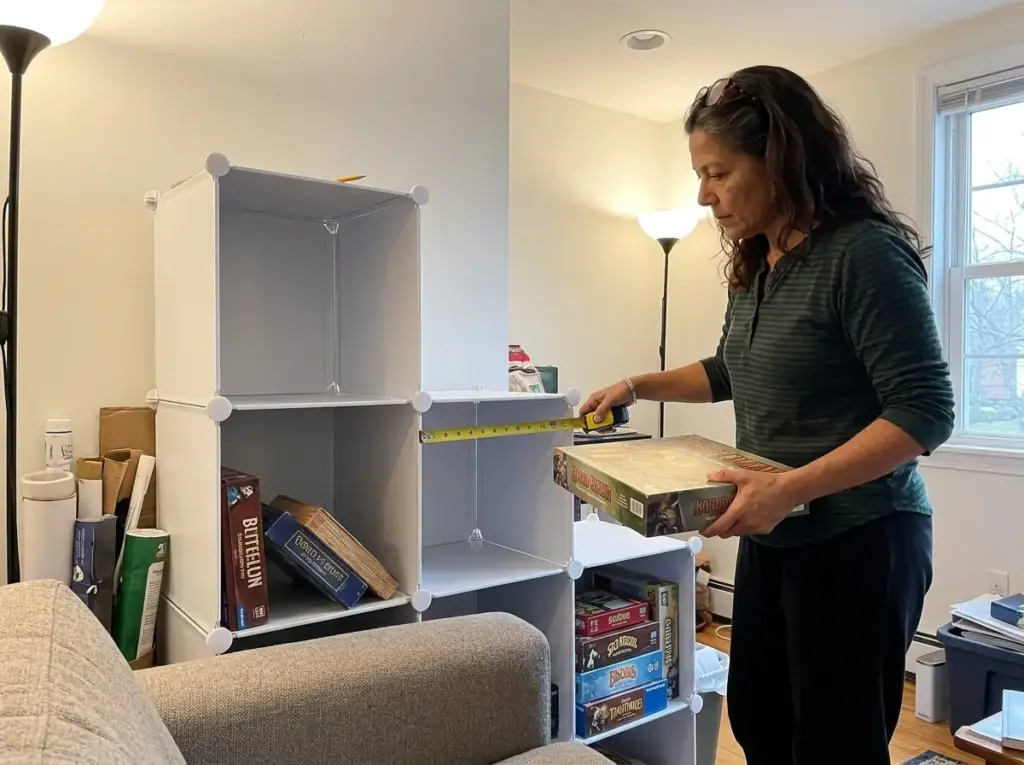
Average box size is useless for a shelf. Measure the tallest box and the widest one, because a single 3-inch-tall game sets the gap for every row, and a single one of the oversized game boxes sets the depth. Write both numbers down before looking at any listing.
Most boxes run 11 to 12 inches square, so the shelf depth has to be at least 12 inches. A bookcase 10 inches deep leaves an inch of every box hanging over the front edge, and that overhang is exactly where hips and sleeves catch.
Cube Openings Are Smaller Than the Listing Suggests
An IKEA Kallax cube is advertised at 13 inches, and the measured inside is about 13 1/4 inches square and 15 1/4 inches deep. So “fits board games” really means games up to about 13 inches, with two inches of dead space behind them. A cheaper cube shelf is a different story: the AWTATOS cube measures 11.8 inches, more than an inch smaller, and a 12-inch box will not drop in. The listing says cube; the inside says otherwise.
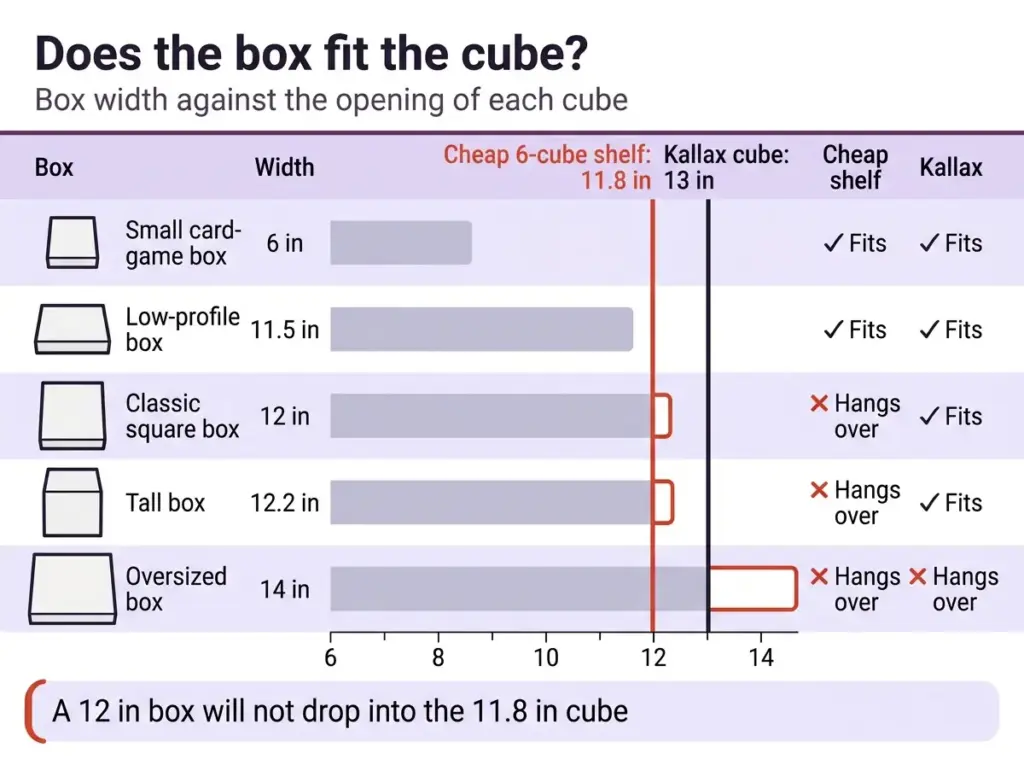
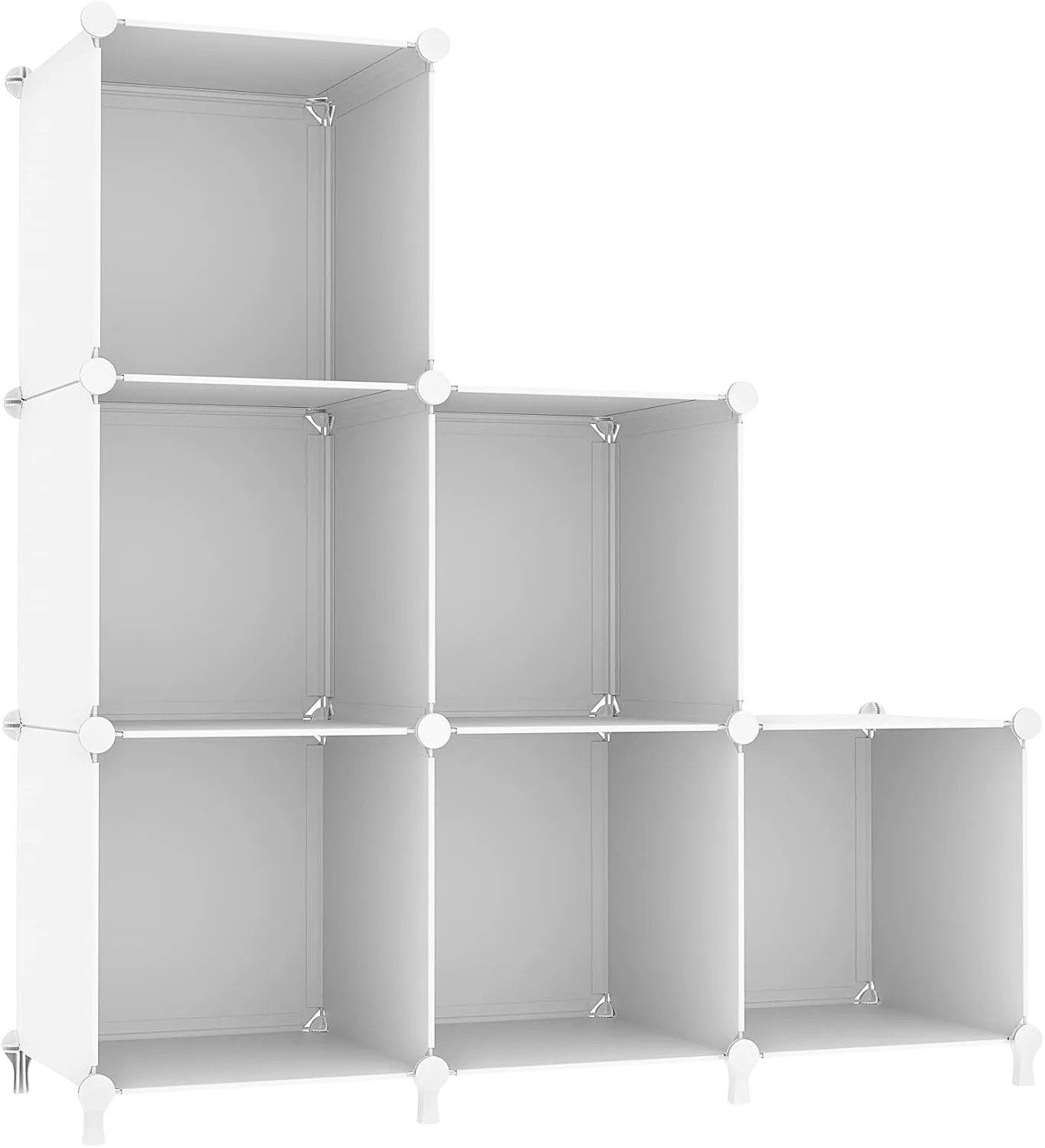
The AWTATOS 6-Cube Storage Organizer is the cheapest way to get six openings, and its 11.8-inch cube is the number to beat. Games that run 11.5 inches or less drop in comfortably, the classic 10-inch square boxes fit with room to spare, and anything bigger needs a different home. Wall-width math is a separate problem on a narrow wall, and how to work out cube shelving for a narrow wall walks through it.
If the shelf has to take the oversized games, any 13-inch cube shelf is the sturdier budget alternative, and the IKEA Kallax holds up better than the AWTATOS where weight matters. The best answer for the one game that fits nowhere is no cube at all.
Cut a piece of cardboard to your tallest box’s front face, 12 inches square or whatever the measurement says, and carry it to the store or hold it to the listing’s inside dimensions. A tape measure tells you the number, and the cutout tells you whether it will actually drop in.
Deep Shelves Swallow the Back Row
The opposite problem shows up in a deep shelf or a closet shelf 24 inches back. A second row of games behind the first disappears, and the back row is the one nobody remembers owning. Two rows deep is a recipe for forgotten games and wasted space, so use the depth for height instead: one row of boxes on edge, and a stack of flat storage on top or underneath for the oversized ones.
Flat is also the right way to store a game with a board that tends to warp. The library study found that storing games flat protects against board warping, so the oversized box lies flat on the bottom, with a lighter game or nothing on top, and the cube grid above it stays for standard sizes. The wide shelf in a game room is where this rule pays off most, because the room to lay a box flat is exactly what a cube shelf does not have.
One Cube Shelf or a Whole Game Room: The Same Rules, Two Budgets
Two readers share the same box-height problem. One has a single shelf and a lease, and the other has a basement and a lot more room to lose things.
The Renter With One Cube Shelf
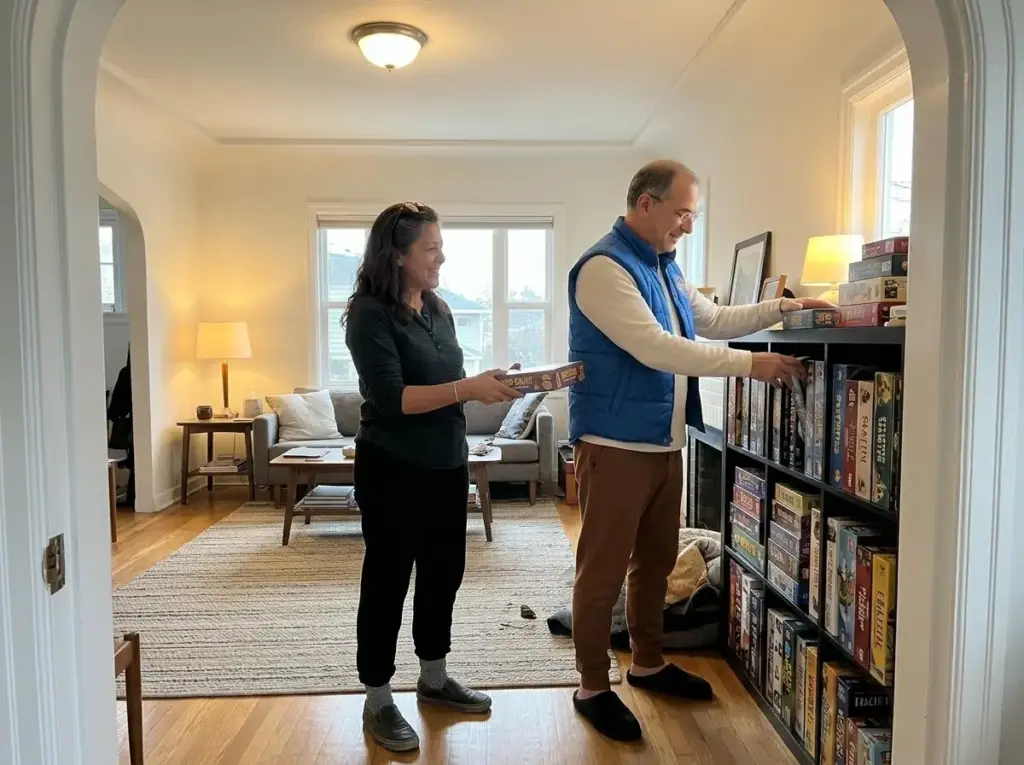
For the renter, the constraint is shelf size, not the wall. One cube-style unit, games on edge, a no-drill setup with nothing anchored, and every fix from the lid and piece sections stays on the box. If the unit is tall and children are around, it needs a decision about stability before it is loaded, and a shorter unit that does not need anchoring is often the safer call in a home where drilling is not allowed. A low shelf also puts the games at a child’s reach, which makes the small-parts rule from earlier more urgent.
A living room that doubles as the game room asks for storage that looks like furniture. Living-room storage that holds up in a small space covers what that looks like when the shelf is the only storage in the room.
The Homeowner With a Game Room
A game room raises the ceiling on how large the collection can grow, which is not always a win. More shelving feels like permission to keep everything, and a spare shelf is a decision to cull, not a decision to expand. The same box-first rules apply, with one advantage: there is room to lay oversized boxes flat and to run a rotation shelf at eye level. Furniture can carry games too: a storage coffee table, an armoire, a rolling cart parked by the table, or a pull-out drawer in a console all hold the boxes that would not fit the grid.
The boutique end of the budget sits last. Laser-cut inserts cost a multiple of the bags-and-tray route, and they pay off only for a collection that has outgrown it, where setup time with bags is a real complaint and the games are played often enough to justify the upgrade. Start with the bags and the trays, and put the money into inserts for the two or three games that earn them.
Sorting the Shelf So a Game Can Be Found
Pick one scheme that matches how the household actually asks for a game. If someone says “something for four players, under an hour”, sort by player count and play time. If the ask is “something cooperative”, sorting by genre answers it.
Sorting by publisher suits a collector who knows the catalog, and sorting by complexity suits a house where kids and adults play at different levels.
Alphabetical looks neat and breaks the day a new C title arrives, because every game after it has to shift one slot. Never sort by color: it looks tidy and finds nothing.
A large collection needs a grid.
Label the shelf with a letter and a number for each cube, write the grid code on a sticker on the box edge, and keep a printed lookup list sorted by player count and play time. Finding a game is then a quick lookup rather than a scan of a long row of spines.
Why the System Reverts, and the Rotation Shelf That Keeps It Alive
A family game night ends late, everyone is tired, the boxes get shoved in wrong, and by the next weekend the closet is the same closet as before. A system built for a perfect household fails in the first month, so the design has to assume the opposite.
The Put-Back Pile
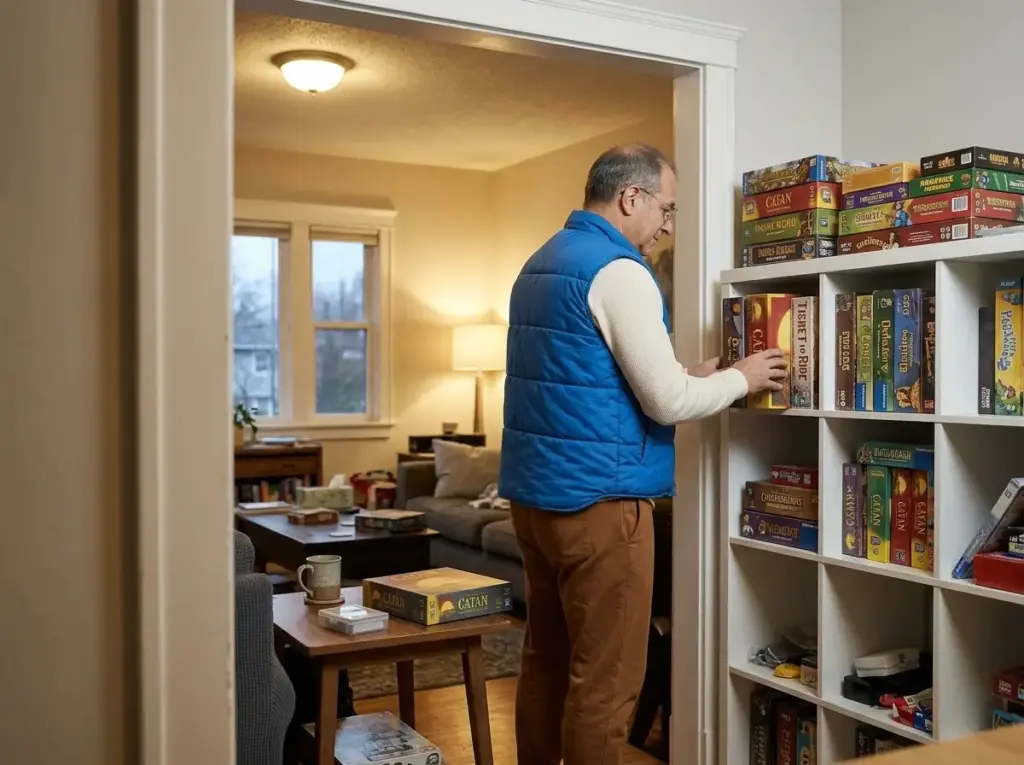
Systems revert at the put-back, the moment of putting games away. The band is left off, the lid goes on crooked, the tokens land in the wrong bag, and the box goes on whichever shelf is nearest. None of that is laziness. It is what happens when the right way takes more effort than the wrong way, and the answer is to make the wrong way harder.
One home per component group, so a stray token has nowhere to hide. A shelf with an obvious empty slot per game, so a box that does not fit is visibly in the wrong place.
A put-back pile on a low table or a closet shelf, so the night can end with the games stacked in one spot and the sorting done in the morning.
The pile has a rule: it gets emptied the next day, not the next week. Otherwise it becomes the new stack of five.
A Rotation Shelf for the Games Played Every Week
Put the five or six active games, the ones played every week, on one shelf at easy reach, ideally at eye level, and let the rest of the collection live higher or lower. The eye-level shelf is for the games that actually come out, not for the ones that look good. Games that never leave the high shelf for a month are candidates for the purge pile, and the games the household keeps asking for move down to the rotation shelf.
The same mechanism that keeps toys from overflowing works here, and you can swap the toys out on a schedule in much the same way for games.
Children change the placement. The kids games they pull out go at kid height with a lid that stays on, and any game with small parts goes above reach, in line with the CPSC rule.
A Ten-Minute Reset That Keeps the Shelf Honest
The maintenance is a short reset every few game nights, which does more than a big annual overhaul. Count the bags, check that the bands are still on, stand up the leaning boxes, and pull out any game whose lid has started to lift. Ten minutes, with the table already cleared.
Leave one empty cube or slot on purpose. A shelf that is completely full has no room for the game someone is holding, and that homeless box ends up on top of the shelf, on the floor, or in a new stack.
Fix the Box First, Then Check the Shelf After a Month of Game Nights
What changes the outcome is the order. The box comes first: tape on the corners, a lid that stays shut, a bag for every group of pieces. Then the shelf, sized to the tallest game, and last the boutique inserts, only if the cheap route has run out. Free first, every time.
A month of ordinary game nights tells you whether it worked. Look at which boxes lean, which bags have split, and which games are still sitting at eye level untouched. Move the untouched ones up or out, and fix whatever keeps splitting. If you want the broader picture for the rest of the playroom, toy organization systems families actually keep using covers where board games fit among everything else.
Today, take the one game that causes the most grief, give each group of pieces a bag and the lid a fix, and notice how the next setup goes.
Frequently Asked Questions
01What is the best way to organize board games?
The best way to organize board games is to stand the boxes on edge, keep the lids shut and give each group of components its own bag or tray. Keep the games you play every week on the shelf that is easiest to reach.
02Is it better to store board games vertically or horizontally?
Vertical storage works best for a shelf you pull from often, because any game comes out without moving the others. Store oversized boxes and any game with a warping board flat, and keep stacks to two or three boxes of the same size.
03What is the best organizer for board games?
The best organizer is the one that matches the tallest box you own: a cube shelf or bookcase with at least 12 inches of depth, plus bags and trays inside the boxes. Boutique inserts come last.
04How do you store board games without boxes?
Move the whole game into a clear rigid box with a clip-lock lid, and bag each group of components. Keep the rules and the cards together in a deck case so nothing gets separated from its game.
05Should I keep the original boxes?
Keep the original boxes while they are intact, since the art, the insert shape and the resale value all live in them. Replace only a box that is splitting and no longer holds its lid, even after taping the corners.
Disclaimer: ClutterlessNest is a participant in the Amazon Services LLC Associates Program. As an Amazon Associate we earn from qualifying purchases. This article may contain affiliate links — if you buy through them, we may earn a small commission at no extra cost to you. We only recommend products we have tested or genuinely believe in.