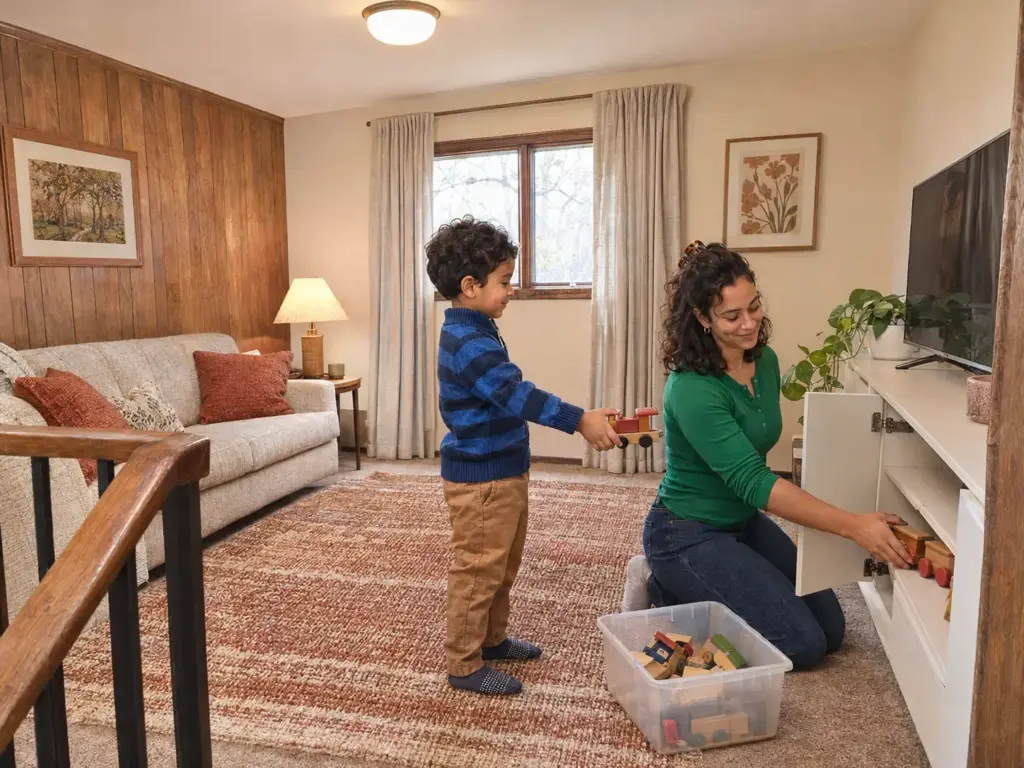
By the end of the day the sofa cushions hold a wooden engine, the coffee table holds a cup of dried-out markers, and the rug holds everything else. Most toy organization ideas for living room spaces fail at that exact point: they were designed for a playroom, and a living room or family room has a TV wall, a sofa and adults who want to sit down. The job is decided by the furniture’s measurements, not the toy count (a console runs 14 to 18 inches deep, a coffee table 16 to 18.5 inches high), and those numbers say which pieces can give a toy collection real living room toy storage and concealed storage (not a playroom in disguise) without turning the room into a preschool. Below: why the room refills, what earns a place in it, the four kinds of furniture that absorb toys, how to zone the floor, and the safety and lease limits of each piece.
Quick Answer
A shared room holds toys when furniture does the hiding and the floor keeps one defined strip. Match the piece to the room:
- A closed-front console, armoire or toy box for bulky sets, 14 inches deep inside.
- Open cubbies with closed baskets on the visible half and one open row at the child’s reach.
- A storage ottoman, storage bench or storage coffee table, 16 to 18.5 inches high.
- Big lidded floor baskets as the cheap, movable layer (a laundry basket works today).
- One strip of floor along a wall, with the sofa facing away from it.
- Anchor anything tall before it carries a single toy.
Why Toy Organization Ideas for the Living Room Stop Working by Week Three
The living room is the one room where a toy system has to get along with a sofa, a TV wall and adults who sit down at night. That is why a setup that worked in a playroom, or in the last apartment, quietly fails here: a cubby wall that suited the old place has to compete with a window, a fireplace and built-ins in the new one. Four mechanisms do the damage, and each shows up within a few weeks. Name yours first, because the furniture chosen later in this guide only helps if it removes the right one.
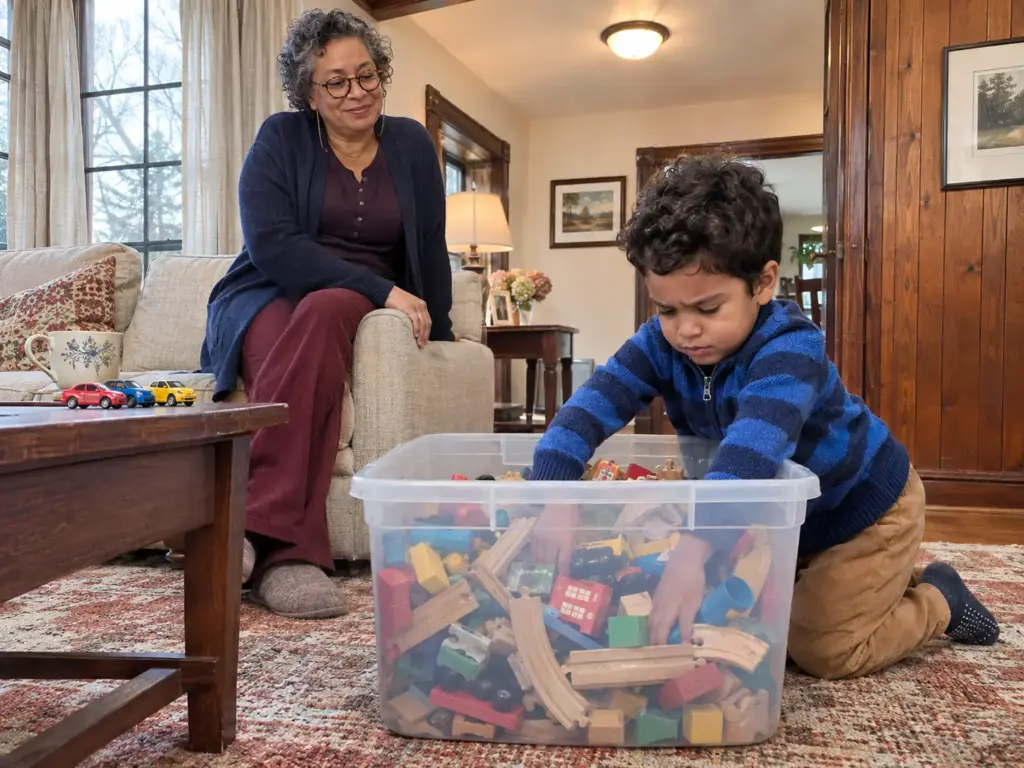
The Dump Bin Becomes a Pit
One big open plastic bin takes everything and gives back nothing. Tossing is effortless. But finding one specific piece means emptying the whole thing onto the rug, so the child stops using the bin and the toys settle wherever they land.
A single dump bin ends up holding the layer nobody has touched since the first day, while the toys in play migrate to the sofa and the floor. Size the container to the category, not to the whole collection: a clear bin for puzzles or one storage bin for cars holds a category, and a pile of everything holds nothing.
A Wall of Small Labeled Bins Is an Adult’s System
The opposite instinct is twenty small bins with picture labels. It looks like a system, and it is one, but it is an adult’s system: a two-year-old cannot hold twenty categories in mind, so putting away turns into a parent job by the second week. Two categories (trucks and not-trucks) plus a toss-in method outlast a perfect taxonomy at that age, and sorting by toy type into a labeled grid starts earning its place around the time a child can read the labels. If the same toys also live in a small bedroom, the square-footage math for a kid’s bedroom is a separate problem with different limits.
Storage at Adult Height Makes Cleanup a Parent Job
Vertical storage is the adult instinct in any room, and it only works for a child where the bottom row is the part that gets used.
A beautiful shelf at chest height holds toys only until a child needs to put one back. Then the child can’t reach it, the toy goes on the floor, and the adult carries the whole load at the end of the day. The reach height of a three- or four-year-old tops out around 24 inches, so the layer that makes cleanup the child’s job has to live below that line. Everything above it is for adults, rotation or decor.
Surfaces Quietly Refill the Room
The coffee table, the console top and the sofa arm are where the day’s toys land first, because they are the nearest flat places. A room with no home for those toys below the surface refills from the top down, one car and one cup of crayons at a time.
Lids and doors give a surface a rival: the toy goes into the ottoman because the ottoman is right there. For the other half of the problem, keep the coffee table from refilling with a method built for the tabletop itself. Measure the room’s furniture, not the toy pile, and the old cubby wall stops being the benchmark.
What Earns a Place in the Living Room (and What Lives Somewhere Else)
Most households hold far more toys in the room than the child actually plays with, and the surplus is what makes the room feel like it belongs to someone under four feet tall. The question is not how to store every toy but how many belong in a space that adults also use. Settle that number first and the furniture shrinks to fit it.
Set the Cap From What Is Actually in Play
The popular 20-toy rule caps the toys available at one time at twenty, and it is easy to read as a law. It is a ceiling. In a survey of 1,000 US parents, 80% said their children played with 20 toys or fewer, and 44% said 5 to 10. So the living room only has to hold what is in play, which for many families is a single basket and a shelf, with the rest in toy rotation elsewhere.
The method for rotating the rest in and out belongs to the main toy guide; the point here is that the room’s cap comes from play, not from the size of the collection. Some households settle on zero toys downstairs, and that is a valid answer too: this just might not be the era for a room that stays mostly adult.
The Kid-Height Layer
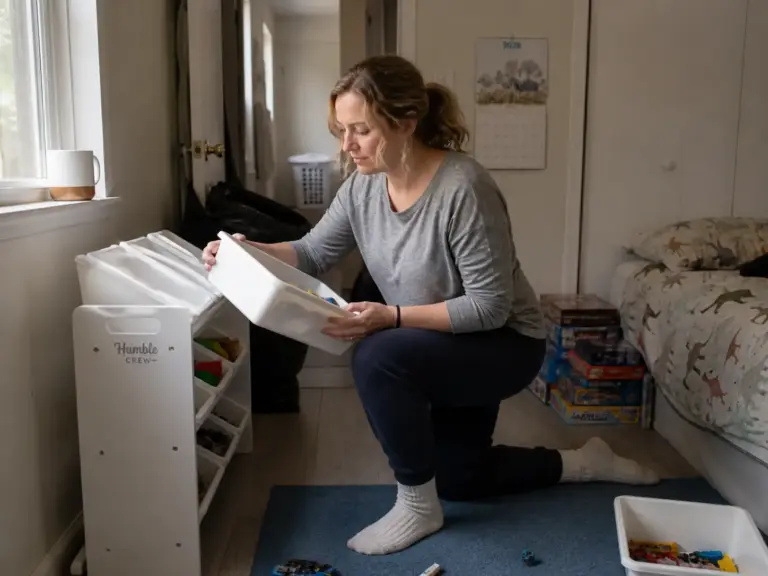
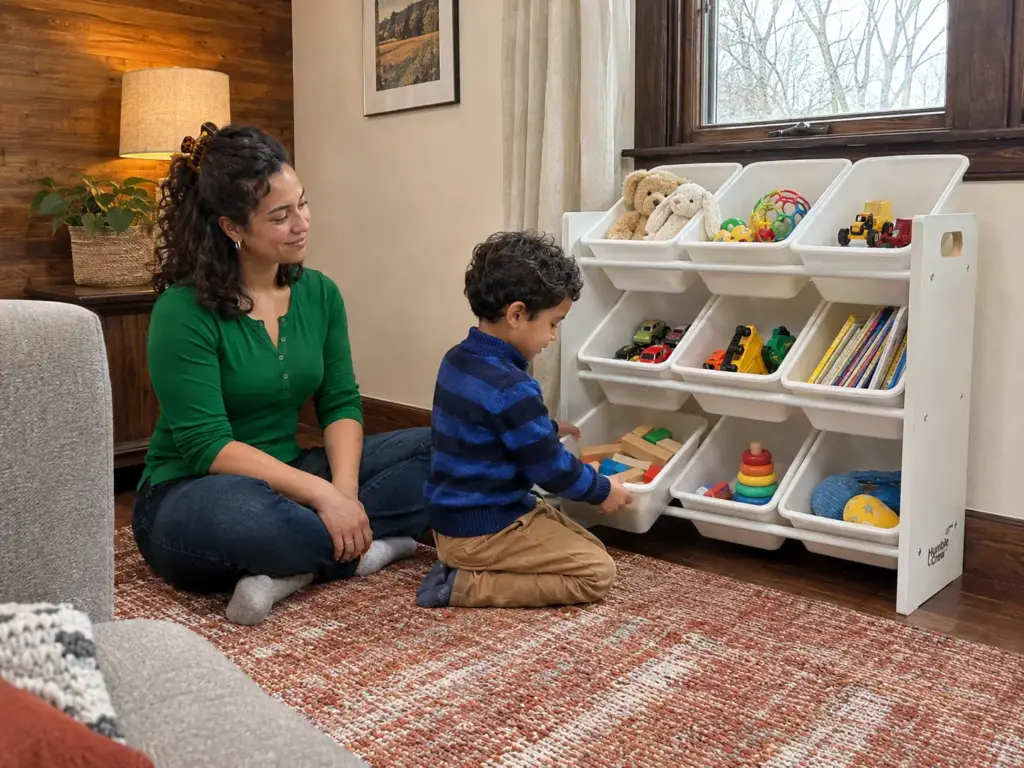
The cheapest way to make cleanup the child’s job is a low unit at the reach band. The Humble Crew Kids Toy Organizer has three tiers and nine removable bins in a frame 26 inches wide, 16 deep and 24 high, with bins of 12 x 9 x 6 inches and 20 pounds per tier. The 24-inch height lands inside a small child’s reach and the wall-anchor kit comes in the box, which answers the tip-over question before it starts.
It has a flaw you can plan around: the bins break easily and the frame runs smaller than expected, so measure the wall space and handle the bins gently. For a fully free version, a row of shoeboxes or shallow totes on a bottom shelf does the same job at the same height.
Hold the child’s hand against the wall and mark the highest comfortable reach with painter’s tape. Anything a child should put away goes below the tape; anything above it is storage for adults.
Where the Rest Goes
Big, loud and supervision-heavy toys never earn a living-room place: ride-on toys, arts and crafts supplies, a dollhouse, dress-up piles and anything with a hundred pieces belong in a closet, a bedroom or a playroom, or under a bed. A bedroom can only take the overflow if it is set up for it, so a kid’s bedroom that can take the overflow is worth sorting out in one afternoon. A closet works as a toy library when the shelf sits at the right height, and shelves a child can actually reach in a closet show how to build that. In a home with no playroom at all, a play kitchen’s oven and fridge double as storage, which turns a bulky toy into its own container.
Closed Furniture That Hides Toys Without Looking Like a Playroom
A closed-front console, sideboard, armoire or chest is the most dependable hidden toy storage in a shared room, because closed storage reads as adult furniture whatever sits behind the doors. The room usually has one already: the TV wall. What decides whether it works is the inside of the piece, not the outside.
The Console the Room Already Has
A TV console bought for the TV quietly becomes the toy cabinet, and it can do that well if the depth allows. Media consoles normally run 15 to 20 inches deep, 12 to 15 for shallow rooms and 20 or more when an AV receiver goes inside; a practical TV-stand depth is 14 to 18 inches. A 14-inch console holds two rows of small bins and nothing deeper. The width gives free room too: a console should be 3 to 8 inches wider than the TV on each side, and since a TV’s frame is about 87% of its diagonal, a 65-inch TV (roughly 57 inches wide) wants a console of 62 to 70 inches.
The WLIVE LED TV Stand with Storage Cabinets is a closed-door answer at that scale: 57.87 x 14.09 x 17.72 inches, with three concealed cabinets plus one open shelf, sized for a mid-size TV. Its limits are known: the LED lights fail on some units, assembly takes time, and it runs smaller than expected.
The free version comes first, though: a used sideboard or media cabinet does the same job for less than a new piece. For depth-first comparisons of TV stands with real storage depth, the depth in the listing counts for more than the finish.
The Interior Number Matters More Than the Outside
Measure the inside of the cabinet, not the outside, with the doors open and the gap behind them counted. A 12-inch-deep shelf swallows baskets but not a board game box stood upright, so a deeper piece gets the boxed games and a shallow one gets soft toys. If the console already holds cables, remotes and a game system, count the shelf that is left, then size the bins to match: sizing bins to the shelf depth inside a console covers how to avoid buying a basket that blocks the door.
Stand the tallest board game box upright in the cabinet and close the door. If the box clears the shelf above, the cabinet takes games; if it does not, it is a basket cabinet and the games belong elsewhere.
A Chest for the Big Sets
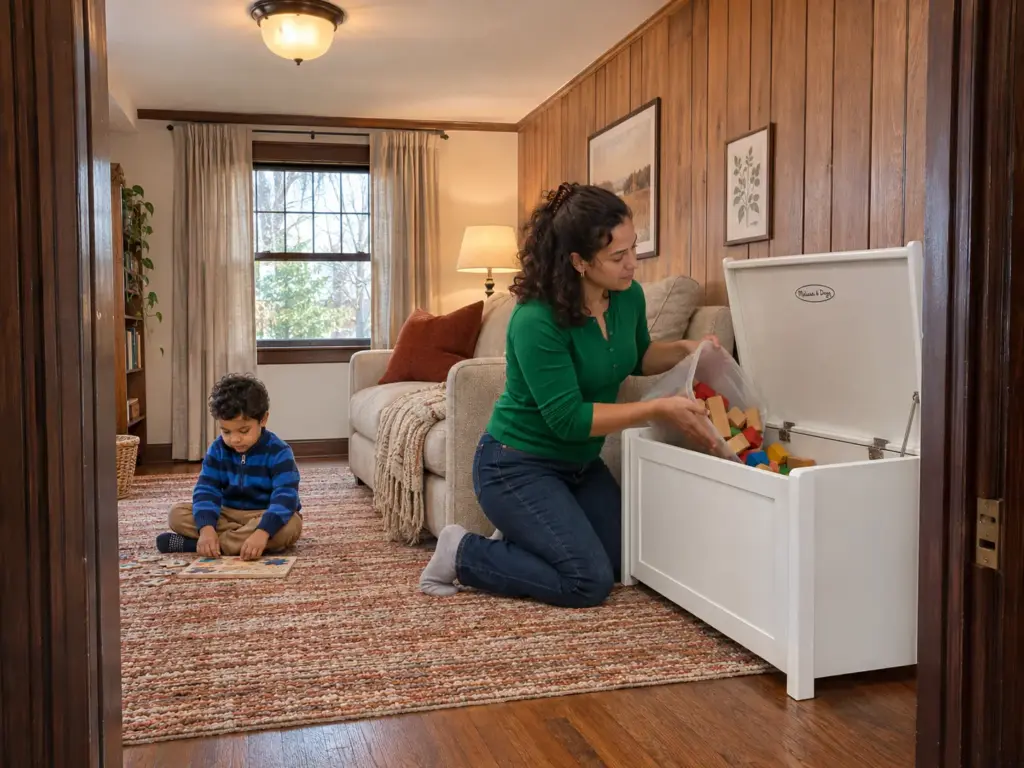
Some sets no bin can swallow: a full block collection, a train table’s worth of track, a pile of stuffed animals. A chest or toy box takes them in one motion, which is why it stays the right tool for the bulky end of the collection even in a room full of shelves. The catch with a chest is the lid, because a lid that drops is a finger-pinch point for a toddler. Choose one with a safety hinge or a lid that lifts away.
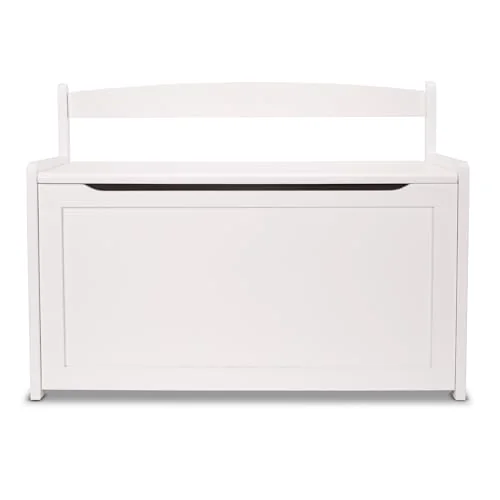
Closed furniture needs no wall, so a renter can use all of this without touching the lease. Owners have more to work with: built-in shelving, built-in cabinetry and fireplace built-ins, plus window seats with lift lids, add the same hiding power with more depth than any freestanding piece.
Open Cubbies and Bookcases With Baskets on the Visible Half
Open shelving looks like the opposite of hiding, but it works when only the baskets show. A bookcase that held books a year ago and now holds toys looks like a toy shelf by Friday unless the half at adult eye level is books, decorative storage baskets or a lamp. The trick is a split: the top half reads as decor, the bottom as the child’s.
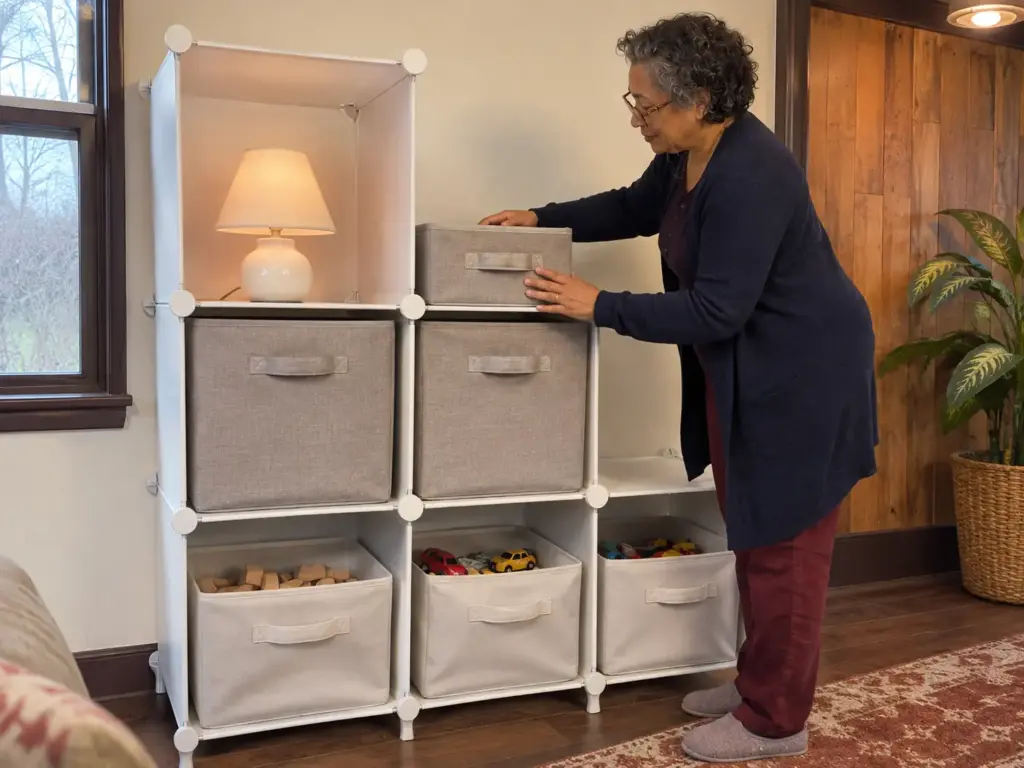
The Display-and-Hide Split
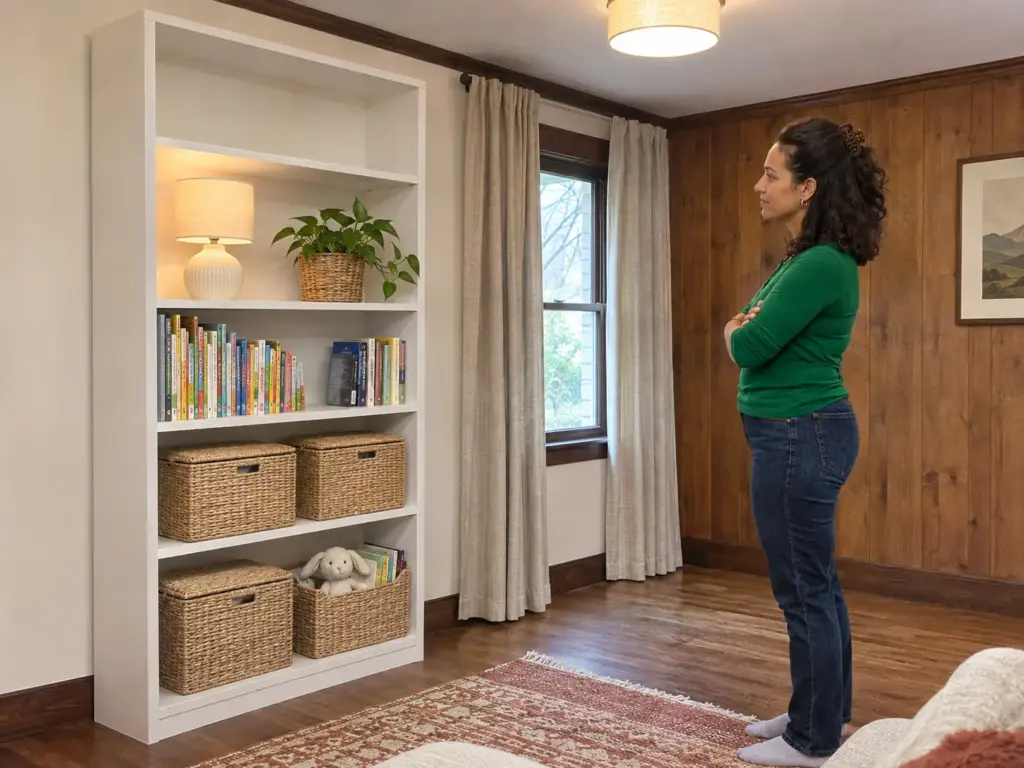
Put closed baskets, felt bins and lidded bins on the visible half, leave the lowest row open and at the child’s reach, and keep the top two rows decorative, with nothing on them a toddler wants within climbing distance. The open row is the one that gets used daily; the closed baskets hold the sets that come out for an afternoon. A narrow unit works better than a wide one on a living-room wall, and narrow bookshelves that fit a living-room wall shows which formats avoid the sag and the sprawl.
Cube Units for Homes Where Nothing Goes Into the Wall
A freestanding cube organizer is the renter’s version of built-ins. The AWTATOS 6-Cube Stackable Organizer measures 35.5 inches wide, 11.8 deep and 37.5 high, with 11.8-inch cubes that each take one standard fabric bin. That 11.8-inch depth is shallower than most toy bins, so check the bin before the unit (and do not assume a toy bin will slide in just because the cube looks big). The frame comes apart with use and is not suitable for heavy loads, so keep books and wooden sets in the lower cubes and soft toys up top.
A thrifted or second-hand IKEA-style cube frame does the same job as the new freestanding unit.
The owner’s route is different: a built-in or a fireplace alcove can take lift-lid window seats and doors, but the cost is the lease. Once a unit carries weight, how a bookshelf stays organized once it carries weight matters for what goes on each shelf and how it is secured.
Rotating and Corner Shelves for the Kid-Height Display
A corner is the one spot a living room never uses, and a rotating shelf puts compartments in it (add a rug and the corner becomes a reading nook). The Guidecraft EdQ Kids Rotating Bookshelf has a 14.5-inch footprint (14.5 x 14.5 x 31.25 inches) with 12 compartments of 6.9 x 6.9 x 9.5 inches, and the spin gives access without opening a walkway. It is the smallest way to add that many compartments, and the compartments suit picture books and small sets best. It is fiddly to assemble and runs smaller than expected, so give the corner a tape-measure test first.
Seating and Tables That Double as Toy Storage
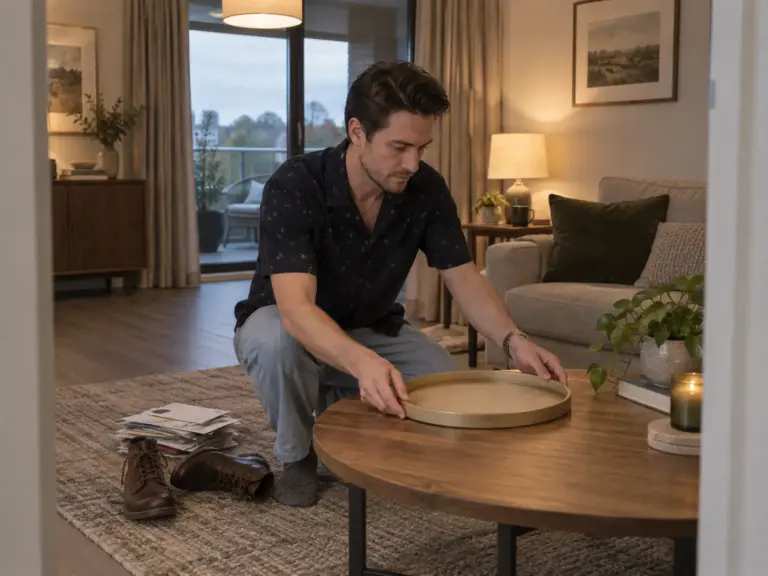
Coffee table storage can be the piece that hides the toys: a storage ottoman, storage bench or storage coffee table with drawers can take the table’s place, if the height is right. The numbers are specific, and a tape measure settles every one of them.
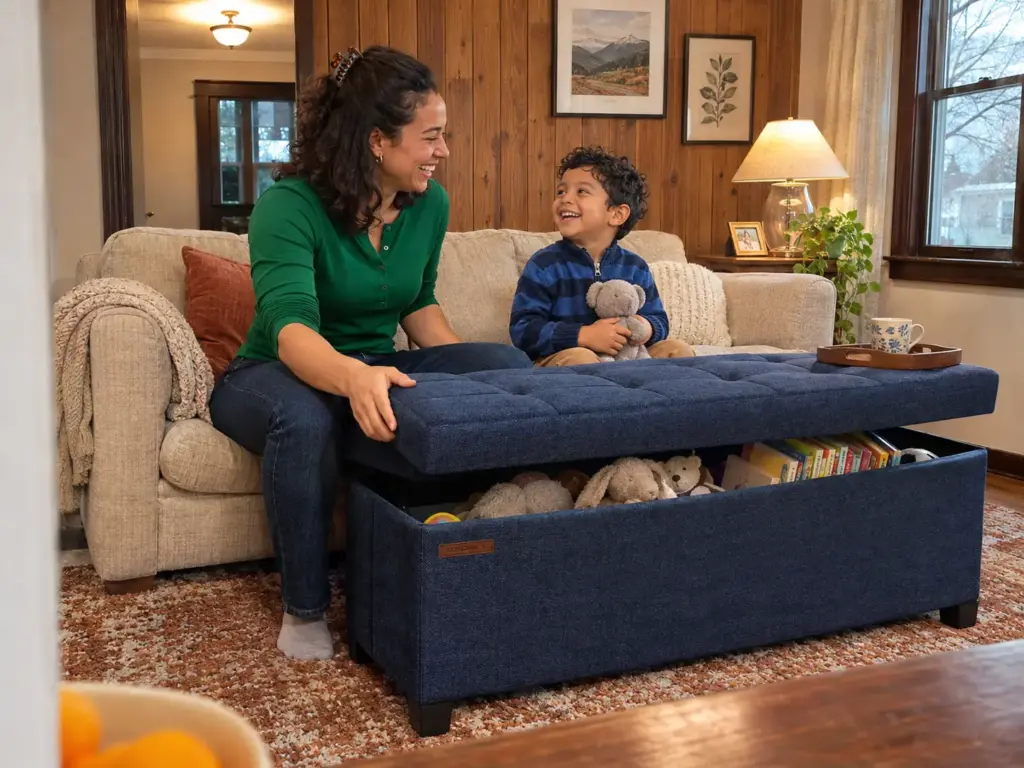
Measure the Sofa Seat First
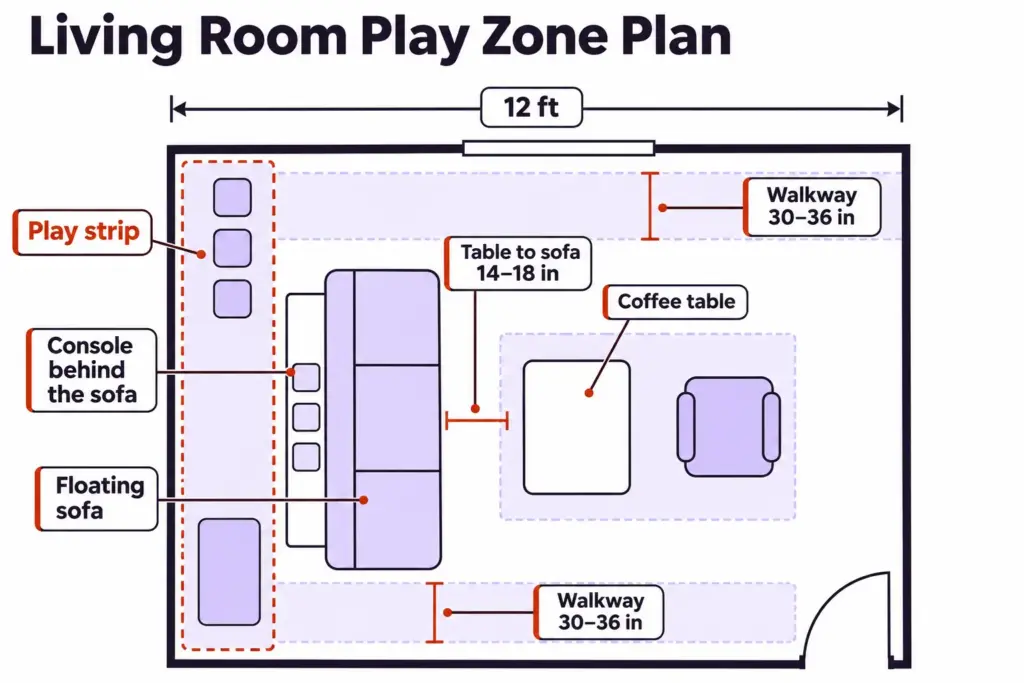
A coffee table sits 16 to 18.5 inches high, with a median near 17, and its top should be level with the sofa seat or up to 2 inches lower; under 16 inches it reads as a footstool. A standard coffee-table height is 16 inches in one common minimalist model, so a bench at that height is in range. Depth runs 18 to 30 inches, with 14 to 18 inches between table and sofa and 30 to 36 inches left on any walkway. In a room 12 feet wide, the table plus the sofa gap eats about 4 feet of floor, and that is the budget shared with a play zone.
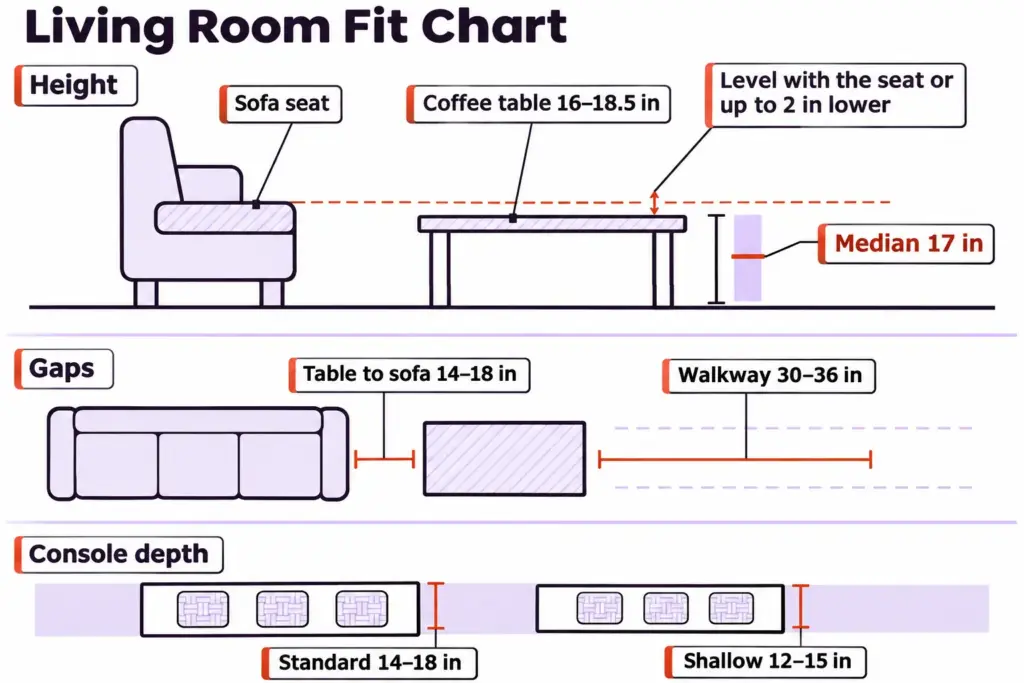
The Ottoman That Replaces the Coffee Table
The SONGMICS Storage Ottoman Bench measures 43.3 x 15 x 15.8 inches with 112 liters (30 gallons) of storage, and the 15.8-inch height sits inside the coffee-table range, so it replaces a table instead of adding a piece.
Its 660-pound static load means it survives being sat on, not just leaned on.
It is not flawless: the legs do not always stay seated. And the frame can fail within weeks, so test it with real weight in the first days of the return window. Any thrifted or second-hand lidded footstool does the same job. For more on dual-purpose living-room pieces and where each fails, clearance math decides which one fits.
Where the Soft Top Fails
The upholstered ottoman looks like the obvious answer. But a soft top is not a play surface. It gives under a mug and under a child standing on it, so the kids move to the floor and the ottoman becomes a footrest. If play happens on the table, use a firm-top piece or put a tray on top.
One more caution: a lid with no slow-close hinge pinches fingers, so choose a lid that lifts away or stays open. Renters have more options than they expect, and renter-safe furniture with exact dimensions lists pieces that need no drilling.
Lay a strip of painter’s tape on the ottoman lid at the edge where a child would sit. If a mug and a stuffed bear cannot share the top without tipping, put a flat tray on it and the surface works for both.
Big Baskets and Bins: The Cheap Movable Layer
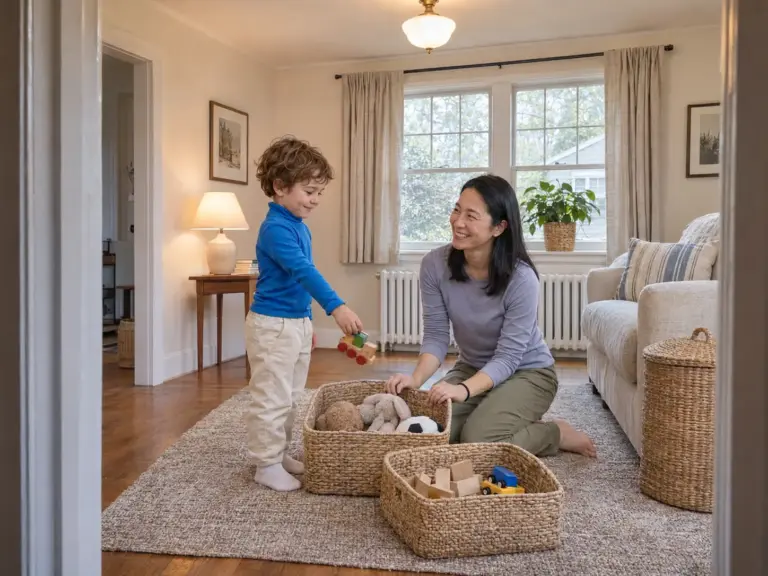
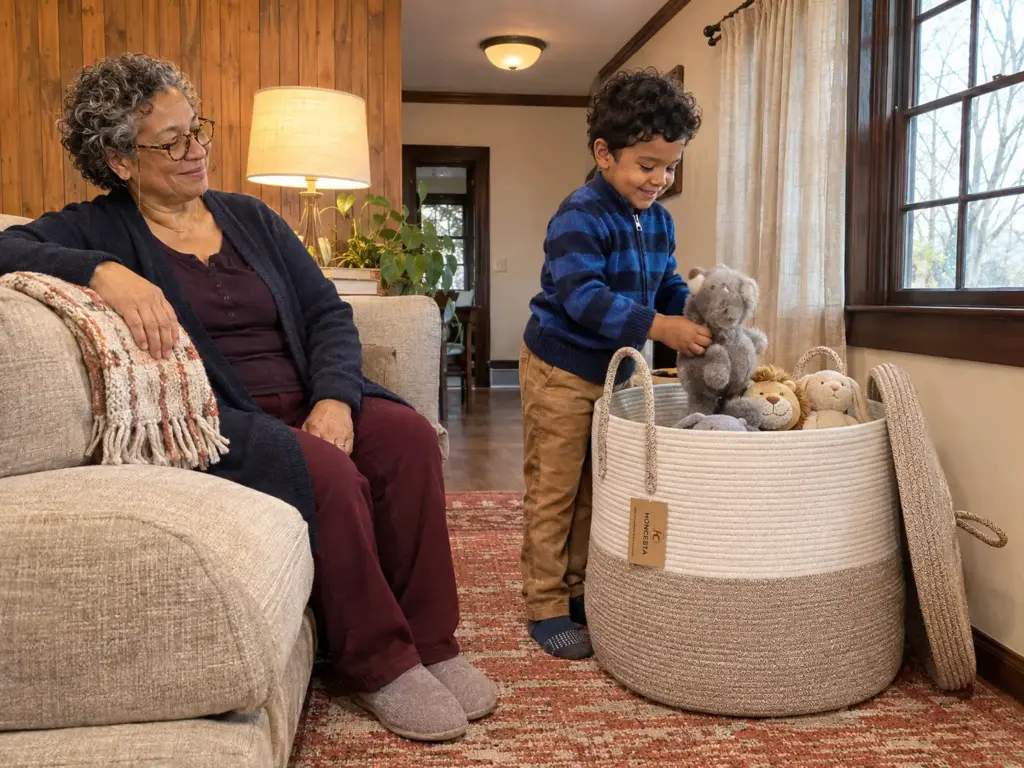
The cheapest layer goes first, and for many living rooms it is also the one that lasts. Several big rope baskets, or a wicker basket in the same size, do the job of a dedicated toy unit, and a floor basket can sit beside the sofa without looking like nursery furniture. Some households that tried lots of little bins went back to the big baskets, because the little bins added stress rather than removing it.
What You Already Own
A laundry basket from a clothing store, used as it came, is a legitimate living-room toy container. Under-sofa storage in shallow totes slid under end tables hides the overflow without a purchase, and under-bed storage in a plain box does the same job. None of it needs assembly. The two-category method (trucks, not-trucks) fits a basket perfectly: the basket is the home and the toss is the method.
The Lidded Basket That Reads as Decor
Where a basket has to stay in view, a lid and a rope weave in a neutral palette blend with decor. The HONCESTA Extra Large Woven Basket with Lid is 18 x 18 x 14 inches in cotton rope, and a 14-inch-high lidded basket hides a full Duplo set in a corner. It needs ironing into shape when it arrives, is not as sturdy as it looks, and the lid is the mixed point, so use the basket as a basket first and the lid as a bonus. The more decorative the weave, the more it earns the visible half of a shelf, and basket sizes and materials for the visible half of a shelf covers which sizes hold up.
Rope baskets keep their shape better with a stiff liner. Drop a shallow tote or a flattened box into the bottom before the first load, and the weave stops sagging under heavy blocks.
Under the Sofa and Behind It
The clearance under the sofa and the side tables decides what slides under, so measure the gap with a tape before buying a tote. The number you need is the clearance, not the bin. Behind the sofa, a narrow console table holds two lidded baskets, and the sofa back hides them from the seating side of the room.
Zone the Room and Send the Big Toys Elsewhere
A large room swallows toys, and storage spread around the perimeter looks like a showroom for a daycare. One defined strip with the adult seating facing away from it keeps the other end adult. The strip is the leftover width after the table, the gap and the walkways, so plan it first.
One Strip Along a Wall, Not Storage Around the Perimeter
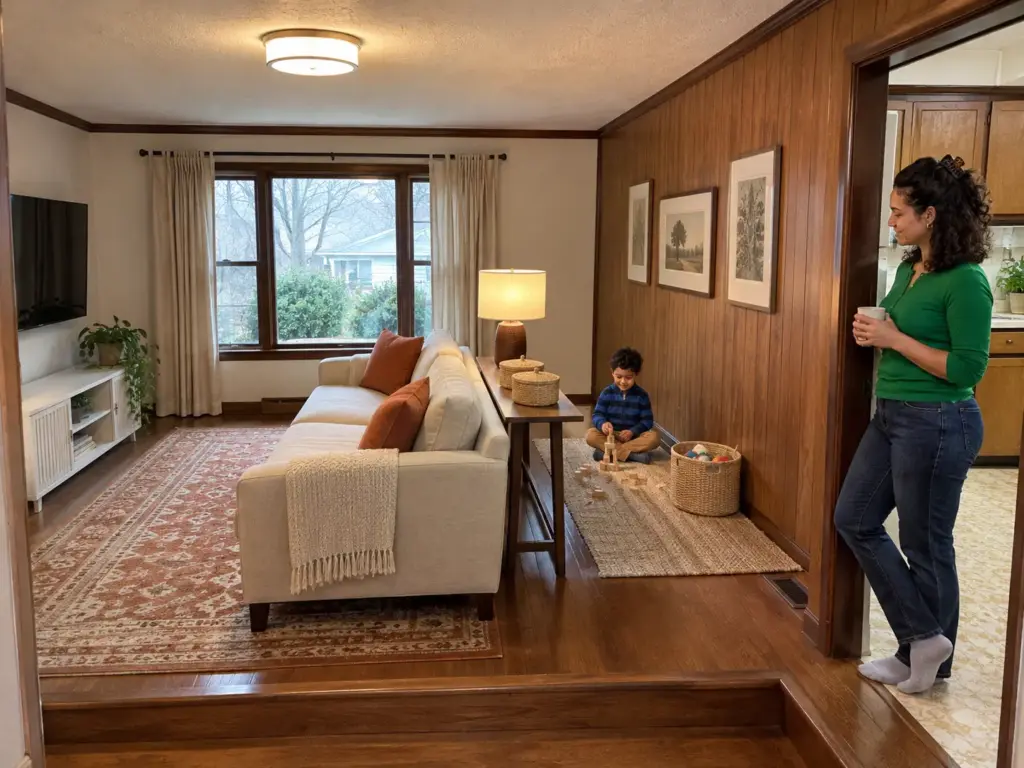
In a large room, define one strip along a wall and face the adult seating away from it, instead of scattering baskets in every corner. Perimeter storage commits every wall to toys; a strip commits only one. Layout rules for zoning a living room work the same in a large space as in a small space, because the principle is separation rather than square footage. With the strip chosen, the rest of the room can go back to being a living room.
Float the Sofa to Make the Zone
A floating sofa, with its back to the play strip, makes the zone with furniture the room already has. A console table behind the sofa holds the baskets, and from the seating side the baskets read as a shelf of decor. The sofa’s back also works as a soft wall that keeps the play area out of sight of the TV. Floating the sofa to carve out a zone shows the clearances that make this work.
Toys That Belong in Another Room
Play kitchens, ride-ons, art supplies and anything supervision-heavy live in a closet, a bedroom, the playroom or under a bed. The living room takes the toys that can be put away in two minutes, and nothing larger. That two-minute shared reset, with baskets lidded and surfaces cleared, is the system; the zone only makes it possible. Closed, no-drill storage supports the reset in a room of any size, and the two-minute shared reset is built on exactly that.
Renting, Owning, and the Tip-Over Check Nobody Mentions
The piece that holds the toys is the piece a toddler climbs. That makes the last decision in a living room toy system a safety one, and the lease changes what you can do about it.
Owner Choices and Renter Choices
Built-ins, window seats and wall-mounted shelving are owner choices. Freestanding pieces (cube units, the 24-inch organizer, the ottoman, baskets) are renter choices, and a freestanding piece in a rental is the one that most often goes unanchored, because the lease says no holes. That is the gap: the household that picked the freestanding option for lease reasons ends up with the tallest, least-secured furniture in the room. The renter’s answer is to keep the heavy loads low, choose a low piece that ships with an anchor kit, and follow the maker’s instructions for any anchoring the lease allows.
A lease that bans holes usually still has a way to ask: one email to the landlord about a single anchor point costs far less than a bookcase on a toddler, and the answer decides whether the piece stays freestanding or gets secured.
Anchor Any Tall Piece That Holds Toys
The federal STURDY rule for clothing storage units covers free-standing units at least 27 inches tall, 30 pounds and 3.2 cubic feet. Bookcases and entertainment furniture are outside its scope, so anchoring a toy-holding bookcase is the household’s job, not the maker’s. The Consumer Product Safety Commission counted 97 furniture tip-over fatalities to children between 2000 and 2015, and in its staff briefing 31 of 61 sampled clothing storage units failed the ASTM F2057-14 stability test.
According to the CPSC’s Anchor It! campaign, “Remove items that might tempt kids to climb, such as toys and remote controls, from the top of the TV and furniture.” In a toy room that means nothing on the top of the bookcase and nothing on the console above eye level.
Measured against the STURDY rule’s 27-inch line, the 37.5-inch AWTATOS stack and the 31.25-inch Guidecraft shelf both count as tall pieces, and any bookcase does too. A stack of open cubes also gives small hands footholds, so follow the maker’s anchoring instructions before the first basket goes in, and keep the heaviest toys on the lowest row.
Lids, Hinges and Finger Pinch
A lid that slams is a finger-pinch point. A chest with a safety-hinged lid answers it (the Melissa & Doug chest above is built that way), and an ottoman lid should lift away or stay open. Check the hinge style on any lidded piece before it lives where a toddler can reach.
Measure the Seat and the Console Before Anything Else
What carries the room is a short list. Closed furniture hides the bulk, one low open layer gives the child cleanup of their own, big baskets handle the rest, and one strip of floor keeps the room adult. The cap comes from what is in play, not from the collection, and anything tall is anchored. A system built that way gives you a family-friendly living room that outlasts the week-three collapse, because the child can do the putting away.
Check one thing later: the next time the coffee table refills, look at what landed on it and where the nearest home for that toy is. If the home is above the child’s reach or behind a lid that fights back, move it. Today, put a tape measure on the sofa seat and inside the console, write both numbers down, and then notice, after one evening, which surface the toys land on first. That surface is where the next piece of furniture should go.
Frequently Asked Questions
01How to keep toys organized in a living room?
Hide the bulk in closed furniture, give the child one low layer they can reach, and cap the room at the toys actually in play. Keep one strip of floor for play and finish the day with a shared two-minute reset.
02What is the 20 toy rule?
The 20 toy rule caps the toys available to a child at one time at 20, with everything else stored away and rotated in. It is a ceiling, not a law: in a survey of 1,000 US parents, 80% of children played with 20 toys or fewer.
03What are some ideas for organizing toys in a living room?
Four kinds of furniture absorb toys: a closed console or chest, open cubbies with baskets on the visible half, a storage ottoman, and big lidded baskets. Add one strip of floor for play, with the sofa facing away from it.
04What is a good toy storage unit for a living room?
It depends on the room: a closed-front console suits a TV wall, a freestanding cube unit suits a renter, and a lidded basket is the cheap answer. Measure interior depth and sofa seat height first.
05Do toy bookcases and cubby shelves need to be anchored?
Yes, any tall bookcase or cube stack that holds toys should be anchored, because the federal STURDY rule covers clothing storage units but not bookcases. Follow the maker’s anchoring instructions; a low piece that ships with a kit is the safer pick for toddlers.
Disclaimer: ClutterlessNest is a participant in the Amazon Services LLC Associates Program. As an Amazon Associate we earn from qualifying purchases. This article may contain affiliate links — if you buy through them, we may earn a small commission at no extra cost to you. We only recommend products we have tested or genuinely believe in.