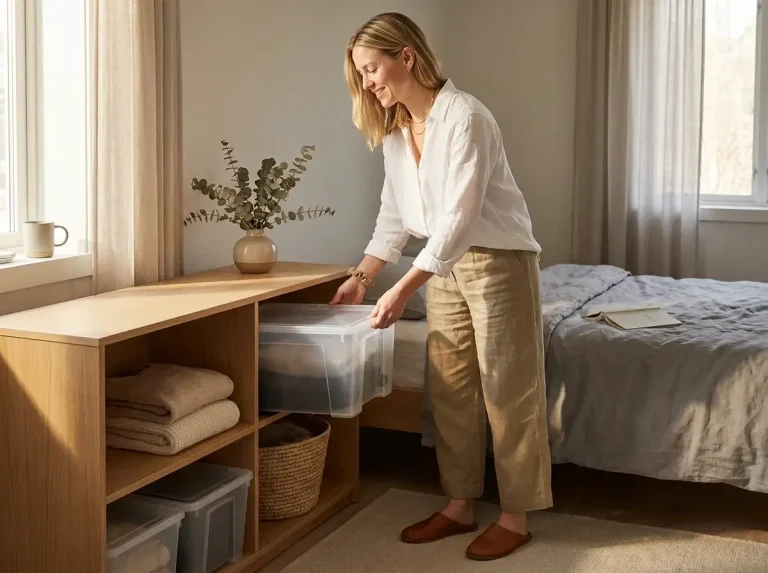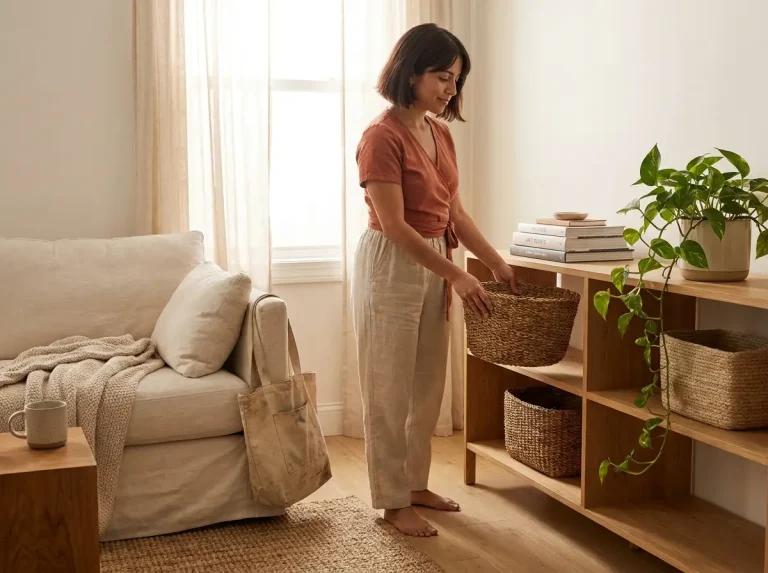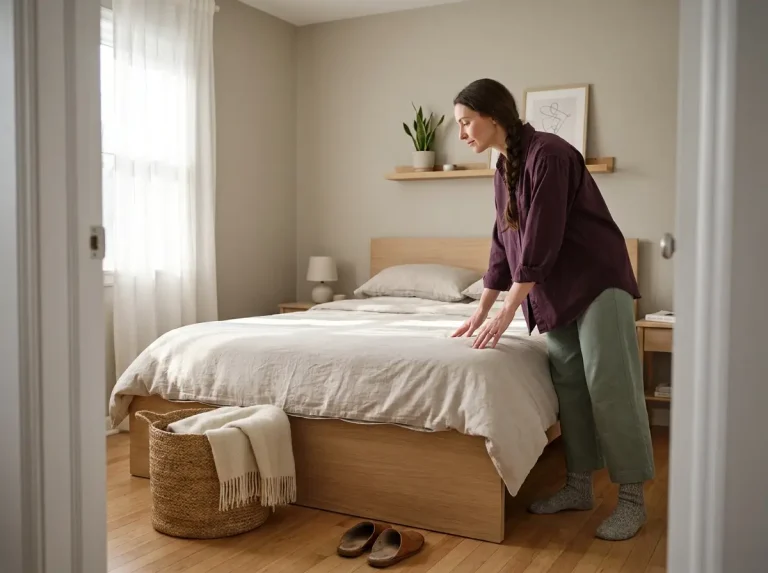

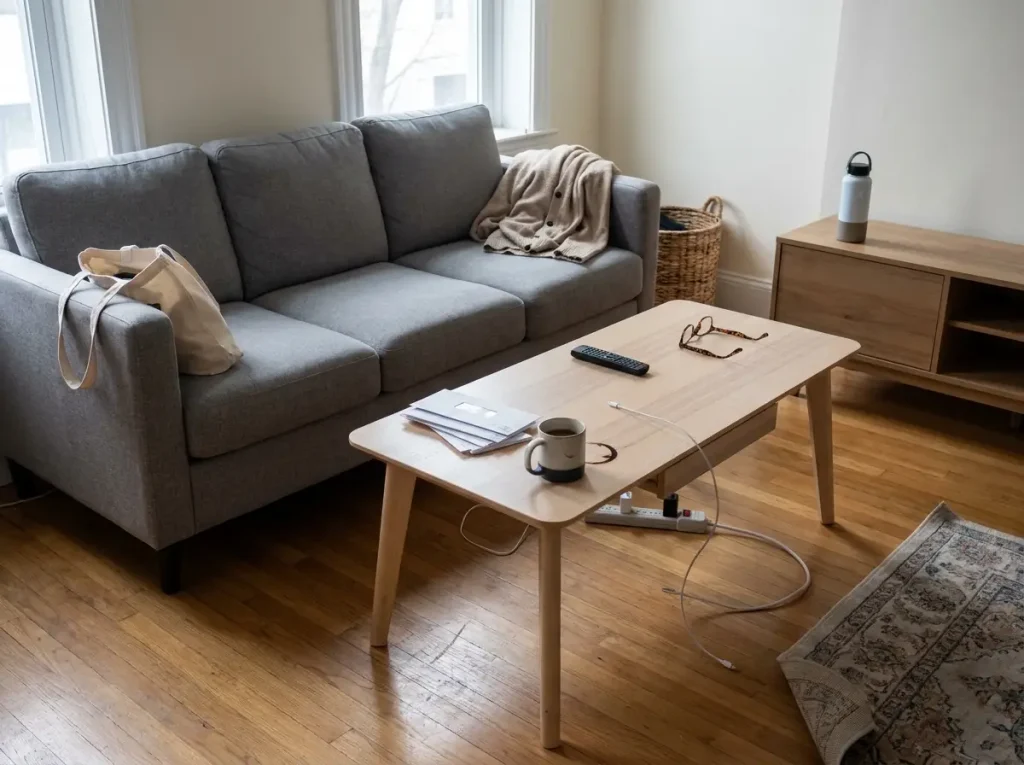
You spent a Saturday clearing the living room. It looked great that night. Two weeks later the coffee table has mail on it again, a throw blanket is balled up on the sofa arm, and a charging cable is snaking across the floor toward the only reachable outlet. The fix is almost never “buy more bins.” Your living room reverts because it’s the one room in the house with no single owner, so everything from every other room lands there by default. This guide walks through why minimalist living rooms specifically resist staying tidy, and the storage and maintenance system that holds up even when you rent and even when the person you live with isn’t following any system at all.
Quick Answer
Keep a minimalist living room tidy in this order:
- Declutter first, before buying any storage
- Give every category one closed home
- Choose furniture that hides mess by default
- Keep two or three items max per surface
- Use no-drill storage if you rent
- Run a two-minute daily surface reset
Why the Living Room Resists Minimalism
Most advice tells you to declutter and move on, as if the living room were just another room with a stuff problem. It isn’t. It re-clutters faster than your bedroom or your bathroom no matter how disciplined you are, and there’s a structural reason for that. Once you see it, every other fix in this article makes sense.
The room nobody owns
Think about who owns each room in your home. The bedroom belongs to the people who sleep in it. The kitchen belongs to food. The bathroom belongs to getting clean. The living room belongs to everyone, which in practice means it belongs to no one. Nobody wakes up feeling responsible for it the way they feel responsible for their own nightstand.
That lack of ownership is the root of the problem. When a space has a clear owner, that person notices when something is off and fixes it. A shared space gets the bystander effect instead, where everyone assumes someone else will deal with the pile. This is the same reason minimalist systems revert across the whole house when they rely on shared effort instead of closed, low-effort homes for things. The living room just feels it worst because it’s the most shared room you have.
How clutter lands here from every other room
Your living room sits between your front door and every other room in the home. Everything you carry in has to pass through it, and a surprising amount of that stuff just stops there. Mail lands on the coffee table on the way to nowhere. A work bag gets dropped on the sofa. A water glass migrates from the kitchen and stays for three days.
Organizers have a name for the flat surface that quietly collects all of this: an entropy zone. It’s any horizontal plane that accumulates objects passively, with no one ever deciding to put them there. The coffee table is the classic one. So is the arm of the sofa, and the corner chair that slowly becomes a clothes rack. Some people call that spot the doom corner, the place where things wait to be “put away somewhere” that never comes.
Why your brain never flags it
Here’s the part that makes living room clutter so sticky. In a kitchen, a shoe on the counter is obviously wrong, and your brain pings you to move it. In a living room, almost anything reads as plausible. A book, a charger, a sweater, a stack of mail, a kid’s toy. None of it looks out of place, so your brain never raises the flag. The clutter accumulates under your radar until one day the whole room feels heavy and you can’t say exactly when that happened. That heaviness isn’t in your head, either; research from a university extension program ties a cluttered environment to more stress and harder focus, which is why a calm room feels like more than just a tidy one. This slow return of objects to cleared surfaces is what organizing communities call clutter creep, and it’s why the week-two collapse is so predictable. Your Saturday system solved storage. It never solved the flow.
Declutter First, Because Minimalism Is Subtraction

Before we talk about a single product, the honest part nobody selling storage wants to say out loud: if the room has too much in it, no system survives. Minimalism is subtraction first and containment second. Buying bins before you reduce just gives the same volume of stuff a nicer place to hide.
The four-box pass for a shared room
The fastest way through is a version of the Four-Box Method. You work through the room with four destinations: keep, relocate, donate, trash. In a living room the relocate box is usually the biggest one, and that surprises people every time. So much of what clutters a living room isn’t even living room stuff. It’s a phone charger that belongs in the bedroom, a cereal bowl that belongs in the kitchen, a stack of bills that belongs in a home office or a single drawer.
Run the pass once, fast, without agonizing. The goal of the first pass is volume, not perfection. You’re trying to get the room down to what actually lives here so that whatever storage you add later has a fighting chance.
Start with your stuff, not theirs
If you share the space, there’s one rule that matters more than any technique: start with your own things and never touch anyone else’s without asking. This is the same declutter-first order that works in a minimalist bedroom, but in a shared room it’s also a relationship rule. The most repeated failure in shared-space minimalism is the partner who comes home to find their belongings “tidied” and digs in their heels for the next year.
Decluttering your own items does something better than an argument anyway. The visible change creates curiosity. People notice a calmer room and often start editing their own things without being asked. Lead by subtraction, not by lecture.
What actually belongs in a living room
Once the relocate and donate boxes are full, name what the room is actually for. Most living rooms serve three honest functions: somewhere comfortable to sit, a media setup, and maybe one hobby or activity that genuinely happens here. The 80/20 reality is that you use a small fraction of what’s out, and the rest is just visual noise taking up space. Everything that supports those three honest functions earns its place. Everything else is a relocate candidate you haven’t caught yet.
Do the relocate box second, not last. Carry it to the other rooms the moment the pass is done. If it sits by the door overnight, half of it migrates right back onto the surfaces you just cleared.
Multi-Functional Furniture That Hides the Mess
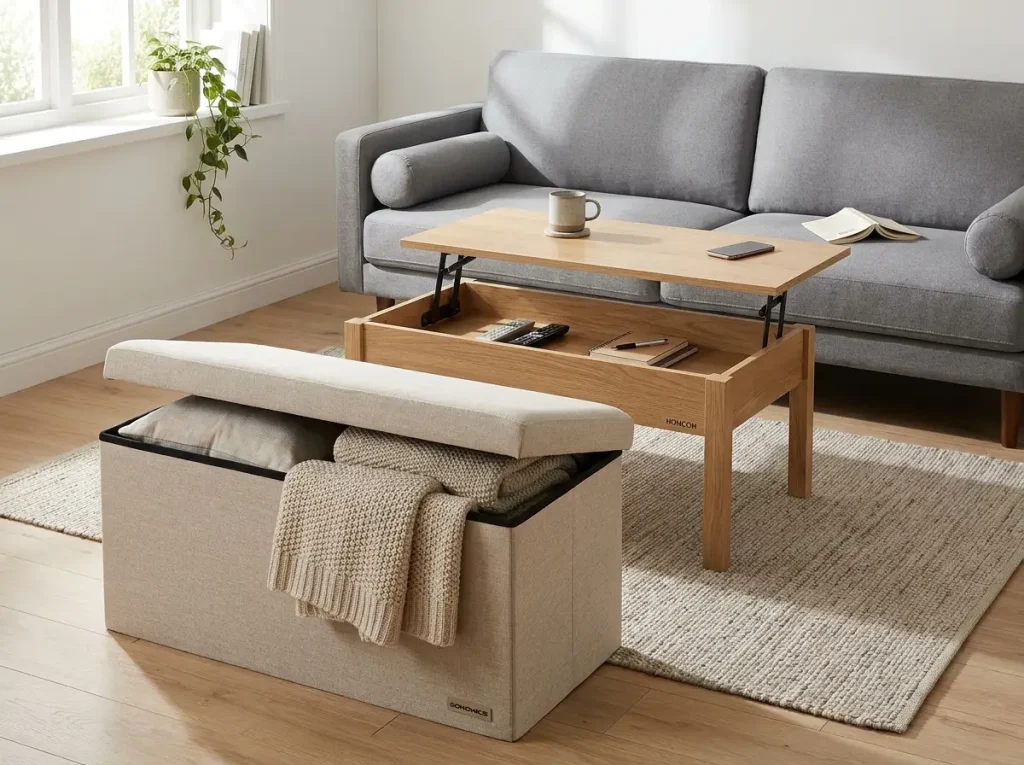
The single highest-leverage move in a small shared room is furniture that does two jobs at once. The trouble is that most buying advice stops at “get a storage ottoman” with zero guidance on which shape actually holds anything. Shape is the whole game here, and getting it wrong is how you end up with a pretty piece that stores almost nothing.
The storage ottoman (why rectangular beats a cube)
A storage ottoman is the workhorse of a minimalist living room. It’s a seat, a footrest, and hidden storage in one footprint. But a cube ottoman’s interior is roughly one large shoebox, which means it holds maybe one or two folded throws before it’s full. A rectangular ottoman holds far more in the same visual footprint, and that difference is bigger than the photos online ever make it look.
I used to point people toward cube ottomans because they look tidy and tuck into a corner. After seeing how fast they fill and how little they actually swallow, I switched to recommending the rectangular format for anyone who wants real storage. The SONGMICS Storage Ottoman Large in linen fabric is the one that fits this brief well: the rectangular body holds several throws and spare pillows, and the neutral fabric disappears into a minimalist room instead of announcing itself. The one caveat is that a large ottoman is a commitment in a tiny room, so measure your floor before you fall for it. If you want the same idea in a narrower piece, the SONGMICS Storage Ottoman Bench is the leaner version.
The lift-top coffee table for surface control
The coffee table is the worst entropy zone in most living rooms, which makes it the smartest place to build in hidden storage. A lift-top coffee table has a surface that raises and slides forward to reveal a storage compartment underneath. In one motion, the remotes, the chargers, and the random small clutter go from on top of the table to inside it. The HOMCOM Lift Top Coffee Table does this without looking like an organizer; it reads as a normal coffee table, which is exactly what you want in a room you’re trying to keep calm. It won’t hold bulky items, so think of it as the home for small surface clutter, not for blankets. A budget alternative that gets you partway there is the VASAGLE Coffee Table with a lower storage shelf, though an open lower shelf needs more discipline to keep tidy than a closed lift-top does.
These are exactly the kind of multi-functional pieces that pull double duty in a small room, and a single one of them often does more for a living room than three separate organizers.
Measure first, floor space is zero-sum
In a small living room, every piece of furniture has to earn its footprint, because a single large ottoman can eat a real chunk of your floor. Furniture selection here is zero-sum: the space one piece takes is space another piece can’t have. So before you buy anything, measure the open floor you actually have and decide what the piece displaces. The reward for measuring is a room that breathes. The penalty for guessing is a return trip and a box you have to repack.
Give your storage ottoman a one-category rule the day it arrives (“throws only”). The fastest way to ruin a storage ottoman is to let it become the junk ottoman, where remotes, cables, and birthday cards pile in until you can’t find anything and the lid won’t sit flat.
Hidden Storage With Baskets and Closed Bins
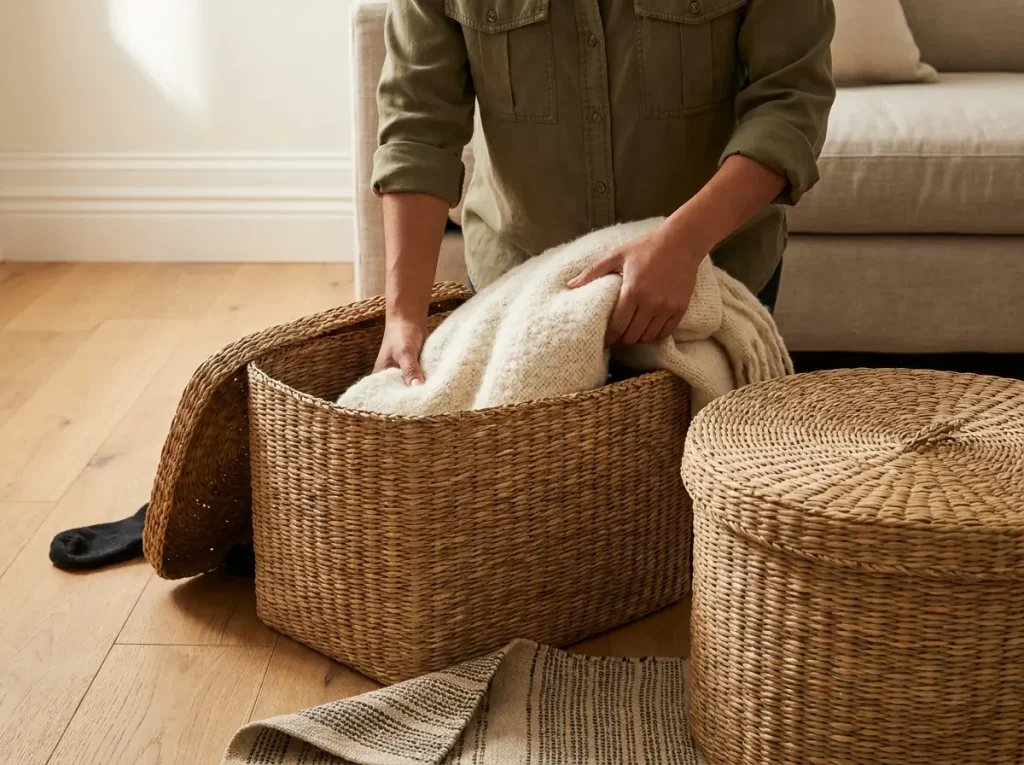
Open styled shelves photograph beautifully and fail fast. For a long time the standard advice was to fill a living room with pretty open baskets, and on Instagram it looks perfect. In a real shared room it falls apart, and the reason isn’t aesthetics at all.
Open baskets vs lidded baskets (the compliance difference)
Open storage needs everyone to put things back neatly, every time, for it to keep looking good. Closed storage doesn’t. That’s the entire difference, and it decides which one survives in a room used by more than one person. A lid forgives a bad day. An open basket records it.
A large woven basket still earns its place for bulky soft items, the kind that look fine left visible. The Large Woven Seagrass Basket handles throws and spare pillows as visible-but-tidy storage, and the natural texture reads as part of the room’s warmth rather than as clutter. For anything that creates active mess, though, you want a lid. The HONCESTA Extra Large Woven Basket with Lid is the upgrade for entropy items like remotes, chargers, and small toys, because the lid is the feature: it conceals the contents completely so the surface reads as calm even when the basket underneath is a little chaotic. The trade-off with any lidded basket is one extra second to open it, which is a price worth paying for the items that otherwise live loose on every surface. If you’d rather spread the cost, a seagrass set with lids gives you several at once.
One basket, one job
The rule that keeps baskets from betraying you is simple: one basket, one job. Throws only. Remotes and controllers only. The moment a basket becomes “miscellaneous,” it eats everything within reach and turns into hidden clutter you can’t see but also can’t search. This is the one-category rule that keeps minimalist kitchen storage from sliding back, and it works in the living room for the same reason: a container with a clear job is one you’ll actually maintain.
Natural materials that read as décor
Material matters more than you’d think in a minimalist room. Seagrass, rattan, and linen disappear into a neutral palette, adding warmth and texture without adding visual noise. Bright plastic bins do the opposite; they read as storage, which pulls the eye and breaks the calm. If a container is going to be visible at all, let it look like something you chose for the room, not something you bought to hold the overflow.
Before you buy any basket, walk the room and find where things already land. Then put the closed basket exactly there, not where it looks best. Storage that sits where clutter naturally falls gets used. Storage placed for the photo gets ignored.
Tame Every Flat Surface
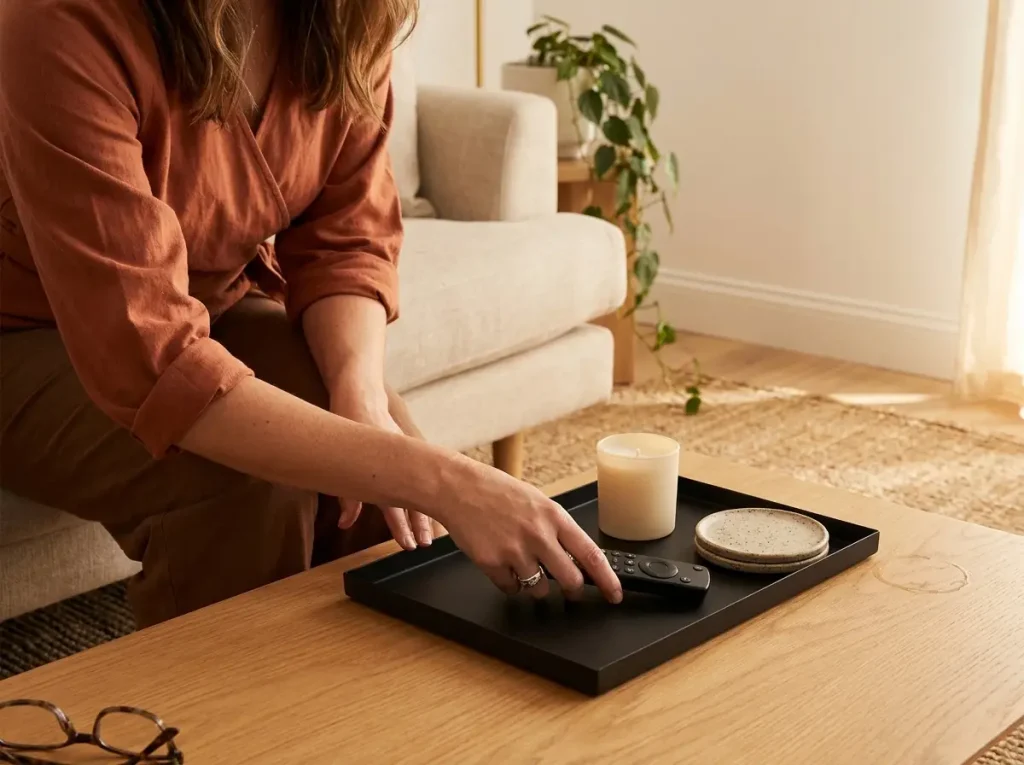
Every horizontal plane in a living room trends toward clutter, and you don’t win that battle with a one-time styling session. You win it with a surface rule clear enough that breaking it feels obvious.
The two-or-three item rule
The baseline professional organizers use is to keep visible items to two or three per surface. Beyond that, a surface reads as cluttered no matter how nice the individual objects are. According to professional organizers at NAPO, limiting visible items to two or three pieces per surface is the practical floor for a visually calm room. It’s a number you can actually check at a glance, which is what makes it stick.
Tray-grouping (five things become one)
Here’s the trick that makes the rule livable. A single tray that corrals the remote, a coaster, and a candle counts as one visual item instead of five scattered ones. Your eye reads the tray as a single unit, so the surface feels calm even though the same number of objects is sitting there. This is why trays work so well in minimalist rooms; they don’t reduce your stuff, they reduce the visual count.
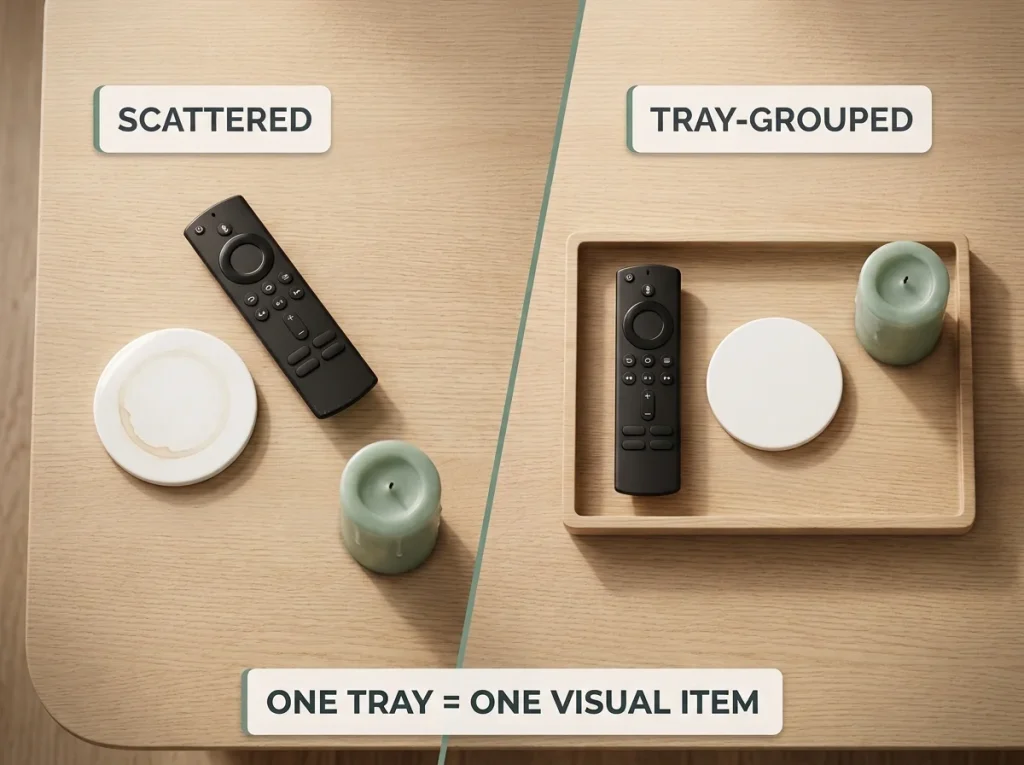
The flip side is the coffee table drift. An emptied surface starts collecting objects within about seventy-two hours, and willpower won’t stop it. What stops it is friction: a closed home sitting close enough that putting the thing away is easier than setting it down. If the basket is across the room, the table wins. If it’s right there, the basket wins.
Cables and remotes, the surface killers
Two things undo a calm living room faster than anything else: a charging cable across the floor and a pile of remotes on the table. Both are worth solving directly. Stash remotes in a closed home and treat cable management as part of the look, corralling cords so they’re not visible, and the room instantly reads more finished. If the cable mess behind your media console is the real eyesore, it’s worth a dedicated fix to get the cable mess off the floor for good. And remember that in minimalism, negative space is the goal; an empty surface isn’t a missed chance to display one more thing.
Renter-Friendly Storage With Zero Drilling
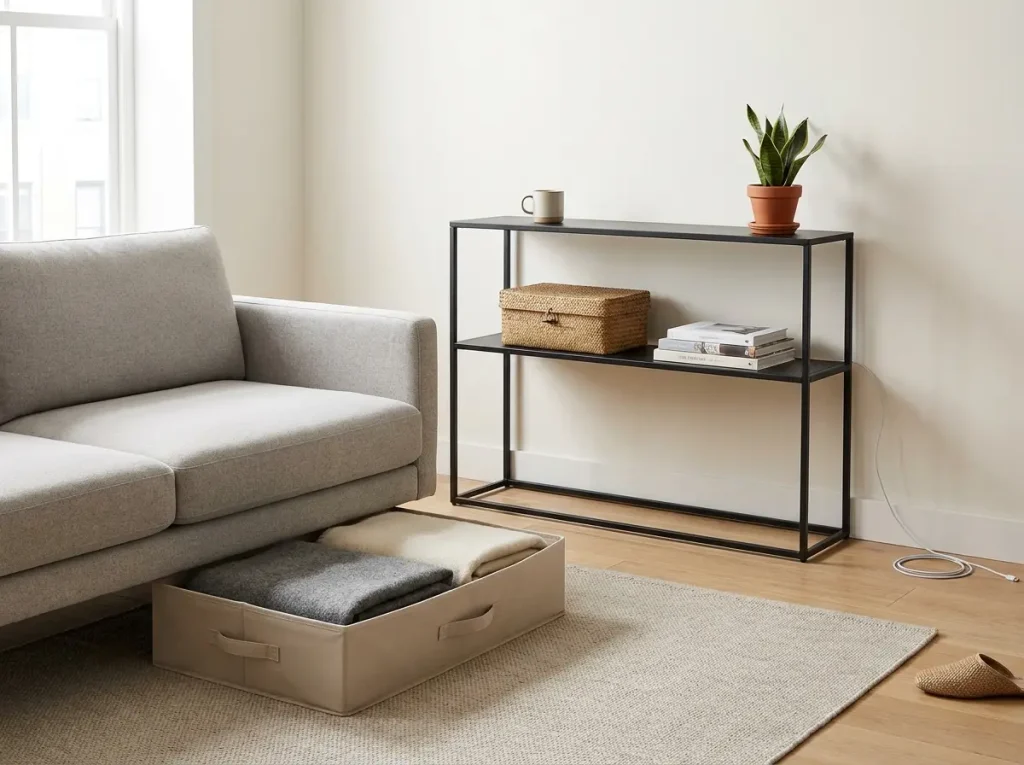
Almost every “minimalist storage” recommendation online quietly assumes you own the place. Floating shelves, anchored units, built-ins. If you rent, most of that list is off the table, and nobody bothers to tell you what’s actually left. Plenty is, and some of it works better than the drilled-in version.
Why floating shelves are a renter trap
The honest math on floating shelves: to hold real weight, like books or bins, the brackets need to anchor into wall studs, and each stud point holds something on the order of forty-five to fifty pounds. That means drilling, which means a lease problem and possibly your deposit. Adhesive strips are the no-drill alternative, but they top out around ten pounds, which is enough for a framed photo or a small plant and nothing more. So if a competitor tells you to “just add floating shelves” for storage and you rent, they’re describing a project you can’t do. Skip it and store in furniture instead.
Furniture that stores without touching a wall
Furniture-based storage is the renter’s whole answer, and it has a quiet advantage: it moves with you at lease-end. The ottoman and the lift-top table from earlier already do this. A slim console table adds vertical storage without eating floor space, which a narrow profile makes possible even behind a sofa or against a tight wall. The WOHOMO Console Table at around twelve inches deep creates a controlled drop-zone for keys, a closed box, and a couple of books, and because it’s freestanding there’s not a hole in the wall anywhere. The trade-off is that an open-shelf console can itself become a clutter magnet, so pair it with one closed box and a strict two-item rule on the open shelves. These no-drill moves sit alongside other vertical storage ideas that won’t cost you the deposit.
Under-sofa and freestanding vertical space
The most overlooked renter move is the dead space under your couch. Foldable bins slide into that gap and vanish, holding flat items like extra blankets and out-of-season throws. But measure your clearance first, because this is where people get burned.
You need roughly four inches of clearance or more, or nothing fits, full stop. The MAINTEEE Under Couch Storage bins are foldable and need zero installation, which makes them the rare under-sofa solution a renter can use freely; just confirm your sofa’s floor gap before ordering. If your couch sits lower than that, there’s an ultra-low version built for minimal-clearance frames. And if you want vertical display without a single hole, a freestanding leaning ladder shelf gives you that and walks out the door with you when the lease ends.
Measure the under-sofa gap at the lowest point, not the highest. Sofa frames often dip toward the middle, so the corner that lets a bin slide in easily can still jam halfway. Measure where it’s tightest and buy for that number.
The Maintenance System That Actually Holds
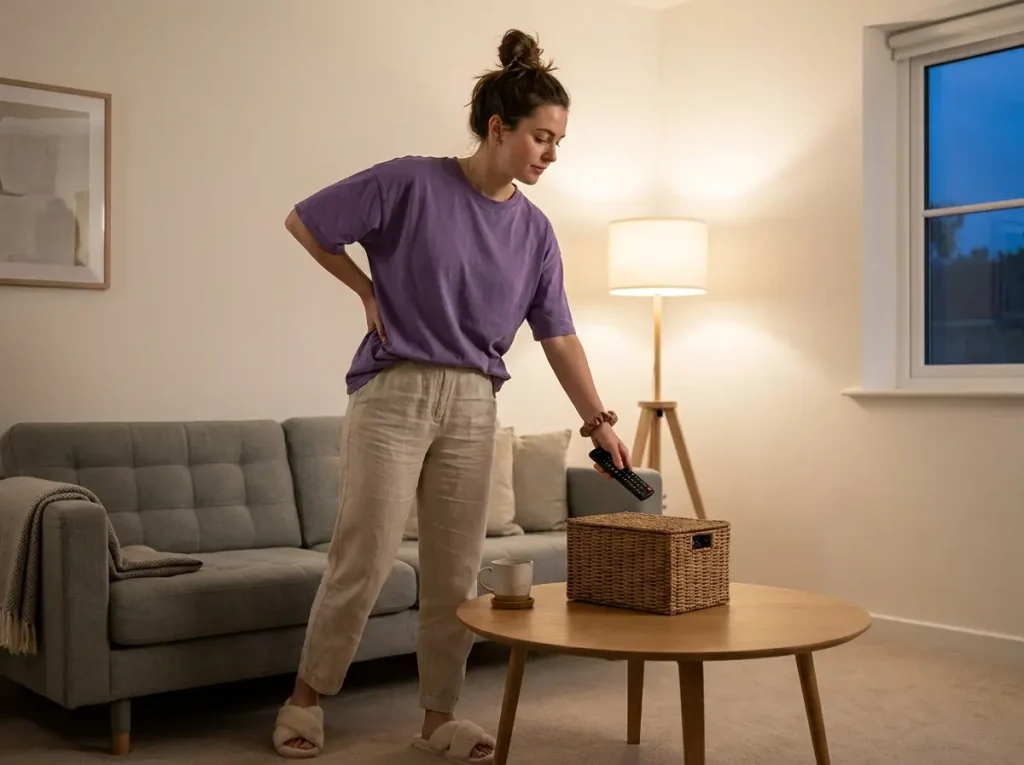
Organizing is the easy day. The room you set up looks great for a week, and then real life moves back in. What you actually need is a maintenance rhythm small enough that you’ll really do it, plus a plan for the very common situation where the person you live with won’t.
The two-minute daily reset
Clutter creep is the enemy, and it works in slow motion. A cleared surface goes from one item to five to fully covered within about two weeks if nothing interrupts it. The interruption is a two-minute daily reset. Each evening, clear the three entropy zones, the coffee table, the sofa, and the doom corner, back into their closed homes. That’s it. Two minutes a night beats a two-hour rescue every Saturday, and because the homes are closed and nearby, the reset stays genuinely quick.
The weekly catch-up reset
The daily reset handles surfaces. A weekly ten to fifteen minute pass, the one a lot of people call the Sunday reset, catches what daily missed: the items that drifted in from other rooms and need relocating, the basket that’s quietly become two categories, the relocate pile that’s forming again. This is where you keep the system honest, and these are the kind of storage habits that survive past the first tidy instead of collapsing by week two.
When the person you live with isn’t on board
This is the failure that sinks more minimalist living rooms than any storage mistake. You build a system; the person you share with doesn’t follow it. The answer isn’t to convince them, it’s to build a system that survives non-compliance. Closed storage tolerates a partner who isn’t on board, because a lid hides a multitude of sins. Styled open shelving does not, because it needs everyone’s cooperation to look right.
So give them one autonomous zone, a shelf or a basket or a corner that’s theirs to manage however they like, and keep the shared surfaces under the closed-storage system. Half of the room running on a system beats none of it, and fifty percent minimalism is genuinely better than zero. Build for the household you have, not the one you wish you had.
Conclusion
Three things to take with you. First, your living room reverts because it has no owner and everything lands there, so you have to solve the flow, not just the storage. Second, closed, multi-functional, no-drill storage beats pretty open shelving in any shared or rented room. And third, a two-minute daily reset is the small habit that makes the whole thing hold.
The three-month test is simple: in three months, check whether one surface has quietly become a catch-all again. That’s not a discipline failure, it’s the entropy zone telling you it needs a closer closed home. Move one there and the surface heals itself.
Start with one surface tonight: the coffee table. Give it a rule and a closed home within arm’s reach. Get that holding for a week, then move to the next one. The calm room comes from the system, not from a single big cleanup.
Frequently Asked Questions
01How do you organize a living room with no storage?
Lean on furniture-based and no-drill storage. A storage ottoman, a lift-top coffee table, a slim console table, and foldable under-sofa bins all add hidden storage without a single shelf or hole in the wall, which makes them ideal for renters.
02What is the minimalist rule for the living room?
Keep two or three visible items maximum on every flat surface, and give every category one closed home. If something doesn’t have a home, it doesn’t get to stay out. The rule is easy to check at a glance, which is what makes it last.
03Why does my living room get cluttered so fast?
Because it’s the only room with no single owner, so items from every other room land there by default. It re-clutters faster than any room in the house until you fix the flow of what comes in, not just the storage of what’s already there.
04How do minimalists keep their living room tidy long-term?
A two-minute daily reset of the main surfaces, plus a ten to fifteen minute weekly catch-up. The habit, not the products, is what keeps a room minimal past the first week. Closed, nearby storage is what keeps the habit quick enough to actually do.
05How do you stay minimalist when your partner isn’t?
Use closed storage that survives one person not following the system, give them one autonomous zone that’s theirs to manage, and only declutter your own things. Fifty percent minimalism beats zero, and a calmer room often wins people over on its own.
Disclaimer: ClutterlessNest is a participant in the Amazon Services LLC Associates Program. As an Amazon Associate we earn from qualifying purchases. This article may contain affiliate links — if you buy through them, we may earn a small commission at no extra cost to you. We only recommend products we have tested or genuinely believe in.