




In this article
You’ve probably walked into your apartment, stared at the walls, and felt like there’s nowhere left to put anything. The floor is full. The closet is packed. But those walls? Mostly bare from about four feet up to the ceiling. I’ve organized enough small apartments to know that the real problem isn’t space — it’s that most renters never think vertically past the first shelf. This guide covers the vertical storage systems that actually hold up after three months of real use, not just for the “after” photo.
Quick Answer: The best vertical storage ideas for apartments that last include:
- Map your walls into three frequency zones before buying anything
- Use no-drill floating shelves for lightweight daily items
- Install over-the-door organizers on closet doors (not hollow-core bathroom doors)
- Add a freestanding narrow bookshelf for your biggest vertical gain
- Use Command hooks for scattered items under 7.5 pounds each
- Run a quarterly reach test to keep everything accessible
Why Most Apartments Waste Half Their Wall Space

Walk into any 500-square-foot apartment and measure the empty wall space between four feet and the ceiling. In most rentals, you’ll find 150 to 200 square feet of usable vertical surface that’s holding nothing. That’s not a rough guess — it’s basic math. A standard 8-foot ceiling with 10 linear feet of wall gives you 40 square feet per wall above the 4-foot line. Multiply by three or four usable walls and the wasted space adds up fast.
The reason it stays empty is simple: most storage advice stops at “add shelves.” That skips the part where you figure out what goes where based on how often you use it.
The Wall Space You’re Not Using (The Math)
Stand in front of any wall in your apartment. Everything between the floor and about four feet is easy to reach without thinking — that’s your grab zone. The stretch from four to seven feet is where most people stop putting things, even though it’s still reachable with one arm. Above seven feet? That’s dead space in most apartments unless you own a step stool and use it regularly.
The gap between “I can reach it” and “I put something there” is where your apartment loses storage capacity. If your walls are painted white and bare from shoulder height to the ceiling, you’re sitting on square footage you already pay rent for.
Frequency Zones — What Goes Where
Zone your walls the way a warehouse zones its shelves: by access frequency. The daily zone sits between four and six feet — keys, bags, the jacket you wear every morning. The weekly zone runs from six to about seven feet — seasonal accessories, backup supplies, books you rotate. The seasonal zone is everything above seven feet, and it earns its name: you touch it maybe four times a year.
If you’re working on a broader small apartment organization plan, this zone system becomes your foundation. Every shelf, hook, and bin you add should map to one of these three bands.
Pro tip: Before buying a single shelf or hook, stand at your tallest wall and mark the 4-foot, 6-foot, and 7-foot lines with painter’s tape. Leave the tape up for a week and notice where you naturally reach. Your hands already know the zones.
The Dead Zone Above 7 Feet
Here’s what most vertical storage guides skip: anything above seven feet in an apartment with standard 8-foot ceilings is almost useless for everyday items. You need a step stool to reach it, and you won’t use a step stool for anything you need more than once a month. I’ve seen people install beautiful floating shelves at 7.5 feet and then never touch what’s on them again.
The only things that belong above seven feet: holiday decorations, suitcases, and anything else you retrieve with a calendar reminder rather than a habit. If you’re stashing daily-use items above arm’s reach, you’ll stop using them within a week.
Floating Shelves Done Right (Measure Before You Mount)
Floating shelves fail in apartments for one reason more than any other: the wrong mounting method for the wall type. A shelf rated for 50 pounds on a stud mount holds about 10 pounds on drywall with adhesive. Most renters don’t drill into studs — and most apartment walls don’t have studs where you want the shelf.
Drilling vs. No-Drill — The Weight Limit Decision
Your mounting method determines your weight limit, and your weight limit determines what you can actually store. Here’s the hierarchy for apartment walls:
Adhesive strips (Command-style): 10 to 16 pounds per shelf. Works on smooth semi-gloss or gloss paint only. This handles a few books, a plant, or a row of small bins. Molly bolts in drywall: 25 to 50 pounds per bolt, but they leave holes you’ll need to patch when you move. Toggle bolts: up to 100 pounds, same hole problem. Stud mounting: 100+ pounds, but good luck finding a stud exactly where you want a shelf in an apartment built in 1985.
If you’re renting, adhesive or molly bolts are your realistic options. The no-drill approach works for most lightweight storage — the key is matching what you put on the shelf to what the adhesive can hold.
Where to Put Floating Shelves in a Small Apartment
Above the sofa is the most wasted wall space in most apartments — it’s wide, usually flat, and already near where you sit. The wall beside a desk works for supplies you grab while working. Kitchen walls between the counter and upper cabinets often have 18 inches of dead space that fits a narrow shelf perfectly.
One place to avoid: directly above your bed headboard. Anything mounted with adhesive can fail, and you don’t want a shelf of books dropping on you at 3 AM. I learned this the hard way when a friend’s no-drill shelf let go during a humid summer — the adhesive softened and the whole thing slid down the wall.
What Actually Belongs on Open Shelves (and What Doesn’t)
Open shelves collect dust. That’s not a design flaw — it’s physics. If you put loose items on an open shelf, you’ll spend more time cleaning the shelf than using it. Bins solve this. A shelf with three small bins stays cleaner and more organized than a shelf with twelve loose objects.
The Floating Wall Shelf No-Drill 16.5″ (2-Pack) fits within the safe weight range for adhesive mounting at around 10 to 15 pounds per shelf, and the 16.5-inch width holds a row of small bins or a few plants without overloading. The limitation: it only bonds to smooth semi-gloss or gloss paint, so test a corner of your wall first. If your wall has flat or matte paint, the adhesive won’t hold — and you’ll find that out the hard way at 2 AM when the whole thing lets go.
Pro tip: Run your finger along any open shelf after 10 days. If there’s visible dust, that shelf needs bins — not more wiping. Bins with lids protect the contents and cut your cleaning time to zero.
Over-the-Door Organizers (The Wrong Door Is the Problem)
Over-the-door organizers are one of the simplest vertical storage adds for renters — no tools, no holes, no commitment. But the failure rate is high, and it’s almost always the door’s fault, not the organizer’s.
The Two Measurements Before You Buy
First: measure the gap between the top of the door and the door frame when the door is closed. Most over-door hooks need at least 1.5 inches of clearance. If your door sits flush against the frame, the hooks won’t fit without preventing the door from closing.
Second: the swing test. Open the door fully, then close it. If the organizer on the back side catches on the frame, a carpet edge, or the wall behind the door, you’ll rip it off every time. Bathroom doors in apartments are the worst offenders — they’re narrow, the swing arc is tight, and the frame tolerances are often uneven.
Best Doors for Over-Door Organizers in Apartments
Closet doors are the best candidates. They open wide, they’re usually out of high-traffic paths, and most apartment closet doors are solid enough to handle moderate weight. Bathroom doors work if the swing clears. Bedroom doors are fine for lightweight items. Front doors are almost always too heavy-use — the constant opening and closing shakes the organizer loose within a month.
The SimpleHouseware Over-The-Door Organizer (5-tier) spans 64 inches tall and 14.5 inches wide, fitting doors up to 1.75 inches thick — which covers most standard apartment doors. The rubber-coated hooks reduce scratching on the door top. Before you spend anything, though, check if a single set of over-door hooks from a hardware store covers what you need — for coats and bags, a simple hook set does the job for a fraction of the cost.
Hollow-Core Doors and Weight (What Not to Hang)
Knock on your apartment door. If it sounds hollow — a thin, papery thud instead of a solid thump — it’s a hollow-core door. Nearly every interior door in apartments built after 1980 is hollow-core. They weigh less, cost less to install, and they can’t handle much weight on an over-door hook.
The safe loaded limit for a hollow-core door with an over-door organizer is about 15 pounds total. That means the organizer itself plus everything in it. A 5-tier organizer loaded with shoes, cleaning bottles, or heavy toiletries will exceed that fast. Stick to lightweight items: scarves, small bags, socks, spice packets, lightweight cleaning cloths.
You’ll learn this limit exists the night the whole organizer tilts forward and drops a tier’s worth of bathroom supplies on the floor. If you need more apartment organization ideas for heavier items, the next section covers freestanding options that skip the door entirely.
Freestanding Tall Shelves (The No-Drill Power Move)
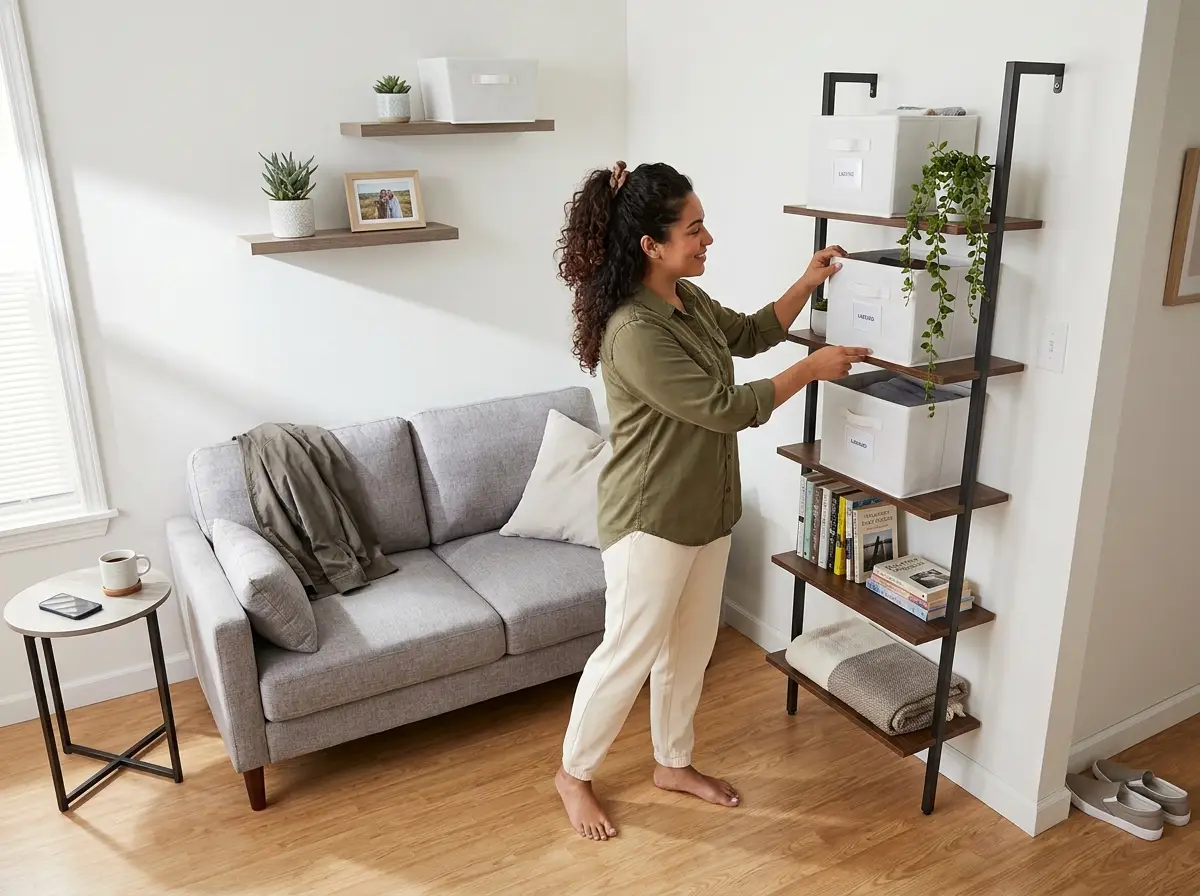
If you want the biggest vertical storage gain with zero wall damage, a freestanding narrow bookshelf is the move. No drilling, no adhesive, no negotiation with your landlord. You place it, load it, and take it with you when you leave.
Height and Footprint Math for Apartment Shelves
The sweet spot for apartment shelving is 60 to 72 inches tall with a depth of 12 to 14 inches. At that height, you get five usable tiers while staying comfortably below an 8-foot ceiling. The depth keeps the unit narrow enough to fit against a wall without jutting into your walkway.
The VASAGLE 5-Tier Narrow Bookshelf measures 11.8 inches deep by 13.3 inches wide by 66.9 inches tall — a floor footprint of about 1.1 square feet. That fits in any gap wider than 14 inches, which includes most apartment corners, entryway nooks, and the dead space beside a closet door. If you need something even slimmer for the gap beside your refrigerator or between the washer and the wall, the Slim 3-Tier Rolling Storage Cart at about 7 inches wide rolls in and out of spaces no other storage product fits. The tradeoff: three tiers instead of five, and it’s mobile — good for access, less stable for stacking heavy items.
Where to Put Freestanding Shelves in a Small Apartment
The entryway corner is the highest-value location — you pass it every time you enter or leave, so daily items on the bottom two shelves get used constantly. Living room corners work for books, plants, and display items. The space beside a bedroom closet often has 14 to 18 inches of unused floor that fits a narrow unit perfectly.
If you’re organizing a one-bedroom apartment, one freestanding shelf in the main living area often does more than three different drawer organizers scattered across rooms. Consolidate before you multiply.
The Anti-Tip Strap That Protects Your Deposit (and Everything Else)
Any freestanding shelf over 48 inches tall needs to be anchored. This isn’t optional. The U.S. Consumer Product Safety Commission (CPSC) reports thousands of furniture tip-over injuries every year, and tall narrow shelving is one of the most common offenders.
The fix is a fabric anti-tip strap that connects the back of the shelf to the wall. Most narrow bookshelves include one. In an apartment, you anchor it to the baseboard with a single small screw — the hole is hidden behind the furniture and costs pennies to patch at move-out. If your lease prohibits any wall modification, use heavy-duty adhesive furniture anchors rated for 50+ pounds of pull force.
You’ll know the strap matters the first time you pull a bin off a loaded top shelf and feel the whole unit tip forward an inch. That one-inch lean is what separates a stable shelf from a real hazard — especially in homes with kids or pets.
Hooks, Pegboards, and Magnetic Strips
Hooks are the fastest vertical storage you can add to an apartment — peel, stick, hang, done. But the weight math trips people up, and the wrong wall surface turns a 7.5-pound-rated hook into a zero-pound-rated one.
Command Hooks and the 7.5-Pound Rule
Every Command hook has a weight rating printed on the package. The large wire hooks max out at 7.5 pounds per hook. That handles a lightweight jacket, a set of keys, a small bag, or a pot lid. It does not handle a backpack full of textbooks, a cast-iron pan, or a heavy winter coat — those exceed the rating and the hook will fail, usually at 2 AM when you’re not expecting it.
The Command Large Wire Hooks (multi-pack) work on smooth painted surfaces and come off without wall damage when you follow the removal instructions. Before you buy a multi-pack, check if dollar store adhesive hooks cover your lighter items — for keys and a single light bag under 3 pounds, the cheap hooks work fine. Save the rated Command hooks for items that actually need the 7.5-pound capacity.
Pegboard as a Modular Wall System
A 22×22-inch pegboard panel gives you a full square foot of modular storage — hooks, baskets, shelves, and holders that rearrange in seconds. The catch: pegboard needs either stud mounting or heavy-duty drywall anchors. Adhesive won’t hold a loaded pegboard.
For renters, the best approach is mounting a pegboard to the inside of a closet door using over-door hooks, or leaning a large pegboard panel against a wall on a desk or countertop as a station organizer. The weight limits of drywall vary by thickness and anchor type, so measure and match before you drill.
What Adhesive Actually Sticks To (The Paint Problem)
Here’s the detail that wrecks half of all adhesive storage in apartments: paint finish matters more than wall material. Adhesive hooks and strips bond well to smooth, semi-gloss, or gloss paint. They struggle on flat or matte paint because the porous surface doesn’t allow full contact with the adhesive.
Test before you commit. Press one strip to a hidden wall area — behind a door frame or inside a closet — and let it cure for 24 hours. Hang a known weight from it. If it holds, your paint finish works. If it slides or pops off, you need mechanical mounting (screws, anchors) for anything heavier than a keychain.
That test saves you from discovering at 3 AM that the hook you trusted for two weeks was slowly losing grip. Every apartment renter learns this lesson eventually — better to learn it on a test strip than on a loaded organizer above your kitchen counter.
Pro tip: If your walls have flat or matte paint and you still want no-drill storage, over-the-door and freestanding options bypass the paint problem entirely. No adhesive, no paint damage, no midnight failures.
The Vertical Storage Reset (Three Months In)
Every vertical storage system works on day one. The systems that actually last are the ones you maintain — and maintenance takes five minutes, not an hour.
The Open Shelf Dust Problem (And the Bin Solution)
Open shelves in apartments collect visible dust in 10 to 14 days. That’s not a cleanliness issue — it’s airflow, HVAC filters, and proximity to windows and doors. If your vertical shelves hold loose items like books, decor, or small objects, you’ll spend more time dusting than organizing.
The fix is straightforward: put everything in a bin. Labeled white fabric bins on open shelves block dust, hide visual clutter, and make the shelf look intentional instead of messy. You wipe the shelf surface once a month and never touch the bin contents unless you need something. After six months of this, the bins look the same as day one — which is the whole point.
The Quarterly Reach Test
Every three months, stand in front of each vertical storage zone and reach for the highest item without a step stool. If you can’t reach it comfortably, it’s in the wrong zone. Move it down. If you haven’t touched something in the weekly zone since the last check, it belongs in the seasonal zone — or out of the apartment entirely.
This takes ten minutes and prevents the slow drift where everything migrates upward until your daily items are above arm’s reach and your shelves become decoration. If you’re building a broader system to maximize your apartment space, this quarterly check applies to every storage zone in your home, not just vertical ones.
When to Rethink Your Vertical System
Three signals that your current setup isn’t working: you consistently ignore an entire shelf (it’s in the wrong zone or holds the wrong items), you’ve added a new category of stuff with no assigned home (the system didn’t account for it), or you find yourself stacking items on the floor beside your vertical storage because the shelves are full.
When any of those happen, don’t add more storage. Edit first. Pull everything off the shelves, sort by frequency, and reload. The system usually isn’t broken — it just drifted from the zones you set up originally. A 20-minute reset puts it back on track.
Conclusion
Vertical storage in apartments comes down to three things: zone your walls by frequency before you buy anything, match every mounting method to its real weight limit, and put everything in bins to cut dust and maintain the system long-term.
Three-Month Check: Stand at your tallest shelf, reach for the top bin without a step stool, and check whether anything in your daily zone hasn’t been touched in a month. If something drifted, move it down.
Start with one wall. Map the zones, add one shelf or one set of hooks, and live with it for two weeks before expanding. The system that works is the one you build gradually — not the one you install in a weekend and abandon by Thursday.
Q1 How do I maximize vertical space in a small apartment?
Map every wall into three zones by access frequency: daily items at 4-6 feet, weekly at 6-7 feet, seasonal above 7 feet. Add freestanding shelves for the biggest gain without drilling, and use no-drill adhesive shelves for lightweight items in the daily zone.
Q2 What is the best vertical storage for small spaces?
A narrow freestanding bookshelf (12-14 inches wide, 60-70 inches tall) gives you the most vertical storage per square foot of floor space. It requires no mounting, works in any apartment, and moves with you when your lease ends.
Q3 Can I install floating shelves in a rental without losing my deposit?
Yes — adhesive-mounted shelves hold 10 to 16 pounds per shelf on smooth semi-gloss or gloss paint and leave no holes. Test the adhesive on a hidden wall area first. If your walls have flat paint, use freestanding or over-the-door storage instead.
Q4 What vertical storage doesn't require drilling?
Adhesive floating shelves, freestanding bookcases, over-the-door organizers, Command hooks, and slim rolling carts all work without a single drill hole. Match each option to its weight limit — adhesive handles 10-16 pounds, over-door organizers handle about 15 pounds on hollow-core doors.
Q5 How high should floating shelves be in an apartment?
Install floating shelves between 4 and 6 feet for daily items you grab without thinking. The top shelf should sit no higher than 7 feet unless you use a step stool regularly. Above 7 feet in a standard apartment is seasonal storage territory only.