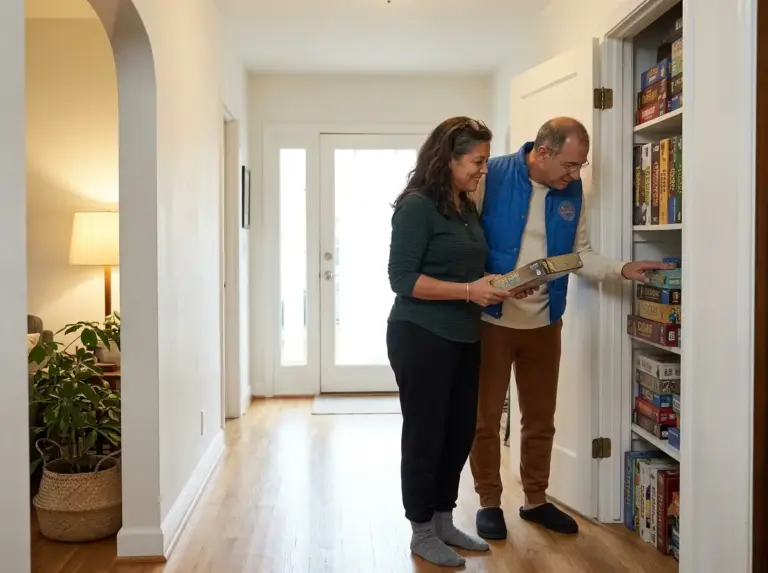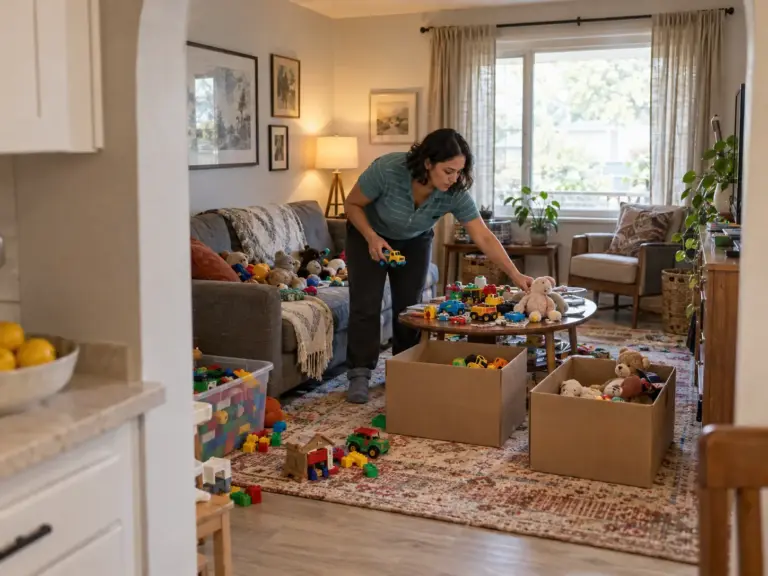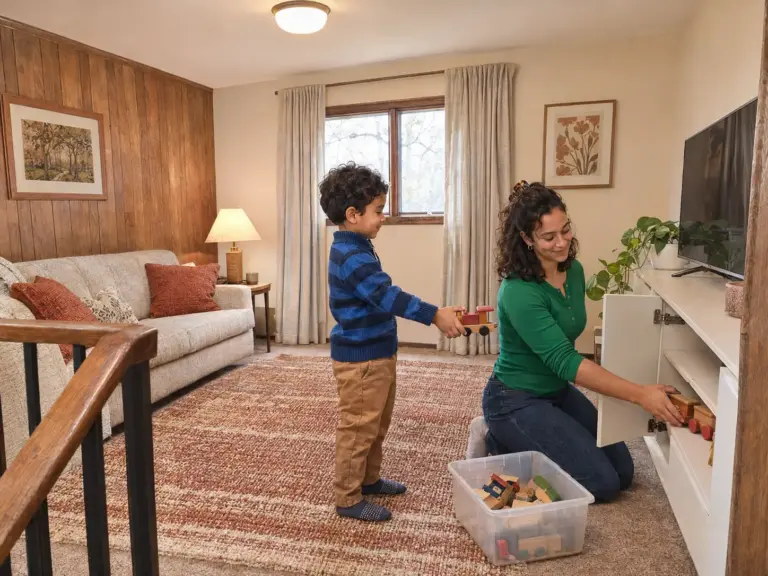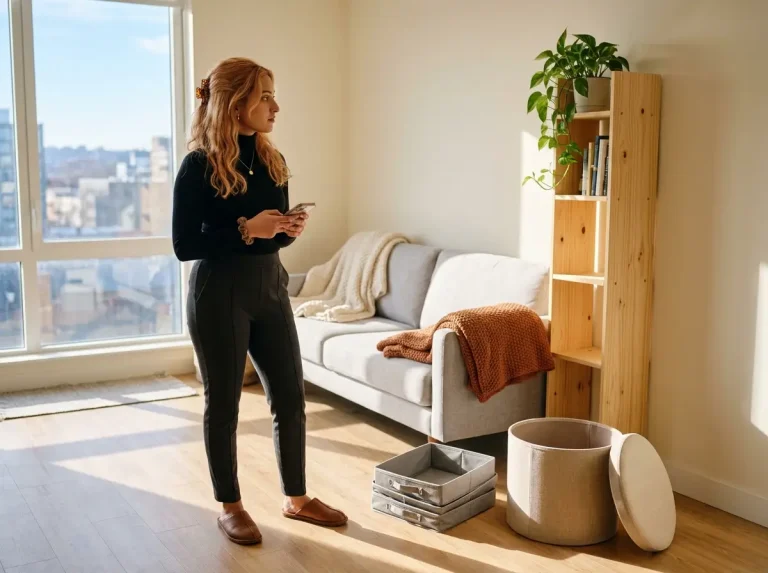
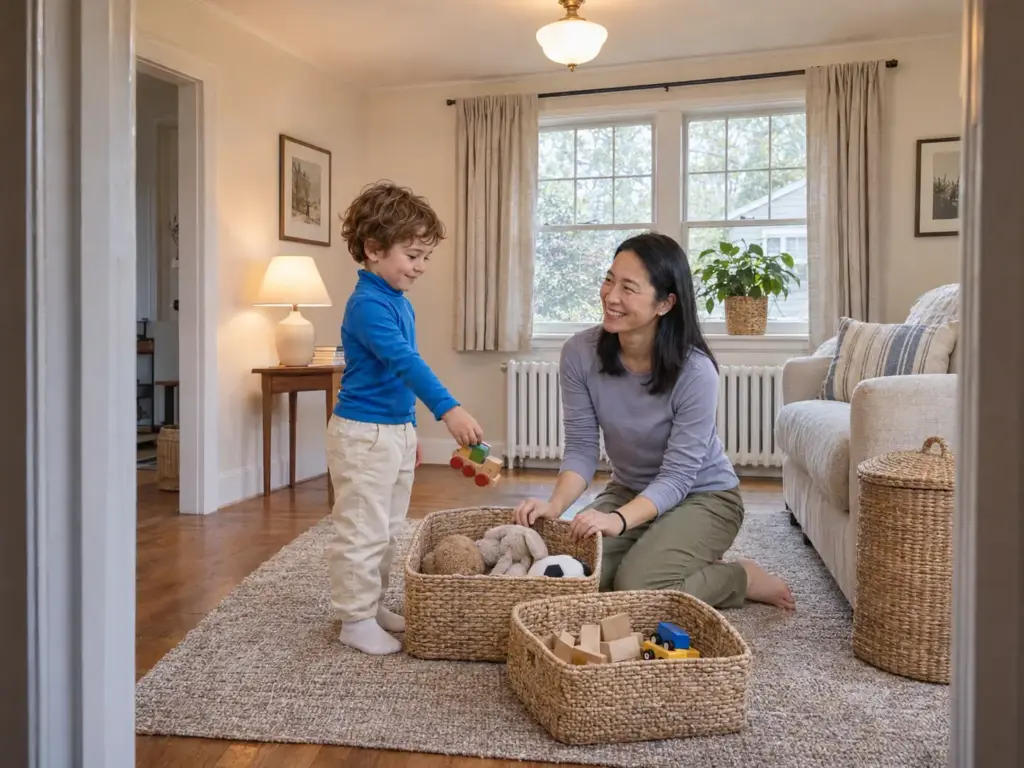
A wooden train catches your heel in the hallway just as you notice the living-room rug has disappeared again, even though the bins you bought last spring are full. In a house with no room called the playroom, toy organization fails in a particular way: the toys spread across three rooms because nobody decided where each kind of toy lives or who walks it back. The number of bins is rarely the problem: toy clutter comes from toy overload, and a setup built for a two-year-old stops fitting a six-year-old without anyone noticing the day it happened. This guide walks the whole house, from counting what you have to a nightly reset that every person in the family can run, and it treats toy storage ideas as the last step instead of the first.
Quick Answer
A toy system that holds is built in this order, and each step gets its own section below.
- Cut the volume first: broken, outgrown and duplicate toys leave before any bin arrives.
- Give each category one home in each room, and move a category instead of enlarging its bin.
- Size the shelf and the container to the child’s reach and the shelf’s depth.
- Put a lid only where an adult manages it, and keep small parts up high.
- Set a fixed day and a fixed number for the reset and the rotation.
Toy Organization Starts With the Number of Toys, Not the Bins
The bins are full, the floor is covered anyway, and buying a bigger bin only moves the problem. A house has a number of toys and a number of homes for them, and when the first number is larger, no container size closes the gap. So the work starts before any shopping: put the whole pile on the floor and find out how many kinds of toy this household actually runs. Call it a toy audit: it takes an hour and shapes every purchase after it.
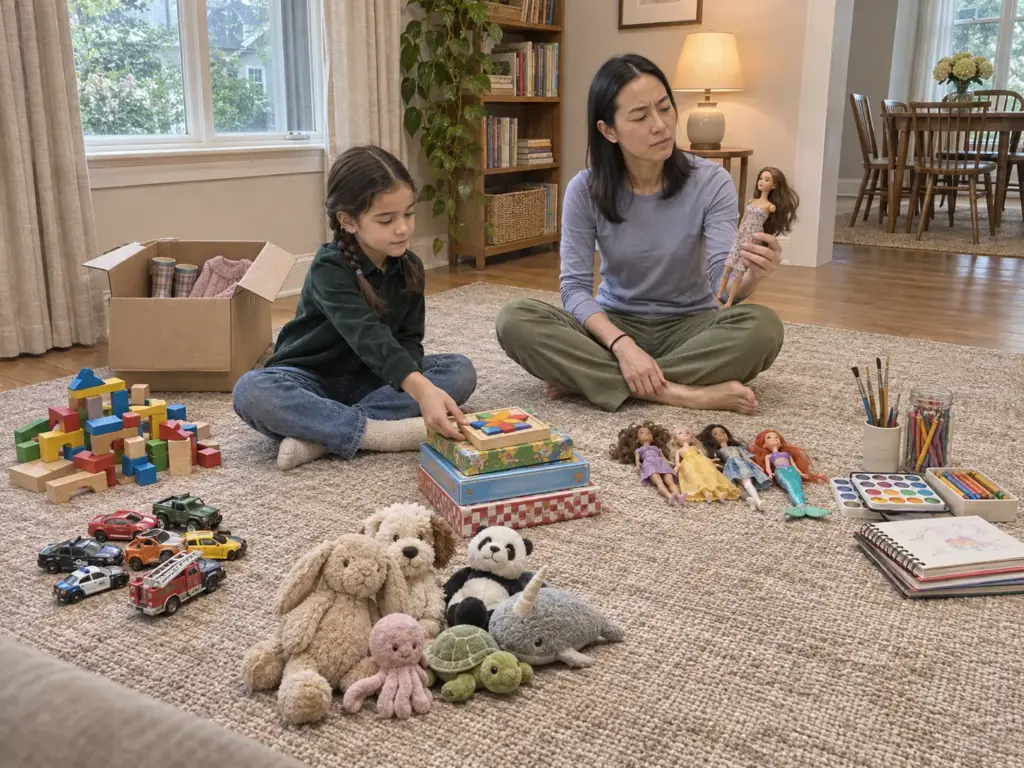
Count by Category Before You Count Bins
Sorting toys goes by kind of play, not by brand and not by the room each toy was found in. A workable set of piles is building (blocks, bricks, magnetic tiles such as Magna-Tiles), pretend (kitchen and play food, dress-up, tools), vehicles, soft toys, books and puzzles, art, games (board games and card decks), babies and dolls (action figures too), and a pile for loose small toys. Storing toys by type means the number of piles, not the number of toys, is the number of homes the house has to provide.
A category with no home is the one that ends up on the floor, every time. Fewer categories with one home each beat a wall of bins with no rule attached, and the reason is simple: a system that asks a toddler to match twenty bins is undone minutes after the adult finishes tidying. What survives is plainer. Everything gets off the floor, anything that fits goes into a bin, heavy things sit low and light things sit high.
The Pieces Nobody Plays With
To declutter toys, purge toys that are broken or missing pieces, pass on outgrown toys, drop the third copy of anything, and donate toys that are still in good shape the same day. All of it happens before storage is even discussed. Two bags of loose small pieces can disappear from a house without a single request to bring them back, and keeping a few of each category is almost always enough. The full method, including the container limit and the dated maybe box that people call toy purgatory, lives in the full purge method and how to stop the pile from returning, so this guide does not repeat it.
The Rule for What Comes In Next
Gift intake is where volume comes back in waves, and the biggest wave has a name among parents: the Great Toy Influx of birthdays, holidays and hand-me-downs. A house that decides in advance what comes in keeps what it cut. That can be one-in-one-out for a single category, a gift request that points relatives at experiences or consumables, or a set intake day when new things are unwrapped, placed in a home and checked against the count. Without one of these, the purge you just did is a delay.
Where Toys Live When There Is No Playroom
Most playroom organization advice assumes a room to send the toys to, and most playroom storage is sold for one. In an ordinary house they colonize the sofa, the bedroom floor and the hallway in the same week, which makes the useful question a different one: which category lives in which room (the activity zones of the house), and what happens when it outgrows that room.
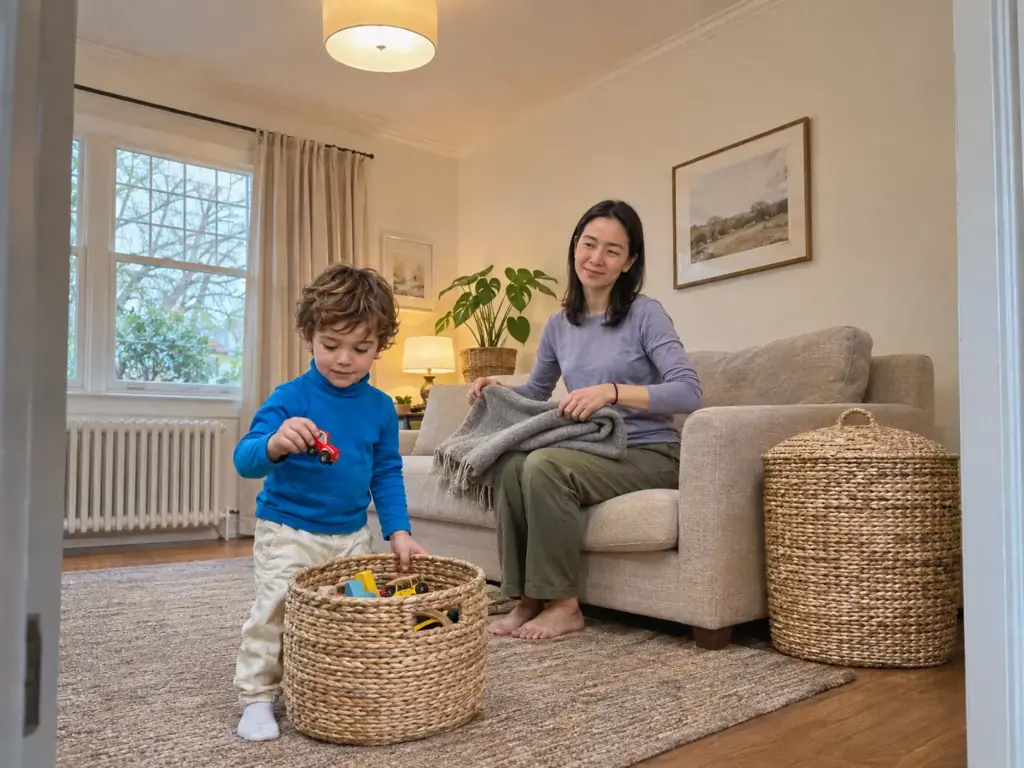
The Living Room: One Open Basket and One Lidded One
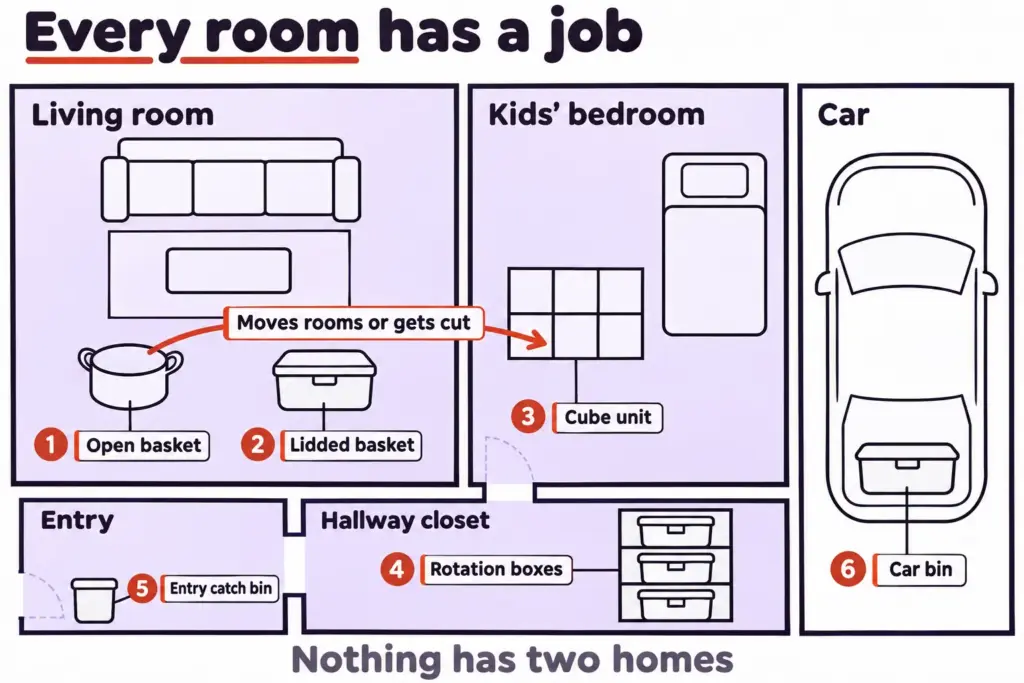
Living room toys get two containers and nothing else. The first is a low open basket the child owns, holding the current favorites, and the child can reach into it and put things back without help. The second is one lidded basket that an adult opens, and its only job is to hide the visual mess in a shared room at the end of the day.
A lid works here for one reason: an adult manages it. A child will not reliably lift a lid. But that is fine (this basket is the overflow, not the daily toys), and it keeps the rug from being the default storage.
The free version comes first. A laundry basket with a folded towel over it, or a storage ottoman already in the room, does the same job tonight, and it tells you in a week whether you want a better-looking one.
When you do, the HONCESTA 18 x 18 x 14 inch woven basket with lid is the one I would point to for the lidded slot: it is big enough to take a sofa-side pile and its lid keeps the room looking calm. It arrives flat and needs shaping into form, and the lid is not as sturdy as the basket itself, which is acceptable for something only an adult opens. For a room that also has to work for adults, living-room storage ideas for a space with no spare room covers what else can carry weight, and choosing baskets for the living room helps you pick one that suits the sofa.
The Bedroom: Cubes by Kind of Play
Bedroom toys go in cube storage or a bin unit, with categories assigned by kind of play and placed at the child’s eye line. Cube units take 11-inch to 13-inch bins, a 2×2 unit is about 26 inches square, and a 4×4 grid needs more than 4 feet of clear wall. The wall math, the weight limits and the renter version are worked out in the cube and over-door math for small rooms, so this section keeps to the categories.
The AWTATOS 6-cube organizer is the cheap, light grid that 11-inch to 13-inch bins drop into: 35.5 inches wide, 11.8 inches deep and 37.5 inches tall, with 11.8-inch cubes. The panels come apart over time and it is built for light loads, so it holds soft toys, books and cars better than a full set of wooden blocks. Because it is 37.5 inches tall, the top row sits above a small child’s reach, and that row belongs to the adult.
A cube unit that looks right can still fail in a way that surprises people: the bins become the toy, and the kids stack, ride and empty them while the contents sit untouched. When that happens, the answer is usually fewer, smaller bins with a picture on each, as set out in the room-level system for a child’s bedroom.
The Closet, the Entry and the Car
Three more places carry a single job each. The toy closet, or simply the closet shelf above the child’s reach band, is the home of the rotation stash (opaque, numbered, out of sight) and of whatever the adults want kept away from small hands. The entry gets one small bin that collects escaped toys, the shoe-sized stray cars and the doll that traveled to the door, and it is walked back to its category when it fills. The car gets one flat bin with a lid, swapped out when the rotation changes.
None of these three is storage in the sense of a place to put more. Each one is a pause point on the way back to a real home, which is why they stay small.
When a Category Outgrows Its Room
When a category outgrows its home, it moves rooms or it gets cut. It never gets a bigger bin in the same room, because a bigger bin hides the problem for a month and then fills too. The pile of soft toys that has taken over the bedroom basket is a signal (and no, the fix is not a second basket beside it) to ask where soft toys should actually live, and the answer is usually vertical storage in a corner, wall storage for the lightest toys, or a move to the living room, not a larger basket on the same floor.
In a small flat with no playroom, different toys live in different rooms, and the family-room set changes with the rotation. In a big house the playroom is the only room allowed more than a handful of toys out, and the basement is where things go to be forgotten. A visible home and a hidden home also teach different habits: an 18-month-old who knows which drawer holds the hidden toys will stand in front of it and demand it be opened, which is evidence that hiding works as storage and fails as forgetting. Renters can keep every piece in this section free-standing, a no-drill setup that works in a small space, and add only the anti-tip strap at the wall, while owners can mount whatever they like.
The Age Ladder: What the Shelf Looks Like at 1, 3, 5 and 8
The kids’ bookcase is often adult height with a child’s name on it, bought for a three-year-old who can reach only the bottom two shelves. One setup cannot last from the crawling stage to the school years, so the shelf, the bins and the labels each change at a predictable point.
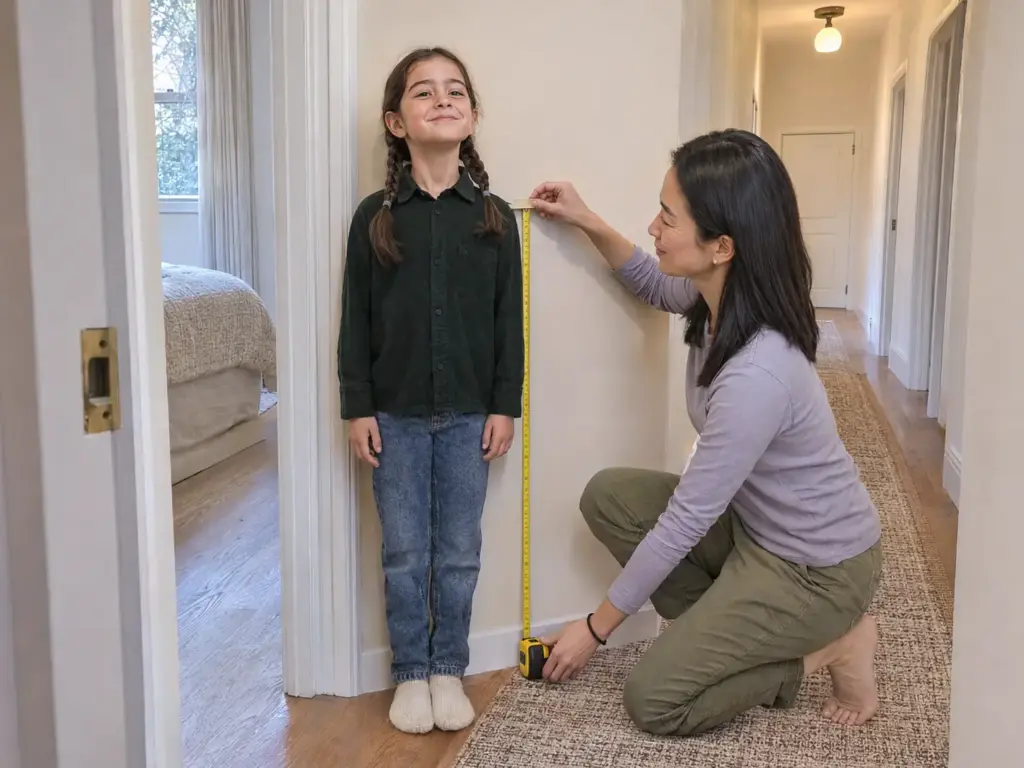
The rule underneath all of it is the reach band, the reach height at which a child can use storage without help. The U.S. Access Board’s advisory ranges for children put reach at about 20 to 36 inches above the floor for ages 3 to 4, about 18 to 40 for ages 5 to 8, and about 16 to 44 for ages 9 to 12. Anything a child is expected to put back alone has to sit inside that band, and everything above it is adult storage rather than child-height storage, however tidy it looks.
Kids’ closets follow the same reach-height rule, and it is worth reading if the clothes are as unreachable as the toys.
The shelf-height rule works from the child’s standing shoulder: the top usable shelf is the shoulder height minus two inches. Shoulders sit at roughly 26 inches at age 2, 30 at ages 3 to 4, 34 at age 5 and 38 at ages 6 to 7, so a 2-year-old’s top shelf is about 24 inches off the floor and a 4-year-old’s is about 28. The common 36- to 48-inch kids’ bookcase is therefore adult height for most of the years it is sold for. The number the shelf catalogs quote is the wrong number for a short child, and the child’s shoulder, measured on the wall, is the right one.
Stand the child square against a bare wall, measure to the shoulder, subtract two inches and stick a strip of masking tape at that height. The tape is the top edge of any shelf you buy or move, and holding it against the bookcase you have now shows in seconds how much of it is out of reach.
Under One: Floor Level and a Few Things Out
For baby toys under 12 months, the shelf stays at floor level, no taller than about 16 inches, with three or four objects out and an open front. There is no category system yet, because the baby is the only person who moves anything, and what the baby needs is a short list of safe things to pick up. Put heavier items at the bottom, soft or light things above them, and keep the shelf depth to 8 to 12 inches so nothing disappears at the back. Everything else waits in the closet.
One to Three: Shelf Top Around Waist Height and Bins a Child Can Carry
For toddler toys, from 12 months to about 3 years, the shelf top sits at roughly 24 inches, in line with Montessori guidance for low open shelving, with two levels and six to eight activities out. The bins matter at this stage: 12 to 15 inches wide and 6 to 10 inches deep is the size a toddler can carry to the rug and back, and a bin that is any larger gets abandoned where it stands. Deep shelves swallow toys at the back where nobody reaches, so low and shallow wins.
This is also the age of the dump and run, where emptying every container is the game and the contents barely matter. A child who spends the afternoon tipping bins is playing with the tipping, and giving that urge a legitimate target (a drawer of dish towels or a basket of scarves to empty) saves the toy shelf. If the bins keep getting emptied anyway, a closed drawer or cabinet with a few toys inside does better than open bins at this age.
Three to Five: Categories, Picture Labels and the Reach Band
At 3 to 5, the top usable shelf runs from 24 to 32 inches and the shelf holds eight to twelve activities grouped by kind of play. Compared with the toddler shelf, the bins can get a little smaller, the categories become real, and the labels turn into picture labels a child can read before reading words. This is where the 20 to 36 inch reach band lands, so every category the child returns alone has to be inside it.
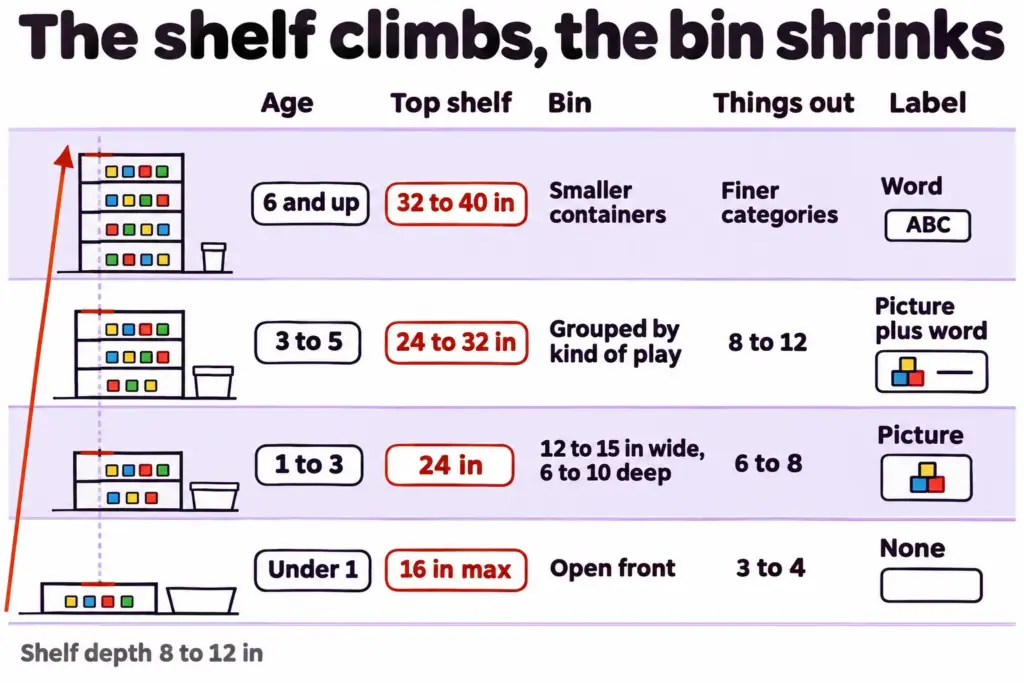
The step from one stage to the next is not tied to a birthday. Move the shelf up only when the child’s shoulder clears the current top shelf by two inches, and move a category out when the child stops returning it, not when the adult gets tired of looking at it. A child who keeps putting back the cars but never the puzzles is telling you which category is still in the right place.
Six and Up: Finer Categories, Smaller Containers
For big kid toys, by 6 the shelves can reach 32 to 40 inches, and the categories get finer: building sets sorted by kind, games sorted by how many players they need. The containers shrink while the shelf stays, because the child can now manage a lid, a smaller tray and a label with words. The shelf is no longer a toy shelf so much as a small library of projects, and the child’s own opinion about where a thing goes starts to carry real weight. For the rest of the room, reorganizing a kid’s room in one afternoon turns this shelf plan into a single working session.
Match the Container to the Toy, Not the Other Way Around
The matching set of toy bins looks right on the shelf and fails on the first cleanup, because the toy inside does not suit the container. Easy cleanup is the real test of a container, independent cleanup by the child is the goal, and the failure of each type is predictable enough to plan around.
Open Bins, Lidded Bins and Baskets: What Each Does to Cleanup
Open low bins win for the toys a child puts back alone. A lid turns a bin into an adult task, and a lid also hides what is inside: a toy that cannot be seen is a toy that is not played with, so the invisible toy turns into a dead one. Deep cubes do the same thing in a different way, because things sink to the back and stay there. Bin size decides it: only the bin a toddler can carry, 12 to 15 inches wide and 6 to 10 deep, gets used.
The common advice is to put everything into lidded bins for a neat shelf. It fails for the toys a child is supposed to play with, because the lid is the barrier. The better call is open bins for daily toys and a lid only on what an adult manages, such as the living-room basket or the rotation stash. Material is a separate decision for storage bins, with its own trade-offs, and when fabric bins fail against plastic is worth a read before committing to either for a toy shelf.
Small Parts: Clear Bins and Pouches
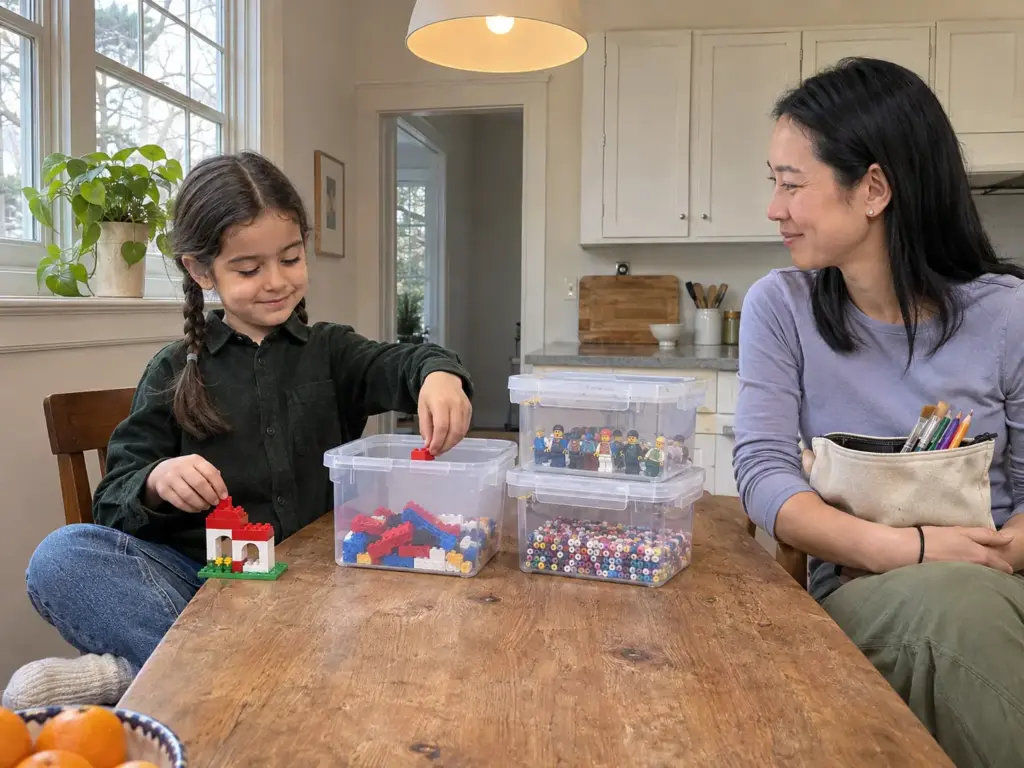
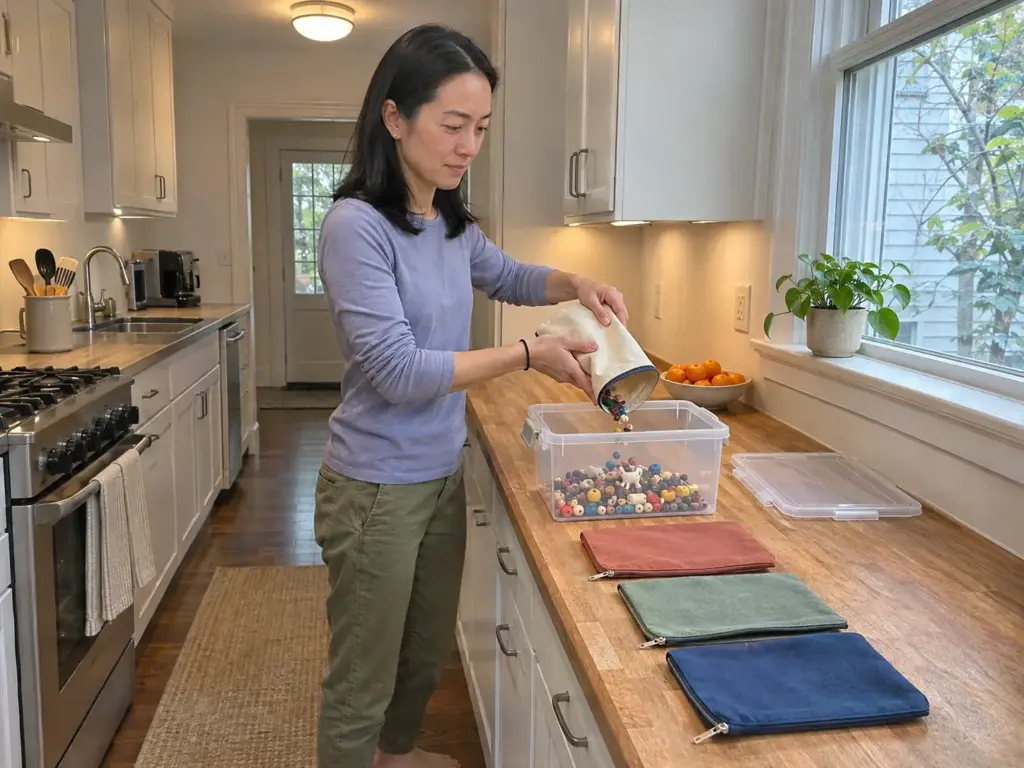
Small parts need three things: a container that is transparent, so the category is visible without pulling the bin out; a lid, so the pieces stay in; and a shelf above the reach of any child who still mouths things. Beads, small figures, tiny blocks and puzzle pieces all belong in this category. The near-free version is a stack of large zipper bags or zipper pouches sorted by category, and the child picks three or four at a time instead of facing the whole collection.
When the zipper bags are not enough, the Vtopmart 6-pack of clear stackable bins with lids works because each bin is 11 inches long, 7.5 inches wide and 6 inches high, and the pack of six gives one bin per category with room to spare. The lids do not snap in place and fall off easily, so these live on a high shelf where the lids are not tested by small hands. Art supplies are a toy category too, and craft storage for a child is usually one basket with a rotating caddy, which stops supplies from spreading across the house, and why art supply organization fails and the ideas that hold explains in more depth.
Building Blocks: A Home That Travels
LEGO storage has a classic failure: five bins of loose bricks dumped across the floor, and the cleanup takes an evening of sorting by color and piece. The better structure is one container where the bricks have one home and a place to build. The WillingHeart building blocks organizer with baseplate lids is a two-tier stackable unit, 13 by 10 by 10 inches, where each lid is a baseplate, so the build can travel to the table and come back without being taken apart. The lids do not always stay on, and the tiers feel light, so it is a tray system for a modest collection, not for a bin of thousands of bricks.
Stuffed Animals: Use the Wall, Not the Floor
Stuffed animal storage is the category most likely to take over floor space, and the cheapest way to take it back is a corner. The Lilly’s Love stuffed animal hammock turns an unused corner into plush storage with no shelf footprint, and it is the lowest-cost piece in this guide.
It is rated for 12 pounds and spans roughly 67 by 47 by 47 inches along the walls. The net stretches under a full load, so it should not be the only plush home in a house with a large collection. It screws to the wall, which owners can do freely; renters can use a toy storage bench in the same corner instead.
Labels a Child Can Read
Bin labels are a promise about where something goes, and a child can only keep it if the label reads at their eye line and in their language. According to the National Association of Productivity and Organizing Professionals, “A huge reason why it’s difficult for some kids to put away their toys is because they don’t know where things go.” For pre-readers that means a picture, taped or printed, at the child’s eye line. Masking tape and a marker work as well as a label maker, and a drawing of a car on the car bin teaches the system faster than the word.
Put the same picture on the bin and on the shelf edge where that bin lives. A child who cannot read still matches two identical drawings, and the bin finds its slot without a grown-up pointing.
Shelves and Bin Walls a Child Can Reach, Open and Put Back Alone
The beautiful cube unit gets played with as a set of boxes, and the long wall of bins has two top rows that are really adult storage. Kids toy storage furniture that carries the whole system has to be picked by reach and footprint first, and style comes last. Before any of it, the free version deserves a look: a low bookcase, a dresser drawer with a latch, or the bottom two shelves of a closet can do the same job. Furniture with a cavity you have already beats a new bin wall, and the cube and over-door math for small rooms covers the sizes and the weight limits for that route.
The Playroom Wall in One Footprint
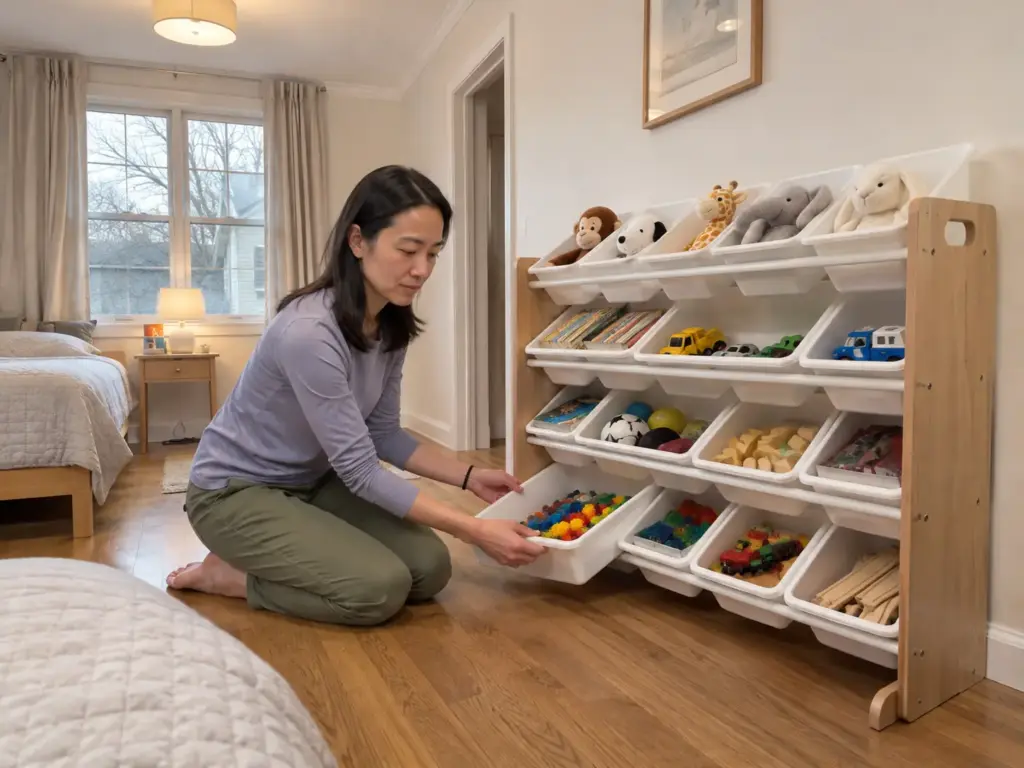
When the free version is not enough, the unit most often named for a whole system is the 16-bin, four-tier piece. It is 42 inches wide, 16 inches deep and 31 inches tall, holds 20 pounds per tier, and comes with 12 standard bins plus 4 large ones. The bottom two tiers belong to the child, and the top tier is the adult’s, with a wall-anchor kit in the box.
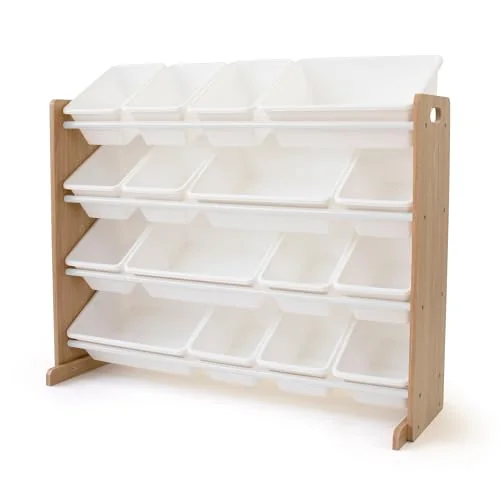
That is the obvious pick, and it is the right one when the wall is wide and the child is three or older. It is the wrong one when the wall is narrow, the child is still a toddler, or the room has to share with a bed, and the next unit is built for exactly that case.
The Narrow Unit for a Small Bedroom
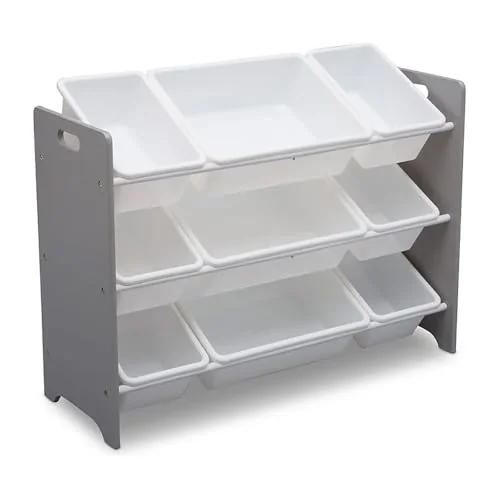
The lower, narrower alternative is a 9-bin unit that is 33.375 inches wide, 11.75 inches deep and only 23.5 inches tall. That height puts the top row inside a preschooler’s reach band instead of in adult territory, and the bins come in two sizes: small ones at 11.5 by 7.75 by 5 inches and large ones at 15.25 by 11.5 by 5. It is rated for ages 3 to 6 and carries a GREENGUARD Gold certification, and it is the in-stock budget pick for the section.
The Wide Shelf-and-Bin Piece
For a wide playroom or a big house, the shelf-and-bin piece takes one wall once instead of five baskets around the house. The SpaceAid 6-shelf organizer with 20 bins is solid pine, 68.1 inches wide, 13.6 inches deep and 31.5 inches tall, with 4 large bins and 16 small ones, and it is the option that looks like a bookcase. It is smaller than it looks, durability is mixed, and it ships without wall anchors, so a kit has to be bought separately.
A piece 64 to 68 inches wide is a whole wall, and it only pays off where the wall is going to be a toy wall. Tall pieces push the top rows out of a young child’s band, so measure the shelf and the wall first, then ask about width and height. A sibling shared room with two ages raises a separate question, because the access has to be controlled instead of everything being reachable; sibling boundaries and per-child bins in a shared room works through that.
Free Versions: The Furniture You Already Own
A low bookcase turns into a DIY toy storage shelf the moment the bottom two shelves get bins. A dresser drawer with a latch is a closed home that an adult controls, and the bottom two shelves of a closet work for a child who is old enough to be in the closet at all. Every one of these has a cavity already, and a cavity is the expensive part of a new bin wall. Renters can stand all of this on the floor and add only the anti-tip strap, while owners can mount anything they like.
Toy Rotation Without a Basement
The parent who tried rotation, found it was one more job, and quit is not wrong about the experience. Toy rotation works as a volume valve only when it costs less effort than the mess it removes, and a family that wants to rotate toys needs a number and a place for the boxes.
The Number on the Shelf Is the System
How many toys stay out is the system, and “a lot but not all” is not a number, so it fails. For babies under 12 months the shelf holds four to six toys, for ages 1 to 2 it holds five to seven, for ages 2 to 3 it holds six to eight, and for ages 3 to 5 it holds eight to twelve plus a permanent art basket. The default swap is every two weeks, with a working range of one to four weeks.
Rotation dies when it is a decision and lives when it is a fixed day and a fixed number. A weekly swap during the nap, six to eight toys out for a 20-month-old and three comfort toys that never rotate is the version that tends to survive.
Where the Swap Box Lives in a Small Home
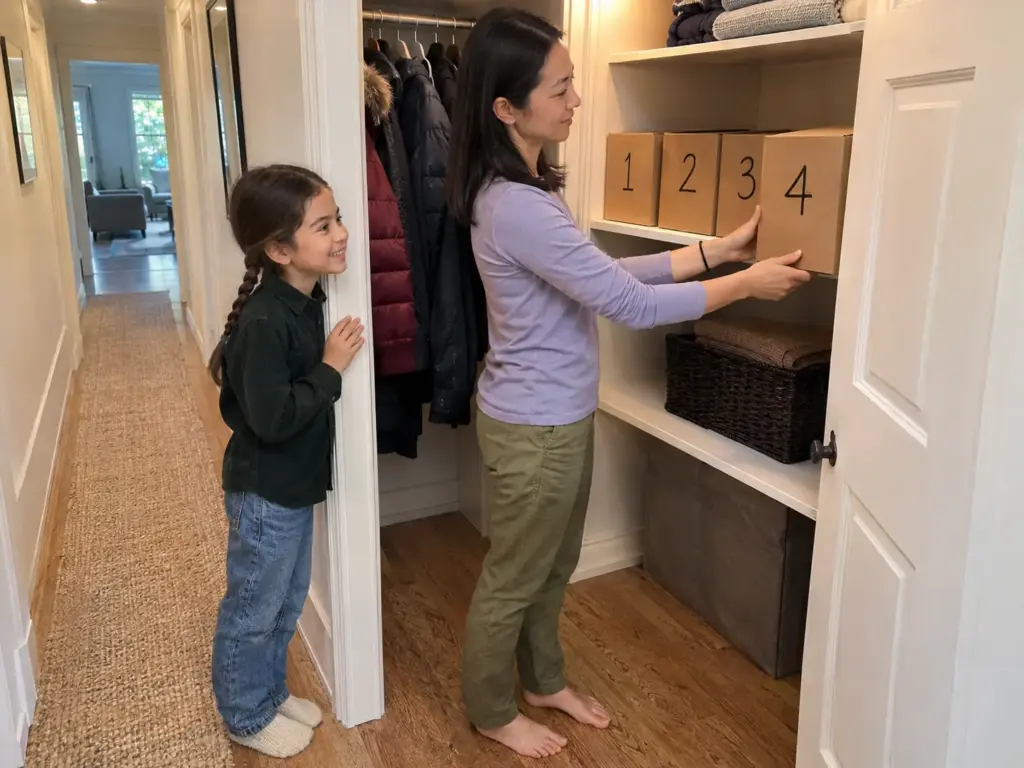
The boxes sit on a top closet shelf, in under-bed storage, or in a lidded bin on the floor of a closet, and they are numbered 1 to 4 on the end and opaque, so the child does not treat the stash as a menu. Using the space under a kid’s bed for the stash covers the clearance and the retrieval problem, and bins that fit real closet shelves matters if the stash goes on a shelf. Diaper boxes and masking tape are the first-month version, so nothing needs to be bought until the habit holds.
Photograph each box open before you close it and keep the pictures in one album as a running toy inventory. On swap day you can see what is in box 3 without lifting it down, and the lids stay on between swaps.
A home with no spare room swaps rooms instead of storing: the bedroom set stays, the family-room set changes, and one box lives in a third-room closet. Do not carry new toys into a room, change the room the toys are in. A garage or basement works for overstock only, such as big outdoor toys or the second set of a favorite, and nothing a child asks for lives there; where big toys and overstock go in a garage has the setup. A long rotation held off site is what some families call a toy library, and it is the place the long-out toys go, not the current ones.
The Fixed Day That Keeps Rotation From Becoming a Chore
Pick one day, one time and one number, and attach the swap to something that already happens, such as the bath or the weekly laundry. The rotation is a habit that runs on the calendar, not a decision made when someone has the energy. Some households find that rotation takes more mental load than they have. For them, having less turned out to be more restful than managing a stash, and cutting the volume is a legitimate answer, not a failure.
What Not to Buy: The Chest, the 20-Piece Set and the Giant Wall
The toy chest that looked classic and became a landfill, and the matching set that half-fills with air, are the two purchases that most often undo a toy system. A third one is the wall of wood and bins that is wider than the child is tall. Each has a cheaper or free version.
The Lidded Chest
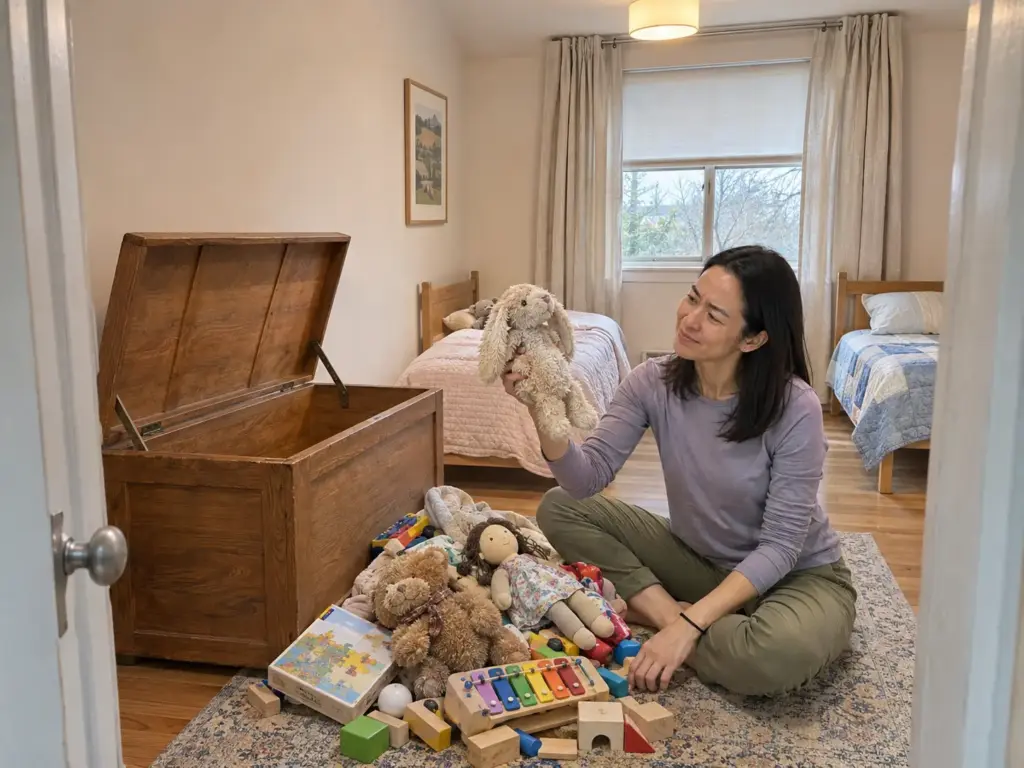
Everything inside a lidded chest, the classic toy box, becomes one undifferentiated pile. The child digs, and the toys at the bottom are never seen again. An unsupported heavy lid is also a finger-pinch and head-strike risk, so for children under five the lid needs soft-close hinges, or no lid at all. Even the safe version of a chest, with a soft-close hinge or no lid, still hides the category, so it works best as a single-purpose home for something like dress-up clothes, not as the central toy store.
The Matching 20-Piece Bin Set
Twenty shallow bins for a child who owns twenty categories means twenty decisions at cleanup, and half the set ends up storing air. The better picks settle on 9 to 16 bins, which is the range the sturdy units above are built around. A set is only worth buying when the category count says it is. And the count comes before the shopping, not after it.
The Wall That Is Wider Than the Child Is Tall
A 64- to 68-inch wood organizer is a whole wall. If the top rows sit above the reach band of the child it is bought for, the wall becomes adult storage with a child’s name on it. Reach and category count set the size of the piece, and the price follows from them.
The budget ladder runs in steps, and each one buys something and stops buying something. The free version of cheap toy storage is a low bookcase, a dresser drawer, diaper boxes and zipper bags from a discount store.
Next come clear bins with lids, then a cube grid, then the 9-bin unit, then the 16-bin unit, and at the top the wide pine piece. Each step up adds capacity and stops adding reach, and no step fixes a house with too many toys. The argument that the bin trap itself is the problem is made in organizing without buying more bins.
Safety That Comes With the Furniture and the Small Parts
Parents often treat the shelf as part of the toy and then find out that the law covers dressers, not open toy shelves. What follows is about the furniture and the contents, and it stays out of installation instructions on purpose: follow the maker’s instructions for those.
Anchor What Can Tip
The CPSC defines a clothing storage unit as free-standing, at least 27 inches tall, at least 30 pounds and at least 3.2 cubic feet. According to the federal tip-over standard for clothing storage units, “Anti-tip device that meets ASTM F3096 must be packaged with the product”. The STURDY rule behind it protects children up to 72 months.
That covers dressers, not an open toy shelf, so the anchor kit on a toy organizer is voluntary and the owner still has to install it. CPSC’s Anchor It! campaign says to anchor all furniture with drawers, doors and shelves to the wall.
A shelf that ships without anchors needs a kit bought separately. Renters have it easy in one respect: free-standing pieces need only the strap at the wall, and the hole is the price of the safety.
Small Parts Go Up, Big Pieces Stay Down
As a rule of thumb, anything that fits through a toilet-paper-tube-sized opening is a choking hazard for a child under three who mouths things, so it stays out of reach. A clear lidded bin on a high shelf is the home for building pieces and beads while the youngest is under three. Larger pieces stay at floor level where the older child can reach them, and the lids stay on the high bins so the small pieces do not travel.
The Chest Lid and Other Pinch Points
A chest lid that drops, an over-the-door organizer loaded past its rating and a heavy bin on a high shelf are the common pinch and weight problems. Check every moving lid by hand, and keep over-door organizers to the maker’s stated weight. The honest approach to all of it is a short walk around the room at the child’s height, looking for what could drop, swing or tip.
The Reset a Six-Year-Old and a Partner Will Actually Run
The system a single parent builds and everybody else undoes within a week is the usual way these setups end. What keeps it alive is not a better bin, but an agreement about who owns what and a reset routine short enough that nobody skips it.
Who Owns Which Bin
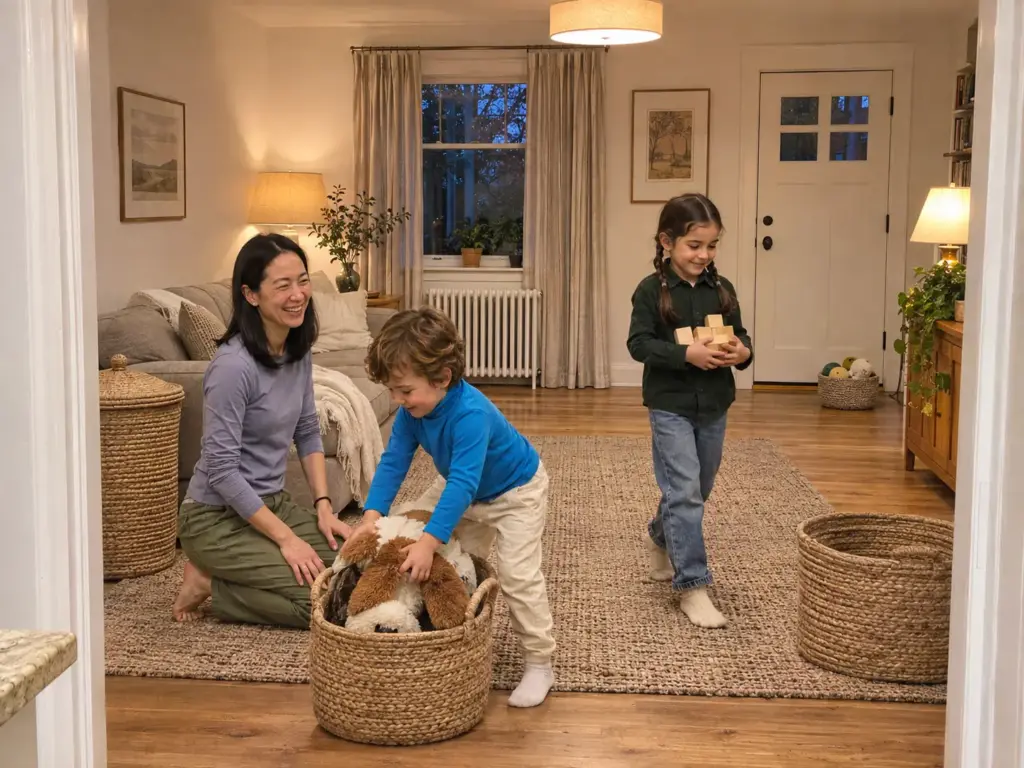
Each category has one owner. The child owns the open bins, an adult owns the lidded basket and the stash, and one rule that everyone agrees to before the first reset is said once and posted at the child’s eye line with picture labels. A rule that only one adult remembers is not a rule.
The Two-Minute Drop Spot
The reset takes five to ten minutes at a fixed time, such as before bed or after dinner, in a fixed order: collect the escapees from the drop spot, return them by category, and swap if it is rotation day. The child puts back what the child can reach, and the adult handles the rest. The drop spot, usually the small entry bin, is the pause point that keeps the reset short, and the same habit applies to the surfaces toys colonize, which the reset habit for the surfaces toys colonize covers.
Use one song as the timer for the reset. When it ends, the reset ends, and whatever is still out goes into the drop-spot bin to be walked back tomorrow.
A System Only One Adult Maintains Reverts
This is the thing that ends most systems. If one adult maintains it and the other works around it, the toys drift back to the old spots within days, and a bigger bin does not help. The remedy is agreement: the same rule, the same homes and the same reset for everyone who lives there. Intake belongs in the same agreement, with a gift request, an intake day and a one-in-one-out rule for a single category, which the one-in-one-out intake rule lays out.
Cut First, Give Every Toy One Home, Then Check the Drop Spot After the Next Gift Wave
The system comes down to a short list. Cut the volume before buying anything, give every category one home in every room, and let the child’s reach set the shelf height. Match the container to the toy, keep a lid only where an adult manages it, rotate on a fixed day with a fixed number, and run the reset together. A house that does these is not tidy at every moment, but it can be put back in ten minutes.
The check for later is simple: after the next birthday or holiday wave, look at the drop spot and ask which category has wandered into a new room. A category that keeps migrating is telling you its home is the wrong one, not that the child is careless.
Today, empty one spot of floor into the bins already in the house, sort a single category to its home, and notice over the next few days whether the child puts that one back without being asked. If so, the rest of the house can follow the same pattern, one category at a time.
Frequently Asked Questions
01What is the simplest toy organization system for a small home?
Give each category one home per room: open low bins for the toys a child puts back, one lidded basket an adult opens, and a fixed daily reset. Fewer categories, each with one home, beats many bins with no rule.
02How many toys should be out at once?
About four to six under 12 months, five to seven at ages 1 to 2, six to eight at 2 to 3, and eight to twelve at 3 to 5, plus a permanent art basket. Rotate every one to four weeks.
03Do toy chests work?
Poorly, because everything inside becomes one pile and the toys at the bottom are never seen again. An unsupported heavy lid is also a pinch risk for children under five, so choose soft-close hinges or no lid.
04Where do you put toys in a living room with no playroom?
Use two containers and nothing else: one open basket the child owns for current favorites and one lidded basket an adult manages. Everything else lives in the bedroom, the closet or the rotation boxes.
05At what age can a child put away their own toys?
As soon as the shelf sits inside the child’s reach band and each bin has a picture label, which is around age 3 for open bins. Picture labels let a pre-reader match a toy to its home.
Disclaimer: ClutterlessNest is a participant in the Amazon Services LLC Associates Program. As an Amazon Associate we earn from qualifying purchases. This article may contain affiliate links — if you buy through them, we may earn a small commission at no extra cost to you. We only recommend products we have tested or genuinely believe in.