
A finished set comes apart on the carpet, its pieces slide into the tub that holds three other sets, and a week later the build you wanted to redo has a hole where a window should be. That is the moment most families discover that a pile of bricks and a collection of kits are two different storage problems. The fix starts at the back of the instruction manual, where every modern set prints its full parts inventory, because that list is the only checklist a set will ever have. Here is how to organize LEGO sets so each one stays rebuildable, then the bags, bins and shelves that fit a real closet, bookcase or basement rack, with toy organization systems families actually keep using as the wider frame.
Quick Answer
Organize LEGO sets by set, not by color or brick type, because a set has a parts list and a type has no edge.
- Gather every brick and every manual in one place.
- Take each set apart and count it against its manual’s inventory.
- Bag the parts with the manual inside the same bag or pouch.
- Label the bag with the set number, name and a photo.
- Store bags in clear rigid boxes sized by piece count, plus one extras bin.
How to Organize LEGO Sets Starts With How Your Household Builds
Before any container goes in a cart, the household has to answer one question: does anyone rebuild kits, or does everyone dig through a pile and invent something new? The honest answer is usually both, and a LEGO collection only stays usable once each bin is assigned to one of those two jobs.
By set, by color, by type, or one mixed bin
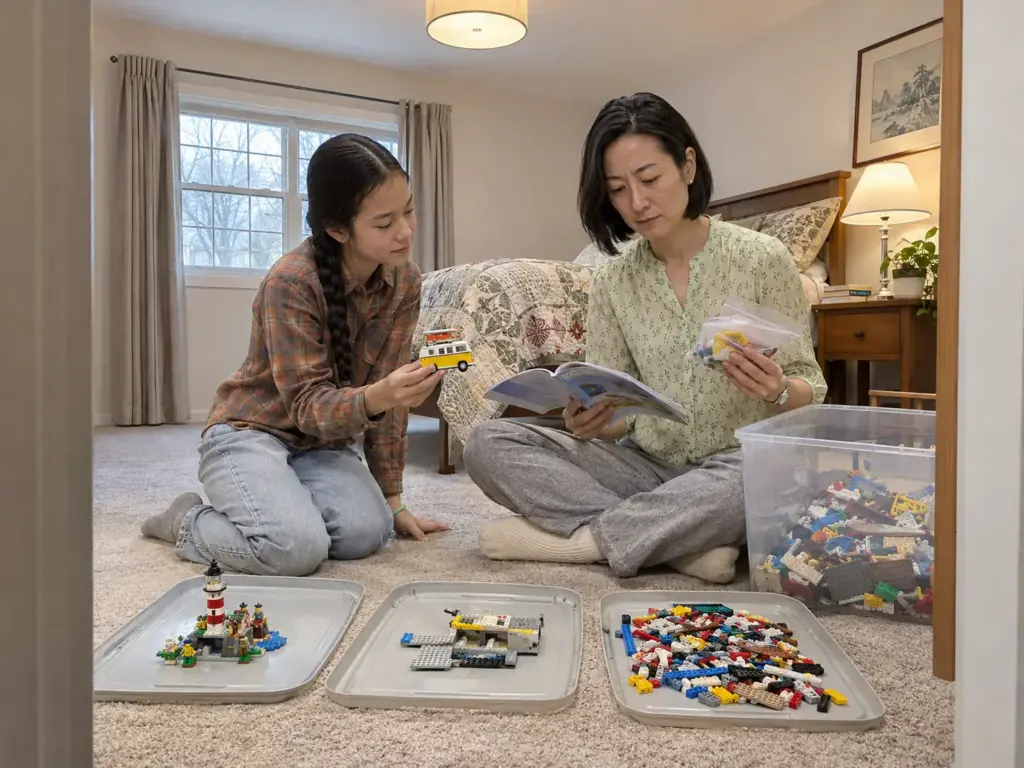
A free-building household (a toddler, a kid who builds spaceships from whatever LEGO bricks are at hand) is well served by a single wide bin with a lid. Nothing in that bin has to be complete, so nothing needs a count. Households that rebuild sets from the manual need the opposite: a container per kit, with the manual and the parts that belong to it.
The first instinct is to sort by color, and it keeps looking logical until the collection passes roughly a thousand bricks. After that, the drawers overflow, and in the greys the eye cannot tell dark bluish gray from light bluish gray at a glance. To sort by shape, or to sort by brick type, is the choice of advanced builders who work from a parts list. It is also the system that quietly breaks every set you own, which is the next problem.
Mixing the two is where a lot of homes end up: one bin of loose bricks for free play, and sets stored whole. That is fine, as long as the labels say which collection each bin belongs to. Every system that lasts starts with that same split between what is a kit and what is a pile.
Why sorting by type falls apart in a few days
Picture the weekend someone sorts every brick by shape and color into drawers, then a set needs a single 1×2 tile with a printed pattern that nobody can find, because the pieces of that kit now live in six different drawers. The sort looked tidy on Sunday night and has no way to answer “is it all here?”
That is the mechanism. A set has a natural limit: its parts inventory. Count it, and the question has an answer.
A type has no limit at all, so a drawer of 1×2 bricks has no edge, no finished state and no signal that anything is missing. New pieces drift in, old pieces drift out, and the system quietly stops matching reality within days. Sorting by set survives because it is built around the one unit that can be checked. And when a set is incomplete, the gap is visible in the bag, not hidden across a wall of drawers.
The same logic explains why a single “chaos bag” of everything becomes a black hole. Nothing in it can be verified, so nothing in it can be trusted.
The size line: when one bag is enough and when a set deserves numbered bags
Under about a thousand pieces, a set can live in one bag, because the total volume is small and a missing piece is easy to spot. Past about three thousand pieces, taking it apart in reverse and numbering bags pays for itself the next time it is built: you open bag 7 and build that stage, instead of sifting a mountain.
Between those two numbers, it depends on how often the set comes back out. A set built every winter is worth the numbered bags. A set built once and shelved is not. Those thresholds are rules of thumb, not law (a set made mostly of tiny repeating parts is harder to sort than one of big bricks), so adjust them to the set in front of you.
The free first step costs nothing. Sort the whole pile into three heaps: complete sets, partial sets and loose bricks. The heaps tell you how many bags you need, and they are also the honest version of the decluttering step in why the pile comes back after you declutter toys, where deciding what stays comes before anything gets bought.
Take Each Set Apart and Count It Against Its Manual
The sort-out is the unglamorous weekend that makes everything after it easy. It goes faster than most people expect, because each set has a finish line.
Gather every brick and every manual before you open a bin
Pull every tub, drawer, backpack and shoebox of bricks into one room, and every manual with them. LEGO manuals live in surprising places: under a bed, inside a game box, in a drawer two rooms away. A set cannot be verified without its manual, so a manual with no set and a set with no manual both go into a “to match” pile for the end. A lost manual can usually be replaced with the digital instructions on LEGO.com, found by set number.
Work on a table, not the floor, and put a sorting tray under the pieces so nothing rolls into the carpet. The method for the room around the sets follows the same order as the purge, zone, contain and reset order for a whole kids’ room: empty everything first, decide second, contain last.
The inventory at the back of the manual is the checklist
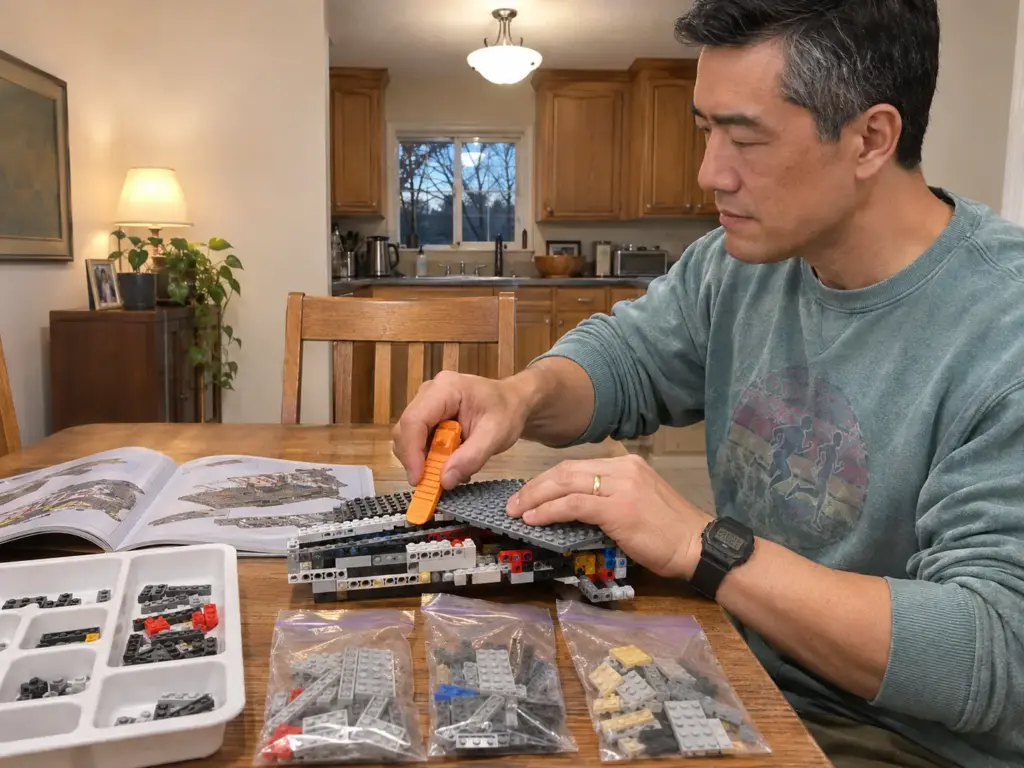
Open a manual to its last pages. Almost every modern set closes with a parts inventory: the size, color and count of every element in the box. Lay out one set’s bags on the table, open the manual to that page, and tick off each part as the pieces come out.
The quiet moment arrives somewhere around the second row, when the count comes up one short. That is the useful moment. It is better to find the gap now, with the manual open and the bags of that set still together, than a year from now when a child asks to rebuild and the piece is nowhere.
Photograph the inventory pages with your phone before a set comes apart. Manuals get creased and torn, and the last pages are the only checklist the set has.
Taking a built set apart in reverse, bag by bag
A set that is still built comes apart by following its manual backwards. To disassemble in reverse, start at the last step, drop those pieces into a bag, then work back toward step one. This is called reverse building, and it keeps parts grouped the way the set was designed to be rebuilt.
Budget bags, not sets. A model with 24 numbered bags comes apart into about a dozen gallon freezer bags, because two numbered bags of parts usually fit in one gallon. If you plan one bag per set, a large set will not fit and the plan collapses halfway through.
Fingernails are the other problem. Pulling tight plates apart with bare hands bends nails and chews the edges of bricks.
The brick separator that comes in most sets works fine and costs nothing, so start there. If a collection needs more than one in different rooms, the LEGO orange brick and axle separator tool, lot of 3 gives you a spare for every table. It ships in small lots and runs out of stock, so don’t count on finding it again next month.
What to do about the piece that never turns up
When a piece pulled from a later bag keeps the disassembly moving, note which one it was and put it back as soon as the right bag is open. When a loose piece turns up in the pile, match it to the inventory by its description instead of guessing.
And when a piece is truly gone, write it on a list and order replacement bricks later. No set gets torn apart twice for one part, and no set is declared lost because of one brick.
Bags and Pouches That Keep One Set in One Place
The bag is the smallest container in the system and the one that does the most work. It is also the container people overspend on.
Why a bag per set beats a bin of everything
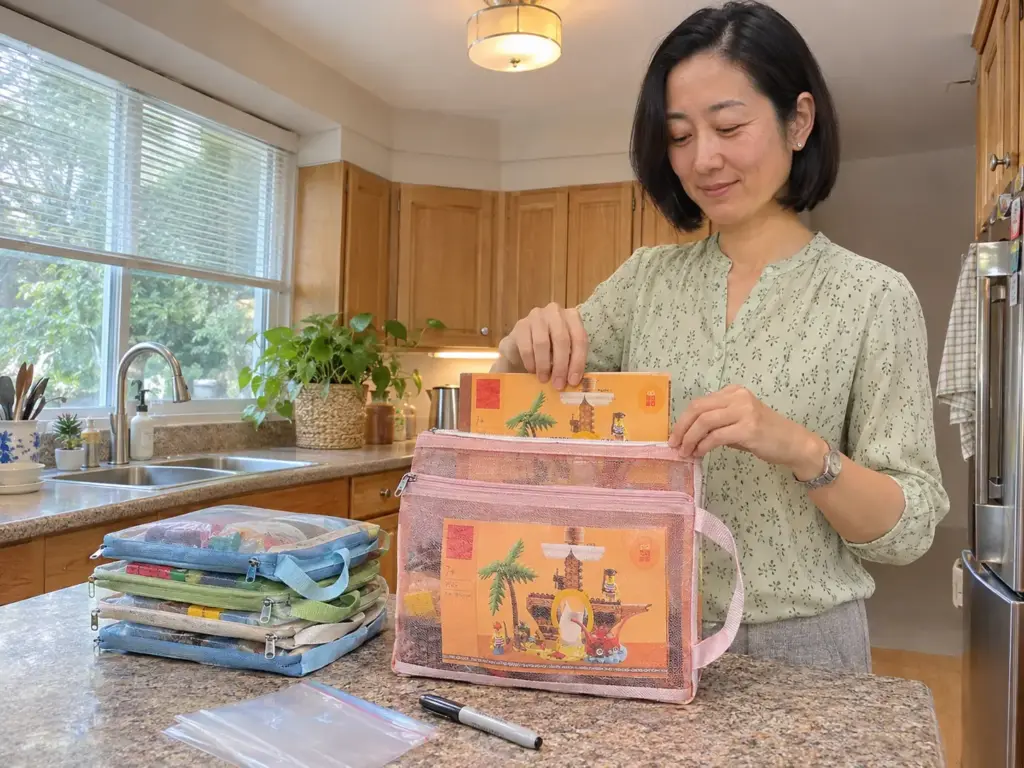
A bag has one job: keep one set’s parts and manual together, so that the set is one object. Put six sets in a single storage tote and the tote becomes a pile again, with extra steps. Put six sets in six bags in the same tub and any one of them can be pulled out, checked and rebuilt without touching the others.
The limit is that bags suit what moves. Bags do not stack well, and parts shift when they are carried. For what stays on a shelf for years, a rigid box is better, and the next section covers it.
Mesh, PVC or a freezer bag
Plain freezer bags come first (any zip-lock bag of freezer weight will do), because they do most of the job. Sandwich bags tear first, so skip them. Quart and gallon freezer bags last for years, and marker on an old bag holds for a decade or more. LEGO bags do not need a brand name; the plastic is not holding food.
For sets that come back out often, a pouch with a handle and a pocket for the manual is more convenient. The TrueLux 10 pack mesh zipper pouch bags have two layers, one for the manual and one for the parts, and the mesh lets you see the contents. Mesh breathes, though: dust and damp get through, so these belong on a shelf or in a closet, not on a basement floor.
For sets with stickered pieces or printed parts, the obvious pick is not the best one. Mesh is soft and lets parts press against each other. The holay clear toy storage bags with zipper, 4 pack are rigid PVC with a pocket for the manual and a name slot, and they protect those surfaces better. The zipper is stiff, the bags arrive smaller than the listing suggests, and the cost per bag is higher than mesh, so save them for the sets that earn it.
Fabric against sealed plastic is the same trade you meet with any container, and why breathable fabric and sealed plastic fail in different ways explains it for the rest of the house.
Sizes, markers and what 1 of 3 means
Zip bags run from 3 x 5 inches for small parts up to 2.5 gallons, enough for a whole large set taken apart. One size does not fit a collection. Quart bags suit small sets and minifigure kits, gallon bags suit mid-size sets, and the 2.5-gallon size is for the biggest models.
Write the set number and name on every bag. For sets that take several bags, add 1 of 3, 2 of 3, 3 of 3 so a missing bag is obvious. Marker on a freezer bag lasts years, while a paper label lifts the first time the bag is pulled from a crowded box.
Buy bags in two sizes, not one: quart and gallon cover most sets, and the 2.5-gallon size is only for the biggest models. A mixed pack of sizes avoids reordering the wrong one.
Bins, Drawers and the Shelf Math Behind Them
This is where the buying decisions live, and also where most mistakes happen: containers bought for the picture on the listing instead of the numbers in the closet.
How many liters a set really takes
The rule of thumb is 80 to 100 loose pieces per liter of container. A 1,000-piece set takes roughly 10 to 12 liters, and a 20-liter box holds roughly 1,600 to 2,000 loose pieces before digging through it becomes the problem. To find the volume a set needs, divide its piece count by about 90.
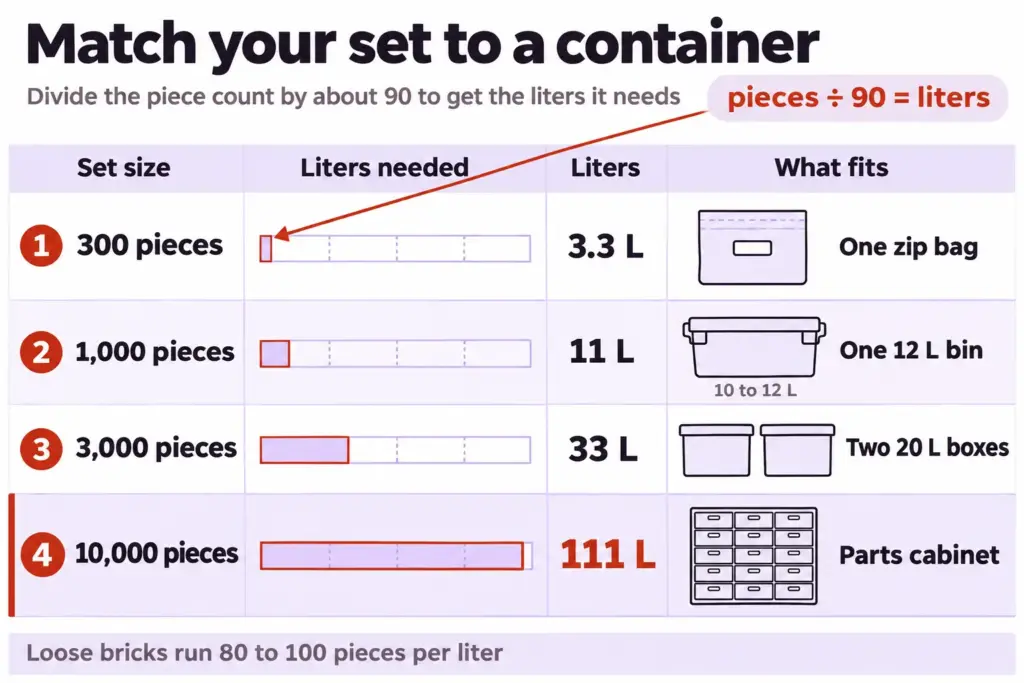
Run the math on a few sizes: a 300-piece set needs a bit over 3 liters, a 3,000-piece set about 33 liters, and a 10,000-piece collection around 110. Those numbers tell you quickly whether a shelf has room before you buy a single box.
Clip boxes for sets that stay put
Sets that stay put for years want a rigid, clear, stackable box with a latching lid. The Sterilite clip box large, 6 pack, 14 x 11 x 3.25 inch is the obvious answer, and its modular footprint is the reason: the five sizes of the line share the same footprint, so they stack without wasted gaps.
The limit is the height. At 3.25 inches tall, the outside dimensions of a box work out to roughly eight liters (a little less inside), enough for a small set taken apart but not a large model built. The sets that fit are small ones, which is where this size earns its place. Whether the lids actually lock stacks together is a separate question, covered in which stackable bins actually stack.
The budget version is the same boxes stacked like a drawer unit on a shelf. It does a cabinet’s job without a cabinet’s wall.
The parts cabinet for loose bricks and the extras bin
Every collection needs one permanent bin for pieces that belong to no set. Without it, strays go into the nearest set bag and corrupt the count. Call it the extras bin, keep it with a lid, and make the rule simple: if you do not know where a piece belongs, it goes here.
Keep the extras bin in the room where the building happens, not in the basement. A stray piece only travels as far as the nearest open container, and the nearest one should be the right one.
When the loose bricks outgrow a bin, the next step is a parts cabinet, and only then. The Akro-Mils 10764 64 drawer parts cabinet, 20 x 6 x 16 inch is the standard answer among adult fans of LEGO (AFOLs) for loose bricks sorted by type, a storage cabinet in the plainest sense. A small drawer holds 0.25 liters, about a handful of pieces and not a whole set, and a large drawer holds 0.76 liters. It hangs on a wall or stacks three high, so it needs a wall or a stable tower, which rules out the hung version in a rental that bans drilling.
It belongs in the extras system, not the set system. A cabinet suits a collection past roughly ten thousand pieces, and below that the stacked clip boxes do the same job. Craft rooms have the same requirement for beads and findings, and small-parts drawers built for craft supplies are worth a look before you commit to a full wall.
The shelf-depth trap that swallows small sets
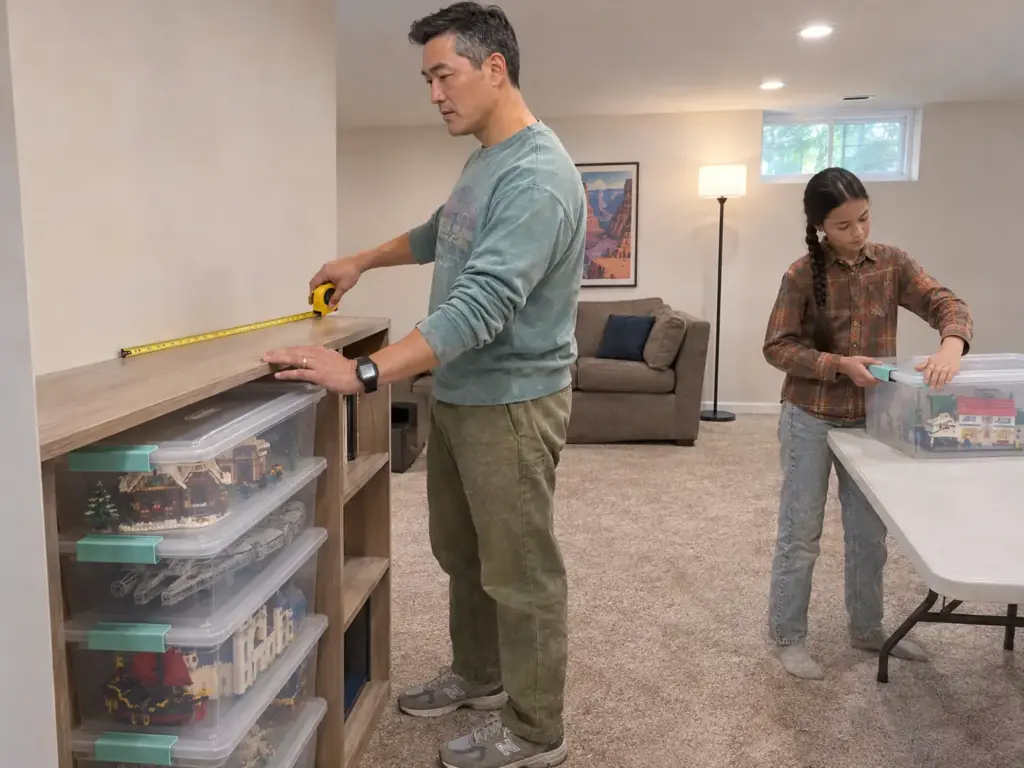
Bins look right in the listing and then half of them hide behind the front row. A 12-inch-deep bookcase swallows small sets behind big ones, and the set at the back becomes the set nobody remembers owning.
Three fixes work. Use clear boxes, so the label and the contents are visible from the front. Put a printed photo of the finished model on the front of each box.
And in an apartment or any small space, go tall rather than wide: a column of boxes fits where a row of shelves does not. Cube storage has the same trap in miniature, since a deep cube hides whatever sits behind the front box. Choosing between shelf widths follows the same logic as clear storage bins sized to a rental shelf: measure the depth of the shelf, then pick the bin.
Minifigures, Printed Parts and Baseplates Need Their Own Rules
A set system handles bricks well. It handles the pieces collectors care about most, the figures, the printed tiles and the baseplates, worst.

A minifigure goes in a small bag of its own
A minifigure dropped into a big bin of loose bricks is found months later with a scratched face and no helmet. Bricks are hard plastic with sharp corners, and a printed face is a thin layer of ink on a small surface. The bin does what bins do: it grinds.
The rule is bags within bags. Each minifigure gets a small zip bag of its own, with its hat, tool and accessories, and that bag goes inside the set’s bag. With more than five minifigures, a divided box with a compartment per figure beats a stack of tiny bags.
Printed parts and stickers inside the set bag
Printed tiles and stickered parts rub against loose bricks, and the print wears. These get their own small bag inside the set bag, the same way a figure does. They are the pieces that cost the most to replace and the ones a set cannot be rebuilt without.
This is also where rigid PVC pouches earn their cost, since the flat pocket keeps the stickered parts from rubbing at all.
Baseplates stay flat
Baseplates are stored flat, never bent, ideally in a banker box or a shallow under-bed box. Heat warps them, and the same heat yellows bricks, which the last section returns to. A baseplate stored on its edge in a hot garage ends up curved, and a curved plate never sits flat again.
Manuals, Boxes and Labels That Anyone in the House Can Read
A system only works if more than one person can use it. These are the pieces that make it readable for a partner, a grandparent or a child.
The manual goes in the bag, not in a drawer
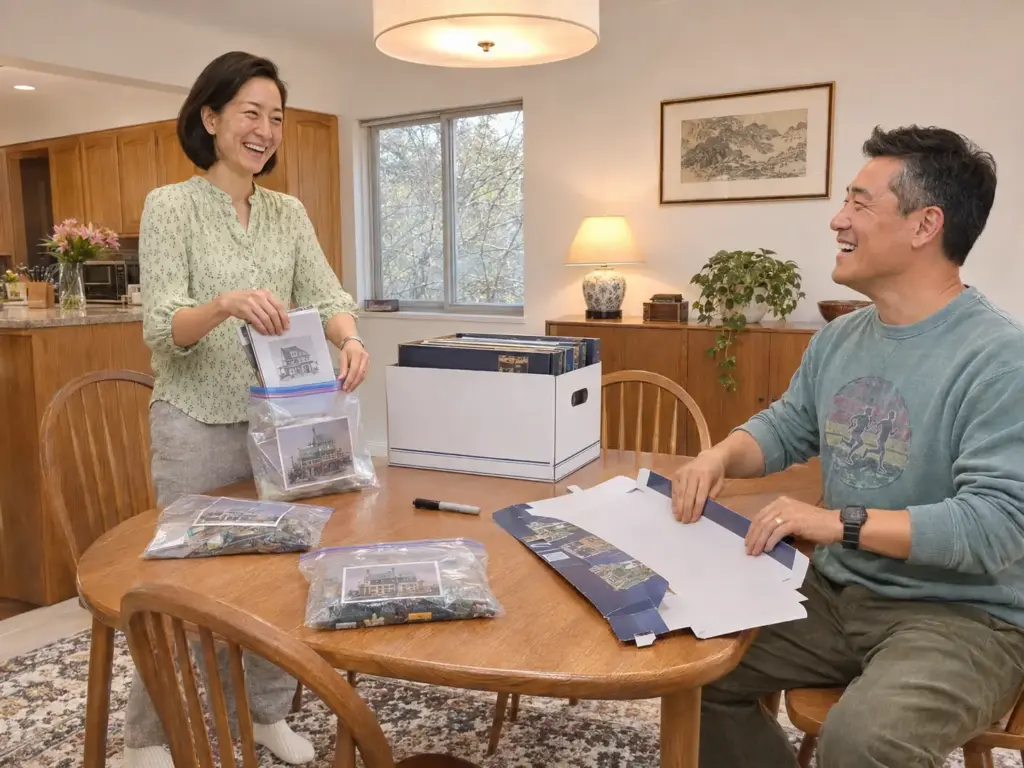
A manual stored away from its set is the first thing lost. The way the two get separated is predictable: the set lives in a box downstairs, the manual lives in a drawer in another room, and they drift further apart each time someone tidies.
Put the manual in the set’s bag or in the pouch pocket. For a collection of many manuals, slide each into a comic book sleeve and store them by theme in a banker box. Either way, the manual and the parts travel as one thing.
What the original box is still good for
An original box, kept whole, eats the space that three sets would take. Flat-packed, boxes fit in a banker box. The box is a keepsake and a space cost at the same time, so the decision belongs to each set: keep the box of a favorite or a rare model (a complete set with its box also protects resale value), flatten the rest, and recycle the ones nobody will miss.
The same space-versus-container decision shows up everywhere in a house, and choosing toy storage by wall width walks through it for a small room.
A photo label instead of a written one
A child who cannot read yet can still match a picture. Print a small photo of the finished model, tape it to the front of the box, and add the set number and name in marker for the adults. A written label on a paper tag lifts and falls off, while a photo covered with clear packing tape survives a lot of handling. A label maker does the same job for the adult half of the label.
Use one scheme for the whole house. If the bags are labeled by set number in one room and by name in another, another family member cannot find a set without asking, and the system quietly turns back into one person’s memory.
Where Built Sets Go in an Apartment, a Rental and a House With a Basement
Built sets are different from stored ones: they are meant to be seen. And the right answer changes with the home, so this section splits by the constraint.
Apartment or rental, no drilling
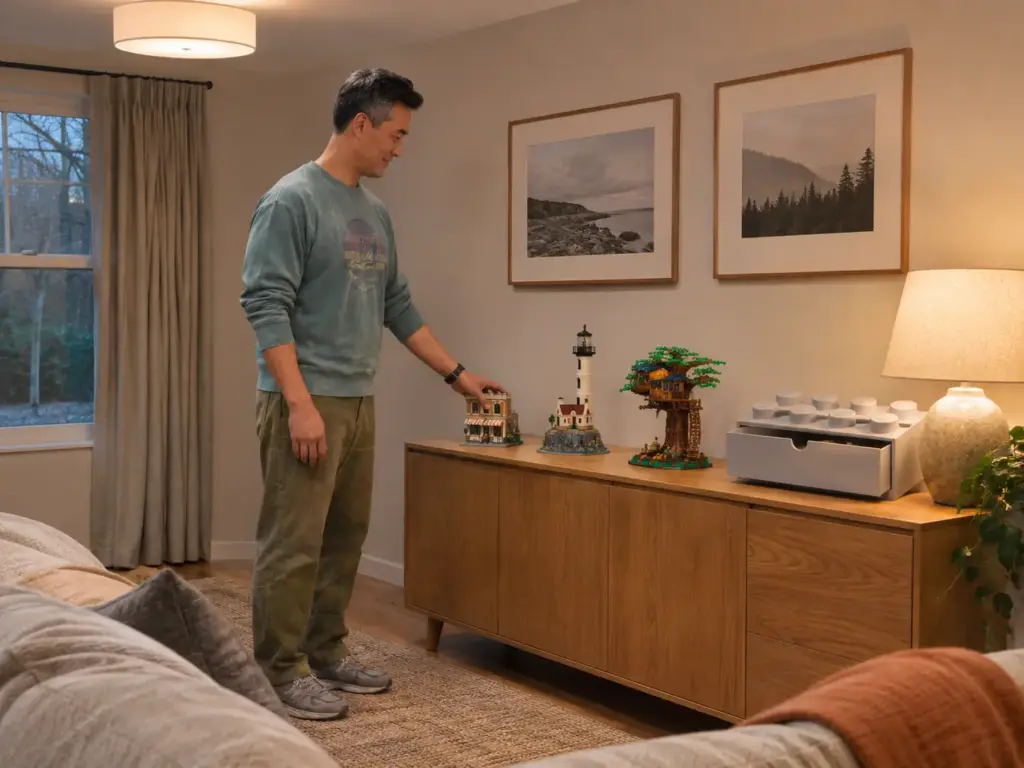
Think of a living room in a home with no playroom, where the finished set is also the thing the household sees every day. Picture ledges and wall shelves need holes, so the no-drill version is freestanding: a low bookcase, a console top or a sideboard. In a small space, go tall rather than wide, since floor width is the scarce thing.
Display only what is built and wanted, and rotate. A set that has not been looked at in a year goes back into a bag, and a fresh one takes its place. The same shared-room logic runs through toy organization ideas for a shared living room, and the broader constraint of having no extra room is the subject of organizing a small apartment without a playroom.
Sets that are put away, not shown, can go under the bed in long flat boxes. Setting up under bed storage that stays organized covers the sizing, and a low rolling box is a good fit for baseplates.
A house with a basement and walls you can use
A house with more room has the opposite problem: everything ends up in the basement and nothing is seen. Wall shelves, glass cabinets, a display case and a banker-box system on a basement shelf all work here. The basement is better than the attic, because an attic is too hot. Where drilling is allowed, floating shelves that hold up put a built set on the wall without taking floor space.
Tall display pieces need anchoring, because a bookcase loaded with sets is top-heavy. The CPSC’s Anchor It! campaign puts it plainly: “Anchoring all furniture with drawers, doors, and shelves to the wall prevents tip-over injuries and deaths.”
The manufacturer’s instructions cover how, and a low sideboard needs far less of it than a tall case.
The budget version and the one-drawer display
The free version is a shelf the household already has: one bookcase shelf, kept clear, with the best three sets on it. That does the job for most families.
The paid version is the Room Copenhagen LEGO storage brick 8 desk drawer, 12.4 x 6.2 x 4.4 inch, a brick-shaped drawer that holds the pieces currently in use and decorates at the same time. The drawer is open, so dust gets in, and it carries a premium for a single drawer. It suits a desk or a shelf where a few pieces are always out, and not a collection.
Why Sorted Sets Come Apart Again and the Habits That Stop It
A system built in one weekend can drift apart in a month. This is LEGO maintenance, and it belongs in the plan from the start.

The outbox for what is left out mid-build
Say a set sits half-built on a desk for a week, its pieces scattering to four rooms. That is how a complete set becomes an incomplete one. One lidded box, the outbox, holds the pieces of whatever is mid-build. When the build ends, the outbox is emptied into the set’s bag, and the count is checked once more against the manual.
A five-minute reset that fits a normal week
Once a week, spend five minutes: push in the drawers that do not close, empty the outbox into its bag, and send strays to the extras bin. Keep one permanent empty bin as overflow, so a busy week does not turn into a pile.
If the sets live on a shared shelf, set the shelf height so a child can reach it, using the same criterion as shelves set at a child’s reach height. A system a child can run is a system that gets run.
Heat, sun and the yellowing that happens in the dark
White and light-colored bricks yellow over the years, a slow discoloration that happens even in a closet that never sees sun, and heat speeds it up. Keeping them in the dark is not enough. The conditions that help are a stable temperature and a spot out of direct sunlight, and closet storage on an interior wall beats an attic every time.
Baseplates warp in the same heat. Match the container to how often the set leaves the shelf, and the plastic lasts.
Take One Set Apart Against Its Manual and Time the Count
The takeaways are short. Decide by set, not by type. Count each set against the inventory in its manual.
Bag the parts with the manual, label the bag, and store the bags by volume in rigid clear boxes. Keep one extras bin for strays and one outbox for builds in progress, and let nothing else wander.
The check that tells you whether the system held comes after the first set that comes back out to be rebuilt: does its bag still hold its manual, and is every piece accounted for? If the extras bin overflows by then, that is a sign the sorting step skipped something.
The small change to make today needs nothing new. Take one finished set apart against its manual into a single bag, and notice how long the count takes. That time is the measure of the whole job, and it tells you how much of a weekend the rest of the collection will need. For the room around the sets, the same habits carry over to keeping a kids bedroom organized past week three.
Frequently Asked Questions
01What is the best way to organize LEGO sets?
Organize by set: take each one apart against its manual, bag the parts with the manual inside, and label the bag. Under about 1,000 pieces one bag is enough. Past about 3,000, numbered bags pay off.
02Is it better to organize LEGO by shape or color?
Neither works well for sets, because both run out of room past roughly a thousand bricks. For free building, shape or type is the better of the two, since color blurs in the greys.
03What is it called when you organize LEGO pieces?
The general term is sorting. Taking a built set apart by following its manual backwards is called reverse building, and rebuilding it one bag at a time uses numbered bags.
04How do you store built LEGO sets long term?
Keep them at a stable temperature, out of direct sun, in an interior closet rather than an attic. White bricks yellow with age and heat speeds it up. Store baseplates flat.
05How do you store built LEGO sets when moving?
Take each set apart into a gallon bag with the set number and 1 of 3, 2 of 3 written on each. Rebuild when there is a shelf to put them on again.
Disclaimer: ClutterlessNest is a participant in the Amazon Services LLC Associates Program. As an Amazon Associate we earn from qualifying purchases. This article may contain affiliate links — if you buy through them, we may earn a small commission at no extra cost to you. We only recommend products we have tested or genuinely believe in.