
















In this article
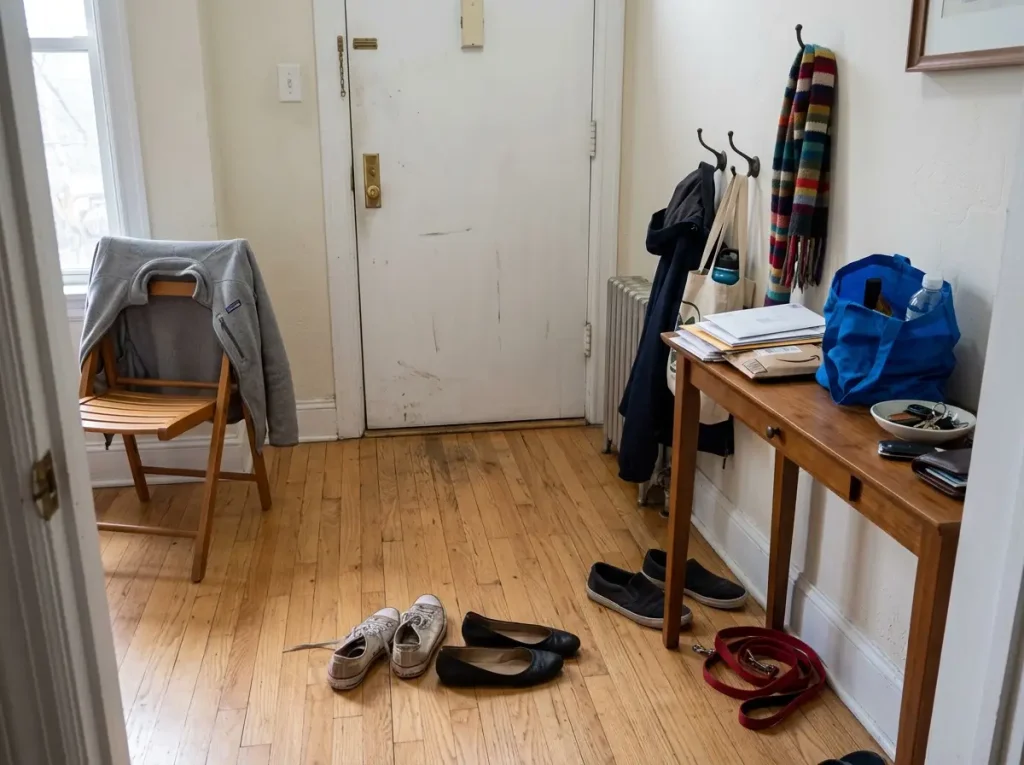
You know the moment. You walk in the door, your arms are full, and everything lands on the nearest flat surface. The keys go on the counter. The coat goes on the chair. The shoes stay by the door — not in a neat line, just wherever they stopped. Two weeks ago you organized all of this. It was perfect. It lasted a week.
After organizing dozens of real apartment entries — including several with no dedicated foyer at all — I’ve watched the same cycle repeat. The products were fine. The system was the problem. This guide covers the full approach, from defining the zone to the weekly reset that keeps everything working past the first week.
Quick Answer: How do you organize a small entryway that stays neat?
- Define a zone with a rug or furniture grouping, even without a foyer
- Keep only active-rotation shoes at the door — two pairs per person max
- Install coat hooks at 60–66 inches from the floor, one per household member
- Use a key tray in the same fixed spot every time you walk in
- Choose furniture that fits your hallway clearance math, not what looks best online
- Run a 3-minute weekly reset to prevent drift
1. Why Most Entryways Fail Before They Start
Every failed entryway has the same backstory. Someone bought the right products, set everything up, and watched it revert to chaos in two weeks. The hooks were fine. The bins were fine. The system had no mechanism for handling real life.
The entryway is the highest-traffic zone in any home. It absorbs everything coming in and going out, multiple times a day, from every person in the household. Without a defined zone, there’s no default behavior — items land on the first available surface, not the designated one. The coat goes on the nearest chair because the chair is closer than the hook.
Designer David Quarles IV puts it plainly: any open console surface in a multi-person household will become a clutter dump rather than a useful landing spot. The entryway fails not because of bad products, but because it was designed for intended behavior — hanging the coat up neatly every time — instead of actual behavior, which is dropping the coat on the nearest surface when you’re carrying groceries and your phone is ringing.
The Drop Zone Problem
The root of entryway chaos isn’t a missing product — it’s a missing zone. Without a defined area that says “this is where things go,” items scatter. Shoes end up in a random cluster. The keys land wherever your hand was when you set them down. The backpack goes on the floor because no hook was within arm’s reach while you were unlocking the door.
A drop zone — the intentional version of this — works because it matches the exact moment you walk in. You set the keys in the tray because the tray is right there. You hang the coat because the hook is at shoulder height, not six inches too high. The system succeeds when it’s easier to use than to bypass.
Design for Actual Habits, Not Ideal Ones
Before buying anything, answer three questions: Who uses this space? What do they physically bring in every day? What do they need to grab on exit? Design for those answers, not for the version of yourself who hangs everything up immediately and sorts mail at the door.
Start by decluttering the items that accumulate at the door. If there are twelve pairs of shoes by the entrance, the problem isn’t organization — it’s volume. Edit first. Then build the system around what remains.
The system you design on a calm Sunday afternoon needs to survive a Wednesday morning when you’re running late and the dog needs to go out. If it can’t handle that, redesign the system — don’t blame yourself for not following it.
The “Extra Hooks” Trap
Installing more hooks than household members is one of the most common mistakes. It feels proactive. But every unclaimed hook becomes a secondary junk zone — the hook where the grocery bag lives permanently, the scarf from two winters ago, the umbrella nobody has used since it broke.
Start with exactly one hook per person who lives there, plus one for guests. That’s it. If you live alone, two hooks total. If a hook sits empty for a month, you don’t need more hooks — you need fewer. The right number of hooks is the number that get used every single day.
2. Start With the Zone — Even If You Don’t Have a Foyer
Half of apartment-dwellers open their front door straight into the living room. There’s no hall, no transition, nothing that says “this is the entryway.” But you still need one — because without a zone, the entire living room becomes the drop zone.
A rug is the single most effective entryway zone definer for open floor plans. It costs nothing if you already have one, and it creates a psychological boundary between “outside” and “inside” without any structural change. Your brain recognizes the rug edge as a transition point, and items naturally stay within it.
Measuring the Space Before Buying
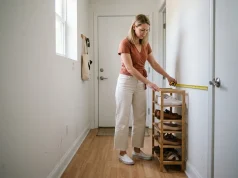
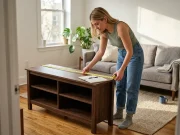
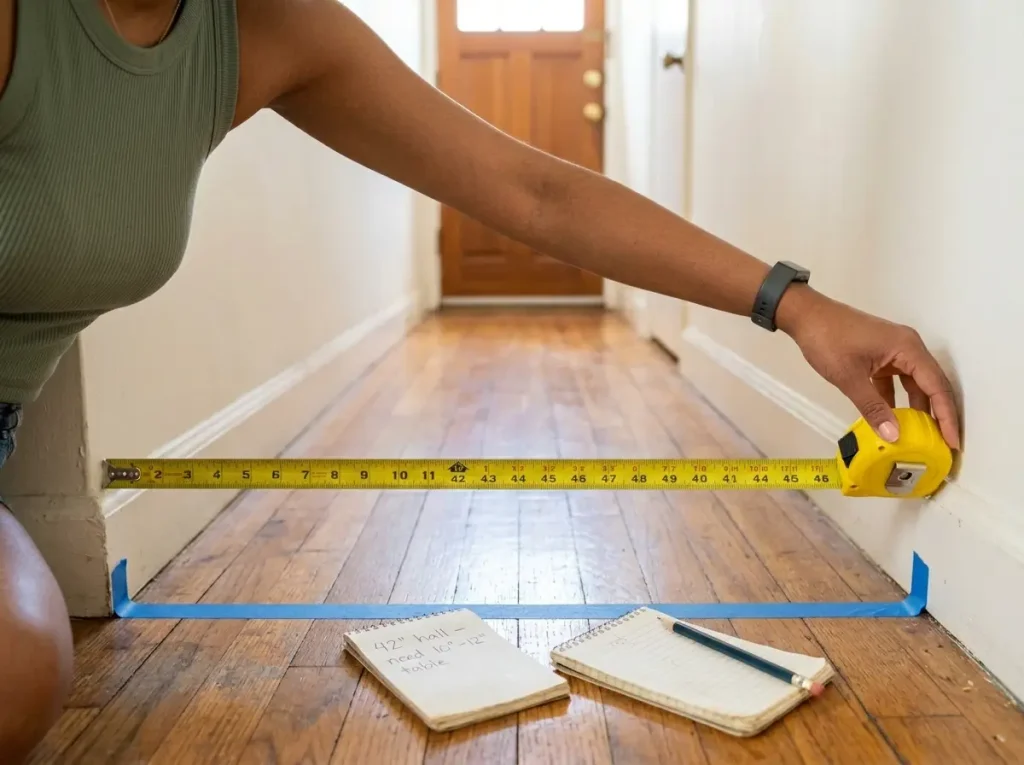
Write down three numbers before you look at a single product: hallway width, distance from door to nearest wall or furniture, and door swing radius. These three measurements determine every furniture choice you’ll make.
Standard hallway clearance: 36 inches minimum for single-person traffic, 42 inches for two people passing comfortably. A console table that’s 14 inches deep sounds slim — until you put it in a 42-inch hallway. That leaves 28 inches of clearance, below comfortable passage for most people. In tight entries, use a 10–12 inch deep table instead.
Pro tip: Close the front door all the way and mark where it stops on the floor with a piece of painter’s tape. Now measure from that mark to your planned furniture placement. If there’s less than 4 inches of clearance between the door’s full swing and the furniture edge, the bench or table will get bumped every single day — and you’ll stop closing the door fully.
Defining the Zone in an Open Floor Plan
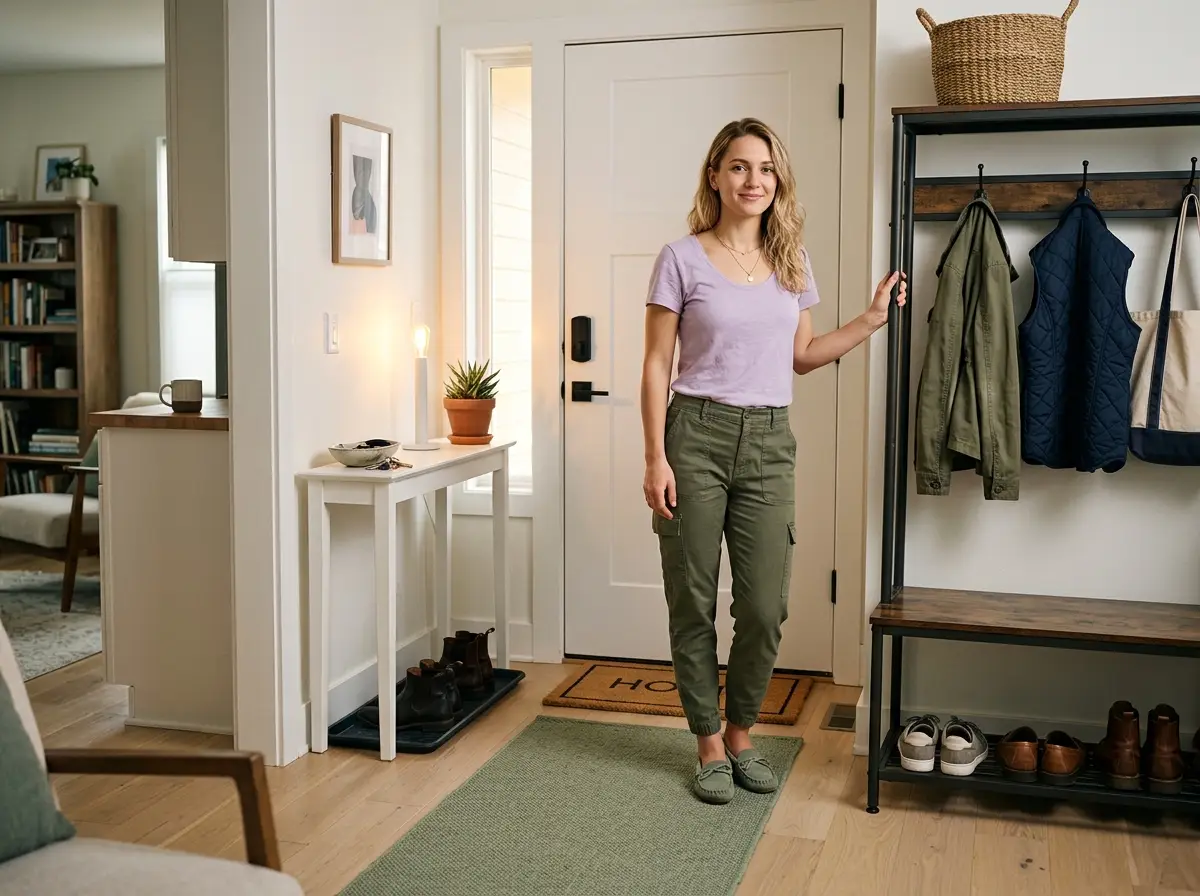
When there are no walls to define the entry, a rug does the job. Place a narrow runner rug or a 3×5 area rug with one edge aligned to the front door. Angle a narrow bench or console table to face the door, mount hooks on the wall behind, and the zone exists — even without walls to contain it.
The rug edge is the psychological line between entry and living space. Shoes stay on the rug side. The living room stays on the other side. This boundary holds up better than you’d expect, especially if other household members can see it. For the full room-by-room approach, see organizing a small apartment room by room.
What Belongs in the Zone (and What Doesn’t)
Limit the entry zone to items used every day when coming or going. Keys, wallet, phone, coat, shoes in active rotation. Everything else — packages, shopping bags, seasonal gear — gets moved out within 24 hours.
If something sits in the entry zone for more than a day without being used, it belongs somewhere else. The zone is a transit area, not a storage area. The moment it starts accumulating “I’ll deal with this later” items, the system is already failing.
3. Shoe Storage at the Entry
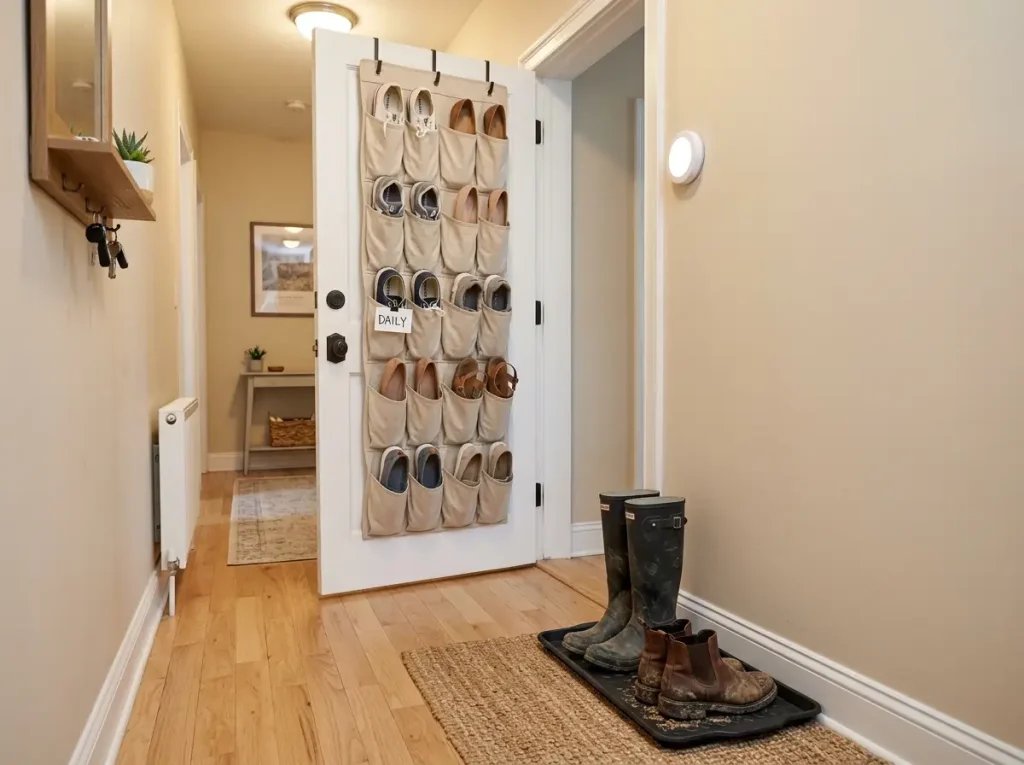
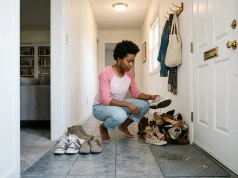
The floor near the front door accumulates shoes faster than anywhere else in the home. The goal isn’t a shoe museum — it’s containing the two to four pairs in active rotation without losing floor clearance.
How Many Shoes Actually Belong at the Door
The number is smaller than you think. Two pairs per household member in current rotation — the shoes you wore today and the ones you’ll grab tomorrow. Everything else belongs in the bedroom closet or a storage area.
This is where most shoe storage at the entry fails. People treat the entry as permanent shoe storage for every pair they own. That’s not organization — that’s relocation. Keep the entry lean and rotate shoes in as needed. You’ll stop tripping over the running shoes you haven’t worn since March.
Shoe Storage Options by Floor Space
Match the solution to what your hallway clearance math allows, not what looks best in a photo. The options from zero floor space to maximum: over-door organizer (zero floor impact) → compact 2-tier rack (12 inches deep) → bench with shoe shelf below (12–14 inches) → standalone shoe cabinet (12–16 inches).
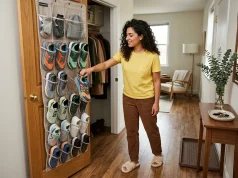
If your hallway can spare zero floor space, an over-door shoe organizer eliminates the problem entirely. The UVIAHOMI Over-Door Shoe Organizer hooks over the front door or a coat closet door without drilling, holds 12–18 pairs, and takes up no floor space at all. The limitation: it adds weight to the door, so check that your door hinges are solid before loading it fully. If you want more vertical storage approaches that work in apartments, the same over-door principle applies to closets and bathroom doors throughout the apartment.
For wet and muddy shoes, a boot tray with raised edges keeps moisture from spreading across the floor. The SUPENUIN Boot Tray fits near the door without blocking clearance and contains the mess in one defined spot. A rubber bath mat or baking sheet from your kitchen works identically for free — the function is the contained edge, not the product itself.
Pro tip: Put a small adhesive label on one pocket of your over-door organizer that says “daily.” That’s where today’s shoes go when you walk in. The label turns a generic organizer into a one-second habit — shoes hit the right pocket without you thinking about it.
When to Skip a Shoe Rack Entirely
If the hallway leaves under 32 inches of clearance after accounting for any furniture, skip floor shoe storage completely. Use the over-door organizer for rotation and a boot tray for wet shoes only. Fighting clearance math with shoe furniture makes the entry feel cramped — and a cramped entry stops being used within a week. You’ll find the shoes back on the floor next to the rack, which is worse than having no rack at all.
4. Coat and Bag Hooks That Actually Get Used
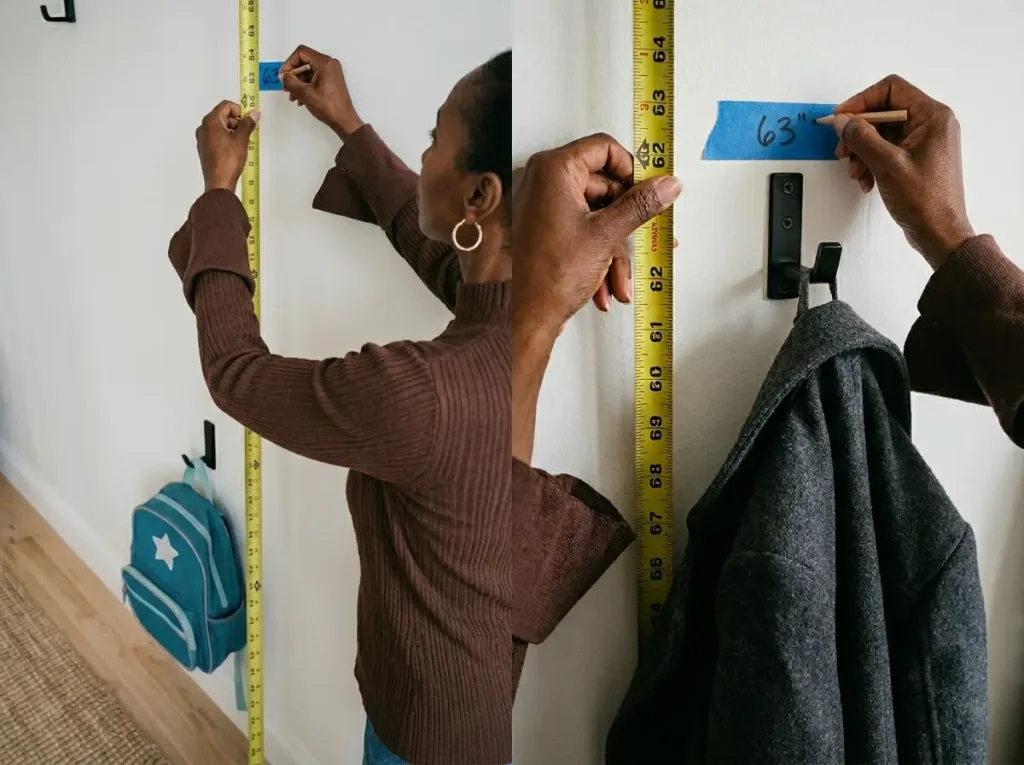
The coat that never makes it onto the hook didn’t miss because of laziness. It missed because the hook is in the wrong place, at the wrong height, or there are too many hooks and none feel assigned. Fix the placement and the coat practically hangs itself.
The Hook Height Rule
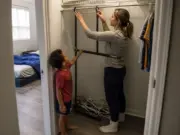
Install adult coat hooks at 60–66 inches from the floor. Not “eye level,” not “chest level” — measure from the floor. At this height, the hook hits the natural shoulder hang point for most adults. Every coat that ends up on a chair instead of a hook is probably missing by six inches.
For renters who can’t drill, Command Large Wire Hooks handle the job without holes. The Command Large Wire Hooks (multi-pack) hold up to 12 pounds per hook — enough for a lightweight to medium coat. Install at 63 inches, press firmly for 30 seconds, and wait an hour before hanging anything. The removal process matters: use a hair dryer on the adhesive tab for 30 seconds before pulling. Cold removal tears paint. For more no-drill approaches that preserve your deposit, the same adhesive principles work throughout the apartment.
If drilling is permitted, a wall-mounted hook rail with shelf is more stable than individual adhesive hooks. The Homode Wall Hooks with Shelf mounts at the correct height, holds heavier coats without shifting, and the integrated narrow shelf above handles hats or a key tray — eliminating the need for a separate console table in ultra-narrow entries. The tradeoff: it requires two wall screws into studs, so this one needs landlord permission.
Kids’ hooks should sit at 36–42 inches from the floor. A hook at adult height gets ignored by every child under 12 — the coat and backpack land on the floor instead. Install their hook where they can actually reach it, not where it looks balanced with the adult hooks.
Freestanding vs. Wall-Mounted: The Renter’s Choice
If you can drill, a wall-mounted hook rail screwed into studs will not move. If you can’t drill, a freestanding hall tree with an anti-tip kit is the renter’s answer — as stable as wall-mounted when the anti-tip strap is anchored to the baseboard.
The baseboard anchor is a 1/16-inch hole in painted wood trim. Most leases allow this — it’s smaller than a thumbtack hole and covered by a small touch-up of matching paint on move-out. Always photograph the spot before anchoring so you have documentation if the landlord asks.
One Hook Per Person — No More
The right number of hooks is one per household member plus one for guests. As NAPO recommends giving each household member their own designated drop zone, each hook should belong to a specific person. An unclaimed hook is an open invitation for items with no home — grocery bags, random scarves, the umbrella that hasn’t been opened in two years.
If you live alone, two hooks total. Add a third only when a specific, recurring need appears. The rule: if you can’t name who uses a hook, remove it.
5. Keys, Mail, and the Daily Essentials Surface
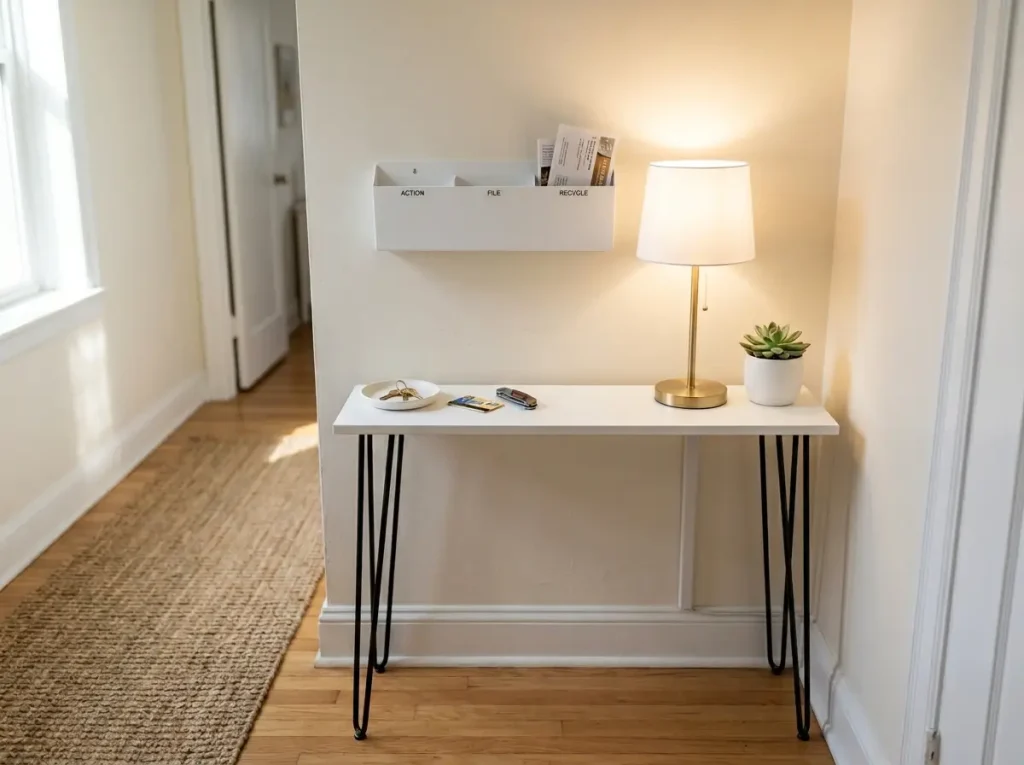
The most reliable entryway habit is also the cheapest to set up. A key tray — any bowl or dish you already own — placed in the same spot every single time you walk in. That’s the whole system.
The Key Tray: One Habit That Holds the Whole System
It doesn’t need to be a specific product. A vintage ashtray, a small ceramic bowl, a decorative plate — any object with a defined perimeter. The rule is the placement, not the object: same spot, every time.
This single habit prevents the “where are my keys” emergency that costs an average of 15 minutes per incident. It also signals to your brain that this spot is intentional — which makes the rest of the entry system hold. If the key tray works, the hooks work. If the key tray fails, everything downstream drifts.
Choosing a Console Table for a Narrow Entry
Measure your hallway width first. Subtract 36 inches for clearance. The remaining number is your maximum console table depth. Most narrow entry spaces need a 10–12 inch table. At 30 inches high — the most common console height — the surface sits at a natural reach for dropping items on the way in without bending.
A 14–16 inch deep table works in hallways wider than 50 inches. Below that, the deeper table steals clearance you’ll feel every time you pass through. The difference between 10 inches and 14 inches of depth sounds small until it’s the difference between brushing the table with your hip every morning and walking past it comfortably.
Mail at the Door: Sort, Don’t Stack
A two-section approach works: action (bills, documents that need a response) and recycle (junk mail that goes straight in the bin). If junk mail enters the home past the door, it will land somewhere and wait. That “somewhere” is usually the console table, and within a week the key tray is buried.
Keep a small recycling bin in or near the entry zone. Sort at the door, not elsewhere. A slim wall-mounted organizer with two or three sections handles incoming mail before it migrates to the kitchen counter. The goal: nothing sits on the console surface that wasn’t placed there intentionally.
6. The Entryway Bench with Storage

An entryway bench is the most requested piece of furniture in this space — and the one that most often disappoints. Not because benches are bad, but because most people buy one that’s two inches too deep and then the front door can’t open fully.
What Makes a Bench Worth the Footprint
A bench that only seats people is taking up prime floor real estate for one function. A bench with a shoe shelf below — or a lift-top storage compartment — justifies its footprint by pulling double duty. If a bench candidate doesn’t serve at least two functions, look at the hall tree or skip to a wall-only system. The floor space it occupies is the same space you’d use for a shoe rack or a narrow cabinet, so the bench needs to earn its spot.
A hall tree — bench, coat hooks, shoe shelf, and top bar in a single unit — is the most space-efficient option when you need all four entry functions but only have one wall section. The VASAGLE Hall Tree with Bench and Shoe Storage 4-in-1 measures 12.7 inches deep by 25.2 inches wide by 70.9 inches tall, fits entries with as little as 26 inches of wall width, and handles seating (198-pound bench capacity), coat hanging (9 removable hooks at 6.6 pounds each), shoe storage on the bottom shelf, and small item storage on the top bar (33-pound capacity). The anti-tip kit is included. The limitation: the 6.6-pound hook limit means lightweight to medium coats only — a saturated winter parka may exceed it. For a sturdier bench with a 300-pound capacity, the VASAGLE 3-in-1 alternative is slightly wider at 27.6 inches.
When you’re evaluating whether any bench or hall tree earns its spot, the same logic applies to all multi-functional furniture that justifies its footprint in a small apartment.
The Dimensions That Matter
Before buying: measure door swing clearance (close the door fully, mark where it stops), note wall width where the bench will sit, and confirm bench depth leaves the required 36 inches of passage. Most buyers skip this step and end up with a bench that blocks the door on cold mornings when coats are hanging off every hook and bags are stacked on the seat.
Bench depth for narrow hallways: 12–14 inches is compact, 18 inches is standard comfortable seating. Anything below 14 inches means the bench works for putting on shoes but not for sitting comfortably for more than 30 seconds. That’s fine for an entryway — you’re not reading a novel on it, you’re tying laces.
When to Skip the Bench
If the hallway clears less than 36 inches after accounting for a bench, skip it. Use a floating wall shelf at 30 inches for the key tray, mount hooks above it, and keep the floor completely open. The wall system uses zero floor space and accomplishes the same job — minus the seating.
Add the bench later if you move somewhere with more room. The worst version of an entryway bench is one that makes you turn sideways to get past it.
7. Renter-Friendly Entryway Organization
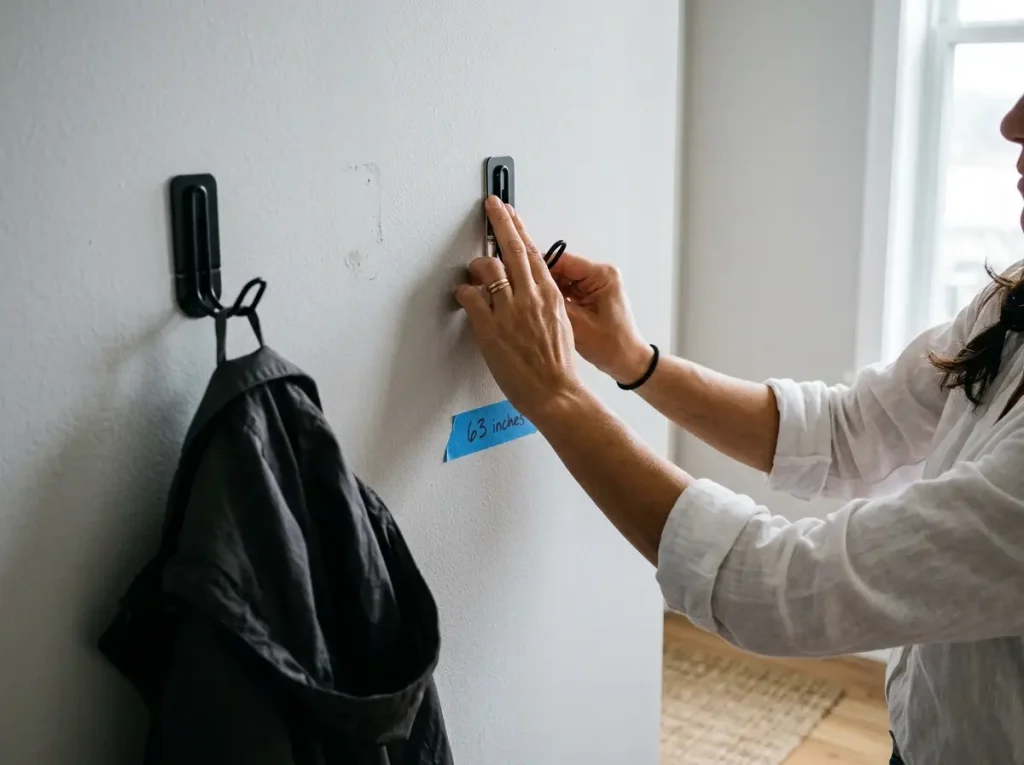
Most entryway articles assume you can drill into walls. Most apartment leases say you can’t. Everything in sections 3 through 6 has a no-drill version — this section collects the renter-specific toolkit in one place.
The Command Hook Toolkit
One Command Large Wire Hook (12-pound capacity) per coat. Two hooks for a one-person apartment, three for two people. Install at 63 inches from the floor — measure from the floor, not from wherever looks right.
The removal process is non-negotiable: heat the adhesive tab with a hair dryer for 30 seconds, then pull the tab straight down slowly. Cold removal peels paint, and paint repair costs come out of your security deposit. I’ve seen three deposits reduced specifically for Command hook removal damage — all from cold pulls.
The Over-Door System
The back of the front door is the most underused surface in most apartments. An over-door coat rack handles 3–4 items. An over-door shoe organizer handles 12–18 pairs. Together, they cover two of the four entry functions — hang and store — without touching a single wall.
The front door works best for shoes (the over-door organizer). A coat closet door — if you have one — works for the coat rack. Splitting the functions between two doors keeps the weight distributed and prevents either door from feeling heavy when you open it.
What Requires Permission and What Doesn’t
No permission needed: rugs, freestanding furniture, over-door organizers, Command hooks (most leases). Check your lease for: adhesive picture strips (some leases prohibit all adhesives beyond Command brand), floating shelves mounted with removable adhesive. Baseboard-anchoring an anti-tip strap is a 1/16-inch hole in painted wood trim — a dab of matching paint covers it on move-out.
For apartment-friendly storage solutions throughout the rest of your home, the same permission hierarchy applies in closets, kitchens, and bathrooms. The full toolkit of small apartment organization strategies room by room uses the same renter-safe methods.
Pro tip: Before move-in day, photograph every wall where you plan to install anything — even Command hooks. On move-out day, photograph the same walls after removal. This documentation has saved more deposits than any removal technique.
8. Why Entryway Organization Fails (and the 3-Minute Weekly Reset)
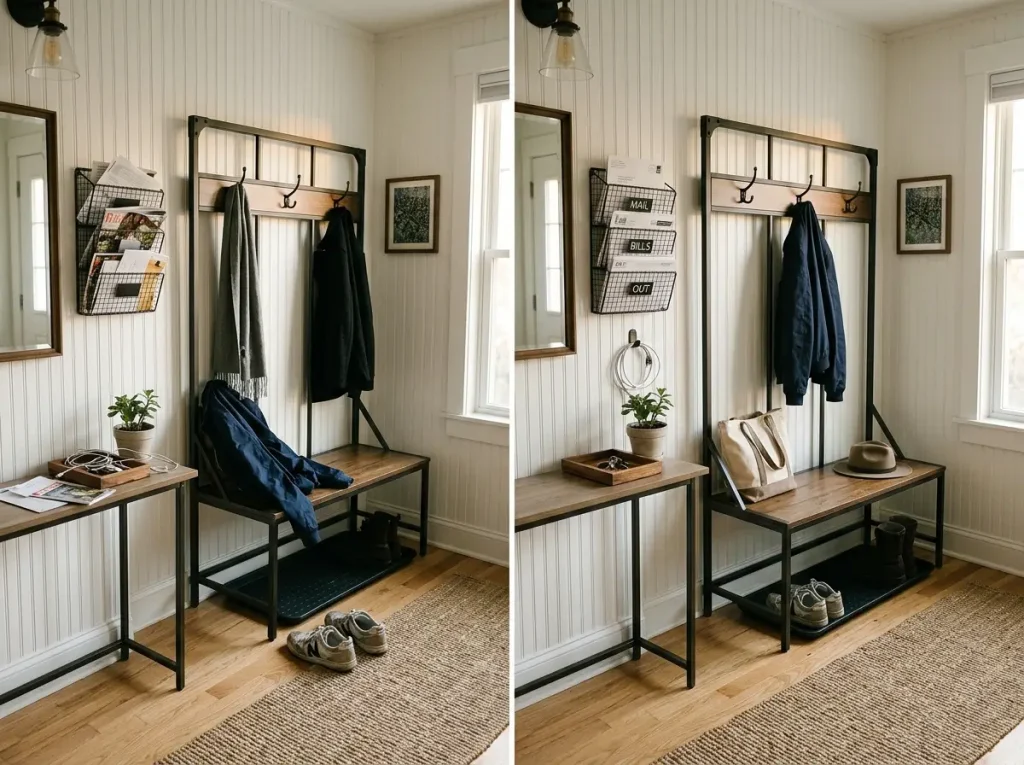
Every organized entryway looks good on setup day. The real test is the third week when the weather turns, everyone’s in a rush, and the system has absorbed two solid weeks of real life. This section is for people who have organized their entry before and watched it revert.
The Four Failure Modes
Almost every collapsed entryway organization system traces back to one of four causes. Knowing which one is failing saves you from starting over when all you need is a targeted fix.
Hook height mismatch. If hooks are installed at the wrong height — too high for shorter household members, too high for kids — items go to the floor instead of the hook. The system isn’t broken. The hooks are in the wrong place. Measure from the floor: 60–66 inches for adults, 36–42 inches for kids.
Extra-hook accumulation. Unused hooks don’t stay unused — they attract items with no home. The grocery bag that “temporarily” lives on the third hook becomes permanent. The scarf from a trip two years ago hangs there until someone finally acknowledges it. Reduce to one hook per person and the accumulation stops.
Inadequate lighting. Most entryway activity happens at the two worst-lit times of day — early morning departure and evening return. A system that works at noon becomes invisible at 6 AM. A simple plug-in LED puck light on the wall near the hooks, or a battery-powered lamp on the console, makes the zone visible and intentional when it matters most.
No reset habit. Without a regular reset, entropy wins. It doesn’t matter how well the system is designed — two weeks of normal life will drift it. The fix isn’t reorganizing. It’s resetting.
The 3-Minute Weekly Reset
Every Sunday or Monday: take out anything that doesn’t belong in the entry zone. Hang anything that landed on the floor or on the bench seat. Check the key tray. That’s it. Three minutes if the system is working. Ten minutes if it drifted. If it’s consistently ten-plus minutes, something in the system needs to change — the reset isn’t the problem, the underlying setup is.
The test isn’t whether the entryway looks organized on setup day. It’s whether it holds on a Tuesday after a rainy school morning — parents, kids, backpacks, wet coats, the whole mess. If it survives that, the system works. If it doesn’t, redesign the system, don’t just reset it harder.
Seasonal Adjustments That Prevent Collapse
In winter: add the boot tray, add a hook for an umbrella, swap the key tray for a slightly larger bowl that can also hold gloves. In summer: remove the boot tray, reduce the hook count by one, and move winter coats to the bedroom closet. The system should never fight the season you’re in.
The seasonal swap takes fifteen minutes twice a year. It prevents the common failure where a summer entry system gets buried under winter gear because nobody adjusted the capacity. The entry should match what you need right now, not what you needed three months ago.
Conclusion
Three takeaways to carry forward:
Define the zone before buying anything. Measure hallway clearance and match furniture depth to what the space actually allows. A console table that blocks comfortable passage will be removed within a month.
Match the system to your actual habits. One hook per person, only active-rotation shoes at the door, a key tray in the exact same spot every time. Design for Tuesday morning, not Sunday afternoon.
Build maintenance into the system from day one. The 3-minute weekly reset is what separates an organized entry from one that looks good for three days. Every system drifts — the reset catches it before it collapses.
Three-month check: Look at which hooks are actually being used. Any unclaimed hook has collected items that don’t belong there — remove it or reassign it. The system should feel easier over time, not harder.
Start with the key tray. Put any small bowl in a fixed spot by the door and keep your keys there for two weeks. That one habit changes how the whole entry functions. Everything else comes after.
Q1 How do you organize a small entryway with no closet?
Wall hooks, an over-door shoe organizer, a boot tray, and a narrow console table cover all four entry functions without a closet. Mount hooks at 63 inches for coats, hang the shoe organizer on the front door or nearest interior door, and use the console surface as your key and mail station.
Q2 What should I put in a small entryway?
Keys in a tray or on a hook, one to two pairs of active-rotation shoes, coats for everyone in the household, and a boot tray in wet weather. Everything else — seasonal items, packages, extra shoes — belongs in a closet or storage area, not in the entry zone.
Q3 How do I create an entryway in an apartment with no foyer?
An area rug defines the zone, and a hook rail or freestanding hall tree positioned to face the door creates the function. The rug edge is the psychological boundary between entry and living room. No structural changes needed — the furniture grouping and rug placement do the work.
Q4 What is the best furniture for a small entryway?
A hall tree with bench, hooks, and shoe shelf in one footprint works for entries with 26 inches or more of wall width. For entries narrower than 24 inches, a wall-mounted hook rail paired with a floating shelf replaces the bench without using any floor space.
Q5 How do I stop my entryway from getting cluttered again?
Run the 3-minute weekly reset every Sunday: remove anything that doesn’t belong in the entry zone, hang anything on the floor, and check the key tray. If the reset consistently takes more than ten minutes, the problem is the setup, not your follow-through — adjust the system.