You saved a calm Japandi living room, bought a few boxes, and by the second week the bare surface holds mail, a charger and a hair tie while the lidded basket beside it has become the place nobody opens. It feels like the style failed you, but the system underneath was never built. The best Japandi home organization ideas follow a rule of thumb the style runs on: roughly nine surfaces closed for every one left open, with storage sturdy enough to survive that ratio. Below you get the ratio and what stays, the wood tones and weaves, the rooms one by one, the measurements that decide each piece, why closed storage turns into a black hole, and the reset that holds when other people live in the house.
Quick Answer
Calm Japandi storage is an edit plus a ratio, and six rules carry it.
- Decide what stays before any container comes into the house.
- Close roughly nine surfaces for every one you leave open.
- Keep one wood tone and one weave family across each room.
- Measure the opening and the lift-out clearance before the box arrives.
- Label the closed fronts so hiding does not depend on memory.
- Give each person one zone that is allowed to be ugly but works.
Japandi Home Organization Ideas Start With a Ratio, Not a Shopping List
Picture the shopping trip: a cart of baskets, a few jars, maybe a bench with a lid, and no decision yet about what any of them is for. The pile at home gets sorted into better containers, and it is still the same unedited pile. A calm room is mostly what is not in it, so the order of work is edit, then close, then show.

What Stays Before Anything Is Bought
Two ideas hold the style up, and each fits in a clause. Danshari is the decision to let things go, and ma is empty space treated as part of the design rather than a gap to fill. Together they are the heart of Japanese organization: the room is built around negative space you protect, and the stuff has to fit what is left. Both come before the first purchase, because a container only changes where a thing sits, not whether it should be in the house.
The numbers are blunt. In NAPO’s survey of 2,000 people, about a third of the items in the surveyed homes were non-functional and about one in eight were pure junk.
That means a third of what a closed door would hide does not need a container at all; it needs to leave. And the free option comes first here: the sideboard, chest or blanket box in the house is the closed piece, so empty it, sort it, and put back only what earns the space. When the edit stalls halfway through a drawer, a step-by-step way to decide what stays keeps the sorting moving.
Run the edit with one cardboard box on the floor. Anything that goes in stays in that box for two weeks, and the things you dig out and use go home. What is still in the box after two weeks has answered the question for you.
The Nine-to-One Rule for Closed and Open Storage
Japandi reads calm at roughly nine closed surfaces to one open one, the 90/10 ratio in the style’s own shorthand: for every shelf you can see into, about nine surfaces sit behind a door, a lid or a drawer front. Most homes run it near half and half and then wonder why the room still looks busy. The ratio is a rule of thumb, not a standard, but it explains something a shopping list never will: the calm comes from how little stays visible.
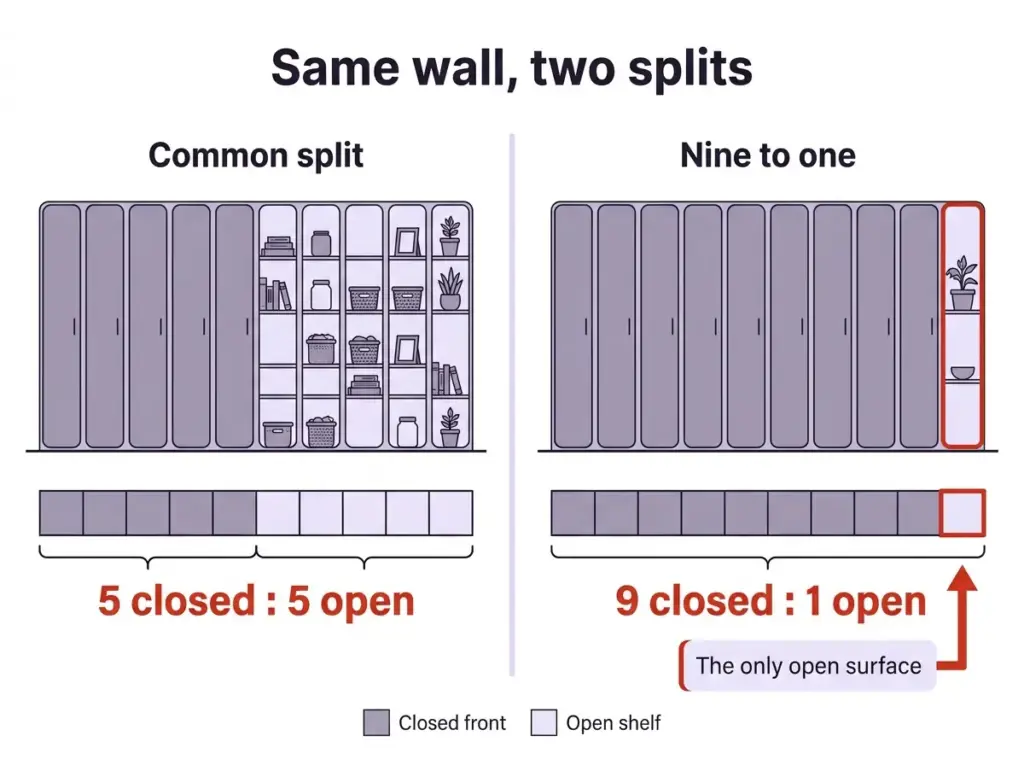
If closing everything is not realistic yet, close the rooms the household shares and leave the rest alone for now. The living room and the entry are where guests, partners and children see the result, so the ratio pays off there first. The full set of Japandi and Scandinavian organization rules is where the wider rule set lives, and this article applies it room by room.
What Earns the Open Surface
The open tenth gets one functional object and one living thing: a ceramic bowl you really use and a small plant, or a lamp and the book on the nightstand. Never a collection. A row of five matching candles is display storage, and display is exactly what the ratio is trying to shrink. The nine tenths behind the doors is hidden storage, and it is what lets the open tenth stay empty.
Pick the Wood Tone and the Weave Before You Pick a Box
You find a good-looking box online, it arrives in an orange-toned finish, and it becomes the first thing your eye lands on in an otherwise quiet room. That is a material problem, not a styling one. The tone and the texture decide whether storage disappears into the room or announces itself.
The Woods and Weaves That Belong
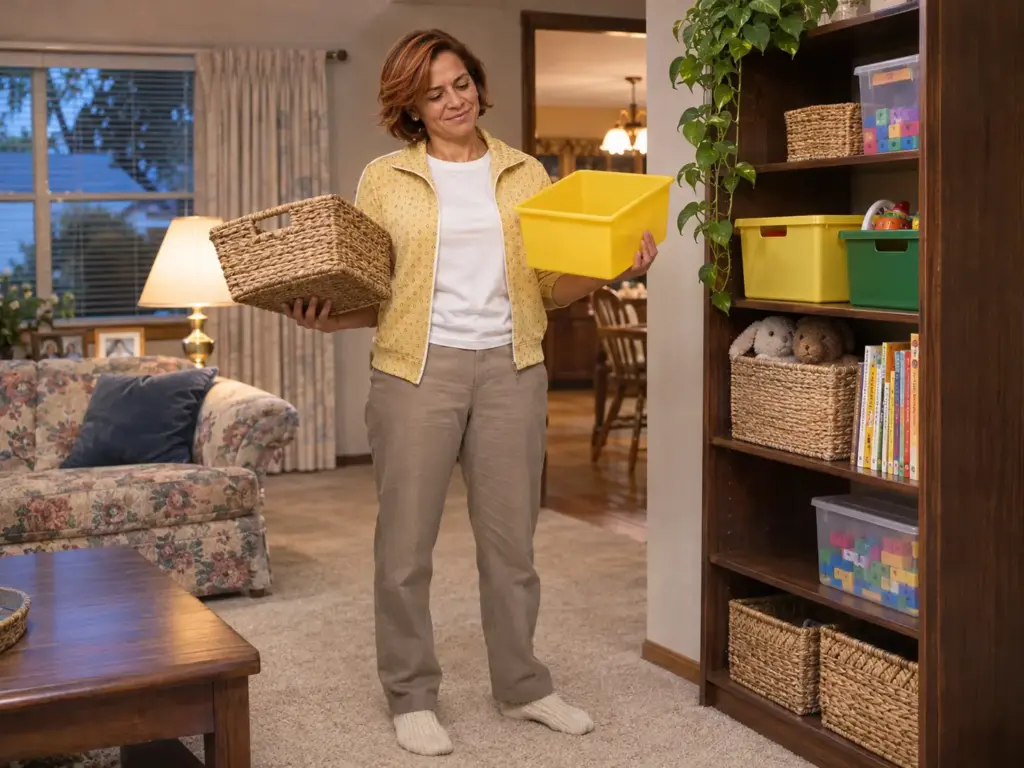
For wood, think light oak, ash, walnut and bamboo. For weaves, rattan, seagrass, water hyacinth and abaca; for cloth, linen and cotton; for jars, matte ceramic and porcelain. What these share is a soft, matte, natural grain, so nothing throws a glare or competes for attention.
What Breaks the Look
Orange pine, high-gloss finishes and bright plastic each read as a different room. Plastic is not banned from the house, only from the visible tenth: a clear bin inside a closed cabinet is invisible and does its job fine. The test is simple. If you can see it from the sofa, it should be in the palette.
One Material Family Across a Room
Three sizes of one weave read as a single block (the uniform containers look), while a mix of weaves and woods reads as clutter even when each piece is nice by itself. So before buying anything, gather the baskets and jars from around the house and see how many share a material; a linen offcut makes a quiet liner, and tape and a marker make a label. How one repeated material makes a room read as a set shows the same logic in another style.
The matching set deserves a second look. It sounds like the obvious route to a coherent room, but a set bought before measuring is the most common wasted purchase in this style, and a set of twelve that fits nothing is worse than four odd pieces that do. The family rule applies to what survives the edit, and it applies after the tape measure has been used.
The Living Room: What Shows and What Closes
Your living room carries the remotes, a throw, a laptop and a pile of mail on every flat surface at once. Each of those needs a closed home, and in a room this size the best closed homes are also a seat or a table. The visible tenth belongs to a few chosen objects; the other nine tenths sit behind the pieces below.
The Low Credenza and the Wall It Anchors
The credenza is the anchor, a low profile piece. It sits 16 to 20 inches off the floor and runs roughly 47 to 59 inches wide, about 18 deep and about 20 tall; much taller than that and it stops floating under the wall and starts to own it. The free version is a low closed cabinet from another room, moved to the TV wall and emptied first.
Side shelves beside a TV wall run about 10 inches deep and 59 to 71 inches tall. Floating shelves go no deeper than about 8 inches, roughly one book and one bowl, because a deeper shelf collects a second row nobody sees. In a deep living room, a long credenza reads as furniture while a short one reads as a cabinet, and the same ratio applies at either size.
The Sofa Wall: An Ottoman and a Coffee Table That Hide Things
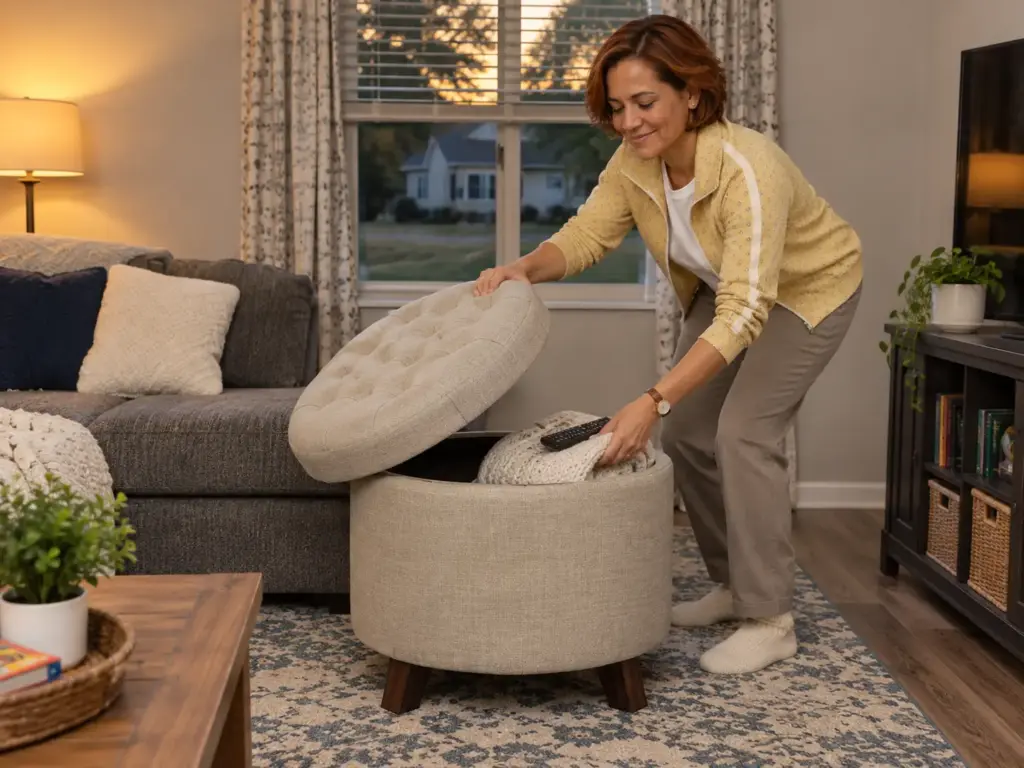
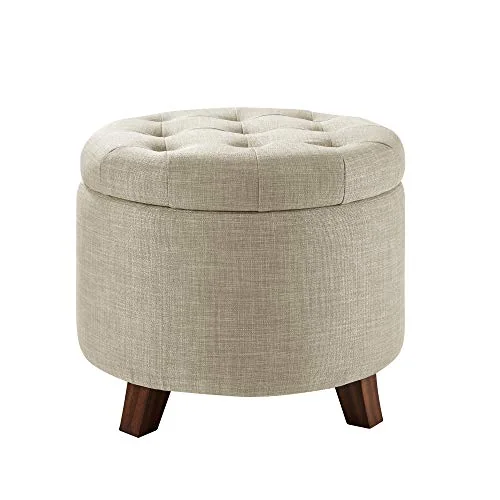
Think about what lands on the sofa wall: throws, remotes, a laptop, the day’s mail. A lidded round ottoman hides the first two and reads as a place to sit, not a container. If you have a storage bench with a lid lying around, it does the same job today at no cost, and it is the right first move in a rental.
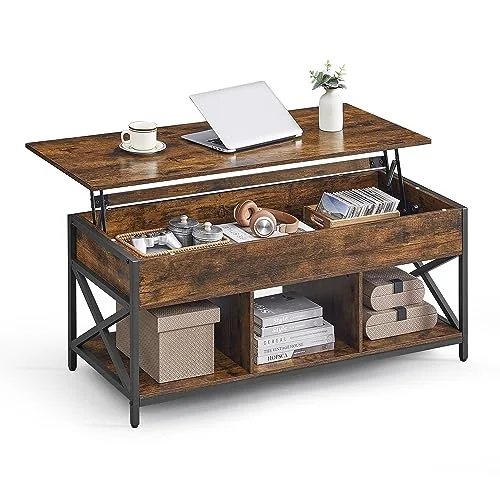
The coffee table is where the laptop lives, so it should hide something too. A lift-top coffee table with a hidden compartment and open cubbies fits the job, and the top rises to desk height so the laptop stops sleeping on the sofa.
In a living room that more than one person uses, the visible surface becomes the household’s dumping ground first. Asking everyone to hold the ratio rarely works; a basket for each person does. Keeping a shared living room tidy when others will not follow the system goes deeper on that exact friction.
The One Open Shelf and the Baskets That Suit It
The open shelf is the exception, so make it honest. A sturdy box lined with a linen offcut does the job for free.
If you want a set, the Honey-Can-Do Woven Water Hyacinth Storage Baskets, a nesting set of three, bring a natural weave and an open top that keep the visible layer from turning into a display of plastic. The set measures 12 × 9 × 10.5 inches, so check that 9-inch side against your shelf: it fits a 10-inch side shelf and overhangs an 8-inch floating one. The smell is the lottery, with some sets arriving with a strong scent out of the box and others with none, so give the baskets a day in a ventilated room before they go anywhere near the sofa. Check the Honey-Can-Do baskets on Amazon.
Past the Living Room: Bedroom, Closet, Kitchen and Bathroom
The bedroom stays calm for a week because everything went under the bed in a heap, and the kitchen counter fills again by Friday. Each room fails in its own place, so the fix goes to that place. The ratio is the same everywhere; what changes is the object.
Under the Bed and on the Dresser
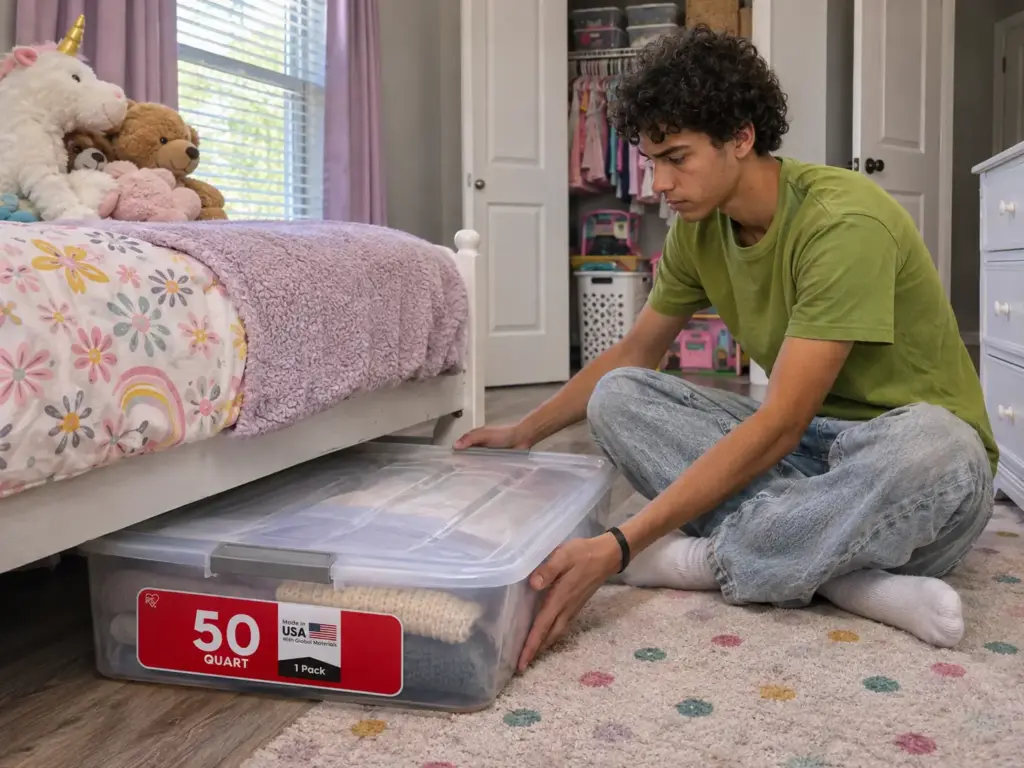
For under-bed storage, use flat bins no taller than about 6 inches and leave roughly a 2-inch shadow gap at the floor line, so the bed reads as floating instead of stuffed. Clear walls end the question of what is in there. The free option is the storage boxes from the hall closet, if they are low enough; measure the clearance first, and how to work out the clearance under your own bed frame walks through it.
The IRIS USA 50 Qt Long Under Bed Storage Bin with Lids is 32.5 × 17.88 × 6.5 inches outside, half an inch over the 6-inch ceiling, which is close enough if your frame leaves about eight and a half inches of clearance. The clear walls are the point. The weak spots are the handles, which can snap within about a week, and a lid latch that sometimes arrives missing on one side, so slide the bin by its rim. See the IRIS bin on Amazon.
A tall bed frame in a larger home leaves room for more than seasonal bedding, and the cap there is whatever the household can lift out with one hand.
Put the label on the end of the bin that faces out, in letters big enough to read from standing height. A label on the top of the lid only works when you are already kneeling, and by then you have opened the wrong bin.
The dresser top holds two objects at most, by the style’s convention: one useful, one living. The third object is where clutter starts. A nightstand with drawers gets the same treatment: the lamp and one book on top, and the charger and cream inside, with drawer dividers so the contents do not slide into one pile.
The Closet, Run Like an Oshiire
Closets rank first as the most disorganized storage area; in NAPO’s 2019 public survey, about 55% of 1,005 people said so. That makes the closet the place where the system is won or lost, not the living room. Run it like an oshiire, the deep Japanese closet that stores bedding and out-of-season things, and use koromogae, the seasonal swap, as the calendar for seasonal rotation: the off-season goes to the high shelf or a bin, and the in-season stays at hand.
Look at a closet built for the photo and you will often find the pattern: perfectly folded, color-sorted, and untouched for two years, because the clothes actually worn live in a clean pile on a chair. A closet should be built for what gets worn this week. Setting up a closet that still works after the first few weeks covers the step-by-step.
The Kitchen: Counters, the One Open Shelf and the Pantry Back Row
The kitchen gets one open shelf for one material family, and everything else closed. Think in five zones (prep, cook, sink, trash and pantry) and keep what is used in each zone inside that zone. Use stackable bins and a tension rod under the sink to turn dead space into a place that works, and leave the kitchen counters nearly empty, and that is where most of the daily friction disappears.
A deep pantry shelf silently becomes a storage unit, because the back row disappears behind the front one. Label the pantry backstock and audit it, and for the weekly mechanics see keeping the pantry back row from becoming a storage unit. For containers, use one family, stackable and airtight, and decant only what the household eats often. Glass jars already in the cupboard come first; if you want a matching set, the OXO Good Grips 5-Piece POP Container Set is a stackable, airtight single family in five sizes, 9 × 9 × 7.25 inches for the largest footprint (find it on Amazon).
The Bathroom Counter
Only what is used daily stays out, and the rest goes behind a closed front. Wet rooms break the weave rule, since rattan swells with steam, so use ceramic, glass and metal there. Label the cabinet door as well as the container, so that hiding never depends on memory. Sorting the bathroom by how often each thing is used turns that into a short routine.
The Measurements That Decide Every Piece Before You Buy It
You order the right piece in the wrong size and find out at the doorway. The size problem, usually a narrow gap that is a half inch short, is the quiet reason a lot of Japandi storage ends up in the middle of the floor, or back in the box. A few numbers, taken in the right order, prevent almost all of it.
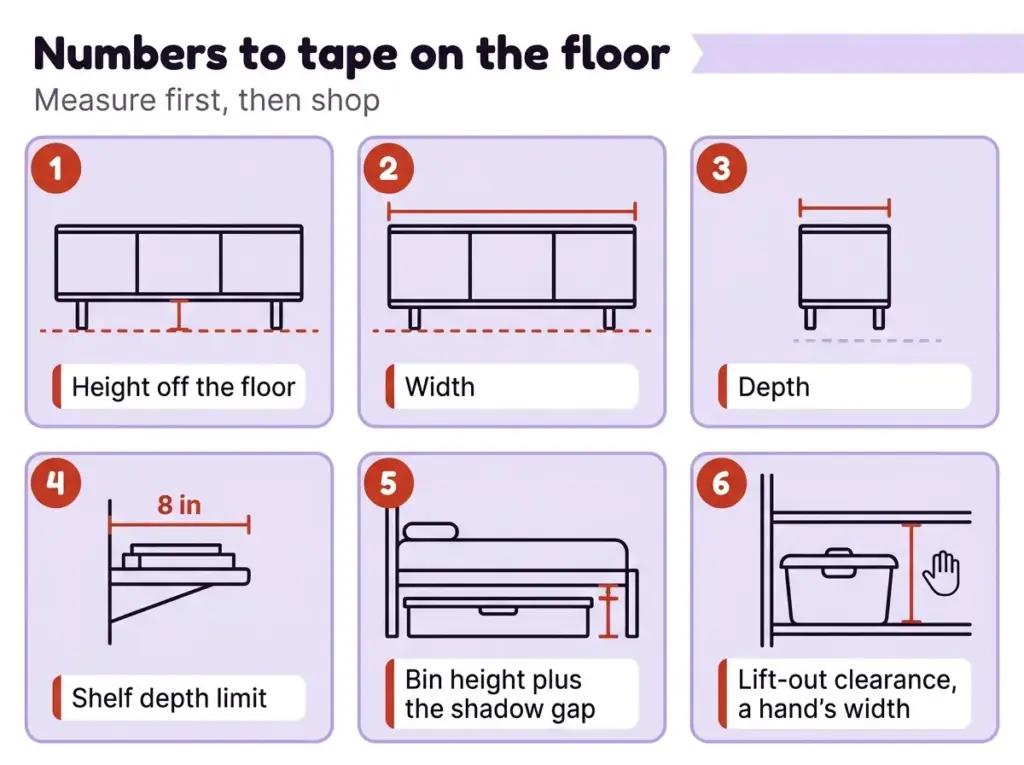
The Three Numbers to Tape on the Floor
Tape the credenza’s footprint on the floor before buying anything. These are the numbers, each with what it prevents:
- Height off the floor, 16 to 20 inches: the piece floats under the wall instead of owning it.
- Width, 47 to 59 inches: the credenza fits the wall without crowding the TV or a window.
- Depth, about 18 inches: you can still walk past it and open the doors.
- Shelf depth, no more than about 8 inches: a second row never forms.
- Under-bed bin height, about 6 inches plus a 2-inch gap: the bed reads as floating.
Leave the tape down for two days and walk the room’s real paths. Then check the opening against the piece, because the doorway, the hall turn and the stair all have to be measured before the box arrives, not after.
If you find yourself stepping around the taped rectangle after two days, the piece is too big for the spot, whatever the product page says. That small detour is what you will feel every morning once the real thing arrives.
Lift-Out Clearance and the Closet’s Depth
The number almost nobody publishes is lift-out clearance. Whatever the container’s height, it has to clear the shelf above it by about a hand’s width, or the closed row becomes a two-hand job and stops being used. A bin that fits the shelf by half an inch is a bin that lives on the floor within a month.
Closet depth works the same way. A closet no deeper than the hanger needs is ideal, so use slim hangers and check that the doors close with the clothes in. If the hangers hit the door, the closet is too shallow for the system you picked, and the sensible move is a different hanger, not a bigger closet.
The Renter Version and the Owner Version
For renters, the no-drill light layer goes on Command strips, the adhesive kind: a peg rail, a robe hook, an over-door basket. Command rates its large picture-hanging strips at about 16 pounds per pair on clean painted drywall, enough for a peg rail and a robe but not for a shelf of books. The heavy layer stays on the floor. Nothing gets drilled.
For owners, the rule is whatever the wall can take, anchored where the material allows, using the hardware maker’s own instructions for that wall. The point of the split is simple: a renter keeps the deposit and gets most of the look, and an owner gets a few more places to hang things.
The Entry Cabinet and Why It Gets Anchored
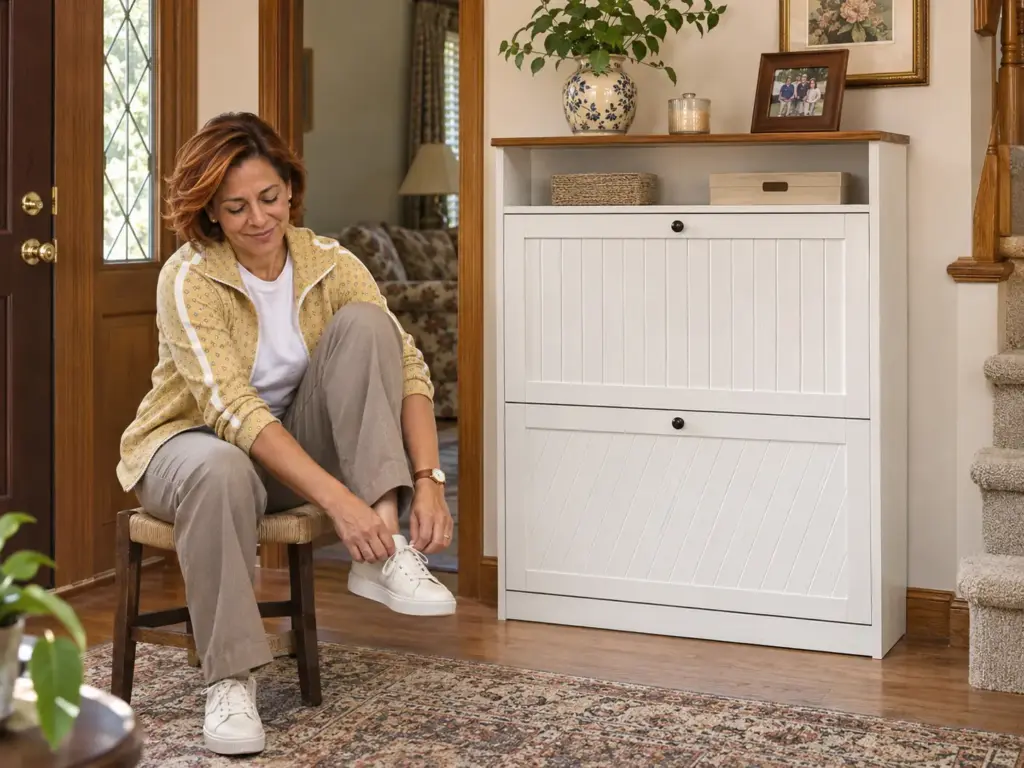
A tall shoe cabinet or dresser in a home with children gets anchored to the wall.
According to the CPSC’s Anchor It! campaign, “Anchoring all furniture with drawers, doors, and shelves to the wall prevents tip-over injuries and deaths.” A federal rule on clothing storage units took effect in September 2023. In a rental, anchor where the lease allows, or pick a piece low enough not to need it.
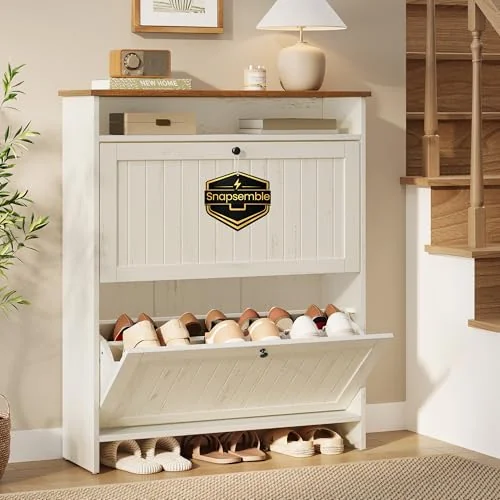
The free option is a lidded entryway bench by the door, and in a Japanese home the genkan, the step-down entry, is where shoes stay. For a closed front that fits a hallway, the SONGMICS Home Snapsemble Shoe Cabinet is 9.8 inches deep.
Why Closed Storage Turns Into a Black Hole
You lift the lid of a basket and find three phone chargers. Or a fourth tape measure goes into the cart because the other three are somewhere in a bin. Out of sight stops the object existing for part of the household. That is a memory problem, not a laziness one, and the Japandi look makes it worse by design.

Hide It, Forget It, Buy It Again
The chain runs the same way in almost every home. A closed front hides the object, the household forgets it, the object is re-bought, and the container fills with duplicates. Eventually the household stops trusting the system and leaves things out, which is how the visible tenth gets eaten. Out of sight, out of mind is the whole mechanism.
The cost is measurable: Americans spend about two and a half days a year looking for lost items, according to NAPO’s own research on what clutter costs. The closet that was built for the photo shows the same thing at a larger scale, with a week spent on the system and none of it used afterward.
Clear Bins, Opaque Bins and the Trade Between Them
Opaque bins solve the look and create the forgetting, while clear bins solve the forgetting and create visual noise for some people. The common answer is clear bins everywhere, but the better call in a Japandi room is the reverse for anything visible: opaque on the open shelf, clear inside the closed cabinets, where the noise is hidden and the contents are not. That placement gets both at once. For the same bin trap seen in another style, read how the bin trap works in a minimalist home.
The counter-move costs nothing: a label on the closed front as well as on the container, in big letters. A picture works better than words for anyone who will not read a label, and tape and a marker are enough.
The Ratio Belongs to the Household, Not to One Person
When one person enforces the ratio and the others do not, the visible tenth becomes the dumping ground, and the calm collapses in the shared rooms first. Nine to one is the number the style quotes, but in a house with a partner and kids it is a target for the shared rooms, not a law for every shelf. A shared room has more than one person’s habits in it, and the clean pile on the chair is usually a sign that the closet has no place for those habits. If the closet is shared too, a shared closet that each person can keep up splits it so one person is not the only one who knows where things go.
The Reset That Survives a Real Household
You want the whole house calm, and you live with someone who does not. A rule with no exception gets broken everywhere. A rule with a labeled exception holds in the rooms that matter.
One Zone That Is Allowed to Be Ugly but Works
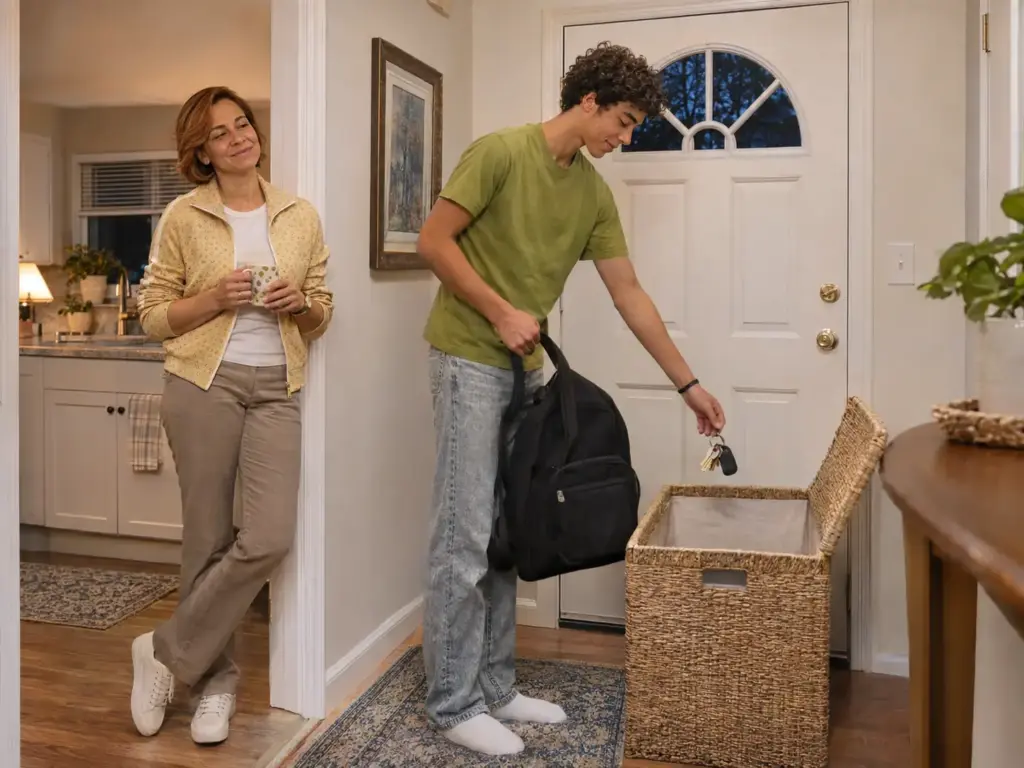
Give each person one zone that does not have to follow the palette: a lidded bin in the hall, a drawer in the entry, one basket per family member for stray items. It sounds like a concession, and it works as the opposite, because it keeps the shared rooms near the ratio and stops the organizer from being the only one who knows where things go. A partner or children who will not follow the display rule do not break the system when they have their own allowed-ugly zone. It also lets everyone close some tabs, and the room stops asking for attention.
Keep a roll of masking tape and a marker in the entry drawer. A label that takes ten seconds to rewrite gets rewritten; a label that needs a trip to the other room stays wrong for a season.
The Calendar: Ten Minutes, the Seasonal Swap and the Yearly Reset
Three rhythms keep the ratio standing.
A weekly 10-minute reset handles the surfaces. Koromogae, the seasonal swap, runs twice a year for clothes. Osoji, the year-end deep reset, is for the closed fronts: open every door, check for duplicates and move what is not used. Add one-in-one-out, so that when something comes in, something leaves, and the edit does not revert.
A bigger house needs the audit more often, because a deep shelf holds a second and third row, so look at the backstock quarterly. When a reset fades after a few weeks, why a minimalist reset stops working after a few weeks explains the same collapse in a neighboring style.
What to Skip and What Is Free
Skip a matching container set bought before measuring, and skip a modular closet system in a rental. Spend nothing on the first moves: declutter before buying, reuse boxes and jars, move the visible pile into the closed piece you own, and label with tape and a marker. The paid pieces above are for the gaps those moves leave, and a gap shows itself after a month of using the free version.
Edit First, Close the Rest, and Go Looking for Duplicates
The order is what holds the system together: edit what you own, close about nine surfaces in ten, keep one family of material in each room, measure and tape before buying, label the closed fronts, and give each person a zone. Done in that order, storage disappears into the room. Done in reverse, it becomes the room.
After a few weeks of ordinary use, open every closed front and look for duplicates; a drawer that has quietly filled with a second charger means the label or the zone needs another pass. Today, empty one closed piece you already have, sort the contents into stays, goes and the rest, and notice a week from now which things you actually reached for.
Frequently Asked Questions
01What is Japandi home organization?
Japandi organization means editing what you own, closing most surfaces, and showing only a few chosen objects, in light wood and natural weaves. The style’s rule of thumb is about nine closed surfaces for every open one, with one material family per room.
02How do you hide clutter in a Japandi home without forgetting what is in there?
Label the closed fronts as well as the containers, and use clear bins inside closed cabinets so the contents stay visible to you and hidden from the room. Open every door once in a while and look for duplicates.
03Can you organize a rental in a Japandi style without drilling?
Yes: put the light layer on adhesive strips at the maker’s rating and keep the heavy layer on the floor. Use low freestanding pieces, and anchor anything tall where the lease allows.
04What do you do when a partner or kids will not follow the display rules?
Give each person one allowed-ugly zone and keep the ratio in the shared rooms only. One basket per person for stray items stops the tidier from being the only one who knows where things go.
05What colors and materials should Japandi storage be?
Choose light oak, ash, walnut, bamboo, rattan, seagrass, linen and matte ceramic. Keep orange-toned pine, high gloss and bright plastic out of the visible layer, where they read as a different room.
Disclaimer: ClutterlessNest is a participant in the Amazon Services LLC Associates Program. As an Amazon Associate we earn from qualifying purchases. This article may contain affiliate links — if you buy through them, we may earn a small commission at no extra cost to you. We only recommend products we have tested or genuinely believe in.