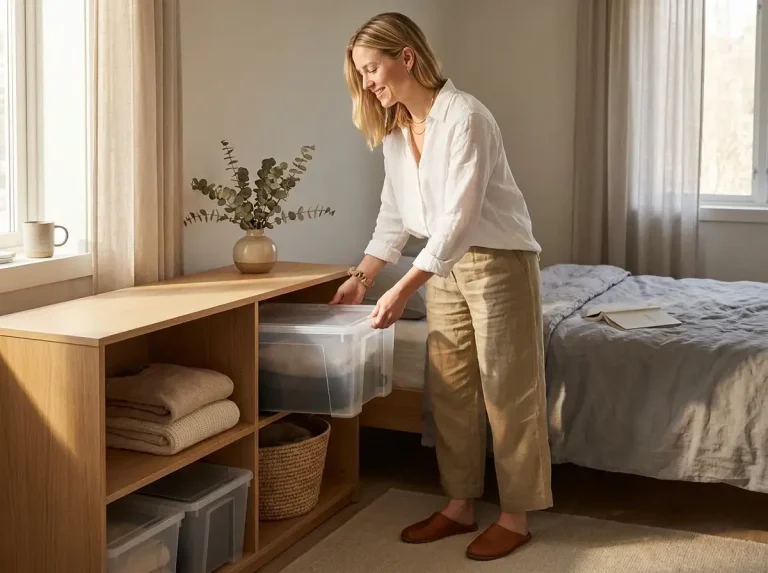

The shelf you styled on Sunday looks right until midweek, when a charger, the keys and a mug have settled onto the tray as if it were a counter. The styling was never the problem: the look had no place for the things that keep arriving, so they landed on the nearest flat surface and the visual clutter came back.
Aesthetic organization is a setup where every item has an easy, visible home and the whole thing reads as one look, and the second half only survives if the first is built properly. This guide picks a look from the room you have, contains the stuff in one container family, styles it with three moves, checks every purchase against a measured fit, and ends with a reset that takes minutes. Each pick below is judged by the interior number that decides whether the real item fits, never by how it looks in a photo.
Quick Answer
Aesthetic organization is the look and the system together. Choose one look from your room’s light and wood tone, keep to a single container family, style with a tray and a riser, and trust only a setup you can put back in a few seconds. An item with no easy return path will not stay put.
What Aesthetic Organization Means, and the Test It Has to Pass

A Look and a System in the Same Setup
Pin enough shelves and the pattern shows: every picture is a look, and every look is hiding a job. The job is to hold the real things of a busy week, the daily ones as well as the pretty ones, and still read as calm. That is the whole tension, and it settles in one direction. Function decides the layout, so form and function are settled in that order, and the look is the second pass, never the first.
A shelf, a drawer or a dresser top is aesthetic when two things are true at once. Everything on it has a home you can reach without moving something else, and the objects share enough material, color and spacing that the eye reads one composition.
Lose the first and the surface becomes a display of whatever landed there. Lose the second and you have a tidy cupboard that still looks busy. This guide starts with the first, because it decides whether the second survives.
What It Is Not: a Photo Set or a Shopping List
It is not a photo set. A setup that only works on the day it is photographed has no way to absorb a bag of groceries, a new charger or a parcel, and a style that needs more empty space than the room has is a costume, not a system. A calm space is the result of a system, never its starting point.
A matching haul of baskets bought before anyone counted what needs to go in them is the third version. All three are built around an image and none around the stuff, and the stripped-back boards make the same mistake with fewer objects: how a stripped-back setup slides back into clutter is the same story told in white and beige.
The mechanism behind most of these failures is shape. The system is the wrong shape for the stuff you own: a bin set picked for its look arrives, the tall and awkward things fit none of the bins, and those things go on the counter. After that the surface carries the pile and the bins hold the leftovers. Why matching bins pile up faster than they hold anything follows that same slide in another style.
The Return-Path Test
One test settles it, and it takes ten minutes. Pick any item on the surface, pick it up, and put it back. Count the seconds and count what you had to move. A few seconds and nothing else disturbed means the item has a return path; a lid to lift, a row to shift or a moment of thinking about where it goes means it has none, and the look will lose to the first tired evening.
Run it on five things: the one you use daily, one that arrives often (mail, a charger), one bulky object, the prettiest item and the one you would happily hide. Each failure points at a different repair.
A failed daily item means the container is too deep or too full. A failed bulky item means the container is the wrong shape. A failed pretty item is no failure at all, since it was placed to be looked at.
Run the test on the item you use most, not the one you styled. The daily item is what breaks a setup first, and moving it to an open spot at the front of the shelf costs nothing.
Choose a Look From the Room You Actually Have

Read the Room Before You Read the Board
A board is somebody else’s room, and yours has three inputs that decide what looks right in it before a single container arrives. The largest wood or floor tone sets the undertone: warm oak and honey tones pull toward cream, brass and rattan, while grey floors and cool whites pull toward clear acrylic, black metal and glass. The direction and amount of daylight sets how much contrast the room can carry, since a bright room forgives a dark container and a dim one swallows it. The wall is the backdrop every container sits against, so it decides whether a black bin looks sharp or like a hole.
Pick the look whose containers match the biggest surface in the room, then build a material palette by bringing contrast in through small objects: one dark tray on a pale shelf, one brass dish against grey. That is judgment, not measurement, and the order matters. Big surfaces decide, small objects argue.
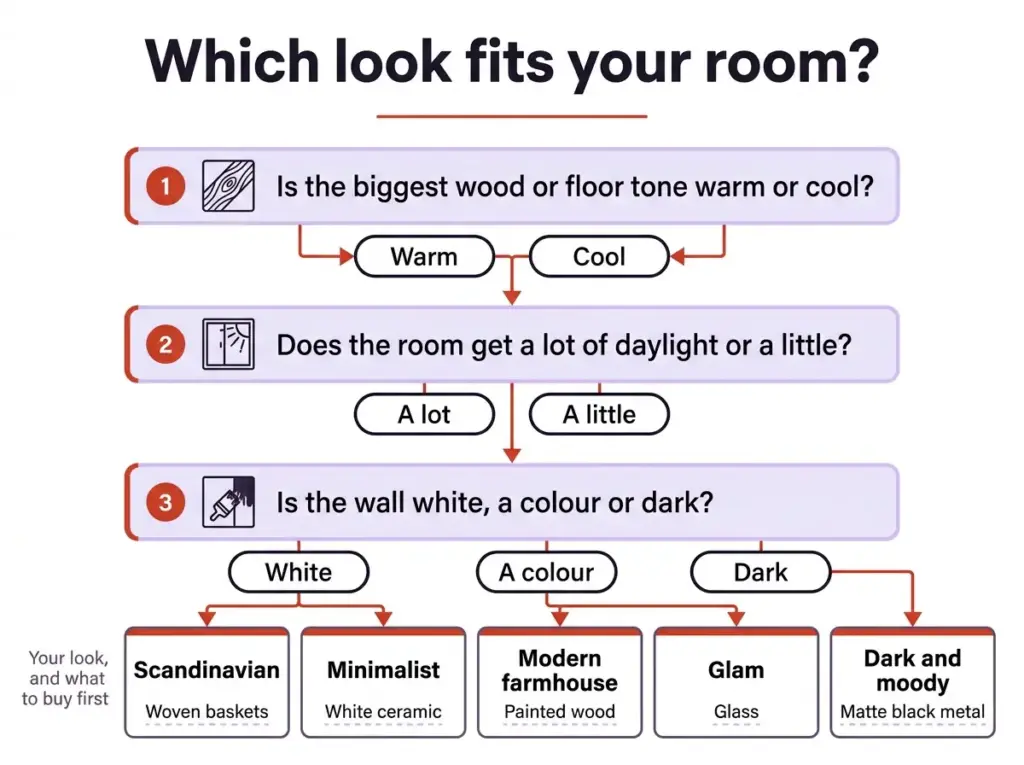
Reading the inputs takes a window and five minutes. Stand where the shelf is at midday, look at the biggest wooden thing in view and decide if it leans yellow or grey. Then hold a white mug against the wall. If the mug looks bright, the room can carry dark containers; if it looks dull, it cannot.
Five Looks Side by Side
Minimalist means few containers and empty space left on purpose: pale surfaces, one material per shelf, nothing that needs explaining. It suits a living-room shelf or a bedroom dresser top, and it leans on a neutral palette, so it fails the first busy week, when the empty space fills with unplaced things. What an open living-room shelf looks like after a month shows how quickly.
Scandinavian adds light wood, bamboo, white and woven texture: pale baskets, a wood tray, plain ceramic. It suits rooms with soft daylight and pale floors. It fails when the woods fight, since a yellow pine shelf holding a grey-toned oak tray reads as a mistake, not a mix.
Dark and moody is deep color, matte black metal and a few brass accents. It works where there is plenty of daylight and a dark wall to sit against. In a small dim room it closes the walls in, and on a pale shelf black containers show every fingerprint and dust line.
Modern farmhouse is painted wood, woven baskets (rattan or wicker) and ceramic, with warm whites and black hardware. It suits kitchens, entries and open shelves over warm wood. Its weak spot is the basket: a woven bin hides what is inside, so everything in it loses its return path unless the basket has one job.
Glam or dopamine brings color, glass and brushed metal, with abundance on purpose. It belongs on a dresser top or makeup vanity where the objects are the point. Without an edit it turns into a pile of shiny things, and it needs a tray more than any other look because the tray is what separates a collection from clutter.
When the Room and the Look Disagree
A pale shelf with black containers, a dark look in a small dim room and a glam shelf with no edit all fail the same way: the look was chosen from a picture and the room was never asked. The cheapest way to ask is to lay what you own in that look’s palette on the surface (a plate, a glass jar, a wooden board, a bowl) and see whether the room accepts it. If it does not, change the container color before you touch a wall.
A look is a palette plus one container family, and the whole thing is no-drill. A renter can build every look above with freestanding pieces. An owner can extend it later with built-ins, once the system has held for a season.
Containers, Decanting and Labels That Read as One Set

One Container Family, Not a Matching Set
A shelf reads as designed when its containers share a family, and a family is smaller than matching containers suggest: one material and one rim shape in two or three sizes. It needs neither one brand nor one color. Clear walls do the rest, because the contents become the decoration and the shelf looks arranged even when the contents do not match. The material also decides how the set ages, and which clear bin material scratches and yellows is worth settling before you commit to a whole shelf of one kind.
Drawers are the cheapest place to start, even the junk drawer. A cutlery tray and a few small boxes from the kitchen work as free drawer dividers, and that free version goes first. When the drawers are too different to share boxes, the Vtopmart 25-pack of clear drawer organizers makes four unlike drawers read as one system: the largest bin is 9 x 6 x 2 in, there are four sizes, and silicone feet keep them from sliding.
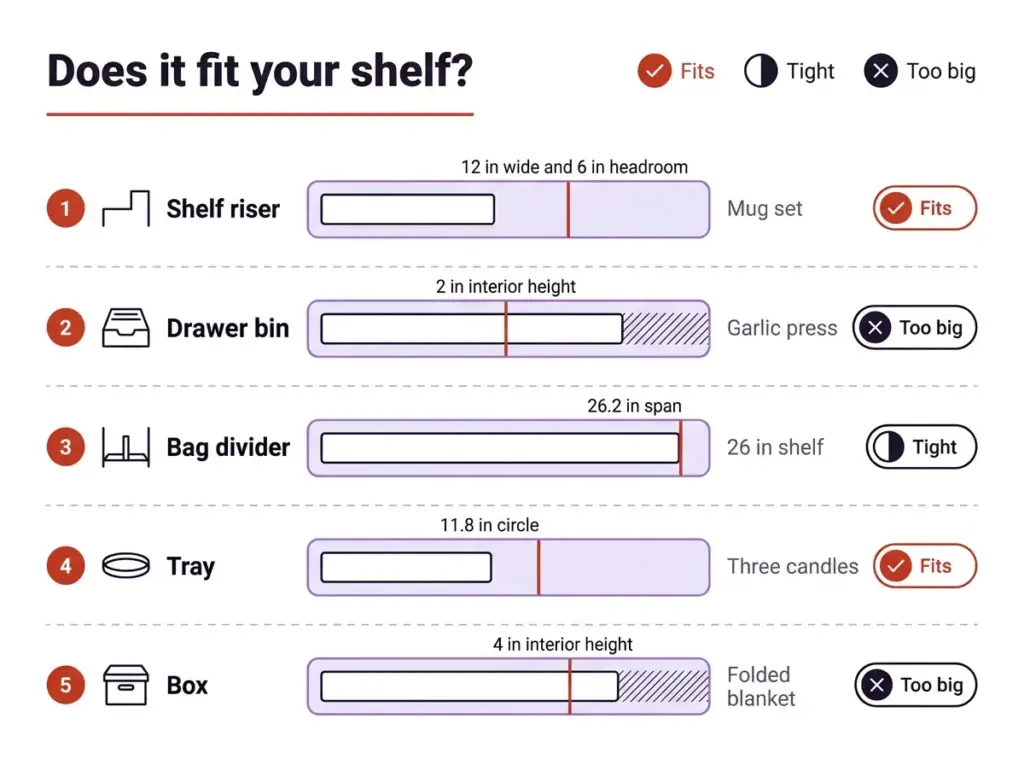
The 2-inch interior height is the honest limit. Cosmetics, jewelry and cutlery fit; a garlic press or a stapler does not.
Decanting: What a Jar Fixes and What It Does Not
Pantry decanting, pouring staples into matching jars, is the move a pantry photo rests on, and it deserves about half the credit it gets. What a jar fixes is real: you see the level at a glance, you open it with one hand, and the shelf reads as a set. What it does not change is how long the food lasts.
According to the USDA’s own guidance on food product dates, “Except for infant formula, dates are not an indicator of the product’s safety and are not required by Federal law.” A “best by” is a quality date, and a jar neither resets nor extends it. A jar adds no shelf life of its own either, so which airtight lids actually seal is the thing to check if you want the flour or the crackers to hold longer.
And the bag you emptied carried the date. A shelf of identical jars with nothing written on them leaves nobody able to say how old the flour is, and the USDA’s food-safety service estimates that 30 percent of the US food supply is lost or wasted at the retail and consumer level, with date-label confusion part of the reason. So decanting works only when the date moves with the food. Write it on the jar or its label the day you pour.
Cut the printed date panel off the bag before it goes in the recycling and tape it to the back of the jar. The original date stays with the food, and the front of the jar stays clean.
Labels That Make Mixed Jars Look Like One Set
Plain, uniform labels are what let mismatched jars read as one set, and no label maker is required. Painter’s tape cut to a single width and written with the same marker does the job for nothing. If you would rather have pre-printed labels, the v2croft 144-piece minimalist label set is black on white, 2.5 x 2.5 in each, and ties unlike jars together; some buyers find they rip or fade, so keep them off anything that gets wet or scrubbed.
Labels that lift at the corners are a surface and adhesive problem, and why pantry labels peel off within weeks goes into it in detail. For a look that has to hold, put the label on the part of the jar that is touched least, not on the lid.
Styling Moves That Do the Visual Work

A Tray Turns Loose Things Into One Object
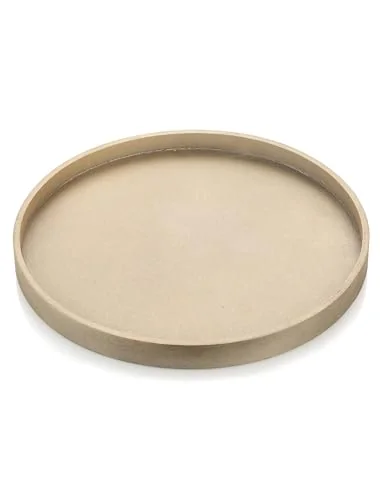
Start with the drop point, not the store. A surface where things land mixed together (keys, wallet, mail, whatever came in with the groceries) needs a tray, a bowl or a box before it needs anything else, because the tray is what separates one object from a heap, and a catch-all tray is the cheapest piece of shelf styling there is. A dinner plate or a wooden cutting board does the job at no cost, so try that first. I’d pick that over any purchase until you know where things really land.
The size is not arbitrary. An 11.8-inch tray with a 2-inch rim is the smallest that holds a perfume bottle, a candle and a small dish without becoming a pile, and the rim is what stops the pile sliding off. How a tray works on a bathroom counter applies the same rule to a vanity.
Risers and the Grouping That Looks Designed
A tiered riser lifts the back row instead of adding another bin, and the grouping that reads as designed, a pyramid grouping, follows one rule: a tall object at the back, a mid-height one beside it, a low one in front, in an odd count. The eye reads that as a single shape, while a row of equal heights reads as stock on a shelf. The Aredpoook 3-tier acrylic display risers are 11.8 x 8.5 x 5.9 in overall and clear enough to disappear; buyers split on durability, since some report them breaking easily and some find them smaller than expected.
They pay off only where the shelf has about 6 inches of headroom and 12 inches of width. Under that they eat the space they were meant to open up. The same tray-and-riser math carries to a worktop, and trays and risers on a kitchen counter shows it with the prep zone included.
Hidden Storage, at Its Honest Size
Hidden storage promises more than it holds, and closed storage hides the mess without removing it. A hinged decorative box with 4 inches of interior height holds remotes and chargers; it does not hold a blanket. The Deco 79 wooden decorative boxes with hinged lids come as a set of two, 10 x 7 x 4 in and 8 in tall, and they are keepsake boxes, not a storage solution, with buyers split on value for money.
A faux-book box and a storage ottoman work by the same limit, so read the interior height, not the outside one. A shoebox with the lid covered in paper does the same job for nothing.
Tip-over is the cost a decorative box does not have and a decorative dresser does. According to CPSC’s Anchor It! campaign on furniture tip-overs, “Anchoring all furniture with drawers, doors, and shelves to the wall prevents tip-over injuries and deaths.” A federal rule on tip-over took effect on 1 September 2023.
For a renter the real hidden-storage cost is the anchor and the conversation with the landlord, not the box.
The Dimensions That Decide Whether It Fits

Shelf Depth, Headroom and Span
Every number in this guide comes from one question: how big is the space inside, and how big is the thing that goes in it? A shelf has three answers. Headroom and width first: a riser pays off where the shelf has about 6 inches of the first and 12 of the second.
Then span: the clear bag divider runs 26.2 inches, so it suits a 26-inch span, and on a deeper shelf the back stays unreachable, which is exactly where the bags you actually use stop going. Depth is the third, and a shelf deeper than the thing it holds wastes the difference.
Basket height against the gap between shelves is the same check. A basket that clears the shelf above by less than the width of your fingers will not come out with one hand, and a basket you cannot lift out is one you stop using. How clear bins measure against real shelves works through the numbers for a rental shelf.
Drawer Interior Height
Two inches of interior height is the number to hold against the real objects before buying a set. A bin that fits a lipstick fails a garlic press, and a drawer of mixed things usually has one tall item that sets the limit for everything else. Lay the tallest item flat beside a ruler and you have the answer in ten seconds. Which drawer inserts fit real dressers covers the deeper dresser drawers where this number changes.
Trays and Boxes Against What Goes on Them
An 11.8-inch circle holds three objects without a pile, as the Hanobe listing gives it, and a 10 x 7 x 4 in box holds remotes and chargers, not a blanket, as the Deco 79 listing gives it. The numbers come from the makers and the sentence names them, with no link out. Measure the thing that has to go on or in, add the gap a hand needs to lift it out, and compare.
A deep pantry shelf is the opposite case: depth wastes itself, and a pull-out reaches the back by pulling, not kneeling. The method is two lines. Write the interior size of the space and the size of the thing that must go in it, then add the working gap for a hand. And apply the one-hand rule: if you cannot remove it with one hand, the look will not last.
Cut a cardboard template to the interior of the drawer or the gap under the shelf, and try the real objects in it. A cereal box gives you the template in a minute, and it settles the size argument before an order does.
A Room-by-Room Pass: Closet, Bags, Sink, Pantry and Desk

The Closet and the Bag Shelf, Boutique Style
The boutique look in a closet is mostly one change, and it is the hanger. A quarter inch of thickness per hanger is the only reason a rod looks calm: same clothes, half the visual noise. The free version is spacing, not buying. Keep the hangers you have, leave an even gap between them, and group by type, then by color (simple color-coding), which is also the first step of a closet system that still works months later.
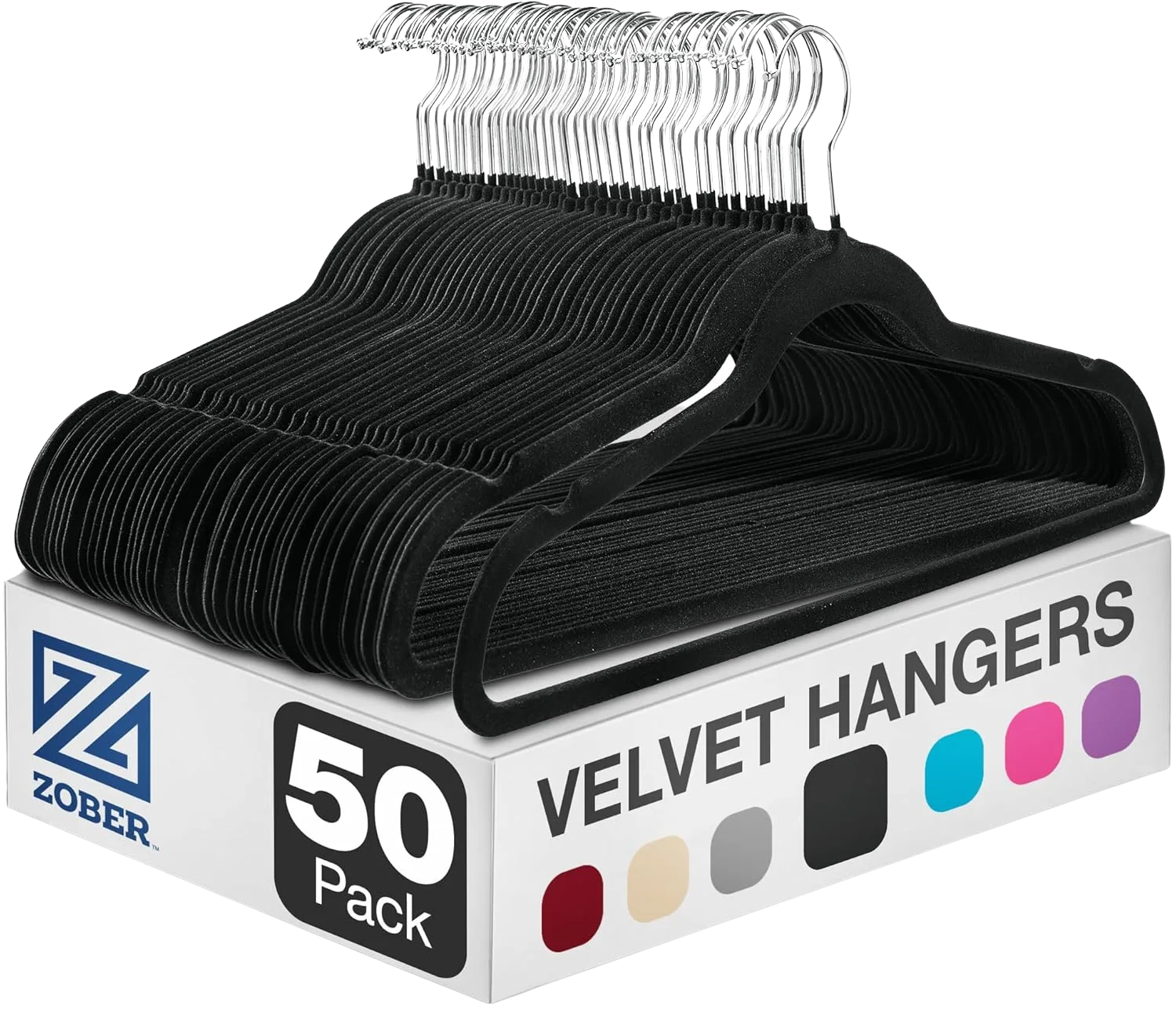
How much rod a slimmer hanger really frees is a number worth knowing, and how much rod space slim hangers really free measures it.
Bags are the second boutique move. A clear divider turns a shelf of bags into a display instead of a pile, and the free way in is two acrylic bookends stood on their sides.
The SPACEKEEPER adjustable clear shelf divider is the bought version: 26.2 x 9.52 x 6.88 in, two bases with four dividers each, and clear slats are what make the shelf read as arranged. Size and fit split, though. It can come out smaller than expected and may not hold larger bags.
Under the Sink and on a Deep Shelf
A deep shelf is where styled storage usually dies, because depth swallows whatever sits at the back and nobody kneels to fetch it. The free version is a rimmed baking sheet used as a sliding tray, ugly and it works. Under a sink the drain pipe decides everything, so measure around it and not just the cabinet width, or the pull-out hits the pipe and goes nowhere.
For a permanent fix, the Delamu 2-tier pull-out organizer 2-pack is the one pick that survives depth: the large one is 13.19 x 7.87 x 10.63 in, the small one 8.27 x 13.19 x 9.06 in, and they stack three high, so you reach the back by pulling instead of crouching. Sturdiness is split, and some call it flimsy for what it costs, so load it with light things and keep the heavy cans on the shelf itself.
The Desk and the Dresser Top
The dresser top takes the tray rule: one tray for what lands there daily, one object that earns the look, and nothing else. The desk takes three categories (what you use daily, what you reach for weekly, what you store) and has a full guide to itself, a desk that survives the second week. The desk-only gear sits with the desk organizers worth buying and the two to skip.
Every pick in this section stands or slides without holes, so a renter can use all of them. An owner can add an installed closet system or built-in pull-outs later, and those are the extension, not the starting point.
Why the Pretty Version Collapses, and the Reset That Keeps It

The Container Is the Ceiling
Open storage accepts unlimited input. An item with no home lands on the surface, and the next one joins it, because a pile gives permission. The ceiling is the container: once a drawer, rod, shelf or box is more than two-thirds full, it stops working, because you can no longer put an item back without moving others. A styled shelf fails earlier, at about 80 percent, since the last fifth fills with the things that fit nowhere.
Hidden clutter works the same way. Clothes crammed into the corners of a drawer keep the laundry from ever going away neatly, and once the corners are emptied the drawer stays tidy. The look cannot survive a full container, so the repair is subtraction, not a prettier bin. That is the whole maintenance plan.
Swaps by Home and Budget
Gather one category in one place before choosing a container for it. The count is usually a surprise (scissors, chargers and tote bags are the usual offenders, and the real number tends to be many times the guess), and the container you were about to order is often sitting in a drawer. The route that starts by owning less is the longer version of this step.
By home: in a small space, a tray first and a riser only where there is headroom. In a deep pantry or walk-in, a pull-out and a hard rule on the back row. A renter uses freestanding pieces and tape-cut labels; owners add built-ins once the system has held, and every pick stays budget-friendly because the free version comes first. The free version of every pick above comes before the purchase, and a pantry that holds on a small budget and what to do first before spending anything on a closet lay out that order for the two rooms where it pays most.
The Weekly Reset and the One Rule for Things That Keep Arriving
A shared space has inflow nobody controls: the partner who buys the item you just donated, the gift that arrives with no shelf, the paper that comes in daily. A system has to absorb that, not assume it stops. One rule covers it, the one-in-one-out rule: something leaves when something arrives, or the new thing goes to a basket with a visible limit.
The reset is a short, fixed pass, five minutes is enough to start, marked off, never a big weekend job. Give every item a home even if the home is temporary. Before any large restyle, edit one category at a time, because a rushed pile mixes the keep and donate sorting and the thing you liked goes in the wrong bag.
Photograph each surface on the day it looks right, then make the weekly reset a matter of putting it back to that photo. It turns a vague chore into a five-minute match.
Build the Return Path First, Then Let the Room Pick the Look
The look comes from the room: its wood, its light and its wall decide the palette, and one container family carries it. Three moves do the visual work (a tray, a riser, and storage that hides at its honest size), and the measured fit decides every purchase, from the 2-inch drawer bin to the 12-inch riser shelf. What keeps all of it standing is a return path for each item and a short reset.
Look again after the first busy week, and again when a season changes the clothes and the things piled on the surfaces. The question is which surface has things standing outside the tray. Whatever is out there has no home yet, and giving it one is the whole job.
Today, put one loose group of items on a plate or a cutting board and see which of them has no place to go. Give that one a home, and watch whether it stays put through the weekend.
Frequently Asked Questions
01What does aesthetic organization mean?
Aesthetic organization is storage that looks calm and still works: every item has an easy home, and the whole setup reads as one look. The test is whether you can put things back in a few seconds without moving anything else.
02How do I organize a closet like a boutique?
Swap thick hangers for slim matching ones, space them evenly, and group by type and then by color. A clear divider on the bag shelf makes bags read as a display instead of a pile.
03How full should a styled shelf or drawer be?
Stop at about two-thirds full. Past that you can no longer put an item back without moving another, and the look fails before the container does. A styled shelf tends to give out nearer 80 percent.
04What should I put in my room to make it look aesthetic?
Start with one tray on the surface where things land, one container family, and one riser or grouping per shelf. Fewer objects in a consistent material read as designed.
05Does moving food into matching jars make it last longer?
No. The USDA says product dates are not an indicator of safety and are not required by federal law, so a jar neither extends nor resets a best-by date. Write the date on the jar when you pour.
Disclaimer: ClutterlessNest is a participant in the Amazon Services LLC Associates Program. As an Amazon Associate we earn from qualifying purchases. This article may contain affiliate links — if you buy through them, we may earn a small commission at no extra cost to you. We only recommend products we have tested or genuinely believe in.