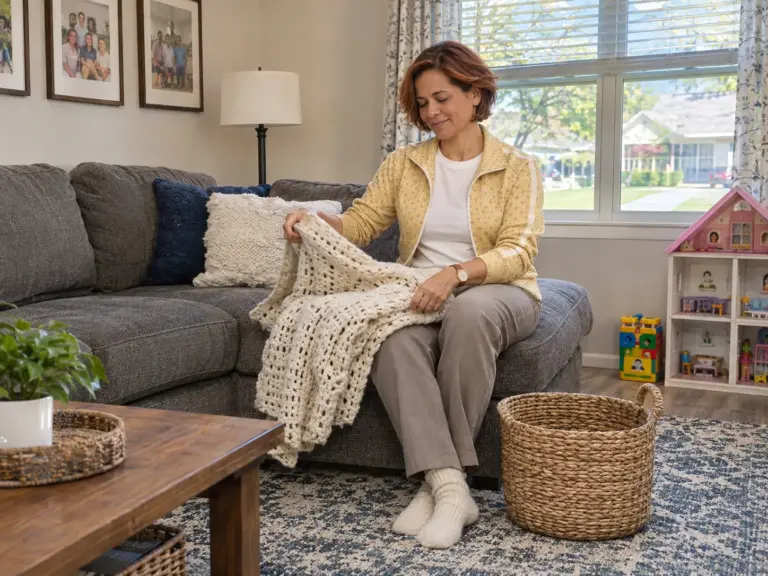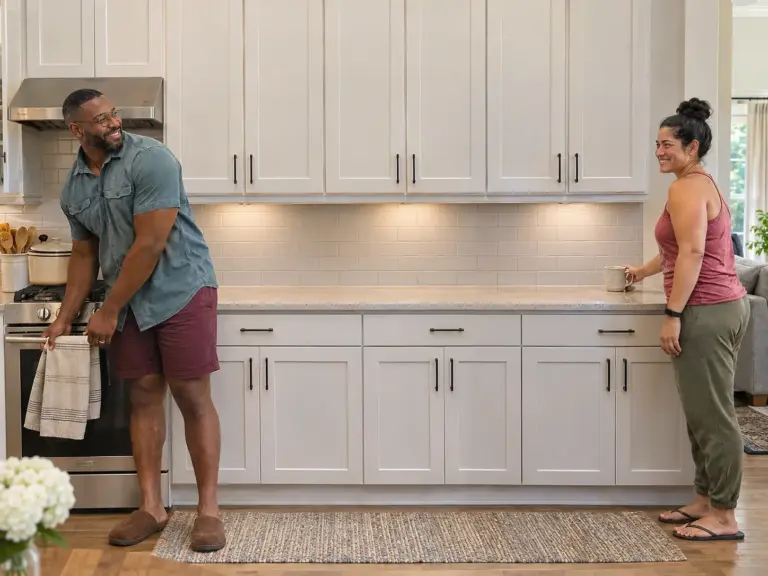

Picture week three of the photo you saved. The shelf that held three objects on the first Saturday now holds the mail, a phone charger and a hairband, and the lidded box beside it has become the one nobody opens. NAPO, the professional organizers’ association, caps décor at two or three pieces per surface. Japandi and Scandinavian organization is the storage that makes that cap survivable: what the two styles share and where they split, the materials and boxes that obey each, which room gets which treatment, how to choose by who lives in the home, and the short reset that keeps it calm.
The quick comparison first, since the two styles get blurred together more than any other pair.
| Scandinavian organization | Japandi organization | |
|---|---|---|
| How it looks | Pale walls and light wood, open and easy to reach | Earthier, deeper tones, restrained |
| What stays visible | A few styled pieces and everyday items within reach | Almost nothing but one or two chosen objects |
| Where the rest goes | Labeled bins, modular cabinets, open shelves styled and not packed | Closed cabinets, drawers and lidded baskets |
| What it asks of the household | To see things in order to use them | To remember what is behind each door |
| What both share | Calm and daily function | |
Japandi and Scandinavian Organization Start With the Edit, Not the Basket
You saved a pale, quiet room, so you went shopping for baskets. Six weeks later the baskets sit around the same unedited pile, now with lids. A calm room is mostly a room with fewer things in it, and no container fixes a surplus.

What the Two Styles Share
Both styles rest on two promises: the home resets in minutes, and every object is either used or loved. A calm home and daily function are the shared core, and the difference between the styles is only how each one gets there.
Three philosophies sit underneath, and they are context, not rules. Hygge is about warmth and comfort, wabi-sabi values the worn and the imperfect, and minimalism asks for fewer things. Each shapes what a shelf is allowed to hold, but none of them tells you where the charger goes, and that part is a storage decision.
Where Scandinavian and Japandi Part Ways
Scandinavian organization reads light, open and reachable: pale walls, light woods such as birch and ash, soft warm textiles, a few styled pieces, modular storage and everyday items within arm’s length. Japandi organization reads restrained and concealed: deeper earthy tones, stone, ceramic and dark wood, generous empty space, and almost nothing visible beyond one or two chosen objects. Treat those as the styles’ conventions, not regulations. No official standard owns either look, and real homes borrow from both.
The split that matters for organizing is not color. It is what each style asks you to hide. A Scandinavian room lets ordinary life show (the kettle, the folded throw, a row of labeled bins) as long as it is in order and within reach, so the household’s job is to see things in order to use them.
A Japandi room closes the door on nearly everything, so the household’s job is to remember what lives behind each door. A memory-based system suits one adult who likes empty surfaces. It suits a house with a toddler and a partner who sets keys down on the first flat spot far less.
Open versus closed storage looks like a decoration choice but behaves like a contract about effort, and the rest of this guide keeps returning to it.
The traditions go deeper than one article can carry: Japandi home organization ideas, Scandinavian storage solutions, Japanese home organization techniques and Nordic minimalism for small spaces each deserve their own treatment. What follows is the working system under all four.
The Edit That Comes Before Any Storage
Edit to essentials: keep what is used or loved. Move the rest out of sight or out of the house. Size the container to what survived, never the other way round, because a box bought first only gives the surplus a permanent address.
The free route comes first. The shoebox from the hall closet, the market basket under the sink and the lidded tin from a gift can all stand in on the shelf for a week, and the week tells you whether you need a real container at all. To find out what survives, pull everything off one shelf and put back only what earns its spot; this walkthrough on how to edit down to the things you actually use covers the sorting. If the edit stalls halfway, decluttering methods that last past the first week offer a different way in.
Choose the Palette and the Materials Before You Choose a Box
The box looked right in the listing. On the shelf, in a pale room, it is the loudest object there, because its tone belongs to a different room. That mismatch is a material problem, not a styling one.
Pale Walls and Light Wood for Scandinavian Rooms
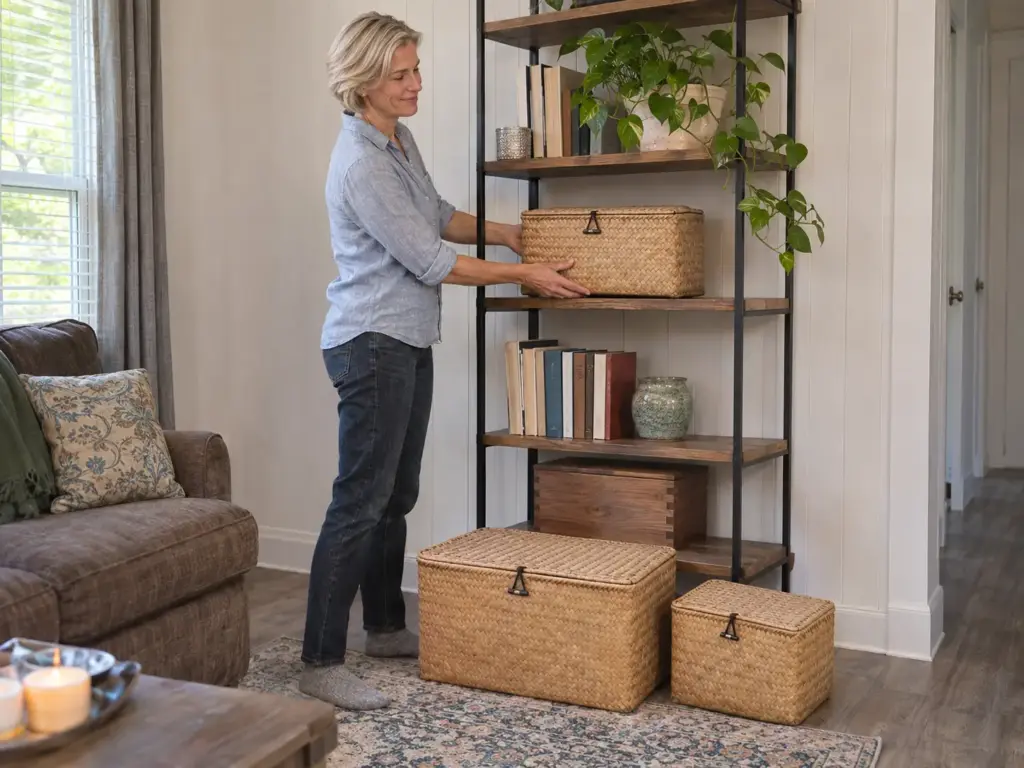
Scandinavian rooms run on a neutral palette of pale walls and light wood, birch and ash above all, with soft linen and wool. A pale fabric box or a natural-weave basket sits inside that palette and reads as part of the wall. The same box in black fabric would look like a hole.
Walnut, Charcoal, Clay and Muted Green for Japandi
Japandi leans deeper and earthier, in muted colors: walnut, charcoal, clay, muted greens, with stone, bamboo and ceramic doing the quiet work. A darker or warm-caramel weave belongs there, and the pale box that vanished in the Scandinavian room would glow here. Soft, warm, layered light belongs to both styles, but that is a styling note, not a storage rule.
One Container Family Across the Room
The functional rule under both palettes is one container family, so that five objects read as one block. Woven baskets from the closet in the same material count as a family, and they cost nothing. When the budget is the problem, clear tubs with lids from a discount store do the job inside a cabinet, where nobody sees the mismatch; buy them two inches shorter than the shelf above and set two or three across.
For the rooms where the boxes stay on show, the Nonam set of three lidded seagrass baskets is the family rule in a single purchase. The sizes run 13 × 8.5 × 6 in, 11.7 × 7.5 × 5.2 in and 10.6 × 6.3 × 4.3 in, and they nest when empty. The 6-inch box takes a top shelf and the 4.3-inch one fits a nightstand.
It is a seagrass set, and seagrass is a dry-room material: the maker’s care note on seagrass baskets says to avoid using one in a wet place for a long time. If your shelf is flat rather than deep, the Hipiwe set in the next section costs less per box. For lidded baskets that earn their shelf space, see which lidded baskets are worth the shelf space.
Cut a sheet of cardboard to the footprint of the box you are considering and leave it on the shelf for a day. If the household walks around it, bumps it or moves it to the counter, the box will do the same, and you learn that for free.
Close the Noise and Leave Two or Three Things Out
The shelf that survives the photo holds two or three objects and a lot of air. Yours holds thirty. And the first things to break the look are small and black: remotes, chargers, cables.
What Stays on the Surface
According to NAPO, “Limit décor to 2-3 pieces per surface for a cleaner, calmer look.” That one sentence is the whole open shelf expressed as a number: three objects with air around them, not a row of matching jars. NAPO’s room-by-room guide applies the same logic to counters, where only daily-use items stay out. In a Japandi kitchen that means the bread box and the kettle; in a Scandinavian one a few chosen items sit within reach.
The decision for each object is binary. It stays visible if it is used daily and is good to look at. It gets a closed home if it has a loud package, a cable or a label.
Open shelving can stay, with restraint, because negative space is what makes it read as styled, and an open bookshelf that reads styled, not packed shows how few things that takes. For the surfaces that refuse to stay clear, there is a longer piece on keeping surfaces clear for good.
What Gets a Lid
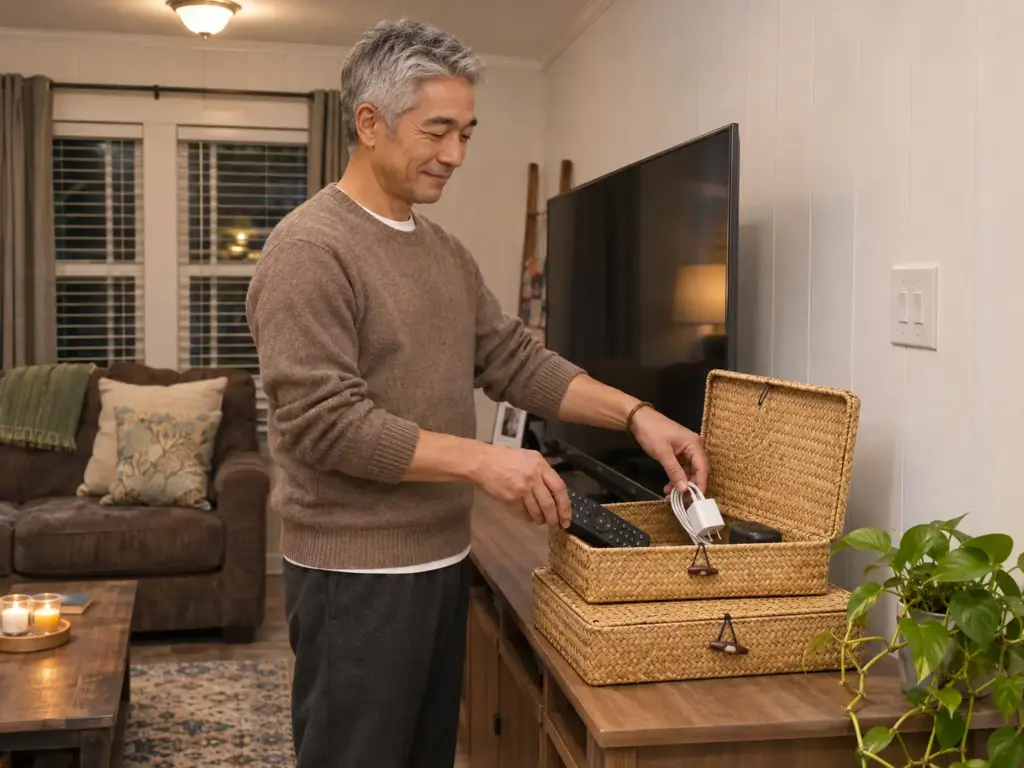
NAPO’s advice for the small black objects is plain: store controllers, remotes and chargers in labeled drawers or baskets. One lidded basket beats seven small trays, because seven trays are seven more things to place.
The lid is an effort decision, and this is where the two styles quietly fail. A lid belongs on what is used less than weekly or what looks loud: seasonal throws, spare cables, the box of batteries. It does not belong on what the household reaches for with full hands, such as keys, sunglasses or the mail.
Japandi’s usual instruction is to hide everything, and that instruction breaks at the entry shelf, where a lift-off lid loses to the nearest flat surface, the household’s drop zone, within a day. Daily-use items get an open tray or a flip-top, closed things get the lid, and nothing in between.
A Flat Lidded Box for the Shelf That Must Look Calm
The shelf that must look calm needs a box that does not stand up. The Hipiwe set of two flat lidded seagrass bins measures 13 × 11.2 × 2.95 in for the large one and 11 × 9.25 × 2.5 in for the small one. Under 3 inches tall, it sits on a 12-inch upper shelf or inside a drawer and reads as one calm block instead of a row of objects.
Some units arrive flimsy, and the weave gives when a full box is stacked on top of it, so keep it to a single layer. If only one shelf needs the look, use the small box alone.
Measure the Shelf Before You Buy the Lidded Box
You bought two storage boxes to hide the clutter, and one will not clear the door of the cabinet above it. The box looked right on the listing and wrong against the shelf.
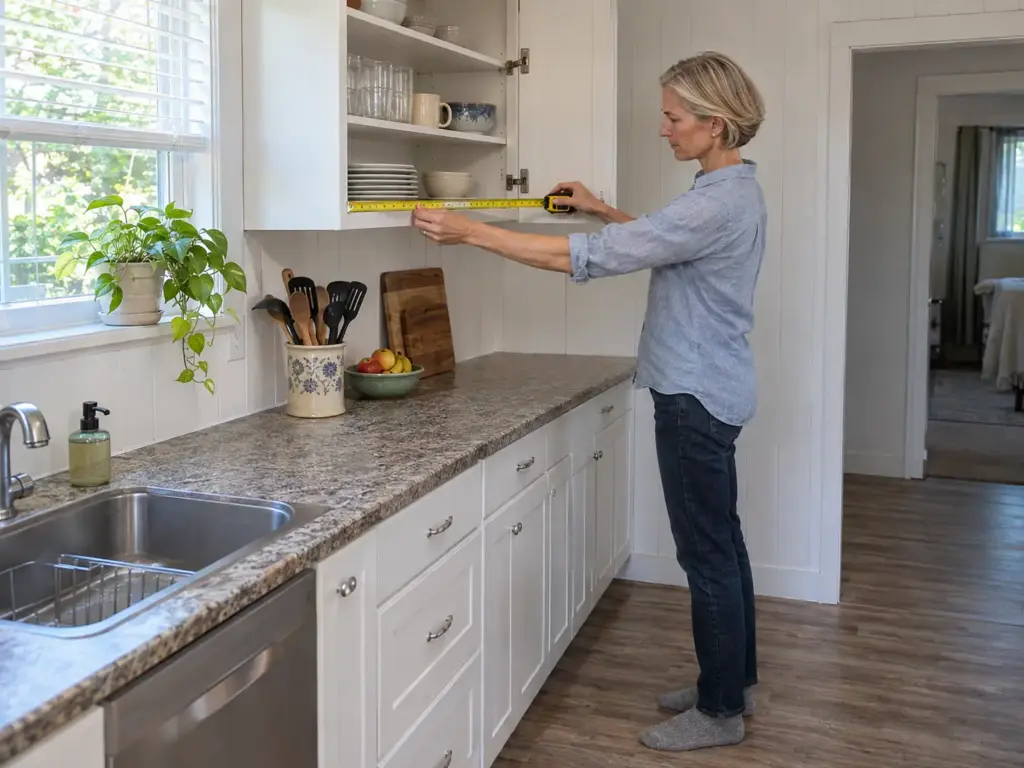
The Cabinet Depths Every Box Has to Beat
Cabinets come in standard sizes, and a closed box has to beat them. Shelf depth decides it: a box that fits the cabinet and still lets the door close is the whole purchase.
NKBA cabinetry guidance puts base cabinets at typically 30 inches high and 24 inches deep, and wall cabinets at generally 12 inches deep with the bottom of the case installed at 54 inches. In practice that means a closed box deeper than about 22 inches disappears at the back of a base cabinet, and a box on an upper shelf has to stay under about 11 inches deep and about 10 inches tall so the door closes.
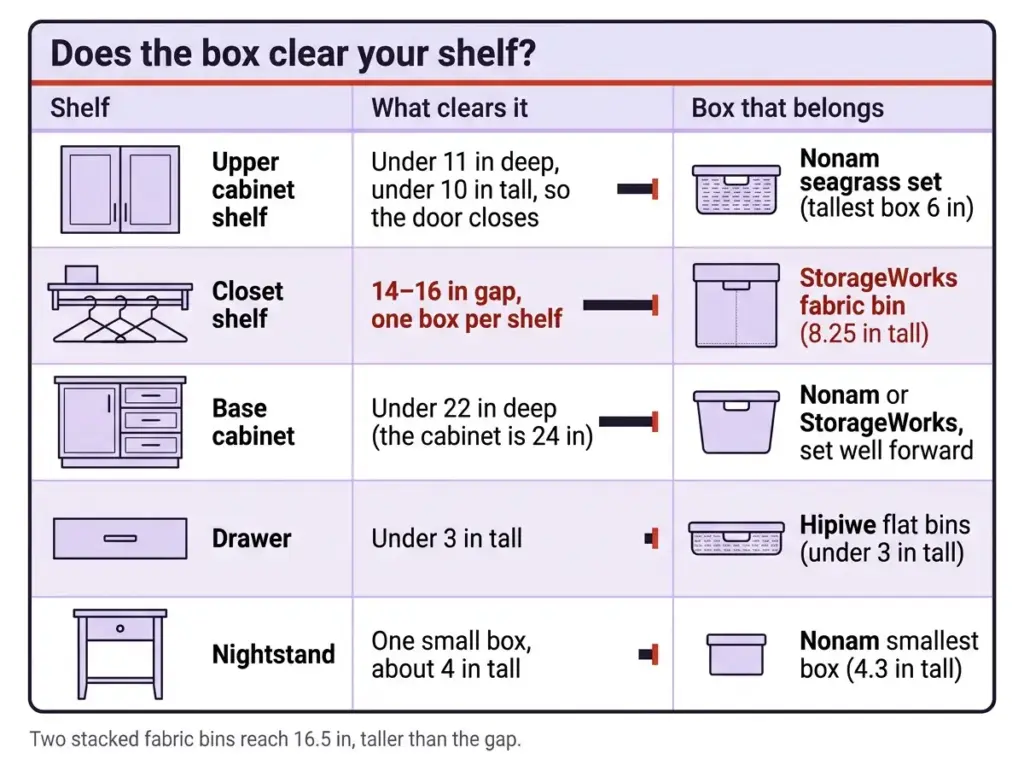
The 24-inch number depends on you. A 24-inch cabinet does not take a 24-inch box: the door frame, a hinge or a pipe takes two inches, and a box that long forces you to pull the whole thing out to reach one item. Two shallower boxes in a row beat one long one.
Three boxes in this guide map to three shelves. The Hipiwe is under 3 inches tall, for a flat shelf or a drawer. The Nonam’s tallest basket is 6 inches, for an upper or closet shelf.
The StorageWorks fabric storage bins with lids are 12.5 × 9 × 8.25 in (15 L each, with an attached flip-top lid and a front pull handle), made for the usual 14 to 16 inch gap between closet shelves. Two stacked reach 16.5 inches, so it is one box per shelf.
The lid can stick if pressed down hard, the bins need a day of airing for an initial odor, and the pale fabric shows dust. One 2-pack is enough, and the same box in black hides shelf dust better.
Measure the opening, not the shelf. Close the cabinet door on a stack of cardboard cut to the box’s height and depth. If the door shuts without a nudge, the box fits; the shelf’s own dimensions never tell you that.
For the method behind every closed box here, read how to choose bins that fit and last.
Which Material Survives the Humid Room
Seagrass is a shelf material. The maker’s care note tells you to avoid long exposure to damp, and a steamy bathroom or the cabinet under a kitchen sink counts as damp. Fabric and woven fiber both take up moisture from the air and dry slowly.
For those two rooms the answer is a sealed material, such as lidded plastic or glazed ceramic, and the lid is the part you check for a snug seal. This comparison of when fabric bins hold up and when plastic is the answer walks through the trade.
The Budget Version Next to the Boutique One
For budget storage the fabric 2-pack is the cheap end; the seagrass sets cost a little more. There is no reason to spend beyond that to get the look, because a pale weave on a dry shelf looks the same at either end. Renter-friendly storage is just as modest, and it is no-drill storage by nature: a lidded box on a shelf that is already there, and a door-hung basket. Nothing adhesive has to carry weight.
Give Each Room One Job for Its Closed Storage
In each room, one surface is the tell. A counter with the toaster, the mail and the fruit bowl is not a Japandi kitchen however pale the cabinets are.

The Kitchen Counter
NKBA’s planning guideline asks for 158 inches of countertop frontage, 24 inches deep with at least 15 inches of clearance above, and it treats that surface as a work area first. You can read it in the NKBA’s kitchen planning guidelines. An appliance parked there permanently eats prep space, and that is the difference between the two looks: a Scandinavian counter reads calm and a Japandi one reads empty. Keep the daily kettle and the bread box, store the rest at a distance (NAPO says the same about infrequently used appliances).
Open shelving in a kitchen has a cost that photos hide. Grease and dust settle on whatever is out, so an open shelf is a room you have to maintain visually. Behind a door that cost disappears, which is the point of storage that hides clutter. For the cabinet side of the job, see measuring kitchen cabinets before you reorganize them.
The Living Room and Its Black Objects
Remotes, chargers and cables go into one lidded basket, kept in a labeled drawer or basket as NAPO advises. One big lidded box beats several small trays, for the same reason a single junk drawer beats five little ones: there is only one place to look. Put the basket where the cables already run, because a basket across the room loses to the nearest end table.
The Bedroom Closet and the Nightstand
The closet shelf takes the StorageWorks box from the last section, one per shelf. The nightstand takes one deep lidded basket.
The ORDELITE X-Large lidded seagrass basket, at 14.3 × 9.4 × 6.9 in, holds a real pile of cables, toiletries and snacks behind one woven face, and its button-secured lid keeps dust out. Sturdiness and lid closure are mixed: some units feel flimsy and the lid is not tight.
Check shelf depth first: if the shelf is shallow, drop to its smaller sizes, and the Hipiwe set handles a flat shelf. For the whole bedroom without drilling, see a bedroom that stays calm with closed storage.
The Bathroom and the Humid-Room Rule
Seagrass is the obvious pick in this guide, and it is the wrong one in a steamy room. Use a sealed material and keep what stays visible to the few things used every day. Anything beyond that closes behind a door. Bathroom organizers worth buying and the ones to skip covers the wet-room materials.
Choose by Who Lives There, Not by the Photo You Saved
The partner who puts things back “anywhere” does it because the lid has no label. The child is not going to open a box to find a toy. The style that wins is the one the least organized person in the house will actually follow.

The Household That Will Not Open a Lid
If anyone has to see a thing to use it, the Scandinavian side wins: visible storage, clear labels, one labeled bin each. Japandi’s concealed storage asks the household to remember what is inside, and a child or a partner on the way out the door will not.
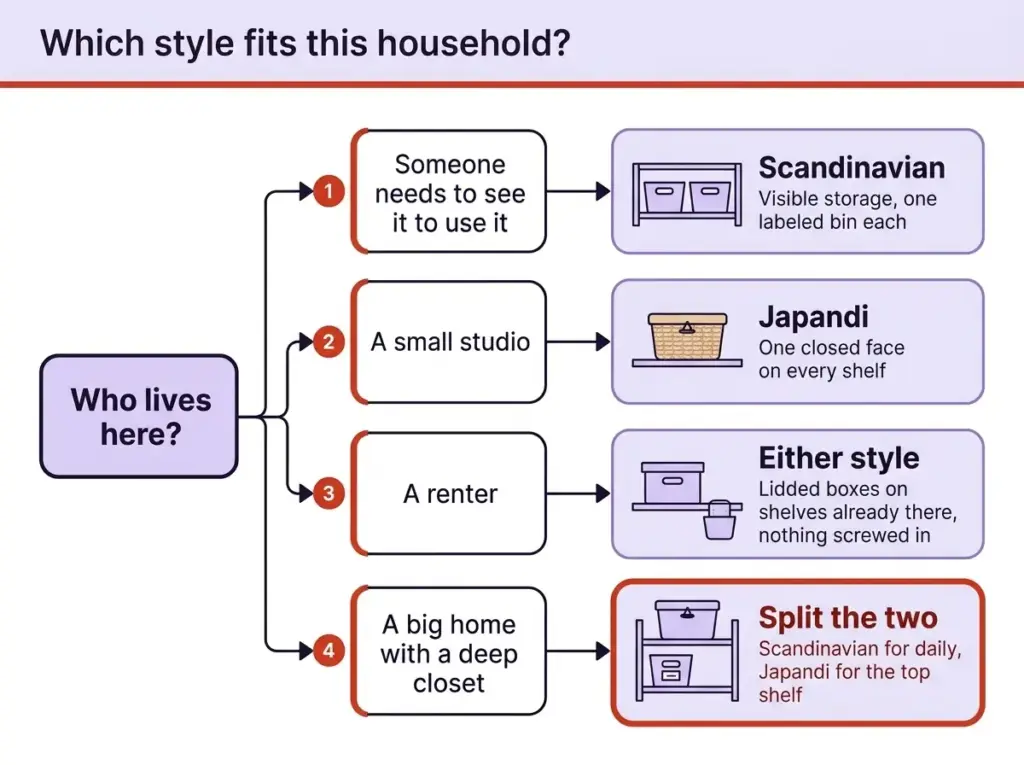
Do not take the Japandi hide-everything advice into that house. A labeled bin per child, open at the top, keeps the system alive; the lid can live on what only adults use.
A Small Studio That Cannot Absorb the Noise
In a studio of about 400 square feet, Japandi pays off. One closed face (a lidded box on each shelf, a big basket for blankets) removes the visual noise that a small room cannot absorb. The studio has no spare corner to hide a pile, so every pile is on show. A guide to organizing a small apartment so it stays neat extends the same logic across the whole floor plan.
The Renter’s Closed Storage
Renting changes the method and almost nothing about the result. Lidded boxes go on shelves that are already there, and a door-hung basket handles the rest. Nothing is screwed into the wall, and the no-drill version looks the same as the drilled one from across the room. If the load is heavy, read about storage for loads that adhesive cannot hold.
The Big Home That Swallows Things
A walk-in closet or a large home has the opposite constraint: too much space, and deep shelves let things pile up out of sight and stay there. Split the styles. Scandinavian handles the daily layer, open and labeled. Japandi takes the top shelf, as category-level lidded baskets labeled once and opened monthly, so the shelf is a decision point and not a dumping ground.
For that top shelf the HONCESTA 18 × 18 × 14 in woven cotton-rope basket with lid is the one big lidded basket. Cotton rope reads softer than seagrass and does not snag, so it holds throws and pillows well. It arrives creased and needs shaping, and the lid does not close tightly. For anything that fits a shelf, the Nonam set takes half the footprint and a third of the bulk.
Expect the Open Shelf to Drift and the Closed Cabinet to Fill
The shelf styled with three objects on the first Saturday holds the mail, a charger and a hairband three weeks later. You blame willpower. This is clutter creep, and the real cause is friction.
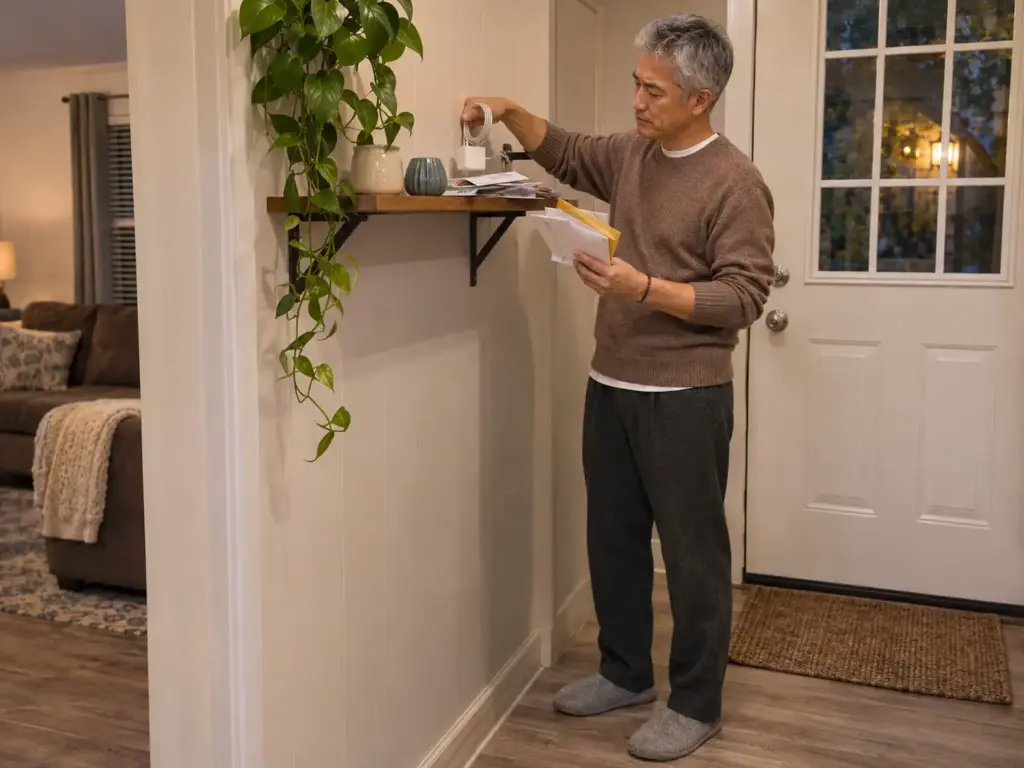
How an Open Shelf Becomes a Landing Zone
NAPO’s behavioral-science post frames it well: “When something consistently piles up in the same place, it’s telling us something about how behavior and environment are interacting.” The same pile in the same place is data, not a character flaw. A flat surface near the door becomes a landing zone because it is the cheapest place to set something down. The styling never removed that. If a styled shelf has already gone messy, a styled shelf that has gone messy and how to fix it starts with where the pile lands.
Why a Closed Cabinet With No Category Becomes a Junk Cabinet
The mirror failure is the closed cabinet. Doors hide the mess, so the cabinet fills quietly, and soon it is a junk drawer with a prettier front. A lid does not fix this, which cuts against the advice to give everything a lid. What fixes it is the category inside: one lidded home per category, so every object has an answer to where it goes.
The Step Count That Decides Whether a System Holds
Count the steps of putting something away: lift the lid, open the box, take the item, replace the lid, set the box down. That is already too many, and it is exactly what a lidded Japandi box adds. NAPO’s behavioral point is that a basket that takes more effort than dropping the thing on the floor will lose to the floor.
One lid, one thing, one motion is the target, and anything slower gets a flip-top or an open tray. For the failure frame the two styles share, see why minimalist organization stops holding.
Keep It Calm With a Two-Minute Reset and a Monthly Look
The reset has to be small enough that the least organized person in the house does it without being asked. If it takes more than a couple of minutes, the floor wins.
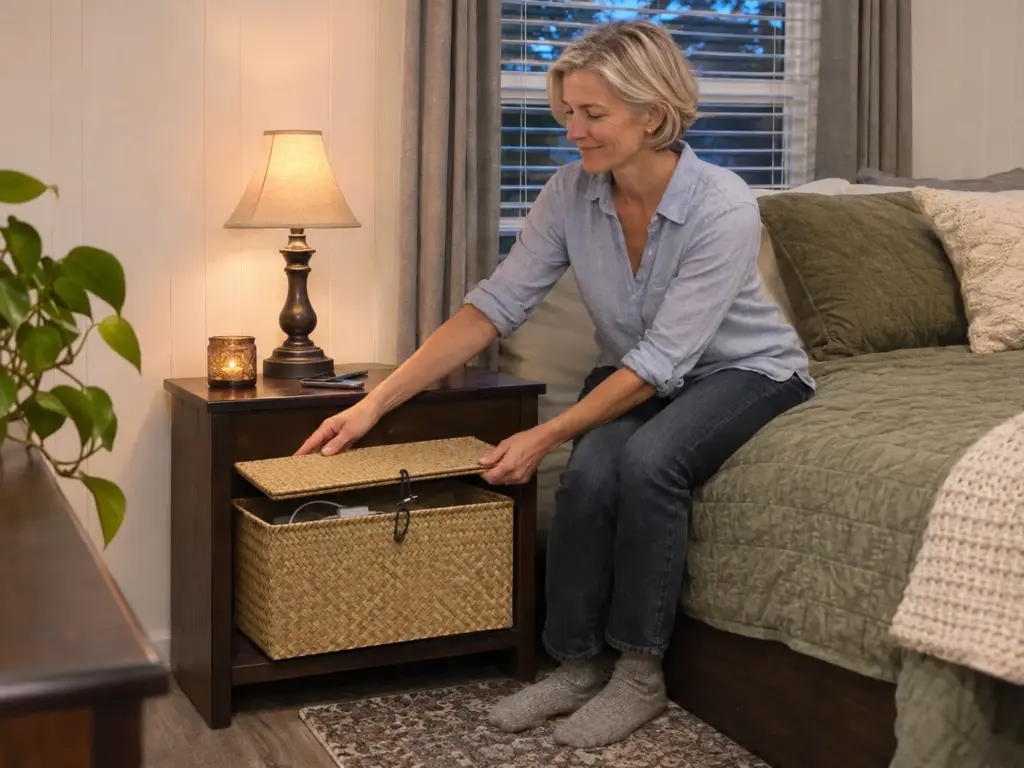
The Two-Minute Reset
The daily reset routine is short: surfaces go back to their two or three objects, the lidded boxes get shut, and the one-day pile returns to its category. Do it where the pile lands, at the end of the day, and nowhere else.
Label Once, and Give Every Category a Lid
Label the category once, at the box level, so a partner who puts things back “anywhere” has an answer. The label is the return path.
Put the label on the side of the box that faces the person most likely to forget. A label that faces the wall is decoration, and a label on the front is a rule.
A related look follows the same logic, one container family and a weekly reset, if you want to see it applied to a different style.
What to Check Monthly and What to Let In
Intake needs control for the category that grows, usually the decorative objects and the storage baskets themselves: one thing in, one thing out. The top shelf is opened monthly and edited, because that is where a walk-in closet slowly becomes a storage room. An intake rule for what comes in after the styling keeps the edit from reversing.
Build the Return Path First, Then the Look
What carries the look is short: an edit first, a palette and a container family, two or three things out, and lids only where the household will actually open them. What carries the keeping is just as short, a two-minute reset and a monthly look at the top shelf. The style comes second; the return path is the system.
Check the surface you cleared once a week and the top shelf once a month. If the pile is back in the same place, move the box toward it instead of scolding the household. Today, take everything off one surface, put back two or three things, and notice where the rest lands after a week.
Frequently Asked Questions
01What is the difference between Scandi and Japandi?
Scandinavian organization is light, open and reachable, while Japandi is restrained and concealed. Scandi keeps everyday items visible and in order, with pale walls and light wood. Japandi uses deeper earthy tones and closes most things behind doors, drawers and lids.
02What is Japandi interior design?
Japandi is a blend of Japanese restraint and Scandinavian warmth, built on natural materials, a muted earthy palette and plenty of empty space. For storage, it means closed cabinets, drawers and lidded baskets, with only a few chosen objects left out.
03What is Japandi versus wabi-sabi?
Japandi is a full interior style, while wabi-sabi is one philosophy inside it, the one that values the worn and the imperfect. A handmade ceramic bowl with a chip belongs to wabi-sabi; the closed cabinet next to it belongs to Japandi.
04How do you organize your home in Scandinavian style?
Keep it pale, open and reachable. Edit to what you use, store daily items where you can see them, label bins by category, and style open shelves with two or three pieces and air around them instead of packing them full.
05Can you mix Japandi and Scandinavian organization in one home?
Yes, and a large home benefits most from the split. Use Scandinavian for the daily layer, open and labeled, and Japandi for the top shelf, with category-level lidded baskets opened monthly. One container family keeps the two reading as one room.
Disclaimer: ClutterlessNest is a participant in the Amazon Services LLC Associates Program. As an Amazon Associate we earn from qualifying purchases. This article may contain affiliate links — if you buy through them, we may earn a small commission at no extra cost to you. We only recommend products we have tested or genuinely believe in.