
You pinned a calm, pale room, bought four matching baskets and a set of white shelves, and a month later the baskets hold whatever got swept off the table while the shelves are crowded from the front edge to the wall. The look did not fail because Scandinavian storage solutions are fussy. It failed because the storage was bought as decoration before anyone measured the wall or edited the pile.
The style’s own working rule is less but better, with storage that hides the mess instead of displaying it, and everything below runs on depths and clearances you can check with a tape measure. You will get the edit, the wall, baskets and boxes, hidden furniture, the rooms one by one, the measurements, and what tends to fail by month three.
Quick Answer
Scandinavian storage solutions hide the mess inside furniture or shallow, wall-flush units in light wood and natural weaves, repeated across a room. Start by editing the pile, measure depth and clearance before buying anything, and add a closed front only where a weekly reset will reach it.
Scandinavian Storage Solutions Start by Editing, Not Buying
A calm room is mostly a room with less in it. The shopping usually starts in the wrong place: matching containers get picked before anyone has decided what the containers are for, and the same pile ends up in prettier lids.

What defines the style: less but better
Scandinavian minimalist storage rests on four conventions, and none of them is a color. Edit first, so that what stays is worth the shelf.
Let hidden storage carry the mess rather than display it. Repeat one neutral palette and one family of materials across the room, because repetition is what lowers the visual noise of a shelf. Give every object a fixed home: when everything has a home, putting it back needs no decision.
The materials follow from how the ranges are built, not from a law of the style. Light wood tones such as oak, birch, ash and pine dominate the affordable end, finished matte, paired with natural fibers like seagrass, cotton rope and linen in warm neutrals. Teak and walnut exist in Scandinavian design, but they are the premium end of it, and a room does not need them to read as Scandinavian.
Why the edit comes before the box
The edit is the free option: declutter before you buy, and give it the first hour. Walk the room and note which pieces come with a closed front, which crate or thrift-shop basket is sitting unused, and which objects have no job at all. Those get placed before a single container goes in a cart.
A basket bought first becomes a lid: it fills with whatever gets chucked in, and a twenty-minute tidy turns into a full re-sort. A basket only works when it holds one category, so the category has to exist before the basket does.
Closed where the room is busy, open where the eye rests
Put closed storage where traffic is heaviest: the entry, the living-room media wall, the floor around the bed. Keep open shelving for the few objects that deserve to be seen, and leave the rest of each surface empty. The claim that closed storage keeps the airy look is real, but it has a cost that gets its own section further down, because anything behind a door stops being looked at.
If you want the rule set behind the look, the wider set of Japandi and Scandinavian organization rules lays it out, and this guide applies those rules piece by piece and room by room.
Use the Wall: The Shelf Depth That Makes the Look
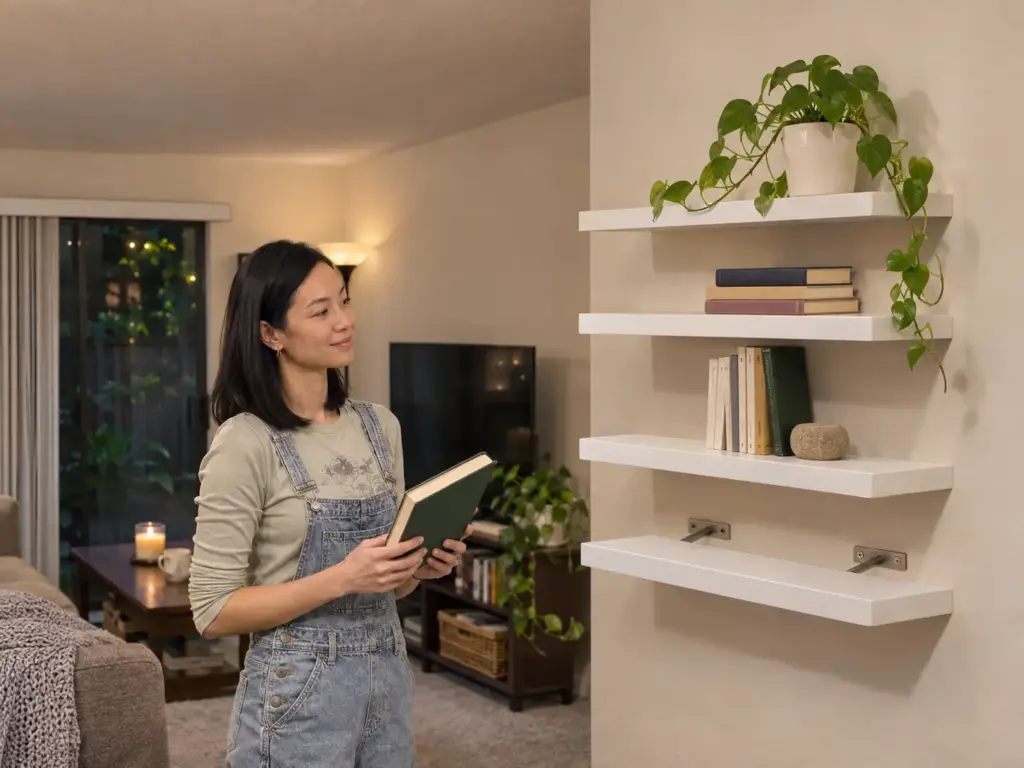
Scandinavian walls look light because the shelves on them are shallow. Depth is the number that decides whether a wall reads as a clean line or as a second closet. Wall-mounted storage frees the floor, and vertical storage is the only way to add capacity to a small room without adding footprint.
Why the depth is the look: shallow beats generous
Hang a generous shelf because it looks like it will hold more, and it fills from the front edge to the wall inside a month. Past about 16 in, a second row starts that nobody can reach, and the back row becomes storage for things you have forgotten.
A standard closet shelf is 14 in deep, which is one folded stack front to back. An upper kitchen cabinet is 12 in deep. The design-house modular system from Muuto, the one most Scandinavian walls are imitating, is 13.78 in deep, and that is the number to remember: it is a wall system, not a wardrobe.
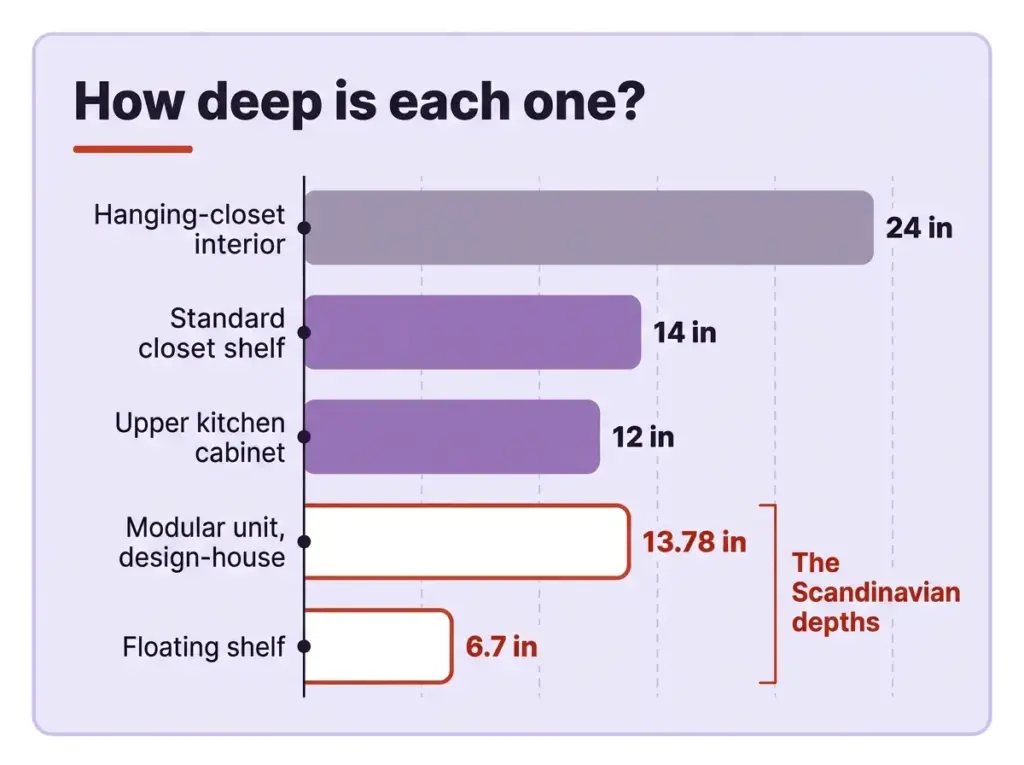
Go shallower still and the shelf stops competing with the wall. A floating shelf of about 6.7 in carries a row of books and a few objects and still reads as a line on the paint.
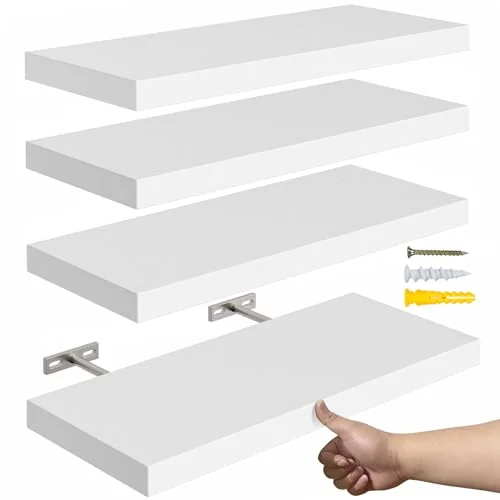
That explains why the YUFLINX 16 inch White Floating Shelves Set of 4 earns a place here: 16 in is the shortest run that still looks intentional, and four of them make one composition instead of four stray planks. They suit a wall that has nothing on it at all. If the wall already holds a shelf, arrange the books and objects you have on that shelf first and see how much of the problem disappears.
The flaw is in the install. The shelves can tilt during mounting, and the anchors in the box are weak, so use anchors rated for your wall type and check the level before the screws go in all the way. They also need a drill, which rules them out for anyone who cannot make holes.
Floor, wall or grid: what the modular systems trade away
The logic of modular shelving is real, and cube storage works the same way: a grid of boxes only stays square when something ties it together. Muuto ships each Stacked module with two powder-coated steel clips, one at the front and one at the back, and those clips are what keep a grid from leaning. The modules stand on the floor, on a plinth or on a wall rail, and a grid with no clips is just boxes balanced on boxes.
The trade is load. Muuto rates a module at 25 kg (55 lb) when it stands on the floor but only 12 kg (26.5 lb) when it hangs on the wall, with a ceiling of five modules and 240 cm in height. Hung on a wall, the same box holds less than half of what it holds on the floor. A wall of books is heavy, so the books belong in the floor-standing columns and the wall-hung modules should carry the light things, a split that also keeps the visual weight low.
Three objects per shelf, and the shelf that overfills anyway
The working rule for open shelving is three objects per shelf: a stack of books, one thing with a shape, one living thing. An open shelf has no limit built into it, which is exactly why it overfills, and why the limit has to be a rule you apply rather than a feeling you wait for. Choosing a mount matters too, and which floating shelves hold weight and which tilt is worth reading before any hole is drilled.
Tall shelving needs a second thought about the wall. Open bookcases fall outside the federal clothing-unit rule, which is precisely why they get skipped, and why they tip. Anchor them anyway.
The renter’s version of a wall
A floating shelf needs a drill, and the person who drills for a single shelf often ends up patching the holes at move-out. The honest renter version is a no-drill one: a leaning ladder shelf, a freestanding slim unit or adhesive hardware used strictly at the maker’s rating. None of those need permission, and none of them go in the deposit conversation.
Baskets, Boxes and the Materials That Hold Their Shape
Containers are where the Scandinavian look is most often bought and least often thought through. The question is not which basket is prettiest. It is which material survives the room and the weight it is given.
One material family, not a matching set
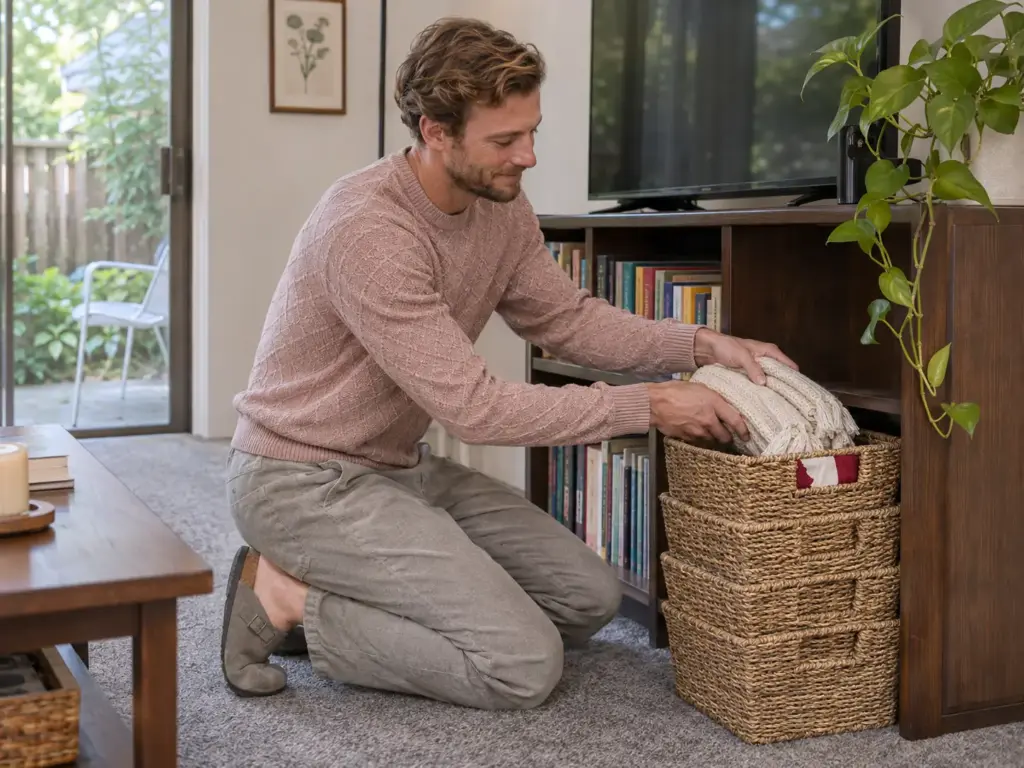
Consistency of weave and tone is what lets two or three sizes read as a single block on a shelf. A mix of weaves reads as clutter, even when each basket is nice. The free version comes first: nested wooden crates and secondhand baskets from the same family cost nothing when a thrift shop or a cupboard already has them.
When a set is the right call, the Best Choice Products Set of 4 Stackable Seagrass Storage Baskets is the budget end of the one-family rule. Each basket runs about 12 in by 9 in by 6 in and carries around 26 lb, and the wire frame stops the sag that fabric cubes get. They are also smaller than people expect, and the open weave lets small things fall through unless you line the inside, so read the dimensions against your shelf before you order.
Put the label on the inside lip of the basket, not on the front. A wall of baskets with outside labels reads as a filing cabinet, and the whole point of the style is that it should not.
What fails in which room
Material behavior is where the style punishes shortcuts. A seagrass basket, a rattan basket or any wicker basket takes on moisture and can turn musty in a humid room, which rules them out of bathrooms and basement closets. A felt basket and cotton rope sag and drop small items unless they are lined. A linen storage bin loses its shape under a stack of books.
Open weave lets pennies, hair ties and cables slip through the gaps. A wire basket frame keeps seagrass upright, and a lining fixes the small-item problem, but neither fixes damp.
That is the reason bathroom storage gets a lidded plastic or ceramic container, even in a Scandinavian room, and why under-sink storage gets the same, since that cabinet is a damp closed space. Which decorative baskets are worth buying and which three to skip covers the sizing and humidity side in more detail.
Sort the container by what goes inside it
What goes inside decides the container. Books and media need rigid bins, because a soft one sags at the point the stack leans on it. Soft goods like throws and scarves take cotton rope.
Small everyday objects need a lidded basket or a lined storage box. Bulky gear needs a crate that sits on the floor, and how interlocking lips differ from open-front stacking helps if that gear is heavy and stacked.
For the odd-shaped things a fixed basket cannot take, the Lawei Set of 3 Bamboo Nesting Storage Crates with Handles is the free-standing alternative. The three sizes run about 14 in, 11 in and 9 in long, and they nest flat when empty, so they take almost no room between uses. Baskets get things out of sight quickly and then fill, so each one needs a category and a reset spot, or the tidy turns into a bigger project than the mess it replaced.
Hidden and Multi-Function Pieces: Benches, Ottomans and Lift-Top Tables
The pieces that do the style’s real work are the ones that hide volume inside furniture you already needed. Each one also carries a failure that comes with a closed front.
The storage ottoman or bench: seat and store
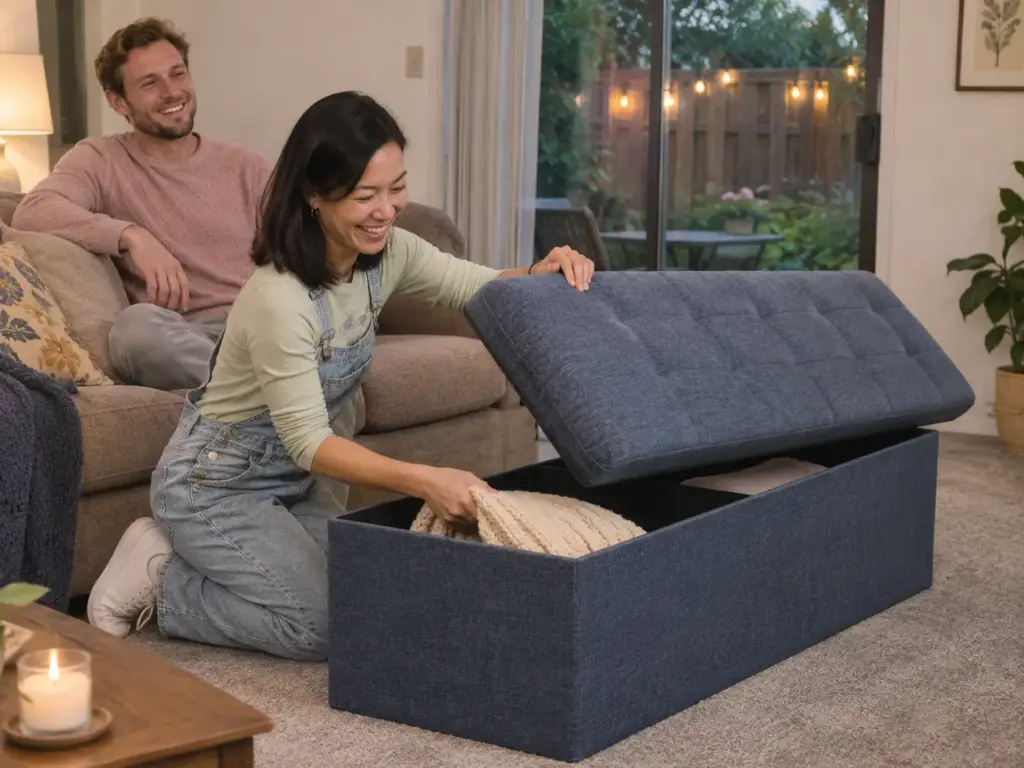
A visible chair, a pile of shoes and a bin of blankets are three kinds of clutter. A storage bench takes two of them and removes the chair. The SONGMICS Storage Ottoman Bench is the argument in one piece: it measures 43.3 by 15 by 15.7 in, holds 35 gallons and folds flat when the room needs the floor. It is also the top-ranked piece in its category on Amazon.
Check the chest or trunk in the attic first, then a bed with drawers, or a shelf under the console. The limit is the one every closed seat has: a bench you cannot see into becomes a box nobody opens, so the contents need a category and a place in your weekly reset.
The lift-top coffee table: volume and a desk
A lift-top table hides real volume, and the raised top doubles as a desk in a small living room. The VASAGLE Lift Top Coffee Table has three compartments and a top that rises from 19.3 in to 24.4 in. It sits at the premium end of the range, with no cheaper alternative worth recommending, so the free option is the budget answer: use a chest or shelf from the spare room until you know you want the desk function.
The piece is also heavy and tedious. Assembly is the weak spot, with a large share of buyers calling it hard, and at 57 lb it is awkward to move alone. Plan for two people on build day.
The tall cabinet and the tip-over rule
Tall cabinets and dressers are the pieces that tip. The federal rule covers free-standing clothing storage units that are 27 in tall or more, weigh 30 lb or more and hold 3.2 cubic feet or more, and the CPSC’s clothing storage unit rule requires an anti-tip kit meeting ASTM F3096 to be packaged with them. If a tall cabinet is the piece hiding your mess, it is in scope, and the kit in the box is not decoration.
Open bookcases and low units sit outside that rule, and they still fall. According to the CPSC’s Anchor It! campaign, “Anchoring all furniture with drawers, doors, and shelves to the wall prevents tip-over injuries and deaths.” The same applies to a shelf in a rental, where adhesive-rated anchoring has to follow the maker’s rating.
The closed box nobody opens
The style’s promise is storage that disappears, and that is also the failure: whatever goes behind a closed front stops getting looked at. A closed bench ends up holding a box of cables nobody remembers, and a closed unit ends up as a second junk drawer. People who need to see an item keep clear bins where nobody walks, and opaque boxes only work for someone who retrieves by memory.
The answer is a scheduled reset, not a remembered one. Why a tidy living room stops staying tidy walks through closed storage, multi-functional furniture and the short reset that keeps it honest.
Room by Room: Entry, Living Room, Bedroom and Kitchen
The same three moves (edit, close, repeat one material) change shape with each room. The usual mistake is solving the living room and leaving the entry as it was, so the first thing anyone sees is the pile by the door.
The entry: a bench, a rail and a basket for the stray
Entryway storage starts with a peg rail, the simplest peg system for a door wall, set above a bench and below eye level, roughly 60 to 66 in from the floor. A bench with a closed seat, or a hallway bench of the same depth, takes the shoes, and one basket takes the objects that have no other place to land. Three pieces, one wall, and the arrival zone has an answer for everything that comes through the door. Where the entry is tight, how to use vertical room in a small apartment adds the dead-zone math.
The living room: the soft basket and the closed media wall
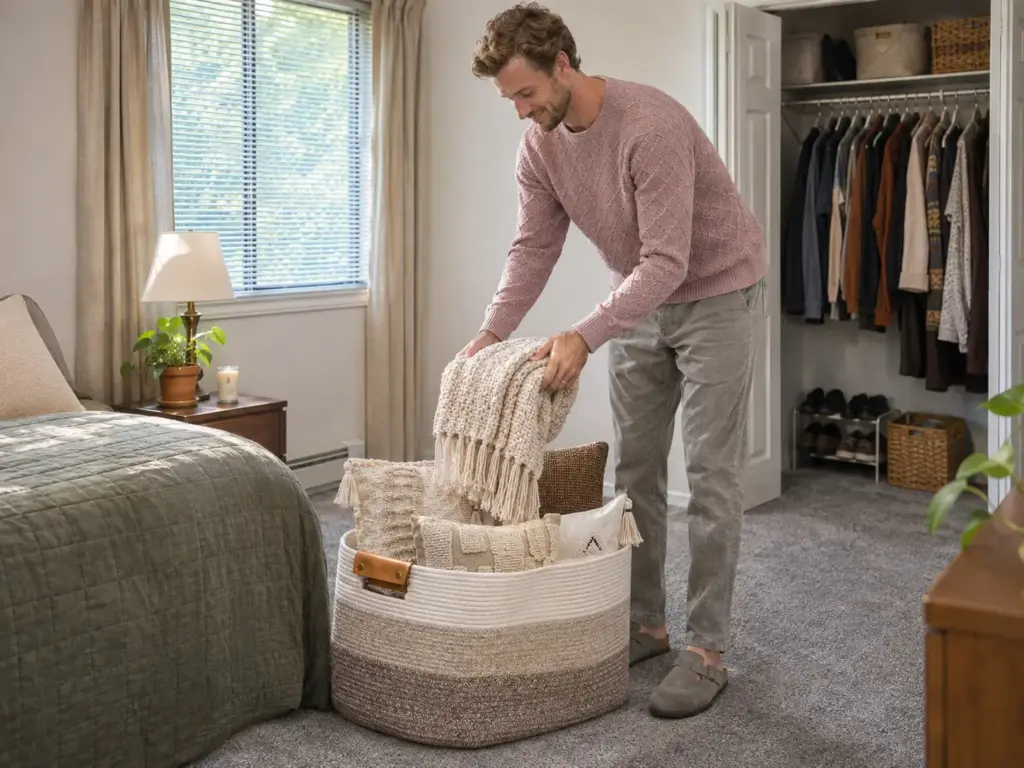
The living room needs a basket for soft goods, not a lid for everything. A cotton rope basket takes the throw that never gets folded, a low closed unit takes media and cables, and the lift-top table takes the remote and the charger. The danpinera 72L Woven Cotton Blanket Basket measures 22 by 17 by 11.8 in and is machine washable, which matters for something that sits against the floor and meets the dog.
If you want the blended Japanese and Scandinavian version of the same room, how the blend of Japanese and Scandinavian looks room by room shows it, with the closed-fronts ratio worked out for each space.
The bedroom: under the bed and beside it
Bins go under the bed and a closed shelf goes beside it, and the clearance rules for both are in the measurement section below. The failure to name in this room is surface creep: the nightstand collects a glass, a charger and a book, and by midweek it is a shelf with no edge. A closed bedside shelf with a category for each of those things stops it.
The kitchen: drawer first, shallow cabinet second
Kitchen storage is a depth problem first: a drawer shows everything from above, and drawer dividers keep it that way, while a base cabinet 21 to 24 in deep hides its back third, so the drawer comes first. Base cabinets run that deep only because a drawer slide needs the length, and without pull-out shelves the back third is dead storage. Upper cabinets at 12 in deep already match the shallow Scandinavian units, and open shelf space is for the few things used daily.
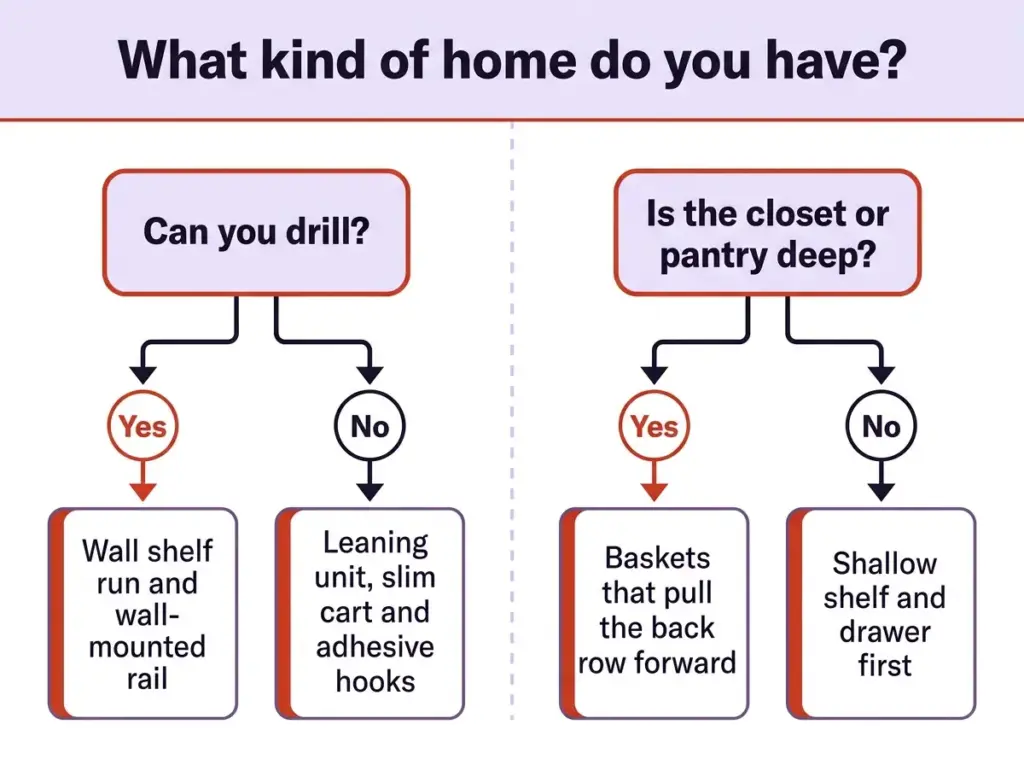
A big house flips the advice. A deep walk-in closet or a deep pantry swallows whatever sits behind the front row, and baskets that pull everything forward solve it there, the opposite of the small-apartment instinct to reduce depth. Reusing trays and baskets already in the room is where that starts.
Measure First: The Clearances That Decide Every Piece
This is the section that saves a return trip. A measured clearance, taken in two minutes, decides whether a piece stays or goes back, and the label on the box is rarely the number that matters.
Under the bed: the clearance is not the label
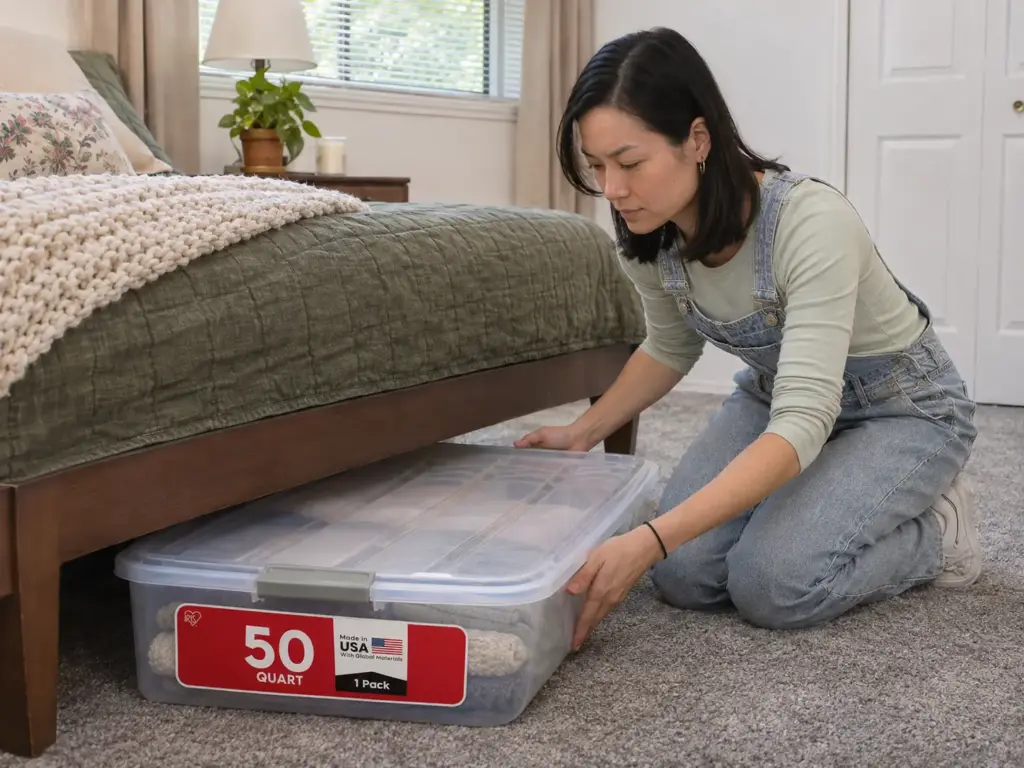
Under-bed clearance is the return reason. A bed sold as 14 in high does not leave 14 in underneath. A bin needs about 7.5 to 8 in of real clearance, measured to the lowest point (a rail, a slat, the centre leg) rather than the top of the frame, minus half an inch. A bin that is 6.5 in high clears a standard 7 in frame, and just barely.
Rolling under-bed storage needs about 8 in, not the 6 in on the label: wheels add up to three-quarters of an inch, and the handle needs about an inch above to grip. Carpet takes more, and carpet is where wheels stop rolling. The clearance maths for rolling and flat bins shows the full rule.
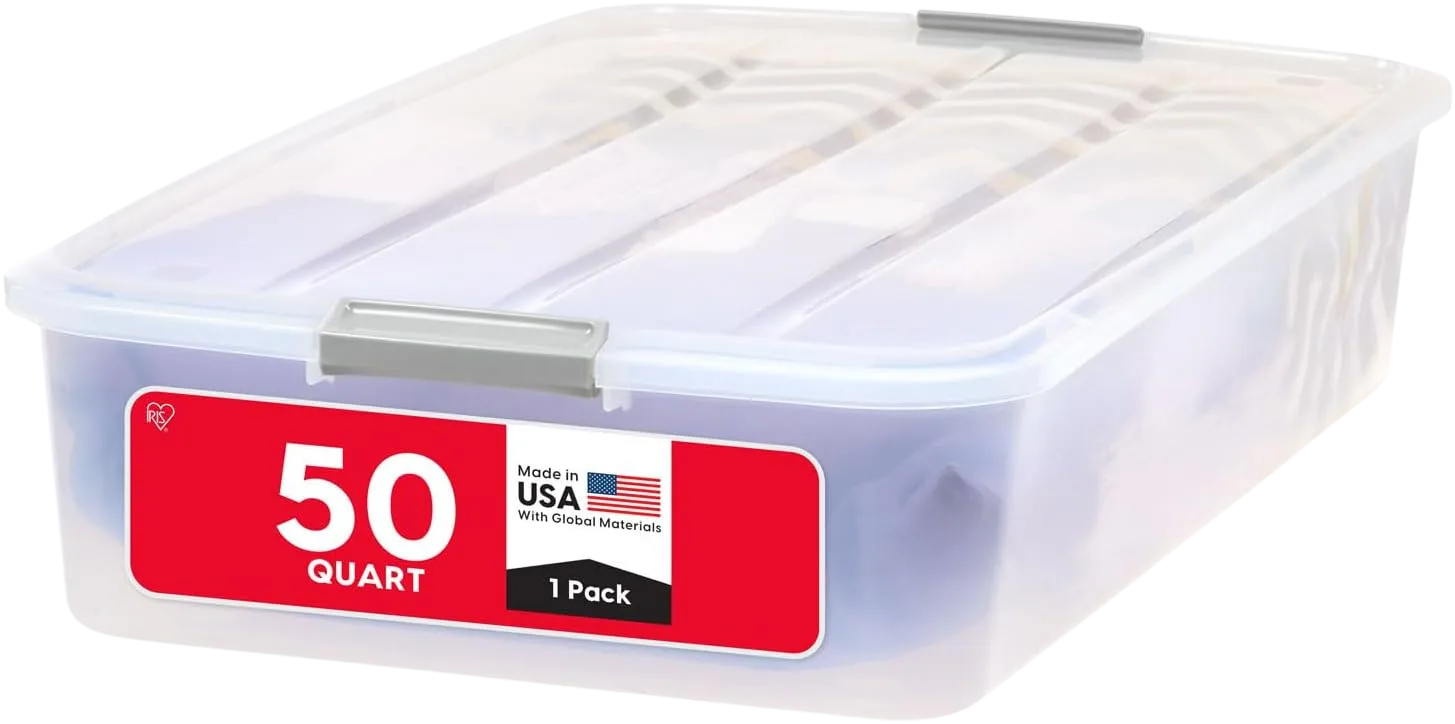
The IRIS USA 50 Qt Long Under Bed Storage Bin with Lids measures 32.5 by 17.88 by 6.5 in outside and 28.25 by 14.25 by 5.75 in inside, so it clears that standard frame. The clear plastic answers the out-of-sight problem, because you can read the contents from the floor.
The handles can snap early, a few arrive without latches on one side, and the size is sometimes not what the buyer expected, so measure first and check the box on arrival. For a frame under about 6 in, a low-profile bin under 5 in tall is the right alternative. How to set up under-bed storage that stays in use covers the setup beyond the measurement.
Measure the clearance at the centre leg and again at the foot end, and trust the smaller number. Frames that look level often sit a few millimeters lower where the middle support lands.
The slot for a slim cart: the gap and the door swing
Slim rolling carts, the slim cabinet on wheels, exist at 5.5 to 6.3 in wide and 30 to 31.5 in tall. A gap of 6 to 7 in between a fridge and a counter, or between a washer and a dryer, can hold one, and almost nobody counts that gap. Measure it, then measure the door swing, because a cart that fits the slot and blocks the fridge door is a cart you return.
The TEAMIX Slim Rolling Cabinet measures 5.5 by 15.75 by 31.5 in and has baffles at the back so nothing slides off. Wheels push the practical width a little over the stated 5.5 in, so allow a few millimeters beyond what you measure.
Hanging depth is not shelf depth
A hanging closet interior starts at 24 in deep, with 22 in as the absolute minimum and 28 to 30 in for bulky coats. A shallow Scandinavian unit is 11 to 14 in, and that is a shelf depth. Rental closets are often 22 in, so a unit built for a 24 in hanging space can leave you with the wrong number in exactly the room where you need it.
The table below puts the four checks in one place so you can take it into the room with a tape.
| Piece | Real size | Opening it needs | If you skip the measuring |
|---|---|---|---|
| Under-bed bin (IRIS 50 Qt) | 6.5 in tall | 7.5 to 8 in measured to the lowest point | It will not slide under the frame |
| Slim cart (TEAMIX) | 5.5 in wide, 31.5 in tall | A 6 to 7 in gap and a clear door swing | Wheels are a little wider than stated, and the door catches |
| Hanging closet interior | 24 in deep (22 in minimum) | 28 to 30 in for bulky coats | Hangers rub the door |
| Shallow shelf unit | 11 to 14 in deep | A shelf zone, not a hanging one | It sits in the wrong room |
What Fails by Month Three, and the Version for Your Home
Look at the finished room at month three and the baskets are full of whatever was nearest, the closed bench holds a box of cables nobody remembers, and the open grid is in a state nobody planned. The look survives only if one small action is scheduled.

The reset is the system
One shelf, one basket, once a week. Closed storage is where things stop being seen, so the reset is scheduled, not remembered, and the room turns into a hot mess after a while when the open grid or the opaque box has no category behind it. Pick the day the household already has a rhythm for, and keep it a one-minute reset, short enough to finish while the kettle heats.
Why a minimalist system loses its shape within a season describes the same reversion in the minimalist branch, and the mechanism is identical: a system with no maintenance step drifts back to the pile.
The rental version, the large-house version
The renter’s floating shelf is off the table. The honest alternatives are a leaning unit, a freestanding slim cart and adhesive hooks at the maker’s rating, and the baskets, crates and the ottoman need no permission at all. Ideas for a small apartment that keep their shape fills out the renter version with under-bed storage and a short reset.
The large house breaks the other way. A deep closet or tall pantry unit swallows the back row, so baskets that pull everything forward are the answer, along with a clear difference between the 24 in hanging depth and the 14 in shelf depth. The Scandinavian look in a large house is a shallower, more repeated version of the small one, not a deeper one.
In a shared household, give each person a basket and make one of them clear. One basket per family member for winter accessories is the pattern that survives, and the person who cannot retrieve from opaque storage gets a bin they can see into.
The honest budget tier and the free version
The cheap tier is real and specific: a seagrass four-pack, a set of floating shelves, nesting crates, a cotton basket and the secondhand piece. The design-house tier, with makers like Muuto, HAY and Audo, is the same logic at a higher material grade. The difference is in the wood, the finish and the joinery, not in how well the basket holds a category. The free tier is the edit, and the first section of this guide is the one that costs nothing.
The wood tone and the weave, picked last
Choose one tone for the room after the system is built: light oak, birch, ash or pine. A warm tone and a cool tone in one room read as two rooms. This is not a rule of the style. It is a consequence of what the affordable ranges are built from, and it is easy to fix once the pieces are in place, which is why it comes last instead of first.
Open Every Closed Front Once, and Keep Only What Has a Category
Edit before you buy. Measure depth and clearance before any shelf or bin goes in the cart. Keep one material family per room, close the fronts only where the reset will reach them, and anchor anything tall. The storage that survives is shallow, repeated and checked, and it holds one category per container.
A few weeks from now, open every closed front once and count what has no category. Anything left over is the next edit, and a bench or basket that has been closed the whole time is the first place to look.
Today, pick one shelf or basket you already have, empty it once, and sort the contents into stay, go and the rest. Then notice, a week later, what crept back and where it landed.
Frequently Asked Questions
01What are Scandinavian storage solutions?
They are furniture and shallow wall-flush units that hide the mess, in light wood and natural weaves repeated across a room. The working version edits first, then uses shelves around 6.7 to 14 in deep and a category for every container.
02What does Scandinavian style look like in storage?
Pale woods, matte finishes, closed fronts in busy rooms and about three objects on an open shelf, all in one material family. The rest of the surface stays empty, which is what makes the room read as calm.
03Where can I buy Scandinavian style furniture on a budget?
Amazon carries the storage pieces named in this guide, and thrift and secondhand finds cover wood crates and baskets. Design-house makers like Muuto, HAY and Audo sit at the premium end, so the budget route is the edit plus one or two good pieces.
04Can I do Scandinavian storage in a rental without drilling?
Yes. Use a leaning unit, a freestanding slim cart, baskets, crates, a storage ottoman and adhesive hooks used at the maker’s rating. A floating shelf needs a drill, so it is the one piece to leave out.
05How do I stop Scandinavian storage from becoming clutter again?
Give each basket one category and reset one shelf every week. Use closed fronts only where the reset will reach them, and keep clear bins for anyone who needs to see what is inside.
Disclaimer: ClutterlessNest is a participant in the Amazon Services LLC Associates Program. As an Amazon Associate we earn from qualifying purchases. This article may contain affiliate links — if you buy through them, we may earn a small commission at no extra cost to you. We only recommend products we have tested or genuinely believe in.